RAIL 2023Tafsiri ya mashine
Orodha ya Maneno Yanayotumiwa Mara kwa Mara katika Sesotho Kulingana na Korasi
Tafsiri ya mashine, haijakaguliwa na binadamu. Makala asili ndiyo toleo la rejeo; sentensi zilizopigiwa mstari ni zile ambazo ukaguzi wa kiotomatiki haukuwa na uhakika nazo.
Proceedings of the Fourth workshop on Resources for African Indigenous Languages (RAIL 2023).
Tafsiri ya Ernst van Gassen (Arktos AI Lab), yenye leseni CC BY 4.0 kama makala asili. Matumizi tena yanaruhusiwa, ikiwemo ya kibiashara, kwa kutaja mwandishi. Waandishi asili hawajakagua wala kuidhinisha tafsiri hii.
Maandishi matupu ya kutumia tena, pamoja na leseni yake: Kiswahili · LESENI
Taasisi
Johannes Sibeko
Orphée de Clercq
Nelson Mandela University
LT3, Ghent University
Port Elizabeth, South Africa
Ghent, Belgium
Anwani za barua pepe zimeondolewa kwa sababu za faragha. Zinapatikana katika PDF asilia.
Muhtasari
Makala hii inaelezea maendeleo ya orodha ya maneno yanayotumika mara kwa mara katika Kisotho cha kuandika. Orodha hiyo imeundwa kwa lengo la kuiingiza katika vipimo vya usomaji wa maandishi vinavyotegemea marudio. Orodha hiyo ilipatikana kwa kutumia njia inayotegemea korasi. Kwa kutumia korasi tatu zilizopo za Sesotho, orodha za marudio ziliweza kutolewa, ambazo baadaye ziliunganishwa na kuchambuliwa kwa njia ya kiubora na kurekebishwa na mzungumzaji mwenye uzoefu wa Sesotho. Changamoto kuu katika kuunda orodha hiyo zilijumuisha kupatanisha tofauti za tahajia, utunzaji wa vifupisho, na uwepo wa maneno yasiyotarajiwa katika orodha za awali. Orodha ya mwisho ina viingizo 3037 na inapatikana kwa umma kwa jumuiya ya watafiti.
1 Utangulizi
Wanafunzi wa Afrika Kusini wanapambana na uelewa wa kusoma hata wanaposoma katika lugha zao za nyumbani (Pretorius et al., 2020). Kwa matokeo hayo, wanafanya kazi vibaya katika matatizo yanayohusisha lugha (Van der Walt et al., 2008). Hili linajitokeza hasa kwa wanafunzi wenye lugha mbili na lugha nyingi kwa kuwa wanasitawisha ujuzi wa kusoma na kuandika kwa wakati mmoja katika lugha mbili (Cockcroft, 2016; Wilsenach and Schaefer, 2022). Wanafunzi kama hao wanafanya kazi vibaya zaidi kuliko wanafunzi wa lugha moja ambao wanapata uzoefu wa kina wa lugha moja (Cockcroft, 2016). Changamoto hii ya msamiati na mahitaji ya lugha huongezeka wakati wanafunzi wa Afrika Kusini wenye lugha za kiasili kama lugha yao ya kwanza wanapohama kutoka darasa la tatu hadi la nne la elimu na ambapo lugha ya kufundishia inabadilika kutoka lugha za kiasili hadi Kiingereza au Kiafrikana (Sibanda and Baxen, 2016).
Kulingana na Stoffelsma (2019b,a), asilimia 78 ya wanafunzi wa darasa la nne la Afrika Kusini hawakufanikiwa kupata maana kutokana na maandiko. Kwa kusikitisha, kutoweza kupata maana kutokana na maandiko huwaweka wenye kujifunza katika hatari ya kutoweza kusoma kwa kuwa ukosefu wao wa msamiati huathiri uwezo wao wa kusoma maandiko kwa ufasaha wenye kutamanika (Pretorius na Stoffelsma, 2017; Stoffelsma, 2019a).
Kwa kusikitisha, kutoweza kwa wanafunzi kusoma kwa kiwango kinachotarajiwa cha ufasaha na kutoweza kwao kutoa maana kutoka kwa matini hufanya iwe vigumu kwa walimu na wakaguzi kuchagua vifungu vya kusoma. Uingiliaji kati wa kusoma ili kuwasaidia wanafunzi wenye uwezo wa kusoma chini ya unaotakiwa unahitajika katika madarasa mengi ya lugha. Kwa bahati mbaya, walimu huenda wasizoezwe vizuri kufundisha kusoma na kuchunguza hatua za usomaji (Pretorius et al., 2020). Pia, viwango vya maagizo ya walimu vinaweza kutokuruhusu kuingilia kati kwa ufanisi (Batinić et al., 2016). Kwa viwango vya juu vya kupita, mtu anaweza kulazimika kutumia maandiko yanayotarajiwa kutolewa kwa wanafunzi wenye miaka michache ya masomo. Hili ni baya hasa kwa utafiti kuhusu uundaji wa vipimo vya usomaji kwa lugha za kiasili za Afrika Kusini.
Makadirio thabiti ya viwango vya usomeki ni muhimu katika miktadha ya kielimu ambapo wakufunzi na watahini wanahitaji kutambua na kugawa matini kwa wasomaji wenye viwango maalum vya elimu. Ulinganifu huu katika kutoa makadirio ya uwezo wa kusoma unazuia matukio ambapo wanafunzi katika madaraja ya juu hupewa maandishi ambayo ni rahisi kusoma kuliko yale yanayotolewa kwa wanafunzi katika madaraja ya chini. Bila vipimo vya usomeki, waandishi, wachapishaji, na wasomaji huenda wasikadirie viwango vya usomeki kwa usahihi au uthabiti kila wakati (Humphreys na Humphreys, 2013).
Kwa bahati mbaya, kwa kadiri tunavyofahamu, hakuna vipimo vya uwezo wa kusoma kwa lugha ya Sesotho. Njia mojawapo ya kukabiliana na tatizo hili inaweza kuwa uendelezaji wa fomula za kawaida za usomaji. Vipimo vya kawaida vya usomaji hutumia fomula za hisabati kukadiria kiwango cha elimu au daraja ambalo msomaji anahitaji ili kusoma maandishi maalum kwa urahisi (Gopal et al., 2021). Mifumo hii ya regresheni ya mstari kwa kawaida inategemea sifa za uso za maandishi kama vile urefu wa maneno, sentensi, silabi, na orodha za marudio. Kwa bahati nzuri, urefu wa sentensi na maneno unaweza kuamuliwa kwa urahisi kwa kutumia zana za kawaida za uchakataji wa awali kwa kuwa hazitegemei lugha. Hata hivyo, kuamua silabi na maneno yanayotumiwa mara kwa mara kunahitaji zana maalum za lugha. Kwa kiasi ambacho kinaweza kubainishwa kwa makala hii, kuna mifumo miwili ya kutenganisha misemo kwa Sesotho, angalia Sibeko na Van Zaanen (2022b). Kwa hiyo, taarifa za misemo ya Sesotho zinaweza kutolewa kutoka kwenye maandishi. Kwa bahati mbaya, hakuna orodha ya mara kwa mara ya maneno yanayotumiwa zaidi katika masomo ya usomaji. Tukiangalia fomula zilizopo za usomaji, mojawapo ya orodha za masafa inayojulikana zaidi ni ile iliyotengenezwa na Dale na Chall (1948). Mkakati wa kukusanya orodha hii ulikuwa ni kuwasilisha maneno haya moja kwa moja katika usomaji kwa wanafunzi wa darasa la 4, neno lilifika kwenye orodha wakati lilijulikana na angalau asilimia 80 ya watoto (Dale na Chall, 1948; Piu et al., 2020; Glazkova et al., 2021). Kwa kawaida, wakati wa kubuni orodha ya maneno kwa lugha ya Sesotho (au lugha nyingine za asili) mbinu sawa inapaswa kutumika. Kwa bahati mbaya, mbinu kama hiyo inayotegemea mtumiaji inaweza kuleta matokeo ya kurudi nyuma kwa sababu wengi wa wanafunzi katika madarasa ya lugha za asili za Afrika wana uwezo mdogo wa kusoma na maarifa ya maneno (Stoffelsma, 2019a,b). Kwa maneno mengine, matokeo ya mbinu inayomtegemea mtumiaji yatakuwa orodha ya maneno ya kiwango cha kuingia katika usomaji.
Makala hii inaonyesha juhudi zetu za kuunda orodha ya maneno 3000 yanayotumiwa mara nyingi zaidi katika lugha ya Sesotho iliyoandikwa kwa kutumia mbinu ya uchambuzi wa korpus. Tunaweka kazi yetu katika utafiti wa kurekebisha vipimo vya usomaji (Sehemu ya 2). Kisha tunataja mbinu yetu ya kutengeneza orodha hiyo (Sehemu 3) na baadaye tunajadili matokeo (Sehemu 4). Tunahitimisha makala yetu kwa kuangazia uimara wa orodha hiyo na kwa kuandaa seti ya mapendekezo ya maboresho zaidi (Sehemu ya 5).
2 Kazi Zinazohusiana
Uhakiki wa rasilimali za lugha za kidijitali na teknolojia za lugha za binadamu kwa lugha za Afrika Kusini unaonyesha kwamba lugha zote za asili za Afrika Kusini hazina rasilimali za kutosha (Grover et al., 2010, 2011; Barnard et al., 2014; Moors et al., 2018a,b). Hasa zaidi, Sibeko na Setaka (2022) walichunguza seti ya msingi ya rasilimali za lugha kwa Sesotho na kuhitimisha kuwa rasilimali nyingi muhimu za lugha za kidijitali bado hazipo.
Tafiti chache zimetathmini usomaji wa maandishi ya Kisotho kwa kutumia vipimo vya usomaji vya Kiingereza. Kwa mfano, Krige na Reid (2017) walitumia maandishi ya kale yaliyosomwa kuchunguza uwezo wa vijitabu vya afya vya Sesotho. Katika utafiti mwingine, Reid et al. (2019) walitengeneza mtihani wa elimu ya afya ya Sesotho. Kwa bahati mbaya, utafiti uliotumia vipimo vya Kiingereza bila kuzingatia tofauti kati ya sifa za maandishi za Sesotho na Kiingereza. Kwa hiyo, matokeo ya tafiti hizi yanaweza kuwakilisha vibaya muktadha wa maandishi ya Sesotho. Zaidi ya hayo, kwa sababu ya ukosefu wa rasilimali, njia za mkono za kuchuja sifa za maandishi zilitumika ambazo ni ngumu sana kutumika kwa kiwango kikubwa na zinazoweza kosa.
Tafiti nyingi zimechunguza urekebishaji wa vipimo vya kawaida vya usomaji kwa lugha zenye rasilimali chache. Kwa Kinorwe, Jakobsen na Skardal (2007) walichunguza urekebishaji wa vipimo nane vya kawaida vya usomaji, navyo ni, Automated Readability Index (ARI) (Smith na Senter, 1967), Coleman-Liau index (CLI) (Coleman na Liau, 1975), Flesch Reading Ease (FRE) (Flesch, 1974), Flesch-Kincaid Grade Level (FKGL) (Kincaid na wenzake, 1975), Gunning Fog index (GFI) (Gunning, 1969), Lasbarhetsindex (LIX) (Anderson, 1983), Rate index (RIX) (Anderson, 1983), na Simple Measure of Gobbledygook (SMOG) (Mc Laughlin, 1969). Takriban vipimo vyote hivyo viliundwa awali kwa Kiingereza, isipokuwa LIX na RIX ambavyo viliundwa kwa Kiswidi. Mojawapo ya mambo muhimu waliyogundua ni kwamba silabi na maneno magumu hayakuwa na matokeo yaleyale juu ya kiwango cha kusoma katika Norway kama yalivyofanya katika metriki za Kiingereza. Mwishowe, ni vipimo vya Kiswidi vya LIX na RIX pekee vilivyoweza kurekebishwa kwa mafanikio kwa Kinorwe chenye rasilimali chache.
Fomula za Kiingereza za FRE na FKGL pia zimerekebishwa kwa Kirusi (Oborneva, 2006). Katika mchakato huu, sifa mbili za maandishi ambazo zimejumuishwa katika fomula, yaani wastani wa sentensi na urefu wa neno, zililinganishwa na uzito uliolingana ulibadilishwa (Glazkova et al., 2021). Vivyo hivyo, FRE ya Kiingereza imerekebishwa kwa Kiholanzi, na wote wawili Douma (Douma, 1960) na Brouwer (Brouwer, 1963), ambao kila mmoja alipeana uzani tofauti kidogo ili kuzingatia tofauti za urefu wa neno na sentensi kati ya Kiingereza na Kiholanzi. Fomula maarufu ya FRE pia imerekebishwa kwa Kifaransa (Kandel and Moles, 1958; Henry, 1975), Kicheki (Bendová, 2021; Bendová and Cinková, 2021) na Kiitaliano (Franchina and Vacca, 1986).
Utafiti wa Van Oosten et al. (2010) ulifunua kwamba matokeo ya fomula za kawaida zilizotengenezwa kwa Kiingereza, Kiholanzi na Kiswidi kwenye data ya Kiholanzi hutoa uwiano imara, ambao unaelezewa na utegemezi mkubwa wa fomula hizo kwenye sifa fulani zisizotegemea lugha, kama vile wastani wa urefu wa neno au sentensi. Hata hivyo, majaribio yaliyoshindwa ya kurekebisha vipimo vya kitamaduni vya usomaji kwa kutumia lugha zenye rasilimali nyingi pia yameripotiwa. Kwa mfano, Sinha et al. (2012) anaripoti jaribio lisilofanikiwa la kurekebisha vipimo vya Kiingereza vya FRE, GFI, FKGL na SMOG kuwa Kihindi na Kibangla. Wao walihitimisha kwamba vipimo vipya ambavyo vinategemea mali za muundo wa lugha ya Kibengali na Kihindi vinapaswa kuendelezwa kwa sababu vipimo vilivyopo vinatoa matokeo ya nje ya mipaka. Vipengele vipya vya maandishi kama vile Juktaakshars vilianzishwa katika metriki za Kihindi. Hii inaashiria kwamba vipimo vya usomaji vinaweza kurekebishwa wakati kuna ulinganifu kama vile katika visa vya Kiingereza, Kiholanzi na Kiswidi, ambazo zote ni lugha za Kijerumaniki. Hata hivyo, huenda fomula mpya zikahitaji kutengenezwa wakati miundo ya lugha hailinganishwi kama ilivyo kwa Kihindi na Kiingereza.
Zaidi ya hayo, baadhi ya fomula maarufu za kawaida pia hujumuisha vigezo vinavyotegemea orodha za marudio. Fomula inayojulikana zaidi katika suala hili ni Dale-Chall Reading Grade Score (Dale and Chall, 1948). Mbali na kutegemea wastani wa urefu wa sentensi, formula hii pia inahesabu ni maneno mangapi yanayotokea katika orodha ya maneno ya Dale-Chall. Orodha hii inajumuisha maneno 3,000 ambayo yanajulikana katika kusoma na angalau asilimia 80 ya watoto wa daraja la nne. Toleo lililosasishwa la orodha hiyo lilichapishwa mwaka 1995 (Chall and Dale, 1995).
Fomula au faharasa ya Dale-Chall ni mojawapo ya vipimo vinavyotumika zaidi katika taarifa za afya (Palotti et al., 2016). Kwa kuzingatia kwamba fomula hiyo ilitengenezwa awali kutathmini nyenzo za kusoma kwa ajili ya watoto, inapendekezwa kurekebisha fomula hiyo, na hasa orodha ya maneno yanayotumika mara kwa mara, wakati wa kuitumia kupima usomaji kwa hadhira maalum lengwa (Gauthier and Johnson, 2019). Kwa upande mwingine, orodha ya maneno ya kawaida imekosolewa kwa kushindwa kuzingatia maana maalumu (Yan et al., 2006).
Katika kazi hii, tunataka kuchunguza kama orodha kama hiyo inaweza kuundwa kwa ajili ya Sesotho. Kwa kimkakati, tungependa pia kutathmini orodha ya maneno na watumiaji kama vile wanafunzi wa shule. Hata hivyo, kabla ya majaribio kuanza, tunahitaji orodha ya awali. Pia tuna wasiwasi kwamba kupima orodha hiyo kwa wanafunzi wa shule kunaweza kuwa changamoto kutokana na taratibu za ulinzi zilizowekwa hivi karibuni zenye lengo la kuwalinda washiriki walio katika mazingira hatarishi katika enzi ya baada ya janga. Hata hivyo, tunachunguza majaribio mengine ya watumiaji ambayo yanaweza kufanya orodha yetu itumike kwa hadhira nyingine lengwa, kama vile wasomaji watu wazima, waandishi, na wachapishaji.
Kwa sasa, kuna angalau orodha mbili za maneno yanayotumika mara kwa mara katika Sesotho, yaani orodha ya MostCommonWords na orodha ya Waston Chen. Hata hivyo, masuala machache yanajitokeza wakati wa kushauriana na orodha hizi. Kwanza kabisa, orodha zote mbili zimetafsiriwa (kwa mashine) kutoka Kiingereza kwenda Kisotho, jambo linalomaanisha kwamba haziwakilishi ipasavyo lugha ya Kisotho. Zaidi ya hayo, kwa baadhi ya tafsiri katika orodha ya Waston Chen, Kipedi inatumika (kama vile kgauswi badala ya haufi ya Kisotho 'karibu'). Kwa sababu ya tafsiri hii kutoka Kiingereza kwenda Kisotho, orodha zote mbili pia zina viingizo mbalimbali ambavyo si maneno moja bali ni vishazi. Kwa mfano, orodha ya Waston Chen inataja yuniti eno ya thuto 'kile kitengo cha somo' kwa kiingizo cha Kiingereza 'unit'. Vilevile, orodha ya MostCommonWords pia inataja sebetsang a 'kazi hiyo' kwa kuingia cha Kiingereza 'active'. Orodha hizo pia zinabadilishana kwa kutofautiana kati ya tahajia mbili tofauti, tahajia ya Kisotho cha Lesotho na tahajia ya Kisotho cha Afrika Kusini zote zinatumika. Mwishowe, kwa orodha zote mbili, ni vigumu kupata taarifa yoyote ya usuli kuhusu jinsi orodha za awali zilivyoundwa hasa.
Kwa hiyo, tunaamini kwamba uundaji wa orodha ya marudio ulio na muundo na madhumuni zaidi unahitajika, na tunachagua mbinu inayotegemea korasi katika makala hii.
3 Mbinu
Tulikusanya jumla ya korasi tatu ambazo zinajumuisha nyenzo asilia za maandishi ya Kisotho, angalia Jedwali 1 kwa takwimu za korasi.
3.1 Korasi 1: Biblia
Tulichuja maandishi kutoka kwenye toleo la Biblia ya Sesotho (Southern Sotho) SSO89 Bibele 'Bible'. Maandishi ya Biblia yalipakuliwa katika muundo wa SQL3lite kutoka https://www.ph4.org/b4_index.php#google_vignette. Maandishi yote yalitolewa kwa kutumia skripti za bash. Maandishi ya Biblia yamegawanywa katika sehemu tatu, yaani, (i) vitabu vya biblia vyenye safu 66 za data, (ii) maandishi yanayotumia safu 31 171 za data na (iii) maelezo yenye safu 10 za data. Kwa korasi yetu, tulitoa maandiko ya aya, ambayo baadaye yalisafishwa kwa kuondoa nambari za vitabu, vichwa vya sura na maelezo ya aya. Maandishi yalikuwa na alama kwa kutumia ucto na mipangilio ya default isipokuwa kwa mipangilio maalum ya kuonyesha kila sentensi kwenye mstari mpya. Mwishowe, korasi ya biblia ina takriban tokeni milioni 1.
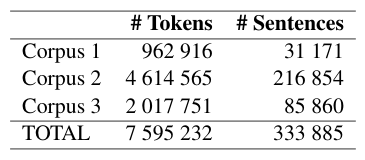
Jedwali la 1: Idadi ya tokeni na sentensi zilizopo katika korasi tatu za Kisotho zilizotumika kwa utafiti huu.
3.2 Korasi ya 2: Autshumato
Mradi wa tafsiri ya mashine wa Autshumato ulitengeneza korpusi ya maandishi ya tafsiri kwa lugha za asili za Afrika Kusini. Maneno haya yilihamishiwa kwa mikono na wahamishaji wa kitaalamu kutoka Kianglizi hadi lugha kumi na moja rasmi za Afrika Kusini, yaani, Afrikaans, IsiZulu, IsiXhosa, IsiNdebele, Siswati, Sesotho, Sepedi, Setswana, Xitsonga, na Tshivenḓa bila mpangilio maalum wa umuhimu. Maandiko ya Kiingereza-Sesotho yanaweza kupatikana kwa umma kwenye Kituo cha Afrika Kusini cha Rasilimali za Lugha za Kidigitali (SADiLaR) (Mckellar, 2023). Faili ya readme inaonyesha kuwa korasi hii inaweza kuhitaji usafishaji zaidi kwa matumizi ya baadaye kwa sababu iliundwa mahsusi kwa ajili ya kufunza mifumo ya tafsiri ya mashine. Hata hivyo, kwa kuwa tulivutiwa tu na maneno yaliyotumika katika korasi, hakukuwa na haja ya usafishaji zaidi. Kwa makala hii, korasi iligawanywa katika tokeni na kugawanywa kwa sentensi kwa kutumia ucto.
Mwishowe, korpusi ya Autshumato ilikuwa na takriban tokens milioni 4.6. Kwa bahati mbaya, korpusi ya asili ilikuwa na maandishi yaliyochanganyikiwa, hivyo, hatukuweza kuthibitisha kwa uhakika aina zote za maandishi zilizopo katika korpusi ya Sesotho. Hata hivyo, McKellar (2022) anaorodhesha angalau aina nne za maandishi, nazo ni magazeti, sera, majarida, kazi za tafsiri na nyaraka zilizotambaa kutoka kikoa cha serikali (gov.za). Kwa hiyo tuna imani kuwa korasi inajumuisha aina mbalimbali za maandishi.
3.3 Korasi 3: NCHLT
Mradi wa Kituo cha Kitaifa cha Teknolojia ya Lugha ya Binadamu (NCHLT) ulilenga kuendeleza data za mazungumzo na maandishi ili kuwezesha maendeleo ya HLT kwa lugha rasmi 11 za Afrika Kusini (Eiselen na Puttkamer, 2014; Badenhorst na De Wet, 2022). Ukusanyaji wa maandishi unajumuisha data iliyochakatwa kutoka kwenye eneo la gov.za la Afrika Kusini. Data kwa kila lugha inajumuisha sampuli za kutosha za mafunzo na upimaji kwa ajili ya kazi kama vile utambuzi wa lugha (Duvenhage, 2019).
Korasi ya maandishi ina seti tatu za data, yaani, maandishi ya chanzo, kamusi, na korasi (Eiselen na Puttkamer, 2014). Badala ya kutegemea leksika, tuliamua kutumia data halisi ya korasi ili kuwa na udhibiti zaidi. Matoleo yote mawili ghafi na yaliyosafishwa ya korasi yapo, tulitumia toleo lililosafishwa na tena tukagawa maandishi yote kwa ucto. Mipangilio ya msingi ilitumika na chaguo la kugawa sentensi. Hatimaye, korasi ya NCHLT inajumuisha takriban tokeni milioni 2.
3.4 Kuelekea Orodha ya Pamoja ya Masafa ya Maneno
Ili kupata orodha ya mara kwa mara, maneno yote yaliandikwa kwanza kwa herufi ndogo. Kisha, marudio yote yalihesabiwa kwa kila korasi. Ili kuwa na marudio ya maneno yasiyotegemea ukubwa wa korasi, haya yalisawazishwa kuwa marudio kwa kila maneno milioni, ambayo ndiyo kipimo sanifu kinachopendekezwa pia kinachojulikana kama marudio linganifu.
Lengo letu kuu lilikuwa kumalizia na orodha ya maneno 3000 ya kipekee kulingana na korasi tatu. Kwa kusudi hili, tuliunganisha orodha tatu na kuhakikisha tunakokotoa wastani wa marudio linganifu ya viingizo vilivyorudiwa. Kwa mfano, ingizo 'a' lilionekana katika orodha zote tatu, likiwa na marudio linganifu ya 54 073.57, 24 853.12 na 27 740.49, mtawalia. Wastani wa marudio linganifu yanayotokana kwa ingizo hili ni 35 555.73.
Baada ya orodha kutolewa kiotomatiki kwa kutumia vipimo vya masafa vinavyotegemea korasi, ilichakatwa pia kwa mikono na mzungumzaji asilia wa Kisotho mwenye uzoefu mkubwa katika ufundishaji wa lugha ya Kisotho na utafiti wa uandishi ili kupata orodha safi.
4 Matokeo na Mjadala
Kama ilivyotajwa hapo juu, orodha tatu za masafa ziliunganishwa na marudio linganifu yakahesabiwa kwa maingizo yaliyorudiwa. Baadaye, uchambuzi wa ubora ulifanywa kwenye kumbukumbu zote, ambao unatajwa hapa chini.
4.1 Majina ya pekee
Orodha ya Dale-Chall inachukulia majina ya watu na mashirika kuwa ya kawaida (Barry na Stevenson, 1975). Kwa hiyo, hayahitaji kujumuishwa katika orodha ya maneno yanayotumika mara kwa mara. Kwa matokeo yake, tuliondoa majina ya watu na mashirika. Majina ya watu yalijumuisha majina ya Biblia kama Judase 'Yuda', majina ya kawaida ya Sesotho kama Mmalerato 'Mama wa upendo', na majina ya watu mashuhuri kama Madiba 'Nelson Mandela'. Majina ya mashirika kama vile South African Revenue Services yaliyofupishwa kama SARS pia yaliondolewa.
4.2 Tahajia
Kulingana na Chokoe (2020), Sepedi na Setswana hazina kanuni zinazosimamia uandishi wa maneno ya kuingia. Vivyo hivyo, maneno ya mkopo katika Sesotho hutofautiana pia katika jinsi yanavyopitishwa. Kwa mfano, neno la Kiingereza 'provinces' limeandikwa kwa njia nne tofauti za uandishi katika korasi, yaani, diporofense, diporofensi, diporovense, na diprovense. Kutopatana kama huku kunaweza kutarajiwa wakati kuna unyumbufu katika kuunda maneno ya mkopo (Kosch, 2013). Ingawa maneno ya Kisotho kwa kawaida hayana herufi 'v', hutumiwa katika maneno ya mkopo ambayo awali yana herufi 'v' kama vile thelevishene 'televisheni'.
Taljard (2008) anajadili masuala matatu wakati wa kuamua tahajia sahihi. Kwanza, ingekuwa rahisi kuchukua neno linalojitokeza zaidi, hata hivyo, korasi kubwa ya kutosha inayowakilisha maandiko katika kikoa hicho ingehitajika. Pili, neno sahihi la mgombea lingeweza kuchaguliwa kulingana na ulinganifu wao bora na tahajia sanifu ya lugha lengwa. Katika mfano wetu wa awali, hii ingemaanisha kuondoa chaguzi zenye herufi isiyo ya kawaida ya 'v'. Kwa bahati mbaya, wakati sheria za lugha zinazosimamia herufi ni za juujuu, njia hii ya kuchagua kwa kuzingatia usawa si lazima iwe suluhisho bora (Taljard, 2008). Mwishowe, mabadiliko yote ya herufi nne yanalingana na muundo wa silabi wa CV ambao kwa kawaida unapendelewa katika lugha za Bantu (Ditsele, 2014).
Miongoni mwa mengine, tuligundua mwelekeo wa kutokubaliana katika tahajia ya (i) ne na ni, kama ilivyo katika kisa cha metjhini, na metjhine, (ii) re na ri kama katika mfano wa rephaboliki na riphaboliki, (iii) pro na poro kama katika mfano wa porofense na profense, na (iv) ka na kha kama katika kisa cha kabinete na khabinete. Tulitambua kwa mikono matukio ambapo tahajia ilitofautiana kwa neno moja na tukaamua kuhifadhi vibadala tofauti vya tahajia ikiwa vilijumuishwa katika maneno 3000 yanayotumiwa zaidi. Hata hivyo, hivi vinachukuliwa kuwa vibadala na kwa hiyo vinawekwa katika orodha kama vibadala viwili au zaidi vya ingizo lilelile. Mwishoni, ni maingizo 30 tu yaliyokuwa na tahajia tofauti kama hizo.
4.3 Miundo ya wingi
Tulichukulia umoja na wingi kama maingizo tofauti katika orodha ya maneno yanayotumiwa mara kwa mara. Kwa mfano, neno dikhemikhale 'chemicals' linaonekana katika orodha za maneno yanayotumiwa mara kwa mara huku umbo la umoja khemikhale 'chemical' halionekani. Maneno mengi yanayoanza na herufi b na herufi m katika orodha hizo ni ya wingi. Kwa kuwa tunataka kutumia orodha yetu kutambua maneno yanayotumiwa mara kwa mara, tulidhani kwamba kuongezwa kwa viambishi awali kwa maneno kulibadilisha jinsi neno linavyofanya kazi na kwa hiyo kunapaswa kutambuliwa. Hata hivyo, tunakubali kwamba orodha ya Dale-Chall ina maana ya wingi pamoja na namna za umoja (Bary na Stevenson, 1975). Kutambua maumbo yote ya umoja na wingi kungesababisha orodha ndefu sana ambapo baadhi ya maneno yasiyotumiwa mara kwa mara yanatambuliwa kimakosa kama yanayotumiwa mara kwa mara. Zaidi ya hayo, uchambuzi kama huo ungehitaji lemmatiser inayoweza kuaminika. Ingawa vifaa vya kutambua mizizi ya maneno (lemmatisers) vimekuwa vikitengenezwa kwa lugha za Afrika Kusini (Eiselen na Puttkamer, 2014), vifaa hivyo vilichunguzwa kwa matumizi yake kwenye maandishi ya serikali na siyo kwenye aina tofauti za maandishi ya Kisesotho. Kwa matokeo hayo, hatuwezi kuthibitisha uaminifu na usahihi wao katika aina nyingine za maandishi.
4.4 Kifupisho
Vifupisho na akronimu chache pia vilitambuliwa baada ya kuunganisha orodha hizo. Wakati wa uchambuzi wa kiubora, iliamuliwa kuondoa vifupisho vyote kama vile jj kwa jwalojwalo 'na kadhalika', mohl kwa mohla 'tarehe', na vinginevyo. Vifupisho vyote na maumbo yake kamili vilikuwepo katika orodha zetu za awali za maneno yaliyotumiwa mara kwa mara. Katika mwisho, fomu kamili tu kwa jj na mohl zilihifadhiwa katika orodha ya mwisho. Hata hivyo, tuliendelea kutumia kifupisho cha tv na neno kamili televishene 'televisheni'. Tuliamua kuweka ufupisho huu kama ulivyo kawaida katika Sesotho. Kwa kweli, kifupisho na neno kamili vyote vinatumiwa mara kwa mara. Hata hivyo, vinahifadhiwa kama ingizo moja lenye tahajia tofauti (tazama sehemu ya 4.2 kwa jinsi tulivyoshughulikia tahajia tofauti).
Vifupisho vya herufi za mwanzo huunganisha maneno kuwa moja. Kwa mfano, Shirika la Afya Duniani linahesabiwa kama neno moja linapofupishwa kuwa WHO (Funk, 1968). Kwa uthabiti, tuliondoa matukio yote ya vifupisho na akronimu kwa mujibu wa orodha ya Dale-Chall ambayo inachukulia vifupisho kuwa visivyojulikana. Hata hivyo, tulihifadhi akronimu mbili, yaani, HIV na AIDS kwa kuwa ni vifupisho vinavyotumika kimataifa. Tafsiri ya neno la mwisho 'eitsi, pia ilihifadhiwa katika orodha ya mwisho kwa kuwa pia ilionekana ndani ya maneno 3000 yaliyotumika mara nyingi zaidi kabla ya uhariri wa mikono. AIDS na eitsi zote mbili zinahesabiwa kama ingizo moja lenye tahajia tofauti.
4.5 Maneno yasiyotarajiwa
Mifano michache ya maneno yasiyotarajiwa pia ilitambuliwa katika orodha iliyochanganywa. Kwa mfano, herufi kama n, d, l, c, r, na b ziliondoshwa kwa sababu hazibebishi maana. Maasi ya maneno yasiyo ya Ki-Sesotho yalikuwa pia kwenye orodha. Kwa mfano, maneno kama vile 'huduma' na 'lugha' yaligunduliwa na kuondolewa kwenye orodha. Tofauti na maneno mengine yasiyotarajiwa, neno la Kiingereza 'sister' halikuondolewa kwenye orodha. Ingawa kuna maneno sawa ya Kisotho kwa ajili ya dada, msimamizi, bikira na muuguzi, neno la mkopo la Kiingereza 'sister' ni la kawaida zaidi. Kwa hakika, neno sawa la Kisotho, mooki halikuonekana katika orodha yoyote ya masafa matatu.
4.6 Tofauti maalum
Tunatarajia kurekebisha kipimo cha Dale-Chall cha Kiingereza ili kiweze kutumika kwa Kisotho. Kwa matokeo hayo, tunazingatia pia muundo wa orodha ya Dale-Chall inayotumika katika kipimo cha Kiingereza. Kiashiria cha Dale-Chall kinatumia fomula ifuatayo kuhesabu viwango vya darasa vinavyokadiriwa kwa kiashiria cha Dale-Chall:
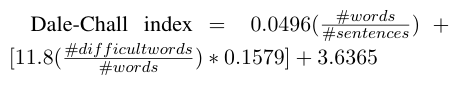
Maneno magumu kama yanavyotumika katika fomula ni yale ambayo hayapatikani katika orodha ya maneno yanayotumika mara kwa mara (Stocker, 1971). Kama inavyoonekana kutoka kwa fomula, utambuzi wa maneno magumu ni sifa ya maandishi moja tu inayotumika katika kuamua usomaji wa maandishi. Si maneno yote na vibadala vyake vimeorodheshwa katika orodha ya maneno yanayotumika mara kwa mara. Hata hivyo, wakati wa kuhesabu alama, tofauti maalum zimeondolewa katika orodha hii ya maneno magumu. Tunazingatia vibadala viwili kama hivyo, navyo ni vitenzi na vielezi.
Kulingana na Barry na Stevenson (1975), vitenzi vinavyomalizia katika - e -ed, -ing, na -ed havihesabiwi kuwa maneno magumu kwa kuwa ni namna - namna tu za vitenzi vya msingi. Miundo ya kitenzi cha Sesotho haina muundo wa -ing. Badala yake, nyakati endelevu huonyeshwa kwa viashirio vya kuendelea kama vile 'a, ya, na ntse' ambavyo ni maneno yanayosimama pekee na havibandikwi kwenye vitenzi. Miundo ya -ed na -ied inaonyeshwa kwa matumizi ya -wa na -uwa ambayo huambishwa kwenye kitenzi. Kwa mfano, neno qetwa/qetuwa 'kumaliza' limetokana na qeta 'kumaliza'. Kwa kusudi la orodha yetu, sisi hupuuza tofauti hizo na badala yake twahesabu namna zote za kitenzi kuwa vitu tofauti.
Mwishowe, vielezi vya Kiingereza vinavyoishia kwa -ly havihesabiwi kama maneno magumu katika orodha ya Dale-Chall (Barry and Stevenson, 1975). Sesotho adverbs huchukua muundo wa aina tofauti. Kwa mfano, kielezi cha namna 'lovingly', kingeelezwa kama ka lerato kama katika 'with love'. Kwa sababu hiyo, tofauti kati ya vielezi tofauti si muhimu katika Sesotho na hivyo kwa orodha yetu.
4.7 Orodha ya mwisho
Baada ya hatua hizi zote za mikono, tunamalizia na orodha ya viingizo 3000 vya kipekee. Takriban theluthi moja ya orodha hii, viingizo 993, ni maneno ambayo yalikuwa ya mara kwa mara katika korasi zote tatu. Theluthi nyingine ni maneno yanayojitokeza mara kwa mara katika korasi 2 na 3, yaani viingizo 975. Theluthi ya mwisho ina maneno ya kipekee 723 kutoka korasi 1, maneno ya kipekee 125 kutoka korasi 2, maneno ya kipekee 109 kutoka korasi 3, maneno ya kipekee 49 kutoka korasi 1 na 2 na maneno ya kipekee 63 kutoka korasi 1 na 3. Kulingana na nambari hizi tunaona tofauti kati ya korasi 1 (Biblia) na korasi nyingine mbili (Autshumato na NCHLT). Utafiti zaidi unaojumuisha orodha hii katika vipimo halisi vya usomaji kulingana na marudio na kwa mtumiaji wa mwisho anayetarajiwa utalazimika kuthibitisha ikiwa orodha hiyo inaweza kutumika kwa madhumuni ya usomaji.
Tafadhali kumbuka kuwa ili kuruhusu tofauti za tahajia za maneno fulani (tafadhali rejea Sehemu ya 4.2 kwa maelezo zaidi kuhusu hili) tofauti hizo ziliongezwa kwenye orodha kwa maneno 30. Matokeo yake, jumla ya idadi ya maneno yaliyojumuishwa kwenye orodha yanafikia 3037. Orodha hiyo inapatikana kwa jumuiya ya utafiti katika hazina ya Wakala wa Usimamizi wa Rasilimali za Lugha wa SADiLaR https://repo.sadilar.gov.
5 Mjadala na Hitimisho
Makala hii ilichambua maendeleo ya orodha ya maneno yanayotumika mara nyingi kwa Kisotho kwa kutumia mbinu inayotegemea korpusi. Korasi tatu tofauti zilitumika kufikia lengo hili. Ingawa huenda si ya kawaida, korasi ya biblia pia imejumuishwa katika uchunguzi huu na matokeo yanaonekana kuthibitisha kwamba korasi hii ina tabia tofauti kwa kiasi fulani. Hata hivyo, tunaamini kujumuishwa kwa korasi hii kunafaa kwa Kisotho kwani tahajia mpya zilianzishwa kwa kutumia tafsiri za biblia (Makutoane, 2022). Kwa mfano, uandishi wa Kisotho wa Afrika Kusini uliingizwa kupitia tafsiri ya Biblia ya mwaka 1960. Mwanzoni, tulitaka pia kuingiza maandishi kutoka kwenye mtandao wa Sesotho Wikipedia. Hata hivyo, baada ya uchunguzi wa karibu, iligundulika kwamba tahajia inayotumika katika kurasa za Wiki inawakilisha Kisotho cha Afrika Kusini na Kisotho cha Lesotho kutegemea ni nani aliyefanya tafsiri na/au uhariri wa awali wa ingizo la Wikipedia. Ukosefu wa ulinganifu kama huo katika tahajia unaweza kusababisha masafa yanayowakilishwa vibaya. Ingawa baadhi ya ukosefu wa ulinganifu kati ya tahajia unaweza kusahihishwa kwa njia ya nusu-otomatiki, mingine inahitaji uchambuzi wa kesi kwa kesi.
Lengo la kubuni mbinu thabiti za kupima usomaji wa maandishi katika Kisotho ni kuwawezesha walimu na watathmini, kwa ujumla, kuweza kuchagua maandishi ya kielimu kwa uthabiti na haki. Kwa kweli, ni vigumu kupata maandiko katika lugha ambayo haijachunguzwa sana kama Sesotho. Kupata maandishi mapya kwa wanafunzi si rahisi daima kwa walimu. Mwishowe, maandishi hutumiwa tena bila kurekebishwa upya kulingana na uwezo wa kusoma wa wanafunzi. Hata hivyo, maandishi yanayotayarishwa na watahini na watungaji wa vitabu vya kiada katika ngazi za kitaifa na kimkoa hutumia upya maandishi ya kifasihi kama vile riwaya na tamthilia pamoja na makala za magazeti na magazeti ya habari. Baadhi ya maandiko hayo hata yametafsiriwa kutokana na maandishi ya Kiingereza kwenye Intaneti. Hata hivyo, kiwango ambacho maandishi haya yanafaa kwa wanafunzi maalum hakijachunguzwa.
Uwepo wa orodha ya marudio iliyotengenezwa kwa njia ya majaribio na data kama ile iliyowasilishwa katika makala hii unaruhusu kuchukua hatua zaidi kuelekea kutengeneza vipimo vya kawaida vya usomaji vinavyotumia orodha za marudio. Ingawa maandiko yaliyotumiwa kwa uchambuzi wetu wa corpus yana kiasi kikubwa cha maandiko ya serikali, tunaamini kuwa orodha ya mwisho haiwakilishi maandishi ya serikali pekee, kwa sababu maana za maneno zimechukuliwa nje ya muktadha. Kwa mfano, maneno kama vile leleme 'ulimi/lugha/msengenyi', na moputso 'mshahara/ujira/malipo/tuzo/faida', ambayo yote yanaonekana kwenye orodha yetu, hayatumiki tu katika maandishi ya serikali. Zaidi ya hayo, orodha ya marudio kutoka korasi ya biblia ilipishana na zaidi ya theluthi moja ya orodha za marudio za korasi nyingine mbili. Hii ni dalili kwamba maneno hayo si lazima yawe yamezuiliwa kwa maandishi ya serikali na kwamba orodha hiyo inaweza kuwa muhimu kwa matumizi hata katika miktadha mingine kama vile maandishi ya kielimu.
Katika kazi ya baadaye, orodha ya marudio itathibitishwa zaidi kwenye korasi ya maandishi ya elimu (Sibeko and Van Zaanen, 2022a), na itajumuishwa katika marekebisho ya fomula kadhaa za usomaji zinazohitaji orodha za maneno ya marudio kutoka Kiingereza hadi Kisotho. Zaidi ya hayo, orodha hiyo itajaribiwa kwa watumiaji wa mwisho wanaotarajiwa kama vile wanafunzi, walimu na wachapishaji kwa uthibitisho zaidi.
Mapungufu
Uundaji huu wa orodha ya maneno yanayotumiwa mara kwa mara katika Kisotho umewekewa mipaka na korasi zilizotumiwa katika makala haya. Kwa hiyo, aina mbalimbali za tanzu za maandishi zinazowakilishwa katika korasi ni chache.
Aidha, ingawa orodha ya awali ya Kiingereza Dale-Chall iliundwa kwa ushiriki wa wanafunzi halisi wa darasa la nne, tumetegemea tu rasilimali zilizopo. Kwa bahati mbaya, kufungwa kwa taifa kutokana na janga la COVID-19 nchini Afrika Kusini limepelekea kuwekwa kwa vikwazo vikali zaidi, jambo ambalo limeifanya iwe ngumu zaidi kufikia washiriki wadhaifu kama vile wanafunzi wa shule. Matokeo yake, kupata ruhusa ya kushirikiana na washiriki hawa imekuwa zoezi linalochukua muda mrefu. Matokeo yake, tuliwekewa mipaka kwa rasilimali za maandishi. Tunatarajia kuwa na uwezo wa kufanya majaribio ya ziada ya uthibitisho na watumiaji wa mwisho wanaotarajiwa katika kazi ya baadaye.
Taarifa ya Maadili
Data zote zilizotumika katika utafiti huu ziliptanuliwa kutoka vyanzo vilivyopatikana kwa umma. Hakuna taarifa za siri au nyeti zilizotumika. Utafiti uliidhinishwa kimaadili na Chuo Kikuu cha North-West kwa nambari ya idhini ya maadili: NWU-00729-21-A7.
Shukrani
Makala hii ni sehemu ya mradi wa udaktari uliokamilika katika Chuo Kikuu cha North-West. Makala hii ilikamilishwa chini ya usimamizi wa Profesa Orphée De Clercq wakati wa utafiti katika Chuo Kikuu cha Gent. Yanafadhiliwa kwa sehemu na Mfuko wa Global Minds katika Chuo Kikuu cha Ghent.
Maelezo
1 https://3000mostcommonwords.com
2 https://wastonchen.com/6417.html
3 Korasi inapatikana kutoka https://hdl.handle.net/20.500.12185/336
4 tazama https://github.com/words/dale-chall
Marejeo
Jonathan Anderson. 1983. Lix and Rix: Variations on a little-known readability index. Journal of Reading, 26(6):490-496.
Jaco Badenhorst and Febe De Wet. 2022. NCHLT auxiliary speech data for ASR technology development in South Africa. Data in Brief, 41:107860.
Etienne Barnard, Marelie H Davel, Charl Van Heerden, Febe De Wet, and Jaco Badenhorst. 2014. The NCHLT corpus of the South African languages. In Proceedings of the 4th International Workshop Spoken Language Technologies for Under-resourced Languages, pages 194-200.
Jeanne Gardner Barry and Timothy E Stevenson. 1975. Using a computer to calculate the Dale-Chall formula. Journal of Reading, 19:218-222.
Dolores Batinić, Sandra Birzer, and Heike Zinsmeister. 2016. Creating an extensible, levelled study corpus of Russian. In Proceedings of the 13th Conference on Natural Language Processing (KONVENS 2016), pages 37-43. Universität Bochum.
Kiára Bendová. 2021. Using a parallel corpus to adapt the Flesch Reading Ease formula to Czech. Journal of linguistics, 72(2):477-487.
Kiára Bendová and Silvie Cinková. 2021. Adaptation of classic readability metrics to Czech. In Proceedings of the International Conference on Text, Speech, and Dialogue: 24th International Conference, pages 159-171. Springer.
RHM Brouwer. 1963. Onderzoek naar de leesmoeilijkheden van nederlands proza (Research into reading difficulty in Dutch prose). Pedagogische studiën, 40:454-464.
Jeanne Sternlicht Chall and Edgar Dale. 1995. Readability revisited: The new Dale-Chall readability formula. Brookline Books.
Sekgaila Chokoe. 2020. Spell it the way you like: The inconsistencies that prevail in the spelling of Northern Sotho loanwords. South African Journal of African Languages, 40(1):130-138.
Kate Cockcroft. 2016. A comparison between verbal working memory and vocabulary in bilingual and monolingual South African school beginners: Implications for bilingual language assessment. International Journal of Bilingual Education and Bilingualism, 19(1):74-88.
Meri Coleman and Ta Lin Liau. 1975. A computer readability formula designed for machine scoring. Journal of Applied Psychology, 60(2):283.
Edgar Dale and Jeanne Sternlicht Chall. 1948. A formula for predicting readability: Instructions. Educational research bulletin, pages 37-54.
Thabo Ditsele. 2014. Why not use Sepitori to enrich the vocabularies of Setswana and Sepedi? Southern African Linguistics and Applied Language Studies, 32(2):215-228.
Hessel Douma. 1960. Readability of Dutch farm papers: a discussion and application of readability-formulas. Wageningen: Afdeling Sociologie en Sociografie van de Landbouwhogeschool, 17:433-470.
Bernardt Duvenhage. 2019. Short text language identification for under resourced languages. arXiv preprint arXiv:1911.07555.
Roald Eiselen and Martin J Puttkamer. 2014. Developing text resources for ten South African languages. In Proceedings of the 9th International Conference on Language Resources and Evaluation, pages 3698-3703.
Rudolph Flesch. 1974. The art of readable writing, 2nd edition. Harper, New York.
Valerio Franchina and Roberto Vacca. 1986. Adaptation of flesh readability index on a bilingual text written by the same author both in Italian and English languages. Linguaggi, 3:47-49.
Laverne Carl Funk. 1968. The reading level of selected magazines as determined by the Dale-Chall readability formula. Ph.D. thesis, University of Minnesota: Minnesota.
Martha Gauthier and Nathan Johnson. 2019. Identification and recommendations of readability tests for the evaluation of clinical outcome assessments. Value in Health, 22:s828.
Anna Glazkova, Yury Egorov, and Maksim Glazkov. 2021. A comparative study of feature types for age-based text classification. In Analysis of Images, Social Networks and Texts: 9th International Conference, AIST 2020, Skolkovo, Moscow, Russia, October 15-16, 2020, Revised Selected Papers 9, pages 120-134. Springer.
Revathi Gopal, Mahendran Maniam, Noor Alhusna Madzlan, Siti Shuhaida binti Shukor, and Kanmani Neelamegam. 2021. Readability formulas: An analysis into reading index of prose forms. Studies in English Language and Education, 8(3):972-985.
Aditi Sharma Grover, Gerhard B van Huyssteen, and Marthinus W Pretorius. 2010. The South African Human Language Technologies audit. In Proceedings of the Seventh International Conference on Language Resources and Evaluation (LREC'10), pages 2847-2850.
Aditi Sharma Grover, Gerhard Beukes. van Huyssteen, and Marthinus W. Pretorius. 2011. The South African Human Language Technology audit. Language resources and evaluation, 45:271-288.
Robert Gunning. 1969. The fog index after twenty years. Journal of Business Communication, 6(2):3-13.
Georges Henry. 1975. Comment Mesurer La Lisibilite (How to Measure Readability). Labor, Brussels, Belgium.
Alexandra H Humphreys and Jere Thomas Humphreys. 2013. Reading difficulty levels of selected articles in the Journal of Research in Music Education and Journal of Historical Research in Music Education. Music Education Research International, 6.
Thomas Jakobsen and Thomas Skardal. 2007. Readability index. Report, Agder University.
Liliane Kandel and Abraham Moles. 1958. Application de l'indice de Flesch à la langue française (Application of Flesch index to the French language). Cahiers Etudes De Radio-Télévision, 19(1958):253-274.
Peter J Kincaid, Robert P Fishburne Jr, Richard L Rogers, and Brad S Chissom. 1975. Derivation of new readability formulas (Automated Readability index, Fog count and Flesch Reading Ease formula) for navy enlisted personnel. Report, Defense Technical Information Center.
Inge Kosch. 2013. An analysis of the oxford bilingual school dictionary: Northern Sotho and English (de schryver 2007). Lexikos, 23:611-627.
Daleen Krige and Marianne Reid. 2017. A pilot investigation into the readability of Sesotho health information pamphlets. Communitas, 22:113-123.
Tshokolo J Makutoane. 2022. 'The people divided by a common language': The orthography of Sesotho in Lesotho, South Africa, and the implications for bible translation. HTS Teologiese Studies/Theological Studies, 78(1):9.
Harry G Mc Laughlin. 1969. Smog grading-a new readability formula. Journal of reading, 12(8):639-646.
Cindy McKellar. 2022. Autshumato Monolingual Sesotho Corpus. South African Centre for Digital Language Resources. Available at: https://repo.sadilar.org/handle/20.500.12185/583 Accessed: 28 Jan 2023.
Cindy Mckellar. 2023. Autshumato English-Sesotho Parallel Corpora. Southern African Centre for Digital Language Resources. Available at: https://repo.sadilar.org/handle/20.500.12185/577 [Accessed: 6 Feb. 2023].
Carmen Moors, Illana Wilken, Karen Calteaux, and Tebogo Gumede. 2018a. Human Language Technology audit 2018: Analysing the development trends in resource availability in all South African languages. In Proceedings of the Annual Conference of the South African Institute of Computer Scientists and Information Technologists, pages 296-304.
Carmen Moors, Illana Wilken, Tebogo Gumede, and Karen Calteaux. 2018b. Human Language Technology audit 2017/18. Technical report, CSIR Meraka Institute.
Irina Vladimirovna Oborneva. 2006. Avtomatizirovannaya otsenka slozhnosti uchebnykh tekstov na osnove statisticheskikh parametrov (Automated estimation of complexity of educational texts on the basis of statistical parameters). Thesis, RAS Institut soderzhaniya i metodov obucheniya [RAS Institute of Content and Teaching Methods].
Joao Palotti, Lorraine Goeuriot, Guido Zuccon, and Allan Hanbury. 2016. Ranking health web pages with relevance and understandability. In Proceedings of the 39th International ACM SIGIR conference on Research and Development in Information Retrieval, pages 965-968.
Romana Kabir Piu, Kazi Rayed Hossain, Noor Hossain Sabab, and Rakib Bin Mannan Ar Rafi. 2020. Hatred Message Identification using DistilBERT. Ph.D. thesis, United International University.
Elizabeth Pretorius, Nompumelelo Mohohlwane, and Nicholas Spaull. 2020. Investigating the comprehension iceberg: Developing empirical benchmarks for early-grade reading in agglutinating African languages. South African Journal of Childhood Education, 10(1):1-14.
Elizabeth J Pretorius and Lieke Stoffelsma. 2017. How is their word knowledge growing? Exploring grade 3 vocabulary in South African township schools. South African Journal of Childhood Education, 7(1):1-13.
Marianne Reid, Mariatte Neil, and Edgar Janse Van Rensburg-Bonthuyzen. 2019. Development of a Sesotho health literacy test in a South African context. African Journal of Primary Health Care and Family Medicine, 11(1):1-13.
Jabulani Sibanda and Jean Baxen. 2016. Determining ESL learners' vocabulary needs from a textbook corpus: Challenges and prospects. Southern African Linguistics and Applied Language Studies, 34(1):57-70.
Johannes Sibeko and Mmasibidi Setaka. 2022. An overview of Sesotho BLARK content. Journal of Digital Humanities Association of South Africa, 4(2):1-11.
Johannes Sibeko and Menno Van Zaanen. 2022a. Final year high school examination texts of South African home and first additional language subjects. Southern African Centre for Digital Language Resources. Available at: https://repo.sadilar.org/handle/20.500.12185/568 [accessed: 29 dec. 2022].
Johannes Sibeko and Menno Van Zaanen. 2022b. Sesotho syllabification systems. Southern African Centre for Digital Language Resources. Available at: https://repo.sadilar.org/handle/20.500.12185/555 [accessed: 3 jan 2023].
Manjira Sinha, Sakshi Sharma, Tirthankar Dasgupta, and Anupam Basu. 2012. New readability measures for Bangla and Hindi texts. In Proceedings of COLING 2012, pages 1141-1151. Association for Computational Linguistics.
Edgar A Smith and R.J Senter. 1967. Automated readability index. University of Cincinnati, Ohio.
Leonard P Stocker. 1971. Increasing the precision of the Dale-Chall readability formula. Reading Improvement, 8(3):87.
Lieke Stoffelsma. 2019a. English vocabulary exposure in South African township schools: Pitfalls and opportunities. Reading & Writing-Journal of the Reading Association of South Africa, 10(1):1-10.
Lieke Stoffelsma. 2019b. From 'sheep' to 'amphibian': English vocabulary teaching strategies in South African township schools. South African Journal of Childhood Education, 9(1):1-10.
Elsabe Taljard. 2008. Terminology practice in a non-standardized environment: A case study. In Proceedings of the XIII EURALEX International Congress (Barcelona, 15-19 July 2008), pages 1073-1080.
Marthie Van der Walt, Kobus Maree, and Suria Ellis. 2008. A mathematics vocabulary questionnaire for use in the intermediate phase. South African Journal of Education, 28(4):489-504.
Phillip Van Oosten, Dries Tanghe, and Véronique Hoste. 2010. Towards an improved methodology for automated readability prediction. In Proceedings of the 7th Conference on International Language Resources and Evaluation (LREC 2010), pages 775-782. European Language Resources Association (ELRA).
Carien Wilsenach and Maxine Schaefer. 2022. Development and initial validation of productive vocabulary tests for isiZulu, Siswati and English in South Africa. Language Testing, pages 567--592.
Xin Yan, Dawei Song, and Xue Li. 2006. Concept-based document readability in domain specific information retrieval. In Proceedings of the 15th ACM international conference on Information and knowledge management, pages 540-549.
English na Kiswahili
A Corpus-Based List of Frequently Used Words in Sesotho
Orodha ya Maneno Yanayotumiwa Mara kwa Mara katika Sesotho Kulingana na Korasi
Affiliations
Johannes Sibeko
Orphée de Clercq
Nelson Mandela University
LT3, Ghent University
Port Elizabeth, South Africa
Ghent, Belgium
Taasisi
Johannes Sibeko
Orphée de Clercq
Nelson Mandela University
LT3, Ghent University
Port Elizabeth, South Africa
Ghent, Belgium
Abstract
Muhtasari
This article describes the development of a list of frequently used words in written Sesotho. The list has been created with the aim of incorporating it into frequency-based text readability metrics. The list was derived using a corpus-based approach. By leveraging three existing Sesotho corpora, frequency lists could be derived, which were subsequently merged and qualitatively analysed and fine-tuned by an experienced speaker of Sesotho. The main challenges in compiling the list included reconciling the spelling variations, the treatment of abbreviations, and the presence of unexpected words in the preliminary lists. The final list comprises 3037 entries and is made publicly available to the research community.
Makala hii inaelezea maendeleo ya orodha ya maneno yanayotumika mara kwa mara katika Kisotho cha kuandika. Orodha hiyo imeundwa kwa lengo la kuiingiza katika vipimo vya usomaji wa maandishi vinavyotegemea marudio. Orodha hiyo ilipatikana kwa kutumia njia inayotegemea korasi. Kwa kutumia korasi tatu zilizopo za Sesotho, orodha za marudio ziliweza kutolewa, ambazo baadaye ziliunganishwa na kuchambuliwa kwa njia ya kiubora na kurekebishwa na mzungumzaji mwenye uzoefu wa Sesotho. Changamoto kuu katika kuunda orodha hiyo zilijumuisha kupatanisha tofauti za tahajia, utunzaji wa vifupisho, na uwepo wa maneno yasiyotarajiwa katika orodha za awali. Orodha ya mwisho ina viingizo 3037 na inapatikana kwa umma kwa jumuiya ya watafiti.
1 Introduction
1 Utangulizi
South African learners struggle with reading comprehension even when reading in their home languages (Pretorius et al., 2020). As a result, they perform poorly on problems involving language (Van der Walt et al., 2008). This is especially pronounced in bilingual and multilingual learners since they develop literacy simultaneously in two languages (Cockcroft, 2016; Wilsenach and Schaefer, 2022). Such learners perform more poorly than monolingual learners who get in-depth exposure to one language (Cockcroft, 2016). This challenge of vocabulary and language demands is increased when South African learners with indigenous languages as their first languages move from the third to the fourth grade of education and where the language of instruction changes from indigenous languages to either English or Afrikaans (Sibanda and Baxen, 2016).
Wanafunzi wa Afrika Kusini wanapambana na uelewa wa kusoma hata wanaposoma katika lugha zao za nyumbani (Pretorius et al., 2020). Kwa matokeo hayo, wanafanya kazi vibaya katika matatizo yanayohusisha lugha (Van der Walt et al., 2008). Hili linajitokeza hasa kwa wanafunzi wenye lugha mbili na lugha nyingi kwa kuwa wanasitawisha ujuzi wa kusoma na kuandika kwa wakati mmoja katika lugha mbili (Cockcroft, 2016; Wilsenach and Schaefer, 2022). Wanafunzi kama hao wanafanya kazi vibaya zaidi kuliko wanafunzi wa lugha moja ambao wanapata uzoefu wa kina wa lugha moja (Cockcroft, 2016). Changamoto hii ya msamiati na mahitaji ya lugha huongezeka wakati wanafunzi wa Afrika Kusini wenye lugha za kiasili kama lugha yao ya kwanza wanapohama kutoka darasa la tatu hadi la nne la elimu na ambapo lugha ya kufundishia inabadilika kutoka lugha za kiasili hadi Kiingereza au Kiafrikana (Sibanda and Baxen, 2016).
According to Stoffelsma (2019b,a), 78% of South African fourth graders were unsuccessful at extracting meaning from texts. Unfortunately, not being able to extract meaning from texts puts learners at risk of not being able to read as their lack of vocabulary affects their ability to read texts with desirable fluency (Pretorius and Stoffelsma, 2017; Stoffelsma, 2019a).
Kulingana na Stoffelsma (2019b,a), asilimia 78 ya wanafunzi wa darasa la nne la Afrika Kusini hawakufanikiwa kupata maana kutokana na maandiko. Kwa kusikitisha, kutoweza kupata maana kutokana na maandiko huwaweka wenye kujifunza katika hatari ya kutoweza kusoma kwa kuwa ukosefu wao wa msamiati huathiri uwezo wao wa kusoma maandiko kwa ufasaha wenye kutamanika (Pretorius na Stoffelsma, 2017; Stoffelsma, 2019a).
Sadly, learners' inability to read with the expected level of fluency and their inability to extract meaning from texts makes it difficult for teachers and assessors to choose reading passages. Reading interventions to assist learners with less-than-desired reading abilities are needed in most language classes. Unfortunately, teachers may not always be well-trained to teach reading and monitor reading interventions (Pretorius et al., 2020). Furthermore, teachers' levels of command may not always allow for successful interventions (Batinić et al., 2016). For higher pass rates, one might have to resort to using texts expected to be administered to learners with fewer years of schooling. This is particularly unfavourable for research on the development of reading metrics for South African indigenous languages.
Kwa kusikitisha, kutoweza kwa wanafunzi kusoma kwa kiwango kinachotarajiwa cha ufasaha na kutoweza kwao kutoa maana kutoka kwa matini hufanya iwe vigumu kwa walimu na wakaguzi kuchagua vifungu vya kusoma. Uingiliaji kati wa kusoma ili kuwasaidia wanafunzi wenye uwezo wa kusoma chini ya unaotakiwa unahitajika katika madarasa mengi ya lugha. Kwa bahati mbaya, walimu huenda wasizoezwe vizuri kufundisha kusoma na kuchunguza hatua za usomaji (Pretorius et al., 2020). Pia, viwango vya maagizo ya walimu vinaweza kutokuruhusu kuingilia kati kwa ufanisi (Batinić et al., 2016). Kwa viwango vya juu vya kupita, mtu anaweza kulazimika kutumia maandiko yanayotarajiwa kutolewa kwa wanafunzi wenye miaka michache ya masomo. Hili ni baya hasa kwa utafiti kuhusu uundaji wa vipimo vya usomaji kwa lugha za kiasili za Afrika Kusini.
Consistent estimations of readability levels are essential in educational contexts where instructors and examiners need to identify and assign texts to readers with specific levels of education. Such consistency in assigning readability estimations prevents instances where learners in higher grades are assigned texts that are easier to read than those that are assigned to learners in lower grades. Without readability metrics, authors, publishers, and readers may not always estimate readability levels accurately or consistently (Humphreys and Humphreys, 2013).
Makadirio thabiti ya viwango vya usomeki ni muhimu katika miktadha ya kielimu ambapo wakufunzi na watahini wanahitaji kutambua na kugawa matini kwa wasomaji wenye viwango maalum vya elimu. Ulinganifu huu katika kutoa makadirio ya uwezo wa kusoma unazuia matukio ambapo wanafunzi katika madaraja ya juu hupewa maandishi ambayo ni rahisi kusoma kuliko yale yanayotolewa kwa wanafunzi katika madaraja ya chini. Bila vipimo vya usomeki, waandishi, wachapishaji, na wasomaji huenda wasikadirie viwango vya usomeki kwa usahihi au uthabiti kila wakati (Humphreys na Humphreys, 2013).
Unfortunately, as far as we are aware, there are no readability metrics for Sesotho. One solution to this may be the development of classical readability formulas. Classical readability metrics use mathematical formulas to estimate the level of education or the grade that a reader needs in order to read a specific text with ease (Gopal et al., 2021). These linear regression formulas are normally based on superficial text properties such as lengths of words, sentences, syllables, and frequency lists. Fortuitously, sentence and word lengths can easily be determined using universal preprocessing tools as they are language-independent. However, determining syllables and frequently used words requires specific language tools. As far as could be ascertained for this article, there are two syllabification systems for Sesotho, see Sibeko and Van Zaanen (2022b). As such, Sesotho syllable information can be extracted from texts. Unfortunately, there is no frequency-based list of the most used words to use in readability studies. Looking at existing readability formulas, one of the most well-known frequency lists is the one developed by Dale and Chall (1948). The strategy to compile this list was to directly present these words in reading to 4th-grade learners, a word made it to the list when it was known by at least 80 per cent of the children (Dale and Chall, 1948; Piu et al., 2020; Glazkova et al., 2021). Ideally, when devising a word list for Sesotho (or other indigenous languages) a similar technique should be used. Unfortunately, such a user-based approach may yield regressive results since the majority of learners in indigenous African language classes have low reading abilities and vocabulary knowledge (Stoffelsma, 2019a,b). In other words, the result of a user-based approach would be a list of reading entry-level words.
Kwa bahati mbaya, kwa kadiri tunavyofahamu, hakuna vipimo vya uwezo wa kusoma kwa lugha ya Sesotho. Njia mojawapo ya kukabiliana na tatizo hili inaweza kuwa uendelezaji wa fomula za kawaida za usomaji. Vipimo vya kawaida vya usomaji hutumia fomula za hisabati kukadiria kiwango cha elimu au daraja ambalo msomaji anahitaji ili kusoma maandishi maalum kwa urahisi (Gopal et al., 2021). Mifumo hii ya regresheni ya mstari kwa kawaida inategemea sifa za uso za maandishi kama vile urefu wa maneno, sentensi, silabi, na orodha za marudio. Kwa bahati nzuri, urefu wa sentensi na maneno unaweza kuamuliwa kwa urahisi kwa kutumia zana za kawaida za uchakataji wa awali kwa kuwa hazitegemei lugha. Hata hivyo, kuamua silabi na maneno yanayotumiwa mara kwa mara kunahitaji zana maalum za lugha. Kwa kiasi ambacho kinaweza kubainishwa kwa makala hii, kuna mifumo miwili ya kutenganisha misemo kwa Sesotho, angalia Sibeko na Van Zaanen (2022b). Kwa hiyo, taarifa za misemo ya Sesotho zinaweza kutolewa kutoka kwenye maandishi. Kwa bahati mbaya, hakuna orodha ya mara kwa mara ya maneno yanayotumiwa zaidi katika masomo ya usomaji. Tukiangalia fomula zilizopo za usomaji, mojawapo ya orodha za masafa inayojulikana zaidi ni ile iliyotengenezwa na Dale na Chall (1948). Mkakati wa kukusanya orodha hii ulikuwa ni kuwasilisha maneno haya moja kwa moja katika usomaji kwa wanafunzi wa darasa la 4, neno lilifika kwenye orodha wakati lilijulikana na angalau asilimia 80 ya watoto (Dale na Chall, 1948; Piu et al., 2020; Glazkova et al., 2021). Kwa kawaida, wakati wa kubuni orodha ya maneno kwa lugha ya Sesotho (au lugha nyingine za asili) mbinu sawa inapaswa kutumika. Kwa bahati mbaya, mbinu kama hiyo inayotegemea mtumiaji inaweza kuleta matokeo ya kurudi nyuma kwa sababu wengi wa wanafunzi katika madarasa ya lugha za asili za Afrika wana uwezo mdogo wa kusoma na maarifa ya maneno (Stoffelsma, 2019a,b). Kwa maneno mengine, matokeo ya mbinu inayomtegemea mtumiaji yatakuwa orodha ya maneno ya kiwango cha kuingia katika usomaji.
This article presents our efforts to create a list of the 3000 most frequently used words in written Sesotho using a corpus analysis approach. We position our work in research on adapting readability metrics (Section 2). We then present our methodology for creating the list (Section 3) and subsequently discuss the results (Section 4). We conclude our article by highlighting the strengths of the list and by formulating a set of suggestions for further improvements (Section 5).
Makala hii inaonyesha juhudi zetu za kuunda orodha ya maneno 3000 yanayotumiwa mara nyingi zaidi katika lugha ya Sesotho iliyoandikwa kwa kutumia mbinu ya uchambuzi wa korpus. Tunaweka kazi yetu katika utafiti wa kurekebisha vipimo vya usomaji (Sehemu ya 2). Kisha tunataja mbinu yetu ya kutengeneza orodha hiyo (Sehemu 3) na baadaye tunajadili matokeo (Sehemu 4). Tunahitimisha makala yetu kwa kuangazia uimara wa orodha hiyo na kwa kuandaa seti ya mapendekezo ya maboresho zaidi (Sehemu ya 5).
2 Related Work
2 Kazi Zinazohusiana
Digital language resources and human language technologies audits for South African languages indicate that all indigenous languages of South Africa are under-resourced (Grover et al., 2010, 2011; Barnard et al., 2014; Moors et al., 2018a,b). More specifically, Sibeko and Setaka (2022) reviewed the basic language resource kit for Sesotho and concluded that many necessary digital language resources are still lacking.
Uhakiki wa rasilimali za lugha za kidijitali na teknolojia za lugha za binadamu kwa lugha za Afrika Kusini unaonyesha kwamba lugha zote za asili za Afrika Kusini hazina rasilimali za kutosha (Grover et al., 2010, 2011; Barnard et al., 2014; Moors et al., 2018a,b). Hasa zaidi, Sibeko na Setaka (2022) walichunguza seti ya msingi ya rasilimali za lugha kwa Sesotho na kuhitimisha kuwa rasilimali nyingi muhimu za lugha za kidijitali bado hazipo.
A few studies have assessed the readability of Sesotho texts using English readability metrics. For instance, Krige and Reid (2017) manually extracted textual properties used in classical readability metrics to investigate the readability of Sesotho health pamphlets. In another study, Reid et al. (2019) developed a Sesotho health literacy test. Unfortunately, the studies used English metrics without considering the differences between Sesotho and English textual properties. Therefore, the results from these studies may have misrepresented the context of Sesotho's written texts. Furthermore, due to the lack of resources, manual methods for extracting textual properties were used which is highly impractical to be used at a large scale and error-prone.
Tafiti chache zimetathmini usomaji wa maandishi ya Kisotho kwa kutumia vipimo vya usomaji vya Kiingereza. Kwa mfano, Krige na Reid (2017) walitumia maandishi ya kale yaliyosomwa kuchunguza uwezo wa vijitabu vya afya vya Sesotho. Katika utafiti mwingine, Reid et al. (2019) walitengeneza mtihani wa elimu ya afya ya Sesotho. Kwa bahati mbaya, utafiti uliotumia vipimo vya Kiingereza bila kuzingatia tofauti kati ya sifa za maandishi za Sesotho na Kiingereza. Kwa hiyo, matokeo ya tafiti hizi yanaweza kuwakilisha vibaya muktadha wa maandishi ya Sesotho. Zaidi ya hayo, kwa sababu ya ukosefu wa rasilimali, njia za mkono za kuchuja sifa za maandishi zilitumika ambazo ni ngumu sana kutumika kwa kiwango kikubwa na zinazoweza kosa.
Multiple studies have explored the adaptation of classical readability metrics to lower-resourced languages. For Norwegian, Jakobsen and Skardal (2007) explored the adaptation of eight classical readability metrics, namely, the Automated Readability Index (ARI) (Smith and Senter, 1967), Coleman-Liau index (CLI) (Coleman and Liau, 1975), Flesch Reading Ease (FRE) (Flesch, 1974), Flesch-Kincaid Grade Level (FKGL) (Kincaid et al., 1975), Gunning Fog index (GFI) (Gunning, 1969), Lasbarhetsindex (LIX) (Anderson, 1983), Rate index (RIX) (Anderson, 1983), and Simple Measure of Gobbledygook (SMOG) (Mc Laughlin, 1969). Almost all those metrics were originally developed for English, except for LIX and RIX which were developed for Swedish. One of their most important findings was that syllable counts and complex words did not have the same effect on readability levels in Norwegian as they did in the English metrics. In the end, only the Swedish LIX and RIX metrics could successfully be adapted to the lower-resourced Norwegian.
Tafiti nyingi zimechunguza urekebishaji wa vipimo vya kawaida vya usomaji kwa lugha zenye rasilimali chache. Kwa Kinorwe, Jakobsen na Skardal (2007) walichunguza urekebishaji wa vipimo nane vya kawaida vya usomaji, navyo ni, Automated Readability Index (ARI) (Smith na Senter, 1967), Coleman-Liau index (CLI) (Coleman na Liau, 1975), Flesch Reading Ease (FRE) (Flesch, 1974), Flesch-Kincaid Grade Level (FKGL) (Kincaid na wenzake, 1975), Gunning Fog index (GFI) (Gunning, 1969), Lasbarhetsindex (LIX) (Anderson, 1983), Rate index (RIX) (Anderson, 1983), na Simple Measure of Gobbledygook (SMOG) (Mc Laughlin, 1969). Takriban vipimo vyote hivyo viliundwa awali kwa Kiingereza, isipokuwa LIX na RIX ambavyo viliundwa kwa Kiswidi. Mojawapo ya mambo muhimu waliyogundua ni kwamba silabi na maneno magumu hayakuwa na matokeo yaleyale juu ya kiwango cha kusoma katika Norway kama yalivyofanya katika metriki za Kiingereza. Mwishowe, ni vipimo vya Kiswidi vya LIX na RIX pekee vilivyoweza kurekebishwa kwa mafanikio kwa Kinorwe chenye rasilimali chache.
The English FRE and FKGL formulas have also been adapted to Russian (Oborneva, 2006). In this process, the two text characteristics that are included in the formulas, i.e. average sentence and word length, were compared and the corresponding weights adapted (Glazkova et al., 2021). Similarly, the English FRE has been adapted to Dutch, by both Douma (Douma, 1960) and Brouwer (Brouwer, 1963), who each assigned slightly different weights in order to account for the differences in word and sentence length between English and Dutch. The popular FRE formula has also been adapted to French (Kandel and Moles, 1958; Henry, 1975), Czech (Bendová, 2021; Bendová and Cinková, 2021) and Italian (Franchina and Vacca, 1986).
Fomula za Kiingereza za FRE na FKGL pia zimerekebishwa kwa Kirusi (Oborneva, 2006). Katika mchakato huu, sifa mbili za maandishi ambazo zimejumuishwa katika fomula, yaani wastani wa sentensi na urefu wa neno, zililinganishwa na uzito uliolingana ulibadilishwa (Glazkova et al., 2021). Vivyo hivyo, FRE ya Kiingereza imerekebishwa kwa Kiholanzi, na wote wawili Douma (Douma, 1960) na Brouwer (Brouwer, 1963), ambao kila mmoja alipeana uzani tofauti kidogo ili kuzingatia tofauti za urefu wa neno na sentensi kati ya Kiingereza na Kiholanzi. Fomula maarufu ya FRE pia imerekebishwa kwa Kifaransa (Kandel and Moles, 1958; Henry, 1975), Kicheki (Bendová, 2021; Bendová and Cinková, 2021) na Kiitaliano (Franchina and Vacca, 1986).
A study by Van Oosten et al. (2010) revealed that the outcomes of classical formulas developed for English, Dutch and Swedish on Dutch data yield strong correlations, which is explained by the formulas' strong reliance on certain language-independent properties, such as average word or sentence length. However, failed attempts of adapting classical readability metrics using higher-resourced languages have also been reported. For instance, Sinha et al. (2012) reports an unsuccessful attempt at adapting the English FRE, GFI, FKGL and SMOG metrics into Hindi and Bangla. They concluded that new metrics which are based on Bangla and Hindi structural properties should be developed as the existing metrics yield out-of-bound results. New textual properties such as Juktaakshars were then introduced in the resulting Hindi metrics. This implies that readability metrics can be adapted when there is comparability such as in the cases of English, Dutch and Swedish, which are all Germanic languages. However, new formulas may need to be developed when language structures are incomparable such as in the case of Hindi and English.
Utafiti wa Van Oosten et al. (2010) ulifunua kwamba matokeo ya fomula za kawaida zilizotengenezwa kwa Kiingereza, Kiholanzi na Kiswidi kwenye data ya Kiholanzi hutoa uwiano imara, ambao unaelezewa na utegemezi mkubwa wa fomula hizo kwenye sifa fulani zisizotegemea lugha, kama vile wastani wa urefu wa neno au sentensi. Hata hivyo, majaribio yaliyoshindwa ya kurekebisha vipimo vya kitamaduni vya usomaji kwa kutumia lugha zenye rasilimali nyingi pia yameripotiwa. Kwa mfano, Sinha et al. (2012) anaripoti jaribio lisilofanikiwa la kurekebisha vipimo vya Kiingereza vya FRE, GFI, FKGL na SMOG kuwa Kihindi na Kibangla. Wao walihitimisha kwamba vipimo vipya ambavyo vinategemea mali za muundo wa lugha ya Kibengali na Kihindi vinapaswa kuendelezwa kwa sababu vipimo vilivyopo vinatoa matokeo ya nje ya mipaka. Vipengele vipya vya maandishi kama vile Juktaakshars vilianzishwa katika metriki za Kihindi. Hii inaashiria kwamba vipimo vya usomaji vinaweza kurekebishwa wakati kuna ulinganifu kama vile katika visa vya Kiingereza, Kiholanzi na Kiswidi, ambazo zote ni lugha za Kijerumaniki. Hata hivyo, huenda fomula mpya zikahitaji kutengenezwa wakati miundo ya lugha hailinganishwi kama ilivyo kwa Kihindi na Kiingereza.
Moreover, certain popular classical formulas also comprise variables based on frequency lists. The most well-known formula in this respect is the Dale-Chall Reading Grade Score (Dale and Chall, 1948). Besides relying on average sentence length, this formula also counts how many words occur in the Dale-Chall word list. This list comprises 3,000 words which are known in reading by at least 80 per cent of fourth-grade children. An updated version of the list was published in 1995 (Chall and Dale, 1995).
Zaidi ya hayo, baadhi ya fomula maarufu za kawaida pia hujumuisha vigezo vinavyotegemea orodha za marudio. Fomula inayojulikana zaidi katika suala hili ni Dale-Chall Reading Grade Score (Dale and Chall, 1948). Mbali na kutegemea wastani wa urefu wa sentensi, formula hii pia inahesabu ni maneno mangapi yanayotokea katika orodha ya maneno ya Dale-Chall. Orodha hii inajumuisha maneno 3,000 ambayo yanajulikana katika kusoma na angalau asilimia 80 ya watoto wa daraja la nne. Toleo lililosasishwa la orodha hiyo lilichapishwa mwaka 1995 (Chall and Dale, 1995).
The Dale-Chall formula or index is one of the most used metrics in health information (Palotti et al., 2016). Given that the formula was originally developed to assess reading material for children, it is recommended to adjust the formula, and especially the list of frequently used words when using it to measure readability for specific target audiences (Gauthier and Johnson, 2019). On the other hand, the list of common words has been criticised for failing to account for specialised meanings (Yan et al., 2006).
Fomula au faharasa ya Dale-Chall ni mojawapo ya vipimo vinavyotumika zaidi katika taarifa za afya (Palotti et al., 2016). Kwa kuzingatia kwamba fomula hiyo ilitengenezwa awali kutathmini nyenzo za kusoma kwa ajili ya watoto, inapendekezwa kurekebisha fomula hiyo, na hasa orodha ya maneno yanayotumika mara kwa mara, wakati wa kuitumia kupima usomaji kwa hadhira maalum lengwa (Gauthier and Johnson, 2019). Kwa upande mwingine, orodha ya maneno ya kawaida imekosolewa kwa kushindwa kuzingatia maana maalumu (Yan et al., 2006).
In this work, we wish to explore whether a similar list can be created for Sesotho. Ideally, we would like to also assess the word list with users such as school learners. Even so, before testing can begin, we need an initial list. We are also concerned that testing the list on school learners may be challenging due to the recently implemented gate-keeping procedures aimed at protecting vulnerable participants in the post-pandemic era. Nevertheless, we are exploring other user tests that could make our list applicable to other target audiences, such as adult readers, authors, and publishers.
Katika kazi hii, tunataka kuchunguza kama orodha kama hiyo inaweza kuundwa kwa ajili ya Sesotho. Kwa kimkakati, tungependa pia kutathmini orodha ya maneno na watumiaji kama vile wanafunzi wa shule. Hata hivyo, kabla ya majaribio kuanza, tunahitaji orodha ya awali. Pia tuna wasiwasi kwamba kupima orodha hiyo kwa wanafunzi wa shule kunaweza kuwa changamoto kutokana na taratibu za ulinzi zilizowekwa hivi karibuni zenye lengo la kuwalinda washiriki walio katika mazingira hatarishi katika enzi ya baada ya janga. Hata hivyo, tunachunguza majaribio mengine ya watumiaji ambayo yanaweza kufanya orodha yetu itumike kwa hadhira nyingine lengwa, kama vile wasomaji watu wazima, waandishi, na wachapishaji.
Currently, there exist at least two lists of frequently used words in Sesotho, namely the MostCommonWords and the Waston Chen list. However, a few issues arise when consulting these lists. First of all, both lists have been (machine) translated from English into Sesotho, which means they are less representative of the Sesotho language. Moreover, for some of the translations in the Waston Chen list, Sepedi is being used (such as kgauswi instead of Sesotho haufi 'near'). Because of this translation from English into Sesotho both lists also contain various entries which are not single words but phrases. For instance, the Waston Chen list mentions yuniti eno ya thuto 'that unit of the lesson' for the English 'unit' entry. Similarly, the MostCommonWords list also mentions a sebetsang a 'that work' for the English entry 'active'. The lists also inconsistently interchange between two different orthographies, both the Lesotho Sesotho and the South African Sesotho orthography are being used. Finally, for both lists, it is difficult to find any background information on how the original lists were actually created.
Kwa sasa, kuna angalau orodha mbili za maneno yanayotumika mara kwa mara katika Sesotho, yaani orodha ya MostCommonWords na orodha ya Waston Chen. Hata hivyo, masuala machache yanajitokeza wakati wa kushauriana na orodha hizi. Kwanza kabisa, orodha zote mbili zimetafsiriwa (kwa mashine) kutoka Kiingereza kwenda Kisotho, jambo linalomaanisha kwamba haziwakilishi ipasavyo lugha ya Kisotho. Zaidi ya hayo, kwa baadhi ya tafsiri katika orodha ya Waston Chen, Kipedi inatumika (kama vile kgauswi badala ya haufi ya Kisotho 'karibu'). Kwa sababu ya tafsiri hii kutoka Kiingereza kwenda Kisotho, orodha zote mbili pia zina viingizo mbalimbali ambavyo si maneno moja bali ni vishazi. Kwa mfano, orodha ya Waston Chen inataja yuniti eno ya thuto 'kile kitengo cha somo' kwa kiingizo cha Kiingereza 'unit'. Vilevile, orodha ya MostCommonWords pia inataja sebetsang a 'kazi hiyo' kwa kuingia cha Kiingereza 'active'. Orodha hizo pia zinabadilishana kwa kutofautiana kati ya tahajia mbili tofauti, tahajia ya Kisotho cha Lesotho na tahajia ya Kisotho cha Afrika Kusini zote zinatumika. Mwishowe, kwa orodha zote mbili, ni vigumu kupata taarifa yoyote ya usuli kuhusu jinsi orodha za awali zilivyoundwa hasa.
We, therefore, believe that a more structured and purposed development of a frequency list is needed and opt for a corpus-based approach in this paper.
Kwa hiyo, tunaamini kwamba uundaji wa orodha ya marudio ulio na muundo na madhumuni zaidi unahitajika, na tunachagua mbinu inayotegemea korasi katika makala hii.
3 Methodology
3 Mbinu
We collected a total of three corpora which comprise original Sesotho text material, see Table 1 for some corpus statistics.
Tulikusanya jumla ya korasi tatu ambazo zinajumuisha nyenzo asilia za maandishi ya Kisotho, angalia Jedwali 1 kwa takwimu za korasi.
3.1 Corpus 1: Bible
3.1 Korasi 1: Biblia
We extracted text from the Sesotho (Southern Sotho) bible version SSO89 Bibele 'Bible'. The Bible texts were downloaded in SQL3lite format from https://www.ph4.org/b4_index.php#google_vignette. All texts were extracted using bash scripts. The Bible texts are divided into three sections, namely, (i) bible books containing 66 rows of data, (ii) verses containing 31 171 rows of data and (iii) info containing 10 rows of data. For our corpus, we extracted verse texts, which were subsequently cleaned by removing book numbers, chapter titles and verse information. The texts were tokenized using ucto with default settings except for specific settings for displaying each sentence on a new line. In the end, the bible corpus contains around 1 million tokens.
Tulichuja maandishi kutoka kwenye toleo la Biblia ya Sesotho (Southern Sotho) SSO89 Bibele 'Bible'. Maandishi ya Biblia yalipakuliwa katika muundo wa SQL3lite kutoka https://www.ph4.org/b4_index.php#google_vignette. Maandishi yote yalitolewa kwa kutumia skripti za bash. Maandishi ya Biblia yamegawanywa katika sehemu tatu, yaani, (i) vitabu vya biblia vyenye safu 66 za data, (ii) maandishi yanayotumia safu 31 171 za data na (iii) maelezo yenye safu 10 za data. Kwa korasi yetu, tulitoa maandiko ya aya, ambayo baadaye yalisafishwa kwa kuondoa nambari za vitabu, vichwa vya sura na maelezo ya aya. Maandishi yalikuwa na alama kwa kutumia ucto na mipangilio ya default isipokuwa kwa mipangilio maalum ya kuonyesha kila sentensi kwenye mstari mpya. Mwishowe, korasi ya biblia ina takriban tokeni milioni 1.
Table 1: The number of tokens and sentences present in the three Sesotho corpora used for this study.
Jedwali la 1: Idadi ya tokeni na sentensi zilizopo katika korasi tatu za Kisotho zilizotumika kwa utafiti huu.
3.2 Corpus 2: Autshumato
3.2 Korasi ya 2: Autshumato
The Autshumato machine translation project developed a corpus of translation texts for South African indigenous languages. These texts were manually translated by professional translators from English into the other ten official languages of South Africa, namely, Afrikaans, IsiZulu, IsiXhosa, IsiNdebele, Siswati, Sesotho, Sepedi, Setswana, Xitsonga, and Tshivenḓa in no particular order of importance. The English-Sesotho texts can be publicly accessed on the South African Centre for Digital Language Resources (SADiLaR) online repository (Mckellar, 2023). The readme file indicates that this corpus may need further cleaning for future uses because it was specifically formatted for training machine translation systems. However, as we were only interested in the words used in the corpus, no further cleaning was necessary. For this article, the corpus was tokenised and sentence segmented using ucto.
Mradi wa tafsiri ya mashine wa Autshumato ulitengeneza korpusi ya maandishi ya tafsiri kwa lugha za asili za Afrika Kusini. Maneno haya yilihamishiwa kwa mikono na wahamishaji wa kitaalamu kutoka Kianglizi hadi lugha kumi na moja rasmi za Afrika Kusini, yaani, Afrikaans, IsiZulu, IsiXhosa, IsiNdebele, Siswati, Sesotho, Sepedi, Setswana, Xitsonga, na Tshivenḓa bila mpangilio maalum wa umuhimu. Maandiko ya Kiingereza-Sesotho yanaweza kupatikana kwa umma kwenye Kituo cha Afrika Kusini cha Rasilimali za Lugha za Kidigitali (SADiLaR) (Mckellar, 2023). Faili ya readme inaonyesha kuwa korasi hii inaweza kuhitaji usafishaji zaidi kwa matumizi ya baadaye kwa sababu iliundwa mahsusi kwa ajili ya kufunza mifumo ya tafsiri ya mashine. Hata hivyo, kwa kuwa tulivutiwa tu na maneno yaliyotumika katika korasi, hakukuwa na haja ya usafishaji zaidi. Kwa makala hii, korasi iligawanywa katika tokeni na kugawanywa kwa sentensi kwa kutumia ucto.
In the end, the Autshumato corpus contained around 4.6 million tokens. Unfortunately, the original corpus contained scrambled texts, as such, we could not unequivocally ascertain all text types present in the Sesotho corpus. Even so, McKellar (2022) lists at least four text types, namely magazines, policies, newsletters, translation works and documents crawled from the government (gov.za) domain. We are therefore confident that the corpus comprises different genres.
Mwishowe, korpusi ya Autshumato ilikuwa na takriban tokens milioni 4.6. Kwa bahati mbaya, korpusi ya asili ilikuwa na maandishi yaliyochanganyikiwa, hivyo, hatukuweza kuthibitisha kwa uhakika aina zote za maandishi zilizopo katika korpusi ya Sesotho. Hata hivyo, McKellar (2022) anaorodhesha angalau aina nne za maandishi, nazo ni magazeti, sera, majarida, kazi za tafsiri na nyaraka zilizotambaa kutoka kikoa cha serikali (gov.za). Kwa hiyo tuna imani kuwa korasi inajumuisha aina mbalimbali za maandishi.
3.3 Corpus 3: NCHLT
3.3 Korasi 3: NCHLT
The National Centre for Human Language Technology (NCHLT) project aimed to develop speech and text data to enable HLT development for the 11 official languages of South Africa (Eiselen and Puttkamer, 2014; Badenhorst and De Wet, 2022). The text collection contains data crawled from the South African gov.za domain. Data for each language contains enough training and testing samples for tasks such as language identification (Duvenhage, 2019).
Mradi wa Kituo cha Kitaifa cha Teknolojia ya Lugha ya Binadamu (NCHLT) ulilenga kuendeleza data za mazungumzo na maandishi ili kuwezesha maendeleo ya HLT kwa lugha rasmi 11 za Afrika Kusini (Eiselen na Puttkamer, 2014; Badenhorst na De Wet, 2022). Ukusanyaji wa maandishi unajumuisha data iliyochakatwa kutoka kwenye eneo la gov.za la Afrika Kusini. Data kwa kila lugha inajumuisha sampuli za kutosha za mafunzo na upimaji kwa ajili ya kazi kama vile utambuzi wa lugha (Duvenhage, 2019).
The text corpus contains three sets of data, namely, the source texts, lexica, and corpus (Eiselen and Puttkamer, 2014). Instead of relying on the lexica, we decided to use the actual corpus data to have more control. Both raw and cleaned versions of the corpus are present, we used the cleaned version and again tokenized all text material with ucto. Basic settings were used with the sentence segmentation option. In the end, the NCHLT corpus comprises around 2 million tokens.
Korasi ya maandishi ina seti tatu za data, yaani, maandishi ya chanzo, kamusi, na korasi (Eiselen na Puttkamer, 2014). Badala ya kutegemea leksika, tuliamua kutumia data halisi ya korasi ili kuwa na udhibiti zaidi. Matoleo yote mawili ghafi na yaliyosafishwa ya korasi yapo, tulitumia toleo lililosafishwa na tena tukagawa maandishi yote kwa ucto. Mipangilio ya msingi ilitumika na chaguo la kugawa sentensi. Hatimaye, korasi ya NCHLT inajumuisha takriban tokeni milioni 2.
3.4 Towards a Common Word Frequency List
3.4 Kuelekea Orodha ya Pamoja ya Masafa ya Maneno
To derive the frequency list all words were first lowercased. Next, all frequencies were calculated per corpus. In order to have word frequencies which are independent of corpus size, these were normalized to frequencies per million words, which is the preferred standard measure also referred to as relative frequency.
Ili kupata orodha ya mara kwa mara, maneno yote yaliandikwa kwanza kwa herufi ndogo. Kisha, marudio yote yalihesabiwa kwa kila korasi. Ili kuwa na marudio ya maneno yasiyotegemea ukubwa wa korasi, haya yalisawazishwa kuwa marudio kwa kila maneno milioni, ambayo ndiyo kipimo sanifu kinachopendekezwa pia kinachojulikana kama marudio linganifu.
Our primary objective was to end up with a list of 3000 unique words based on the three corpora. To this end, we merged the three lists and made sure to average the relative frequencies of duplicate entries. For example, the entry 'a' appeared in all three lists, with a relative frequency of 54 073.57, 24 853.12 and 27 740.49, respectively. The resulting average relative frequency for this entry is 35 555.73.
Lengo letu kuu lilikuwa kumalizia na orodha ya maneno 3000 ya kipekee kulingana na korasi tatu. Kwa kusudi hili, tuliunganisha orodha tatu na kuhakikisha tunakokotoa wastani wa marudio linganifu ya viingizo vilivyorudiwa. Kwa mfano, ingizo 'a' lilionekana katika orodha zote tatu, likiwa na marudio linganifu ya 54 073.57, 24 853.12 na 27 740.49, mtawalia. Wastani wa marudio linganifu yanayotokana kwa ingizo hili ni 35 555.73.
After the list was derived automatically using corpus-based frequency measures it was also manually processed by a native speaker of Sesotho with much experience in Sesotho language teaching and writing research in order to end up with a clean list.
Baada ya orodha kutolewa kiotomatiki kwa kutumia vipimo vya masafa vinavyotegemea korasi, ilichakatwa pia kwa mikono na mzungumzaji asilia wa Kisotho mwenye uzoefu mkubwa katika ufundishaji wa lugha ya Kisotho na utafiti wa uandishi ili kupata orodha safi.
4 Results and discussion
4 Matokeo na Mjadala
As mentioned above the three frequency lists were merged and relative frequencies were calculated for duplicate entries. Afterwards, a qualitative analysis was carried out on all entries, which is presented next.
Kama ilivyotajwa hapo juu, orodha tatu za masafa ziliunganishwa na marudio linganifu yakahesabiwa kwa maingizo yaliyorudiwa. Baadaye, uchambuzi wa ubora ulifanywa kwenye kumbukumbu zote, ambao unatajwa hapa chini.
4.1 Proper names
4.1 Majina ya pekee
The Dale-Chall index considers names of people and organisations as familiar (Barry and Stevenson, 1975). Therefore, they do not need to be included in the list of frequently used words. As a result, we removed the names of people and organisations. People's names included biblical names like Judase 'Judas', typical Sesotho names like Mmalerato 'Mother of love', and names of public figures like Madiba 'the iconic Nelson Mandela'. Organisation names such as the South African Revenue Services abbreviated as SARS were also removed.
Orodha ya Dale-Chall inachukulia majina ya watu na mashirika kuwa ya kawaida (Barry na Stevenson, 1975). Kwa hiyo, hayahitaji kujumuishwa katika orodha ya maneno yanayotumika mara kwa mara. Kwa matokeo yake, tuliondoa majina ya watu na mashirika. Majina ya watu yalijumuisha majina ya Biblia kama Judase 'Yuda', majina ya kawaida ya Sesotho kama Mmalerato 'Mama wa upendo', na majina ya watu mashuhuri kama Madiba 'Nelson Mandela'. Majina ya mashirika kama vile South African Revenue Services yaliyofupishwa kama SARS pia yaliondolewa.
4.2 Spelling
4.2 Tahajia
According to Chokoe (2020), Sepedi and Setswana do not have rules governing the spelling of loan words. Similarly, loan words in Sesotho also vary in how they are spelt. For instance, the English word 'provinces' is written using four varying spellings in the corpora, that is, diporofense, diporofensi, diporovense, and diprovense. Inconsistencies like this can be expected when there is flexibility when forming loan words (Kosch, 2013). Although Sesotho words typically do not contain the letter 'v', it is used in loan words that originally contain 'v' letters such as thelevishene 'television'.
Kulingana na Chokoe (2020), Sepedi na Setswana hazina kanuni zinazosimamia uandishi wa maneno ya kuingia. Vivyo hivyo, maneno ya mkopo katika Sesotho hutofautiana pia katika jinsi yanavyopitishwa. Kwa mfano, neno la Kiingereza 'provinces' limeandikwa kwa njia nne tofauti za uandishi katika korasi, yaani, diporofense, diporofensi, diporovense, na diprovense. Kutopatana kama huku kunaweza kutarajiwa wakati kuna unyumbufu katika kuunda maneno ya mkopo (Kosch, 2013). Ingawa maneno ya Kisotho kwa kawaida hayana herufi 'v', hutumiwa katika maneno ya mkopo ambayo awali yana herufi 'v' kama vile thelevishene 'televisheni'.
Taljard (2008) discusses three issues when deciding on the correct spelling. First, it would be easy to take the word that appears the most, however, a large enough corpus representing texts in that domain would be required. Second, the correct candidate word could be chosen based on their best conformity with the target language's standard spelling. In our previous example, this would entail eliminating options with the unusual 'v' letter. Unfortunately, when the language rules governing spelling are superficial, this method of choosing based on conformity is not necessarily the best solution (Taljard, 2008). In the end, all four spelling variations conform to the CV-syllable structure typically preferred in Bantu languages (Ditsele, 2014).
Taljard (2008) anajadili masuala matatu wakati wa kuamua tahajia sahihi. Kwanza, ingekuwa rahisi kuchukua neno linalojitokeza zaidi, hata hivyo, korasi kubwa ya kutosha inayowakilisha maandiko katika kikoa hicho ingehitajika. Pili, neno sahihi la mgombea lingeweza kuchaguliwa kulingana na ulinganifu wao bora na tahajia sanifu ya lugha lengwa. Katika mfano wetu wa awali, hii ingemaanisha kuondoa chaguzi zenye herufi isiyo ya kawaida ya 'v'. Kwa bahati mbaya, wakati sheria za lugha zinazosimamia herufi ni za juujuu, njia hii ya kuchagua kwa kuzingatia usawa si lazima iwe suluhisho bora (Taljard, 2008). Mwishowe, mabadiliko yote ya herufi nne yanalingana na muundo wa silabi wa CV ambao kwa kawaida unapendelewa katika lugha za Bantu (Ditsele, 2014).
Among others, we noticed a trend of discord in the spelling of (i) ne and ni, as in the case of metjhini, and metjhine, (ii) re and ri as in the example of rephaboliki and riphaboliki, (iii) pro and poro as in porofense and profense, and (iv) ka and kha as in the case of kabinete and khabinete. We manually identified instances where spelling varied for one word and decided to retain different spelling variants if they were included in the 3000 most used words. However, these are considered variations and are thus kept in the list as two or more variants of the same entry. In the end, only 30 entries had such varied spellings.
Miongoni mwa mengine, tuligundua mwelekeo wa kutokubaliana katika tahajia ya (i) ne na ni, kama ilivyo katika kisa cha metjhini, na metjhine, (ii) re na ri kama katika mfano wa rephaboliki na riphaboliki, (iii) pro na poro kama katika mfano wa porofense na profense, na (iv) ka na kha kama katika kisa cha kabinete na khabinete. Tulitambua kwa mikono matukio ambapo tahajia ilitofautiana kwa neno moja na tukaamua kuhifadhi vibadala tofauti vya tahajia ikiwa vilijumuishwa katika maneno 3000 yanayotumiwa zaidi. Hata hivyo, hivi vinachukuliwa kuwa vibadala na kwa hiyo vinawekwa katika orodha kama vibadala viwili au zaidi vya ingizo lilelile. Mwishoni, ni maingizo 30 tu yaliyokuwa na tahajia tofauti kama hizo.
4.3 Plural forms
4.3 Miundo ya wingi
We treated singular and plural as different entries in the list of frequently used words. For instance, the word dikhemikhale 'chemicals' appears in the lists of frequently used words while the singular form khemikhale 'chemical' does not. Most of the words starting with the letter b and the letter m in the lists are plurals. Given that we want to use our list to identify words that are frequently used, we assumed that the addition of the prefixes to the words changed how the word behaves and therefore should be acknowledged. However, we do acknowledge that the Dale-Chall list counts plurals together with singular forms (Barry and Stevenson, 1975). Identifying all singular and plural forms would result in a very long list where some infrequently used words are falsely identified as frequently used. Furthermore, such analyses would require a trusted lemmatiser. Although lemmatisers have been developed for South African languages (Eiselen and Puttkamer, 2014), the lemmatisers were evaluated on government texts and not on different types of Sesotho texts. As a result, we cannot ascertain their reliability and accuracy in other text genres.
Tulichukulia umoja na wingi kama maingizo tofauti katika orodha ya maneno yanayotumiwa mara kwa mara. Kwa mfano, neno dikhemikhale 'chemicals' linaonekana katika orodha za maneno yanayotumiwa mara kwa mara huku umbo la umoja khemikhale 'chemical' halionekani. Maneno mengi yanayoanza na herufi b na herufi m katika orodha hizo ni ya wingi. Kwa kuwa tunataka kutumia orodha yetu kutambua maneno yanayotumiwa mara kwa mara, tulidhani kwamba kuongezwa kwa viambishi awali kwa maneno kulibadilisha jinsi neno linavyofanya kazi na kwa hiyo kunapaswa kutambuliwa. Hata hivyo, tunakubali kwamba orodha ya Dale-Chall ina maana ya wingi pamoja na namna za umoja (Bary na Stevenson, 1975). Kutambua maumbo yote ya umoja na wingi kungesababisha orodha ndefu sana ambapo baadhi ya maneno yasiyotumiwa mara kwa mara yanatambuliwa kimakosa kama yanayotumiwa mara kwa mara. Zaidi ya hayo, uchambuzi kama huo ungehitaji lemmatiser inayoweza kuaminika. Ingawa vifaa vya kutambua mizizi ya maneno (lemmatisers) vimekuwa vikitengenezwa kwa lugha za Afrika Kusini (Eiselen na Puttkamer, 2014), vifaa hivyo vilichunguzwa kwa matumizi yake kwenye maandishi ya serikali na siyo kwenye aina tofauti za maandishi ya Kisesotho. Kwa matokeo hayo, hatuwezi kuthibitisha uaminifu na usahihi wao katika aina nyingine za maandishi.
4.4 Abbreviations
4.4 Kifupisho
A few abbreviations and acronyms were also identified after merging the lists. During the qualitative analysis, it was decided to remove all abbreviations such as jj for jwalojwalo 'etcetera', mohl for mohla 'date', and others. Both the abbreviations and their full forms were present in our initial lists of frequently used words. In the end, only the full forms for jj and mohl were retained in the final list. Even so, we kept both the abbreviation of tv and the full word thelevishene 'television'. We decided to keep this abbreviation as it is common in Sesotho. In fact, both the abbreviation and the full word are frequently used Even so, they are retained as one entry with varied spellings (see section4.2 for our treatment of varied spellings).
Vifupisho na akronimu chache pia vilitambuliwa baada ya kuunganisha orodha hizo. Wakati wa uchambuzi wa kiubora, iliamuliwa kuondoa vifupisho vyote kama vile jj kwa jwalojwalo 'na kadhalika', mohl kwa mohla 'tarehe', na vinginevyo. Vifupisho vyote na maumbo yake kamili vilikuwepo katika orodha zetu za awali za maneno yaliyotumiwa mara kwa mara. Katika mwisho, fomu kamili tu kwa jj na mohl zilihifadhiwa katika orodha ya mwisho. Hata hivyo, tuliendelea kutumia kifupisho cha tv na neno kamili televishene 'televisheni'. Tuliamua kuweka ufupisho huu kama ulivyo kawaida katika Sesotho. Kwa kweli, kifupisho na neno kamili vyote vinatumiwa mara kwa mara. Hata hivyo, vinahifadhiwa kama ingizo moja lenye tahajia tofauti (tazama sehemu ya 4.2 kwa jinsi tulivyoshughulikia tahajia tofauti).
Acronyms concatenate words into one. For instance, World Health Organisation is counted as one word when abbreviated as WHO (Funk, 1968). For consistency, we removed all instances of abbreviations and acronyms as per Dale-Chall's list which considers abbreviations as unfamiliar. We, however, kept two acronyms, namely, HIV and AIDS as they are globally used abbreviations. The translation of the latter 'eitsi, was also retained in the final list as it also appeared within the top 3000 most frequently used words before manual editing. Both AIDS and eitsi are counted as one entry with varied spellings.
Vifupisho vya herufi za mwanzo huunganisha maneno kuwa moja. Kwa mfano, Shirika la Afya Duniani linahesabiwa kama neno moja linapofupishwa kuwa WHO (Funk, 1968). Kwa uthabiti, tuliondoa matukio yote ya vifupisho na akronimu kwa mujibu wa orodha ya Dale-Chall ambayo inachukulia vifupisho kuwa visivyojulikana. Hata hivyo, tulihifadhi akronimu mbili, yaani, HIV na AIDS kwa kuwa ni vifupisho vinavyotumika kimataifa. Tafsiri ya neno la mwisho 'eitsi, pia ilihifadhiwa katika orodha ya mwisho kwa kuwa pia ilionekana ndani ya maneno 3000 yaliyotumika mara nyingi zaidi kabla ya uhariri wa mikono. AIDS na eitsi zote mbili zinahesabiwa kama ingizo moja lenye tahajia tofauti.
4.5 Unexpected words
4.5 Maneno yasiyotarajiwa
A few instances of unexpected words were also identified in the merged list. For instance, letters such as n, d, l, c, r, and b were removed as they do not carry meaning. Instances of non-Sesotho terms were also present on the list. For instance, words such as 'services' and 'language' were identified and removed from the list. Unlike the other unexpected words, the English word 'sister' was not removed from the list. Although there are Sesotho equivalent words for a sister, a matron, a maiden and a nurse, the loan English word 'sister' is more common. In fact, the Sesotho equivalent, mooki did not appear in any of the three frequency lists.
Mifano michache ya maneno yasiyotarajiwa pia ilitambuliwa katika orodha iliyochanganywa. Kwa mfano, herufi kama n, d, l, c, r, na b ziliondoshwa kwa sababu hazibebishi maana. Maasi ya maneno yasiyo ya Ki-Sesotho yalikuwa pia kwenye orodha. Kwa mfano, maneno kama vile 'huduma' na 'lugha' yaligunduliwa na kuondolewa kwenye orodha. Tofauti na maneno mengine yasiyotarajiwa, neno la Kiingereza 'sister' halikuondolewa kwenye orodha. Ingawa kuna maneno sawa ya Kisotho kwa ajili ya dada, msimamizi, bikira na muuguzi, neno la mkopo la Kiingereza 'sister' ni la kawaida zaidi. Kwa hakika, neno sawa la Kisotho, mooki halikuonekana katika orodha yoyote ya masafa matatu.
4.6 Specific variations
4.6 Tofauti maalum
We hope to adapt the English Dale-Chall metric into Sesotho. As a result, we also consider the composition of the Dale-Chall list used in the English metric. The Dale-Chall index uses the formula below to compute estimated grade levels for the Dale-Chall index:
Tunatarajia kurekebisha kipimo cha Dale-Chall cha Kiingereza ili kiweze kutumika kwa Kisotho. Kwa matokeo hayo, tunazingatia pia muundo wa orodha ya Dale-Chall inayotumika katika kipimo cha Kiingereza. Kiashiria cha Dale-Chall kinatumia fomula ifuatayo kuhesabu viwango vya darasa vinavyokadiriwa kwa kiashiria cha Dale-Chall:
Difficult words as used in the formula are those that do not appear in the list of frequently used words (Stocker, 1971). As evident from the formula, the identification of difficult words is only one textual property used in determining the readability of texts. Not all words and their variations are listed in the list of frequently used words. However, when computing the scores, specific variations are excluded from this list of difficult words. We focus on two such variations, namely verbs and adverbs.
Maneno magumu kama yanavyotumika katika fomula ni yale ambayo hayapatikani katika orodha ya maneno yanayotumika mara kwa mara (Stocker, 1971). Kama inavyoonekana kutoka kwa fomula, utambuzi wa maneno magumu ni sifa ya maandishi moja tu inayotumika katika kuamua usomaji wa maandishi. Si maneno yote na vibadala vyake vimeorodheshwa katika orodha ya maneno yanayotumika mara kwa mara. Hata hivyo, wakati wa kuhesabu alama, tofauti maalum zimeondolewa katika orodha hii ya maneno magumu. Tunazingatia vibadala viwili kama hivyo, navyo ni vitenzi na vielezi.
According to Barry and Stevenson (1975), verbs that end in -s, -ed, -ing, and -ied are not counted as difficult words as they are simply varieties of basic verbs. The Sesotho verb structures do not have an -ing structure. Instead, the continuous tenses are indicated by progressive markers such as 'a, ya, and ntse' which are stand-alone words and not suffixed to the verbs. The -ed and -ied structures are indicated by the use of -wa and -uwa which are suffixed to the verb. For instance, the word qetwa/qetuwa 'finished' is derived from qeta 'finish'. For the purpose of our list, we disregard these differences and instead count all verb forms as different items.
Kulingana na Barry na Stevenson (1975), vitenzi vinavyomalizia katika - e -ed, -ing, na -ed havihesabiwi kuwa maneno magumu kwa kuwa ni namna - namna tu za vitenzi vya msingi. Miundo ya kitenzi cha Sesotho haina muundo wa -ing. Badala yake, nyakati endelevu huonyeshwa kwa viashirio vya kuendelea kama vile 'a, ya, na ntse' ambavyo ni maneno yanayosimama pekee na havibandikwi kwenye vitenzi. Miundo ya -ed na -ied inaonyeshwa kwa matumizi ya -wa na -uwa ambayo huambishwa kwenye kitenzi. Kwa mfano, neno qetwa/qetuwa 'kumaliza' limetokana na qeta 'kumaliza'. Kwa kusudi la orodha yetu, sisi hupuuza tofauti hizo na badala yake twahesabu namna zote za kitenzi kuwa vitu tofauti.
Finally, English adverbs that end in -ly are not counted as difficult words in the Dale-Chall list (Barry and Stevenson, 1975). Sesotho adverbs take a different type of structure. For instance, the adverb of manner 'lovingly', would be expressed as ka lerato as in 'with love'. As a result, distinctions between different adverbs are unimportant in Sesotho and thus for our list.
Mwishowe, vielezi vya Kiingereza vinavyoishia kwa -ly havihesabiwi kama maneno magumu katika orodha ya Dale-Chall (Barry and Stevenson, 1975). Sesotho adverbs huchukua muundo wa aina tofauti. Kwa mfano, kielezi cha namna 'lovingly', kingeelezwa kama ka lerato kama katika 'with love'. Kwa sababu hiyo, tofauti kati ya vielezi tofauti si muhimu katika Sesotho na hivyo kwa orodha yetu.
4.7 Final list
4.7 Orodha ya mwisho
After all these manual steps, we end up with a list of 3000 unique entries. About one third of this list, 993 entries, are words which were frequent in all three corpora. Another third are words frequently appearing in both corpus 2 and 3, namely 975 entries. The final third consists of 723 unique words from corpus 1, 125 unique words from corpus 2, 109 unique words from corpus 3, 49 unique words from corpus 1 and 2 and 63 unique from corpus 1 and 3. Based on these numbers we do notice a difference between corpus 1 (the Bible) and the other two corpora (Autshumato and NCHLT). Further research incorporating this list into actual frequency-based readability metrics and with envisaged end-user will have to corroborate whether the list can be employed for readability purposes.
Baada ya hatua hizi zote za mikono, tunamalizia na orodha ya viingizo 3000 vya kipekee. Takriban theluthi moja ya orodha hii, viingizo 993, ni maneno ambayo yalikuwa ya mara kwa mara katika korasi zote tatu. Theluthi nyingine ni maneno yanayojitokeza mara kwa mara katika korasi 2 na 3, yaani viingizo 975. Theluthi ya mwisho ina maneno ya kipekee 723 kutoka korasi 1, maneno ya kipekee 125 kutoka korasi 2, maneno ya kipekee 109 kutoka korasi 3, maneno ya kipekee 49 kutoka korasi 1 na 2 na maneno ya kipekee 63 kutoka korasi 1 na 3. Kulingana na nambari hizi tunaona tofauti kati ya korasi 1 (Biblia) na korasi nyingine mbili (Autshumato na NCHLT). Utafiti zaidi unaojumuisha orodha hii katika vipimo halisi vya usomaji kulingana na marudio na kwa mtumiaji wa mwisho anayetarajiwa utalazimika kuthibitisha ikiwa orodha hiyo inaweza kutumika kwa madhumuni ya usomaji.
Please note that in order to allow for spelling variation of certain words (please refer back to Section 4.2 for more information on this) such variations were added to the list for 30 words. As a result, the total number of words included in the list amounts to 3037. The list is made available to the research community at the repository of the Language Resource Management Agency of SADiLaR https://repo.sadilar.gov.
Tafadhali kumbuka kuwa ili kuruhusu tofauti za tahajia za maneno fulani (tafadhali rejea Sehemu ya 4.2 kwa maelezo zaidi kuhusu hili) tofauti hizo ziliongezwa kwenye orodha kwa maneno 30. Matokeo yake, jumla ya idadi ya maneno yaliyojumuishwa kwenye orodha yanafikia 3037. Orodha hiyo inapatikana kwa jumuiya ya utafiti katika hazina ya Wakala wa Usimamizi wa Rasilimali za Lugha wa SADiLaR https://repo.sadilar.gov.
5 Discussion and Conclusion
5 Mjadala na Hitimisho
This article discussed the development of a list of frequently used words in Sesotho using a corpus-based approach. Three different corpora were employed to this end. Although possibly unconventional the bible corpus has also been included in this investigation and the results seem to confirm that this corpus behaves somewhat differently. Nevertheless, we believe the inclusion of this corpus is fitting for Sesotho as new orthographies were introduced using bible translations (Makutoane, 2022). For instance, the South African Sesotho orthography was introduced through the 1960 bible translation. Initially, we also wished to incorporate texts from the Sesotho Wikipedia. However, upon closer inspection, it was found that the orthography used in the Wiki pages represents both Sesotho from South Africa and Sesotho from Lesotho depending on who did the translation and/or initial editing of the Wikipedia entry. Such inconsistencies in the orthography may result in misrepresented frequencies. Although some inconsistencies between the orthographies may be semi-automatically corrected, others need a case-by-case analysis.
Makala hii ilichambua maendeleo ya orodha ya maneno yanayotumika mara nyingi kwa Kisotho kwa kutumia mbinu inayotegemea korpusi. Korasi tatu tofauti zilitumika kufikia lengo hili. Ingawa huenda si ya kawaida, korasi ya biblia pia imejumuishwa katika uchunguzi huu na matokeo yanaonekana kuthibitisha kwamba korasi hii ina tabia tofauti kwa kiasi fulani. Hata hivyo, tunaamini kujumuishwa kwa korasi hii kunafaa kwa Kisotho kwani tahajia mpya zilianzishwa kwa kutumia tafsiri za biblia (Makutoane, 2022). Kwa mfano, uandishi wa Kisotho wa Afrika Kusini uliingizwa kupitia tafsiri ya Biblia ya mwaka 1960. Mwanzoni, tulitaka pia kuingiza maandishi kutoka kwenye mtandao wa Sesotho Wikipedia. Hata hivyo, baada ya uchunguzi wa karibu, iligundulika kwamba tahajia inayotumika katika kurasa za Wiki inawakilisha Kisotho cha Afrika Kusini na Kisotho cha Lesotho kutegemea ni nani aliyefanya tafsiri na/au uhariri wa awali wa ingizo la Wikipedia. Ukosefu wa ulinganifu kama huo katika tahajia unaweza kusababisha masafa yanayowakilishwa vibaya. Ingawa baadhi ya ukosefu wa ulinganifu kati ya tahajia unaweza kusahihishwa kwa njia ya nusu-otomatiki, mingine inahitaji uchambuzi wa kesi kwa kesi.
The aim of designing objective methods for measuring text readability in Sesotho is to enable teachers and assessors, in general, to be able to choose educational texts consistently and fairly. In reality, it is difficult to find texts in an under-researched language such as Sesotho. Finding new texts for learners is not always easy for teachers. In the end, texts are re-used without being re-adjusted to learners' reading abilities. Even so, texts prepared by examiners and textbook compilers at national and provincial levels re-purpose literary texts such as novels and dramas together with magazine and newspaper articles. Some of the texts are even translated from online English texts. The extent to which these texts are suitably adapted to specific learners has not been investigated.
Lengo la kubuni mbinu thabiti za kupima usomaji wa maandishi katika Kisotho ni kuwawezesha walimu na watathmini, kwa ujumla, kuweza kuchagua maandishi ya kielimu kwa uthabiti na haki. Kwa kweli, ni vigumu kupata maandiko katika lugha ambayo haijachunguzwa sana kama Sesotho. Kupata maandishi mapya kwa wanafunzi si rahisi daima kwa walimu. Mwishowe, maandishi hutumiwa tena bila kurekebishwa upya kulingana na uwezo wa kusoma wa wanafunzi. Hata hivyo, maandishi yanayotayarishwa na watahini na watungaji wa vitabu vya kiada katika ngazi za kitaifa na kimkoa hutumia upya maandishi ya kifasihi kama vile riwaya na tamthilia pamoja na makala za magazeti na magazeti ya habari. Baadhi ya maandiko hayo hata yametafsiriwa kutokana na maandishi ya Kiingereza kwenye Intaneti. Hata hivyo, kiwango ambacho maandishi haya yanafaa kwa wanafunzi maalum hakijachunguzwa.
The presence of an empirically developed frequency list such as the one presented in this article allows for taking further steps towards developing classical readability metrics which use frequency lists. Although the texts used for our corpus analysis contain a vast amount of government texts, we believe the final list does not necessarily solely represent government texts, because the meanings of the words are taken out of context. For instance, words such as leleme 'tongue/language/gossiper', and moputso 'salary/wage/payment/reward/gain', which both appear on our list, are not only used in government texts. Furthermore, the frequency list from the bible corpus overlapped with more than a third of the frequency lists of the other two corpora. This is an indication that the words are not necessarily restricted to government texts and that the list may be relevant for use even in other contexts such as educational texts.
Uwepo wa orodha ya marudio iliyotengenezwa kwa njia ya majaribio na data kama ile iliyowasilishwa katika makala hii unaruhusu kuchukua hatua zaidi kuelekea kutengeneza vipimo vya kawaida vya usomaji vinavyotumia orodha za marudio. Ingawa maandiko yaliyotumiwa kwa uchambuzi wetu wa corpus yana kiasi kikubwa cha maandiko ya serikali, tunaamini kuwa orodha ya mwisho haiwakilishi maandishi ya serikali pekee, kwa sababu maana za maneno zimechukuliwa nje ya muktadha. Kwa mfano, maneno kama vile leleme 'ulimi/lugha/msengenyi', na moputso 'mshahara/ujira/malipo/tuzo/faida', ambayo yote yanaonekana kwenye orodha yetu, hayatumiki tu katika maandishi ya serikali. Zaidi ya hayo, orodha ya marudio kutoka korasi ya biblia ilipishana na zaidi ya theluthi moja ya orodha za marudio za korasi nyingine mbili. Hii ni dalili kwamba maneno hayo si lazima yawe yamezuiliwa kwa maandishi ya serikali na kwamba orodha hiyo inaweza kuwa muhimu kwa matumizi hata katika miktadha mingine kama vile maandishi ya kielimu.
In future work, the frequency list will be further validated on a corpus of education texts (Sibeko and Van Zaanen, 2022a), and be incorporated into adaptations of several readability formulas requiring frequency word lists from English to Sesotho. Furthermore, the list will be tested on envisaged end-users such as learners, teachers and publishers for further validation.
Katika kazi ya baadaye, orodha ya marudio itathibitishwa zaidi kwenye korasi ya maandishi ya elimu (Sibeko and Van Zaanen, 2022a), na itajumuishwa katika marekebisho ya fomula kadhaa za usomaji zinazohitaji orodha za maneno ya marudio kutoka Kiingereza hadi Kisotho. Zaidi ya hayo, orodha hiyo itajaribiwa kwa watumiaji wa mwisho wanaotarajiwa kama vile wanafunzi, walimu na wachapishaji kwa uthibitisho zaidi.
Limitations
Mapungufu
This creation of a list of frequently used words in Sesotho is limited by the corpora used in this article. As such, the variety of text genres represented in the corpora is limited.
Uundaji huu wa orodha ya maneno yanayotumiwa mara kwa mara katika Kisotho umewekewa mipaka na korasi zilizotumiwa katika makala haya. Kwa hiyo, aina mbalimbali za tanzu za maandishi zinazowakilishwa katika korasi ni chache.
Additionally, although the original English Dale-Chall list was designed with the participation of actual fourth graders, we have relied solely on existing resources. Regrettably, the COVID-19 pandemic national lockdown in South Africa has resulted in stricter restrictions being put in place, making it more challenging to access vulnerable participants such as school learners. As a result, obtaining permission to engage with these participants has become a time-consuming exercise. As a result, we were restricted to text-based resources. We hope to be able to carry out additional validation experiments with the envisaged end-users in future work.
Aidha, ingawa orodha ya awali ya Kiingereza Dale-Chall iliundwa kwa ushiriki wa wanafunzi halisi wa darasa la nne, tumetegemea tu rasilimali zilizopo. Kwa bahati mbaya, kufungwa kwa taifa kutokana na janga la COVID-19 nchini Afrika Kusini limepelekea kuwekwa kwa vikwazo vikali zaidi, jambo ambalo limeifanya iwe ngumu zaidi kufikia washiriki wadhaifu kama vile wanafunzi wa shule. Matokeo yake, kupata ruhusa ya kushirikiana na washiriki hawa imekuwa zoezi linalochukua muda mrefu. Matokeo yake, tuliwekewa mipaka kwa rasilimali za maandishi. Tunatarajia kuwa na uwezo wa kufanya majaribio ya ziada ya uthibitisho na watumiaji wa mwisho wanaotarajiwa katika kazi ya baadaye.
Ethics Statement
Taarifa ya Maadili
All data used in this study was obtained from publicly available sources. No confidential or sensitive information was used. The study was cleared for ethics by North-West University with the ethics clearance number: NWU-00729-21-A7.
Data zote zilizotumika katika utafiti huu ziliptanuliwa kutoka vyanzo vilivyopatikana kwa umma. Hakuna taarifa za siri au nyeti zilizotumika. Utafiti uliidhinishwa kimaadili na Chuo Kikuu cha North-West kwa nambari ya idhini ya maadili: NWU-00729-21-A7.
Acknowledgements
Shukrani
This article forms part of a doctoral project completed at North-West University. This article was completed under the supervision of Professor Orphée De Clercq during a research stay at Gent University. It is partly funded by the Global Minds Fund at Ghent University.
Makala hii ni sehemu ya mradi wa udaktari uliokamilika katika Chuo Kikuu cha North-West. Makala hii ilikamilishwa chini ya usimamizi wa Profesa Orphée De Clercq wakati wa utafiti katika Chuo Kikuu cha Gent. Yanafadhiliwa kwa sehemu na Mfuko wa Global Minds katika Chuo Kikuu cha Ghent.
Notes
Maelezo
1 https://3000mostcommonwords.com
2 https://wastonchen.com/6417.html
3 The corpus is available from https://hdl.handle.net/20.500.12185/336
3 Korasi inapatikana kutoka https://hdl.handle.net/20.500.12185/336
4 see https://github.com/words/dale-chall
4 tazama https://github.com/words/dale-chall
References
Marejeo
Jonathan Anderson. 1983. Lix and Rix: Variations on a little-known readability index. Journal of Reading, 26(6):490-496.
Jaco Badenhorst and Febe De Wet. 2022. NCHLT auxiliary speech data for ASR technology development in South Africa. Data in Brief, 41:107860.
Etienne Barnard, Marelie H Davel, Charl Van Heerden, Febe De Wet, and Jaco Badenhorst. 2014. The NCHLT corpus of the South African languages. In Proceedings of the 4th International Workshop Spoken Language Technologies for Under-resourced Languages, pages 194-200.
Jeanne Gardner Barry and Timothy E Stevenson. 1975. Using a computer to calculate the Dale-Chall formula. Journal of Reading, 19:218-222.
Dolores Batinić, Sandra Birzer, and Heike Zinsmeister. 2016. Creating an extensible, levelled study corpus of Russian. In Proceedings of the 13th Conference on Natural Language Processing (KONVENS 2016), pages 37-43. Universität Bochum.
Kiára Bendová. 2021. Using a parallel corpus to adapt the Flesch Reading Ease formula to Czech. Journal of linguistics, 72(2):477-487.
Kiára Bendová and Silvie Cinková. 2021. Adaptation of classic readability metrics to Czech. In Proceedings of the International Conference on Text, Speech, and Dialogue: 24th International Conference, pages 159-171. Springer.
RHM Brouwer. 1963. Onderzoek naar de leesmoeilijkheden van nederlands proza (Research into reading difficulty in Dutch prose). Pedagogische studiën, 40:454-464.
Jeanne Sternlicht Chall and Edgar Dale. 1995. Readability revisited: The new Dale-Chall readability formula. Brookline Books.
Sekgaila Chokoe. 2020. Spell it the way you like: The inconsistencies that prevail in the spelling of Northern Sotho loanwords. South African Journal of African Languages, 40(1):130-138.
Kate Cockcroft. 2016. A comparison between verbal working memory and vocabulary in bilingual and monolingual South African school beginners: Implications for bilingual language assessment. International Journal of Bilingual Education and Bilingualism, 19(1):74-88.
Meri Coleman and Ta Lin Liau. 1975. A computer readability formula designed for machine scoring. Journal of Applied Psychology, 60(2):283.
Edgar Dale and Jeanne Sternlicht Chall. 1948. A formula for predicting readability: Instructions. Educational research bulletin, pages 37-54.
Thabo Ditsele. 2014. Why not use Sepitori to enrich the vocabularies of Setswana and Sepedi? Southern African Linguistics and Applied Language Studies, 32(2):215-228.
Hessel Douma. 1960. Readability of Dutch farm papers: a discussion and application of readability-formulas. Wageningen: Afdeling Sociologie en Sociografie van de Landbouwhogeschool, 17:433-470.
Bernardt Duvenhage. 2019. Short text language identification for under resourced languages. arXiv preprint arXiv:1911.07555.
Roald Eiselen and Martin J Puttkamer. 2014. Developing text resources for ten South African languages. In Proceedings of the 9th International Conference on Language Resources and Evaluation, pages 3698-3703.
Rudolph Flesch. 1974. The art of readable writing, 2nd edition. Harper, New York.
Valerio Franchina and Roberto Vacca. 1986. Adaptation of flesh readability index on a bilingual text written by the same author both in Italian and English languages. Linguaggi, 3:47-49.
Laverne Carl Funk. 1968. The reading level of selected magazines as determined by the Dale-Chall readability formula. Ph.D. thesis, University of Minnesota: Minnesota.
Martha Gauthier and Nathan Johnson. 2019. Identification and recommendations of readability tests for the evaluation of clinical outcome assessments. Value in Health, 22:s828.
Anna Glazkova, Yury Egorov, and Maksim Glazkov. 2021. A comparative study of feature types for age-based text classification. In Analysis of Images, Social Networks and Texts: 9th International Conference, AIST 2020, Skolkovo, Moscow, Russia, October 15-16, 2020, Revised Selected Papers 9, pages 120-134. Springer.
Revathi Gopal, Mahendran Maniam, Noor Alhusna Madzlan, Siti Shuhaida binti Shukor, and Kanmani Neelamegam. 2021. Readability formulas: An analysis into reading index of prose forms. Studies in English Language and Education, 8(3):972-985.
Aditi Sharma Grover, Gerhard B van Huyssteen, and Marthinus W Pretorius. 2010. The South African Human Language Technologies audit. In Proceedings of the Seventh International Conference on Language Resources and Evaluation (LREC'10), pages 2847-2850.
Aditi Sharma Grover, Gerhard Beukes. van Huyssteen, and Marthinus W. Pretorius. 2011. The South African Human Language Technology audit. Language resources and evaluation, 45:271-288.
Robert Gunning. 1969. The fog index after twenty years. Journal of Business Communication, 6(2):3-13.
Georges Henry. 1975. Comment Mesurer La Lisibilite (How to Measure Readability). Labor, Brussels, Belgium.
Alexandra H Humphreys and Jere Thomas Humphreys. 2013. Reading difficulty levels of selected articles in the Journal of Research in Music Education and Journal of Historical Research in Music Education. Music Education Research International, 6.
Thomas Jakobsen and Thomas Skardal. 2007. Readability index. Report, Agder University.
Liliane Kandel and Abraham Moles. 1958. Application de l'indice de Flesch à la langue française (Application of Flesch index to the French language). Cahiers Etudes De Radio-Télévision, 19(1958):253-274.
Peter J Kincaid, Robert P Fishburne Jr, Richard L Rogers, and Brad S Chissom. 1975. Derivation of new readability formulas (Automated Readability index, Fog count and Flesch Reading Ease formula) for navy enlisted personnel. Report, Defense Technical Information Center.
Inge Kosch. 2013. An analysis of the oxford bilingual school dictionary: Northern Sotho and English (de schryver 2007). Lexikos, 23:611-627.
Daleen Krige and Marianne Reid. 2017. A pilot investigation into the readability of Sesotho health information pamphlets. Communitas, 22:113-123.
Tshokolo J Makutoane. 2022. 'The people divided by a common language': The orthography of Sesotho in Lesotho, South Africa, and the implications for bible translation. HTS Teologiese Studies/Theological Studies, 78(1):9.
Harry G Mc Laughlin. 1969. Smog grading-a new readability formula. Journal of reading, 12(8):639-646.
Cindy McKellar. 2022. Autshumato Monolingual Sesotho Corpus. South African Centre for Digital Language Resources. Available at: https://repo.sadilar.org/handle/20.500.12185/583 Accessed: 28 Jan 2023.
Cindy Mckellar. 2023. Autshumato English-Sesotho Parallel Corpora. Southern African Centre for Digital Language Resources. Available at: https://repo.sadilar.org/handle/20.500.12185/577 [Accessed: 6 Feb. 2023].
Carmen Moors, Illana Wilken, Karen Calteaux, and Tebogo Gumede. 2018a. Human Language Technology audit 2018: Analysing the development trends in resource availability in all South African languages. In Proceedings of the Annual Conference of the South African Institute of Computer Scientists and Information Technologists, pages 296-304.
Carmen Moors, Illana Wilken, Tebogo Gumede, and Karen Calteaux. 2018b. Human Language Technology audit 2017/18. Technical report, CSIR Meraka Institute.
Irina Vladimirovna Oborneva. 2006. Avtomatizirovannaya otsenka slozhnosti uchebnykh tekstov na osnove statisticheskikh parametrov (Automated estimation of complexity of educational texts on the basis of statistical parameters). Thesis, RAS Institut soderzhaniya i metodov obucheniya [RAS Institute of Content and Teaching Methods].
Joao Palotti, Lorraine Goeuriot, Guido Zuccon, and Allan Hanbury. 2016. Ranking health web pages with relevance and understandability. In Proceedings of the 39th International ACM SIGIR conference on Research and Development in Information Retrieval, pages 965-968.
Romana Kabir Piu, Kazi Rayed Hossain, Noor Hossain Sabab, and Rakib Bin Mannan Ar Rafi. 2020. Hatred Message Identification using DistilBERT. Ph.D. thesis, United International University.
Elizabeth Pretorius, Nompumelelo Mohohlwane, and Nicholas Spaull. 2020. Investigating the comprehension iceberg: Developing empirical benchmarks for early-grade reading in agglutinating African languages. South African Journal of Childhood Education, 10(1):1-14.
Elizabeth J Pretorius and Lieke Stoffelsma. 2017. How is their word knowledge growing? Exploring grade 3 vocabulary in South African township schools. South African Journal of Childhood Education, 7(1):1-13.
Marianne Reid, Mariatte Neil, and Edgar Janse Van Rensburg-Bonthuyzen. 2019. Development of a Sesotho health literacy test in a South African context. African Journal of Primary Health Care and Family Medicine, 11(1):1-13.
Jabulani Sibanda and Jean Baxen. 2016. Determining ESL learners' vocabulary needs from a textbook corpus: Challenges and prospects. Southern African Linguistics and Applied Language Studies, 34(1):57-70.
Johannes Sibeko and Mmasibidi Setaka. 2022. An overview of Sesotho BLARK content. Journal of Digital Humanities Association of South Africa, 4(2):1-11.
Johannes Sibeko and Menno Van Zaanen. 2022a. Final year high school examination texts of South African home and first additional language subjects. Southern African Centre for Digital Language Resources. Available at: https://repo.sadilar.org/handle/20.500.12185/568 [accessed: 29 dec. 2022].
Johannes Sibeko and Menno Van Zaanen. 2022b. Sesotho syllabification systems. Southern African Centre for Digital Language Resources. Available at: https://repo.sadilar.org/handle/20.500.12185/555 [accessed: 3 jan 2023].
Manjira Sinha, Sakshi Sharma, Tirthankar Dasgupta, and Anupam Basu. 2012. New readability measures for Bangla and Hindi texts. In Proceedings of COLING 2012, pages 1141-1151. Association for Computational Linguistics.
Edgar A Smith and R.J Senter. 1967. Automated readability index. University of Cincinnati, Ohio.
Leonard P Stocker. 1971. Increasing the precision of the Dale-Chall readability formula. Reading Improvement, 8(3):87.
Lieke Stoffelsma. 2019a. English vocabulary exposure in South African township schools: Pitfalls and opportunities. Reading & Writing-Journal of the Reading Association of South Africa, 10(1):1-10.
Lieke Stoffelsma. 2019b. From 'sheep' to 'amphibian': English vocabulary teaching strategies in South African township schools. South African Journal of Childhood Education, 9(1):1-10.
Elsabe Taljard. 2008. Terminology practice in a non-standardized environment: A case study. In Proceedings of the XIII EURALEX International Congress (Barcelona, 15-19 July 2008), pages 1073-1080.
Marthie Van der Walt, Kobus Maree, and Suria Ellis. 2008. A mathematics vocabulary questionnaire for use in the intermediate phase. South African Journal of Education, 28(4):489-504.
Phillip Van Oosten, Dries Tanghe, and Véronique Hoste. 2010. Towards an improved methodology for automated readability prediction. In Proceedings of the 7th Conference on International Language Resources and Evaluation (LREC 2010), pages 775-782. European Language Resources Association (ELRA).
Carien Wilsenach and Maxine Schaefer. 2022. Development and initial validation of productive vocabulary tests for isiZulu, Siswati and English in South Africa. Language Testing, pages 567--592.
Xin Yan, Dawei Song, and Xue Li. 2006. Concept-based document readability in domain specific information retrieval. In Proceedings of the 15th ACM international conference on Information and knowledge management, pages 540-549.
Jinsi ya kunukuu
Nukuu makala asili kwa maudhui na matokeo yake. Nukuu tafsiri unapotumia maneno ya tafsiri.
Nukuu makala asili
Sibeko, J. na De Clercq, O. (2023). A Corpus-Based List of Frequently Used Words in Sesotho. Katika Proceedings of the Fourth workshop on Resources for African Indigenous Languages (RAIL 2023) (uk. 32-41). https://doi.org/10.18653/v1/2023.rail-1.5
@inproceedings{sibeko-de-clercq-2023-corpus,
    title = "A Corpus-Based List of Frequently Used Words in Sesotho",
    author = "Sibeko, Johannes  and
      De Clercq, Orph{\'e}e",
    editor = "Mabuya, Rooweither  and
      Mthobela, Don  and
      Setaka, Mmasibidi  and
      Van Zaanen, Menno",
    booktitle = "Proceedings of the Fourth workshop on Resources for {A}frican Indigenous Languages ({RAIL} 2023)",
    month = may,
    year = "2023",
    address = "Dubrovnik, Croatia",
    publisher = "Association for Computational Linguistics",
    url = "https://aclanthology.org/2023.rail-1.5/",
    doi = "10.18653/v1/2023.rail-1.5",
    pages = "32--41"
}TY - CONF AU - Sibeko, Johannes AU - De Clercq, Orphée TI - A Corpus-Based List of Frequently Used Words in Sesotho T2 - Proceedings of the Fourth workshop on Resources for African Indigenous Languages (RAIL 2023) PY - 2023 SP - 32 EP - 41 DO - 10.18653/v1/2023.rail-1.5 UR - https://aclanthology.org/2023.rail-1.5/ LA - en ER -
Nukuu tafsiri hii
Sibeko, J. na De Clercq, O. (2026). Orodha ya Maneno Yanayotumiwa Mara kwa Mara katika Sesotho Kulingana na Korasi (E. van Gassen, mf.). Tafsiri ya "A Corpus-Based List of Frequently Used Words in Sesotho" (Proceedings of the Fourth workshop on Resources for African Indigenous Languages (RAIL 2023), 2023). Talitha, Arktos AI Lab. https://talithapapers.com/sw/papers/2023.rail-1.5/
@misc{sibeko-de-clercq-2023-corpus-sw,
  author = {Johannes Sibeko and Orphée De Clercq},
  translator = {van Gassen, Ernst},
  title = {{Orodha ya Maneno Yanayotumiwa Mara kwa Mara katika Sesotho Kulingana na Korasi}},
  year = {2026},
  publisher = {Arktos AI Lab},
  language = {swahili},
  url = {https://talithapapers.com/sw/papers/2023.rail-1.5/},
  note = {Tafsiri ya A Corpus-Based List of Frequently Used Words in Sesotho (Proceedings of the Fourth workshop on Resources for African Indigenous Languages (RAIL 2023), 2023). Tafsiri ya mashine, haijakaguliwa na binadamu.}
}TY - GEN AU - Sibeko, Johannes AU - De Clercq, Orphée TA - van Gassen, Ernst TI - Orodha ya Maneno Yanayotumiwa Mara kwa Mara katika Sesotho Kulingana na Korasi PY - 2026 PB - Arktos AI Lab UR - https://talithapapers.com/sw/papers/2023.rail-1.5/ LA - sw N1 - Tafsiri ya A Corpus-Based List of Frequently Used Words in Sesotho (Proceedings of the Fourth workshop on Resources for African Indigenous Languages (RAIL 2023), 2023). Tafsiri ya mashine, haijakaguliwa na binadamu. ER -