RAIL 2023Original text
Evaluating the Sesotho rule-based syllabification system on Sepedi and Setswana words
This is the original text of the paper. Translations are linked above.
Proceedings of the Fourth workshop on Resources for African Indigenous Languages (RAIL 2023).
Original text, shown under its licence (CC BY 4.0). Reuse allowed, including commercial, with attribution. The translations on this site are by Ernst van Gassen (Arktos AI Lab).
Plain text for reuse, with its licence: English · LICENSE
Affiliations
Johannes Sibeko
Nelson Mandela University
Linguistics and Applied Linguistics
Port Elizabeth, South Africa
Mmasibidi Setaka
South African Centre
for Digital Language Resources
Potchefstroom, South Africa
E-mail addresses removed for privacy. They are in the original PDF.
Abstract
The purpose of this article is to demonstrate that the recently developed automated rule-based syllabification system for Sesotho can be used broadly across the officially recognised South African Sotho-Tswana language group encompassing Sepedi, Sesotho and Setswana. We evaluate the automatic syllabification system on 400 words comprising 100 most frequently used words and 100 least-used words in Sepedi and Setswana as evident in the Autshumato corpus publicly available online. It is found that the Sesotho rule-based syllabification system can be used to correctly identify vowel-only syllables, consonant-vowel syllables and consonant-only syllables in Sepedi and Setswana. Among other findings, it has been demonstrated that words with diacritics as in the case of Sepedi are correctly broken down into syllables. We make two main recommendations. First, the rules for syllabification should be updated so that Sepedi diacritics are accommodated. Second, the syllabification system should be updated so that it reflects the broader Sotho-Tswana language group instead of being limited to Sesotho. Further research is needed to ascertain whether the complex consonant [ɲ] behaves similarly in all three officially recognised Sotho-Tswana languages and evaluate the need for a specific rule for the [ɲ] nasal consonant.
1 Introduction
This article presents an evaluation of the Sesotho rule-based syllabification system for use in Sepedi and Setswana written texts. The Republic of South Africa recognises eleven official languages, namely, Afrikaans, English, isiNdebele, isiXhosa, isiZulu, SiSwati, Sepedi, Sesotho, Setswana, Tshivenda, and Xitsonga (Republic of South Africa, 1996). Of these eleven languages, Afrikaans and English are often identified as Germanic languages (Zulu et al., 2008). Even so, some argue that Afrikaans is an African language as it is spoken in Africa even though it is a variant of Dutch (Willemse, 2018; Staphorst, 2022). IsiNdebele, isiXhosa, isiZulu and isiSwati are classified under the Nguni language group. Sepedi [also referred to as Northern Sotho (Rakgogo and Zungu, 2021)], Sesotho [also referred to as Southern Sotho (Demuth, 2007)], and Setswana [sometimes referred to as Western Sotho (Mojela, 2016)] are grouped under the Sotho-Tswana language group. These Sotho-Tswana languages have many variations within themselves. Even so, they are mutually intelligible in that the speakers of these languages can understand each other without difficulty (Makalela, 2009). The national language bodies, under the auspices of the Pan South African Language Board (PanSALB) have dictated three different orthographies for these languages. PanSALB develops rules and standards for spelling and orthography for the proper functioning of all official languages.
According to the 2011 census, there were at least 4 618 577 Sepedi first language speakers, 3 849 562 Sesotho first language speakers and 4 067 248 Setswana first language speakers in South Africa alone (Lehohla, 2011). Sesotho is also an official language in Lesotho and Zimbabwe. Setswana is also one of the official languages of Botswana. The South African Human Language Technologies surveys indicate that there is a paucity of research in syllabification systems for the indigenous languages of South Africa (Grover et al., 2010, 2011; Barnard et al., 2014; Moors et al., 2018a,b). As far as we are aware, Sesotho is presently the only South African indigenous language to have a publicly accessible rule-based syllabification system. Even so, according to Sibeko and Setaka (2022), there are two systems for syllabification in Sesotho. The machine learning TEX-based patterning system relies on gold-standard corpora with exemplified syllable annotations. The Sesotho TEX-based syllabification system used a gold standard list of words and their syllables. Unfortunately, we are not aware of similar lists for Sepedi and Setswana. As such, we cannot evaluate this machine learning system in this article.
This article aims to demonstrate the applicability of the Sesotho rule-based system in identifying syllables in the wider South African Sotho-Tswana language group. We provide a very brief background to orthographies of South African languages and expected syllable types in Sepedi and Setswana in section 2. We then describe our method of data collection in section 3. Finally, we discuss our findings in section 4 and end with a discussion in section 5.
2 Background
2.1 Orthographies
Written languages have systematic rules for spelling words (Matlosa, 2017). Rules for writing in African languages were introduced by religious missionaries. As a result, most orthographies of African languages are modelled after European orthographies (Mahlangu, 2015). Two major writing systems are used in South African languages. First, the Sotho-Tswana language group together with Tshivenda and Xitsonga use disjunctive writing systems, while the Nguni language group composing isiZulu, isiXhosa, isiNdebele, and SiSwati, use a conjunctive writing system (Prinsloo, 2011). The writing systems are illustrated below:
(a) Bana ba ya matha. - Sesotho
Children they are running. - English
(b) Abantwana bayagijima. - Isizulu
The+children they+are+running. - English
As exemplified above, languages such as Sotho-Tswana languages with disjunctive writing systems isolate words while languages with conjunctive writing systems [for example, isiZulu] combine some parts of speech such the present tense and the plural subject marker in the word bayagijima. Nonetheless, Sotho-Tswana languages are easy to compare as they follow the same phonemic orthography where seven phonemic representations are mutually common [ɑ, e, i, o, u, ɛ, and ɔ] (Dickens, 1978; Matlosa, 2017).
Sesotho has two recognised orthographies, namely, (i) the South African Sesotho (SAS) orthography and (ii) the Lesotho Sesotho (LS) orthography. One of the main differences between SAS and LS orthographies is the use of diacritics in LS orthography. For instance, see examples (c) and (d) below:
(c) Tshepiso. - SAS orthography
Promise. - English
(d) Tšepiso. - LS orthography
Promise. - English
In the example above, the LS orthography uses the accented š letter while the SAS orthography uses the 'sh' digraph. Differences between SAS and LS orthographies are discussed thoroughly in studies such as Demuth (2007) and Matlosa (2017). The rule-based syllabification system evaluated in this article uses the SAS orthography (Sibeko and van Zaanen, 2022a).
According to Suyanto et al. (2021), rule-based systems perform better for low-resourced languages with limited to no gold standard corpora. This was also demonstrated in the case of Sesotho where the rule-based system outperformed the TEX-based patterning system (Sibeko and van Zaanen, 2022a). Rule-based systems are based on sets of rules carefully designed by language experts. According to Sibeko (2022), when the designed list of rules is properly implemented, syllable boundaries can be identified in any Sesotho word.
The Sesotho rule-based system for syllabification uses rules for vowel-only syllables (v-syllables), consonant-only syllables (c-syllables), and consonant-vowel syllables (cv-syllables). According to Sibeko (2022) and Guma (1982) these are the only syllable types in Sesotho. Sibeko and Van Zaanen's (2022b) rule-based syllabification system takes one word per line as input and then outputs the syllabified version. The syllable boundaries are indicated by spaces.
The rule-based syllabification system recognises only 26 letters of the alphabet [abcdefghijklmnopqrstuvwxyz]. The rules for syllabification identify three main syllable types together with sixteen subtypes. These types, subtypes, and examples are presented in table 1. Interestingly, the Sesotho rule-based syllabification system used in this article demonstrated exceptional accuracy by achieving a rate of 99.6% (Sibeko and van Zaanen, 2022a,b).
The sounds w and y are considered semivowels when they occur at the onset of a syllable. However, some studies, such as Nkolola-Wakumelo et al.'s (2012) analysis of Setswana and Sesotho syllables, use the term "glides" instead.
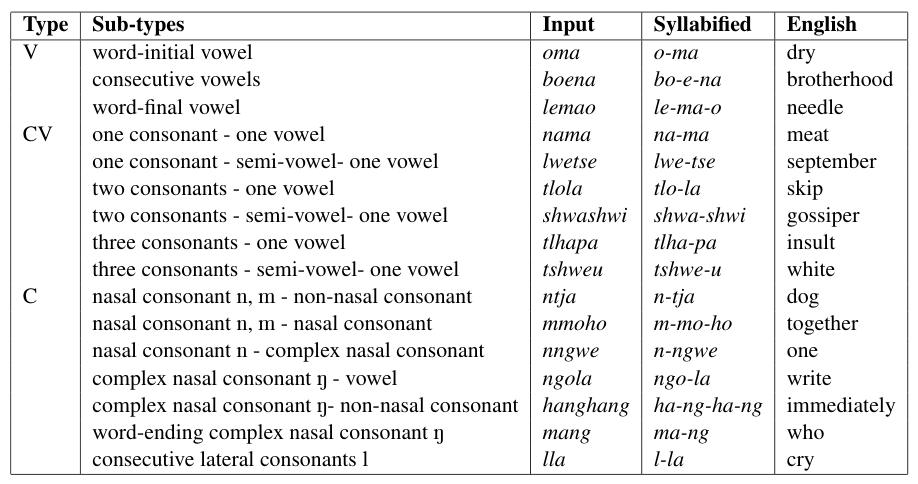
Table 1: Syllabification rules and examples.
2.2 Sepedi syllables
According to Wilsenach (2019), Sotho-Tswana languages have similar syllable structures. That is, Sepedi words can also be broken down into v-syllables, cv-syllables and c-syllables. The v-syllables are formed using only one vowel either at the beginning, middle or end of a word, or by monosyllabic words formed only of a vowel. The cv-syllable structure can contain between one and four onsets. The four onsets can be composed of three consonants (ccc) as in words like tlhekišo [tlhe-ki-šo], and a semi-vowel (w) resulting in the four onsets and a vowel syllable (cccwv) as in words like tlhwekišo [tlhwe-ki-šo].
The c-syllables can be formed m, n, l, r, ɲ, and ŋ syllabic consonants (Chokoe, 2020). First, c-syllables are formed when two identical syllabic consonants occur in succession within a single word, for instance in words like ba-l-li 'criers', and wa-r-ra 'brother' (Chokoe, 2020). Second, when nasal consonants precede any other consonant, for instance in words like n-tšha 'draw', and m-phsa 'new'. Third, the ŋ c-syllable is formed when the ŋ complex nasal takes the word-final position such as in words like n-tlo-ng- (Makaure, 2021; Chokoe, 2020).
2.3 Setswana syllables
There are also three syllable structures in Setswana Otlogetswe (2017). First, Setswana uses the open cv-syllable structure where cv-syllables can contain between one (cv) and four (cccwv) onset consonants (Sebina, 2014). Second, v-syllables can be formed using one vowel either at the word-initial, word-medial or word-final positions such in words like a-lo-la, lo-e-to, bo-e- 'make, trip, return'. Vowel-only monosyllabic words are also used in Setswana, for instance in words like ao 'to/of'. Third, like Sepedi, c-syllables can be formed by the m, n, l, r, and ŋ syllabic consonants. The simple syllabic consonants can appear at the word-initial position such as in words like m-ma 'mom', and word-medial positions such as in words like bo-r-re 'fathers' (Otlogetswe and Ramaeba, 2022). The ŋ nasal consonant can also appear at the word-final position such as in words like fi-sa-ng- 'hot'. While other syllabic consonants behave similarly to those in Sesotho, the current Sesotho syllabification system does not account for the representation of the r c-syllable in its rules.
3 Methodology
The South African Centre for Digital Language Resources hosts a publicly available online repository at repo.sadilar.org. For this article, we collected two Autshumato 6 corpora, that is, the Sepedi (McKellar, 2022a) and Setswana (McKellar, 2022b) Autshumato monolingual corpora. The Sepedi corpus contained a total of 3 458 067 words while the Setswana corpus contained a total of 5 219 070 words.
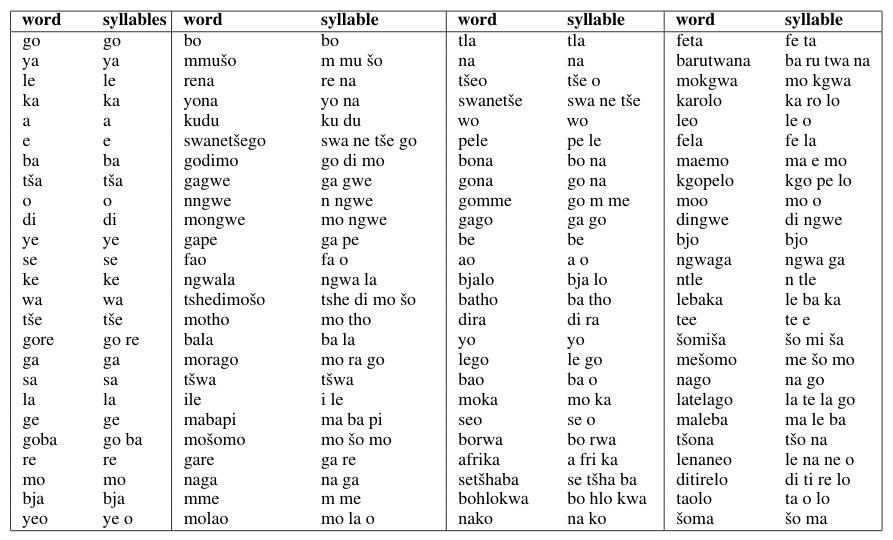
Table 2: Lists of frequently used words and syllabified counterparts in Sepedi
We used bash to extract four frequency lists. One, a list of one hundred most frequently used words in Sepedi. Two, the hundred most frequently used words in Setswana. Three, the hundred most infrequently used words in Sepedi. Four, the hundred least frequently used words in the Setswana corpus.
We then extracted the syllabification information from all four lists using Sibeko and Van Zaanen's (2022b) rule-based syllabification system that was also downloaded from SADiLaR's repository.
4 Results
This section presents the results of the syllabification process. Both the 100 most used words and the 100 least used words from the Autshumato corpora for Sepedi and Setswana are presented. Stop words were not considered for any of the four lists.
4.1 Sepedi
4.1.1 Frequently used words
The hundred most frequently used Sepedi words ranged between 229 028 times [for the word go] and 3 387 times [for the word šoma]. The list of original words and their syllables are presented in table 2. The v-syllable, cv-syllable, and c-syllable types can be observed from the list. Note that we use the dash (-) to indicate syllable boundaries while the syllabification system only uses spaces.
The v-syllables structure was observed for monosyllabic vowel-only words such as a, e, ɛ, ɔ and o. Furthermore, we observed v-syllables at the word-initial position in words such as ile [i-le-] 'went', the word-medial position in words such as taolo [ta-o-lo-] 'control', and the word-final position in words such as tee [te-e-] 'only'. We did not observe any erroneous identification of v-syllables.
At least four cv-syllable types are present on the list. First, the one-consonant-one-vowel structure was observed in words such as kudu [ku-du-] 'a lot' which was correctly broken into two syllables. Second, the cwv syllable structure was evident in words such as bohlokwa [bo-hlo-kwa-] 'important' which was broken into three syllables. Third, the ccv structure was evident in words such as tšeo [tše-o-] 'those'. Fourth, the ccwv structure was evident in words such as ngwaga [ngwa-ga-] 'year' which was broken into two syllables. Fifth, the cccv structure was observed in words such as setšhaba [se-tšha-ba-] 'nation' which was broken into three syllables. Unfortunately, there were no instances of cccwv syllable structures on the list.
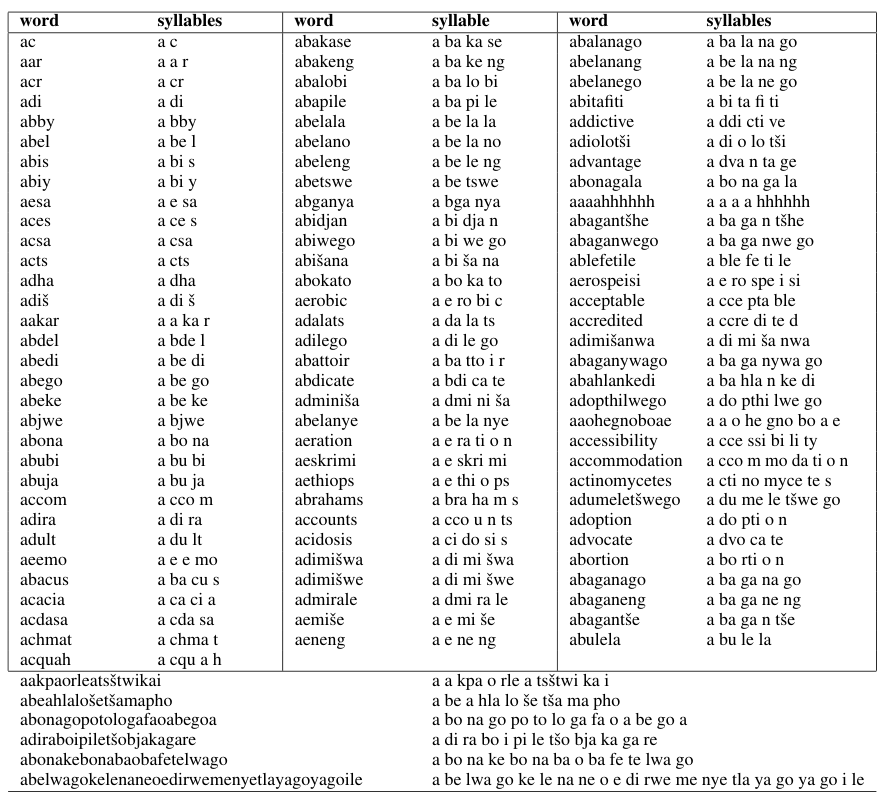
Table 3: Lists of least used words and syllabified counterparts in Sepedi
Furthermore, our list of frequently used words was limited in that it did not reflect all possible consonant-only syllable types. Even so, we were able to investigate the behaviour of the syllabic m and n nasal consonants. For instance, we find words such as mmušo [m-mu-šo-] 'government' and nngwe [n-ngwe-] 'one' which were correctly broken into syllables.
4.1.2 Least used words
We also surveyed the hundred least-used words from the Sepedi corpus. Each of the words appeared no more than once in the corpus. The original words and the derived syllables are listed in table 3.
Our Sepedi list of most infrequently used words contained instances of untranslated English words. Some of the English words were left as references for newly coined Sepedi words. We did not clean the list, instead, we fed it into the syllabification system to see how the system would handle all the different unexpected words.
Fortunately, rule-based syllabification systems are best for unseen words (Adsett et al., 2009). Being able to handle unseen words allows the syllabification system to identify syllable boundaries in unexpected words such as concatenations like abelwagokelenaneoedirwemenyetlayagoyagoile and in words from a different language such as the English word 'Abrahams' [a-bra-ha-ms].
Three v-syllable structures were observed. First, the word-initial v-syllable structure was observed in words such as abjwe [a-bjwe-] 'shared' which was broken down into two syllables. Second, the word-final v-syllable structure was observed in the word aaohegnoboae which was broken into eight syllables [a-a-o-he-gno-bo-a-e-]. Finally, the word-medial v-syllable structure was observed in words such as aemiše [a-e-mi-še-] 'he stops' which was broken into four syllables.
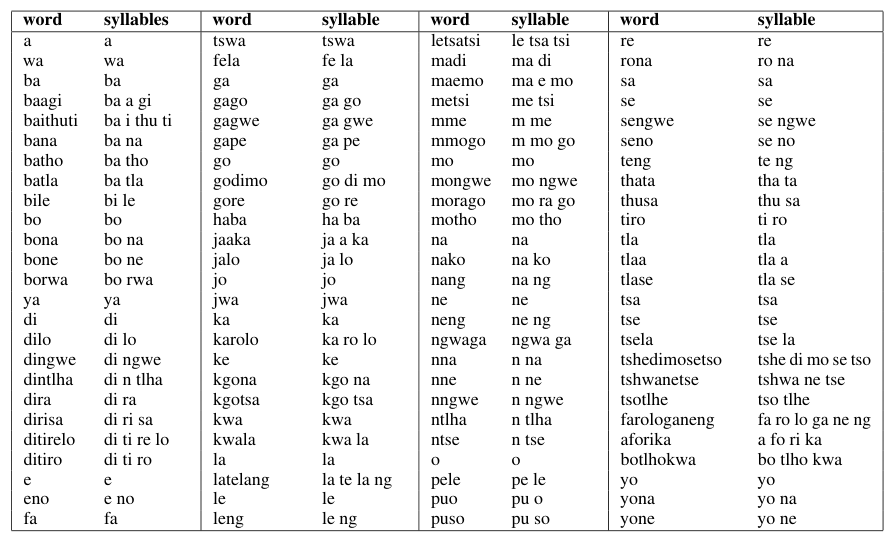
Table 4: Lists of frequently used words and syllabified counterparts in Setswana
Five cv-syllable structures were identified from the word list. First, the one-consonant-one-vowel structure was observed in words such as abulela 'he opened' which was broken into four syllables [a-bu-le-la-]. Second, the cwv structure was evident in words such as adimišwe 'lend' which was broken into four syllables [a-di-mi-šwe-]. Third, the ccv structure was observed in words such as abagantše 'divided' which was broken into five syllables [a-ba-ga-n-tše-]. Fourth, we observed the ccwv structure in words like adumeletšwego [a-du-me-le-tšwe-go-] 'approved' which was broken into six syllables. Finally, we observed the cccv structure in words such as abagantšhe [a-ba-ga-n-tšhe-] 'separate' which was broken into five syllables. There were no instances of the cccwv structure in the current word list.
Only two c-syllable structures were observed from the list of one hundred least frequently used words. First, the n syllabic nasal structure was observed in words such as abagantše discussed above. Second, the ŋ complex syllabic nasal structure was observed in words such as abaganeng [a-ba-ga-ne-ng-] where it is in the word-final position.
Although there were no instances of the syllabic nasal m, there is an interesting behaviour of the consonant m in words such as adminiša [a-dmi-ni-ša-] 'administer' and admirale [a-dmi-ra-le-] 'admiral' which are respectively broken down into four syllables. This structure of the dmi syllable is unexpected in the Sepedi language and it is enabled only by naturalised loaned words. One would expect a vowel between the letters d and m as in adiminiša [a-di-mi-ni-ša-] and adimirale [a-di-mi-ra-le-].
Nonetheless, Sotho-Tswana languages do not have strict rules for spelling loaned words. As a result, the 'dmi' syllable does not break spelling rules as it is a ccv syllable which falls under the cv-syllable structure generally preferred in Bantu languages (Ditsele, 2014). What is important here is that the syllable boundaries are correctly identified.
4.2 Setswana
4.2.1 Frequently used words
The one hundred most frequently used Setswana words ranged between 334 188 times [for the word go] and 4 688 times [for the word yona].
Vowel-only monosyllabic words such as a, e, and o were frequently used in the corpus. Furthermore, we observed v-syllable structures in word-initial positions in words such as eno [e-no-] 'that one', in word-final positions such as in words like puo [pu-o-] 'speech', and in word-medial position in words such as 'jaaka' [ja-a-ka-] 'like'. Overall, no errors were observed for v-syllable structures.
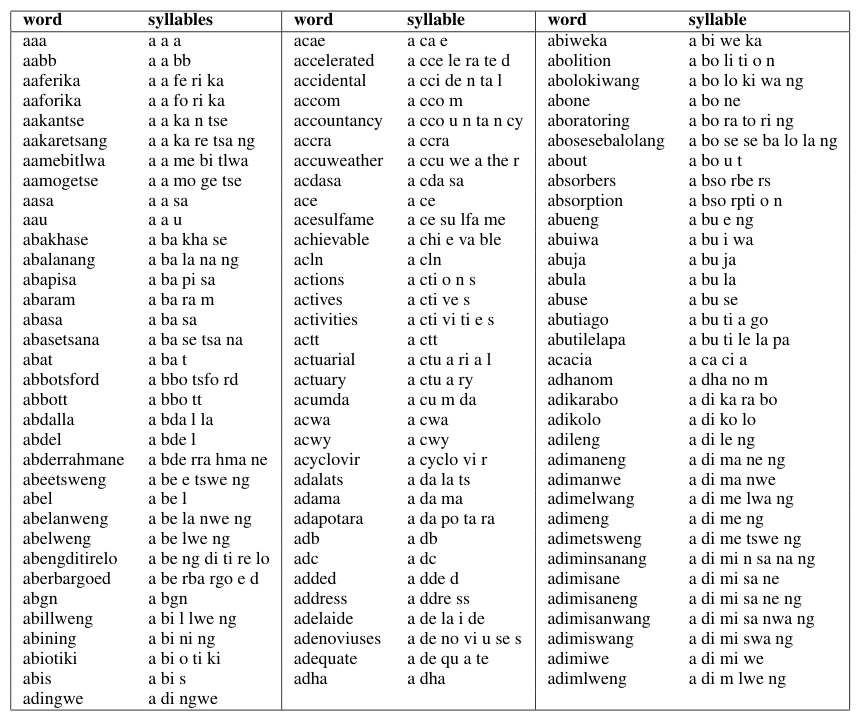
Table 5: List of least used words and syllabified counterparts in Setswana
At least six cv-syllable structures were observed. One, the cv structure was evident in words such as pele [pe-le-] 'following'. Two, the cwv structure was observed in words like kwala [kwa-la-] 'write'. Three, the ccv syllable structure was observed in words such as tlase [tla-se-] 'low'. Four, the ccwv syllable structure was observed in words such as sengwe [se-ngwe-]'something'. Five, we observed the cccv syllable structure in words like botlhokwa [bo-tlho-kwa-] 'important'. Six, we observed the cccwv structure in words such as tshwanetse [tshwa-ne-tse-] 'must'.
We also observed three c-syllable types. One, the m syllable was evident in words such as mmogo 'together' where it appeared at the word-initial position [m-mo-go-]. Two, the n syllable was observed at the word-medial position in words like dintlha [di-n-tlha-] 'details'. Three, the ŋ syllable appeared at the word-final position in words like neng [ne-ng-] 'when'.
4.2.2 Least used words
The rarest words from the Setswana corpus appeared no more than once in the corpus. The original words together with the syllables are presented in table 5. Similar to the Sepedi list, the Setswana list contains some instances of incorrect spelling such as adiminsanang [a-di-mi-n-sa-na-ng-]. Even so, the syllabification system was able to insert justifiable syllable boundaries at the expected spaces. For instance, the additional n in adimi-n-sanang is followed by a correct syllable boundary. Furthermore, like the Sepedi list, there are numerous instances of non-Setswana words on the list.
Three v-syllable structures were observed. That is, at the word-initial placement in words like adileng [a-di-le-ng-] 'laid out', the word-medial position in words such as abiotiki [a-bi-o-ti-ki-] 'abiotic', and the word-final location in the untranslated English acronym for Autism Centers of Excellence, that is acae [a-ca-e-].
Five cv-syllable structures were also observed. That is, the cv syllable in words like adikarabo [a-di-ka-ra-bo-] 'of answers', the cwv syllable in words like abelwaneng [a-be-lwa-ne-ng-] 'shared', the ccv syllable in words such as adimanwe [a-di-ma-nwe-] 'borrowed each other', and the ccwv syllable in words like adimetsweng [a-di-me-tswe-ng-] 'borrowed for'.
Finally, three c-syllable types were observed. One, the m syllable was observed in words like adimlweng [a-di-m-lwe-ng-]. Although the word is incorrectly spelt, the syllable boundaries are in the expected places. Two, the word-medial position l syllable is evident in words such as abillweng [a-bi-l-lwe-ng]. The second lateral in the word is unfortunately a typo. Even so, the syllabification system managed to insert justifiable boundaries following the order of letters in the word. Finally, the ŋ syllable was observed in the word-final position in words such as adimeng [a-di-me-ng-] and in the word-medial position in words like abengditirelo [a-be-ng-di-ti-re-lo-].
As we expected, the Setswana syllabic 'r' is not covered by the Sesotho rules for syllabification as described in Sibeko (2022) and Sibeko and van Zaanen (2022a). Unfortunately, a proper Setswana word containing the 'r' c-syllable is not present in both lists of Setswana words. Even so, the word abderrahmane [a-bde-rra-hma-ne-] contains consecutive 'r' letters. In this occurrence, the expected syllable boundary between the 'rra', syllable, i.e. [r-ra-] is missing.
5 Discussion
As stated earlier in this article, the Sotho-Tswana languages are mutually intelligible to a great extent. Even though some vocabulary choices may be ambiguous, the ambiguity does not affect syllable breaks. This article set out to evaluate the Sesotho rule-based syllabification system on both Sepedi and Setswana words. We used the Autshumato machine translation corpora for both Sepedi and Setswana. The texts were translated from English texts as a pivot language. As a result, they contain somewhat similar information.
The v-syllable structures showed consistently correct syllable placement in both Sepedi and Setswana. All v-syllable structures argued by Sibeko (2022) were identified for both Sepedi and Setswana. All word-initial, word-medial, and word-final v-syllable structures were correctly identified. This consistency in the accuracy of the syllable breaks indicates that the current Sesotho syllabification system is ideal for identifying v-syllables in both Sepedi and Setswana. Unfortunately, single-letter words cannot be broken down into syllables. Even so, no unexpected outputs were observed for single-letter vowel-only words.
The syllabification system inserted consistently correct syllable breaks in words containing the m and n syllabic consonants on both Sepedi and Setswana texts. Unfortunately, the ŋ could only be identified at the word-end position in Sepedi. As such, we were not able to observe its behaviour when it appears at word-initial and word-medial positions. Even so, the word-medial ŋ syllable was correctly identified in the Setswana list. Furthermore, the Sepedi list did not contain any instances of the l syllable. However, it was observed in the Setswana list. As a result, we can safely assume that the current syllabification system can insert correct syllable boundaries for the l consonant even in Sepedi as the l syllable behaves similarly in all three Sotho-Tswana languages.
The unexpected structure of the dmi syllable highlights a need for clear rules governing the behaviour of nasal consonants that follow other consonants. To this point, the rules are only descriptive when the nasal consonant comes before the other consonants. It might be interesting to also investigate this in future studies.
Although the system attempted to identify syllable boundaries in non-Sotho-Tswana words, that is English words, the discord between the rules as implemented in the syllabification system and the structure of the orthography of English words could not be ignored.
All expected syllable boundaries in the correctly spelt words in Setswana were successfully identified by the syllabification system. We however missed an instance of consecutive r syllable in both the Sepedi and the Setswana lists. It would have been interesting to analyse actual Setswana words with such instances. Nonetheless, we noticed the absence of a syllable break between consecutive r letters in the non-Setswana examples. This finding confirms our initial assumption that the current Sesotho syllabification system does not identify the r syllabic consonants.
We also noticed inconsistencies in the spelling of words like aaforika and aaferika 'Africa' in the Setswana list of one hundred rarest used words. Both words were justifiably broken into syllables according to the given incorrect spelling, see table 5. Although this is unimportant in the identification of syllables, it does affect the counts of syllables as it may exaggerate syllable counts and types identified from a text.
The syllabification system's inability to recognise diacritics such as those used in Sepedi proved unproblematic for our selected words. That is, Sepedi words with diacritics were correctly broken into syllables. Even so, we are not aware of all possible placements of letters with accents in the written Sepedi words. As a caution, we recommend that the update to the syllabification system include letters with diacritics.
Overall, we recommend that the Sesotho rule-based syllabification be updated to cover all three standardised Sotho-Tswana languages. We also recommend that diacritics be included and specifically handled in the recommended Sotho-Tswana syllabification system. Equally important, we recommend that updated rules should also cover specific rules for handling the Sepedi and Setswana r syllable.
Limitations
The results of this article are limited by our sampling method which included the use of the hundred most used words and the hundred least used words in each of the languages as evidenced by the Autshumato corpora. Future studies could consider developing gold-standard syllable information annotated corpora for Sepedi and Setswana. The corpora could then be used for evaluating the usability of the TEX-based Sesotho syllabification system on Sepedi and Setswana texts. In this article, we were limited by the lack of such corpora and were therefore limited only to the evaluation of the rule-based syllabification system. The lists used did not contain correct Sepedi examples of words containing consecutive r consonants. As a result, we are unable to draw concrete conclusions on the rule-based syllabification system's performance on such words.
Ethics Statement
This article utilizes publicly available resources. The authors have taken measures to ensure that the data used is properly cited and attributed to the original sources and that any potential biases or limitations in the data are acknowledged.
Notes
1 see mandates for South African language boards accessible at https://static.pmg.org.za/PanSALB_APP_2122_compressed_reviewed_08032021_final.pdf
2 South Africa's 2022 census results have not been released
3 The Sesotho syllable information annotated wordlist can be freely accessed at https://repo.sadilar.org/handle/20.500.12185/556
4 see https://repo.sadilar.org/handle/20.500.12185/556 for the Sesotho syllabification systems
5 note that this is another instance of a non-Sepedi word. It was used here due to the absence of a proper Sepedi word with the word-final v-syllable
References
Connie R Adsett, Yannick Marchand, Vlado Kes, et al. 2009. Syllabification rules versus data-driven methods in a language with low syllabic complexity: The case of italian. Computer Speech & Language, 23(4):444-463.
Etienne Barnard, Marelie H Davel, Charl Van Heerden, Febe De Wet, and Jaco Badenhorst. 2014. The NCHLT corpus of the South African languages. In Proceedings of the 4th International Workshop Spoken Language Technologies for Under-resourced Languages, pages 194-200.
Sekgaila Chokoe. 2020. Spell it the way you like: The inconsistencies that prevail in the spelling of Northern Sotho loanwords. South African Journal of African Languages, 40(1):130-138.
Katherine Demuth. 2007. Sesotho speech acquisition. The international guide to speech acquisition, pages 526-538.
Patrick Dickens. 1978. A preliminary report on Kgalagadi vowels. African Studies, 37(1):99-106.
Thabo Ditsele. 2014. Why not use Sepitori to enrich the vocabularies of Setswana and Sepedi? Southern African Linguistics and Applied Language Studies, 32(2):215-228.
Aditi Sharma Grover, Gerhard B van Huyssteen, and Marthinus W Pretorius. 2010. The South African Human Language Technologies audit. In Proceedings of the Seventh International Conference on Language Resources and Evaluation (LREC'10), pages 2847-2850.
Aditi Sharma Grover, Gerhard Beukes. van Huyssteen, and Marthinus W. Pretorius. 2011. The South African Human Language Technology audit. Language resources and evaluation, 45:271-288.
Samson Mbizo Guma. 1982. An outline structure of Southern Sotho, 2nd edition. Shooter and Shuter Publishers, Pietermaritzburg, South Africa.
Pali Lehohla. 2011. Census in brief. Statistics South Africa. government printing works: Pretoria.
Katjie Sponono Mahlangu. 2015. The growth and development of isiNdebele orthography and spelling (1921-2010). Ph.D. thesis, University of Pretoria.
Leketi Makalela. 2009. Harmonizing South African Sotho language varieties: Lessons from reading proficiency assessment. International Multilingual Research Journal, 3(2):120-133.
Zvinaiye Patricia Makaure. 2021. The contribution of phonological processing skills to early literacy development in Northern Sotho-English bilingual children: A longitudinal investigation. Ph.D. thesis, The University of South Africa, Pretoria.
Litsépiso Matlosa. 2017. Sesotho orthography called into question: The case of some Sesotho personal names. Nomina Africana: Journal of African Onomastics, 31(1):51-58.
Cindy McKellar. 2022a. Autshumato Monolingual Sepedi Corpus. ONLINE. South African Centre for Digital Language Resources. Available at: https://repo.sadilar.org/handle/20.500.12185/582 Accessed: 28 Jan 2023.
Cindy McKellar. 2022b. Autshumato Monolingual Setswana Corpus. ONLINE. South African Centre for Digital Language Resources. Available at: https://repo.sadilar.org/handle/20.500.12185/584 Accessed: 28 Jan 2023.
Victor Mojela. 2016. Etymology & figurative: The role of etymology in the lemmatization of Sotho terminology. In The 10th International Conference of the Asian Association for Lexicography (AsiaLex2016) 1-3 June 2016 Manila, The Philippines, page 93.
Carmen Moors, Illana Wilken, Karen Calteaux, and Tebogo Gumede. 2018a. Human Language Technology audit 2018: Analysing the development trends in resource availability in all South African languages. In Proceedings of the Annual Conference of the South African Institute of Computer Scientists and Information Technologists, pages 296-304.
Carmen Moors, Illana Wilken, Tebogo Gumede, and Karen Calteaux. 2018b. Human Language Technology audit 2017/18. Technical report, CSIR Meraka Institute.
Mildred Nkolola-Wakumelol, Liketso Rantsoz, and Keneilwe Matlhaku. 2012. Syllabification of consonants in Sesotho and Setswana. In H S NgingaKoumba-Binza and S Bosch, editors, Language Science and Language technology in Africa: Festschrift for Justus C. Roux, pages 10-13. Sun Express, Stellenbosch, South Africa.
Thapelo J Otlogetswe. 2017. Setswana syllable structure and distribution. Nordic Journal of African Studies, 26(4):28-28.
Thapelo J Otlogetswe and Goabilwe N Ramaeba. 2022. Nickname creation through shortening Setswana personal names. South African Journal of African Languages, 42(2):200-206.
Danie Prinsloo. 2011. Tribute to Professor Louis Jacobus Louwrens: This issue of the south african journal of african languages is dedicated to Professor Louis Jacobus Louwrens. South African Journal of African Languages, 31(1):1-5.
Tebogo Rakgogo and Evangeline Zungu. 2021. The onomastic possibility of renaming the Sepedi and Sesotho sa Leboa (Northern Sotho) language names to restore peace, dignity and solidarity. Literator (Potchefstroom. Online), 42(1):1-14.
Republic of South Africa. 1996. Constitution of the Republic of South Africa. Department of Justice, Pretoria.
Boikanyego Sebina. 2014. First language attrition in the native environment. LANGUAGE, 6:53-60.
Johannes Sibeko. 2022. Tshebediso ya melao kabong ya dinoko tsa Sesotho. Southern African Linguistics and Applied Language Studies, 40(4):494-506.
Johannes Sibeko and Mmasibidi Setaka. 2022. An overview of Sesotho blark content. Journal of the Digital Humanities Association of Southern Africa, 4(01).
Johannes Sibeko and Menno van Zaanen. 2022a. Developing a text readability system for Sesotho based on classical readability metrics. In Responding to Asian diversity, pages 571-572.
Johannes Sibeko and Menno van Zaanen. 2022b. Sesotho syllabification systems. Southern African Centre for Digital Language Resources. Available at: https://repo.sadilar.org/handle/20.500.12185/555 [accessed: 3 jan 2023].
Luan Staphorst. 2022. Ongehoord: Voices unaccented; voices unharmonized. Afrikaans and South Africa's first peoples in discourses of higher education transformation. Unpublished MA dissertation, Nelson Mandela University.
Suyanto Suyanto, Ade Romadhony, Febryanti Sthevanie, and Rezza Nafi Ismail. 2021. Augmented words to improve a deep learning-based indonesian syllabification. Heliyon, 7(10):e08115.
Hein Willemse. 2018. The hidden histories of Afrikaans. Whiteness Afrikaans Afrikaners: Addressing PostApartheid Legacies, Privileges and Burdens, page 115.
Carien Wilsenach. 2019. Phonological awareness and reading in Northern Sotho-understanding the contribution of phonemes and syllables in grade 3 reading attainment. South African Journal of Childhood Education, 9(1):1-10.
Philimon Nhlanhla Zulu, Gerrit Botha, and Etienne Barnard. 2008. Orthographic measures of language distances between the official South African languages. Literator: Journal of literary criticism, comparative linguistics and literary studies, 29(1):185-204.
Evaluating the Sesotho rule-based syllabification system on Sepedi and Setswana words
Évaluation du système de syllabification à base de règles du sesotho sur des mots sepedi et setswana
Affiliations
Johannes Sibeko
Nelson Mandela University
Linguistics and Applied Linguistics
Port Elizabeth, South Africa
Mmasibidi Setaka
South African Centre
for Digital Language Resources
Potchefstroom, South Africa
Affiliations
Johannes Sibeko
Nelson Mandela University
Linguistics and Applied Linguistics
Port Elizabeth, South Africa
Mmasibidi Setaka
South African Centre
for Digital Language Resources
Potchefstroom, South Africa
Abstract
Résumé
The purpose of this article is to demonstrate that the recently developed automated rule-based syllabification system for Sesotho can be used broadly across the officially recognised South African Sotho-Tswana language group encompassing Sepedi, Sesotho and Setswana. We evaluate the automatic syllabification system on 400 words comprising 100 most frequently used words and 100 least-used words in Sepedi and Setswana as evident in the Autshumato corpus publicly available online. It is found that the Sesotho rule-based syllabification system can be used to correctly identify vowel-only syllables, consonant-vowel syllables and consonant-only syllables in Sepedi and Setswana. Among other findings, it has been demonstrated that words with diacritics as in the case of Sepedi are correctly broken down into syllables. We make two main recommendations. First, the rules for syllabification should be updated so that Sepedi diacritics are accommodated. Second, the syllabification system should be updated so that it reflects the broader Sotho-Tswana language group instead of being limited to Sesotho. Further research is needed to ascertain whether the complex consonant [ɲ] behaves similarly in all three officially recognised Sotho-Tswana languages and evaluate the need for a specific rule for the [ɲ] nasal consonant.
Le but de cet article est de démontrer que le système de syllabification automatique basé sur des règles récemment développé pour le sesotho peut être largement utilisé dans le groupe linguistique sotho-tswana officiellement reconnu en Afrique du Sud, comprenant le sepedi, le sesotho et le setswana. Nous évaluons le système de syllabification automatique sur 400 mots comprenant les 100 mots les plus fréquemment utilisés et les 100 mots les moins utilisés en sepédi et en setswana, comme le montre le corpus Autshumato disponible publiquement en ligne. Il est constaté que le système de syllabification basé sur des règles pour le sesotho peut être utilisé pour identifier correctement les syllabes uniquement vocaliques, les syllabes consonantiques-vocaliques et les syllabes uniquement consonantiques en sepédi et en setswana. Entre autres découvertes, il a été démontré que les mots avec des signes diacritiques comme dans le cas de Sepedi sont correctement décomposés en syllabes. Nous formulons deux recommandations principales. Premièrement, les règles de syllabification devraient être mises à jour pour tenir compte des signes diacritiques du Sepedi. Deuxièmement, le système de syllabification doit être mis à jour afin de refléter le groupe de langues sotho-tswana plus large au lieu de se limiter au sesotho. D'autres recherches sont nécessaires pour déterminer si la consonne complexe [ɲ] se comporte de manière similaire dans les trois langues sotho-tswana officiellement reconnues et évaluer la nécessité d'une règle spécifique pour la consonne nasale [ɲ].
1 Introduction
1 Introduction
This article presents an evaluation of the Sesotho rule-based syllabification system for use in Sepedi and Setswana written texts. The Republic of South Africa recognises eleven official languages, namely, Afrikaans, English, isiNdebele, isiXhosa, isiZulu, SiSwati, Sepedi, Sesotho, Setswana, Tshivenda, and Xitsonga (Republic of South Africa, 1996). Of these eleven languages, Afrikaans and English are often identified as Germanic languages (Zulu et al., 2008). Even so, some argue that Afrikaans is an African language as it is spoken in Africa even though it is a variant of Dutch (Willemse, 2018; Staphorst, 2022). IsiNdebele, isiXhosa, isiZulu and isiSwati are classified under the Nguni language group. Sepedi [also referred to as Northern Sotho (Rakgogo and Zungu, 2021)], Sesotho [also referred to as Southern Sotho (Demuth, 2007)], and Setswana [sometimes referred to as Western Sotho (Mojela, 2016)] are grouped under the Sotho-Tswana language group. These Sotho-Tswana languages have many variations within themselves. Even so, they are mutually intelligible in that the speakers of these languages can understand each other without difficulty (Makalela, 2009). The national language bodies, under the auspices of the Pan South African Language Board (PanSALB) have dictated three different orthographies for these languages. PanSALB develops rules and standards for spelling and orthography for the proper functioning of all official languages.
Cet article présente une évaluation du système de syllabification à base de règles Sesotho pour une utilisation dans les textes écrits en Sepedi et en Setswana. La République d'Afrique du Sud reconnaît onze langues officielles, à savoir l'afrikaans, l'anglais, l'isiNdebele, l'isiXhosa, l'isiZulu, le SiSwati, le Sepedi, le Sesotho, le Setswana, le Tshivenda et le Xitsonga (République d'Afrique du Sud, 1996). Parmi ces onze langues, l'afrikaans et l'anglais sont souvent identifiés comme des langues germaniques (Zulu et al., 2008). Malgré cela, certains affirment que l’afrikaans est une langue africaine telle qu’elle est parlée en Afrique, même s’il s’agit d’une variante du néerlandais (Willemse, 2018; Staphorst, 2022). L'isiNdebele, l'isiXhosa, l'isiZulu et l'isiSwati sont classés dans le groupe linguistique Nguni. Le sepédi [également appelé sotho du Nord (Rakgogo et Zungu, 2021)], le sesotho [également appelé sotho du Sud (Demuth, 2007)], et le setswana [parfois appelé sotho de l'Ouest (Mojela, 2016)] sont regroupés sous le groupe de langues sotho-tswana. Ces langues Sotho-Tswana présentent de nombreuses variations en leur sein. Malgré cela, elles sont mutuellement intelligibles en ce sens que les locuteurs de ces langues peuvent se comprendre sans difficulté (Makalela, 2009). Les organismes linguistiques nationaux, sous les auspices du Pan South African Language Board (PanSALB) ont dicté trois orthographes différentes pour ces langues. La PanSALB développe des règles et des normes pour l'orthographe et l'orthotypographie afin d'assurer le bon fonctionnement de toutes les langues officielles.
According to the 2011 census, there were at least 4 618 577 Sepedi first language speakers, 3 849 562 Sesotho first language speakers and 4 067 248 Setswana first language speakers in South Africa alone (Lehohla, 2011). Sesotho is also an official language in Lesotho and Zimbabwe. Setswana is also one of the official languages of Botswana. The South African Human Language Technologies surveys indicate that there is a paucity of research in syllabification systems for the indigenous languages of South Africa (Grover et al., 2010, 2011; Barnard et al., 2014; Moors et al., 2018a,b). As far as we are aware, Sesotho is presently the only South African indigenous language to have a publicly accessible rule-based syllabification system. Even so, according to Sibeko and Setaka (2022), there are two systems for syllabification in Sesotho. The machine learning TEX-based patterning system relies on gold-standard corpora with exemplified syllable annotations. The Sesotho TEX-based syllabification system used a gold standard list of words and their syllables. Unfortunately, we are not aware of similar lists for Sepedi and Setswana. As such, we cannot evaluate this machine learning system in this article.
Selon le recensement de 2011, il y avait au moins 4 618 577 locuteurs de langue maternelle sepedi, 3 849 562 locuteurs de langue maternelle sesotho et 4 067 248 locuteurs de langue maternelle setswana en Afrique du Sud seulement (Lehohla, 2011). Le sesotho est également une langue officielle au Lesotho et au Zimbabwe. Le setswana est également l'une des langues officielles du Botswana. Les enquêtes sur les technologies du langage humain en Afrique du Sud indiquent qu’il existe une pénurie de recherches sur les systèmes de syllabification pour les langues autochtones d’Afrique du Sud (Grover et al., 2010, 2011; Barnard et al., 2014; Moors et al., 2018a,b). À notre connaissance, le sesotho est actuellement la seule langue autochtone sud-africaine à avoir un système de syllabification basé sur des règles accessible au public. Néanmoins, selon Sibeko et Setaka (2022), il existe deux systèmes de syllabification en sesotho. Le système de motifs basé sur l'apprentissage automatique et sur TEX repose sur des corpus de référence avec des annotations de syllabes exemplifiées. Le système de syllabification basé sur TEX pour le Sesotho a utilisé une liste de référence de mots et de leurs syllabes. Malheureusement, nous ne connaissons pas de listes similaires pour Sepedi et Setswana. En tant que tel, nous ne pouvons pas évaluer ce système d'apprentissage automatique dans cet article.
This article aims to demonstrate the applicability of the Sesotho rule-based system in identifying syllables in the wider South African Sotho-Tswana language group. We provide a very brief background to orthographies of South African languages and expected syllable types in Sepedi and Setswana in section 2. We then describe our method of data collection in section 3. Finally, we discuss our findings in section 4 and end with a discussion in section 5.
Cet article vise à démontrer l'applicabilité du système à base de règles Sesotho dans l'identification des syllabes dans le groupe de langues plus large Sotho-Tswana d'Afrique du Sud. Nous fournissons un très bref aperçu des orthographes des langues sud-africaines et des types de syllabes attendus en Sepedi et Setswana dans la section 2. Nous décrivons ensuite notre méthode de collecte de données dans la section 3. Enfin, nous discutons de nos conclusions à la section 4 et nous concluons par une discussion à la section 5.
2 Background
2 Contexte
2.1 Orthographies
2.1 Orthographies
Written languages have systematic rules for spelling words (Matlosa, 2017). Rules for writing in African languages were introduced by religious missionaries. As a result, most orthographies of African languages are modelled after European orthographies (Mahlangu, 2015). Two major writing systems are used in South African languages. First, the Sotho-Tswana language group together with Tshivenda and Xitsonga use disjunctive writing systems, while the Nguni language group composing isiZulu, isiXhosa, isiNdebele, and SiSwati, use a conjunctive writing system (Prinsloo, 2011). The writing systems are illustrated below:
Les langues écrites ont des règles systématiques pour l'orthographe des mots (Matlosa, 2017). Les règles d'écriture dans les langues africaines ont été introduites par les missionnaires religieux. Par conséquent, la plupart des orthographes des langues africaines sont modélisées d'après les orthographes européennes (Mahlangu, 2015). Deux principaux systèmes d'écriture sont utilisés dans les langues sud-africaines. Premièrement, le groupe de langues Sotho-Tswana ainsi que le Tshivenda et le Xitsonga utilisent des systèmes d'écriture disjonctifs, tandis que le groupe de langues Nguni composé de l'isiZulu, de l'isiXhosa, de l'isiNdebele et du SiSwati, utilisent un système d'écriture conjoint (Prinsloo, 2011). Les systèmes d'écriture sont illustrés ci-dessous :
(a) Bana ba ya matha. - Sesotho
Children they are running. - English
Les enfants, ils courent. - Anglais
(b) Abantwana bayagijima. - Isizulu
The+children they+are+running. - English
Les+enfants ils+courent. - Anglais
As exemplified above, languages such as Sotho-Tswana languages with disjunctive writing systems isolate words while languages with conjunctive writing systems [for example, isiZulu] combine some parts of speech such the present tense and the plural subject marker in the word bayagijima. Nonetheless, Sotho-Tswana languages are easy to compare as they follow the same phonemic orthography where seven phonemic representations are mutually common [ɑ, e, i, o, u, ɛ, and ɔ] (Dickens, 1978; Matlosa, 2017).
Comme illustré ci-dessus, les langues telles que les langues sotho-tswana dotées de systèmes d'écriture disjonctifs isolent les mots, tandis que les langues dotées de systèmes d'écriture conjonctifs [par exemple, l'isizulu] combinent certaines parties du discours telles que le temps présent et le marqueur de sujet pluriel dans le mot bayagijima. Néanmoins, les langues sotho-tswana sont faciles à comparer car elles suivent la même orthographe phonémique où sept représentations phonémiques sont mutuellement communes [ɑ, e, i, o, u, ɛ et ɔ] (Dickens, 1978; Matlosa, 2017).
Sesotho has two recognised orthographies, namely, (i) the South African Sesotho (SAS) orthography and (ii) the Lesotho Sesotho (LS) orthography. One of the main differences between SAS and LS orthographies is the use of diacritics in LS orthography. For instance, see examples (c) and (d) below:
Le sesotho possède deux orthographes reconnues, à savoir, (i) l’orthographe sud-africaine Sesotho (SAS) et (ii) l'orthographe du sesotho du Lesotho (LS). L'une des principales différences entre les orthographes SAS et LS est l'utilisation de diacritiques dans l'orthographe LS. Par exemple, voir les exemples (c) et (d) ci-dessous :
(c) Tshepiso. - SAS orthography
Promise. - English
Promesse. - Anglais
(d) Tšepiso. - LS orthography
Promise. - English
Promesse. - Anglais
In the example above, the LS orthography uses the accented š letter while the SAS orthography uses the 'sh' digraph. Differences between SAS and LS orthographies are discussed thoroughly in studies such as Demuth (2007) and Matlosa (2017). The rule-based syllabification system evaluated in this article uses the SAS orthography (Sibeko and van Zaanen, 2022a).
Dans l'exemple ci-dessus, l'orthographe LS utilise la lettre accentuée š tandis que l'orthographe SAS utilise le digramme 'sh'. Les différences entre les orthographes SAS et LS sont discutées en détail dans des études telles que Demuth (2007) et Matlosa (2017). Le système de syllabification basé sur des règles évalué dans cet article utilise l’orthographe SAS (Sibeko et van Zaanen, 2022a).
According to Suyanto et al. (2021), rule-based systems perform better for low-resourced languages with limited to no gold standard corpora. This was also demonstrated in the case of Sesotho where the rule-based system outperformed the TEX-based patterning system (Sibeko and van Zaanen, 2022a). Rule-based systems are based on sets of rules carefully designed by language experts. According to Sibeko (2022), when the designed list of rules is properly implemented, syllable boundaries can be identified in any Sesotho word.
Selon Suyanto et al. (2021), les systèmes basés sur des règles fonctionnent mieux pour les langues à faibles ressources avec un corpus standard limité ou inexistant. Cela a également été démontré dans le cas du sesotho où le système à base de règles a surpassé le système de motifs basé sur TEX (Sibeko et van Zaanen, 2022a). Les systèmes basés sur des règles reposent sur des ensembles de règles soigneusement conçues par des experts en linguistique. Selon Sibeko (2022), lorsque la liste de règles conçue est correctement mise en œuvre, les limites des syllabes peuvent être identifiées dans n'importe quel mot sesotho.
The Sesotho rule-based system for syllabification uses rules for vowel-only syllables (v-syllables), consonant-only syllables (c-syllables), and consonant-vowel syllables (cv-syllables). According to Sibeko (2022) and Guma (1982) these are the only syllable types in Sesotho. Sibeko and Van Zaanen's (2022b) rule-based syllabification system takes one word per line as input and then outputs the syllabified version. The syllable boundaries are indicated by spaces.
Le système à base de règles pour la syllabification en Sesotho utilise des règles pour les syllabes ne contenant que des voyelles (v-syllabes), les syllabes ne contenant que des consonnes (c-syllabes), et les syllabes consonne-voyelle (cv-syllabes). Selon Sibeko (2022) et Guma (1982), ce sont les seuls types de syllabes en Sesotho. Le système de syllabification à base de règles de Sibeko et Van Zaanen (2022b) prend un mot par ligne en entrée et produit ensuite la version syllabifiée. Les limites des syllabes sont indiquées par des espaces.
The rule-based syllabification system recognises only 26 letters of the alphabet [abcdefghijklmnopqrstuvwxyz]. The rules for syllabification identify three main syllable types together with sixteen subtypes. These types, subtypes, and examples are presented in table 1. Interestingly, the Sesotho rule-based syllabification system used in this article demonstrated exceptional accuracy by achieving a rate of 99.6% (Sibeko and van Zaanen, 2022a,b).
Le système de syllabification basé sur des règles ne reconnaît que 26 lettres de l'alphabet [abcdefghijklmnopqrstuvwxyz]. Les règles de syllabification identifient trois types de syllabes principales ainsi que seize sous-types. Ces types, sous-types et exemples sont présentés dans le tableau 1. Fait intéressant, le système de syllabification à base de règles du sesotho utilisé dans cet article a démontré une exactitude exceptionnelle en atteignant un taux de 99,6 % (Sibeko et van Zaanen, 2022a,b).
The sounds w and y are considered semivowels when they occur at the onset of a syllable. However, some studies, such as Nkolola-Wakumelo et al.'s (2012) analysis of Setswana and Sesotho syllables, use the term "glides" instead.
Les sons w et y sont considérés comme des semi-voyelles lorsqu'ils se produisent à l'attaque d'une syllabe. Cependant, certaines études, telles que l'analyse des syllabes de Setswana et Sesotho par Nkolola-Wakumelo et al. (2012), utilisent plutôt le terme "glides".
Table 1: Syllabification rules and examples.
Tableau 1 : Règles de syllabification et exemples.
2.2 Sepedi syllables
2.2 Syllabes de Sepedi
According to Wilsenach (2019), Sotho-Tswana languages have similar syllable structures. That is, Sepedi words can also be broken down into v-syllables, cv-syllables and c-syllables. The v-syllables are formed using only one vowel either at the beginning, middle or end of a word, or by monosyllabic words formed only of a vowel. The cv-syllable structure can contain between one and four onsets. The four onsets can be composed of three consonants (ccc) as in words like tlhekišo [tlhe-ki-šo], and a semi-vowel (w) resulting in the four onsets and a vowel syllable (cccwv) as in words like tlhwekišo [tlhwe-ki-šo].
Selon Wilsenach (2019), les langues sotho-tswana ont des structures de syllabes similaires. C'est-à-dire que les mots en sepédi peuvent également être décomposés en v-syllabes, cv-syllabes et c-syllabes. Les v-syllabes sont formées en utilisant une seule voyelle soit au début, au milieu ou à la fin d'un mot, ou par des mots monosyllabiques formés uniquement d'une voyelle. La structure cv-syllable peut contenir entre un et quatre onsets. Les quatre attaques peuvent être composées de trois consonnes (ccc) comme dans des mots comme tlhekišo [tlhe-ki-šo], et d'une semi-voyelle (w) résultant en les quatre attaques et une syllabe vocalique (cccwv) comme dans des mots comme tlhwekišo [tlhwe-ki-šo].
The c-syllables can be formed m, n, l, r, ɲ, and ŋ syllabic consonants (Chokoe, 2020). First, c-syllables are formed when two identical syllabic consonants occur in succession within a single word, for instance in words like ba-l-li 'criers', and wa-r-ra 'brother' (Chokoe, 2020). Second, when nasal consonants precede any other consonant, for instance in words like n-tšha 'draw', and m-phsa 'new'. Third, the ŋ c-syllable is formed when the ŋ complex nasal takes the word-final position such as in words like n-tlo-ng- (Makaure, 2021; Chokoe, 2020).
Les c-syllabes peuvent être formées par les consonnes syllabiques m, n, l, r, ɲ, et ŋ (Chokoe, 2020). Tout d’abord, les c-syllabes sont formées lorsque deux consonnes syllabiques identiques se succèdent dans un même mot, par exemple dans des mots comme ba-l-li « crieurs » et wa-r-ra « frère » (Chokoe, 2020). Deuxièmement, quand les consonnes nasales précèdent toute autre consonne, par exemple dans des mots comme n-tšha 'dessiner', et m-phsa 'nouveau'. Troisièmement, la c-syllabe ŋ est formée lorsque la nasale complexe ŋ occupe la position finale du mot, comme dans des mots tels que n-tlo-ng- (Makaure, 2021 ; Chokoe, 2020).
2.3 Setswana syllables
2.3 Syllabes de Setswana
There are also three syllable structures in Setswana Otlogetswe (2017). First, Setswana uses the open cv-syllable structure where cv-syllables can contain between one (cv) and four (cccwv) onset consonants (Sebina, 2014). Second, v-syllables can be formed using one vowel either at the word-initial, word-medial or word-final positions such in words like a-lo-la, lo-e-to, bo-e- 'make, trip, return'. Vowel-only monosyllabic words are also used in Setswana, for instance in words like ao 'to/of'. Third, like Sepedi, c-syllables can be formed by the m, n, l, r, and ŋ syllabic consonants. The simple syllabic consonants can appear at the word-initial position such as in words like m-ma 'mom', and word-medial positions such as in words like bo-r-re 'fathers' (Otlogetswe and Ramaeba, 2022). The ŋ nasal consonant can also appear at the word-final position such as in words like fi-sa-ng- 'hot'. While other syllabic consonants behave similarly to those in Sesotho, the current Sesotho syllabification system does not account for the representation of the r c-syllable in its rules.
Il existe également trois structures de syllabes dans Setswana Otlogetswe (2017). Tout d’abord, le setswana utilise la structure syllabique cv ouverte où les syllabes cv peuvent contenir entre une (cv) et quatre (cccwv) consonnes initiales (Sebina, 2014). Deuxièmement, les v-syllabes peuvent être formées en utilisant une voyelle soit à la position initiale, médiale ou finale du mot, comme dans des mots comme a-lo-la, lo-e-to, bo-e- 'faire, voyager, retourner'. Les mots monosyllabiques à voyelle seule sont aussi utilisés en setswana, par exemple dans des mots comme ao 'à/de'. Troisièmement, comme le Sepedi, les syllabes c peuvent être formées par les consonnes syllabiques m, n, l, r, et ŋ. Les consonnes syllabiques simples peuvent apparaître à la position initiale du mot, comme dans des mots comme m-ma 'maman', et à la position médiane du mot, comme dans des mots comme bo-r-re 'pères' (Otlogetswe et Ramaeba, 2022). La consonne nasale ŋ peut également apparaître en position finale de mot comme dans les mots fi-sa-ng- 'chaud'. Bien que les autres consonnes syllabiques se comportent de manière similaire à celles du Sesotho, le système actuel de syllabification du Sesotho ne tient pas compte de la représentation de la syllabe c r dans ses règles.
3 Methodology
3 Méthodologie
The South African Centre for Digital Language Resources hosts a publicly available online repository at repo.sadilar.org. For this article, we collected two Autshumato 6 corpora, that is, the Sepedi (McKellar, 2022a) and Setswana (McKellar, 2022b) Autshumato monolingual corpora. The Sepedi corpus contained a total of 3 458 067 words while the Setswana corpus contained a total of 5 219 070 words.
Le Centre sud-africain des ressources linguistiques numériques héberge un dépôt en ligne accessible au public à l'adresse repo.sadilar.org. Pour cet article, nous avons collecté deux corpus Autshumato 6, à savoir les corpus monolingues Autshumato Sepedi (McKellar, 2022a) et Setswana (McKellar, 2022b). Le corpus Sepedi contenait un total de 3 458 067 mots tandis que le corpus Setswana contenait un total de 5 219 070 mots.
Table 2: Lists of frequently used words and syllabified counterparts in Sepedi
Tableau 2: Listes de mots fréquemment utilisés et leurs équivalents syllabisés en Sepedi
We used bash to extract four frequency lists. One, a list of one hundred most frequently used words in Sepedi. Two, the hundred most frequently used words in Setswana. Three, the hundred most infrequently used words in Sepedi. Four, the hundred least frequently used words in the Setswana corpus.
Nous avons utilisé bash pour extraire quatre listes de fréquences. Un, une liste de cent mots les plus fréquemment utilisés en Sepedi. Deux, les cent mots les plus fréquemment utilisés en setswana. Trois, les cent mots les moins fréquemment utilisés en Sepedi. Quatre, les cent mots les moins fréquemment utilisés dans le corpus setswana.
We then extracted the syllabification information from all four lists using Sibeko and Van Zaanen's (2022b) rule-based syllabification system that was also downloaded from SADiLaR's repository.
Nous avons ensuite extrait les informations de syllabification de toutes les listes en utilisant le système de syllabification basé sur des règles de Sibeko et Van Zaanen (2022b) que nous avons également téléchargé depuis le dépôt de SADiLaR.
4 Results
4 Résultats
This section presents the results of the syllabification process. Both the 100 most used words and the 100 least used words from the Autshumato corpora for Sepedi and Setswana are presented. Stop words were not considered for any of the four lists.
Cette section présente les résultats du processus de syllabification. Les 100 mots les plus utilisés et les 100 mots les moins utilisés des corpus Autshumato pour le Sepedi et le Setswana sont présentés. Les mots vides n'ont été pris en compte pour aucune des quatre listes.
4.1 Sepedi
4.1 Sepedi
4.1.1 Frequently used words
4.1.1 Mots fréquemment utilisés
The hundred most frequently used Sepedi words ranged between 229 028 times [for the word go] and 3 387 times [for the word šoma]. The list of original words and their syllables are presented in table 2. The v-syllable, cv-syllable, and c-syllable types can be observed from the list. Note that we use the dash (-) to indicate syllable boundaries while the syllabification system only uses spaces.
Les cent mots Sepedi les plus fréquemment utilisés variaient entre 229 028 fois [pour le mot go] et 3 387 fois [pour le mot šoma]. La liste des mots originaux et leurs syllabes sont présentées dans le tableau 2. Les types v-syllable, cv-syllable et c-syllable peuvent être observés dans la liste. Notez que nous utilisons le tiret (-) pour indiquer les limites des syllabes tandis que le système de syllabification n'utilise que des espaces.
The v-syllables structure was observed for monosyllabic vowel-only words such as a, e, ɛ, ɔ and o. Furthermore, we observed v-syllables at the word-initial position in words such as ile [i-le-] 'went', the word-medial position in words such as taolo [ta-o-lo-] 'control', and the word-final position in words such as tee [te-e-] 'only'. We did not observe any erroneous identification of v-syllables.
La structure des v-syllabes a été observée pour des mots monosyllabiques ne contenant que des voyelles tels que a, e, ɛ, ɔ et o. De plus, nous avons observé des v-syllabes en position initiale de mot dans des mots tels que ile [i-le-] 'alla', en position médiane de mot dans des mots tels que taolo [ta-o-lo-] 'contrôle', et en position finale de mot dans des mots tels que tee [te-e-] 'seulement'. Nous n'avons pas observé d'identification erronée des v-syllabes.
At least four cv-syllable types are present on the list. First, the one-consonant-one-vowel structure was observed in words such as kudu [ku-du-] 'a lot' which was correctly broken into two syllables. Second, the cwv syllable structure was evident in words such as bohlokwa [bo-hlo-kwa-] 'important' which was broken into three syllables. Third, the ccv structure was evident in words such as tšeo [tše-o-] 'those'. Fourth, the ccwv structure was evident in words such as ngwaga [ngwa-ga-] 'year' which was broken into two syllables. Fifth, the cccv structure was observed in words such as setšhaba [se-tšha-ba-] 'nation' which was broken into three syllables. Unfortunately, there were no instances of cccwv syllable structures on the list.
Au moins quatre types de cv-syllabes sont présents sur la liste. Tout d'abord, la structure consonne-voyelle a été observée dans des mots tels que kudu [ku-du-] 'beaucoup' qui a été correctement divisé en deux syllabes. Deuxièmement, la structure syllabique cwv était évidente dans des mots tels que bohlokwa [bo-hlo-kwa-] « important » qui était divisé en trois syllabes. Troisièmement, la structure ccv était évidente dans des mots tels que tšeo [tše-o-] « ceux-là ». Quatrièmement, la structure ccwv était évidente dans des mots tels que ngwaga [ngwa-ga-] 'année' qui était divisé en deux syllabes. Cinquièmement, la structure cccv a été observée dans des mots tels que setšhaba [se-tšha-ba-] « nation » qui a été divisé en trois syllabes. Malheureusement, il n'y avait aucune instance de structures syllabiques cccwv sur la liste.
Table 3: Lists of least used words and syllabified counterparts in Sepedi
Tableau 3: Listes des mots les moins utilisés et leurs équivalents syllabisés en Sepedi
Furthermore, our list of frequently used words was limited in that it did not reflect all possible consonant-only syllable types. Even so, we were able to investigate the behaviour of the syllabic m and n nasal consonants. For instance, we find words such as mmušo [m-mu-šo-] 'government' and nngwe [n-ngwe-] 'one' which were correctly broken into syllables.
De plus, notre liste de mots fréquemment utilisés était limitée en ce sens qu’elle ne reflétait pas tous les types de syllabes consonantiques possibles. Malgré cela, nous avons pu étudier le comportement des consonnes nasales syllabiques m et n. Par exemple, nous trouvons des mots tels que mmušo [m-mu-šo-] 'gouvernement' et nngwe [n-ngwe-] 'un' qui étaient correctement divisés en syllabes.
4.1.2 Least used words
4.1.2 Mots les moins utilisés
We also surveyed the hundred least-used words from the Sepedi corpus. Each of the words appeared no more than once in the corpus. The original words and the derived syllables are listed in table 3.
Nous avons également étudié les cent mots les moins utilisés du corpus Sepedi. Chacun des mots n'apparaissait pas plus d'une fois dans le corpus. Les mots originaux et les syllabes dérivées sont répertoriés dans le tableau 3.
Our Sepedi list of most infrequently used words contained instances of untranslated English words. Some of the English words were left as references for newly coined Sepedi words. We did not clean the list, instead, we fed it into the syllabification system to see how the system would handle all the different unexpected words.
Notre liste de mots les moins fréquemment utilisés en Sepedi contenait des exemples de mots anglais non traduits. Certains des mots anglais ont été laissés comme références pour les mots Sepedi nouvellement inventés. Nous n'avons pas nettoyé la liste, au lieu de cela, nous l'avons introduite dans le système de syllabification pour voir comment le système gérerait tous les différents mots inattendus.
Fortunately, rule-based syllabification systems are best for unseen words (Adsett et al., 2009). Being able to handle unseen words allows the syllabification system to identify syllable boundaries in unexpected words such as concatenations like abelwagokelenaneoedirwemenyetlayagoyagoile and in words from a different language such as the English word 'Abrahams' [a-bra-ha-ms].
Heureusement, les systèmes de syllabification basés sur des règles sont les meilleurs pour les mots non vus (Adsett et al., 2009). Être capable de gérer des mots non vus permet au système de syllabification d'identifier les limites des syllabes dans des mots inattendus tels que des concaténations comme abelwagokelenaneoedirwemenyetlayagoyagoile et dans des mots d'une langue différente comme le mot anglais 'Abrahams' [a-bra-ha-ms].
Three v-syllable structures were observed. First, the word-initial v-syllable structure was observed in words such as abjwe [a-bjwe-] 'shared' which was broken down into two syllables. Second, the word-final v-syllable structure was observed in the word aaohegnoboae which was broken into eight syllables [a-a-o-he-gno-bo-a-e-]. Finally, the word-medial v-syllable structure was observed in words such as aemiše [a-e-mi-še-] 'he stops' which was broken into four syllables.
Trois structures v-syllabiques ont été observées. Tout d'abord, la structure v-syllabique initiale du mot a été observée dans des mots tels que abjwe [a-bjwe-] 'partagé' qui a été décomposé en deux syllabes. Deuxièmement, la structure v-syllabique en fin de mot a été observée dans le mot aaohegnoboae qui a été divisé en huit syllabes [a-a-o-he-gno-bo-a-e-]. Enfin, la structure v-syllabique mot-médial a été observée dans des mots tels que aemiše [a-e-mi-še-] 'il s'arrête' qui a été divisé en quatre syllabes.
Table 4: Lists of frequently used words and syllabified counterparts in Setswana
Tableau 4 : Listes de mots fréquemment utilisés et leurs équivalents syllabifiés en setswana
Five cv-syllable structures were identified from the word list. First, the one-consonant-one-vowel structure was observed in words such as abulela 'he opened' which was broken into four syllables [a-bu-le-la-]. Second, the cwv structure was evident in words such as adimišwe 'lend' which was broken into four syllables [a-di-mi-šwe-]. Third, the ccv structure was observed in words such as abagantše 'divided' which was broken into five syllables [a-ba-ga-n-tše-]. Fourth, we observed the ccwv structure in words like adumeletšwego [a-du-me-le-tšwe-go-] 'approved' which was broken into six syllables. Finally, we observed the cccv structure in words such as abagantšhe [a-ba-ga-n-tšhe-] 'separate' which was broken into five syllables. There were no instances of the cccwv structure in the current word list.
Cinq structures cv-syllabiques ont été identifiées à partir de la liste de mots. Tout d'abord, la structure une-consonne-une-voyelle a été observée dans des mots tels que abulela « il a ouvert » qui a été divisé en quatre syllabes [a-bu-le-la-]. Deuxièmement, la structure cwv était évidente dans des mots tels que adimišwe « prêter » qui a été décomposé en quatre syllabes [a-di-mi-šwe-]. Troisièmement, la structure ccv a été observée dans des mots tels que abagantše « divisé » qui a été décomposé en cinq syllabes [a-ba-ga-n-tše-]. Quatrièmement, nous avons observé la structure ccwv dans des mots comme adumeletšwego [a-du-me-le-tšwe-go-] « approuvé » qui a été divisé en six syllabes. Enfin, nous avons observé la structure cccv dans des mots tels que abagantšhe [a-ba-ga-n-tšhe-] « séparé » qui était divisé en cinq syllabes. Il n'y avait aucune instance de la structure cccwv dans la liste de mots actuelle.
Only two c-syllable structures were observed from the list of one hundred least frequently used words. First, the n syllabic nasal structure was observed in words such as abagantše discussed above. Second, the ŋ complex syllabic nasal structure was observed in words such as abaganeng [a-ba-ga-ne-ng-] where it is in the word-final position.
Seules deux structures de syllabe c ont été observées à partir de la liste des cent mots les moins fréquemment utilisés. Premièrement, la structure nasale syllabique n a été observée dans des mots tels que abagantše discutés ci-dessus. Deuxièmement, la structure nasale syllabique complexe ŋ a été observée dans des mots tels que abaganeng [a-ba-ga-ne-ng-] où elle est en position finale de mot.
Although there were no instances of the syllabic nasal m, there is an interesting behaviour of the consonant m in words such as adminiša [a-dmi-ni-ša-] 'administer' and admirale [a-dmi-ra-le-] 'admiral' which are respectively broken down into four syllables. This structure of the dmi syllable is unexpected in the Sepedi language and it is enabled only by naturalised loaned words. One would expect a vowel between the letters d and m as in adiminiša [a-di-mi-ni-ša-] and adimirale [a-di-mi-ra-le-].
Bien qu'il n'y ait eu aucune occurrence de la nasale syllabique m, on observe un comportement intéressant de la consonne m dans des mots tels que adminiša [a-dmi-ni-ša-] « administrer » et admirale [a-dmi-ra-le-] « amiral », qui sont respectivement décomposés en quatre syllabes. Cette structure de la syllabe dmi est inattendue dans la langue sepedi et elle n'est rendue possible que par des mots d'emprunt naturalisés. On s'attendrait à une voyelle entre les lettres d et m comme dans adiminiša [a-di-mi-ni-ša-] et adimirale [a-di-mi-ra-le-].
Nonetheless, Sotho-Tswana languages do not have strict rules for spelling loaned words. As a result, the 'dmi' syllable does not break spelling rules as it is a ccv syllable which falls under the cv-syllable structure generally preferred in Bantu languages (Ditsele, 2014). What is important here is that the syllable boundaries are correctly identified.
Néanmoins, les langues sotho-tswana n'ont pas de règles strictes pour l'orthographe des mots empruntés. Par conséquent, la syllabe 'dmi' n'enfreint pas les règles d'orthographe puisqu'il s'agit d'une syllabe ccv qui relève de la structure syllabique cv généralement préférée dans les langues bantoues (Ditsele, 2014). Ce qui est important ici, c'est que les limites des syllabes soient correctement identifiées.
4.2 Setswana
4.2 Setswana
4.2.1 Frequently used words
4.2.1 Mots fréquemment utilisés
The one hundred most frequently used Setswana words ranged between 334 188 times [for the word go] and 4 688 times [for the word yona].
Les cent mots Setswana les plus fréquemment utilisés variaient entre 334 188 fois [pour le mot go] et 4 688 fois [pour le mot yona].
Vowel-only monosyllabic words such as a, e, and o were frequently used in the corpus. Furthermore, we observed v-syllable structures in word-initial positions in words such as eno [e-no-] 'that one', in word-final positions such as in words like puo [pu-o-] 'speech', and in word-medial position in words such as 'jaaka' [ja-a-ka-] 'like'. Overall, no errors were observed for v-syllable structures.
Les mots monosyllabiques composés uniquement de voyelles, tels que a, e et o, étaient fréquemment utilisés dans le corpus. De plus, nous avons observé des structures de syllabe v en position initiale de mot dans des mots tels que eno [e-no-] « celui-là », en position finale de mot comme dans des mots tels que puo [pu-o-] « parole », et en position médiane de mot dans des mots tels que « jaaka » [ja-a-ka-] « comme ». Dans l'ensemble, aucune erreur n'a été observée pour les structures syllabiques v.
Table 5: List of least used words and syllabified counterparts in Setswana
Tableau 5: Liste des mots les moins utilisés et leurs équivalents syllabisés en setswana
At least six cv-syllable structures were observed. One, the cv structure was evident in words such as pele [pe-le-] 'following'. Two, the cwv structure was observed in words like kwala [kwa-la-] 'write'. Three, the ccv syllable structure was observed in words such as tlase [tla-se-] 'low'. Four, the ccwv syllable structure was observed in words such as sengwe [se-ngwe-]'something'. Five, we observed the cccv syllable structure in words like botlhokwa [bo-tlho-kwa-] 'important'. Six, we observed the cccwv structure in words such as tshwanetse [tshwa-ne-tse-] 'must'.
Au moins six structures cv-syllabiques ont été observées. Premièrement, la structure du CV était évidente dans des mots tels que pele [pe-le-] 'suivant'. Deuxièmement, la structure cwv a été observée dans des mots comme kwala [kwa-la-] 'écrire'. Troisièmement, la structure syllabique ccv a été observée dans des mots tels que tlase [tla-se-] « bas ». Quatrièmement, la structure de la syllabe ccwv a été observée dans des mots tels que sengwe [se-ngwe-]'quelque chose'. Cinquièmement, nous avons observé la structure syllabique cccv dans des mots comme botlhokwa [bo-tlho-kwa-] « important ». Sixièmement, nous avons observé la structure cccwv dans des mots tels que tshwanetse [tshwa-ne-tse-] « doit ».
We also observed three c-syllable types. One, the m syllable was evident in words such as mmogo 'together' where it appeared at the word-initial position [m-mo-go-]. Two, the n syllable was observed at the word-medial position in words like dintlha [di-n-tlha-] 'details'. Three, the ŋ syllable appeared at the word-final position in words like neng [ne-ng-] 'when'.
Nous avons également observé trois types de syllabes C. Premièrement, la syllabe m était évidente dans des mots tels que mmogo « ensemble » où elle apparaissait en position initiale du mot [m-mo-go-]. Deuxièmement, la syllabe n a été observée en position médiane du mot dans des mots comme dintlha [di-n-tlha-] 'détails'. Troisièmement, la syllabe ŋ apparaissait en position finale du mot dans des mots comme neng [ne-ng-] « quand ».
4.2.2 Least used words
4.2.2 Mots les moins utilisés
The rarest words from the Setswana corpus appeared no more than once in the corpus. The original words together with the syllables are presented in table 5. Similar to the Sepedi list, the Setswana list contains some instances of incorrect spelling such as adiminsanang [a-di-mi-n-sa-na-ng-]. Even so, the syllabification system was able to insert justifiable syllable boundaries at the expected spaces. For instance, the additional n in adimi-n-sanang is followed by a correct syllable boundary. Furthermore, like the Sepedi list, there are numerous instances of non-Setswana words on the list.
Les mots les plus rares du corpus setswana n’apparaissent pas plus d’une fois dans le corpus. Les mots originaux ainsi que les syllabes sont présentés dans le tableau 5. Similaire à la liste Sepedi, la liste Setswana contient quelques cas d'orthographe incorrecte comme adiminsanang [a-di-mi-n-sa-na-ng-]. Malgré cela, le système de syllabification a été capable d'insérer des limites de syllabes justifiables aux espaces attendus. Par exemple, le n supplémentaire dans adimi-n-sanang est suivi d'une frontière de syllabe correcte. En outre, comme la liste Sepedi, il existe de nombreux cas de mots non setswana sur la liste.
Three v-syllable structures were observed. That is, at the word-initial placement in words like adileng [a-di-le-ng-] 'laid out', the word-medial position in words such as abiotiki [a-bi-o-ti-ki-] 'abiotic', and the word-final location in the untranslated English acronym for Autism Centers of Excellence, that is acae [a-ca-e-].
Trois structures v-syllabiques ont été observées. C'est-à-dire, en position initiale du mot dans des mots comme adileng [a-di-le-ng-] « disposé », en position médiane du mot dans des mots tels que abiotiki [a-bi-o-ti-ki-] « abiotique », et en position finale du mot dans l'acronyme anglais non traduit pour Autism Centers of Excellence, c'est-à-dire acae [a-ca-e-].
Five cv-syllable structures were also observed. That is, the cv syllable in words like adikarabo [a-di-ka-ra-bo-] 'of answers', the cwv syllable in words like abelwaneng [a-be-lwa-ne-ng-] 'shared', the ccv syllable in words such as adimanwe [a-di-ma-nwe-] 'borrowed each other', and the ccwv syllable in words like adimetsweng [a-di-me-tswe-ng-] 'borrowed for'.
Cinq structures cv-syllabiques ont également été observées. C'est-à-dire, la syllabe cv dans des mots comme adikarabo [a-di-ka-ra-bo-] 'des réponses', la syllabe cwv dans des mots comme abelwaneng [a-be-lwa-ne-ng-] 'partagé', la syllabe ccv dans des mots comme adimanwe [a-di-ma-nwe-] 'emprunté l'un à l'autre', et la syllabe ccwv dans des mots comme adimetsweng [a-di-me-tswe-ng-] 'emprunté pour'.
Finally, three c-syllable types were observed. One, the m syllable was observed in words like adimlweng [a-di-m-lwe-ng-]. Although the word is incorrectly spelt, the syllable boundaries are in the expected places. Two, the word-medial position l syllable is evident in words such as abillweng [a-bi-l-lwe-ng]. The second lateral in the word is unfortunately a typo. Even so, the syllabification system managed to insert justifiable boundaries following the order of letters in the word. Finally, the ŋ syllable was observed in the word-final position in words such as adimeng [a-di-me-ng-] and in the word-medial position in words like abengditirelo [a-be-ng-di-ti-re-lo-].
Enfin, trois types de c-syllabiques ont été observés. Premièrement, la syllabe m a été observée dans des mots comme adimlweng [a-di-m-lwe-ng-]. Bien que le mot soit mal orthographié, les frontières syllabiques se trouvent aux endroits attendus. Deuxièmement, la position médiane dans le mot de la syllabe l est évidente dans des mots comme abillweng [a-bi-l-lwe-ng]. La deuxième latérale dans le mot est malheureusement une faute de frappe. Même ainsi, le système de syllabification a réussi à insérer des limites justifiables suivant l'ordre des lettres dans le mot. Enfin, la syllabe ŋ a été observée en position finale de mot dans des mots comme adimeng [a-di-me-ng-] et en position médiale de mot dans des mots comme abengditirelo [a-be-ng-di-ti-re-lo-].
As we expected, the Setswana syllabic 'r' is not covered by the Sesotho rules for syllabification as described in Sibeko (2022) and Sibeko and van Zaanen (2022a). Unfortunately, a proper Setswana word containing the 'r' c-syllable is not present in both lists of Setswana words. Even so, the word abderrahmane [a-bde-rra-hma-ne-] contains consecutive 'r' letters. In this occurrence, the expected syllable boundary between the 'rra', syllable, i.e. [r-ra-] is missing.
Comme nous nous y attendions, le 'r' syllabique du Setswana n'est pas couvert par les règles de syllabification du Sesotho telles que décrites dans Sibeko (2022) et Sibeko et van Zaanen (2022a). Malheureusement, un mot Setswana approprié contenant la 'r' c-syllabe n'est pas présent dans les deux listes de mots Setswana. Même ainsi, le mot abderrahmane [a-bde-rra-hma-ne-] contient des lettres « r » consécutives. Dans cette occurrence, la limite syllabique attendue entre la syllabe 'rra', c'est-à-dire [r-ra-] est manquante.
5 Discussion
5 Discussion
As stated earlier in this article, the Sotho-Tswana languages are mutually intelligible to a great extent. Even though some vocabulary choices may be ambiguous, the ambiguity does not affect syllable breaks. This article set out to evaluate the Sesotho rule-based syllabification system on both Sepedi and Setswana words. We used the Autshumato machine translation corpora for both Sepedi and Setswana. The texts were translated from English texts as a pivot language. As a result, they contain somewhat similar information.
Comme indiqué précédemment dans cet article, les langues sotho-tswana sont mutuellement intelligibles dans une large mesure. Bien que certains choix de vocabulaire puissent être ambigus, l'ambiguïté n'affecte pas les coupures de syllabes. Cet article visait à évaluer le système de syllabification à base de règles du sesotho sur des mots en sepedi et en setswana. Nous avons utilisé les corpus de traduction automatique Autshumato pour le sepédi et le setswana. Les textes ont été traduits à partir de textes anglais servant de langue pivot. En conséquence, ils contiennent des informations quelque peu similaires.
The v-syllable structures showed consistently correct syllable placement in both Sepedi and Setswana. All v-syllable structures argued by Sibeko (2022) were identified for both Sepedi and Setswana. All word-initial, word-medial, and word-final v-syllable structures were correctly identified. This consistency in the accuracy of the syllable breaks indicates that the current Sesotho syllabification system is ideal for identifying v-syllables in both Sepedi and Setswana. Unfortunately, single-letter words cannot be broken down into syllables. Even so, no unexpected outputs were observed for single-letter vowel-only words.
Les structures syllabiques en v ont montré un placement correct des syllabes en Sepedi et en Setswana. Toutes les structures de syllabes en V argumentées par Sibeko (2022) ont été identifiées à la fois pour Sepedi et Setswana. Toutes les structures v-syllabiques initiales, médiales et finales ont été correctement identifiées. Cette cohérence dans l'exactitude des ruptures de syllabes indique que le système actuel de syllabification du sesotho est idéal pour identifier les syllabes en v dans le sepedi et le setswana. Malheureusement, les mots d'une seule lettre ne peuvent pas être décomposés en syllabes. Malgré cela, aucune sortie inattendue n'a été observée pour les mots à voyelle unique.
The syllabification system inserted consistently correct syllable breaks in words containing the m and n syllabic consonants on both Sepedi and Setswana texts. Unfortunately, the ŋ could only be identified at the word-end position in Sepedi. As such, we were not able to observe its behaviour when it appears at word-initial and word-medial positions. Even so, the word-medial ŋ syllable was correctly identified in the Setswana list. Furthermore, the Sepedi list did not contain any instances of the l syllable. However, it was observed in the Setswana list. As a result, we can safely assume that the current syllabification system can insert correct syllable boundaries for the l consonant even in Sepedi as the l syllable behaves similarly in all three Sotho-Tswana languages.
Le système de syllabification insère systématiquement des ruptures de syllabes correctes dans les mots contenant les consonnes syllabiques m et n sur les textes Sepedi et Setswana. Malheureusement, le ŋ n'a pu être identifié qu'en position finale de mot en Sepedi. De ce fait, nous n'avons pas pu observer son comportement lorsqu'il apparaît en position initiale et médiane de mot. Malgré cela, la syllabe ŋ médiale du mot a été correctement identifiée dans la liste du setswana. De plus, la liste du Sepedi ne contenait aucune occurrence de la syllabe l. Cependant, il a été observé dans la liste Setswana. En conséquence, nous pouvons supposer en toute sécurité que le système de syllabification actuel peut insérer des limites de syllabes correctes pour la consonne l, même en Sepedi, car la syllabe l se comporte de la même manière dans les trois langues Sotho-Tswana.
The unexpected structure of the dmi syllable highlights a need for clear rules governing the behaviour of nasal consonants that follow other consonants. To this point, the rules are only descriptive when the nasal consonant comes before the other consonants. It might be interesting to also investigate this in future studies.
La structure inattendue de la syllabe dmi met en évidence un besoin de règles claires régissant le comportement des consonnes nasales qui suivent d'autres consonnes. À ce stade, les règles ne sont descriptives que lorsque la consonne nasale vient avant les autres consonnes. Il pourrait être intéressant d'étudier également cela dans de futures études.
Although the system attempted to identify syllable boundaries in non-Sotho-Tswana words, that is English words, the discord between the rules as implemented in the syllabification system and the structure of the orthography of English words could not be ignored.
Bien que le système ait tenté d'identifier les limites des syllabes dans les mots non-sotho-tswana, c'est-à-dire les mots anglais, la discordance entre les règles mises en œuvre dans le système de syllabification et la structure de l'orthographe des mots anglais ne pouvait pas être ignorée.
All expected syllable boundaries in the correctly spelt words in Setswana were successfully identified by the syllabification system. We however missed an instance of consecutive r syllable in both the Sepedi and the Setswana lists. It would have been interesting to analyse actual Setswana words with such instances. Nonetheless, we noticed the absence of a syllable break between consecutive r letters in the non-Setswana examples. This finding confirms our initial assumption that the current Sesotho syllabification system does not identify the r syllabic consonants.
Toutes les limites de syllabes attendues dans les mots correctement orthographiés en Setswana ont été identifiées avec succès par le système de syllabification. Nous avons cependant manqué une occurrence de syllabe avec 'r' consécutif à la fois dans les listes en sepedi et en setswana. Il aurait été intéressant d'analyser des mots setswana réels avec de tels exemples. Néanmoins, nous avons remarqué l'absence d'une rupture de syllabe entre les lettres r consécutives dans les exemples non-Setswana. Cette découverte confirme notre hypothèse initiale selon laquelle le système de syllabification Sesotho actuel n'identifie pas les consonnes syllabiques r.
We also noticed inconsistencies in the spelling of words like aaforika and aaferika 'Africa' in the Setswana list of one hundred rarest used words. Both words were justifiably broken into syllables according to the given incorrect spelling, see table 5. Although this is unimportant in the identification of syllables, it does affect the counts of syllables as it may exaggerate syllable counts and types identified from a text.
Nous avons également remarqué des incohérences dans l'orthographe de mots comme aaforika et aaferika 'Afrique' dans la liste des cent mots les plus rares utilisés en Setswana. Les deux mots ont été à juste titre divisés en syllabes selon l'orthographe incorrecte donnée, voir tableau 5. Bien que cela soit sans importance pour l'identification des syllabes, cela affecte le décompte des syllabes, car cela peut exagérer le nombre de syllabes et les types identifiés dans un texte.
The syllabification system's inability to recognise diacritics such as those used in Sepedi proved unproblematic for our selected words. That is, Sepedi words with diacritics were correctly broken into syllables. Even so, we are not aware of all possible placements of letters with accents in the written Sepedi words. As a caution, we recommend that the update to the syllabification system include letters with diacritics.
L'incapacité du système de syllabification à reconnaître les diacritiques tels que ceux utilisés dans Sepedi s'est avérée sans problème pour nos mots sélectionnés. C'est-à-dire que les mots Sepedi avec des diacritiques ont été correctement décomposés en syllabes. Même ainsi, nous ne connaissons pas tous les placements possibles des lettres avec des accents dans les mots écrits Sepedi. Par mesure de précaution, nous recommandons que la mise à jour du système de syllabification inclue les lettres avec des signes diacritiques.
Overall, we recommend that the Sesotho rule-based syllabification be updated to cover all three standardised Sotho-Tswana languages. We also recommend that diacritics be included and specifically handled in the recommended Sotho-Tswana syllabification system. Equally important, we recommend that updated rules should also cover specific rules for handling the Sepedi and Setswana r syllable.
Dans l'ensemble, nous recommandons que la syllabification à base de règles du sesotho soit mise à jour pour couvrir les trois langues standardisées sotho-tswana. Nous recommandons également que les diacritiques soient inclus et spécifiquement traités dans le système de syllabification recommandé sotho-tswana. Tout aussi important, nous recommandons que les règles mises à jour devraient également couvrir des règles spécifiques pour le traitement de la syllabe r du sepedi et du setswana.
Limitations
Limites
The results of this article are limited by our sampling method which included the use of the hundred most used words and the hundred least used words in each of the languages as evidenced by the Autshumato corpora. Future studies could consider developing gold-standard syllable information annotated corpora for Sepedi and Setswana. The corpora could then be used for evaluating the usability of the TEX-based Sesotho syllabification system on Sepedi and Setswana texts. In this article, we were limited by the lack of such corpora and were therefore limited only to the evaluation of the rule-based syllabification system. The lists used did not contain correct Sepedi examples of words containing consecutive r consonants. As a result, we are unable to draw concrete conclusions on the rule-based syllabification system's performance on such words.
Les résultats de cet article sont limités par notre méthode d'échantillonnage qui comprenait l'utilisation des cent mots les plus utilisés et des cent mots les moins utilisés dans chacune des langues comme en témoignent les corpus Autshumato. Les études futures pourraient envisager de développer des corpus annotés d'information syllabique de référence pour le Sepedi et le Setswana. Les corpus pourraient ensuite être utilisés pour évaluer l'utilisabilité du système de syllabification Sesotho basé sur TEX sur les textes Sepedi et Setswana. Dans cet article, nous avons été limités par l'absence de tels corpus et nous nous sommes donc limités à l'évaluation du système de syllabification fondé sur des règles. Les listes utilisées ne contenaient pas d'exemples corrects en Sepedi de mots contenant des consonnes r consécutives. Par conséquent, nous ne sommes pas en mesure de tirer des conclusions concrètes sur les performances du système de syllabification basé sur des règles sur de tels mots.
Ethics Statement
Déclaration éthique
This article utilizes publicly available resources. The authors have taken measures to ensure that the data used is properly cited and attributed to the original sources and that any potential biases or limitations in the data are acknowledged.
Cet article utilise des ressources publiquement disponibles. Les auteurs ont pris des mesures pour s'assurer que les données utilisées sont correctement citées et attribuées aux sources originales et que tout biais ou limitation potentiel dans les données sont reconnus.
Notes
Notes
1 see mandates for South African language boards accessible at https://static.pmg.org.za/PanSALB_APP_2122_compressed_reviewed_08032021_final.pdf
1 voir les mandats pour les conseils linguistiques sud-africains accessibles à https://static.pmg.org.za/PanSALB_APP_2122_compressed_reviewed_08032021_final.pdf
2 South Africa's 2022 census results have not been released
2 Les résultats du recensement de 2022 en Afrique du Sud n'ont pas été publiés
3 The Sesotho syllable information annotated wordlist can be freely accessed at https://repo.sadilar.org/handle/20.500.12185/556
3 La liste de mots annotée avec les informations sur les syllabes en sesotho peut être librement consultée à l'adresse suivante : https://repo.sadilar.org/handle/20.500.12185/556
4 see https://repo.sadilar.org/handle/20.500.12185/556 for the Sesotho syllabification systems
4 voir https://repo.sadilar.org/handle/20.500.12185/556 pour les systèmes de syllabification du sesotho
5 note that this is another instance of a non-Sepedi word. It was used here due to the absence of a proper Sepedi word with the word-final v-syllable
5 notez qu'il s'agit d'un autre exemple de mot non Sepedi. Il a été utilisé ici en raison de l'absence d'un mot Sepedi approprié avec le mot final v-syllable
References
Références
Connie R Adsett, Yannick Marchand, Vlado Kes, et al. 2009. Syllabification rules versus data-driven methods in a language with low syllabic complexity: The case of italian. Computer Speech & Language, 23(4):444-463.
Etienne Barnard, Marelie H Davel, Charl Van Heerden, Febe De Wet, and Jaco Badenhorst. 2014. The NCHLT corpus of the South African languages. In Proceedings of the 4th International Workshop Spoken Language Technologies for Under-resourced Languages, pages 194-200.
Sekgaila Chokoe. 2020. Spell it the way you like: The inconsistencies that prevail in the spelling of Northern Sotho loanwords. South African Journal of African Languages, 40(1):130-138.
Katherine Demuth. 2007. Sesotho speech acquisition. The international guide to speech acquisition, pages 526-538.
Patrick Dickens. 1978. A preliminary report on Kgalagadi vowels. African Studies, 37(1):99-106.
Thabo Ditsele. 2014. Why not use Sepitori to enrich the vocabularies of Setswana and Sepedi? Southern African Linguistics and Applied Language Studies, 32(2):215-228.
Aditi Sharma Grover, Gerhard B van Huyssteen, and Marthinus W Pretorius. 2010. The South African Human Language Technologies audit. In Proceedings of the Seventh International Conference on Language Resources and Evaluation (LREC'10), pages 2847-2850.
Aditi Sharma Grover, Gerhard Beukes. van Huyssteen, and Marthinus W. Pretorius. 2011. The South African Human Language Technology audit. Language resources and evaluation, 45:271-288.
Samson Mbizo Guma. 1982. An outline structure of Southern Sotho, 2nd edition. Shooter and Shuter Publishers, Pietermaritzburg, South Africa.
Pali Lehohla. 2011. Census in brief. Statistics South Africa. government printing works: Pretoria.
Katjie Sponono Mahlangu. 2015. The growth and development of isiNdebele orthography and spelling (1921-2010). Ph.D. thesis, University of Pretoria.
Leketi Makalela. 2009. Harmonizing South African Sotho language varieties: Lessons from reading proficiency assessment. International Multilingual Research Journal, 3(2):120-133.
Zvinaiye Patricia Makaure. 2021. The contribution of phonological processing skills to early literacy development in Northern Sotho-English bilingual children: A longitudinal investigation. Ph.D. thesis, The University of South Africa, Pretoria.
Litsépiso Matlosa. 2017. Sesotho orthography called into question: The case of some Sesotho personal names. Nomina Africana: Journal of African Onomastics, 31(1):51-58.
Cindy McKellar. 2022a. Autshumato Monolingual Sepedi Corpus. ONLINE. South African Centre for Digital Language Resources. Available at: https://repo.sadilar.org/handle/20.500.12185/582 Accessed: 28 Jan 2023.
Cindy McKellar. 2022b. Autshumato Monolingual Setswana Corpus. ONLINE. South African Centre for Digital Language Resources. Available at: https://repo.sadilar.org/handle/20.500.12185/584 Accessed: 28 Jan 2023.
Victor Mojela. 2016. Etymology & figurative: The role of etymology in the lemmatization of Sotho terminology. In The 10th International Conference of the Asian Association for Lexicography (AsiaLex2016) 1-3 June 2016 Manila, The Philippines, page 93.
Carmen Moors, Illana Wilken, Karen Calteaux, and Tebogo Gumede. 2018a. Human Language Technology audit 2018: Analysing the development trends in resource availability in all South African languages. In Proceedings of the Annual Conference of the South African Institute of Computer Scientists and Information Technologists, pages 296-304.
Carmen Moors, Illana Wilken, Tebogo Gumede, and Karen Calteaux. 2018b. Human Language Technology audit 2017/18. Technical report, CSIR Meraka Institute.
Mildred Nkolola-Wakumelol, Liketso Rantsoz, and Keneilwe Matlhaku. 2012. Syllabification of consonants in Sesotho and Setswana. In H S NgingaKoumba-Binza and S Bosch, editors, Language Science and Language technology in Africa: Festschrift for Justus C. Roux, pages 10-13. Sun Express, Stellenbosch, South Africa.
Thapelo J Otlogetswe. 2017. Setswana syllable structure and distribution. Nordic Journal of African Studies, 26(4):28-28.
Thapelo J Otlogetswe and Goabilwe N Ramaeba. 2022. Nickname creation through shortening Setswana personal names. South African Journal of African Languages, 42(2):200-206.
Danie Prinsloo. 2011. Tribute to Professor Louis Jacobus Louwrens: This issue of the south african journal of african languages is dedicated to Professor Louis Jacobus Louwrens. South African Journal of African Languages, 31(1):1-5.
Tebogo Rakgogo and Evangeline Zungu. 2021. The onomastic possibility of renaming the Sepedi and Sesotho sa Leboa (Northern Sotho) language names to restore peace, dignity and solidarity. Literator (Potchefstroom. Online), 42(1):1-14.
Republic of South Africa. 1996. Constitution of the Republic of South Africa. Department of Justice, Pretoria.
Boikanyego Sebina. 2014. First language attrition in the native environment. LANGUAGE, 6:53-60.
Johannes Sibeko. 2022. Tshebediso ya melao kabong ya dinoko tsa Sesotho. Southern African Linguistics and Applied Language Studies, 40(4):494-506.
Johannes Sibeko and Mmasibidi Setaka. 2022. An overview of Sesotho blark content. Journal of the Digital Humanities Association of Southern Africa, 4(01).
Johannes Sibeko and Menno van Zaanen. 2022a. Developing a text readability system for Sesotho based on classical readability metrics. In Responding to Asian diversity, pages 571-572.
Johannes Sibeko and Menno van Zaanen. 2022b. Sesotho syllabification systems. Southern African Centre for Digital Language Resources. Available at: https://repo.sadilar.org/handle/20.500.12185/555 [accessed: 3 jan 2023].
Luan Staphorst. 2022. Ongehoord: Voices unaccented; voices unharmonized. Afrikaans and South Africa's first peoples in discourses of higher education transformation. Unpublished MA dissertation, Nelson Mandela University.
Suyanto Suyanto, Ade Romadhony, Febryanti Sthevanie, and Rezza Nafi Ismail. 2021. Augmented words to improve a deep learning-based indonesian syllabification. Heliyon, 7(10):e08115.
Hein Willemse. 2018. The hidden histories of Afrikaans. Whiteness Afrikaans Afrikaners: Addressing PostApartheid Legacies, Privileges and Burdens, page 115.
Carien Wilsenach. 2019. Phonological awareness and reading in Northern Sotho-understanding the contribution of phonemes and syllables in grade 3 reading attainment. South African Journal of Childhood Education, 9(1):1-10.
Philimon Nhlanhla Zulu, Gerrit Botha, and Etienne Barnard. 2008. Orthographic measures of language distances between the official South African languages. Literator: Journal of literary criticism, comparative linguistics and literary studies, 29(1):185-204.
Evaluating the Sesotho rule-based syllabification system on Sepedi and Setswana words
Kupima mfumo wa kugawanya misemo wa Sesotho unaotegemea kanuni kwenye maneno ya Sepedi na Setswana
Affiliations
Johannes Sibeko
Nelson Mandela University
Linguistics and Applied Linguistics
Port Elizabeth, South Africa
Mmasibidi Setaka
South African Centre
for Digital Language Resources
Potchefstroom, South Africa
Taasisi
Johannes Sibeko
Nelson Mandela University
Linguistics and Applied Linguistics
Port Elizabeth, South Africa
Mmasibidi Setaka
South African Centre
for Digital Language Resources
Potchefstroom, South Africa
Abstract
Muhtasari
The purpose of this article is to demonstrate that the recently developed automated rule-based syllabification system for Sesotho can be used broadly across the officially recognised South African Sotho-Tswana language group encompassing Sepedi, Sesotho and Setswana. We evaluate the automatic syllabification system on 400 words comprising 100 most frequently used words and 100 least-used words in Sepedi and Setswana as evident in the Autshumato corpus publicly available online. It is found that the Sesotho rule-based syllabification system can be used to correctly identify vowel-only syllables, consonant-vowel syllables and consonant-only syllables in Sepedi and Setswana. Among other findings, it has been demonstrated that words with diacritics as in the case of Sepedi are correctly broken down into syllables. We make two main recommendations. First, the rules for syllabification should be updated so that Sepedi diacritics are accommodated. Second, the syllabification system should be updated so that it reflects the broader Sotho-Tswana language group instead of being limited to Sesotho. Further research is needed to ascertain whether the complex consonant [ɲ] behaves similarly in all three officially recognised Sotho-Tswana languages and evaluate the need for a specific rule for the [ɲ] nasal consonant.
Lengo la makala hii ni kuonyesha kuwa mfumo wa kisasa wa kiotomatiki wa kanuni za kusambaza silabi uliobuniwa hivi karibuni kwa Sesotho unaweza kutumika kwa upana katika kundi la lugha za Sotho-Tswana zilizotambuliwa rasmi nchini Afrika Kusini, lenye kujumuisha Sepedi, Sesotho na Setswana. Tunatathmini mfumo wa usilabishaji wa kiotomatiki kwa maneno 400 yanayojumuisha maneno 100 yanayotumiwa mara kwa mara na maneno 100 yanayotumiwa mara chache zaidi katika Sepedi na Setswana kama inavyoonekana katika korasi ya Autshumato inayopatikana hadharani mtandaoni. Imepatikana kuwa mfumo wa kutenganisha misemo kwa Sesotho unaweza kutumika kutambua kwa usahihi misemo yenye virefu pekee, misemo ya konsonanti-virefu na misemo yenye konsonanti pekee katika Sepedi na Setswana. Miongoni mwa matokeo mengine, imeonyeshwa kwamba maneno yenye alama za matamshi kama ilivyo kwa Sepedi yanagawanywa kwa usahihi katika silabi. Tunatoa mapendekezo mawili makuu. Kwanza, kanuni za usilabishaji zinapaswa kusasishwa ili alama za matamshi za Sepedi zizingatiwe. Pili, mfumo wa usilabishaji unapaswa kusasishwa ili uakisi kundi pana la lugha la Sotho-Tswana badala ya kuwa mdogo kwa Sesotho pekee. Utafiti zaidi unahitajika ili kubaini iwapo konsonanti tata [ɲ] ina tabia sawa katika lugha zote tatu zinazotambuliwa rasmi za Sotho-Tswana na kutathmini haja ya sheria maalum kwa konsonanti ya pua [ɲ].
1 Introduction
1 Utangulizi
This article presents an evaluation of the Sesotho rule-based syllabification system for use in Sepedi and Setswana written texts. The Republic of South Africa recognises eleven official languages, namely, Afrikaans, English, isiNdebele, isiXhosa, isiZulu, SiSwati, Sepedi, Sesotho, Setswana, Tshivenda, and Xitsonga (Republic of South Africa, 1996). Of these eleven languages, Afrikaans and English are often identified as Germanic languages (Zulu et al., 2008). Even so, some argue that Afrikaans is an African language as it is spoken in Africa even though it is a variant of Dutch (Willemse, 2018; Staphorst, 2022). IsiNdebele, isiXhosa, isiZulu and isiSwati are classified under the Nguni language group. Sepedi [also referred to as Northern Sotho (Rakgogo and Zungu, 2021)], Sesotho [also referred to as Southern Sotho (Demuth, 2007)], and Setswana [sometimes referred to as Western Sotho (Mojela, 2016)] are grouped under the Sotho-Tswana language group. These Sotho-Tswana languages have many variations within themselves. Even so, they are mutually intelligible in that the speakers of these languages can understand each other without difficulty (Makalela, 2009). The national language bodies, under the auspices of the Pan South African Language Board (PanSALB) have dictated three different orthographies for these languages. PanSALB develops rules and standards for spelling and orthography for the proper functioning of all official languages.
Makala hii inawasilisha tathmini ya mfumo wa ugawaji wa silabi wa Kisotho unaotegemea kanuni kwa matumizi katika maandishi ya Kipedi na Kitswana. Jamhuri ya Afrika Kusini inatambua lugha rasmi kumi na moja, yaani, Afrikaans, Kiingereza, isiNdebele, isiXhosa, isiZulu, SiSwati, Sepedi, Sesotho, Setswana, Tshivenda, na Xitsonga (Jamhuri ya Afrika Kusini, 1996). Kati ya lugha hizi kumi na moja, Kiafrikaans na Kiingereza mara nyingi hutambuliwa kama lugha za Kigermanik (Zulu et al., 2008). Hata hivyo, wengine wanasema kuwa Afrikaans ni lugha ya Afrika kwa sababu inazungumzwa Afrika ingawa ni toleo la Kiholanzi (Willemse, 2018; Staphorst, 2022). IsiNdebele, isiXhosa, isiZulu na isiSwati zimeainishwa chini ya kundi la lugha za Nguni. Sepedi [pia inajulikana kama Kisotho cha Kaskazini (Rakgogo na Zungu, 2021)], Sesotho [pia inajulikana kama Kisotho cha Kusini (Demuth, 2007)], na Setswana [wakati mwingine inajulikana kama Kisotho cha Magharibi (Mojela, 2016)] zimepangwa chini ya kundi la lugha za Sotho-Tswana. Lugha hizi za Sotho-Tswana zina tofauti nyingi ndani yazo zenyewe. Hata hivyo, zinaeleweka kwa pande zote kwa kuwa wazungumzaji wa lugha hizi wanaweza kuelewana bila ugumu (Makalela, 2009). Mabaraza ya lugha ya kitaifa, chini ya usimamizi wa Pan South African Language Board (PanSALB) yameamuru tahajia tatu tofauti kwa lugha hizi. PanSALB huendeleza sheria na viwango vya kuandika na kutamka kwa ajili ya utendaji kazi wa lugha zote rasmi.
According to the 2011 census, there were at least 4 618 577 Sepedi first language speakers, 3 849 562 Sesotho first language speakers and 4 067 248 Setswana first language speakers in South Africa alone (Lehohla, 2011). Sesotho is also an official language in Lesotho and Zimbabwe. Setswana is also one of the official languages of Botswana. The South African Human Language Technologies surveys indicate that there is a paucity of research in syllabification systems for the indigenous languages of South Africa (Grover et al., 2010, 2011; Barnard et al., 2014; Moors et al., 2018a,b). As far as we are aware, Sesotho is presently the only South African indigenous language to have a publicly accessible rule-based syllabification system. Even so, according to Sibeko and Setaka (2022), there are two systems for syllabification in Sesotho. The machine learning TEX-based patterning system relies on gold-standard corpora with exemplified syllable annotations. The Sesotho TEX-based syllabification system used a gold standard list of words and their syllables. Unfortunately, we are not aware of similar lists for Sepedi and Setswana. As such, we cannot evaluate this machine learning system in this article.
Kulingana na sensa ya 2011, kulikuwa na angalau wasemaji 4 618 577 wa lugha ya kwanza ya Sepedi, wasemaji 3 849 562 wa lugha ya kwanza ya Sesotho na wasemaji 4 067 248 wa lugha ya kwanza ya Setswana nchini Afrika Kusini pekee (Lehohla, 2011). Sesotho pia ni lugha rasmi nchini Lesotho na Zimbabwe. Setswana pia ni mojawapo ya lugha rasmi za Botswana. Tafiti za South African Human Language Technologies zinaonyesha kwamba kuna uhaba wa utafiti katika mifumo ya ugawaji wa silabi kwa lugha za kiasili za Afrika Kusini (Grover et al., 2010, 2011; Barnard et al., 2014; Moors et al., 2018a,b). Kwa kiasi tunachojua, Sesotho kwa sasa ni lugha pekee ya asili ya Afrika Kusini yenye mfumo wa syllabification kulingana na kanuni unaopatikana kwa umma. Hata hivyo, kulingana na Sibeko na Setaka (2022), kuna mifumo miwili ya syllabification katika Sesotho. Mfumo wa uchoraji ruwaza unaotegemea TEX wa ujifunzaji wa mashine unategemea korasi za kiwango cha dhahabu zenye ufafanuzi wa silabi uliotolewa kama mifano. Mfumo wa silabi wa Sesotho TEX ulitumia orodha ya kiwango cha dhahabu ya maneno na silabi zao. Kwa kusikitisha, hatujui orodha kama hizo za Sepedi na Setswana. Kwa hiyo, hatuwezi kutathmini mfumo huu wa kujifunza kwa mashine katika makala hii.
This article aims to demonstrate the applicability of the Sesotho rule-based system in identifying syllables in the wider South African Sotho-Tswana language group. We provide a very brief background to orthographies of South African languages and expected syllable types in Sepedi and Setswana in section 2. We then describe our method of data collection in section 3. Finally, we discuss our findings in section 4 and end with a discussion in section 5.
Nukuu hii inalenga kuonyesha uwezo wa mfumo wa kanuni za Sesotho katika kutambua misemo katika kikundi kikubwa cha lugha za Sotho-Tswana za Afrika Kusini. Tunatoa maelezo mafupi sana ya historia ya nyakati za lugha za Afrika Kusini na aina za mistari zinazotarajiwa katika Sepedi na Setswana katika sehemu 2. Kisha tunaeleza mbinu yetu ya ukusanyaji wa data katika sehemu 3. Hatimaye, tunajadili matokeo yetu katika sehemu 4 na kumaliza na majadiliano katika sehemu 5.
2 Background
2 Usuli
2.1 Orthographies
2.1 Tahajia
Written languages have systematic rules for spelling words (Matlosa, 2017). Rules for writing in African languages were introduced by religious missionaries. As a result, most orthographies of African languages are modelled after European orthographies (Mahlangu, 2015). Two major writing systems are used in South African languages. First, the Sotho-Tswana language group together with Tshivenda and Xitsonga use disjunctive writing systems, while the Nguni language group composing isiZulu, isiXhosa, isiNdebele, and SiSwati, use a conjunctive writing system (Prinsloo, 2011). The writing systems are illustrated below:
Lugha zilizoandikwa zina kanuni za kimfumo za tahajia ya maneno (Matlosa, 2017). Kanuni za uandishi katika Lugha za Afrika zilianzishwa na wamisionari wa kidini. Kwa sababu hiyo, othografia nyingi za Lugha za Afrika zimeundwa kwa kuiga othografia za Ulaya (Mahlangu, 2015). Mifumo miwili mikuu ya uandishi inatumika katika lugha za Afrika Kusini. Kwanza, kundi la lugha za Sotho-Tswana pamoja na Tshivenda na Xitsonga hutumia mifumo ya uandishi yenye kutenganisha, huku kundi la lugha za Nguni linaloundwa na isiZulu, isiXhosa, isiNdebele, na SiSwati, likitumia mfumo wa uandishi unaounganisha (Prinsloo, 2011). Mifumo ya uandishi imeonyeshwa hapa chini:
(a) Bana ba ya matha. - Sesotho
Children they are running. - English
Watoto wao wanakimbia. - Kiingereza
(b) Abantwana bayagijima. - Isizulu
The+children they+are+running. - English
Watoto+hao wao+wanakimbia. - Kiingereza
As exemplified above, languages such as Sotho-Tswana languages with disjunctive writing systems isolate words while languages with conjunctive writing systems [for example, isiZulu] combine some parts of speech such the present tense and the plural subject marker in the word bayagijima. Nonetheless, Sotho-Tswana languages are easy to compare as they follow the same phonemic orthography where seven phonemic representations are mutually common [ɑ, e, i, o, u, ɛ, and ɔ] (Dickens, 1978; Matlosa, 2017).
Kama ilivyoonyeshwa hapo juu, lugha kama zile za Sotho-Tswana zenye mifumo ya uandishi yenye kutenganisha hutenga maneno huku lugha zenye mifumo ya uandishi unaounganisha [kwa mfano, isiZulu] zikiunganisha baadhi ya sehemu za usemi kama vile wakati uliopo na kiashirio cha kiima cha wingi katika neno bayagijima. Hata hivyo, lugha za Sotho-Tswana ni rahisi kulinganisha kwa kuwa zinafuata imla ya fonemiki ileile ambapo uwakilishi saba wa fonemiki ni wa kawaida kwa pamoja [ɑ, e, i, o, u, ɛ, na ɔ] (Dickens, 1978; Matlosa, 2017).
Sesotho has two recognised orthographies, namely, (i) the South African Sesotho (SAS) orthography and (ii) the Lesotho Sesotho (LS) orthography. One of the main differences between SAS and LS orthographies is the use of diacritics in LS orthography. For instance, see examples (c) and (d) below:
Sesotho ina orthographies mbili zinazotambuliwa, yaani, (i) orthography ya Sesotho ya Afrika Kusini (SAS) na (ii) Lesotho Sesotho (LS) orthography. Mojawapo ya tofauti kuu kati ya orthographies za SAS na LS ni matumizi ya diacritics katika orthography ya LS. Kwa mfano, tazama mifano (c) na (d) hapa chini:
(c) Tshepiso. - SAS orthography
Promise. - English
Ahadi. - Kiingereza
(d) Tšepiso. - LS orthography
Promise. - English
Ahadi. - Kiingereza
In the example above, the LS orthography uses the accented š letter while the SAS orthography uses the 'sh' digraph. Differences between SAS and LS orthographies are discussed thoroughly in studies such as Demuth (2007) and Matlosa (2017). The rule-based syllabification system evaluated in this article uses the SAS orthography (Sibeko and van Zaanen, 2022a).
Katika mfano ulio hapo juu, tahajia ya LS inatumia herufi yenye alama ya lafudhi š huku tahajia ya SAS ikitumia digrafu 'sh'. Tofauti kati ya mwandiko wa SAS na mwandiko wa LS zimejadiliwa kwa kina katika tafiti kama vile Demuth (2007) na Matlosa (2017). Utaratibu wa silabi unaotegemea kanuni uliotathminiwa katika makala hii unatumia mwandiko wa SAS (Sibeko na van Zaanen, 2022a).
According to Suyanto et al. (2021), rule-based systems perform better for low-resourced languages with limited to no gold standard corpora. This was also demonstrated in the case of Sesotho where the rule-based system outperformed the TEX-based patterning system (Sibeko and van Zaanen, 2022a). Rule-based systems are based on sets of rules carefully designed by language experts. According to Sibeko (2022), when the designed list of rules is properly implemented, syllable boundaries can be identified in any Sesotho word.
Kulingana na Suyanto et al. (2021), mifumo inayotegemea kanuni hufanya vizuri zaidi kwa lugha zenye rasilimali chache zilizo na korasi za kiwango cha dhahabu kidogo sana hadi kutokuwepo kabisa. Hili pia lilionyeshwa katika kisa cha Sesotho ambapo mfumo unaotegemea kanuni ulifanya vizuri zaidi kuliko mfumo wa uchoraji ruwaza unaotegemea TEX (Sibeko na van Zaanen, 2022a). Mifumo inayotegemea kanuni inajengwa juu ya seti za kanuni zilizoundwa kwa uangalifu na wataalamu wa lugha. Kulingana na Sibeko (2022), wakati orodha iliyobuniwa ya kanuni inatekelezwa kwa usahihi, mipaka ya silabi inaweza kutambuliwa katika neno lolote la Sesotho.
The Sesotho rule-based system for syllabification uses rules for vowel-only syllables (v-syllables), consonant-only syllables (c-syllables), and consonant-vowel syllables (cv-syllables). According to Sibeko (2022) and Guma (1982) these are the only syllable types in Sesotho. Sibeko and Van Zaanen's (2022b) rule-based syllabification system takes one word per line as input and then outputs the syllabified version. The syllable boundaries are indicated by spaces.
Mfumo wa Sesotho unaotegemea kanuni kwa usilabishaji unatumia kanuni za silabi zenye vokali pekee (silabi-v), silabi zenye konsonanti pekee (silabi-k), na silabi za konsonanti-vokali (silabi-kv). Kwa mujibu wa Sibeko (2022) na Guma (1982) hizi ndizo aina pekee za silabi katika lugha ya Sesotho. Mfumo wa usilabishaji unaotegemea kanuni wa Sibeko na Van Zaanen (2022b) huchukua neno moja kwa kila mstari kama ingizo na kisha hutoa toleo lililosilabishwa. Mipaka ya silabi inaonyeshwa na nafasi.
The rule-based syllabification system recognises only 26 letters of the alphabet [abcdefghijklmnopqrstuvwxyz]. The rules for syllabification identify three main syllable types together with sixteen subtypes. These types, subtypes, and examples are presented in table 1. Interestingly, the Sesotho rule-based syllabification system used in this article demonstrated exceptional accuracy by achieving a rate of 99.6% (Sibeko and van Zaanen, 2022a,b).
Mfumo wa usilabishaji unaotegemea kanuni unatambua herufi 26 pekee za alfabeti [abcdefghijklmnopqrstuvwxyz]. Kanuni za usilabishaji zinabainisha aina kuu tatu za silabi pamoja na aina ndogo kumi na sita. Aina hizi, aina ndogo, na mifano imeonyeshwa katika jedwali 1. Kwa kushangaza, mfumo wa silabi wa lugha ya Sesotho uliotumika katika makala hii ulionyesha usahihi wa hali ya juu kwa kufikia kiwango cha asilimia 99.6 (Sibeko na van Zaanen, 2022a,b).
The sounds w and y are considered semivowels when they occur at the onset of a syllable. However, some studies, such as Nkolola-Wakumelo et al.'s (2012) analysis of Setswana and Sesotho syllables, use the term "glides" instead.
Sauti w na y huchukuliwa kuwa irabu-nusu zinapotokea mwanzoni mwa silabi. Hata hivyo, baadhi ya tafiti, kama vile uchambuzi wa Nkolola-Wakumelo et al. (2012) wa silabi za Setswana na Sesotho, hutumia istilahi "glides" badala yake.
Table 1: Syllabification rules and examples.
Jedwali 1: Kanuni na mifano ya ugawaji wa silabi.
2.2 Sepedi syllables
2.2 Silabi za Sepedi
According to Wilsenach (2019), Sotho-Tswana languages have similar syllable structures. That is, Sepedi words can also be broken down into v-syllables, cv-syllables and c-syllables. The v-syllables are formed using only one vowel either at the beginning, middle or end of a word, or by monosyllabic words formed only of a vowel. The cv-syllable structure can contain between one and four onsets. The four onsets can be composed of three consonants (ccc) as in words like tlhekišo [tlhe-ki-šo], and a semi-vowel (w) resulting in the four onsets and a vowel syllable (cccwv) as in words like tlhwekišo [tlhwe-ki-šo].
Kulingana na Wilsenach (2019), lugha za Sotho-Tswana zina miundo ya silabi inayofanana. Yaani, maneno ya Sepedi pia yanaweza kugawanywa katika v-silabi, cv-silabi na c-silabi. V-silabi huundwa kwa kutumia irabu moja tu mwanzoni, katikati au mwishoni mwa neno, au kwa maneno ya silabi moja yanayoundwa na irabu pekee. Muundo wa silabi ya cv unaweza kuwa na kati ya konsonanti moja na nne za mwanzo. Mianzo minne inaweza kuundwa na konsonanti tatu (ccc) kama katika maneno kama tlhekišo [tlhe-ki-šo], na nusu-irabu (w) ikisababisha mianzo minne na silabi ya irabu (cccwv) kama katika maneno kama tlhwekišo [tlhwe-ki-šo].
The c-syllables can be formed m, n, l, r, ɲ, and ŋ syllabic consonants (Chokoe, 2020). First, c-syllables are formed when two identical syllabic consonants occur in succession within a single word, for instance in words like ba-l-li 'criers', and wa-r-ra 'brother' (Chokoe, 2020). Second, when nasal consonants precede any other consonant, for instance in words like n-tšha 'draw', and m-phsa 'new'. Third, the ŋ c-syllable is formed when the ŋ complex nasal takes the word-final position such as in words like n-tlo-ng- (Makaure, 2021; Chokoe, 2020).
C-syllables zinaweza kuundwa na m, n, l, r, ɲ, na ŋ syllabic consonants (Chokoe, 2020). Kwanza, silabi-c huundwa wakati konsonanti mbili za silabi zinazofanana zinatokea mfululizo ndani ya neno moja, kwa mfano katika maneno kama ba-l-li 'waliaji', na wa-r-ra 'kaka' (Chokoe, 2020). Pili, wakati konsonanti za nazali zinapotangulia konsonanti nyingine yoyote, kwa mfano katika maneno kama n-tšha 'chora', na m-phsa 'mpya'. Tatu, silabi-c ya ŋ huundwa wakati nazali changamano ya ŋ inapochukua nafasi ya mwisho wa neno kama vile katika maneno kama n-tlo-ng- (Makaure, 2021; Chokoe, 2020).
2.3 Setswana syllables
2.3 Silabi za Setswana
There are also three syllable structures in Setswana Otlogetswe (2017). First, Setswana uses the open cv-syllable structure where cv-syllables can contain between one (cv) and four (cccwv) onset consonants (Sebina, 2014). Second, v-syllables can be formed using one vowel either at the word-initial, word-medial or word-final positions such in words like a-lo-la, lo-e-to, bo-e- 'make, trip, return'. Vowel-only monosyllabic words are also used in Setswana, for instance in words like ao 'to/of'. Third, like Sepedi, c-syllables can be formed by the m, n, l, r, and ŋ syllabic consonants. The simple syllabic consonants can appear at the word-initial position such as in words like m-ma 'mom', and word-medial positions such as in words like bo-r-re 'fathers' (Otlogetswe and Ramaeba, 2022). The ŋ nasal consonant can also appear at the word-final position such as in words like fi-sa-ng- 'hot'. While other syllabic consonants behave similarly to those in Sesotho, the current Sesotho syllabification system does not account for the representation of the r c-syllable in its rules.
Kuna pia miundo mitatu ya silabi katika Setswana Otlogetswe (2017). Kwanza, Setswana hutumia muundo wazi wa silabi-cv ambapo silabi-cv zinaweza kuwa na konsonanti za mwanzo kati ya moja (cv) na nne (cccwv) (Sebina, 2014). Pili, silabi-v zinaweza kuundwa kwa kutumia irabu moja ama katika nafasi ya mwanzo wa neno, katikati ya neno au mwisho wa neno kama vile katika maneno kama a-lo-la, lo-e-to, bo-e- 'tengeneza, safari, rudi'. Maneno yenye silabi moja ya vokali pekee pia hutumika katika Setswana, kwa mfano katika maneno kama ao 'kwa/kwa'. Tatu, kama Sepedi, silabi-c zinaweza kuundwa na konsonanti za silabi m, n, l, r, na ŋ. Konsonanti rahisi za mizizi zinaweza kuonekana katika nafasi ya mwanzo wa neno kama vile katika maneno kama m-ma 'mama', na katika nafasi za kati ya neno kama vile katika maneno kama bo-r-re 'baba' (Otlogetswe na Ramaeba, 2022). Konsonanti ya nazali ŋ pia inaweza kuonekana katika nafasi ya mwisho wa neno kama vile katika maneno kama fi-sa-ng- 'moto'. Ingawa konsonanti nyingine za silabi zina tabia sawa na zile za Sesotho, mfumo wa sasa wa usilabishaji wa Sesotho hauzingatii uwakilishi wa silabi-c ya r katika kanuni zake.
3 Methodology
3 Mbinu
The South African Centre for Digital Language Resources hosts a publicly available online repository at repo.sadilar.org. For this article, we collected two Autshumato 6 corpora, that is, the Sepedi (McKellar, 2022a) and Setswana (McKellar, 2022b) Autshumato monolingual corpora. The Sepedi corpus contained a total of 3 458 067 words while the Setswana corpus contained a total of 5 219 070 words.
Kituo cha Afrika Kusini cha Rasilimali za Lugha za Kidigitali kinahifadhi kumbukumbu ya mtandaoni inayopatikana kwa umma katika repo.sadilar.org. Kwa makala hii, tulikusanya korasi mbili za Autshumato 6, yaani, korasi ya lugha moja ya Sepedi (McKellar, 2022a) na ya Setswana (McKellar, 2022b) ya Autshumato. Korasi ya Sepedi ilikuwa na jumla ya maneno 3 458 067 wakati korasi ya Setswana ilikuwa na jumla ya maneno 5 219 070.
Table 2: Lists of frequently used words and syllabified counterparts in Sepedi
Jedwali la 2: Orodha za maneno yanayotumiwa mara kwa mara na viambajengo vya silabi katika Sepedi
We used bash to extract four frequency lists. One, a list of one hundred most frequently used words in Sepedi. Two, the hundred most frequently used words in Setswana. Three, the hundred most infrequently used words in Sepedi. Four, the hundred least frequently used words in the Setswana corpus.
Tulitumia bash kuchuja orodha nne za masafa. Kwanza, orodha ya maneno mia moja yanayotumiwa mara nyingi zaidi katika Sepedi. Pili, maneno mia moja yanayotumiwa mara nyingi zaidi katika Setswana. Tatu, maneno mia moja yanayotumiwa mara chache zaidi katika Sepedi. Nne, maneno mia moja yanayotumiwa mara chache zaidi katika korasi ya Setswana.
We then extracted the syllabification information from all four lists using Sibeko and Van Zaanen's (2022b) rule-based syllabification system that was also downloaded from SADiLaR's repository.
Kisha tukatoa taarifa za silabi kutoka orodha zote nne kwa kutumia mfumo wa silabi unaotegemea kanuni wa Sibeko na Van Zaanen (2022b) ambao pia ulipakuliwa kutoka kwenye maktaba ya SADiLaR.
4 Results
4 Matokeo
This section presents the results of the syllabification process. Both the 100 most used words and the 100 least used words from the Autshumato corpora for Sepedi and Setswana are presented. Stop words were not considered for any of the four lists.
Sehemu hii inawasilisha matokeo ya mchakato wa ugawaji wa silabi. Maneno 100 yaliyotumiwa zaidi na maneno 100 yaliyotumiwa kidogo zaidi kutoka korasi za Autshumato za Sepedi na Setswana yanawasilishwa. Maneno ya kusimamisha hayakuzingatiwa kwa yoyote ya orodha nne.
4.1 Sepedi
4.1 Sepedi
4.1.1 Frequently used words
4.1.1 Maneno yanayotumiwa mara kwa mara
The hundred most frequently used Sepedi words ranged between 229 028 times [for the word go] and 3 387 times [for the word šoma]. The list of original words and their syllables are presented in table 2. The v-syllable, cv-syllable, and c-syllable types can be observed from the list. Note that we use the dash (-) to indicate syllable boundaries while the syllabification system only uses spaces.
Maneno ya Sepedi yanayotumika mara nyingi zaidi mia moja yalikuwa kati ya mara 229 028 [kwa neno go] na mara 3 387 [kwa neno šoma]. Orodha ya maneno ya awali na silabi zake huonyeshwa katika meza ya 2. Aina za silabi-v, silabi-cv, na silabi-c zinaweza kuonekana kutoka kwenye orodha. Kumbuka kwamba tunatumia kistari (-) kuashiria mipaka ya silabi wakati mfumo wa usilabishaji unatumia nafasi tu.
The v-syllables structure was observed for monosyllabic vowel-only words such as a, e, ɛ, ɔ and o. Furthermore, we observed v-syllables at the word-initial position in words such as ile [i-le-] 'went', the word-medial position in words such as taolo [ta-o-lo-] 'control', and the word-final position in words such as tee [te-e-] 'only'. We did not observe any erroneous identification of v-syllables.
Muundo wa v-syllables uligunduliwa kwa maneno ya monosyllabic yenye virefu pekee kama vile a, e, ɛ, ɔ na o. Aidha, tuliona silabi za v katika nafasi ya mwanzo wa neno katika maneno kama ile [i-le-] 'alikwenda', nafasi ya kati ya neno katika maneno kama taolo [ta-o-lo-] 'udhibiti', na nafasi ya mwisho wa neno katika maneno kama tee [te-e-] 'tu'. Hatukuona utambuzi wowote usio sahihi wa v-syllables.
At least four cv-syllable types are present on the list. First, the one-consonant-one-vowel structure was observed in words such as kudu [ku-du-] 'a lot' which was correctly broken into two syllables. Second, the cwv syllable structure was evident in words such as bohlokwa [bo-hlo-kwa-] 'important' which was broken into three syllables. Third, the ccv structure was evident in words such as tšeo [tše-o-] 'those'. Fourth, the ccwv structure was evident in words such as ngwaga [ngwa-ga-] 'year' which was broken into two syllables. Fifth, the cccv structure was observed in words such as setšhaba [se-tšha-ba-] 'nation' which was broken into three syllables. Unfortunately, there were no instances of cccwv syllable structures on the list.
Angalau aina nne za silabi za cv zinapatikana kwenye orodha hiyo. Kwanza, muundo wa konsonanti-moja-irabu-moja ulionekana katika maneno kama vile kudu [ku-du-] 'sana' ambayo yaligawanywa kwa usahihi katika silabi mbili. Pili, muundo wa silabi wa cwv ulikuwa dhahiri katika maneno kama vile bohlokwa [bo-hlo-kwa-] 'muhimu' ambayo yaligawanywa katika silabi tatu. Tatu, muundo wa ccv ulionekana katika maneno kama vile tšeo [tše-o-] 'hayo'. Nne, muundo wa ccwv ulikuwa dhahiri katika maneno kama vile ngwaga [ngwa-ga-] 'mwaka' ambayo yaligawanywa katika silabi mbili. Tano, muundo wa cccv ulionekana katika maneno kama vile setšhaba [se-tšha-ba-] 'taifa' ambayo yaligawanywa katika silabi tatu. Kwa bahati mbaya, hakukuwa na mifano ya miundo ya silabi ya cccwv kwenye orodha hiyo.
Table 3: Lists of least used words and syllabified counterparts in Sepedi
Jedwali 3: Orodha za maneno yaliyotumika kidogo na viambajengo vyake vya silabi katika Sepedi
Furthermore, our list of frequently used words was limited in that it did not reflect all possible consonant-only syllable types. Even so, we were able to investigate the behaviour of the syllabic m and n nasal consonants. For instance, we find words such as mmušo [m-mu-šo-] 'government' and nngwe [n-ngwe-] 'one' which were correctly broken into syllables.
Zaidi ya hayo, orodha yetu ya maneno yaliyotumika mara kwa mara ilikuwa na kikomo kwa kuwa haikuakisi aina zote zinazowezekana za silabi zenye konsonanti pekee. Hata hivyo, tuliweza kuchunguza tabia ya konsonanti za nazali za silabi m na n. Kwa mfano, tunapata maneno kama mmušo [m-mu-šo-] 'serikali' na nngwe [n-ngwe-] 'moja' ambayo yamegawanywa kwa usahihi katika misemo.
4.1.2 Least used words
4.1.2 Maneno yaliyotumika kidogo
We also surveyed the hundred least-used words from the Sepedi corpus. Each of the words appeared no more than once in the corpus. The original words and the derived syllables are listed in table 3.
Tulichunguza pia maneno mia moja yaliyotumika kidogo kutoka kwenye korasi ya Sepedi. Kila moja ya maneno haya yalionekana si zaidi ya mara moja katika korasi. Maneno asilia na silabi zilizotokana nazo zimeorodheshwa katika jedwali la 3.
Our Sepedi list of most infrequently used words contained instances of untranslated English words. Some of the English words were left as references for newly coined Sepedi words. We did not clean the list, instead, we fed it into the syllabification system to see how the system would handle all the different unexpected words.
Orodha yetu ya Sepedi ya maneno yanayotumika mara chache zaidi ilikuwa na mifano ya maneno ya Kiingereza yasiyotafsiriwa. Baadhi ya maneno ya Kiingereza yaliachwa kama marejeleo kwa maneno mapya ya Sepedi. Hatukusafisha orodha; badala yake, tulifunga orodha hiyo kwenye mfumo wa kutenganisha misillabi ili kuona jinsi mfumo unavyoshughulika na maneno yote yasiyotarajiwa tofauti.
Fortunately, rule-based syllabification systems are best for unseen words (Adsett et al., 2009). Being able to handle unseen words allows the syllabification system to identify syllable boundaries in unexpected words such as concatenations like abelwagokelenaneoedirwemenyetlayagoyagoile and in words from a different language such as the English word 'Abrahams' [a-bra-ha-ms].
Kwa bahati nzuri, mifumo ya silabi inayotegemea sheria ni bora kwa maneno yasiyoonekana (Adsett et al., 2009). Uwezo wa kushughulikia maneno ambayo hayajaonekana huwezesha mfumo wa ugawaji silabi kutambua mipaka ya silabi katika maneno yasiyotarajiwa kama vile miunganiko kama abelwagokelenaneoedirwemenyetlayagoyagoile na katika maneno kutoka lugha tofauti kama vile neno la Kiingereza 'Abrahams' [a-bra-ha-ms].
Three v-syllable structures were observed. First, the word-initial v-syllable structure was observed in words such as abjwe [a-bjwe-] 'shared' which was broken down into two syllables. Second, the word-final v-syllable structure was observed in the word aaohegnoboae which was broken into eight syllables [a-a-o-he-gno-bo-a-e-]. Finally, the word-medial v-syllable structure was observed in words such as aemiše [a-e-mi-še-] 'he stops' which was broken into four syllables.
Miundo mitatu ya silabi-v ilionekana. Kwanza, muundo wa silabi-v wa mwanzo wa neno ulionekana katika maneno kama vile abjwe [a-bjwe-] 'ilishirikiwa' ambayo yaligawanywa katika silabi mbili. Pili, muundo wa silabi ya v mwishoni mwa neno ulionekana katika neno aaohegnoboae ambalo liligawanywa katika silabi nane [a-a-o-he-gno-bo-a-e-]. Mwishowe, muundo wa silabi ya v katikati ya neno ulionekana katika maneno kama vile aemiše [a-e-mi-še-] 'anakoma' ambayo yaligawanywa katika silabi nne.
Table 4: Lists of frequently used words and syllabified counterparts in Setswana
Jedwali la 4: Orodha za maneno yanayotumika mara kwa mara na viambajengo vyake vilivyogawanywa katika silabi katika Setswana
Five cv-syllable structures were identified from the word list. First, the one-consonant-one-vowel structure was observed in words such as abulela 'he opened' which was broken into four syllables [a-bu-le-la-]. Second, the cwv structure was evident in words such as adimišwe 'lend' which was broken into four syllables [a-di-mi-šwe-]. Third, the ccv structure was observed in words such as abagantše 'divided' which was broken into five syllables [a-ba-ga-n-tše-]. Fourth, we observed the ccwv structure in words like adumeletšwego [a-du-me-le-tšwe-go-] 'approved' which was broken into six syllables. Finally, we observed the cccv structure in words such as abagantšhe [a-ba-ga-n-tšhe-] 'separate' which was broken into five syllables. There were no instances of the cccwv structure in the current word list.
Miundo mitano ya silabi ya cv ilitambuliwa kutoka kwenye orodha ya maneno. Kwanza, muundo wa konsonanti moja-vokali moja ulionekana katika maneno kama vile abulela 'alifungua' ambayo yaligawanywa katika silabi nne [a-bu-le-la-]. Pili, muundo wa cwv ulikuwa dhahiri katika maneno kama vile adimišwe 'kopesha' ambayo yaligawanywa katika silabi nne [a-di-mi-šwe-]. Tatu, muundo wa ccv ulionekana katika maneno kama vile abagantše 'iliyogawanywa' ambayo yaligawanywa katika silabi tano [a-ba-ga-n-tše-]. Nne, tuliona muundo wa ccwv katika maneno kama adumeletšwego [a-du-me-le-tšwe-go-] 'iliyoidhinishwa' ambayo yaligawanywa katika silabi sita. Hatimaye, tuliona muundo wa cccv katika maneno kama vile abagantšhe [a-ba-ga-n-tšhe-] 'tenganisha' ambao uligawanywa katika silabi tano. Hakukuwa na mifano ya muundo wa cccwv katika orodha ya maneno ya sasa.
Only two c-syllable structures were observed from the list of one hundred least frequently used words. First, the n syllabic nasal structure was observed in words such as abagantše discussed above. Second, the ŋ complex syllabic nasal structure was observed in words such as abaganeng [a-ba-ga-ne-ng-] where it is in the word-final position.
Miundo miwili tu ya silabi-c ilionekana kutoka kwenye orodha ya maneno mia moja yaliyotumika mara chache zaidi. Kwanza, muundo wa nazali ya silabi n ulionekana katika maneno kama vile abagantše yaliyojadiliwa hapo juu. Pili, muundo changamano wa nazali ya silabi ŋ ulionekana katika maneno kama vile abaganeng [a-ba-ga-ne-ng-] ambapo iko katika nafasi ya mwisho wa neno.
Although there were no instances of the syllabic nasal m, there is an interesting behaviour of the consonant m in words such as adminiša [a-dmi-ni-ša-] 'administer' and admirale [a-dmi-ra-le-] 'admiral' which are respectively broken down into four syllables. This structure of the dmi syllable is unexpected in the Sepedi language and it is enabled only by naturalised loaned words. One would expect a vowel between the letters d and m as in adiminiša [a-di-mi-ni-ša-] and adimirale [a-di-mi-ra-le-].
Ingawa hakukuwa na matukio ya nazali ya silabi m, kuna tabia ya kuvutia ya konsonanti m katika maneno kama vile adminiša [a-dmi-ni-ša-] 'simamia' na admirale [a-dmi-ra-le-] 'admirali' ambayo kwa mtiririko huo yamegawanywa katika silabi nne. Muundo huu wa msemo wa dmi haukutarajiwa katika lugha ya Sepedi na unawezekana tu kwa maneno yaliyoborashwa na kuingizwa kutoka nje. Mtu angetarajia irabu kati ya herufi d na m kama katika adiminiša [a-di-mi-ni-ša-] na adimirale [a-di-mi-ra-le-].
Nonetheless, Sotho-Tswana languages do not have strict rules for spelling loaned words. As a result, the 'dmi' syllable does not break spelling rules as it is a ccv syllable which falls under the cv-syllable structure generally preferred in Bantu languages (Ditsele, 2014). What is important here is that the syllable boundaries are correctly identified.
Hata hivyo, lugha za Sotho-Tswana hazina sheria kali za kuandika maneno yaliyokopwa. Kwa matokeo hayo, silabi ya 'dmi' haivunji sheria za uandishi kwani ni silabi ya ccv ambayo inang'ana na muundo wa silabi za cv ambao kwa ujumla unapendelewa katika lugha za Bantu (Ditsele, 2014). Kilicho muhimu hapa ni kwamba mipaka ya silabi inatambuliwa kwa usahihi.
4.2 Setswana
4.2 Setswana
4.2.1 Frequently used words
4.2.1 Maneno yanayotumiwa mara kwa mara
The one hundred most frequently used Setswana words ranged between 334 188 times [for the word go] and 4 688 times [for the word yona].
Maneno ya Setswana yaliyotumika mara nyingi zaidi mia moja yalikuwa kati ya mara 334 188 [kwa neno go] na mara 4 688 [kwa neno yona].
Vowel-only monosyllabic words such as a, e, and o were frequently used in the corpus. Furthermore, we observed v-syllable structures in word-initial positions in words such as eno [e-no-] 'that one', in word-final positions such as in words like puo [pu-o-] 'speech', and in word-medial position in words such as 'jaaka' [ja-a-ka-] 'like'. Overall, no errors were observed for v-syllable structures.
Maneno ya silabi moja yenye irabu pekee kama vile a, e, na o yalitumiwa mara kwa mara katika korasi. Zaidi ya hayo, tuliona miundo ya silabi ya v katika nafasi za mwanzo wa neno katika maneno kama vile eno [e-no-] 'huyo', katika nafasi za mwisho wa neno kama vile katika maneno kama puo [pu-o-] 'hotuba', na katika nafasi ya kati ya neno katika maneno kama vile 'jaaka' [ja-a-ka-] 'kama'. Kwa ujumla, hakuna makosa yaliyoshuhudiwa kwa miundo ya v-syllable.
Table 5: List of least used words and syllabified counterparts in Setswana
Jedwali la 5: Orodha ya maneno yaliyotumika kidogo zaidi na viambajengo vyake vya silabi katika Setswana
At least six cv-syllable structures were observed. One, the cv structure was evident in words such as pele [pe-le-] 'following'. Two, the cwv structure was observed in words like kwala [kwa-la-] 'write'. Three, the ccv syllable structure was observed in words such as tlase [tla-se-] 'low'. Four, the ccwv syllable structure was observed in words such as sengwe [se-ngwe-]'something'. Five, we observed the cccv syllable structure in words like botlhokwa [bo-tlho-kwa-] 'important'. Six, we observed the cccwv structure in words such as tshwanetse [tshwa-ne-tse-] 'must'.
Angalau miundo sita ya silabi za cv ilionekana. Moja, muundo wa cv ulikuwa dhahiri katika maneno kama vile pele [pe-le-] 'kufuata'. Pili, muundo wa cwv ulionekana katika maneno kama vile kwala [kwa-la-] 'andika'. Tatu, muundo wa silabi wa ccv ulionekana katika maneno kama vile tlase [tla-se-] 'chini'. Nne, muundo wa silabi ccwv ulionekana katika maneno kama vile sengwe [se-ngwe-]'kitu'. Tano, tuliona muundo wa silabi wa cccv katika maneno kama botlhokwa [bo-tlho-kwa-] 'muhimu'. Sita, tuliona muundo wa cccwv katika maneno kama vile tshwanetse [tshwa-ne-tse-] 'lazima'.
We also observed three c-syllable types. One, the m syllable was evident in words such as mmogo 'together' where it appeared at the word-initial position [m-mo-go-]. Two, the n syllable was observed at the word-medial position in words like dintlha [di-n-tlha-] 'details'. Three, the ŋ syllable appeared at the word-final position in words like neng [ne-ng-] 'when'.
Pia tuliona aina tatu za silabi-c. Moja, silabi m ilikuwa dhahiri katika maneno kama vile mmogo 'pamoja' ambapo ilionekana katika nafasi ya mwanzo wa neno [m-mo-go-]. Mbili, silabi n ilionekana katika nafasi ya kati ya neno katika maneno kama dintlha [di-n-tlha-] 'maelezo'. Tatu, silabi ŋ ilionekana katika nafasi ya mwisho wa neno katika maneno kama neng [ne-ng-] 'lini'.
4.2.2 Least used words
4.2.2 Maneno yaliyotumika mara chache zaidi
The rarest words from the Setswana corpus appeared no more than once in the corpus. The original words together with the syllables are presented in table 5. Similar to the Sepedi list, the Setswana list contains some instances of incorrect spelling such as adiminsanang [a-di-mi-n-sa-na-ng-]. Even so, the syllabification system was able to insert justifiable syllable boundaries at the expected spaces. For instance, the additional n in adimi-n-sanang is followed by a correct syllable boundary. Furthermore, like the Sepedi list, there are numerous instances of non-Setswana words on the list.
Maneno yanayotofauti zaidi kutoka kwenye korpusi ya Setswana yalionekana mara moja tu au siyo zaidi ya mara moja katika korpusi. Maneno ya awali pamoja na silabi huonyeshwa katika meza ya 5. Sawa na orodha ya Sepedi, orodha ya Setswana ina baadhi ya matukio ya tahajia isiyo sahihi kama vile adiminsanang [a-di-mi-n-sa-na-ng-]. Hata hivyo, mfumo wa usilabishaji uliweza kuingiza mipaka ya silabi inayoweza kuhalalishwa katika nafasi zilizotarajiwa. Kwa mfano, n ya ziada katika adimi-n-sanang inafuatwa na mpaka sahihi wa silabi. Pia, kama orodha ya Sepedi, kuna mifano mingi ya maneno yasiyo ya Setswana katika orodha hii.
Three v-syllable structures were observed. That is, at the word-initial placement in words like adileng [a-di-le-ng-] 'laid out', the word-medial position in words such as abiotiki [a-bi-o-ti-ki-] 'abiotic', and the word-final location in the untranslated English acronym for Autism Centers of Excellence, that is acae [a-ca-e-].
Miundo mitatu ya silabi-v ilionekana. Yaani, katika nafasi ya mwanzo wa neno katika maneno kama adileng [a-di-le-ng-] 'iliyowekwa wazi', nafasi ya katikati ya neno katika maneno kama abiotiki [a-bi-o-ti-ki-] 'abiotic', na eneo la mwisho wa neno katika kifupi cha Kiingereza kisichotafsiriwa cha Autism Centers of Excellence, yaani acae [a-ca-e-].
Five cv-syllable structures were also observed. That is, the cv syllable in words like adikarabo [a-di-ka-ra-bo-] 'of answers', the cwv syllable in words like abelwaneng [a-be-lwa-ne-ng-] 'shared', the ccv syllable in words such as adimanwe [a-di-ma-nwe-] 'borrowed each other', and the ccwv syllable in words like adimetsweng [a-di-me-tswe-ng-] 'borrowed for'.
Miundo mitano ya silabi za cv pia ilishuhudiwa. Yaani, silabi cv katika maneno kama adikarabo [a-di-ka-ra-bo-] 'ya majibu', silabi cwv katika maneno kama abelwaneng [a-be-lwa-ne-ng-] 'iliyoshirikiwa', silabi ccv katika maneno kama adimanwe [a-di-ma-nwe-] 'walikopana', na silabi ccwv katika maneno kama adimetsweng [a-di-me-tswe-ng-] 'iliyokopwa kwa ajili ya'.
Finally, three c-syllable types were observed. One, the m syllable was observed in words like adimlweng [a-di-m-lwe-ng-]. Although the word is incorrectly spelt, the syllable boundaries are in the expected places. Two, the word-medial position l syllable is evident in words such as abillweng [a-bi-l-lwe-ng]. The second lateral in the word is unfortunately a typo. Even so, the syllabification system managed to insert justifiable boundaries following the order of letters in the word. Finally, the ŋ syllable was observed in the word-final position in words such as adimeng [a-di-me-ng-] and in the word-medial position in words like abengditirelo [a-be-ng-di-ti-re-lo-].
Hatimaye, aina tatu za silabi-c zilionekana. Moja, silabi m ilionekana katika maneno kama adimlweng [a-di-m-lwe-ng-]. Ingawa neno hilo halipitishwi kimakosa, mipaka ya silabi imo katika mahali panapotarajiwa. Mbili, silabi l katika nafasi ya katikati ya neno inaonekana katika maneno kama abillweng [a-bi-l-lwe-ng]. Konsonanti ya pembeni ya pili katika neno kwa bahati mbaya ni hitilafu ya uchapaji. Hata hivyo, mfumo huo wa kuainisha herufi uliweza kuweka mipaka halali kwa kufuata mpangilio wa herufi katika neno hilo. Hatimaye, silabi ŋ ilionekana katika nafasi ya mwisho wa neno katika maneno kama adimeng [a-di-me-ng-] na katika nafasi ya katikati ya neno katika maneno kama abengditirelo [a-be-ng-di-ti-re-lo-].
As we expected, the Setswana syllabic 'r' is not covered by the Sesotho rules for syllabification as described in Sibeko (2022) and Sibeko and van Zaanen (2022a). Unfortunately, a proper Setswana word containing the 'r' c-syllable is not present in both lists of Setswana words. Even so, the word abderrahmane [a-bde-rra-hma-ne-] contains consecutive 'r' letters. In this occurrence, the expected syllable boundary between the 'rra', syllable, i.e. [r-ra-] is missing.
Kama tulivyotarajia, 'r' ya kisilabi ya Setswana haijashughulikiwa na kanuni za Sesotho za ugawaji silabi kama ilivyoelezwa katika Sibeko (2022) na Sibeko na van Zaanen (2022a). Kwa bahati mbaya, neno sahihi la Setswana lenye silabi 'r' halipo katika orodha zote mbili za maneno ya Setswana. Hata hivyo, neno abderrahmane [a-bde-rra-hma-ne-] lina herufi za 'r' zinazofuatana. Katika tukio hili, mpaka wa silabi unaotarajiwa kati ya silabi ya 'rra', yaani [r-ra-] haupo.
5 Discussion
5 Mjadala
As stated earlier in this article, the Sotho-Tswana languages are mutually intelligible to a great extent. Even though some vocabulary choices may be ambiguous, the ambiguity does not affect syllable breaks. This article set out to evaluate the Sesotho rule-based syllabification system on both Sepedi and Setswana words. We used the Autshumato machine translation corpora for both Sepedi and Setswana. The texts were translated from English texts as a pivot language. As a result, they contain somewhat similar information.
Kama ilivyotajwa mapema katika makala hii, lugha za Sotho-Tswana zinaeleweka kwa kiwango kikubwa. Ingawa baadhi ya chaguo za msamiati zinaweza kuwa na utata, utata huo hauathiri mipaka ya silabi. Makala hii ililenga kuthibitisha mfumo wa kugawanya silabi wa Sesotho unaotegemea kanuni kwa maneno yote ya Sepedi na Setswana. Tulitumia mashine ya Autshumato kutafsiri kwa ajili ya Sepedi na Setswana. Maandishi hayo yalitafsiriwa kutoka kwa maandishi ya Kiingereza kama lugha ya msingi. Kwa sababu hiyo, zina taarifa zinazofanana kwa kiasi fulani.
The v-syllable structures showed consistently correct syllable placement in both Sepedi and Setswana. All v-syllable structures argued by Sibeko (2022) were identified for both Sepedi and Setswana. All word-initial, word-medial, and word-final v-syllable structures were correctly identified. This consistency in the accuracy of the syllable breaks indicates that the current Sesotho syllabification system is ideal for identifying v-syllables in both Sepedi and Setswana. Unfortunately, single-letter words cannot be broken down into syllables. Even so, no unexpected outputs were observed for single-letter vowel-only words.
Miundo ya v-syllable ilionyesha uwiano sahihi wa nafasi ya syllable katika lugha zote mbili za Sepedi na Setswana. Miundo yote ya v-syllable iliyodaiwa na Sibeko (2022) iligunduliwa kwa lugha zote mbili za Sepedi na Setswana. Miundo yote ya silabi-v ya mwanzo wa neno, katikati ya neno, na mwisho wa neno ilitambuliwa kwa usahihi. Uthabiti huu katika Usahihi wa sehemu za silabi unaonyesha kwamba mfumo wa sasa wa ugawaji silabi wa Sesotho ni bora kwa kutambua silabi-v katika Sepedi na Setswana. Kwa bahati mbaya, maneno ya herufi moja hayawezi kugawanywa kuwa silabi. Hata hivyo, hakuna matokeo yasiyotarajiwa yaliyozingatiwa kwa maneno ya herufi moja yenye vokali pekee.
The syllabification system inserted consistently correct syllable breaks in words containing the m and n syllabic consonants on both Sepedi and Setswana texts. Unfortunately, the ŋ could only be identified at the word-end position in Sepedi. As such, we were not able to observe its behaviour when it appears at word-initial and word-medial positions. Even so, the word-medial ŋ syllable was correctly identified in the Setswana list. Furthermore, the Sepedi list did not contain any instances of the l syllable. However, it was observed in the Setswana list. As a result, we can safely assume that the current syllabification system can insert correct syllable boundaries for the l consonant even in Sepedi as the l syllable behaves similarly in all three Sotho-Tswana languages.
Mfumo wa ugawaji silabi uliweka sehemu sahihi za silabi mara kwa mara katika maneno yenye konsonanti za silabi m na n kwenye maandishi ya Sepedi na Setswana. Kwa bahati mbaya, ŋ ilikuweza kutambuliwa tu katika nafasi ya mwisho wa neno katika Sepedi. Kwa hivyo, hatukuweza kuona tabia yake inapotokea katika nafasi za mwanzo wa neno na katikati ya neno. Hata hivyo, silabi ya ŋ katikati ya neno ilikutambuliwa kwa usahihi katika orodha ya Setswana. Aidha, orodha ya Sepedi haikuwa na mifano yoyote ya silabi ya l. Hata hivyo, ilionekana katika orodha ya Setswana. Kwa sababu hiyo, tunaweza kudhani kwa usalama kwamba mfumo wa sasa wa ugawaji silabi unaweza kuingiza mipaka sahihi ya silabi kwa konsonanti l hata katika Sepedi kwani silabi ya l ina tabia sawa katika lugha zote tatu za Kisotho-Tswana.
The unexpected structure of the dmi syllable highlights a need for clear rules governing the behaviour of nasal consonants that follow other consonants. To this point, the rules are only descriptive when the nasal consonant comes before the other consonants. It might be interesting to also investigate this in future studies.
Muundo usiotarajiwa wa silabi ya dmi unaangazia hitaji la sheria wazi zinazosimamia tabia ya konsonanti za nazali zinazofuata konsonanti nyingine. Kufikia hatua hii, sheria hizo ni za kuelezea tu wakati konsonanti ya nazali inapokuja kabla ya konsonanti nyingine. Inaweza kuwa ya kuvutia pia kuchunguza hili katika masomo ya baadaye.
Although the system attempted to identify syllable boundaries in non-Sotho-Tswana words, that is English words, the discord between the rules as implemented in the syllabification system and the structure of the orthography of English words could not be ignored.
Ingawa mfumo huo ulijaribu kutambua mipaka ya silabi kwa maneno yasiyo ya ki-Sotho-Tswana, yaani maneno ya Kiingereza, kutopatana kati ya sheria hizo kama zitumiwavyo katika mfumo wa utakasaji na muundo wa herufi za Kiingereza hakungeweza kupuuzwa.
All expected syllable boundaries in the correctly spelt words in Setswana were successfully identified by the syllabification system. We however missed an instance of consecutive r syllable in both the Sepedi and the Setswana lists. It would have been interesting to analyse actual Setswana words with such instances. Nonetheless, we noticed the absence of a syllable break between consecutive r letters in the non-Setswana examples. This finding confirms our initial assumption that the current Sesotho syllabification system does not identify the r syllabic consonants.
Mipaka yote iliyotarajiwa ya silabi katika maneno sahihi ya Setswana ilitambuliwa kwa mafanikio na mfumo wa uzuiaji wa syllabi. Hata hivyo, tulipoteza mfano wa silabi ya r inayofuatana katika orodha zote mbili za Sepedi na Setswana. Ingekuwa na kuvutia kuchunguza maneno halisi ya Setswana yenye mifano kama hiyo. Hata hivyo, tuligundua kutokuwepo kwa kugawanyika kwa silabi kati ya herufi za r zinazofuatana katika mifano isiyo ya Setswana. Ufunuo huu unathibitisha dhana yetu ya awali kwamba mfumo wa sasa wa kutenganisha misilabi ya Sesotho haugundui konsonanti za silabi za r.
We also noticed inconsistencies in the spelling of words like aaforika and aaferika 'Africa' in the Setswana list of one hundred rarest used words. Both words were justifiably broken into syllables according to the given incorrect spelling, see table 5. Although this is unimportant in the identification of syllables, it does affect the counts of syllables as it may exaggerate syllable counts and types identified from a text.
Pia tuliona kutokupatana katika mwendelezo wa maneno kama vile aaforika na Araferika 'Afrika' katika orodha ya Setswana ya maneno mia moja yaliyotumiwa kwa nadra sana. Maneno yote mawili yalivunjwa kuwa silabi kwa kuhalalishwa kulingana na tahajia isiyo sahihi iliyotolewa, tazama jedwali 5. Ijapokuwa hili si muhimu katika utambuzi wa silabi, linaathiri hesabu za silabi kwani linaweza kutilia chumvi hesabu za silabi na aina zilizotambuliwa kutoka katika maandishi.
The syllabification system's inability to recognise diacritics such as those used in Sepedi proved unproblematic for our selected words. That is, Sepedi words with diacritics were correctly broken into syllables. Even so, we are not aware of all possible placements of letters with accents in the written Sepedi words. As a caution, we recommend that the update to the syllabification system include letters with diacritics.
Uwezo usio wa mfumo wa kutenganisha misillabu kutambua alama za diacritiki kama zile zinazotumika katika Sepedi haukuwa tatizo kwa maneno tuliyochagua. Yaani, maneno ya Sepedi yenye alama za diacritiki yaligawanywa kwa usahihi kuwa misemo. Hata hivyo, hatufahamu uwekaji wote unaowezekana wa herufi zenye lafudhi katika maneno ya Sepedi yaliyoandikwa. Kama tahadhari, tunapendekeza kuwa sasisho la mfumo wa kutenganisha misemo lijumuishe herufi zenye alama za diacritiki.
Overall, we recommend that the Sesotho rule-based syllabification be updated to cover all three standardised Sotho-Tswana languages. We also recommend that diacritics be included and specifically handled in the recommended Sotho-Tswana syllabification system. Equally important, we recommend that updated rules should also cover specific rules for handling the Sepedi and Setswana r syllable.
Kwa ujumla, tunapendekeza kuwa mfumo wa kugawanya misemo wa Sesotho unaotegemea kanuni ujasishwe ili kufunika lugha zote tatu za Sotho-Tswana zilizobainishwa. Pia tunapendekeza kwamba alama za msamiati zijumuishwe na kushughulikiwa hasa katika mfumo uliopendekezwa wa alama za msamiati wa Sotho-Tswana. Muhimu sawa, tunapendekeza kwamba kanuni zilizosasishwa pia zifunike kanuni mahususi za kushughulikia silabi ya r ya Sepedi na Setswana.
Limitations
Mapungufu
The results of this article are limited by our sampling method which included the use of the hundred most used words and the hundred least used words in each of the languages as evidenced by the Autshumato corpora. Future studies could consider developing gold-standard syllable information annotated corpora for Sepedi and Setswana. The corpora could then be used for evaluating the usability of the TEX-based Sesotho syllabification system on Sepedi and Setswana texts. In this article, we were limited by the lack of such corpora and were therefore limited only to the evaluation of the rule-based syllabification system. The lists used did not contain correct Sepedi examples of words containing consecutive r consonants. As a result, we are unable to draw concrete conclusions on the rule-based syllabification system's performance on such words.
Matokeo ya makala haya yana mipaka kutokana na mbinu yetu ya sampuli iliyojumuisha matumizi ya maneno mia moja yaliyotumiwa zaidi na maneno mia moja yaliyotumiwa kidogo zaidi katika kila lugha kama inavyothibitishwa na korasi za Autshumato. Tafiti za baadaye zinaweza kufikiria kuunda korasi zilizo na maelezo ya silabi za kiwango cha dhahabu kwa Sepedi na Setswana. Korasi hizo zinaweza kisha kutumika kwa kutathmini utumiaji wa mfumo wa usilabishaji wa Sesotho unaotegemea TEX kwenye maandishi ya Sepedi na Setswana. Katika makala hii, tulikumbana na vikwazo kutokana na ukosefu wa hifadhidata kama hizo na hivyo tulikwaa tu kwenye tathmini ya mfumo wa kutenganisha misemo kulingana na kanuni. Orodha zilizotumiwa hazikuwa na mifano sahihi ya Sepedi ya maneno yenye konsonanti mfululizo za r. Kwa matokeo hayo, hatuwezi kutoa hitimisho maalum kuhusu utendaji wa mfumo wa kutenganisha misemo kulingana na kanuni kwa maneno kama hayo.
Ethics Statement
Taarifa ya Maadili
This article utilizes publicly available resources. The authors have taken measures to ensure that the data used is properly cited and attributed to the original sources and that any potential biases or limitations in the data are acknowledged.
Makala hii inatumia rasilimali zinazopatikana hadharani. Waandishi wamechukua hatua za kuhakikisha kuwa data iliyotumika imetajwa vizuri na kuhusishwa na vyanzo vya awali na kwamba upendeleo wowote unaowezekana au vikwazo katika data vinatambuliwa.
Notes
Maelezo
1 see mandates for South African language boards accessible at https://static.pmg.org.za/PanSALB_APP_2122_compressed_reviewed_08032021_final.pdf
1 angalia maagizo kwa bodi za lugha za Afrika Kusini zinazopatikana katika https://static.pmg.org.za/PanSALB_APP_2122_compressed_reviewed_08032021_final.pdf
2 South Africa's 2022 census results have not been released
2 Matokeo ya sensa ya Afrika Kusini ya 2022 hayajatolewa
3 The Sesotho syllable information annotated wordlist can be freely accessed at https://repo.sadilar.org/handle/20.500.12185/556
3 Orodha ya maneno iliyofafanuliwa kwa taarifa za silabi za Kisotho inaweza kufikiwa kwa uhuru katika https://repo.sadilar.org/handle/20.500.12185/556
4 see https://repo.sadilar.org/handle/20.500.12185/556 for the Sesotho syllabification systems
4 ona https://repo.sadilar.org/handle/20.500.12185/556 kwa ajili ya mifumo ya Sesotho syllabation
5 note that this is another instance of a non-Sepedi word. It was used here due to the absence of a proper Sepedi word with the word-final v-syllable
5 Ona kwamba huu ni mfano mwingine wa neno lisilo la ki-Sepedi. Iliitumika hapa kutokana na kutokuwepo kwa neno sahihi la Sepedi lenye silabi ya v-mwisho wa neno
References
Marejeo
Connie R Adsett, Yannick Marchand, Vlado Kes, et al. 2009. Syllabification rules versus data-driven methods in a language with low syllabic complexity: The case of italian. Computer Speech & Language, 23(4):444-463.
Etienne Barnard, Marelie H Davel, Charl Van Heerden, Febe De Wet, and Jaco Badenhorst. 2014. The NCHLT corpus of the South African languages. In Proceedings of the 4th International Workshop Spoken Language Technologies for Under-resourced Languages, pages 194-200.
Sekgaila Chokoe. 2020. Spell it the way you like: The inconsistencies that prevail in the spelling of Northern Sotho loanwords. South African Journal of African Languages, 40(1):130-138.
Katherine Demuth. 2007. Sesotho speech acquisition. The international guide to speech acquisition, pages 526-538.
Patrick Dickens. 1978. A preliminary report on Kgalagadi vowels. African Studies, 37(1):99-106.
Thabo Ditsele. 2014. Why not use Sepitori to enrich the vocabularies of Setswana and Sepedi? Southern African Linguistics and Applied Language Studies, 32(2):215-228.
Aditi Sharma Grover, Gerhard B van Huyssteen, and Marthinus W Pretorius. 2010. The South African Human Language Technologies audit. In Proceedings of the Seventh International Conference on Language Resources and Evaluation (LREC'10), pages 2847-2850.
Aditi Sharma Grover, Gerhard Beukes. van Huyssteen, and Marthinus W. Pretorius. 2011. The South African Human Language Technology audit. Language resources and evaluation, 45:271-288.
Samson Mbizo Guma. 1982. An outline structure of Southern Sotho, 2nd edition. Shooter and Shuter Publishers, Pietermaritzburg, South Africa.
Pali Lehohla. 2011. Census in brief. Statistics South Africa. government printing works: Pretoria.
Katjie Sponono Mahlangu. 2015. The growth and development of isiNdebele orthography and spelling (1921-2010). Ph.D. thesis, University of Pretoria.
Leketi Makalela. 2009. Harmonizing South African Sotho language varieties: Lessons from reading proficiency assessment. International Multilingual Research Journal, 3(2):120-133.
Zvinaiye Patricia Makaure. 2021. The contribution of phonological processing skills to early literacy development in Northern Sotho-English bilingual children: A longitudinal investigation. Ph.D. thesis, The University of South Africa, Pretoria.
Litsépiso Matlosa. 2017. Sesotho orthography called into question: The case of some Sesotho personal names. Nomina Africana: Journal of African Onomastics, 31(1):51-58.
Cindy McKellar. 2022a. Autshumato Monolingual Sepedi Corpus. ONLINE. South African Centre for Digital Language Resources. Available at: https://repo.sadilar.org/handle/20.500.12185/582 Accessed: 28 Jan 2023.
Cindy McKellar. 2022b. Autshumato Monolingual Setswana Corpus. ONLINE. South African Centre for Digital Language Resources. Available at: https://repo.sadilar.org/handle/20.500.12185/584 Accessed: 28 Jan 2023.
Victor Mojela. 2016. Etymology & figurative: The role of etymology in the lemmatization of Sotho terminology. In The 10th International Conference of the Asian Association for Lexicography (AsiaLex2016) 1-3 June 2016 Manila, The Philippines, page 93.
Carmen Moors, Illana Wilken, Karen Calteaux, and Tebogo Gumede. 2018a. Human Language Technology audit 2018: Analysing the development trends in resource availability in all South African languages. In Proceedings of the Annual Conference of the South African Institute of Computer Scientists and Information Technologists, pages 296-304.
Carmen Moors, Illana Wilken, Tebogo Gumede, and Karen Calteaux. 2018b. Human Language Technology audit 2017/18. Technical report, CSIR Meraka Institute.
Mildred Nkolola-Wakumelol, Liketso Rantsoz, and Keneilwe Matlhaku. 2012. Syllabification of consonants in Sesotho and Setswana. In H S NgingaKoumba-Binza and S Bosch, editors, Language Science and Language technology in Africa: Festschrift for Justus C. Roux, pages 10-13. Sun Express, Stellenbosch, South Africa.
Thapelo J Otlogetswe. 2017. Setswana syllable structure and distribution. Nordic Journal of African Studies, 26(4):28-28.
Thapelo J Otlogetswe and Goabilwe N Ramaeba. 2022. Nickname creation through shortening Setswana personal names. South African Journal of African Languages, 42(2):200-206.
Danie Prinsloo. 2011. Tribute to Professor Louis Jacobus Louwrens: This issue of the south african journal of african languages is dedicated to Professor Louis Jacobus Louwrens. South African Journal of African Languages, 31(1):1-5.
Tebogo Rakgogo and Evangeline Zungu. 2021. The onomastic possibility of renaming the Sepedi and Sesotho sa Leboa (Northern Sotho) language names to restore peace, dignity and solidarity. Literator (Potchefstroom. Online), 42(1):1-14.
Republic of South Africa. 1996. Constitution of the Republic of South Africa. Department of Justice, Pretoria.
Boikanyego Sebina. 2014. First language attrition in the native environment. LANGUAGE, 6:53-60.
Johannes Sibeko. 2022. Tshebediso ya melao kabong ya dinoko tsa Sesotho. Southern African Linguistics and Applied Language Studies, 40(4):494-506.
Johannes Sibeko and Mmasibidi Setaka. 2022. An overview of Sesotho blark content. Journal of the Digital Humanities Association of Southern Africa, 4(01).
Johannes Sibeko and Menno van Zaanen. 2022a. Developing a text readability system for Sesotho based on classical readability metrics. In Responding to Asian diversity, pages 571-572.
Johannes Sibeko and Menno van Zaanen. 2022b. Sesotho syllabification systems. Southern African Centre for Digital Language Resources. Available at: https://repo.sadilar.org/handle/20.500.12185/555 [accessed: 3 jan 2023].
Luan Staphorst. 2022. Ongehoord: Voices unaccented; voices unharmonized. Afrikaans and South Africa's first peoples in discourses of higher education transformation. Unpublished MA dissertation, Nelson Mandela University.
Suyanto Suyanto, Ade Romadhony, Febryanti Sthevanie, and Rezza Nafi Ismail. 2021. Augmented words to improve a deep learning-based indonesian syllabification. Heliyon, 7(10):e08115.
Hein Willemse. 2018. The hidden histories of Afrikaans. Whiteness Afrikaans Afrikaners: Addressing PostApartheid Legacies, Privileges and Burdens, page 115.
Carien Wilsenach. 2019. Phonological awareness and reading in Northern Sotho-understanding the contribution of phonemes and syllables in grade 3 reading attainment. South African Journal of Childhood Education, 9(1):1-10.
Philimon Nhlanhla Zulu, Gerrit Botha, and Etienne Barnard. 2008. Orthographic measures of language distances between the official South African languages. Literator: Journal of literary criticism, comparative linguistics and literary studies, 29(1):185-204.
How to cite
Cite the original paper for its content and results. Cite the translation when you quote the translated wording.
Cite the original paper
Sibeko, J., & Setaka, M. (2023). Evaluating the Sesotho rule-based syllabification system on Sepedi and Setswana words. In Proceedings of the Fourth workshop on Resources for African Indigenous Languages (RAIL 2023) (pp. 76-85). https://doi.org/10.18653/v1/2023.rail-1.9
@inproceedings{sibeko-setaka-2023-evaluating,
    title = "Evaluating the Sesotho rule-based syllabification system on Sepedi and Setswana words",
    author = "Sibeko, Johannes  and
      Setaka, Mmasibidi",
    editor = "Mabuya, Rooweither  and
      Mthobela, Don  and
      Setaka, Mmasibidi  and
      Van Zaanen, Menno",
    booktitle = "Proceedings of the Fourth workshop on Resources for {A}frican Indigenous Languages ({RAIL} 2023)",
    month = may,
    year = "2023",
    address = "Dubrovnik, Croatia",
    publisher = "Association for Computational Linguistics",
    url = "https://aclanthology.org/2023.rail-1.9/",
    doi = "10.18653/v1/2023.rail-1.9",
    pages = "76--85"
}TY - CONF AU - Sibeko, Johannes AU - Setaka, Mmasibidi TI - Evaluating the Sesotho rule-based syllabification system on Sepedi and Setswana words T2 - Proceedings of the Fourth workshop on Resources for African Indigenous Languages (RAIL 2023) PY - 2023 SP - 76 EP - 85 DO - 10.18653/v1/2023.rail-1.9 UR - https://aclanthology.org/2023.rail-1.9/ LA - en ER -
Translations have their own pages, each with a citation.