RAIL 2023Original text
IsiXhosa Intellectual Traditions Digital Archive: Digitizing isiXhosa texts from 1870-1914
This is the original text of the paper. Translations are linked above.
Proceedings of the Fourth workshop on Resources for African Indigenous Languages (RAIL 2023).
Original text, shown under its licence (CC BY 4.0). Reuse allowed, including commercial, with attribution. The translations on this site are by Ernst van Gassen (Arktos AI Lab).
Plain text for reuse, with its licence: English · LICENSE
Affiliations
Jonathan Schoots
LEAP
Stellenbosch University
Amandla Ngwendu
Department of African languages and Literature
University of Cape Town
Jacques de Wet
Department of Sociology
University of Cape Town
Sanjin Muftic
Digital Library Services
University of Cape Town
jschoots@
sun.ac.za
amandla.ngwendu@
jacques.dewet@
sanjin.muftic@
uct.ac.za
uct.ac.za
uct.ac.za
Abstract
This article offers an overview of the IsiXhosa Intellectual Traditions Digital Archive, which hosts digitized texts and images of early isiXhosa newspapers and books from 1870-1914. The archive offers new opportunities for a range of research across multiple fields, and responds to debates around the importance of African intellectual traditions and their indigenous language sources in generating African social sciences which is contextually relevant. We outline the content and context of these materials and offer qualitative and quantitative details with the aim of providing an overview for interested scholars and a reference for those using the archive.
1 Introduction
The IsiXhosa Intellectual Traditions Archive (IsiXIT) is a collection of isiXhosa newspapers and books from the turn of the 20th Century, accessible online at https://ibali.uct.ac.za/s/isixit/page/welcome. This archive collects isiXhosa newspapers produced in the colonial period, covering 1870-1894 (with 1860-69 and 1895-1912 to be added in the future), as well as pioneering isiXhosa literature published in the early part of the 20th century. The archive allows users to browse images and to download MS Word text files of early isiXhosa newspapers and books and collects metadata about each publication and its content.
There has been a great demand for deeper knowledge of African intellectual traditions, analyses, and histories. However, many key materials written in indigenous languages by African intellectuals have been inaccessible-available only as hard copies carefully preserved in archives, or as expensive and limited subscription services.
The IsiXhosa Intellectual Traditions Archive is in the process of creating a substantial digital and textual database of these early isiXhosa texts, in order to make this data freely available to researchers and the general public. Our aim is to both increase access to these important historical materials, and to advance research by making source materials 'research ready' and removing barriers to access, thereby allowing a wide community of researchers access.
The archive currently includes the newspaper Isigidimi sama-Xosa (published from 1870 to 1888) and Imvo Zabantsundu (published from 1884 onward) as well as the books Zemk'inkomo Magwalandini first published in 1906 (Rubusana, 1911) and Ityala Lamawele first published in 1914 (Mqhayi, 1931). Other sources, including newspapers such as Indaba (1862-1865), and Izwi Labantu (1897-1909), as well as standalone works by early isiXhosa writers will be incorporated into the project over time. The entire archive can be easily browsed on our website (see above). We also make converted text files of these collections accessible for download using permanent DOI links (see footnotes above). These permanent links allow a stable way to access the files which will be maintain in perpetuity by UCT. Researchers can use these permanent DOIs to access and download the text files of the collection, and to view version changes over time. Researchers can also cite these collections to offer readers a permanent link to the data, thus supporting academic rigour.
The newspapers and books in this collection represent the earliest written record of sustained intellectual and political debates by black South Africans. Produced in the eastern part of the Cape Colony (today's Eastern Cape), these texts capture the intellectual work of an emerging group of thinkers, activists, political leaders, and their wider public, as they developed new knowledge, oriented to understanding and engaging with colonialism and their changing social world from an African perspective. The isiXhosa newspapers were a central source of social, and increasingly political, reporting. They also make visible debates and dialogues of a wider public sphere through the printing of letters sent in from literate Africans from across present day South Africa, providing key insights on the development of African social and political discussion and theorizing. The archive also includes some of the earliest and most central isiXhosa book publications, published by leading figures of the African intellectual and political movement of the time. These publications offer one of the most systematic and complete records which reveal the development of African intellectual traditions in the face of colonialism.
2 IsiXhosa newspapers and books in historical context
The early isiXhosa newspaper press was a forerunner for African language newspaper publication on the continent. The first isiXhosa newspapers were published from 1837, and isiXhosa papers again took the lead in development as the first papers to be headed by African editors (Cagé and Rueda 2016; Switzer and Switzer 1979, see also Masilela 2009; McCracken 2015; Gilmour 2007). Isigidimi sama-Xosa had the first independent African editor, Elijah Makiwane, from 1876. The first black owned and run paper, Imvo Zabantsundu, appeared in 1884. These papers represent the first sustained platforms for African led journalism where an emerging class of isiXhosa speaking political leaders, activists, and intellectuals could share opinions, debate contemporary issues, and coordinate social and political activity. That they chose to write for a literate isiXhosa-speaking readership is also significant. Contributors to this newspaper community increasingly "focused on conscientising educated Africans in order to mobilise support for social change" (De Wet, 2021). These newspapers published articles and editorials, reports written by correspondents across the eastern part of the Cape Colony, and letters written to the editor which represent the voices of a broad range of the newspaper's readership (Switzer and Switzer, 1979, 40-41, 45-46).
Isigidimi sama-Xosa (trans: The Xhosa Messenger) was founded in 1870 by James Steward of the Glasgow Missionary Society, and was published at Lovedale, the pre-eminent center of African missionary education in southern Africa at the time (Attwell, 2005). First published as the isiXhosa section of a dual language newspaper, it became an independent publication under the editorship of Elijah Makiwane from 1876 (Switzer and Switzer, 1979, 45-46). For 14 years, from its founding in 1870 until the founding of Imvo Zabantsundu in 1884, it was the leading site for African intellectuals of the eastern Cape colony to publish social, religious, and historical writings. It created a space of debate and analysis on a host of social issues by publishing letters written in from a wider community including some contributors from across present day South Africa (Odendaal, 2013). Imvo Zabantsundu (trans: Native Opinion) was the first African owned and run newspaper in South Africa. It was founded by John Tengo Jabavu in King William's Town with its first edition published in November 1884. Imvo Zabantsundu offered the first platform for African journalism, political and social commentary, and opinions which were free from any missionary control or censorship, and played a pivotal role in explicitly foregrounding African political interests. Imvo was primarily published in isiXhosa, but also included a translation of the editorial into English and at times published other English articles, letters, and advertisements (Switzer and Switzer 1979, 40-41, Moropa 2010; Mkhize 2018).
The IsiXIT collection also includes some of the earliest publications of isiXhosa literature - texts which emerged from leading intellectuals of the same community as newspaper contributors. These texts have gone on to be cultural touchstones of isiXhosa literature (Jordan, 1973). The books in this collection currently include Zemk'inkomo Magwalandini, a collection of praise poems and other writings, edited by Mpilo Walter Benson Rubusana one of the most important cultural and political leaders of the early 20th century (Jordan, 1984). The collection also includes Ityala Lamawele, the celebrated novel of Samuel Edward Krune Mqhayi, who is perhaps most remembered as the preeminent Xhosa poet and "African Shakespeare" (Mqhayi, 2009). The archive aims to host these and other writings of African intellectuals and social commentators whose writings significantly influenced African ideological and intellectual projects of the period.
3 Importance and possibilities of isiXhosa language historical archives
The immediate and practical goal of the IsiXIT archive is to make early isiXhosa texts authored by African intellectuals in the late 1800s and early 1900s available and "research-ready" for contemporary study. To the best of our knowledge there are no other open access digital archives for isiXhosa texts from the late 1800s and early 1900s that make OCRed texts available to users. However, the added value of this archive lies in its contribution to emerging African social sciences. Inspired by the isiXhosa writings of the African intellectual S.E.K. Mqhayi, and by the work of the social scientist Neville Alexander on multilingualism and decolonising academia, we realised that if we are going to decolonise social sciences and contribute meaningfully to the making of an African sociology then we need to engage with these and other historical vernacular texts. This work requires grappling with the socially constructed meanings of African sociological concepts as they are conveyed through these texts and in relation to historical contexts.
Tracing socially constructed meanings of key isiXhosa sociological concepts at critical moments in the history of an indigenous socio-linguistic grouping is about mapping what Raymond Williams (1981:109) in his famous book "Keywords: A Vocabulary of Culture and Society" refers to as the "modulations of the word through history", which help us understand the term itself in relation to changing social conditions and lived experiences. We cannot generate African sociological theory without African concepts, because concepts are the building blocks of theory. This scholarship, which relies on texts in indigenous languages, is grounded in African ontologies and what Mafeje (2000) calls endogeneity.
Up until recently, the challenge has been accessing and collecting these early isiXhosa writings and then converting image files of newspapers found in various library archives into a text format that is more easily researchable. The value of the IsiXIT digital archive gained considerable urgency after the devastating fire at the University of Cape Town in 2021 that damaged multiple buildings and destroyed many primary African collections, which were housed in the African Studies library.
IsiXhosa speakers have also alerted us to another advantage of drawing on the IsiXIT archive to explain the meanings of African sociological concepts and incorporate African languages in the evolution of social sciences on the continent (and elsewhere). It is a matter of identity affirmation. One of the authors of this paper recalls how one of his isiXhosa-speaking students articulated the ability of the archive and associated research to change her view of Sociology in relation to identity. She said that when she first studied Sociology she could not find herself in the discipline; she saw it as something foreign. In time and after working on the IsiXIT Digital Archive and reading the research outputs, her view changed: The archive helped her locate herself in the discipline and began to see Sociology as "something that is ours". This insightful observation reminds us of the value of the IsiXIT Digital Archive as a source for decolonising our curricula. When Sociology and other social sciences are no longer foreign, and students can identify with them, and academia as a whole, then we are likely to see new contextually relevant innovative research that pushes the frontiers of knowledge both locally and globally.
To-date, numerous studies and research outputs have drawn on the textual data from the IsiXIT archive. These include, for example, studies on the socially constructed meanings of "Imfundo" (De Wet, 2021), "Impucuko" (Sigenu, 2021), and "Umsebenzi" (Qazisa, 2022), examinations of IsiXhosa tradition and culture as presented in African newspapers (Majokweni, 2022), and the role of African intellectuals, social networks, and newspaper discourse in shaping the innovation seen in emergence of African nationalism (Schoots, 2021).
4 Description of archival materials
4.1 Qualitative description of the materials
Newspapers: Both newspapers in this collection include a variety of published content, including leading newspaper articles, shorter articles and reports written by a staff of newspaper correspondents, letters written by the general public, and a range of announcements, advertisements, and government proclamations. Figure 1 shows a sample front page of one edition of each newspaper in the collection. To offer a taste of each newspaper's own specific style and ethos we now outline some of the content published in both Imvo Zabantsundu and Isigidimi sama-Xosa.
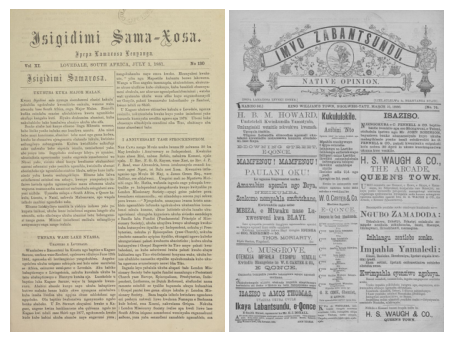
Figure 1: Front pages of Isigidimi (left) and Imvo (right)
Imvo Zabantsundu published a great number of announcements and advertising containing a wealth of information. Such announcements relayed important messages from local chiefs, alerted its audience to new consumer goods such as medications (traditional and Western) or wedding attire, and announced newly-opening shops, church services, and deaths, among many other topics. Adverts in the paper cover a wide range of places and companies, ranging from shipping or land transportation companies to companies selling clothing or new medications for animals. Announcements too reflect a wide range of topics, from updates about influential and famous people which reveal details and activities of their lives, announcements of open job positions, or the latest telegrams. All these adverts and information sought to help the readers stay informed in their everyday lives. At times these adverts specifically were directed to abantu abantsundu (Black/African people), showing the overall intended audience and sense of collective identity fostered by this newspaper. This advertising thus offers a window which extends beyond the regular publication of writing and ideas, showing the advertised image of the lifestyle, consumption patterns, and gender norms and expectations which were received by the readers.
Isigidimi sama-Xosa is particularly notable in the way that it tells stories. Through these narratives we learn details of events specific to that period, which reveal the ways people understood what was happening around them. The missionary foundation of Isigidimi is revealed in the frequency of church and Bible stories. Articles cover topics about churches and priests, including what they preached about. They also talk about the different chiefs and what they achieved, as well as discuss the wars of the period and the effects they had on the black people of the time. The paper also offers insights into the Lovedale Missionary school (where the paper was also printed) and offers rich information about the education of the time, including details about the students, such as the number of students of different races that study there. Articles also speak about quotidian topics like farming and the harvesting of crops.
Isigidimi sama-Xosa also includes a range of letters and adverts which give broader insight into debates around important social issues of the day (such as questions of drinking and temperance, or debates around cultural and religious practice), as well as offer reflections on the professions of the letter-writers (notably teachers). Announcements in the paper give information into important meetings and emerging organizations of the time, court cases, the opening of university, and available bursary, among other topics. Adverts reveal what is available at the market and even their prices, and show the sale of land, or medication.
In summary, these papers offer a revealing window into the events of the period. They make visible the ideas of both African intellectuals and a letter writing public in the eastern part of the Cape Colony and richly reveal a picture of daily life of the time through adverts and announcements.
Books: Zemk'inkomo Magwalandini (1906) was written by Mpilo Walter Benson Rubusana. Literally translated the title of this book would be "The Cows have Gone, you Cowards!" In this book the author reprimands isiXhosa-speaking people for allowing their heritage to be lost. The text also argues for a hybrid combination of a re-imagined isiXhosa culture and sense of self that appropriates (and integrates) aspects of English and isiXhosa culture.
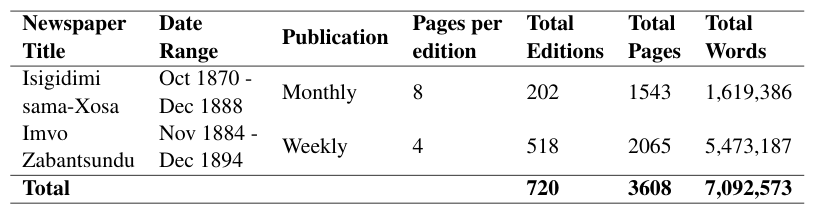
Table 1: Details of digitized newspapers
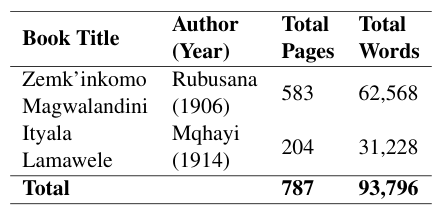
Table 2: Details of digitized books
The book is a compilation of works by a number of authors edited by Rubusana. Substantial selections include religious poetry. There are also three famous sections by William Wellington Gqoba; two of which are entitled Ingxoxo Enkulu YomGinwa nom-Kristu (Big Discussion between the "Pagan" and the Christian) and the third is called Ingxoxo Enkulu Ngemfundo (Big Discussion on Education).
Ityala Lamawele (1914) was authored by Samuel Edward Krune Mqhayi and includes fiction, history and poetry. The title means "the lawsuit of the twins", which is taken from the story narrated in the first half of the book. The plot is inspired by the biblical story about twins in Genesis Chapter 38. Mqhayi uses different aspects of the story to present a picture of the operation of customary law among isiXhosa-speaking people, in particular, its democratic character, as well as their social life during the reign of King Hintsa. The second part of the book is a historical account of the relations between the amaXhosa, the amaMfengu and the colonialists. The remainder of the book focuses on the political manoeuvring by the English in fuelling tensions between various isiXhosa-speaking groupings up to the 1917 sinking of the troopship the SS Mendi (there were 607 black South African troops on board, all of whom perished). The book ends with short biographies of the new leaders of the "reaction to conquest".
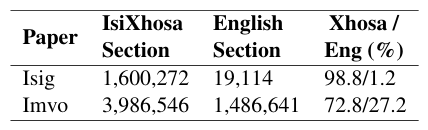
Table 3: Language composition of newspapers
4.2 Overview by the numbers
The collection represents a significant contribution to making isiXhosa historical text available. Notably, the collection already includes over 7 million words in newspapers alone and an additional almost 100,000 words of book materials. This sizable collection is thus useful for large scale isiXhosa computational text analysis. The collection also has considerable time coverage: the newspaper collection currently spans 25 years from 1870 to 1894, covering an especially important period of the formation of new social, political, religious, and other institutions. The two books also reflect some of the most famous early 20th Century isiXhosa literature. We intend to extend this collection as we continue to grow the archive.
Table 1 and 2 report the key statistics of the archive's current collection of newspapers and books. Table 3 shows an estimate of the total isiXhosa language section words and English language section words. This is assessed at the paragraph level, and reflects whole blocks of English or isiXhosa text, not the use of single words. This analysis shows that Isigidimi sama-Xosa is published almost entirely in isiXhosa. The approximately 1% of English text comes from the very few letters, advertisements, or government announcements printed in English. Imvo has a far more substantial, although still minor, English language section, on average covering about 27% of the printed content. This included the editorial translated to English as well as other letters, articles, or adverts.
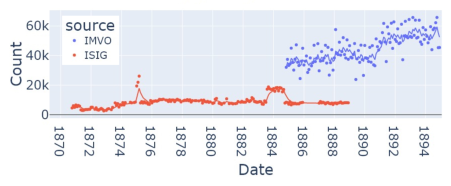
Figure 2: Count of all words in Isigidimi and Imvo
Figure 2 shows the total count of all words (isiXhosa and English) for both papers over the period, grouped by month. Isigidimi is shown in orange and Imvo is shown in blue. The dots represent the count of words, and the line represents a smoothed moving average. While both publications have approximately the same number of words per edition, this monthly grouping shows that the total volume of Imvo was far higher than Isigidimi due to its weekly publication. This also shows that, while Isigidimi published monthly for most of its lifespan, the paper was published twice monthly between July 1883 and September 1884.
Editions missing from the collection: While we have aimed to have as complete an archive as possible, at times some editions are no longer available in hard copy at South African institutions. Most notably, the collection is missing the entirety of the year 1886 editions of Isigidimi, which we have been unable to locate in hardcopy original. A small number of other individual editions are missing due to the inability to access hard copy scans. However, these missing editions are sporadic and limited.
5 Overview of the digitizing process
The goal of our digitizing process has been to create materials which are easily accessible and offer a high quality replica in both image and digital text formats. We start with high quality scanning undertaken by the National Library of South Africa of original hard copy documents, producing a high resolution .tiff image of no less than 400 dpi. From this image we undertake Optical Character Recognition (OCR) using ABBYY FineReader 15. We use ABBYY's built in language model for both English and isiXhosa during this scanning process. These scans then go through a two stage checking, correction, and quality assurance process by our team of isiXhosa language experts. The first stage involves working to correct any character errors in the OCR process. Each page is read over by one of our team of first language isiXhosa speakers. They pay particular attention to areas where the ABBYY program itself has highlighted uncertainty, but also check the entire text correcting errors. This results in the completion of the first quality assurance stage. The text is then output as a .docx file with the aim of preserving the layout of the original image. A second stage of correction and quality assurance is then undertaken on these documents, ensuring that the layout and formatting of the document is readable and reflects the original, while also seeking to catch any other outstanding problems. With the completion of this second quality assurance stage, the documents are completed. We then undertake an additional audit of around 20% of these final documents to ensure that we are producing high quality output and to catch any systematic errors in the process. These documents are uploaded to our hosting site with additional metadata created for each newspaper edition. They are also hosted as complete collections for download on our repository hosted on UCT's Zivahub which is accessible via the website and via permanent DOIs (see footnote 3-6). Metadata for each newspaper edition and each book includes the available information on the title, date issued, volume and edition numbers, editor or author, publisher, media type (newspaper or book), extent or number of pages, and available formats of the files. More details on this hosting are outlined in the following section.
6 Showcasing the archive with Omeka S and IIIF on Ibali: UCT Digital Collections
In 2021, the Digital Library Services (DLS) department at the University of Cape Town Libraries launched a university-wide showcasing platform for the university's digital collections, here: https://ibali.uct.ac.za. The site is called Ibali: UCT Digital Collections (isiXhosa for 'story') and it runs on a set of semantic web technologies called Omeka S and IIIF. Ibali is part of the Libraries' drive to nurture an Open Access space where digital collections can be created, curated, published and showcased. It is a highly collaborative and flexible, future-thinking online repository space. Since its launch a number of diverse collections have already been showcased on Ibali - including a library of open access resources focusing on climate change, an archive of an active theatrical research project and the IsiXhosa Intellectual Traditions under Colonialism collection.
The main architecture of Ibali is the open source software Omeka S. Omeka S is a web publishing platform for GLAMs (Galleries | Libraries | Archives | Museums), designed to create relationships between objects in collections as well as describe them through linked open data resources on the internet. The 'S' in Omeka S stands for 'semantic', as in connecting to the semantic web, where data in web pages is structured and tagged. Its primary focus is on organising elements of a collection such that the links in between items and the greater elements of the internet are strengthened, allowing for much more relevant searches and deeper explorations. It relies heavily on metadata and allows creators of websites great flexibility to set up metadata templates to consistently describe their items. These templates are constructed out of internationally recognized metadata standards (Dublin Core, schema.org) as well as customised ontologies. It makes Omeka S a piece of software that is both heavily customizable, while at the same time being rigorous and interoperable with metadata.
Creating a collection showcase site such as one for IsiXIT is done in partnership with Digital Library Services. Initially, we engaged in a collection/site interview where key aspects of the collection are identified together with desired characteristics of the site. It was identified that the ability to engage with the newspapers visually while having the ability to download the working files was key to create an interesting collection website. The process of building the site onto Ibali was split into three steps: 1) Prepping the Metadata Entries 2) Packaging Data and Metadata for Upload and 3) Website Design. Steps 1 and 2 would be repeatable to accommodate batches of completed newspaper editions.
The prep for the metadata entries required looking at the appropriate metadata fields to create a template that would align itself with the publication of the items of the collection (predominantly newspapers). We were able to select metadata properties from the ontology standards of Dublin Core and Schema.org to include entries for vol number, issue number, editor, language, etc. As Omeka S allows for the capturing of items which are not just media, we looked at creating items for the people who were instrumental in the publishing of the newspapers such as John Tengo Jabavu. With Omeka S functioning as a database, we could also work on linking every single issue of a newspaper to its edition, thus allowing users to quickly jump back and forth between a single issue and its edition. This allowed us to organise and keep track of the different newspaper editions, so that the database queries underneath Omeka S could return user queries based on their search. All of this metadata was mapped to a spreadsheet so that the team could populate the entries with new batches of newspaper editions.
Another column within the spreadsheet contained the names of the transcribed WORD files relevant to that issue (which would be preloaded onto the server). Using the CSV Import module of Omeka S, the columns in the spreadsheet would be mapped to the different metadata fields, and each row would be considered a new item. Omeka S then created items for each of the issues, with the metadata linking the word transcript files. Together with the included OCR module, it also looked at the imported Word Documents and extracted the text so that a full text internal search could be made on the site.
Once these items are uploaded, Omeka S automatically creates website pages for each item. The look and feel of these pages is dependent on the look and feel of the site. In Omeka S this is managed through Themes, with many of them being available freely online. They are also heavily customizable with some programming experience in a combination of CSS, HTML and PHP. Within the Omeka S site creation tool it is also possible to create stand alone pages which can highlight certain aspects, or to create landing pages for the collection. The theme can then be customised to present a particular look and feel to the site, and we worked together on finding design choices that would make navigation easy as well as present the newspapers and their media in an interesting way.
A couple of Omeka S modules also enhanced the process, such as the ability to quickly create an index list of items based on shared metadata. With this module we created an index tree for each year that would allow users to quickly jump to an issue in a particular month of a particular year. Another important consideration was allowing multiple languages to be presented on the page, as is the case with having website text in IsiXhosa as well as English.
6.1 Facilitating both exhibition and analysis: combining Omeka S exhibition with Figshare repository
Our overall aim to make materials easy to access for both researchers and a general public leads to two goals: 1. Exhibiting and creating user friendly access to the materials and 2. making the underlying data easily and permanently available to the research community.
We use Omeka S for exhibition and broad access. This offers us a location for a public facing exhibition of these materials on a platform that facilitates intuitive and visually appealing exploration as well as metadata presentation and a robust faceting search for processed articles.
We use UCT's digital repository Zivahub, hosted on the Figshare repository system, to make the whole collection easily accessible for download for scholars who will use these materials offline for both quantitative analysis (such as linguists or computational social scientists) and qualitative analysis (such as historians or Media studies scholars). Zivahub offers a permanent record of the available files, including DOIs which will always reference the materials, and a permanently accessible version history. This allows researchers to both access and reference the materials in a format that will always be accessible to the scholarly community. ZivaHub will ensure that our dataset will always be available no matter what versions or formats of the data we share. This will assist the project in making the data FAIR (Findable, Accessible, Interoperable and Reusable).
7 Example of article search with keywords
We are also developing extended search functionality in this archive which is currently offered on the 'Article Search' tab of the site. By using the power of Omeka S and combining it with work done to catalogue, label, and extract information of the articles of the newspaper, we are able to offer a powerful search feature which allows users to explore the papers in new ways. This search is already available for both Isigidimi and Imvo for the year of 1885, and we intend to expand this detailed metadata in the future to encompass more of the collection.
This search functionality allows the user to search for keywords together with a set of five additional labels which capture the type and content of each newspaper item. This includes capturing the 'type' of article (advert, letter, editorials, etc) and sub-types (or topics such as education, law services, politics, or marriages). These two columns were formatted as a controlled vocabulary, meaning that the entries came from a limited pool of options. Additional search labels also include author, location, and language (isiXhosa or English) of the newspaper item when available.
The 'type' and 'subtype' labels were developed through human qualitative analysis and coding of newspaper articles by project researchers and research assistants. The 'type' category was developed to capture different newspaper item type categories such as articles, letters, adverts, announcements, etc. The 'sub-type' category was created to capture the primary topic or content of the item. The controlled vocabulary of each of these sets were created, tested, and revised through a pilot coding of four editions. The two coders both covered all editions and met to define a list together with the supervisor. This was then used to code the full dataset. Regular meetings were held during the full coding process to ensure common coding practices and inter-coder reliability, and to assess if additional labels needed to be added to the sets. Finally, the labels were checked and cleaned by a supervising researcher, using text analysis approaches to remove spelling errors, standardize formats of names and places, and clean and merge subcategories as necessary to create a standardized and computer readable label set.
We use this coding together with the tools of Omeka S to offer a search page which allows researchers to select from these identified labels, thus facilitating the cross search of articles by any combination of article type, subtype, author and location while also searching for any keywords in the text. This then returns links which take the user to the text of the specific articles and links to the display of that newspaper.
To offer an example of the utility of this search: a user might search widely, perhaps for all use of the term 'umsebenzi' (work), seeing how newspaper contributors use this concept. The user might also use a much more focused search, perhaps looking only at editorials which mention "Sprigg" (the Prime minister of the Cape), or letters which discuss "Rulumente" (parliament). A search might combine labels, searching for all announcements and advertisements which come from King Williams Town or Ngqamakwe. Searching by combining language and labels attached to articles offers an exciting opportunity to quickly move through the newspaper collection in a new and nonlinear way, and enables easy research and exploration of specific topics as well as content, people, or places. This search capacity is thus an exciting and powerful extension of the archive which supports research. Although generating this newspaper item level information is time consuming, we are currently seeking ways to expand this level of search to all newspapers in the archive.
8 Possibilities for research using the archives
The isiXhosa materials held in this archive have great potential to open up exciting new avenues for research across a number of disciplines, including Sociology, Political Science, History, Literature and Languages, Linguistics, Media studies, Data Science and many more. Possible examples of research are wide ranging. We imagine that these sources may be useful for questions which range across topics such as: discovering specific historical details, following the writings of individuals or small groups, studies of advertising, analysis of the linguistic structure of historical isiXhosa, the development of isiXhosa intellectual concepts and analysis, or building computational tools for the analysis of isiXhosa text, to name just a few examples. Such wide ranging research possibilities will inevitably be undertaken from a diverse range of disciplinary and methodological perspectives.
For this reason we have aimed to produce materials in a format which allows a broad range of engagement. For example, historical analysis might prioritise the exact replica of the image to preserve the maximal detail of the source, while computational text analysis approaches might be happy to strip the material to represent only the text of the corpus. We have aimed to host the material in a format which seeks a middle ground by making the digitized and OCRed newspaper pages available for download in a .docx format. This format preserves the layout of the original newspaper page, allowing qualitative readers to use word searching techniques while still experiencing the layout and style of the original paper. For researchers who are interested in only the textual corpus, the text can be extracted from these documents to support corpus linguistics or other computational text analysis methods. We also allow users to view the image scans on the website in a lower resolution JPG format which facilitates a "reading room" experience, allowing researchers browse and peruse the newspapers as they please. However, we do not offer access to image download, as the high resolution original images remain the property of National Libraries South Africa. To maximise access to the materials in the future we will explore making other download formats available including .pdf and .txt versions which might be suitable for different research needs such as preserving the visual architecture of the newspaper (pdf) or accessing the text only corpus (txt).
9 Conclusion
This paper has outlined the scope, content, and context of the materials collected in the IsiXhosa Intellectual Traditions Archive. We intend this to serve as a reference for scholars already utilizing the archive and as an overview for scholars interested in new research possibilities created by the archive. We believe this archive offers resources which may advance research in a wide range of fields, and we hope to continue to expand our coverage in the future to incorporate all major isiXhosa newspapers and books from 1860-1914.
Limitations
This paper outlines an archival collection with the intention of detailing useful information for a range of research fields. However, the focus of the information has been shaped by the specific perspective created by our own limited disciplinary lens, grounded in the fields of Sociology and African Languages and Literature. For this reason, while we seek to provide adequate information for a broad audience, we may not provide the information or metrics most desirable to researchers in other fields. In addition, the information we provide now is a static snapshot of an evolving archive which we hope will expand. The information provided here will always provide a useful overview, but the specific details will continue to evolve as the archive grows.
Ethics Statement
We provide access to digitized versions of isiXhosa texts which are all in the public domain. We do so for free with the intent to make materials available for both researchers and the general public. It is thus our aim to expand access to historically difficult to access materials, in a language which has faced a lack of research resources. Our hope is that this gives more access to historically marginalized researchers and publics. This project is not subject to ethics review as there are no living subjects discussed in these materials. The authors have acquired permission from quoted participants to use these quotes and conversations.
Human coders and language editors who have worked on this archive are all employed as members of the project. All coders and editors are first language isiXhosa speakers and are either students or researchers.
Acknowledgements
This article was written with partial supported from the National Research Foundation of South Africa, grant number 138493.
Notes
1 In addition to the authors, the archive has been created with the support of the following student research assistants: Zimingonaphakade Sigenu, Siphenkosi Hlangu, Sipile Nqiyama, Philisa Plamana, Sinovuyo Xhonga and Likhona Qazisa.
2 We intent to expand download formats to include PDF and TXT formats in the future.
3 Isigidimi sama-Xosa collection DOI: https://doi.org/10.25375/uct.22332271
4 Imvo Zabantsundu collection DOI: https://doi.org/10.25375/uct.22332268
5 Zemk'inkomo Magwalandini collection DOI: https://doi.org/10.25375/uct.22332286
6 Ityala Lamawele collection DOI: https://doi.org/10.25375/uct.22332277
7 We refer throughout the paper to an isiXhosa speaking community instead of amaXhosa people because the community was comprised amaXhosa as well as amaMfengu, abaThembu as well as other participants and were united by the shared language format.
8 There is a growing effort by libraries, universities, and private companies to make digital scans of African newspapers available through paid (or limited but growing free) services. This project advances what is available by making OCRed texts available, for free, with an interactive website that facilitates rich navigation, searching and browsing.
9 We currently rely on human correction by isiXhosa experts rather than an automated approach. Because we correct all OCR with human correction we do not calculate the OCR error rate. We do not currently include automated spell checking due to limited tools as the orthography of turn of the 20th century isiXhosa is different from present day isiXhosa. However, we recognize that automatic error detection and statistics would be valuable for the project and hope to explore automated checking and reporting approaches in the future.
10 Visit https://omeka.org/s/ for a tour of Omeka S.
11 Omeka S also has a large community developing additional open source modules and themes which add extra functionality to the main software architecture.
12 1885 was selected as it is the first full year that both Isigidimi and Imvo were published (after Imvo's founding in Nov 1884)
13 We hope in the future to incorporate automation into this label generation process to more quickly label additional texts. We are exploring using the human coded labels as training data for a supervised machine learning approach to label recommendation. As isiXhosa language NLP tools advance we will also explore Named Entity recognition and topic identification approaches among others, which can further enrich the search functionality.
14 Although MS Word .docx is a proprietary format, most people have access to a version of the software. However, we are looking into using other open formats in the future.
References
David Attwell. 2005. The Transculturation of Enlightenment. The Journal of Tiyo Soga. D Atwell, Rewriting modernity. Studies in black South African literary history (Pietermaritzburg, KwaZulu-Natal University Press, 2005), pages 40-41.
Julia Cagé and Valeria Rueda. 2016. The long-term effects of the printing press in sub-saharan africa. American Economic Journal: Applied Economics, 8(3):69-99.
Jacques P. De Wet. 2021. Social construction of the meanings of imfundo by African intellectuals in the Cape Colony at the turn of the twentieth century. Canadian Journal of African Studies / Revue canadienne des études africaines, pages 1-23.
Rachael Gilmour. 2007. Missionaries, Colonialism and Language in Nineteenth-Century South Africa. History Compass, 5(6):1761-1777.
Archibald Currie Jordan. 1973. Towards an African Literature: The Emergence of Literary Form in Xhosa. University of California Press, Berkeley.
Pallo Jordan. 1984. Zemk'inkomo magwalandini. The life and times of WB Rubusana (1858-1936). Sechaba, 4.
Archie Mafeje. 2000. Africanity: a combative ontology. CODESRIA Bulletin, pages 66-71.
Anelisa Majokweni. 2022. We are the voice of our people: IsiXhosa tradition and culture as presented in African newspapers: 1874-1890. Honours Thesis, Department of History, Stellenbosch University, Stellenbosch.
Ntongela Masilela. 2009. The Vernacular Press and African Literature. Unpublished paper, pages 1-13.
Donal P. McCracken. 2015. The imperial British newspaper, with special reference to South Africa, India and the 'Irish model'. Critical Arts: A South-North Journal of Cultural & Media Studies, 29(1):5-25. Publisher: Routledge.
Khwezi Mkhize. 2018. 'To See Us As We See Ourselves': John Tengo Jabavu and the Politics of the Black Periodical. Journal of Southern African Studies, 44(3):413-430.
Koliswa Moropa. 2010. African voices in Imvo Zabantsundu : Literary pieces from the past. South African Journal of African Languages, 30(2):135-144.
Samuel E. K. Mqhayi. 2009. Abantu Besizwe: Historical and biographical writings 1902-1944 SEK Mqhayi. Wits University Press, Johannesburg.
Samuel Edward Krune Mqhayi. 1931. Ityala LamaWele. Lovedale Press, Lovedale, South Africa.
André Odendaal. 2013. The founders: The origins of the ANC and the struggle for democracy in South Africa. The University Press of Kentucky, Kentucky.
Likhona Qazisa. 2022. Socially Constructed Meanings of Umsebenzi and Associated Terms. Honours Thesis, Department of Sociology, University of Cape Town, Cape Town.
Walter Benson Rubusana. 1911. Zemk'iinkomo Magwalandini. Selwood Printing Works, Frome.
Leo Jonathan Schoots. 2021. Novelty, Networks, and the Rise of African Nationalism: African Intermediary Intelligentsia and the Making of Political Innovation in Colonial South Africa (1860-1890). Ph.D., The University of Chicago, United States - Illinois.
Zimingonaphakade Sigenu. 2021. Socially Constructed Meanings of Impucuko in a Comparative Historical Analysis. Master's Thesis, Department of Sociology, University of Cape Town, Cape Town.
Les Switzer and Donna Switzer. 1979. The Black press in South Africa and Lesotho: a descriptive bibliographic guide to African, Coloured, and Indian newspapers, newsletters, and magazines, 1836-1976. Boston: Hall.
IsiXhosa Intellectual Traditions Digital Archive: Digitizing isiXhosa texts from 1870-1914
Archives numériques des traditions intellectuelles isiXhosa : numérisation de textes isiXhosa de 1870 à 1914
Affiliations
Jonathan Schoots
LEAP
Stellenbosch University
Amandla Ngwendu
Department of African languages and Literature
University of Cape Town
Jacques de Wet
Department of Sociology
University of Cape Town
Sanjin Muftic
Digital Library Services
University of Cape Town
jschoots@
sun.ac.za
amandla.ngwendu@
jacques.dewet@
sanjin.muftic@
uct.ac.za
uct.ac.za
uct.ac.za
Abstract
Résumé
This article offers an overview of the IsiXhosa Intellectual Traditions Digital Archive, which hosts digitized texts and images of early isiXhosa newspapers and books from 1870-1914. The archive offers new opportunities for a range of research across multiple fields, and responds to debates around the importance of African intellectual traditions and their indigenous language sources in generating African social sciences which is contextually relevant. We outline the content and context of these materials and offer qualitative and quantitative details with the aim of providing an overview for interested scholars and a reference for those using the archive.
Cet article offre un aperçu de l'IsiXhosa Intellectual Traditions Digital Archive, qui héberge des textes et des images numérisés de journaux et de livres isiXhosa anciens datant de 1870 à 1914. L'archive offre de nouvelles opportunités pour une gamme de recherches dans divers domaines, et répond aux débats sur l'importance des traditions intellectuelles africaines et de leurs sources en langues indigènes dans la génération de sciences sociales africaines contextuellement pertinentes. Nous présentons le contenu et le contexte de ces matériaux et offrons des détails qualitatifs et quantitatifs dans le but de fournir un aperçu pour les chercheurs intéressés et une référence pour ceux qui utilisent l'archive.
1 Introduction
1 Introduction
The IsiXhosa Intellectual Traditions Archive (IsiXIT) is a collection of isiXhosa newspapers and books from the turn of the 20th Century, accessible online at https://ibali.uct.ac.za/s/isixit/page/welcome. This archive collects isiXhosa newspapers produced in the colonial period, covering 1870-1894 (with 1860-69 and 1895-1912 to be added in the future), as well as pioneering isiXhosa literature published in the early part of the 20th century. The archive allows users to browse images and to download MS Word text files of early isiXhosa newspapers and books and collects metadata about each publication and its content.
L'Archive des Traditions Intellectuelles IsiXhosa (IsiXIT) est une collection de journaux et de livres en isiXhosa datant du début du 20e siècle, accessible en ligne à l'adresse https://ibali.uct.ac.za/s/isixit/page/welcome. Cette archive rassemble des journaux isiXhosa produits à l'époque coloniale, couvrant 1870-1894 (avec 1860-69 et 1895-1912 à ajouter à l'avenir), ainsi que la littérature pionnière isiXhosa publiée au début du 20ème siècle. L'archive permet aux utilisateurs de parcourir les images et de télécharger des fichiers texte MS Word des premiers journaux et livres isiXhosa et recueille des métadonnées sur chaque publication et son contenu.
There has been a great demand for deeper knowledge of African intellectual traditions, analyses, and histories. However, many key materials written in indigenous languages by African intellectuals have been inaccessible-available only as hard copies carefully preserved in archives, or as expensive and limited subscription services.
Il y a eu une grande demande pour une connaissance plus approfondie des traditions intellectuelles, des analyses et des histoires africaines. Cependant, de nombreux documents clés écrits dans les langues autochtones par des intellectuels africains ont été inaccessibles - disponibles uniquement sous forme de copies papier soigneusement conservées dans des archives, ou sous forme de services d'abonnement coûteux et limités.
The IsiXhosa Intellectual Traditions Archive is in the process of creating a substantial digital and textual database of these early isiXhosa texts, in order to make this data freely available to researchers and the general public. Our aim is to both increase access to these important historical materials, and to advance research by making source materials 'research ready' and removing barriers to access, thereby allowing a wide community of researchers access.
L'Archive des Traditions Intellectuelles IsiXhosa est en train de créer une base de données numérique et textuelle substantielle de ces premiers textes en isiXhosa, afin de rendre ces données librement accessibles aux chercheurs et au grand public. Notre objectif est à la fois d'accroître l'accès à ces documents historiques importants et de faire progresser la recherche en rendant les documents sources "prêts pour la recherche" et en supprimant les obstacles à l'accès, permettant ainsi à une large communauté de chercheurs d'y accéder.
The archive currently includes the newspaper Isigidimi sama-Xosa (published from 1870 to 1888) and Imvo Zabantsundu (published from 1884 onward) as well as the books Zemk'inkomo Magwalandini first published in 1906 (Rubusana, 1911) and Ityala Lamawele first published in 1914 (Mqhayi, 1931). Other sources, including newspapers such as Indaba (1862-1865), and Izwi Labantu (1897-1909), as well as standalone works by early isiXhosa writers will be incorporated into the project over time. The entire archive can be easily browsed on our website (see above). We also make converted text files of these collections accessible for download using permanent DOI links (see footnotes above). These permanent links allow a stable way to access the files which will be maintain in perpetuity by UCT. Researchers can use these permanent DOIs to access and download the text files of the collection, and to view version changes over time. Researchers can also cite these collections to offer readers a permanent link to the data, thus supporting academic rigour.
L'archive comprend actuellement le journal Isigidimi sama-Xosa (publié de 1870 à 1888) et Imvo Zabantsundu (publié à partir de 1884) ainsi que les livres Zemk'inkomo Magwalandini publié pour la première fois en 1906 (Rubusana, 1911) et Ityala Lamawele publié pour la première fois en 1914 (Mqhayi, 1931). D'autres sources, notamment des journaux tels que Indaba (1862-1865) et Izwi Labantu (1897-1909), ainsi que des œuvres autonomes des premiers écrivains isiXhosa seront intégrées au projet au fil du temps. L'ensemble de l'archive peut être facilement consulté sur notre site web (voir ci-dessus). Nous rendons également accessibles au téléchargement des fichiers texte convertis de ces collections en utilisant des liens DOI permanents (voir les notes de bas de page ci-dessus). Ces liens permanents permettent un accès stable aux fichiers qui seront maintenus à perpétuité par l'UCT. Les chercheurs peuvent utiliser ces DOI permanents pour accéder et télécharger les fichiers texte de la collection, et pour visualiser les changements de version au fil du temps. Les chercheurs peuvent également citer ces collections pour offrir aux lecteurs un lien permanent vers les données, soutenant ainsi la rigueur académique.
The newspapers and books in this collection represent the earliest written record of sustained intellectual and political debates by black South Africans. Produced in the eastern part of the Cape Colony (today's Eastern Cape), these texts capture the intellectual work of an emerging group of thinkers, activists, political leaders, and their wider public, as they developed new knowledge, oriented to understanding and engaging with colonialism and their changing social world from an African perspective. The isiXhosa newspapers were a central source of social, and increasingly political, reporting. They also make visible debates and dialogues of a wider public sphere through the printing of letters sent in from literate Africans from across present day South Africa, providing key insights on the development of African social and political discussion and theorizing. The archive also includes some of the earliest and most central isiXhosa book publications, published by leading figures of the African intellectual and political movement of the time. These publications offer one of the most systematic and complete records which reveal the development of African intellectual traditions in the face of colonialism.
Les journaux et les livres de cette collection représentent le plus ancien document écrit de débats intellectuels et politiques soutenus par des Sud-Africains noirs. Produits dans la partie orientale de la colonie du Cap (aujourd'hui Eastern Cape), ces textes capturent le travail intellectuel d'un groupe émergent de penseurs, d'activistes, de dirigeants politiques et de leur public plus large, alors qu'ils développaient de nouvelles connaissances, orientées vers la compréhension et l'engagement avec le colonialisme et leur monde social en mutation d'une perspective africaine. Les journaux isiXhosa étaient une source centrale de reportages sociaux, et de plus en plus politiques. Ils rendent également visibles les débats et les dialogues d'une sphère publique plus large grâce à l'impression de lettres envoyées par des Africains alphabétisés de toute l'Afrique du Sud actuelle, fournissant des informations clés sur le développement de la discussion et de la théorisation sociales et politiques africaines. L'archive comprend également certaines des premières et des plus centrales publications de livres en isiXhosa, publiées par des figures de proue du mouvement intellectuel et politique africain de l'époque. Ces publications offrent l’un des documents les plus systématiques et complets qui révèlent le développement des traditions intellectuelles africaines face au colonialisme.
2 IsiXhosa newspapers and books in historical context
2 Les journaux et livres isiXhosa dans un contexte historique
The early isiXhosa newspaper press was a forerunner for African language newspaper publication on the continent. The first isiXhosa newspapers were published from 1837, and isiXhosa papers again took the lead in development as the first papers to be headed by African editors (Cagé and Rueda 2016; Switzer and Switzer 1979, see also Masilela 2009; McCracken 2015; Gilmour 2007). Isigidimi sama-Xosa had the first independent African editor, Elijah Makiwane, from 1876. The first black owned and run paper, Imvo Zabantsundu, appeared in 1884. These papers represent the first sustained platforms for African led journalism where an emerging class of isiXhosa speaking political leaders, activists, and intellectuals could share opinions, debate contemporary issues, and coordinate social and political activity. That they chose to write for a literate isiXhosa-speaking readership is also significant. Contributors to this newspaper community increasingly "focused on conscientising educated Africans in order to mobilise support for social change" (De Wet, 2021). These newspapers published articles and editorials, reports written by correspondents across the eastern part of the Cape Colony, and letters written to the editor which represent the voices of a broad range of the newspaper's readership (Switzer and Switzer, 1979, 40-41, 45-46).
Les premiers journaux en isiXhosa ont été les précurseurs de la publication de journaux en langue africaine sur le continent. Les premiers journaux en isiXhosa ont été publiés à partir de 1837, et les journaux en isiXhosa ont de nouveau pris la tête du développement en tant que premiers journaux dirigés par des rédacteurs africains (Cagé et Rueda 2016; Switzer et Switzer 1979, voir aussi Masilela 2009; McCracken 2015; Gilmour 2007). Isigidimi sama-Xosa a eu le premier rédacteur africain indépendant, Elijah Makiwane, à partir de 1876. Le premier journal possédé et géré par des Noirs, Imvo Zabantsundu, est apparu en 1884. Ces journaux représentent les premières plateformes durables pour le journalisme dirigé par des Africains, où une classe émergente de dirigeants politiques, d'activistes et d'intellectuels parlant l'isiXhosa pouvait partager des opinions, débattre de questions contemporaines et coordonner des activités sociales et politiques. Le fait qu’ils aient choisi d’écrire pour un lectorat alphabétisé parlant isiXhosa est également significatif. Les contributeurs à cette communauté de journaux « se sont de plus en plus concentrés sur la sensibilisation des Africains instruits afin de mobiliser le soutien au changement social » (De Wet, 2021). Ces journaux publiaient des articles et des éditoriaux, des rapports rédigés par des correspondants à travers la partie orientale de la colonie du Cap, et des lettres adressées au rédacteur en chef qui représentent les voix d'une large gamme du lectorat du journal (Switzer et Switzer, 1979, 40-41, 45-46).
Isigidimi sama-Xosa (trans: The Xhosa Messenger) was founded in 1870 by James Steward of the Glasgow Missionary Society, and was published at Lovedale, the pre-eminent center of African missionary education in southern Africa at the time (Attwell, 2005). First published as the isiXhosa section of a dual language newspaper, it became an independent publication under the editorship of Elijah Makiwane from 1876 (Switzer and Switzer, 1979, 45-46). For 14 years, from its founding in 1870 until the founding of Imvo Zabantsundu in 1884, it was the leading site for African intellectuals of the eastern Cape colony to publish social, religious, and historical writings. It created a space of debate and analysis on a host of social issues by publishing letters written in from a wider community including some contributors from across present day South Africa (Odendaal, 2013). Imvo Zabantsundu (trans: Native Opinion) was the first African owned and run newspaper in South Africa. It was founded by John Tengo Jabavu in King William's Town with its first edition published in November 1884. Imvo Zabantsundu offered the first platform for African journalism, political and social commentary, and opinions which were free from any missionary control or censorship, and played a pivotal role in explicitly foregrounding African political interests. Imvo was primarily published in isiXhosa, but also included a translation of the editorial into English and at times published other English articles, letters, and advertisements (Switzer and Switzer 1979, 40-41, Moropa 2010; Mkhize 2018).
Isigidimi sama-Xosa (traduction : Le messager xhosa) a été fondé en 1870 par James Steward de la Glasgow Missionary Society, et a été publié à Lovedale, le centre prééminent de l'éducation missionnaire africaine en Afrique australe à l'époque (Attwell, 2005). D'abord publié en tant que section isiXhosa d'un journal bilingue, il est devenu une publication indépendante sous la direction d'Elijah Makiwane à partir de 1876 (Switzer et Switzer, 1979, 45-46). Pendant 14 ans, de sa fondation en 1870 jusqu'à la fondation d'Imvo Zabantsundu en 1884, il était le principal lieu pour les intellectuels africains de la colonie du Cap oriental pour publier des écrits sociaux, religieux et historiques. Il a créé un espace de débat et d'analyse sur une multitude de questions sociales en publiant des lettres écrites par une communauté plus large, y compris certains contributeurs de toute l'Afrique du Sud actuelle (Odendaal, 2013). Imvo Zabantsundu (traduction : L'Opinion indigène) était le premier journal détenu et géré par des Africains en Afrique du Sud. Il a été fondé par John Tengo Jabavu à King William's Town, avec sa première édition publiée en novembre 1884. Imvo Zabantsundu offrait la première plateforme pour le journalisme africain, le commentaire politique et social, et les opinions qui étaient libres de tout contrôle ou censure missionnaire, et a joué un rôle pivot dans la mise en avant explicite des intérêts politiques africains. Imvo était principalement publié en isiXhosa, mais incluait également une traduction de l'éditorial en anglais et publiait parfois d'autres articles, lettres et publicités en anglais (Switzer et Switzer 1979, 40-41, Moropa 2010; Mkhize 2018).
The IsiXIT collection also includes some of the earliest publications of isiXhosa literature - texts which emerged from leading intellectuals of the same community as newspaper contributors. These texts have gone on to be cultural touchstones of isiXhosa literature (Jordan, 1973). The books in this collection currently include Zemk'inkomo Magwalandini, a collection of praise poems and other writings, edited by Mpilo Walter Benson Rubusana one of the most important cultural and political leaders of the early 20th century (Jordan, 1984). The collection also includes Ityala Lamawele, the celebrated novel of Samuel Edward Krune Mqhayi, who is perhaps most remembered as the preeminent Xhosa poet and "African Shakespeare" (Mqhayi, 2009). The archive aims to host these and other writings of African intellectuals and social commentators whose writings significantly influenced African ideological and intellectual projects of the period.
La collection IsiXIT comprend également certaines des premières publications de la littérature isiXhosa - des textes qui ont émergé des principaux intellectuels de la même communauté que les contributeurs du journal. Ces textes sont devenus des jalons culturels de la littérature isiXhosa (Jordan, 1973). Les livres de cette collection comprennent actuellement Zemk'inkomo Magwalandini, une collection de poèmes élogieux et autres écrits, édités par Mpilo Walter Benson Rubusana, l'un des dirigeants culturels et politiques les plus importants du début du 20e siècle (Jordan, 1984). La collection comprend également Ityala Lamawele, le célèbre roman de Samuel Edward Krune Mqhayi, qui est peut-être surtout connu comme le poète xhosa prééminent et le "Shakespeare africain" (Mqhayi, 2009). L'objectif de l'archive est d'accueillir ces écrits et d'autres écrits d'intellectuels et de commentateurs sociaux africains dont les écrits ont significativement influencé les projets idéologiques et intellectuels africains de l'époque.
3 Importance and possibilities of isiXhosa language historical archives
3 Importance et possibilités des archives historiques de la langue isiXhosa
The immediate and practical goal of the IsiXIT archive is to make early isiXhosa texts authored by African intellectuals in the late 1800s and early 1900s available and "research-ready" for contemporary study. To the best of our knowledge there are no other open access digital archives for isiXhosa texts from the late 1800s and early 1900s that make OCRed texts available to users. However, the added value of this archive lies in its contribution to emerging African social sciences. Inspired by the isiXhosa writings of the African intellectual S.E.K. Mqhayi, and by the work of the social scientist Neville Alexander on multilingualism and decolonising academia, we realised that if we are going to decolonise social sciences and contribute meaningfully to the making of an African sociology then we need to engage with these and other historical vernacular texts. This work requires grappling with the socially constructed meanings of African sociological concepts as they are conveyed through these texts and in relation to historical contexts.
L'objectif immédiat et pratique de l'archive IsiXIT est de rendre les premiers textes isiXhosa rédigés par des intellectuels africains à la fin des années 1800 et au début des années 1900 disponibles et "prêts à la recherche" pour l'étude contemporaine. À notre connaissance, il n'existe pas d'autres archives numériques en libre accès pour les textes en isiXhosa de la fin des années 1800 et du début des années 1900 qui mettent des textes OCRisés à la disposition des utilisateurs. Cependant, la valeur ajoutée de cette archive réside dans sa contribution aux sciences sociales africaines émergentes. Inspirés par les écrits en isiXhosa de l’intellectuel africain S.E.K. Mqhayi, et par le travail du sociologue Neville Alexander sur le multilinguisme et la décolonisation du monde universitaire, nous avons réalisé que si nous voulons décoloniser les sciences sociales et contribuer de manière significative à la création d’une sociologie africaine, nous devons nous engager avec ces textes et d’autres textes vernaculaires historiques. Ce travail nécessite de se confronter aux significations socialement construites des concepts sociologiques africains tels qu'ils sont transmis à travers ces textes et en relation avec les contextes historiques.
Tracing socially constructed meanings of key isiXhosa sociological concepts at critical moments in the history of an indigenous socio-linguistic grouping is about mapping what Raymond Williams (1981:109) in his famous book "Keywords: A Vocabulary of Culture and Society" refers to as the "modulations of the word through history", which help us understand the term itself in relation to changing social conditions and lived experiences. We cannot generate African sociological theory without African concepts, because concepts are the building blocks of theory. This scholarship, which relies on texts in indigenous languages, is grounded in African ontologies and what Mafeje (2000) calls endogeneity.
Tracer les significations socialement construites des concepts sociologiques clés de l'isiXhosa à des moments critiques de l'histoire d'un groupe sociolinguistique autochtone consiste à cartographier ce que Raymond Williams (1981:109) dans son célèbre livre "Keywords: A Vocabulary of Culture and Society" appelle les "modulations du mot à travers l'histoire", qui nous aident à comprendre le terme lui-même en relation avec les conditions sociales changeantes et les expériences vécues. Nous ne pouvons pas générer la théorie sociologique africaine sans concepts africains, parce que les concepts sont les éléments constitutifs de la théorie. Cette recherche, qui s'appuie sur des textes en langues indigènes, repose sur les ontologies africaines et ce que Mafeje (2000) appelle l'endogénéité.
Up until recently, the challenge has been accessing and collecting these early isiXhosa writings and then converting image files of newspapers found in various library archives into a text format that is more easily researchable. The value of the IsiXIT digital archive gained considerable urgency after the devastating fire at the University of Cape Town in 2021 that damaged multiple buildings and destroyed many primary African collections, which were housed in the African Studies library.
Jusqu’à récemment, le défi consistait à accéder à ces premiers écrits en isiXhosa et à les collecter, puis à convertir les fichiers image des journaux trouvés dans diverses archives de bibliothèques en un format texte plus facilement consultable. La valeur de l'archive numérique IsiXIT a pris une urgence considérable après l'incendie dévastateur à l'Université de Cape Town en 2021, qui a endommagé plusieurs bâtiments et détruit de nombreuses collections africaines primaires, qui étaient logées dans la bibliothèque d'études africaines.
IsiXhosa speakers have also alerted us to another advantage of drawing on the IsiXIT archive to explain the meanings of African sociological concepts and incorporate African languages in the evolution of social sciences on the continent (and elsewhere). It is a matter of identity affirmation. One of the authors of this paper recalls how one of his isiXhosa-speaking students articulated the ability of the archive and associated research to change her view of Sociology in relation to identity. She said that when she first studied Sociology she could not find herself in the discipline; she saw it as something foreign. In time and after working on the IsiXIT Digital Archive and reading the research outputs, her view changed: The archive helped her locate herself in the discipline and began to see Sociology as "something that is ours". This insightful observation reminds us of the value of the IsiXIT Digital Archive as a source for decolonising our curricula. When Sociology and other social sciences are no longer foreign, and students can identify with them, and academia as a whole, then we are likely to see new contextually relevant innovative research that pushes the frontiers of knowledge both locally and globally.
Les locuteurs isiXhosa nous ont également alertés sur un autre avantage de s'appuyer sur l'archive IsiXIT pour expliquer les significations des concepts sociologiques africains et intégrer les langues africaines dans l'évolution des sciences sociales sur le continent (et ailleurs). C’est une question d’affirmation identitaire. L’un des auteurs de cet article rappelle comment l’une de ses étudiantes de langue isiXhosa a exprimé la capacité des archives et de la recherche associée à changer sa vision de la sociologie en relation avec l’identité. Elle a déclaré que lorsqu'elle a étudié la sociologie pour la première fois, elle ne pouvait pas se retrouver dans cette discipline ; elle la voyait comme quelque chose d'étranger. Avec le temps et après avoir travaillé sur l'IsiXIT Digital Archive et lu les productions de recherche, sa vision a changé : l'archive l'a aidée à se situer dans la discipline et a commencé à voir la Sociologie comme "quelque chose qui nous appartient". Cette observation perspicace nous rappelle la valeur de l’Archive Numérique IsiXIT comme source de décolonisation de nos curricula. Lorsque la sociologie et les autres sciences sociales ne sont plus étrangères, et que les étudiants peuvent s'identifier à elles, et à l'académie dans son ensemble, alors nous sommes susceptibles de voir de nouvelles recherches innovantes, contextuellement pertinentes, qui repoussent les frontières de la connaissance à la fois localement et mondialement.
To-date, numerous studies and research outputs have drawn on the textual data from the IsiXIT archive. These include, for example, studies on the socially constructed meanings of "Imfundo" (De Wet, 2021), "Impucuko" (Sigenu, 2021), and "Umsebenzi" (Qazisa, 2022), examinations of IsiXhosa tradition and culture as presented in African newspapers (Majokweni, 2022), and the role of African intellectuals, social networks, and newspaper discourse in shaping the innovation seen in emergence of African nationalism (Schoots, 2021).
À ce jour, de nombreuses études et résultats de recherche ont été tirés des données textuelles des archives IsiXIT. Celles-ci incluent, par exemple, des études sur les significations socialement construites de "Imfundo" (De Wet, 2021), "Impucuko" (Sigenu, 2021), et "Umsebenzi" (Qazisa, 2022), des examens de la tradition et de la culture isiXhosa telles que présentées dans les journaux africains (Majokweni, 2022), et le rôle des intellectuels africains, des réseaux sociaux et du discours des journaux dans la formation de l'innovation observée dans l'émergence du nationalisme africain (Schoots, 2021).
4 Description of archival materials
4 Description des documents d'archives
4.1 Qualitative description of the materials
4.1 Description qualitative des matériaux
Newspapers: Both newspapers in this collection include a variety of published content, including leading newspaper articles, shorter articles and reports written by a staff of newspaper correspondents, letters written by the general public, and a range of announcements, advertisements, and government proclamations. Figure 1 shows a sample front page of one edition of each newspaper in the collection. To offer a taste of each newspaper's own specific style and ethos we now outline some of the content published in both Imvo Zabantsundu and Isigidimi sama-Xosa.
Journaux : Les deux journaux de cette collection comprennent une variété de contenus publiés, y compris des articles de journaux principaux, des articles et rapports plus courts écrits par une équipe de correspondants de journaux, des lettres écrites par le grand public, ainsi qu'une gamme d'annonces, de publicités et de proclamations gouvernementales. La figure 1 montre un échantillon de la première page d’une édition de chaque journal de la collection. Pour donner un avant-goût du style et de la philosophie propres à chaque journal, nous décrivons maintenant certains des contenus publiés dans Imvo Zabantsundu et Isigidimi sama-Xosa.
Figure 1: Front pages of Isigidimi (left) and Imvo (right)
Figure 1: Premières pages de Isigidimi (à gauche) et Imvo (à droite)
Imvo Zabantsundu published a great number of announcements and advertising containing a wealth of information. Such announcements relayed important messages from local chiefs, alerted its audience to new consumer goods such as medications (traditional and Western) or wedding attire, and announced newly-opening shops, church services, and deaths, among many other topics. Adverts in the paper cover a wide range of places and companies, ranging from shipping or land transportation companies to companies selling clothing or new medications for animals. Announcements too reflect a wide range of topics, from updates about influential and famous people which reveal details and activities of their lives, announcements of open job positions, or the latest telegrams. All these adverts and information sought to help the readers stay informed in their everyday lives. At times these adverts specifically were directed to abantu abantsundu (Black/African people), showing the overall intended audience and sense of collective identity fostered by this newspaper. This advertising thus offers a window which extends beyond the regular publication of writing and ideas, showing the advertised image of the lifestyle, consumption patterns, and gender norms and expectations which were received by the readers.
Imvo Zabantsundu a publié un grand nombre d'annonces et de publicités contenant une richesse d'informations. De telles annonces relayaient des messages importants de la part des chefs locaux, alertaient son public sur de nouveaux biens de consommation tels que des médicaments (traditionnels et occidentaux) ou des tenues de mariage, et annonçaient l'ouverture de nouveaux magasins, des services religieux et des décès, parmi de nombreux autres sujets. Les publicités dans le journal couvrent une large gamme de lieux et d'entreprises, allant des compagnies de transport maritime ou terrestre aux entreprises vendant des vêtements ou de nouveaux médicaments pour animaux. Les annonces reflètent également une large gamme de sujets, des mises à jour sur les personnes influentes et célèbres qui révèlent des détails et des activités de leur vie, aux annonces de postes vacants ou aux derniers télégrammes. Toutes ces publicités et informations ont cherché à aider les lecteurs à rester informés dans leur vie quotidienne. Parfois, ces publicités étaient spécifiquement destinées aux abantu abantsundu (personnes noires/africaines), montrant le public visé global et le sens d'identité collective cultivé par ce journal. Cette publicité offre ainsi une fenêtre qui s'étend au-delà de la publication régulière d'écrits et d'idées, montrant l'image publicitaire du mode de vie, des schémas de consommation et des normes et attentes de genre qui étaient reçues par les lecteurs.
Isigidimi sama-Xosa is particularly notable in the way that it tells stories. Through these narratives we learn details of events specific to that period, which reveal the ways people understood what was happening around them. The missionary foundation of Isigidimi is revealed in the frequency of church and Bible stories. Articles cover topics about churches and priests, including what they preached about. They also talk about the different chiefs and what they achieved, as well as discuss the wars of the period and the effects they had on the black people of the time. The paper also offers insights into the Lovedale Missionary school (where the paper was also printed) and offers rich information about the education of the time, including details about the students, such as the number of students of different races that study there. Articles also speak about quotidian topics like farming and the harvesting of crops.
Isigidimi sama-Xosa est particulièrement remarquable dans la façon dont il raconte des histoires. Grâce à ces récits, nous apprenons les détails des événements spécifiques à cette période, qui révèlent la façon dont les gens comprenaient ce qui se passait autour d'eux. Le fondement missionnaire d'Isigidimi se révèle dans la fréquence des récits bibliques et ecclésiastiques. Les articles abordent des sujets sur les églises et les prêtres, y compris ce qu'ils prêchaient. Ils parlent également des différents chefs et de ce qu'ils ont accompli, ainsi que des guerres de l'époque et des effets qu'elles ont eus sur les Noirs de l'époque. Le journal offre également un aperçu de l'école missionnaire de Lovedale (où le journal a également été imprimé) et offre de riches informations sur l'éducation de l'époque, y compris des détails sur les étudiants, tels que le nombre d'étudiants de différentes races qui y étudient. Les articles parlent également de sujets quotidiens comme l'agriculture et la récolte des cultures.
Isigidimi sama-Xosa also includes a range of letters and adverts which give broader insight into debates around important social issues of the day (such as questions of drinking and temperance, or debates around cultural and religious practice), as well as offer reflections on the professions of the letter-writers (notably teachers). Announcements in the paper give information into important meetings and emerging organizations of the time, court cases, the opening of university, and available bursary, among other topics. Adverts reveal what is available at the market and even their prices, and show the sale of land, or medication.
Isigidimi sama-Xosa comprend également une série de lettres et d'annonces qui donnent un aperçu plus large des débats autour des questions sociales importantes de l'époque (telles que les questions de boisson et de tempérance, ou les débats autour des pratiques culturelles et religieuses), ainsi que des réflexions sur les professions des auteurs des lettres (notamment les enseignants). Les annonces dans le journal donnent des informations sur les réunions importantes et les organisations émergentes de l'époque, les affaires judiciaires, l'ouverture de l'université et les bourses disponibles, entre autres sujets. Les publicités révèlent ce qui est disponible sur le marché et même leurs prix, et montrent la vente de terres ou de médicaments.
In summary, these papers offer a revealing window into the events of the period. They make visible the ideas of both African intellectuals and a letter writing public in the eastern part of the Cape Colony and richly reveal a picture of daily life of the time through adverts and announcements.
En résumé, ces journaux offrent une fenêtre révélatrice sur les événements de la période. Ils rendent visibles les idées des intellectuels africains et d'un public écrivant des lettres dans la partie orientale de la colonie du Cap et révèlent richement un tableau de la vie quotidienne de l'époque à travers des annonces et des publicités.
Books: Zemk'inkomo Magwalandini (1906) was written by Mpilo Walter Benson Rubusana. Literally translated the title of this book would be "The Cows have Gone, you Cowards!" In this book the author reprimands isiXhosa-speaking people for allowing their heritage to be lost. The text also argues for a hybrid combination of a re-imagined isiXhosa culture and sense of self that appropriates (and integrates) aspects of English and isiXhosa culture.
Livres : Zemk'inkomo Magwalandini (1906) a été écrit par Mpilo Walter Benson Rubusana. Traduit littéralement, le titre de ce livre serait « Les vaches sont parties, lâches ! » Dans ce livre, l'auteur réprimande les gens parlant isiXhosa pour avoir laissé leur héritage se perdre. Le texte plaide également pour une combinaison hybride d'une culture isiXhosa réinventée et d'un sens de soi qui s'approprie (et intègre) des aspects de la culture anglaise et isiXhosa.
Table 1: Details of digitized newspapers
Tableau 1 : Détails des journaux numérisés
Table 2: Details of digitized books
Tableau 2: Détails des livres numérisés
The book is a compilation of works by a number of authors edited by Rubusana. Substantial selections include religious poetry. There are also three famous sections by William Wellington Gqoba; two of which are entitled Ingxoxo Enkulu YomGinwa nom-Kristu (Big Discussion between the "Pagan" and the Christian) and the third is called Ingxoxo Enkulu Ngemfundo (Big Discussion on Education).
Le livre est une compilation d'œuvres de plusieurs auteurs éditées par Rubusana. Les sélections substantielles incluent la poésie religieuse. Il existe également trois sections célèbres de William Wellington Gqoba ; deux d'entre elles s'intitulent Ingxoxo Enkulu YomGinwa nom-Kristu (Grande Discussion entre le "Païen" et le Chrétien) et la troisième s'intitule Ingxoxo Enkulu Ngemfundo (Grande Discussion sur l'Éducation).
Ityala Lamawele (1914) was authored by Samuel Edward Krune Mqhayi and includes fiction, history and poetry. The title means "the lawsuit of the twins", which is taken from the story narrated in the first half of the book. The plot is inspired by the biblical story about twins in Genesis Chapter 38. Mqhayi uses different aspects of the story to present a picture of the operation of customary law among isiXhosa-speaking people, in particular, its democratic character, as well as their social life during the reign of King Hintsa. The second part of the book is a historical account of the relations between the amaXhosa, the amaMfengu and the colonialists. The remainder of the book focuses on the political manoeuvring by the English in fuelling tensions between various isiXhosa-speaking groupings up to the 1917 sinking of the troopship the SS Mendi (there were 607 black South African troops on board, all of whom perished). The book ends with short biographies of the new leaders of the "reaction to conquest".
Ityala Lamawele (1914) a été rédigé par Samuel Edward Krune Mqhayi et comprend de la fiction, de l'histoire et de la poésie. Le titre signifie "le procès des jumeaux", qui est tiré de l'histoire racontée dans la première moitié du livre. L'intrigue est inspirée de l'histoire biblique des jumeaux dans le chapitre 38 de la Genèse. Mqhayi utilise différents aspects de l'histoire pour présenter une image du fonctionnement du droit coutumier chez les personnes de langue isiXhosa, en particulier son caractère démocratique, ainsi que leur vie sociale sous le règne du roi Hintsa. La deuxième partie du livre est un compte rendu historique des relations entre les amaXhosa, les amaMfengu et les colonialistes. Le reste du livre se concentre sur les manœuvres politiques des Anglais pour alimenter les tensions entre les différents groupes de langue isiXhosa jusqu'au naufrage en 1917 du navire militaire SS Mendi (il y avait 607 soldats sud-africains noirs à bord, qui ont tous péri). Le livre se termine par de courtes biographies des nouveaux dirigeants de la "réaction à la conquête".
Table 3: Language composition of newspapers
Tableau 3 : Composition linguistique des journaux
4.2 Overview by the numbers
4.2 Vue d'ensemble par les chiffres
The collection represents a significant contribution to making isiXhosa historical text available. Notably, the collection already includes over 7 million words in newspapers alone and an additional almost 100,000 words of book materials. This sizable collection is thus useful for large scale isiXhosa computational text analysis. The collection also has considerable time coverage: the newspaper collection currently spans 25 years from 1870 to 1894, covering an especially important period of the formation of new social, political, religious, and other institutions. The two books also reflect some of the most famous early 20th Century isiXhosa literature. We intend to extend this collection as we continue to grow the archive.
La collection représente une contribution significative pour rendre les textes historiques en isiXhosa disponibles. Notamment, la collection comprend déjà plus de 7 millions de mots dans les seuls journaux et près de 100 000 mots supplémentaires dans les livres. Cette importante collection est donc utile pour l'analyse informatique de textes isiXhosa à grande échelle. La collection a également une couverture de temps considérable: la collection de journaux couvre actuellement 25 ans de 1870 à 1894, couvrant une période particulièrement importante de la formation de nouvelles institutions sociales, politiques, religieuses et autres. Les deux livres reflètent également certaines des œuvres littéraires en isiXhosa les plus célèbres du début du 20e siècle. Nous avons l'intention d'étendre cette collection à mesure que nous continuons à développer l'archive.
Table 1 and 2 report the key statistics of the archive's current collection of newspapers and books. Table 3 shows an estimate of the total isiXhosa language section words and English language section words. This is assessed at the paragraph level, and reflects whole blocks of English or isiXhosa text, not the use of single words. This analysis shows that Isigidimi sama-Xosa is published almost entirely in isiXhosa. The approximately 1% of English text comes from the very few letters, advertisements, or government announcements printed in English. Imvo has a far more substantial, although still minor, English language section, on average covering about 27% of the printed content. This included the editorial translated to English as well as other letters, articles, or adverts.
Les tableaux 1 et 2 présentent les principales statistiques de la collection actuelle de journaux et de livres de l'archive. Le tableau 3 montre une estimation du nombre total de mots de la section en langue isiXhosa et de la section en langue anglaise. Cela est évalué au niveau du paragraphe, et reflète des blocs entiers de texte en anglais ou en isiXhosa, et non l'utilisation de mots isolés. Cette analyse montre que Isigidimi sama-Xosa est publié presque entièrement en isiXhosa. Environ 1% du texte anglais provient des très rares lettres, publicités ou annonces gouvernementales imprimées en anglais. Imvo a une section en langue anglaise bien plus substantielle, bien que toujours mineure, couvrant en moyenne environ 27% du contenu imprimé. Cela incluait l'éditorial traduit en anglais ainsi que d'autres lettres, articles ou publicités.
Figure 2: Count of all words in Isigidimi and Imvo
Figure 2 : Nombre total de mots dans Isigidimi et Imvo
Figure 2 shows the total count of all words (isiXhosa and English) for both papers over the period, grouped by month. Isigidimi is shown in orange and Imvo is shown in blue. The dots represent the count of words, and the line represents a smoothed moving average. While both publications have approximately the same number of words per edition, this monthly grouping shows that the total volume of Imvo was far higher than Isigidimi due to its weekly publication. This also shows that, while Isigidimi published monthly for most of its lifespan, the paper was published twice monthly between July 1883 and September 1884.
La figure 2 montre le nombre total de mots (isiXhosa et anglais) pour les deux journaux au cours de la période, regroupés par mois. Isigidimi est représenté en orange et Imvo en bleu. Les points représentent le nombre de mots, et la ligne représente une moyenne mobile lissée. Bien que les deux publications aient environ le même nombre de mots par édition, ce regroupement mensuel montre que le volume total d'Imvo était bien plus élevé que celui d'Isigidimi en raison de sa publication hebdomadaire. Cela montre également que, bien qu'Isigidimi ait été publié mensuellement pendant la majeure partie de sa durée de vie, le journal a été publié deux fois par mois entre juillet 1883 et septembre 1884.
Editions missing from the collection: While we have aimed to have as complete an archive as possible, at times some editions are no longer available in hard copy at South African institutions. Most notably, the collection is missing the entirety of the year 1886 editions of Isigidimi, which we have been unable to locate in hardcopy original. A small number of other individual editions are missing due to the inability to access hard copy scans. However, these missing editions are sporadic and limited.
Éditions manquantes de la collection: Bien que nous ayons cherché à avoir une archive aussi complète que possible, certaines éditions ne sont parfois plus disponibles en version papier dans les institutions sud-africaines. Plus particulièrement, il manque à la collection l'intégralité des éditions de l'année 1886 d'Isigidimi, que nous n'avons pas pu localiser en copie papier originale. Un petit nombre d'autres éditions individuelles sont manquantes en raison de l'impossibilité d'accéder à des scans papier. Cependant, ces éditions manquantes sont sporadiques et limitées.
5 Overview of the digitizing process
5 Aperçu du processus de numérisation
The goal of our digitizing process has been to create materials which are easily accessible and offer a high quality replica in both image and digital text formats. We start with high quality scanning undertaken by the National Library of South Africa of original hard copy documents, producing a high resolution .tiff image of no less than 400 dpi. From this image we undertake Optical Character Recognition (OCR) using ABBYY FineReader 15. We use ABBYY's built in language model for both English and isiXhosa during this scanning process. These scans then go through a two stage checking, correction, and quality assurance process by our team of isiXhosa language experts. The first stage involves working to correct any character errors in the OCR process. Each page is read over by one of our team of first language isiXhosa speakers. They pay particular attention to areas where the ABBYY program itself has highlighted uncertainty, but also check the entire text correcting errors. This results in the completion of the first quality assurance stage. The text is then output as a .docx file with the aim of preserving the layout of the original image. A second stage of correction and quality assurance is then undertaken on these documents, ensuring that the layout and formatting of the document is readable and reflects the original, while also seeking to catch any other outstanding problems. With the completion of this second quality assurance stage, the documents are completed. We then undertake an additional audit of around 20% of these final documents to ensure that we are producing high quality output and to catch any systematic errors in the process. These documents are uploaded to our hosting site with additional metadata created for each newspaper edition. They are also hosted as complete collections for download on our repository hosted on UCT's Zivahub which is accessible via the website and via permanent DOIs (see footnote 3-6). Metadata for each newspaper edition and each book includes the available information on the title, date issued, volume and edition numbers, editor or author, publisher, media type (newspaper or book), extent or number of pages, and available formats of the files. More details on this hosting are outlined in the following section.
L'objectif de notre processus de numérisation a été de créer des matériaux facilement accessibles et offrant une réplique de haute qualité dans les formats image et texte numérique. Nous commençons par la numérisation de haute qualité entreprise par la Bibliothèque nationale d'Afrique du Sud de documents originaux sur papier, produisant une image haute résolution .tiff de pas moins de 400 dpi. À partir de cette image, nous effectuons une reconnaissance optique de caractères (OCR) en utilisant ABBYY FineReader 15. Nous utilisons le modèle de langage intégré d'ABBYY pour l'anglais et l'isiXhosa lors de ce processus de numérisation. Ces scans subissent ensuite un processus de vérification, de correction et d'assurance qualité en deux étapes par notre équipe d'experts de la langue isiXhosa. La première étape consiste à travailler pour corriger toute erreur de caractère dans le processus OCR. Chaque page est lue par un membre de notre équipe de locuteurs isiXhosa en langue maternelle. Ils accordent une attention particulière aux zones où le programme ABBYY a lui-même mis en évidence une incertitude, mais ils vérifient également l'ensemble du texte en corrigeant les erreurs. Cela se traduit par l'achèvement de la première étape de l'assurance qualité. Le texte est ensuite exporté sous forme de fichier .docx dans le but de préserver la mise en page de l'image originale. Une deuxième étape de correction et d'assurance de la qualité est ensuite entreprise sur ces documents, en veillant à ce que la mise en page et le formatage du document soient lisibles et reflètent l'original, tout en cherchant également à détecter tout autre problème en suspens. Avec l'achèvement de cette deuxième étape d'assurance de la qualité, les documents sont complétés. Nous procédons ensuite à un audit supplémentaire d'environ 20 % de ces documents finaux pour nous assurer que nous produisons une sortie de haute qualité et pour repérer toute erreur systématique dans le processus. Ces documents sont téléchargés sur notre site d'hébergement avec des métadonnées supplémentaires créées pour chaque édition de journal. Ils sont également hébergés comme des collections complètes pour téléchargement sur notre dépôt hébergé sur Zivahub de l'UCT, accessible via le site web et via des DOIs permanents (voir note de bas de page 3-6). Les métadonnées pour chaque édition de journal et chaque livre comprennent les informations disponibles sur le titre, la date de publication, les numéros de volume et d'édition, le rédacteur ou l'auteur, l'éditeur, le type de média (journal ou livre), l'étendue ou le nombre de pages et les formats disponibles des fichiers. Plus de détails sur cet hébergement sont décrits dans la section suivante.
6 Showcasing the archive with Omeka S and IIIF on Ibali: UCT Digital Collections
6 Présentation de l'archive avec Omeka S et IIIF sur Ibali: UCT Digital Collections
In 2021, the Digital Library Services (DLS) department at the University of Cape Town Libraries launched a university-wide showcasing platform for the university's digital collections, here: https://ibali.uct.ac.za. The site is called Ibali: UCT Digital Collections (isiXhosa for 'story') and it runs on a set of semantic web technologies called Omeka S and IIIF. Ibali is part of the Libraries' drive to nurture an Open Access space where digital collections can be created, curated, published and showcased. It is a highly collaborative and flexible, future-thinking online repository space. Since its launch a number of diverse collections have already been showcased on Ibali - including a library of open access resources focusing on climate change, an archive of an active theatrical research project and the IsiXhosa Intellectual Traditions under Colonialism collection.
En 2021, le département des services de bibliothèque numérique (DLS) des bibliothèques de l'Université du Cap a lancé une plate-forme de présentation des collections numériques de l'université à l'échelle de l'université, à l'adresse suivante: https://ibali.uct.ac.za. Le site s'appelle Ibali: UCT Digital Collections (isiXhosa pour 'histoire') et il fonctionne sur un ensemble de technologies de web sémantique appelées Omeka S et IIIF. Ibali fait partie de la volonté des bibliothèques de créer un espace en libre accès où les collections numériques peuvent être créées, organisées, publiées et mises en valeur. Il s'agit d'un espace de dépôt en ligne hautement collaboratif et flexible, tourné vers l'avenir. Depuis son lancement, un certain nombre de collections diverses ont déjà été présentées sur Ibali - y compris une bibliothèque de ressources en libre accès axées sur le changement climatique, une archive d'un projet de recherche théâtrale actif et la collection IsiXhosa Intellectual Traditions under Colonialism.
The main architecture of Ibali is the open source software Omeka S. Omeka S is a web publishing platform for GLAMs (Galleries | Libraries | Archives | Museums), designed to create relationships between objects in collections as well as describe them through linked open data resources on the internet. The 'S' in Omeka S stands for 'semantic', as in connecting to the semantic web, where data in web pages is structured and tagged. Its primary focus is on organising elements of a collection such that the links in between items and the greater elements of the internet are strengthened, allowing for much more relevant searches and deeper explorations. It relies heavily on metadata and allows creators of websites great flexibility to set up metadata templates to consistently describe their items. These templates are constructed out of internationally recognized metadata standards (Dublin Core, schema.org) as well as customised ontologies. It makes Omeka S a piece of software that is both heavily customizable, while at the same time being rigorous and interoperable with metadata.
L'architecture principale d'Ibali est le logiciel open source Omeka S. Omeka S est une plateforme de publication web pour les GLAM (Galleries | Libraries | Archives | Museums), conçue pour créer des relations entre les objets des collections ainsi que les décrire à travers des ressources de données ouvertes liées sur Internet. Le 'S' dans Omeka S signifie'sémantique', comme dans la connexion au web sémantique, où les données dans les pages web sont structurées et étiquetées. Son objectif principal est d'organiser les éléments d'une collection de manière à ce que les liens entre les éléments et les éléments plus importants de l'Internet soient renforcés, ce qui permet des recherches beaucoup plus pertinentes et des explorations plus approfondies. Il repose fortement sur les métadonnées et permet aux créateurs de sites web une grande flexibilité pour configurer des modèles de métadonnées afin de décrire de manière cohérente leurs éléments. Ces modèles sont construits à partir de normes de métadonnées internationalement reconnues (Dublin Core, schema.org) ainsi que d'ontologies personnalisées. Cela fait d'Omeka S un logiciel à la fois fortement personnalisable, tout en étant rigoureux et interopérable avec les métadonnées.
Creating a collection showcase site such as one for IsiXIT is done in partnership with Digital Library Services. Initially, we engaged in a collection/site interview where key aspects of the collection are identified together with desired characteristics of the site. It was identified that the ability to engage with the newspapers visually while having the ability to download the working files was key to create an interesting collection website. The process of building the site onto Ibali was split into three steps: 1) Prepping the Metadata Entries 2) Packaging Data and Metadata for Upload and 3) Website Design. Steps 1 and 2 would be repeatable to accommodate batches of completed newspaper editions.
La création d'un site de présentation de collections comme celui d'IsiXIT se fait en partenariat avec Digital Library Services. Initialement, nous avons mené un entretien sur la collection/site où les aspects clés de la collection sont identifiés ainsi que les caractéristiques souhaitées du site. Il a été identifié que la capacité d'interagir avec les journaux visuellement tout en ayant la possibilité de télécharger les fichiers de travail était la clé pour créer un site Web de collection intéressant. Le processus de construction du site sur Ibali a été divisé en trois étapes : 1) Préparation des entrées de métadonnées 2) Emballage des données et des métadonnées pour le téléchargement et 3) Conception de site Web. Les étapes 1 et 2 seraient répétables pour tenir compte des lots d'éditions de journaux terminées.
The prep for the metadata entries required looking at the appropriate metadata fields to create a template that would align itself with the publication of the items of the collection (predominantly newspapers). We were able to select metadata properties from the ontology standards of Dublin Core and Schema.org to include entries for vol number, issue number, editor, language, etc. As Omeka S allows for the capturing of items which are not just media, we looked at creating items for the people who were instrumental in the publishing of the newspapers such as John Tengo Jabavu. With Omeka S functioning as a database, we could also work on linking every single issue of a newspaper to its edition, thus allowing users to quickly jump back and forth between a single issue and its edition. This allowed us to organise and keep track of the different newspaper editions, so that the database queries underneath Omeka S could return user queries based on their search. All of this metadata was mapped to a spreadsheet so that the team could populate the entries with new batches of newspaper editions.
La préparation des entrées de métadonnées nécessitait d'examiner les champs de métadonnées appropriés pour créer un modèle qui s'alignerait sur la publication des éléments de la collection (principalement les journaux). Nous avons pu sélectionner des propriétés de métadonnées à partir des normes d'ontologie de Dublin Core et Schema.org pour inclure des entrées pour le numéro de volume, le numéro de parution, l'éditeur, la langue, etc. Comme Omeka S permet de saisir des éléments qui ne sont pas uniquement des médias, nous avons envisagé de créer des éléments pour les personnes qui ont joué un rôle déterminant dans la publication des journaux, comme John Tengo Jabavu. Avec Omeka S fonctionnant comme une base de données, nous pourrions également travailler sur la liaison de chaque numéro d'un journal à son édition, permettant ainsi aux utilisateurs de sauter rapidement entre un seul numéro et son édition. Cela nous a permis d'organiser et de suivre les différentes éditions de journaux, afin que les requêtes de base de données sous Omeka S puissent renvoyer les requêtes des utilisateurs en fonction de leur recherche. Toutes ces métadonnées ont été mises en correspondance avec une feuille de calcul afin que l'équipe puisse remplir les entrées avec de nouveaux lots d'éditions de journaux.
Another column within the spreadsheet contained the names of the transcribed WORD files relevant to that issue (which would be preloaded onto the server). Using the CSV Import module of Omeka S, the columns in the spreadsheet would be mapped to the different metadata fields, and each row would be considered a new item. Omeka S then created items for each of the issues, with the metadata linking the word transcript files. Together with the included OCR module, it also looked at the imported Word Documents and extracted the text so that a full text internal search could be made on the site.
Une autre colonne de la feuille de calcul contenait les noms des fichiers WORD transcrits pertinents pour ce numéro (qui seraient préchargés sur le serveur). En utilisant le module CSV Import d'Omeka S, les colonnes du tableau seraient mappées aux différents champs de métadonnées, et chaque ligne serait considérée comme un nouvel élément. Omeka S créait ensuite des éléments pour chacun des numéros, les métadonnées reliant les fichiers de transcription Word. Avec le module OCR inclus, il a également examiné les documents Word importés et extrait le texte afin qu'une recherche interne en texte intégral puisse être effectuée sur le site.
Once these items are uploaded, Omeka S automatically creates website pages for each item. The look and feel of these pages is dependent on the look and feel of the site. In Omeka S this is managed through Themes, with many of them being available freely online. They are also heavily customizable with some programming experience in a combination of CSS, HTML and PHP. Within the Omeka S site creation tool it is also possible to create stand alone pages which can highlight certain aspects, or to create landing pages for the collection. The theme can then be customised to present a particular look and feel to the site, and we worked together on finding design choices that would make navigation easy as well as present the newspapers and their media in an interesting way.
Une fois ces éléments téléchargés, Omeka S crée automatiquement des pages de site Web pour chaque élément. L'apparence de ces pages dépend de l'apparence et de la convivialité du site. Dans Omeka S, cela est géré par des thèmes, dont beaucoup sont disponibles gratuitement en ligne. Ils sont également fortement personnalisables avec une certaine expérience de programmation dans une combinaison de CSS, HTML et PHP. Dans l'outil de création de site Omeka S, il est également possible de créer des pages autonomes qui peuvent mettre en évidence certains aspects, ou de créer des pages de destination pour la collection. Le thème peut ensuite être personnalisé pour présenter une apparence et un style particuliers au site, et nous avons travaillé ensemble pour trouver des choix de conception qui rendraient la navigation facile ainsi que présenter les journaux et leurs médias de manière intéressante.
A couple of Omeka S modules also enhanced the process, such as the ability to quickly create an index list of items based on shared metadata. With this module we created an index tree for each year that would allow users to quickly jump to an issue in a particular month of a particular year. Another important consideration was allowing multiple languages to be presented on the page, as is the case with having website text in IsiXhosa as well as English.
Quelques modules Omeka S ont également amélioré le processus, comme la possibilité de créer rapidement une liste d'éléments d'index basée sur des métadonnées partagées. Avec ce module, nous avons créé un arbre d'index pour chaque année permettant aux utilisateurs de se rendre rapidement à un numéro dans un mois particulier d'une année particulière. Une autre considération importante était de permettre la présentation de plusieurs langues sur la page, comme c'est le cas avec le texte du site en isiXhosa ainsi qu'en anglais.
6.1 Facilitating both exhibition and analysis: combining Omeka S exhibition with Figshare repository
6.1 Faciliter à la fois l'exposition et l'analyse : combiner l'exposition Omeka S avec le dépôt Figshare
Our overall aim to make materials easy to access for both researchers and a general public leads to two goals: 1. Exhibiting and creating user friendly access to the materials and 2. making the underlying data easily and permanently available to the research community.
Notre objectif global de rendre les matériaux facilement accessibles tant pour les chercheurs que pour le grand public conduit à deux objectifs : 1. Présenter et créer un accès convivial aux matériaux et 2. rendre les données sous-jacentes facilement et en permanence accessibles à la communauté de la recherche.
We use Omeka S for exhibition and broad access. This offers us a location for a public facing exhibition of these materials on a platform that facilitates intuitive and visually appealing exploration as well as metadata presentation and a robust faceting search for processed articles.
Nous utilisons Omeka S pour l'exposition et un large accès. Cela nous offre un lieu pour une exposition publique de ces matériaux sur une plateforme qui facilite l'exploration intuitive et visuellement attrayante ainsi que la présentation des métadonnées et une recherche par facettes robuste pour les articles traités.
We use UCT's digital repository Zivahub, hosted on the Figshare repository system, to make the whole collection easily accessible for download for scholars who will use these materials offline for both quantitative analysis (such as linguists or computational social scientists) and qualitative analysis (such as historians or Media studies scholars). Zivahub offers a permanent record of the available files, including DOIs which will always reference the materials, and a permanently accessible version history. This allows researchers to both access and reference the materials in a format that will always be accessible to the scholarly community. ZivaHub will ensure that our dataset will always be available no matter what versions or formats of the data we share. This will assist the project in making the data FAIR (Findable, Accessible, Interoperable and Reusable).
Nous utilisons le dépôt numérique de UCT, Zivahub, hébergé sur le système de dépôt Figshare, pour rendre l'ensemble de la collection facilement accessible en téléchargement pour les chercheurs qui utiliseront ces documents hors ligne à la fois pour l'analyse quantitative (comme les linguistes ou les chercheurs en sciences sociales computationnelles) et l'analyse qualitative (comme les historiens ou les chercheurs en études des médias). Zivahub offre un enregistrement permanent des fichiers disponibles, y compris les DOI qui référenceront toujours les documents, et un historique des versions accessible en permanence. Cela permet aux chercheurs d'accéder et de référencer les matériaux dans un format qui sera toujours accessible à la communauté scientifique. ZivaHub veillera à ce que notre ensemble de données soit toujours disponible, quelles que soient les versions ou les formats des données que nous partageons. Cela aidera le projet à rendre les données FAIR (trouvables, accessibles, interopérables et réutilisables).
7 Example of article search with keywords
7 Exemple de recherche d'article avec des mots-clés
We are also developing extended search functionality in this archive which is currently offered on the 'Article Search' tab of the site. By using the power of Omeka S and combining it with work done to catalogue, label, and extract information of the articles of the newspaper, we are able to offer a powerful search feature which allows users to explore the papers in new ways. This search is already available for both Isigidimi and Imvo for the year of 1885, and we intend to expand this detailed metadata in the future to encompass more of the collection.
Nous développons également une fonctionnalité de recherche étendue dans cette archive qui est actuellement proposée dans l'onglet 'Recherche d'articles' du site. En utilisant la puissance d'Omeka S et en la combinant avec les travaux réalisés pour cataloguer, étiqueter et extraire les informations des articles du journal, nous pouvons offrir une fonctionnalité de recherche puissante qui permet aux utilisateurs d'explorer les journaux de nouvelles manières. Cette recherche est déjà disponible pour Isigidimi et Imvo pour l'année 1885, et nous avons l'intention d'étendre ces métadonnées détaillées à l'avenir pour englober davantage la collection.
This search functionality allows the user to search for keywords together with a set of five additional labels which capture the type and content of each newspaper item. This includes capturing the 'type' of article (advert, letter, editorials, etc) and sub-types (or topics such as education, law services, politics, or marriages). These two columns were formatted as a controlled vocabulary, meaning that the entries came from a limited pool of options. Additional search labels also include author, location, and language (isiXhosa or English) of the newspaper item when available.
Cette fonctionnalité de recherche permet à l'utilisateur de rechercher des mots-clés avec un ensemble de cinq étiquettes supplémentaires qui capturent le type et le contenu de chaque article de journal. Cela inclut la capture du « type » d'article (publicité, lettre, éditoriaux, etc.) et des sous-types (ou sujets tels que l'éducation, les services juridiques, la politique ou les mariages). Ces deux colonnes étaient formatées comme un vocabulaire contrôlé, ce qui signifie que les entrées provenaient d'un ensemble limité d'options. Les étiquettes de recherche supplémentaires incluent également l'auteur, le lieu et la langue (isiXhosa ou anglais) de l'article de journal lorsque cela est disponible.
The 'type' and 'subtype' labels were developed through human qualitative analysis and coding of newspaper articles by project researchers and research assistants. The 'type' category was developed to capture different newspaper item type categories such as articles, letters, adverts, announcements, etc. The 'sub-type' category was created to capture the primary topic or content of the item. The controlled vocabulary of each of these sets were created, tested, and revised through a pilot coding of four editions. The two coders both covered all editions and met to define a list together with the supervisor. This was then used to code the full dataset. Regular meetings were held during the full coding process to ensure common coding practices and inter-coder reliability, and to assess if additional labels needed to be added to the sets. Finally, the labels were checked and cleaned by a supervising researcher, using text analysis approaches to remove spelling errors, standardize formats of names and places, and clean and merge subcategories as necessary to create a standardized and computer readable label set.
Les étiquettes « type » et « sous-type » ont été élaborées grâce à une analyse qualitative et un codage humains d'articles de journaux par les chercheurs et les assistants de recherche du projet. La catégorie « type » a été développée pour capturer différentes catégories de types d'articles de journaux tels que les articles, les lettres, les publicités, les annonces, etc. La catégorie « sous-type » a été créée pour capturer le sujet ou le contenu principal de l'article. Le vocabulaire contrôlé de chacun de ces ensembles a été créé, testé et révisé grâce à un codage pilote de quatre éditions. Les deux codeurs ont couvert toutes les éditions et se sont rencontrés pour définir une liste avec le superviseur. Cela a ensuite été utilisé pour coder le jeu de données complet. Des réunions régulières ont eu lieu pendant le processus de codage complet pour assurer des pratiques de codage communes et la fiabilité des inter-codeurs, et pour évaluer si des étiquettes supplémentaires devaient être ajoutées aux ensembles. Enfin, les étiquettes ont été vérifiées et nettoyées par un chercheur superviseur, en utilisant des approches d'analyse de texte pour supprimer les erreurs d'orthographe, normaliser les formats des noms et des lieux, et nettoyer et fusionner les sous-catégories au besoin pour créer un ensemble d'étiquettes normalisé et lisible par ordinateur.
We use this coding together with the tools of Omeka S to offer a search page which allows researchers to select from these identified labels, thus facilitating the cross search of articles by any combination of article type, subtype, author and location while also searching for any keywords in the text. This then returns links which take the user to the text of the specific articles and links to the display of that newspaper.
Nous utilisons ce codage avec les outils d'Omeka S pour offrir une page de recherche qui permet aux chercheurs de choisir parmi ces étiquettes identifiées, facilitant ainsi la recherche croisée d'articles par toute combinaison de type d'article, de sous-type, d'auteur et de lieu tout en recherchant des mots clés dans le texte. Cela renvoie ensuite des liens qui amènent l'utilisateur au texte des articles spécifiques et des liens vers l'affichage de ce journal.
To offer an example of the utility of this search: a user might search widely, perhaps for all use of the term 'umsebenzi' (work), seeing how newspaper contributors use this concept. The user might also use a much more focused search, perhaps looking only at editorials which mention "Sprigg" (the Prime minister of the Cape), or letters which discuss "Rulumente" (parliament). A search might combine labels, searching for all announcements and advertisements which come from King Williams Town or Ngqamakwe. Searching by combining language and labels attached to articles offers an exciting opportunity to quickly move through the newspaper collection in a new and nonlinear way, and enables easy research and exploration of specific topics as well as content, people, or places. This search capacity is thus an exciting and powerful extension of the archive which supports research. Although generating this newspaper item level information is time consuming, we are currently seeking ways to expand this level of search to all newspapers in the archive.
Pour offrir un exemple de l'utilité de cette recherche : un utilisateur pourrait rechercher largement, peut-être toutes les utilisations du terme 'umsebenzi' (travail), voyant comment les contributeurs de journaux utilisent ce concept. L'utilisateur pourrait également utiliser une recherche beaucoup plus ciblée, peut-être en regardant uniquement les éditoriaux qui mentionnent "Sprigg" (le Premier ministre du Cap), ou les lettres qui discutent de "Rulumente" (parlement). Une recherche peut combiner des étiquettes, rechercher toutes les annonces et publicités qui viennent de King Williams Town ou Ngqamakwe. Rechercher en combinant la langue et les étiquettes attachées aux articles offre une opportunité passionnante de parcourir rapidement la collection de journaux de manière nouvelle et non linéaire, et permet une recherche et une exploration faciles de sujets spécifiques ainsi que de contenu, de personnes ou de lieux. Cette capacité de recherche est donc une extension passionnante et puissante des archives qui soutiennent la recherche. Bien que la production de cette information de niveau article de journal prend du temps, nous cherchons actuellement des moyens d'étendre ce niveau de recherche à tous les journaux dans les archives.
8 Possibilities for research using the archives
8 Possibilités de recherche utilisant les archives
The isiXhosa materials held in this archive have great potential to open up exciting new avenues for research across a number of disciplines, including Sociology, Political Science, History, Literature and Languages, Linguistics, Media studies, Data Science and many more. Possible examples of research are wide ranging. We imagine that these sources may be useful for questions which range across topics such as: discovering specific historical details, following the writings of individuals or small groups, studies of advertising, analysis of the linguistic structure of historical isiXhosa, the development of isiXhosa intellectual concepts and analysis, or building computational tools for the analysis of isiXhosa text, to name just a few examples. Such wide ranging research possibilities will inevitably be undertaken from a diverse range of disciplinary and methodological perspectives.
Les documents isiXhosa conservés dans cette archive ont un grand potentiel pour ouvrir de nouvelles voies passionnantes pour la recherche dans un certain nombre de disciplines, y compris la sociologie, les sciences politiques, l'histoire, la littérature et les langues, la linguistique, les études des médias, la science des données et bien d'autres. Les exemples possibles de recherches sont variés. Nous imaginons que ces sources peuvent être utiles pour des questions qui couvrent des sujets tels que: la découverte de détails historiques spécifiques, la suite des écrits d'individus ou de petits groupes, les études de la publicité, l'analyse de la structure linguistique de l'isiXhosa historique, le développement de concepts intellectuels et d'analyses isiXhosa, ou la construction d'outils informatiques pour l'analyse du texte isiXhosa, pour ne citer que quelques exemples. Des possibilités de recherche aussi larges seront inévitablement entreprises à partir d'un large éventail de perspectives disciplinaires et méthodologiques.
For this reason we have aimed to produce materials in a format which allows a broad range of engagement. For example, historical analysis might prioritise the exact replica of the image to preserve the maximal detail of the source, while computational text analysis approaches might be happy to strip the material to represent only the text of the corpus. We have aimed to host the material in a format which seeks a middle ground by making the digitized and OCRed newspaper pages available for download in a .docx format. This format preserves the layout of the original newspaper page, allowing qualitative readers to use word searching techniques while still experiencing the layout and style of the original paper. For researchers who are interested in only the textual corpus, the text can be extracted from these documents to support corpus linguistics or other computational text analysis methods. We also allow users to view the image scans on the website in a lower resolution JPG format which facilitates a "reading room" experience, allowing researchers browse and peruse the newspapers as they please. However, we do not offer access to image download, as the high resolution original images remain the property of National Libraries South Africa. To maximise access to the materials in the future we will explore making other download formats available including .pdf and .txt versions which might be suitable for different research needs such as preserving the visual architecture of the newspaper (pdf) or accessing the text only corpus (txt).
Pour cette raison, nous avons cherché à produire des matériaux dans un format qui permet une large gamme d'engagement. Par exemple, une analyse historique pourrait privilégier la réplique exacte de l'image pour préserver le maximum de détails de la source, tandis que les approches d'analyse textuelle computationnelle pourraient se contenter de réduire le matériel pour ne représenter que le texte du corpus. Nous avons cherché à héberger le matériel dans un format qui cherche un juste milieu en rendant les pages de journaux numérisées et OCRisées disponibles pour téléchargement au format .docx. Ce format préserve la mise en page de la page de journal originale, permettant aux lecteurs qualitatifs d'utiliser des techniques de recherche de mots tout en expérimentant la mise en page et le style du journal original. Pour les chercheurs qui s'intéressent uniquement au corpus textuel, le texte peut être extrait de ces documents pour soutenir la linguistique du corpus ou d'autres méthodes d'analyse de texte computationnelle. Nous permettons également aux utilisateurs de visualiser les scans d'images sur le site Web dans un format JPG de résolution inférieure, ce qui facilite une expérience de "salle de lecture", permettant aux chercheurs de parcourir et de feuilleter les journaux comme ils le souhaitent. Cependant, nous n'offrons pas l'accès au téléchargement d'images, car les images originales haute résolution restent la propriété de National Libraries South Africa. Pour maximiser l'accès aux matériaux à l'avenir, nous explorerons la possibilité de proposer d'autres formats de téléchargement, y compris les versions .pdf et .txt, qui pourraient convenir à différents besoins de recherche tels que la préservation de l'architecture visuelle du journal (pdf) ou l'accès au corpus textuel uniquement (txt).
9 Conclusion
9 Conclusion
This paper has outlined the scope, content, and context of the materials collected in the IsiXhosa Intellectual Traditions Archive. We intend this to serve as a reference for scholars already utilizing the archive and as an overview for scholars interested in new research possibilities created by the archive. We believe this archive offers resources which may advance research in a wide range of fields, and we hope to continue to expand our coverage in the future to incorporate all major isiXhosa newspapers and books from 1860-1914.
Cet article a décrit la portée, le contenu et le contexte des documents recueillis dans les archives des traditions intellectuelles isiXhosa. Nous entendons fournir une référence aux chercheurs utilisant déjà l'archive et une vue d'ensemble aux chercheurs intéressés par les nouvelles possibilités de recherche créées par l'archive. Nous croyons que cette archive offre des ressources qui peuvent faire avancer la recherche dans un large éventail de domaines, et nous espérons continuer à élargir notre couverture à l'avenir pour intégrer tous les principaux journaux et livres isiXhosa de 1860-1914.
Limitations
Limites
This paper outlines an archival collection with the intention of detailing useful information for a range of research fields. However, the focus of the information has been shaped by the specific perspective created by our own limited disciplinary lens, grounded in the fields of Sociology and African Languages and Literature. For this reason, while we seek to provide adequate information for a broad audience, we may not provide the information or metrics most desirable to researchers in other fields. In addition, the information we provide now is a static snapshot of an evolving archive which we hope will expand. The information provided here will always provide a useful overview, but the specific details will continue to evolve as the archive grows.
Cet article présente une collection d'archives avec l'intention de détailler des informations utiles pour une gamme de domaines de recherche. Cependant, l'orientation de l'information a été façonnée par la perspective spécifique créée par notre propre prisme disciplinaire limité, ancré dans les domaines de la sociologie et des langues africaines et de la littérature. Pour cette raison, bien que nous cherchions à fournir des informations adéquates à un large public, il se peut que nous ne fournissions pas les informations ou les mesures les plus souhaitables aux chercheurs dans d'autres domaines. De plus, les informations que nous fournissons maintenant sont une capture statique d'une archive évolutive que nous espérons voir s'étendre. Les informations fournies ici offriront toujours une vue d'ensemble utile, mais les détails spécifiques continueront d'évoluer à mesure que l'archive grandira.
Ethics Statement
Déclaration éthique
We provide access to digitized versions of isiXhosa texts which are all in the public domain. We do so for free with the intent to make materials available for both researchers and the general public. It is thus our aim to expand access to historically difficult to access materials, in a language which has faced a lack of research resources. Our hope is that this gives more access to historically marginalized researchers and publics. This project is not subject to ethics review as there are no living subjects discussed in these materials. The authors have acquired permission from quoted participants to use these quotes and conversations.
Nous donnons accès à des versions numérisées de textes en isiXhosa qui sont tous dans le domaine public. Nous le faisons gratuitement avec l'intention de rendre les matériaux disponibles pour les chercheurs et le grand public. Il est donc de notre intention d'élargir l'accès à des matériaux historiquement difficiles d'accès, dans une langue qui a fait face à un manque de ressources de recherche. Notre espoir est que cela donne plus d'accès à des chercheurs et publics historiquement marginalisés. Ce projet n'est pas soumis à un examen éthique puisqu'aucun sujet vivant n'est abordé dans ces documents. Les auteurs ont obtenu la permission des participants cités pour utiliser ces citations et conversations.
Human coders and language editors who have worked on this archive are all employed as members of the project. All coders and editors are first language isiXhosa speakers and are either students or researchers.
Les codeurs humains et les éditeurs linguistiques qui ont travaillé sur cette archive sont tous employés en tant que membres du projet. Tous les codeurs et éditeurs sont des locuteurs isiXhosa de langue maternelle et sont soit des étudiants, soit des chercheurs.
Acknowledgements
Remerciements
This article was written with partial supported from the National Research Foundation of South Africa, grant number 138493.
Cet article a été rédigé avec le soutien partiel de la National Research Foundation of South Africa, numéro de subvention 138493.
Notes
Notes
1 In addition to the authors, the archive has been created with the support of the following student research assistants: Zimingonaphakade Sigenu, Siphenkosi Hlangu, Sipile Nqiyama, Philisa Plamana, Sinovuyo Xhonga and Likhona Qazisa.
1 En plus des auteurs, l'archive a été créée avec le soutien des assistants de recherche étudiants suivants : Zimingonaphakade Sigenu, Siphenkosi Hlangu, Sipile Nqiyama, Philisa Plamana, Sinovuyo Xhonga et Likhona Qazisa.
2 We intent to expand download formats to include PDF and TXT formats in the future.
2 Nous avons l'intention d'élargir les formats de téléchargement pour inclure les formats PDF et TXT à l'avenir.
3 Isigidimi sama-Xosa collection DOI: https://doi.org/10.25375/uct.22332271
3 Collection Isigidimi sama-Xosa DOI : https://doi.org/10.25375/uct.22332271
4 Imvo Zabantsundu collection DOI: https://doi.org/10.25375/uct.22332268
4 Collection Imvo Zabantsundu DOI : https://doi.org/10.25375/uct.22332268
5 Zemk'inkomo Magwalandini collection DOI: https://doi.org/10.25375/uct.22332286
5 Collection Zemk'inkomo Magwalandini DOI : https://doi.org/10.25375/uct.22332286
6 Ityala Lamawele collection DOI: https://doi.org/10.25375/uct.22332277
6 Collection Ityala Lamawele DOI : https://doi.org/10.25375/uct.22332277
7 We refer throughout the paper to an isiXhosa speaking community instead of amaXhosa people because the community was comprised amaXhosa as well as amaMfengu, abaThembu as well as other participants and were united by the shared language format.
7 Nous faisons référence tout au long de l'article à une communauté isiXhosa plutôt qu'aux amaXhosa, car la communauté était composée d'amaXhosa ainsi que d'amaMfengu, d'abaThembu ainsi que d'autres participants et étaient unis par le format de langue partagé.
8 There is a growing effort by libraries, universities, and private companies to make digital scans of African newspapers available through paid (or limited but growing free) services. This project advances what is available by making OCRed texts available, for free, with an interactive website that facilitates rich navigation, searching and browsing.
8 Il existe un effort croissant de la part des bibliothèques, des universités et des entreprises privées pour rendre disponibles des numérisations numériques de journaux africains via des services payants (ou des services gratuits limités mais en croissance). Ce projet fait progresser ce qui est disponible en rendant les textes OCRisés accessibles, gratuitement, avec un site web interactif qui facilite une navigation, une recherche et une consultation riches.
9 We currently rely on human correction by isiXhosa experts rather than an automated approach. Because we correct all OCR with human correction we do not calculate the OCR error rate. We do not currently include automated spell checking due to limited tools as the orthography of turn of the 20th century isiXhosa is different from present day isiXhosa. However, we recognize that automatic error detection and statistics would be valuable for the project and hope to explore automated checking and reporting approaches in the future.
9 Nous nous appuyons actuellement sur la correction humaine par des experts isiXhosa plutôt que sur une approche automatisée. Comme nous corrigeons toute la reconnaissance optique de caractères (OCR) avec une correction humaine, nous ne calculons pas le taux d'erreur de l'OCR. Nous n'incluons pas actuellement de correction orthographique automatisée en raison d'outils limités, car l'orthographe de l'isiXhosa du tournant du 20e siècle est différente de l'isiXhosa actuel. Cependant, nous reconnaissons que la détection automatique des erreurs et les statistiques seraient précieuses pour le projet et espérons explorer les approches de vérification et de rapport automatisés à l'avenir.
10 Visit https://omeka.org/s/ for a tour of Omeka S.
10 Visitez https://omeka.org/s/ pour une visite guidée d'Omeka S.
11 Omeka S also has a large community developing additional open source modules and themes which add extra functionality to the main software architecture.
11 Omeka S dispose également d'une large communauté développant des modules et thèmes open source supplémentaires qui ajoutent des fonctionnalités supplémentaires à l'architecture logicielle principale.
12 1885 was selected as it is the first full year that both Isigidimi and Imvo were published (after Imvo's founding in Nov 1884)
12 1885 a été choisie car c'est la première année complète où Isigidimi et Imvo ont été publiés (après la fondation d'Imvo en novembre 1884)
13 We hope in the future to incorporate automation into this label generation process to more quickly label additional texts. We are exploring using the human coded labels as training data for a supervised machine learning approach to label recommendation. As isiXhosa language NLP tools advance we will also explore Named Entity recognition and topic identification approaches among others, which can further enrich the search functionality.
13 Nous espérons à l'avenir intégrer l'automatisation dans ce processus de génération d'étiquettes pour étiqueter plus rapidement des textes supplémentaires. Nous explorons l'utilisation des étiquettes codées par des humains comme données d'entraînement pour une approche d'apprentissage automatique supervisé de recommandation d'étiquettes. À mesure que les outils de TAL pour la langue isiXhosa progressent, nous explorerons également les approches de reconnaissance d'entités nommées et d'identification de sujets, entre autres, qui peuvent enrichir davantage la fonctionnalité de recherche.
14 Although MS Word .docx is a proprietary format, most people have access to a version of the software. However, we are looking into using other open formats in the future.
14 Bien que le format .docx de MS Word soit un format propriétaire, la plupart des gens ont accès à une version du logiciel. Cependant, nous envisageons d'utiliser d'autres formats ouverts à l'avenir.
References
Références
David Attwell. 2005. The Transculturation of Enlightenment. The Journal of Tiyo Soga. D Atwell, Rewriting modernity. Studies in black South African literary history (Pietermaritzburg, KwaZulu-Natal University Press, 2005), pages 40-41.
Julia Cagé and Valeria Rueda. 2016. The long-term effects of the printing press in sub-saharan africa. American Economic Journal: Applied Economics, 8(3):69-99.
Jacques P. De Wet. 2021. Social construction of the meanings of imfundo by African intellectuals in the Cape Colony at the turn of the twentieth century. Canadian Journal of African Studies / Revue canadienne des études africaines, pages 1-23.
Rachael Gilmour. 2007. Missionaries, Colonialism and Language in Nineteenth-Century South Africa. History Compass, 5(6):1761-1777.
Archibald Currie Jordan. 1973. Towards an African Literature: The Emergence of Literary Form in Xhosa. University of California Press, Berkeley.
Pallo Jordan. 1984. Zemk'inkomo magwalandini. The life and times of WB Rubusana (1858-1936). Sechaba, 4.
Archie Mafeje. 2000. Africanity: a combative ontology. CODESRIA Bulletin, pages 66-71.
Anelisa Majokweni. 2022. We are the voice of our people: IsiXhosa tradition and culture as presented in African newspapers: 1874-1890. Honours Thesis, Department of History, Stellenbosch University, Stellenbosch.
Ntongela Masilela. 2009. The Vernacular Press and African Literature. Unpublished paper, pages 1-13.
Donal P. McCracken. 2015. The imperial British newspaper, with special reference to South Africa, India and the 'Irish model'. Critical Arts: A South-North Journal of Cultural & Media Studies, 29(1):5-25. Publisher: Routledge.
Khwezi Mkhize. 2018. 'To See Us As We See Ourselves': John Tengo Jabavu and the Politics of the Black Periodical. Journal of Southern African Studies, 44(3):413-430.
Koliswa Moropa. 2010. African voices in Imvo Zabantsundu : Literary pieces from the past. South African Journal of African Languages, 30(2):135-144.
Samuel E. K. Mqhayi. 2009. Abantu Besizwe: Historical and biographical writings 1902-1944 SEK Mqhayi. Wits University Press, Johannesburg.
Samuel Edward Krune Mqhayi. 1931. Ityala LamaWele. Lovedale Press, Lovedale, South Africa.
André Odendaal. 2013. The founders: The origins of the ANC and the struggle for democracy in South Africa. The University Press of Kentucky, Kentucky.
Likhona Qazisa. 2022. Socially Constructed Meanings of Umsebenzi and Associated Terms. Honours Thesis, Department of Sociology, University of Cape Town, Cape Town.
Walter Benson Rubusana. 1911. Zemk'iinkomo Magwalandini. Selwood Printing Works, Frome.
Leo Jonathan Schoots. 2021. Novelty, Networks, and the Rise of African Nationalism: African Intermediary Intelligentsia and the Making of Political Innovation in Colonial South Africa (1860-1890). Ph.D., The University of Chicago, United States - Illinois.
Zimingonaphakade Sigenu. 2021. Socially Constructed Meanings of Impucuko in a Comparative Historical Analysis. Master's Thesis, Department of Sociology, University of Cape Town, Cape Town.
Les Switzer and Donna Switzer. 1979. The Black press in South Africa and Lesotho: a descriptive bibliographic guide to African, Coloured, and Indian newspapers, newsletters, and magazines, 1836-1976. Boston: Hall.
IsiXhosa Intellectual Traditions Digital Archive: Digitizing isiXhosa texts from 1870-1914
Kumbukumbu ya Dijitali ya Mila za Kiakili za IsiXhosa: Kuweka katika Dijitali maandishi ya isiXhosa kuanzia 1870-1914
Affiliations
Jonathan Schoots
LEAP
Stellenbosch University
Amandla Ngwendu
Department of African languages and Literature
University of Cape Town
Jacques de Wet
Department of Sociology
University of Cape Town
Sanjin Muftic
Digital Library Services
University of Cape Town
jschoots@
sun.ac.za
amandla.ngwendu@
jacques.dewet@
sanjin.muftic@
uct.ac.za
uct.ac.za
uct.ac.za
Taasisi
Jonathan Schoots
LEAP
Stellenbosch University
Amandla Ngwendu
Department of African languages and Literature
University of Cape Town
Jacques de Wet
Department of Sociology
University of Cape Town
Sanjin Muftic
Digital Library Services
University of Cape Town
jschoots@
sun.ac.za
amandla.ngwendu@
jacques.dewet@
sanjin.muftic@
uct.ac.za
uct.ac.za
uct.ac.za
Abstract
Muhtasari
This article offers an overview of the IsiXhosa Intellectual Traditions Digital Archive, which hosts digitized texts and images of early isiXhosa newspapers and books from 1870-1914. The archive offers new opportunities for a range of research across multiple fields, and responds to debates around the importance of African intellectual traditions and their indigenous language sources in generating African social sciences which is contextually relevant. We outline the content and context of these materials and offer qualitative and quantitative details with the aim of providing an overview for interested scholars and a reference for those using the archive.
Makala hii inatoa muhtasari wa kumbukumbu za kidigitali za mila za kifikra za Kixhosa, ambazo zina maandishi na picha za magazeti na vitabu vya awali vya Kixhosa kutoka 1870-1914. Kumbukumbu hii inatoa fursa mpya kwa aina mbalimbali za utafiti katika nyanja nyingi, na inajibu mijadala kuhusu umuhimu wa mila za kiakili za Kiafrika na vyanzo vyake vya lugha asilia katika kuzalisha sayansi za jamii za Kiafrika ambazo zinafaa kimuktadha. Tunaeleza maudhui na muktadha wa nyenzo hizi na kutoa maelezo ya kiubora na ya kiidadi kwa lengo la kutoa muhtasari kwa wasomi wanaopendezwa na rejeleo kwa wale wanaotumia kumbukumbu hii.
1 Introduction
1 Utangulizi
The IsiXhosa Intellectual Traditions Archive (IsiXIT) is a collection of isiXhosa newspapers and books from the turn of the 20th Century, accessible online at https://ibali.uct.ac.za/s/isixit/page/welcome. This archive collects isiXhosa newspapers produced in the colonial period, covering 1870-1894 (with 1860-69 and 1895-1912 to be added in the future), as well as pioneering isiXhosa literature published in the early part of the 20th century. The archive allows users to browse images and to download MS Word text files of early isiXhosa newspapers and books and collects metadata about each publication and its content.
The IsiXhosa Intellectual Traditions Archive (IsiXIT) ni mkusanyiko wa magazeti na vitabu vya lugha ya IsiXhosa kutoka mwanzoni mwa karne ya 20, vinaweza kupatikana mtandaoni kwenye https://ibali.uct.ac.za/s/isixit/page/welcome. Kumbukumbu hii inakusanya magazeti ya isiXhosa yaliyotolewa katika kipindi cha ukoloni, yakihusisha 1870-1894 (pamoja na 1860-69 na 1895-1912 zitakazoongezwa baadaye), pamoja na fasihi tangulizi ya isiXhosa iliyochapishwa katika sehemu ya mapema ya karne ya 20. Hifadhidata hiyo inaruhusu watumiaji kutazama picha na kupakua faili za maandishi za MS Word za gazeti na vitabu vya awali vya isiXhosa na kukusanya metadata kuhusu kila chapisho na yaliyomo.
There has been a great demand for deeper knowledge of African intellectual traditions, analyses, and histories. However, many key materials written in indigenous languages by African intellectuals have been inaccessible-available only as hard copies carefully preserved in archives, or as expensive and limited subscription services.
Kumekuwa na mahitaji makubwa ya maarifa ya kina zaidi ya mila za kiakili za Kiafrika, uchambuzi, na historia. Hata hivyo, nyenzo nyingi muhimu zilizoandikwa katika lugha za kiasili na wasomi wa Kiafrika zimekuwa hazifikiki—zinapatikana tu kama nakala ngumu zilizohifadhiwa kwa uangalifu kwenye nyaraka, au kama huduma za usajili za gharama kubwa na zenye ukomo.
The IsiXhosa Intellectual Traditions Archive is in the process of creating a substantial digital and textual database of these early isiXhosa texts, in order to make this data freely available to researchers and the general public. Our aim is to both increase access to these important historical materials, and to advance research by making source materials 'research ready' and removing barriers to access, thereby allowing a wide community of researchers access.
Hifadhi ya Mila za Kiakili za IsiXhosa iko katika mchakato wa kuunda hifadhidata kubwa ya kidijitali na kimaandishi ya maandiko haya ya awali ya isiXhosa, ili kufanya data hii ipatikane kwa uhuru kwa watafiti na umma kwa ujumla. Lengo letu ni kuongeza upatikanaji wa nyenzo muhimu za kihistoria hizi, na kuendeleza utafiti kwa kufanya nyenzo za chanzo kuwa 'tayari kwa utafiti' na kuondoa vizuizi vya upatikanaji, hivyo kuruhusu jamii pana ya watafiti kupata upatikanaji.
The archive currently includes the newspaper Isigidimi sama-Xosa (published from 1870 to 1888) and Imvo Zabantsundu (published from 1884 onward) as well as the books Zemk'inkomo Magwalandini first published in 1906 (Rubusana, 1911) and Ityala Lamawele first published in 1914 (Mqhayi, 1931). Other sources, including newspapers such as Indaba (1862-1865), and Izwi Labantu (1897-1909), as well as standalone works by early isiXhosa writers will be incorporated into the project over time. The entire archive can be easily browsed on our website (see above). We also make converted text files of these collections accessible for download using permanent DOI links (see footnotes above). These permanent links allow a stable way to access the files which will be maintain in perpetuity by UCT. Researchers can use these permanent DOIs to access and download the text files of the collection, and to view version changes over time. Researchers can also cite these collections to offer readers a permanent link to the data, thus supporting academic rigour.
Hifadhi ya sasa inajumuisha gazeti Isigidimi sama-Xosa (liyochapishwa kutoka 1870 hadi 1888) na Imvo Zabantsundu (liyochapishwa tangu 1884) pamoja na vitabu Zemk'inkomo Magwalandini vilivyochapishwa mara ya kwanza mwaka 1906 (Rubusana, 1911) na Ityala Lamawele vilivyochapishwa mara ya kwanza mwaka 1914 (Mqhayi, 1931). Vyanzo vingine, vikiwemo magazeti kama vile Indaba (1862-1865), na Izwi Labantu (1897-1909), pamoja na kazi za kujitegemea za waandishi wa awali wa isiXhosa zitajumuishwa kwenye mradi huo kadri muda unavyopita. Hifadhi yote inaweza kutazamwa kwa urahisi kwenye tovuti yetu (angalia hapo juu). Pia tunafanya faili za maandishi zilizobadilishwa za makusanyo haya zipatikane kwa upakuaji kwa kutumia viungo vya kudumu vya DOI (tazama tanbihi hapo juu). Viungo hivi vya kudumu vinaruhusu njia thabiti ya kufikia faili ambazo zitadumishwa daima na UCT. Watafiti wanaweza kutumia DOI hizi za kudumu kufikia na kupakua faili za maandishi za mkusanyiko, na kuona mabadiliko ya toleo kadri muda unavyopita. Watafiti pia wanaweza kunukuu makusanyo haya ili kuwapa wasomaji kiungo cha kudumu kwa data, na hivyo kusaidia ukali wa kitaaluma.
The newspapers and books in this collection represent the earliest written record of sustained intellectual and political debates by black South Africans. Produced in the eastern part of the Cape Colony (today's Eastern Cape), these texts capture the intellectual work of an emerging group of thinkers, activists, political leaders, and their wider public, as they developed new knowledge, oriented to understanding and engaging with colonialism and their changing social world from an African perspective. The isiXhosa newspapers were a central source of social, and increasingly political, reporting. They also make visible debates and dialogues of a wider public sphere through the printing of letters sent in from literate Africans from across present day South Africa, providing key insights on the development of African social and political discussion and theorizing. The archive also includes some of the earliest and most central isiXhosa book publications, published by leading figures of the African intellectual and political movement of the time. These publications offer one of the most systematic and complete records which reveal the development of African intellectual traditions in the face of colonialism.
Magazeti na vitabu katika mkusanyo huu vyawakilisha rekodi ya mapema zaidi iliyoandikwa ya mijadala ya kiakili na kisiasa yenye kudumu iliyofanywa na Waafrika weusi wa Kusini. Yakitolewa katika sehemu ya mashariki ya Koloni la Cape (Mkoa wa Eastern Cape wa leo), maandiko haya yanakamata kazi ya kielimu ya kundi linaloibuka la wanafikra, wanaharakati, viongozi wa kisiasa, na umma wao mpana, walipokuwa wakiendeleza maarifa mapya, yaliyoelekezwa kuelewa na kushirikiana na ukoloni na ulimwengu wao wa kijamii unaobadilika kutoka mtazamo wa Kiafrika. Magazeti ya isiXhosa yalikuwa chanzo kikuu cha taarifa za kijamii, na kwa kuongezeka, za kisiasa. Pia yanafanya mijadala na mazungumzo ya nyanja pana ya umma kuonekana kupitia uchapishaji wa barua zilizotumwa kutoka kwa Waafrika wanaojua kusoma na kuandika kutoka kote Afrika Kusini ya leo, yakitoa maarifa muhimu juu ya maendeleo ya majadiliano na nadharia za kijamii na kisiasa za Kiafrika. Hifadhi ya nyaraka pia inajumuisha baadhi ya vitabu vya kwanza na muhimu zaidi vya isiXhosa, vilivyochapishwa na watu wakuu wa harakati ya kiakili na kisiasa ya Kiafrika ya wakati huo. Machapisho haya yanatoa mojawapo ya rekodi za kimfumo na kamili ambazo zinaonyesha maendeleo ya mila za kifikra za Kiafrika katika uso wa ukoloni.
2 IsiXhosa newspapers and books in historical context
2 Magazeti na vitabu vya IsiXhosa katika muktadha wa kihistoria
The early isiXhosa newspaper press was a forerunner for African language newspaper publication on the continent. The first isiXhosa newspapers were published from 1837, and isiXhosa papers again took the lead in development as the first papers to be headed by African editors (Cagé and Rueda 2016; Switzer and Switzer 1979, see also Masilela 2009; McCracken 2015; Gilmour 2007). Isigidimi sama-Xosa had the first independent African editor, Elijah Makiwane, from 1876. The first black owned and run paper, Imvo Zabantsundu, appeared in 1884. These papers represent the first sustained platforms for African led journalism where an emerging class of isiXhosa speaking political leaders, activists, and intellectuals could share opinions, debate contemporary issues, and coordinate social and political activity. That they chose to write for a literate isiXhosa-speaking readership is also significant. Contributors to this newspaper community increasingly "focused on conscientising educated Africans in order to mobilise support for social change" (De Wet, 2021). These newspapers published articles and editorials, reports written by correspondents across the eastern part of the Cape Colony, and letters written to the editor which represent the voices of a broad range of the newspaper's readership (Switzer and Switzer, 1979, 40-41, 45-46).
Vyombo vya habari vya mapema vya magazeti ya IsiXhosa vilikuwa mtangulizi wa uchapishaji wa magazeti ya lugha za Kiafrika barani. Magazeti ya kwanza ya Kixhosa yalichapishwa tangu mwaka 1837, na magazeti ya Kixhosa tena yaliongoza katika maendeleo kama magazeti ya kwanza kuongozwa na wahariri wa Kiafrika (Cagé na Rueda 2016; Switzer na Switzer 1979, angalia pia Masilela 2009; McCracken 2015; Gilmour 2007). Isigidimi sama-Xosa ilikuwa na mhariri huru wa kwanza wa Kiafrika, Elijah Makiwane, tangu mwaka wa 1876. Gazeti la kwanza lililomilikiwa na kuendeshwa na watu weusi, Imvo Zabantsundu, lilionekana mwaka wa 1884. Makala hizi zinawakilisha majukwaa ya kwanza ya kudumu kwa uandishi wa habari unaoongozwa na Afrika ambapo kizazi kipya cha viongozi wa kisiasa, wanaharakati, na wasomi wanaozungumza lugha ya isiXhosa wanaweza kubadilishana maoni, kujadili masuala ya kisasa, na kuratibu shughuli za kijamii na kisiasa. Kwamba walichagua kuandika kwa hadhira inayojua kusoma na kuandika inayozungumza IsiXhosa pia ni muhimu. Wachangiaji wa jumuiya hii ya magazeti "walijikita zaidi katika kuwahamasisha Waafrika walio na elimu ili kuharakisha msaada kwa ajili ya mabadiliko ya kijamii" (De Wet, 2021). Gazeti hizi zilichapisha makala na makala za uhariri, ripoti zilizoandikwa na waandishi wa habari katika sehemu ya mashariki ya Koloni la Rasi, na barua zilizoandikwa kwa mhariri ambazo zinawakilisha sauti za wasomaji wengi wa gazeti (Switzer na Switzer, 1979, 40-41, 45-46).
Isigidimi sama-Xosa (trans: The Xhosa Messenger) was founded in 1870 by James Steward of the Glasgow Missionary Society, and was published at Lovedale, the pre-eminent center of African missionary education in southern Africa at the time (Attwell, 2005). First published as the isiXhosa section of a dual language newspaper, it became an independent publication under the editorship of Elijah Makiwane from 1876 (Switzer and Switzer, 1979, 45-46). For 14 years, from its founding in 1870 until the founding of Imvo Zabantsundu in 1884, it was the leading site for African intellectuals of the eastern Cape colony to publish social, religious, and historical writings. It created a space of debate and analysis on a host of social issues by publishing letters written in from a wider community including some contributors from across present day South Africa (Odendaal, 2013). Imvo Zabantsundu (trans: Native Opinion) was the first African owned and run newspaper in South Africa. It was founded by John Tengo Jabavu in King William's Town with its first edition published in November 1884. Imvo Zabantsundu offered the first platform for African journalism, political and social commentary, and opinions which were free from any missionary control or censorship, and played a pivotal role in explicitly foregrounding African political interests. Imvo was primarily published in isiXhosa, but also included a translation of the editorial into English and at times published other English articles, letters, and advertisements (Switzer and Switzer 1979, 40-41, Moropa 2010; Mkhize 2018).
Isigidimi sama-Xosa (tafsiri: Mjumbe wa Kixhosa) ilianzishwa mwaka 1870 na James Steward wa Glasgow Missionary Society, na ilichapishwa huko Lovedale, kituo kikuu cha elimu ya kimisionari ya Kiafrika kusini mwa Afrika wakati huo (Attwell, 2005). Ilichapishwa kwa mara ya kwanza kama sehemu ya lugha ya isiXhosa ya gazeti la lugha mbili, ikawa jarida huru chini ya uhariri wa Elijah Makiwane kuanzia mwaka wa 1876 (Switzer na Switzer, 1979, 45-46). Kwa miaka 14, tangu kuanzishwa kwake mwaka 1870 hadi kuanzishwa kwa Imvo Zabantsundu mwaka 1884, ilikuwa tovuti inayoongoza kwa wasomi wa Afrika wa koloni ya Mashariki ya Cape kuchapisha maandishi ya kijamii, kidini na kihistoria. Kiliunda nafasi ya mjadala na uchambuzi juu ya masuala mengi ya kijamii kwa kuchapisha barua zilizoandikwa kutoka kwa jamii pana ikijumuisha baadhi ya wachangiaji kutoka kote Afrika Kusini ya leo (Odendaal, 2013). Imvo Zabantsundu (tafsiri: Maoni ya Wenyeji) lilikuwa gazeti la kwanza kumilikiwa na kuendeshwa na Waafrika nchini Afrika Kusini. Ilianzishwa na John Tengo Jabavu mjini King William's Town na toleo lake la kwanza lilitolewa mwezi Novemba 1884. Imvo Zabantsundu ilitoa jukwaa la kwanza kwa uandishi wa habari wa Kiafrika, maoni ya kisiasa na kijamii, na maoni ambayo hayakuwa na udhibiti wowote wa kimisionari wala usensa, na ilichukua jukumu muhimu katika kuweka mbele kwa uwazi maslahi ya kisiasa ya Kiafrika. Imvo ilichapishwa hasa kwa Kixhosa, lakini pia ilijumuisha tafsiri ya tahariri katika Kiingereza na wakati mwingine ilichapisha makala nyingine za Kiingereza, barua, na matangazo (Switzer na Switzer 1979, 40-41, Moropa 2010; Mkhize 2018).
The IsiXIT collection also includes some of the earliest publications of isiXhosa literature - texts which emerged from leading intellectuals of the same community as newspaper contributors. These texts have gone on to be cultural touchstones of isiXhosa literature (Jordan, 1973). The books in this collection currently include Zemk'inkomo Magwalandini, a collection of praise poems and other writings, edited by Mpilo Walter Benson Rubusana one of the most important cultural and political leaders of the early 20th century (Jordan, 1984). The collection also includes Ityala Lamawele, the celebrated novel of Samuel Edward Krune Mqhayi, who is perhaps most remembered as the preeminent Xhosa poet and "African Shakespeare" (Mqhayi, 2009). The archive aims to host these and other writings of African intellectuals and social commentators whose writings significantly influenced African ideological and intellectual projects of the period.
Mkusanyiko wa IsiXIT pia unajumuisha baadhi ya machapisho ya awali kabisa ya fasihi ya Kixhosa - maandiko ambayo yalitokea kutoka kwa wasomi mashuhuri wa jamii ileile kama wachangiaji wa magazeti. Maandishi haya yamekuwa viashiria vya utamaduni wa fasihi ya isiXhosa (Jordan, 1973). Vitabu katika mkusanyiko huu kwa sasa ni pamoja na Zemk'inkomo Magwalandini, mkusanyiko wa mashairi ya sifa na maandishi mengine, yaliyohaririwa na Mpilo Walter Benson Rubusana mmoja wa viongozi muhimu wa utamaduni na siasa wa mwanzoni mwa karne ya 20 (Jordan, 1984). Mkusanyiko huo pia unajumuisha Ityala Lamawele, riwaya maarufu ya Samuel Edward Krune Mqhayi, ambaye labda anakumbukwa zaidi kama mshairi bora wa Xhosa na "Shakespeare wa Kiafrika" (Mqhayi, 2009). Makala haya yanalenga kuhifadhi maandishi haya na mengine ya wasomi wa Afrika na wachambuzi wa kijamii ambao maandishi yao yaliathiri sana miradi ya kiitikadi na kifikra ya Afrika ya kipindi hicho.
3 Importance and possibilities of isiXhosa language historical archives
3 Umuhimu na uwezekano wa nyaraka za kihistoria za lugha ya isiXhosa
The immediate and practical goal of the IsiXIT archive is to make early isiXhosa texts authored by African intellectuals in the late 1800s and early 1900s available and "research-ready" for contemporary study. To the best of our knowledge there are no other open access digital archives for isiXhosa texts from the late 1800s and early 1900s that make OCRed texts available to users. However, the added value of this archive lies in its contribution to emerging African social sciences. Inspired by the isiXhosa writings of the African intellectual S.E.K. Mqhayi, and by the work of the social scientist Neville Alexander on multilingualism and decolonising academia, we realised that if we are going to decolonise social sciences and contribute meaningfully to the making of an African sociology then we need to engage with these and other historical vernacular texts. This work requires grappling with the socially constructed meanings of African sociological concepts as they are conveyed through these texts and in relation to historical contexts.
Lengo la haraka na la kivitendo la hifadhi ya IsiXIT ni kufanya maandiko ya awali ya Kixhosa yaliyoandikwa na wasomi wa Kiafrika mwishoni mwa miaka ya 1800 na mwanzoni mwa miaka ya 1900 yapatikane na yawe "tayari kwa utafiti" kwa ajili ya uchunguzi wa kisasa. Kwa maarifa yetu bora, hakuna hazina nyingine za kidijitali za ufunguzi wa ufikiaji kwa maandishi ya isiXhosa kutoka mwishoni mwa miaka ya 1800 na mwanzoni mwa miaka ya 1900 zinazotoa maandishi yaliyochakatwa na OCR kwa watumiaji. Hata hivyo, thamani iliyoongezwa ya kumbukumbu hii iko katika mchango wake kwa sayansi za kijamii za Afrika zinazoibuka. Kutokana na msukumo wa maandishi ya lugha ya isiXhosa ya mwanafalsafa wa Afrika S.E.K. Mqhayi, na kazi ya mwanasayansi wa kijamii Neville Alexander juu ya lugha nyingi na ukombozi wa vyuo vikuu, tulitambua kwamba kama tunataka kukomboa sayansi za kijamii na kuchangia kwa maana katika kuunda sosholojia ya Afrika basi tunahitaji kushirikiana na hizi na maandiko mengine ya kihistoria ya lugha za asili. Kazi hii inahitaji kupambana na maana zilizojengwa kijamii za dhana za kisosholojia za Kiafrika jinsi zinavyowasilishwa kupitia maandishi haya na kuhusiana na miktadha ya kihistoria.
Tracing socially constructed meanings of key isiXhosa sociological concepts at critical moments in the history of an indigenous socio-linguistic grouping is about mapping what Raymond Williams (1981:109) in his famous book "Keywords: A Vocabulary of Culture and Society" refers to as the "modulations of the word through history", which help us understand the term itself in relation to changing social conditions and lived experiences. We cannot generate African sociological theory without African concepts, because concepts are the building blocks of theory. This scholarship, which relies on texts in indigenous languages, is grounded in African ontologies and what Mafeje (2000) calls endogeneity.
Kufuatilia maana zilizojengwa kijamii za dhana muhimu za kisosholojia za isiXhosa katika nyakati muhimu katika historia ya kundi la kijamii-lugha la kienyeji ni kuhusu kuweka ramani ya kile Raymond Williams (1981:109) katika kitabu chake maarufu "Keywords: A Vocabulary of Culture and Society" anachokiita "mabadiliko ya neno kupitia historia", ambayo hutusaidia kuelewa neno lenyewe kuhusiana na mabadiliko ya hali za kijamii na uzoefu wa kuishi. Hatuwezi kutengeneza nadharia ya sosiolojia ya Kiafrika bila dhana za Kiafrika, kwa sababu dhana ndizo vifaa vya ujenzi wa nadharia. Usomi huu, unaotegemea maandishi katika lugha za kiasili, umejikita katika ontolojia za Kiafrika na kile Mafeje (2000) anachokiita endogeneity.
Up until recently, the challenge has been accessing and collecting these early isiXhosa writings and then converting image files of newspapers found in various library archives into a text format that is more easily researchable. The value of the IsiXIT digital archive gained considerable urgency after the devastating fire at the University of Cape Town in 2021 that damaged multiple buildings and destroyed many primary African collections, which were housed in the African Studies library.
Hadi hivi karibuni, changamoto ilikuwa kupata na kukusanya maandishi haya ya awali ya isiXhosa na kisha kubadili faili za picha za magazeti yaliyopatikana katika maktaba mbalimbali katika muundo wa maandishi ambayo ni rahisi zaidi kutafitiwa. Thamani ya kumbukumbu za kidijitali za IsiXIT ilipata umuhimu mkubwa baada ya moto ulioteketeza Chuo Kikuu cha Cape Town mwaka 2021 ambao uliharibu majengo mengi na kuharibu makusanyo mengi ya msingi ya Afrika, ambayo yalikuwa yamehifadhiwa katika maktaba ya African Studies.
IsiXhosa speakers have also alerted us to another advantage of drawing on the IsiXIT archive to explain the meanings of African sociological concepts and incorporate African languages in the evolution of social sciences on the continent (and elsewhere). It is a matter of identity affirmation. One of the authors of this paper recalls how one of his isiXhosa-speaking students articulated the ability of the archive and associated research to change her view of Sociology in relation to identity. She said that when she first studied Sociology she could not find herself in the discipline; she saw it as something foreign. In time and after working on the IsiXIT Digital Archive and reading the research outputs, her view changed: The archive helped her locate herself in the discipline and began to see Sociology as "something that is ours". This insightful observation reminds us of the value of the IsiXIT Digital Archive as a source for decolonising our curricula. When Sociology and other social sciences are no longer foreign, and students can identify with them, and academia as a whole, then we are likely to see new contextually relevant innovative research that pushes the frontiers of knowledge both locally and globally.
Wasemaji wa IsiXhosa pia wametujulisha faida nyingine ya kutumia hazina ya IsiXIT kueleza maana ya dhana za kisosiolojia za Kiafrika na kuunganisha lugha za Kiafrika katika maendeleo ya sayansi za kijamii barani Afrika (na mahali pengine). Hili ni suala la uthibitishaji wa utambulisho. Mmoja wa waandishi wa makala hii anakumbuka jinsi mmoja wa wanafunzi wake wasemaji wa isiXhosa alivyoeleza uwezo wa hazina na utafiti unaohusiana nayo kubadilisha mtazamo wake wa Sosiolojia kuhusiana na utambulisho. Alisema kwamba alipoanza kusoma Sosholojia hakuweza kujikuta katika taaluma hiyo; aliiona kama kitu cha kigeni. Baada ya muda na kufanya kazi kwenye Hifadhi ya Dijitali ya IsiXIT na kusoma matokeo ya utafiti, maoni yake yalibadilika: Hifadhi hiyo ilimsaidia kujitambua katika taaluma na kuanza kuona Sosholojia kama "kitu ambacho ni chetu". Uchunguzi huu wa kina unatukumbusha thamani ya IsiXIT Digital Archive kama chanzo cha kuondoa ukoloni katika mitaala yetu. Wakati Sosholojia na sayansi nyingine za jamii zinapokuwa si za kigeni tena, na wanafunzi wanaweza kujitambulisha nazo, na wasomi kwa ujumla, basi kuna uwezekano wa kuona utafiti mpya wa kibunifu unaofaa kimuktadha unaosukuma mipaka ya maarifa ndani na kimataifa.
To-date, numerous studies and research outputs have drawn on the textual data from the IsiXIT archive. These include, for example, studies on the socially constructed meanings of "Imfundo" (De Wet, 2021), "Impucuko" (Sigenu, 2021), and "Umsebenzi" (Qazisa, 2022), examinations of IsiXhosa tradition and culture as presented in African newspapers (Majokweni, 2022), and the role of African intellectuals, social networks, and newspaper discourse in shaping the innovation seen in emergence of African nationalism (Schoots, 2021).
Hadi sasa, masomo na matokeo ya utafiti mengi yamechukua data ya maandishi kutoka kwenye hazina ya IsiXIT. Haya ni pamoja na, kwa mfano, tafiti juu ya maana zilizojengwa kijamii za "Imfundo" (De Wet, 2021), "Impucuko" (Sigenu, 2021), na "Umsebenzi" (Qazisa, 2022), uchunguzi wa mila na utamaduni wa IsiXhosa kama ilivyoonyeshwa katika magazeti ya Afrika (Majokweni, 2022), na jukumu la wasomi wa Afrika, mitandao ya kijamii, na mazungumzo ya magazeti katika kuunda ubunifu unaoonekana katika kuibuka kwa utaifa wa Afrika (Schoots, 2021).
4 Description of archival materials
4 Maelezo ya nyenzo za kumbukumbu
4.1 Qualitative description of the materials
4.1 Maelezo ya kiubora ya nyenzo
Newspapers: Both newspapers in this collection include a variety of published content, including leading newspaper articles, shorter articles and reports written by a staff of newspaper correspondents, letters written by the general public, and a range of announcements, advertisements, and government proclamations. Figure 1 shows a sample front page of one edition of each newspaper in the collection. To offer a taste of each newspaper's own specific style and ethos we now outline some of the content published in both Imvo Zabantsundu and Isigidimi sama-Xosa.
Magazeti: Magazeti yote mawili katika mkusanyiko huu yanajumuisha aina mbalimbali za maudhui yaliyochapishwa, ikijumuisha makala kuu za magazeti, makala fupi na ripoti zilizoandikwa na wafanyakazi wa waandishi wa magazeti, barua zilizoandikwa na umma kwa ujumla, na aina mbalimbali za matangazo, matangazo ya biashara, na matamko ya serikali. Picha 1 inaonyesha mfano wa ukurasa wa mbele wa toleo moja la kila gazeti katika mkusanyiko huo. Ili kutoa ladha ya mtindo na mwelekeo wa kimsingi mahususi wa kila gazeti, sasa tunaelezea baadhi ya maudhui yaliyochapishwa katika Imvo Zabantsundu na Isigidimi sama-Xosa.
Figure 1: Front pages of Isigidimi (left) and Imvo (right)
Kielelezo 1: Kurasa za mbele za Isigidimi (kushoto) na Imvo (kulia)
Imvo Zabantsundu published a great number of announcements and advertising containing a wealth of information. Such announcements relayed important messages from local chiefs, alerted its audience to new consumer goods such as medications (traditional and Western) or wedding attire, and announced newly-opening shops, church services, and deaths, among many other topics. Adverts in the paper cover a wide range of places and companies, ranging from shipping or land transportation companies to companies selling clothing or new medications for animals. Announcements too reflect a wide range of topics, from updates about influential and famous people which reveal details and activities of their lives, announcements of open job positions, or the latest telegrams. All these adverts and information sought to help the readers stay informed in their everyday lives. At times these adverts specifically were directed to abantu abantsundu (Black/African people), showing the overall intended audience and sense of collective identity fostered by this newspaper. This advertising thus offers a window which extends beyond the regular publication of writing and ideas, showing the advertised image of the lifestyle, consumption patterns, and gender norms and expectations which were received by the readers.
Imvo Zabantsundu ilichapisha idadi kubwa ya matangazo na matangazo yaliyokuwa na utajiri wa habari. Matangazo kama hayo yalisambaza ujumbe muhimu kutoka kwa wakuu wa mitaa, yalitoa tahadhari kwa watazamaji wake kuhusu bidhaa mpya za matumizi kama vile dawa (za jadi na za Magharibi) au mavazi ya harusi, na yalitangaza maduka mapya, huduma za kanisa, na vifo, miongoni mwa mada nyingine nyingi. Matangazo ya kuuza kwenye gazeti huo yanafunika anuwai pana ya maeneo na makampuni, kuanzia makampuni ya usafiri wa baharini au nchi kavu hadi makampuni yanayouza mavazi au dawa mpya za wanyama. Matangazo pia yanaonyesha anuwai kubwa ya mada, kuanzia taarifa mpya kuhusu watu wenye ushawishi na maarufu zinazofichua maelezo na shughuli za maisha yao, matangazo ya nafasi wazi za kazi, au telegramu za hivi karibuni. Matangazo na taarifa zote hizo zililenga kuwasaidia wasomaji kuendelea kupata habari katika maisha yao ya kila siku. Wakati mwingine matangazo haya yalielekezwa hasa kwa abantu abantsundu (watu Weusi/Waafrika), jambo linaloonyesha hadhira iliyokusudiwa kwa ujumla na hisia ya utambulisho wa pamoja iliyokuzwa na gazeti hili. Hivyo matangazo hayo yatoa dirisha linaloenea zaidi ya kuchapishwa kwa kawaida kwa maandishi na mawazo, likionyesha picha iliyotangazwa ya mtindo wa maisha, mazoea ya ulaji, na desturi za kijinsia na matarajio yaliyopokewa na wasomaji.
Isigidimi sama-Xosa is particularly notable in the way that it tells stories. Through these narratives we learn details of events specific to that period, which reveal the ways people understood what was happening around them. The missionary foundation of Isigidimi is revealed in the frequency of church and Bible stories. Articles cover topics about churches and priests, including what they preached about. They also talk about the different chiefs and what they achieved, as well as discuss the wars of the period and the effects they had on the black people of the time. The paper also offers insights into the Lovedale Missionary school (where the paper was also printed) and offers rich information about the education of the time, including details about the students, such as the number of students of different races that study there. Articles also speak about quotidian topics like farming and the harvesting of crops.
Isigidimi sama-Xosa ni maarufu hasa kwa namna inavyosimulia hadithi. Kupitia simulizi hizi tunajifunza maelezo ya matukio mahususi ya kipindi hicho, ambayo yanadhihirisha jinsi watu walivyoelewa yaliyokuwa yakitokea karibu nao. Msingi wa kimisionari wa Isigidimi unadhihirishwa katika mara ambazo hadithi za kanisa na Biblia zinaonekana. Makala hushughulikia mada kuhusu makanisa na mapadri, ikiwemo yale waliyohubiri kuhusu. Pia zinazungumzia kuhusu wakuu tofauti na yale walivyofanikiwa, pamoja na kuzungumzia vita za kipindi hicho na athari zilizokuwa na kwa watu weusi wa wakati huo. Gazeti hili pia linatoa ufahamu kuhusu shule ya Lovedale Missionary (ambapo gazeti hilo lilichapishwa pia) na linatoa taarifa tele kuhusu elimu ya wakati huo, ikiwemo maelezo kuhusu wanafunzi, kama vile idadi ya wanafunzi wa rangi tofauti wanaosoma huko. Makala pia yanazungumza kuhusu mada za kila siku kama vile kilimo na uvunaji wa mazao.
Isigidimi sama-Xosa also includes a range of letters and adverts which give broader insight into debates around important social issues of the day (such as questions of drinking and temperance, or debates around cultural and religious practice), as well as offer reflections on the professions of the letter-writers (notably teachers). Announcements in the paper give information into important meetings and emerging organizations of the time, court cases, the opening of university, and available bursary, among other topics. Adverts reveal what is available at the market and even their prices, and show the sale of land, or medication.
Isigidimi sama-Xosa pia inatia ndani namna mbalimbali za barua na maandishi yanayotoa muono mpana katika mijadala kuhusu masuala muhimu ya kijamii ya siku hiyo (kama vile maswali ya kunywa na kukasirika, au majadiliano kuhusu desturi za kitamaduni na kidini), na vilevile kutoa maoni juu ya kazi za waandishi wa barua (hasa walimu). Matangazo katika gazeti yanatoa taarifa kuhusu mikutano muhimu na mashirika yanayoibuka ya wakati huo, kesi za mahakamani, ufunguzi wa chuo kikuu, na ufadhili unaopatikana, miongoni mwa mada nyingine. Matangazo yanaonyesha kile kinachopatikana sokoni na hata bei zake, na kuonyesha uuzaji wa ardhi, au dawa.
In summary, these papers offer a revealing window into the events of the period. They make visible the ideas of both African intellectuals and a letter writing public in the eastern part of the Cape Colony and richly reveal a picture of daily life of the time through adverts and announcements.
Kwa ufupi, makala hizi zinatoa dirisha linaloonyesha matukio ya kipindi hicho. Yanafanya mawazo ya wasomi wa Kiafrika na umma wa waandikaji barua katika sehemu ya mashariki ya Koloni la Cape kuonekana na yanafichua kwa wingi picha ya maisha ya kila siku ya wakati huo kupitia matangazo na matamko.
Books: Zemk'inkomo Magwalandini (1906) was written by Mpilo Walter Benson Rubusana. Literally translated the title of this book would be "The Cows have Gone, you Cowards!" In this book the author reprimands isiXhosa-speaking people for allowing their heritage to be lost. The text also argues for a hybrid combination of a re-imagined isiXhosa culture and sense of self that appropriates (and integrates) aspects of English and isiXhosa culture.
Vitabu: Zemk'inkomo Magwalandini (1906) kiliandikwa na Mpilo Walter Benson Rubusana. Kwa tafsiri halisi kichwa cha kitabu hiki kingekuwa "Ng'ombe Wameondoka, Enyi Waoga!" Katika kitabu hiki mwandishi anawakemea watu wanaozungumza isiXhosa kwa kuruhusu urithi wao kupotea. Maandishi pia yanatetea mchanganyiko wa mseto wa utamaduni wa isiXhosa uliofikiriwa upya na hisia ya ubinafsi inayotumia (na kuunganisha) vipengele vya utamaduni wa Kiingereza na isiXhosa.
Table 1: Details of digitized newspapers
Jedwali 1: Maelezo ya magazeti yaliyowekwa katika mfumo wa kidijitali
Table 2: Details of digitized books
Jedwali 2: Maelezo ya vitabu vya kidijitali
The book is a compilation of works by a number of authors edited by Rubusana. Substantial selections include religious poetry. There are also three famous sections by William Wellington Gqoba; two of which are entitled Ingxoxo Enkulu YomGinwa nom-Kristu (Big Discussion between the "Pagan" and the Christian) and the third is called Ingxoxo Enkulu Ngemfundo (Big Discussion on Education).
Kitabu hicho ni mkusanyo wa vitabu vya waandishi kadhaa vilivyohaririwa na Rubusana. Sehemu kubwa zilizochaguliwa zinajumuisha ushairi wa kidini. Pia kuna sehemu tatu maarufu za William Wellington Gqoba; mbili zikiwa na kichwa Ingxoxoxo Enkulu YomGinwa nom-Kristu (Majadiliano kati ya "Pagan" na Mkristo) na ya tatu huitwa Ingxoxoxo Enkulu Ngemfundo (Majadiliano juu ya Elimu).
Ityala Lamawele (1914) was authored by Samuel Edward Krune Mqhayi and includes fiction, history and poetry. The title means "the lawsuit of the twins", which is taken from the story narrated in the first half of the book. The plot is inspired by the biblical story about twins in Genesis Chapter 38. Mqhayi uses different aspects of the story to present a picture of the operation of customary law among isiXhosa-speaking people, in particular, its democratic character, as well as their social life during the reign of King Hintsa. The second part of the book is a historical account of the relations between the amaXhosa, the amaMfengu and the colonialists. The remainder of the book focuses on the political manoeuvring by the English in fuelling tensions between various isiXhosa-speaking groupings up to the 1917 sinking of the troopship the SS Mendi (there were 607 black South African troops on board, all of whom perished). The book ends with short biographies of the new leaders of the "reaction to conquest".
Ityala Lamawele (1914) kiliandikwa na Samuel Edward Krune Mqhayi na kinajumuisha tamthiliya, historia na ushairi. Jina la kitabu linamaanisha "Kesi ya mapacha", ambalo limechukuliwa kutoka kwa hadithi iliyosimuliwa katika nusu ya kwanza ya kitabu. Mpango huo umechochewa na simulizi la Biblia kuhusu mapacha katika kitabu cha Mwanzo sura ya 38. Mqhayi anatumia vipengele tofauti vya hadithi kuwasilisha picha ya utendakazi wa sheria za kimila miongoni mwa watu wanaozungumza isiXhosa, hasa, tabia yake ya kidemokrasia, pamoja na maisha yao ya kijamii wakati wa utawala wa Mfalme Hintsa. Sehemu ya pili ya kitabu ni simulizi la kihistoria la mahusiano kati ya amaXhosa, amaMfengu na wakoloni. Sehemu iliyobaki ya kitabu inaangazia hila za kisiasa za Waingereza katika kuchochea mivutano kati ya makundi mbalimbali yanayozungumza isiXhosa hadi kuzama kwa meli ya kijeshi SS Mendi mwaka 1917 (kulikuwa na wanajeshi 607 Weusi wa Afrika Kusini ndani yake, ambao wote waliangamia). Kitabu hicho kinamalizia kwa wasifu fupi wa viongozi wapya wa "mwitikio wa utekaji".
Table 3: Language composition of newspapers
Jedwali la 3: Muundo wa lugha wa magazeti
4.2 Overview by the numbers
4.2 Muhtasari kwa nambari
The collection represents a significant contribution to making isiXhosa historical text available. Notably, the collection already includes over 7 million words in newspapers alone and an additional almost 100,000 words of book materials. This sizable collection is thus useful for large scale isiXhosa computational text analysis. The collection also has considerable time coverage: the newspaper collection currently spans 25 years from 1870 to 1894, covering an especially important period of the formation of new social, political, religious, and other institutions. The two books also reflect some of the most famous early 20th Century isiXhosa literature. We intend to extend this collection as we continue to grow the archive.
Ukusanya huu unawakilisha mchango mkubwa katika kufanya maandishi ya kihistoria ya isiXhosa yapatikane. Hasa, ukusanya huu tayari unajumuisha zaidi ya maneno milioni 7 katika gazeti pekee na maneno takriban 100,000 ya nyenzo za vitabu. Mkusanyiko huu mkubwa kwa hivyo ni muhimu kwa uchambuzi wa maandishi ya kompyuta ya isiXhosa kwa kiwango kikubwa. Mkusanyiko huu pia una ufunikaji mkubwa wa wakati: mkusanyiko wa magazeti kwa sasa unachukua miaka 25 kutoka 1870 hadi 1894, ukifunika kipindi muhimu hasa cha uundaji wa taasisi mpya za kijamii, kisiasa, kidini, na nyinginezo. Vitabu hivyo viwili pia vinaakisi baadhi ya fasihi maarufu zaidi za mapema za Karne ya 20 za isiXhosa. Tunakusudia kupanua mkusanyiko huu tunapoendelea kukuza hifadhi.
Table 1 and 2 report the key statistics of the archive's current collection of newspapers and books. Table 3 shows an estimate of the total isiXhosa language section words and English language section words. This is assessed at the paragraph level, and reflects whole blocks of English or isiXhosa text, not the use of single words. This analysis shows that Isigidimi sama-Xosa is published almost entirely in isiXhosa. The approximately 1% of English text comes from the very few letters, advertisements, or government announcements printed in English. Imvo has a far more substantial, although still minor, English language section, on average covering about 27% of the printed content. This included the editorial translated to English as well as other letters, articles, or adverts.
Jedwali 1 na 2 zinaelezea takwimu muhimu za mkusanyiko wa sasa wa habari na vitabu katika hazina hiyo. Jedwali 3 linaonyesha makadirio ya jumla ya maneno ya sehemu ya lugha ya isiXhosa na maneno ya sehemu ya lugha ya Kiingereza. Hili linatathminiwa katika kiwango cha aya, na linaakisi vifungu vizima vya maandishi ya Kiingereza au isiXhosa, si matumizi ya maneno moja. Uchambuzi huu unaonyesha kuwa Isigidimi sama-Xosa inachapishwa karibu kabisa kwa isiXhosa. Takriban asilimia 1 ya maandishi ya Kiingereza inatokana na barua chache sana, matangazo, au taarifa za serikali zilizochapishwa kwa Kiingereza. Imvo ina sehemu kubwa zaidi, ingawa bado ndogo, ya lugha ya Kiingereza, kwa wastani wa takriban asilimia 27 ya maudhui yaliyochapishwa. Hii ilijumuisha tahariri iliyotafsiriwa kwa Kiingereza pamoja na barua, makala, au matangazo mengine.
Figure 2: Count of all words in Isigidimi and Imvo
Kielelezo 2: Idadi ya maneno yote katika Isigidimi na Imvo
Figure 2 shows the total count of all words (isiXhosa and English) for both papers over the period, grouped by month. Isigidimi is shown in orange and Imvo is shown in blue. The dots represent the count of words, and the line represents a smoothed moving average. While both publications have approximately the same number of words per edition, this monthly grouping shows that the total volume of Imvo was far higher than Isigidimi due to its weekly publication. This also shows that, while Isigidimi published monthly for most of its lifespan, the paper was published twice monthly between July 1883 and September 1884.
Mchoro 2 unaonyesha jumla ya idadi ya maneno yote (isiXhosa na Kiingereza) kwa magazeti yote mawili katika kipindi hicho, yaliyokusanywa kwa mwezi. Isimimi huonyeshwa kwa rangi ya machungwa na Imvo kwa rangi ya buluu. Vitone vinawakilisha hesabu ya maneno, na mstari unawakilisha wastani wa mwendo uliolainishwa. Ingawa machapisho yote mawili yana takriban idadi sawa ya maneno kwa toleo, kundi hili la kila mwezi linaonyesha kuwa jumla ya Imvo ilikuwa kubwa zaidi kuliko Isigidimi kutokana na uchapishaji wake wa kila wiki. Hii pia inaonyesha kuwa, ingawa Isigidimi ilichapishwa kila mwezi kwa sehemu kubwa ya maisha yake, jarida hilo lilichapishwa mara mbili kwa mwezi kati ya Julai 1883 na Septemba 1884.
Editions missing from the collection: While we have aimed to have as complete an archive as possible, at times some editions are no longer available in hard copy at South African institutions. Most notably, the collection is missing the entirety of the year 1886 editions of Isigidimi, which we have been unable to locate in hardcopy original. A small number of other individual editions are missing due to the inability to access hard copy scans. However, these missing editions are sporadic and limited.
Matoleo yanayokosekana kwenye mkusanyiko: Ingawa tumelenga kuwa na kumbukumbu kamili iwezekanavyo, wakati mwingine baadhi ya matoleo hayapatikani tena katika nakala halisi katika taasisi za Afrika Kusini. Kinachojulikana zaidi, mkusanyiko unakosa matoleo yote ya mwaka 1886 ya Isigidimi, ambayo tumeshindwa kuyapata katika nakala halisi asili. Idadi ndogo ya matoleo mengine ya kibinafsi yamepotea kwa sababu ya ukosefu wa uwezo wa kupata nakala ngumu za skanning. Hata hivyo, matoleo haya yanayokosekana ni ya nadra na yenye mipaka.
5 Overview of the digitizing process
5 Muhtasari wa mchakato wa uwekaji kidijitali
The goal of our digitizing process has been to create materials which are easily accessible and offer a high quality replica in both image and digital text formats. We start with high quality scanning undertaken by the National Library of South Africa of original hard copy documents, producing a high resolution .tiff image of no less than 400 dpi. From this image we undertake Optical Character Recognition (OCR) using ABBYY FineReader 15. We use ABBYY's built in language model for both English and isiXhosa during this scanning process. These scans then go through a two stage checking, correction, and quality assurance process by our team of isiXhosa language experts. The first stage involves working to correct any character errors in the OCR process. Each page is read over by one of our team of first language isiXhosa speakers. They pay particular attention to areas where the ABBYY program itself has highlighted uncertainty, but also check the entire text correcting errors. This results in the completion of the first quality assurance stage. The text is then output as a .docx file with the aim of preserving the layout of the original image. A second stage of correction and quality assurance is then undertaken on these documents, ensuring that the layout and formatting of the document is readable and reflects the original, while also seeking to catch any other outstanding problems. With the completion of this second quality assurance stage, the documents are completed. We then undertake an additional audit of around 20% of these final documents to ensure that we are producing high quality output and to catch any systematic errors in the process. These documents are uploaded to our hosting site with additional metadata created for each newspaper edition. They are also hosted as complete collections for download on our repository hosted on UCT's Zivahub which is accessible via the website and via permanent DOIs (see footnote 3-6). Metadata for each newspaper edition and each book includes the available information on the title, date issued, volume and edition numbers, editor or author, publisher, media type (newspaper or book), extent or number of pages, and available formats of the files. More details on this hosting are outlined in the following section.
Lengo la mchakato wetu wa uwekaji kidijitali limekuwa ni kuunda nyenzo ambazo zinapatikana kwa urahisi na kutoa nakala ya ubora wa juu katika miundo ya picha na maandishi ya kidijitali. Tunaanza na skani ya ubora wa juu inayofanywa na Maktaba ya Kitaifa ya Afrika Kusini ya nyaraka halisi asili, tukitoa picha ya .tiff yenye azimio la juu isiyopungua dpi 400. Kutoka kwenye picha hii tunafanya Utambuzi wa Herufi za Optiki (OCR) kwa kutumia ABBYY FineReader 15. Tunatumia muundo wa lugha uliojengwa ndani wa ABBYY kwa Kiingereza na isiXhosa wakati wa mchakato huu wa kuchanganua. Skani hizi kisha hupitia mchakato wa hatua mbili wa kukagua, kusahihisha, na uhakikisho wa ubora unaofanywa na timu yetu ya wataalamu wa lugha ya isiXhosa. Hatua ya kwanza inahusisha kazi ya kusahihisha makosa yoyote ya herufi katika mchakato wa OCR. Kila ukurasa unasomwa na mmoja wa timu yetu ya wasemaji wa lugha ya kwanza isiXhosa. Wanatoa umakini maalum kwa maeneo ambapo programu ya ABBYY yenyewe imeangazia utata, lakini pia wanakagua maandishi yote kwa kurekebisha makosa. Hii inasababisha kukamilika kwa hatua ya kwanza ya uhakikisho wa ubora. Maandishi kisha hutolewa kama faili la .docx kwa lengo la kuhifadhi mpangilio wa picha asilia. Hatua ya pili ya usahihishaji na uhakikisho wa ubora kisha inafanywa kwenye nyaraka hizi, ikihakikisha kwamba mpangilio na muundo wa waraka unasomeka na unaakisi asilia, huku pia ikilenga kupata matatizo mengine yoyote yaliyosalia. Kwa kukamilika kwa hatua hii ya pili ya uhakikisho wa ubora, nyaraka zinakamilika. Kisha tunafanya ukaguzi wa ziada wa takriban 20% ya nyaraka hizi za mwisho ili kuhakikisha kuwa tunazalisha matokeo ya ubora wa juu na kukamata makosa yoyote ya kimfumo katika mchakato. Nyaraka hizi zinapakiwa kwenye tovuti yetu ya kuhifadhi huku metadata ya ziada ikiundwa kwa kila toleo la gazeti. Pia zinahifadhiwa kama makusanyo kamili kwa ajili ya kupakuliwa kwenye hazina yetu inayohifadhiwa kwenye Zivahub ya UCT ambayo inaweza kufikiwa kupitia tovuti na kupitia DOI za kudumu (angalia tanbihi 3-6). Metadata kwa kila toleo la gazeti na kila kitabu inajumuisha taarifa zilizopo kuhusu kichwa, tarehe iliyotolewa, nambari za juzuu na toleo, mhariri au mwandishi, mchapishaji, aina ya media (gazeti au kitabu), kiwango au idadi ya kurasa, na miundo ya faili inayopatikana. Maelezo zaidi juu ya mwenyeji huu ni iliyoelezwa katika sehemu zifuatazo.
6 Showcasing the archive with Omeka S and IIIF on Ibali: UCT Digital Collections
6 Kuonyesha kumbukumbu kwa kutumia Omeka S na IIIF kwenye Ibali: UCT Digital Collections
In 2021, the Digital Library Services (DLS) department at the University of Cape Town Libraries launched a university-wide showcasing platform for the university's digital collections, here: https://ibali.uct.ac.za. The site is called Ibali: UCT Digital Collections (isiXhosa for 'story') and it runs on a set of semantic web technologies called Omeka S and IIIF. Ibali is part of the Libraries' drive to nurture an Open Access space where digital collections can be created, curated, published and showcased. It is a highly collaborative and flexible, future-thinking online repository space. Since its launch a number of diverse collections have already been showcased on Ibali - including a library of open access resources focusing on climate change, an archive of an active theatrical research project and the IsiXhosa Intellectual Traditions under Colonialism collection.
Mwaka 2021, idara ya Digital Library Services (DLS) katika Maktaba za Chuo Kikuu cha Cape Town ilizindua jukwaa la kuonyesha la chuo kizima kwa makusanyo ya kidijitali ya chuo kikuu, hapa: https://ibali.uct.ac.za. Tovuti hiyo inaitwa Ibali: UCT Digital Collections (kwa isiXhosa maana yake ni 'hadithi') na inaendesha seti ya teknolojia za wavuti za semantiki zinazoitwa Omeka S na IIIF. Ibali ni sehemu ya harakati za maktaba za kukuza nafasi ya upatikanaji wa wazi ambapo makusanyo ya dijiti yanaweza kuundwa, kuhifadhiwa, kuchapishwa na kuonyeshwa. Ni nafasi ya hifadhi ya mtandaoni yenye ushirikiano mkubwa na inayonyumbulika, inayofikiri kuhusu siku zijazo. Tangu kuzinduliwa kwake idadi ya mikusanyo mbalimbali tayari imeonyeshwa kwenye Ibali - ikiwa ni pamoja na maktaba ya rasilimali za ufikiaji huria zinazozingatia mabadiliko ya tabianchi, kumbukumbu ya mradi hai wa utafiti wa tamthilia na mkusanyo wa IsiXhosa Intellectual Traditions under Colonialism.
The main architecture of Ibali is the open source software Omeka S. Omeka S is a web publishing platform for GLAMs (Galleries | Libraries | Archives | Museums), designed to create relationships between objects in collections as well as describe them through linked open data resources on the internet. The 'S' in Omeka S stands for 'semantic', as in connecting to the semantic web, where data in web pages is structured and tagged. Its primary focus is on organising elements of a collection such that the links in between items and the greater elements of the internet are strengthened, allowing for much more relevant searches and deeper explorations. It relies heavily on metadata and allows creators of websites great flexibility to set up metadata templates to consistently describe their items. These templates are constructed out of internationally recognized metadata standards (Dublin Core, schema.org) as well as customised ontologies. It makes Omeka S a piece of software that is both heavily customizable, while at the same time being rigorous and interoperable with metadata.
Usanifu mkuu wa Ibali ni programu huria ya Omeka S. Omeka S ni jukwaa la uchapishaji wa wavuti kwa GLAMs (Galleries | Libraries | Archives | Museums), lililoundwa kuunda uhusiano kati ya vitu katika mikusanyo na pia kuvielezea kupitia rasilimali za data huria zilizounganishwa kwenye mtandao. 'S' katika Omeka S inamaanisha'semantic', kama katika kuunganisha kwenye mtandao wa semantiki, ambapo data katika kurasa za wavuti zimepangwa na kuwekwa alama. Lengo lake kuu ni kuunganisha viungo vya mkusanyo wa vitu hivi kwamba viunganishi vilivyo kati ya vitu na sehemu kubwa zaidi za mtandao wa intaneti vinaimarishwa, na hivyo kuwezesha uchunguzi muhimu na uvumbuzi mwingi zaidi. Inategemea sana metadata na inawaruhusu waundaji wa tovuti unyumbufu mkubwa wa kuunda violezo vya metadata ili kuelezea vitu vyao kwa uthabiti. Violezo hivi vinajengwa kutokana na viwango vya metadata vinavyotambulika kimataifa (Dublin Core, schema.org) pamoja na ontolojia zilizobinafsishwa. Inafanya Omeka S kuwa kipande cha programu ambacho kinaweza kubinafsishwa kwa kiasi kikubwa, wakati huo huo kikiwa thabiti na kinachoweza kushirikiana na metadata.
Creating a collection showcase site such as one for IsiXIT is done in partnership with Digital Library Services. Initially, we engaged in a collection/site interview where key aspects of the collection are identified together with desired characteristics of the site. It was identified that the ability to engage with the newspapers visually while having the ability to download the working files was key to create an interesting collection website. The process of building the site onto Ibali was split into three steps: 1) Prepping the Metadata Entries 2) Packaging Data and Metadata for Upload and 3) Website Design. Steps 1 and 2 would be repeatable to accommodate batches of completed newspaper editions.
Kuunda tovuti ya kuonyesha mkusanyiko kama ile ya IsiXIT kunafanywa kwa ushirikiano na Huduma za Maktaba ya Dijitali. Awali, tulishiriki katika mahojiano ya ukusanyaji / tovuti ambapo vipengele muhimu vya ukusanyaji vinatambuliwa pamoja na sifa zinazohitajika za tovuti. Ilibainika kuwa uwezo wa kushirikiana na magazeti kwa njia ya kuona huku ukiwa na uwezo wa kupakua faili za kazi ulikuwa muhimu ili kuunda tovuti ya mkusanyiko ya kuvutia. Utaratibu wa kujenga uwanja huo huko Ibali uligawanyika katika hatua tatu: 1) Kutayarisha Vichujio vya Metadata 2) Kufunga data na metadata kwa ajili ya kupakia na 3) Tovuti Design. Hatua za 1 na 2 zinaweza kurudiwa ili kukidhi makundi ya matoleo ya magazeti yaliyokamilika.
The prep for the metadata entries required looking at the appropriate metadata fields to create a template that would align itself with the publication of the items of the collection (predominantly newspapers). We were able to select metadata properties from the ontology standards of Dublin Core and Schema.org to include entries for vol number, issue number, editor, language, etc. As Omeka S allows for the capturing of items which are not just media, we looked at creating items for the people who were instrumental in the publishing of the newspapers such as John Tengo Jabavu. With Omeka S functioning as a database, we could also work on linking every single issue of a newspaper to its edition, thus allowing users to quickly jump back and forth between a single issue and its edition. This allowed us to organise and keep track of the different newspaper editions, so that the database queries underneath Omeka S could return user queries based on their search. All of this metadata was mapped to a spreadsheet so that the team could populate the entries with new batches of newspaper editions.
Maandalizi ya viingizo vya metadata yalihitaji kuangalia sehemu sahihi za metadata ili kuunda kiolezo ambacho kingejipanga sawa na uchapishaji wa vipengee vya mkusanyiko (hasa magazeti). Tuliweza kuchagua sifa za metadata kutoka kwa viwango vya ontolojia vya Dublin Core na Schema.org ili kujumuisha viingizo vya nambari ya juzuu, nambari ya toleo, mhariri, lugha, n.k. Kwa vile Omeka S inaruhusu kunasa vipengee ambavyo si vyombo vya habari pekee, tuliangazia kuunda vipengee vya watu waliokuwa muhimu katika uchapishaji wa magazeti kama vile John Tengo Jabavu. Kwa Omeka S kufanya kazi kama database, tunaweza pia kufanya kazi ya kuunganisha kila suala moja la gazeti na toleo lake, hivyo kuruhusu watumiaji kwa haraka kuruka nyuma na mbele kati ya suala moja na toleo lake. Hii ilituwezesha kuandaa na kufuatilia matoleo tofauti ya magazeti, ili kwamba maswali ya database chini ya Omeka S yanaweza kurudisha maswali ya mtumiaji kulingana na utafutaji wao. Metadata hii yote ilipangwa kwenye lahajedwali ili timu iweze kujaza viingizo kwa makundi mapya ya matoleo ya magazeti.
Another column within the spreadsheet contained the names of the transcribed WORD files relevant to that issue (which would be preloaded onto the server). Using the CSV Import module of Omeka S, the columns in the spreadsheet would be mapped to the different metadata fields, and each row would be considered a new item. Omeka S then created items for each of the issues, with the metadata linking the word transcript files. Together with the included OCR module, it also looked at the imported Word Documents and extracted the text so that a full text internal search could be made on the site.
Safu nyingine ndani ya lahajedwali ilikuwa na majina ya faili za Word zilizonakiliwa zinazohusiana na toleo hilo (ambazo zingepakiwa mapema kwenye seva). Kwa kutumia moduli ya Kuingiza CSV ya Omeka S, safu katika lahajedwali zingepangwa kwa nyuga tofauti za metadata, na kila safu mlalo ingechukuliwa kuwa kipengee kipya. Omeka S kisha iliunda vipengee kwa kila toleo, huku metadata ikiunganisha faili za nakala za Word. Pamoja na moduli ya OCR iliyojumuishwa, pia iliangalia nyaraka za Word zilizoingizwa na kuondoa maandishi ili utafutaji kamili wa maandishi ya ndani uweze kufanywa kwenye tovuti.
Once these items are uploaded, Omeka S automatically creates website pages for each item. The look and feel of these pages is dependent on the look and feel of the site. In Omeka S this is managed through Themes, with many of them being available freely online. They are also heavily customizable with some programming experience in a combination of CSS, HTML and PHP. Within the Omeka S site creation tool it is also possible to create stand alone pages which can highlight certain aspects, or to create landing pages for the collection. The theme can then be customised to present a particular look and feel to the site, and we worked together on finding design choices that would make navigation easy as well as present the newspapers and their media in an interesting way.
Mara tu vipengee hivi vinapopakiwa, Omeka S huunda kiotomatiki kurasa za tovuti kwa kila kipengee. Muonekano na hisia za kurasa hizi hutegemea muonekano na hisia za tovuti. Katika Omeka S hii inasimamiwa kupitia mandhari, na nyingi kati yake zinapatikana bure mtandaoni. Pia zinaweza kubinafsishwa kwa kiasi kikubwa kwa uzoefu fulani wa upangaji programu katika mchanganyiko wa CSS, HTML na PHP. Ndani ya zana ya uundaji wa tovuti ya Omeka S inawezekana pia kuunda kurasa zinazojitegemea ambazo zinaweza kuangazia vipengele fulani, au kuunda kurasa za kutua kwa mkusanyiko. Mada inaweza kisha kubadilishwa ili kuonyesha sura na hisia maalum kwa tovuti, na tulifanya kazi pamoja katika kutafuta chaguzi za kubuni ambazo zingefanya urambazaji kuwa rahisi pamoja na kuonyesha magazeti na vyombo vya habari vyao kwa njia ya kuvutia.
A couple of Omeka S modules also enhanced the process, such as the ability to quickly create an index list of items based on shared metadata. With this module we created an index tree for each year that would allow users to quickly jump to an issue in a particular month of a particular year. Another important consideration was allowing multiple languages to be presented on the page, as is the case with having website text in IsiXhosa as well as English.
Moduli chache za Omeka S pia ziliongeza mchakato huo, kama vile uwezo wa kuunda kwa haraka orodha ya vifaa kulingana na metadata inayoshirikiwa. Kwa moduli hii tulitengeneza mti wa faharasa kwa kila mwaka ambao ungearuhusu watumiaji kuruka haraka hadi kwenye namba fulani ya mwezi maalum wa mwaka fulani. Uchunguzi mwingine muhimu ulikuwa kuruhusu lugha nyingi kuonyeshwa kwenye ukurasa, kama ilivyo kwa kuwa na maandishi ya tovuti katika IsiXhosa pamoja na Kiingereza.
6.1 Facilitating both exhibition and analysis: combining Omeka S exhibition with Figshare repository
6.1 Kuwezesha maonyesho na uchambuzi: kuunganisha maonyesho ya Omeka S na hazina ya Figshare
Our overall aim to make materials easy to access for both researchers and a general public leads to two goals: 1. Exhibiting and creating user friendly access to the materials and 2. making the underlying data easily and permanently available to the research community.
Lengo letu la jumla la kufanya nyenzo ziwe rahisi kupatikana kwa watafiti na umma kwa ujumla huleta malengo mawili: 1. Kuonyesha na kuunda upatikanaji wa nyenzo ambao ni rahisi kwa mtumiaji na 2. kufanya data za msingi zipatikane kwa urahisi na kwa kudumu kwa jamii ya utafiti.
We use Omeka S for exhibition and broad access. This offers us a location for a public facing exhibition of these materials on a platform that facilitates intuitive and visually appealing exploration as well as metadata presentation and a robust faceting search for processed articles.
Tunatumia Omeka S kwa ajili ya maonyesho na upatikanaji mpana. Hii inatuwezesha kuwa na eneo la maonyesho ya umma ya nyenzo hizi kwenye jukwaa linalorahisisha uchunguzi wa kina na unaonekana vizuri pamoja na uwasilishaji wa metadata na utafutaji thabiti wa makala zilizochakatwa.
We use UCT's digital repository Zivahub, hosted on the Figshare repository system, to make the whole collection easily accessible for download for scholars who will use these materials offline for both quantitative analysis (such as linguists or computational social scientists) and qualitative analysis (such as historians or Media studies scholars). Zivahub offers a permanent record of the available files, including DOIs which will always reference the materials, and a permanently accessible version history. This allows researchers to both access and reference the materials in a format that will always be accessible to the scholarly community. ZivaHub will ensure that our dataset will always be available no matter what versions or formats of the data we share. This will assist the project in making the data FAIR (Findable, Accessible, Interoperable and Reusable).
Tunatumia hazina ya kidijitali ya UCT ya Zivahub, inayopangishwa kwenye mfumo wa hazina wa Figshare, ili kufanya mkusanyiko mzima upatikane kwa urahisi kwa kupakuliwa kwa wasomi ambao watatumia nyenzo hizi nje ya mtandao kwa uchanganuzi wa kiasi (kama vile wanaisimu au wanasayansi wa kijamii wa kikompyuta) na uchanganuzi wa kiubora (kama vile wanahistoria au wasomi wa masomo ya vyombo vya habari). Zivahub inatoa rekodi ya kudumu ya faili zinazopatikana, ikijumuisha DOIs ambazo zitarejelea nyenzo hizo daima, na historia ya matoleo inayopatikana kwa kudumu. Hii inawaruhusu watafiti kupata na kurejelea nyenzo hizo katika muundo ambao utapatikana daima kwa jamii ya wasomi. ZivaHub itahakikisha kwamba seti yetu ya data itapatikana daima bila kujali matoleo au miundo gani ya data tunayoshiriki. Hii itasaidia mradi katika kufanya data kuwa FAIR (Inayopatikana, Inayofikika, Inayoweza Kushirikiana na Inayoweza Kutumika Tena).
7 Example of article search with keywords
7 Mfano wa utafutaji wa makala kwa kutumia maneno muhimu
We are also developing extended search functionality in this archive which is currently offered on the 'Article Search' tab of the site. By using the power of Omeka S and combining it with work done to catalogue, label, and extract information of the articles of the newspaper, we are able to offer a powerful search feature which allows users to explore the papers in new ways. This search is already available for both Isigidimi and Imvo for the year of 1885, and we intend to expand this detailed metadata in the future to encompass more of the collection.
Pia tunaendeleza utendakazi wa utafutaji uliopanuliwa katika hifadhi hii ambao kwa sasa unatolewa kwenye kichupo cha 'Article Search' cha tovuti. Kwa kutumia nguvu ya Omeka S na kuichanganya na kazi iliyofanywa kuorodhesha, kuweka lebo, na kutoa taarifa za makala za gazeti, tunaweza kutoa kipengele chenye nguvu cha utafutaji ambacho kinawaruhusu watumiaji kuchunguza magazeti kwa njia mpya. Utafutaji huo tayari unapatikana kwa ajili ya Isigidimi na Imvo kwa mwaka wa 1885, nasi twanuia kupanua karadata hii yenye mambo mengi katika wakati ujao ili kutia ndani vingi zaidi vya mkusanyo huo.
This search functionality allows the user to search for keywords together with a set of five additional labels which capture the type and content of each newspaper item. This includes capturing the 'type' of article (advert, letter, editorials, etc) and sub-types (or topics such as education, law services, politics, or marriages). These two columns were formatted as a controlled vocabulary, meaning that the entries came from a limited pool of options. Additional search labels also include author, location, and language (isiXhosa or English) of the newspaper item when available.
Uwezo huu wa kutafuta unaruhusu mtumiaji kutafuta maneno muhimu pamoja na seti ya lebo tano za ziada zinazochukua aina na maudhui ya kila kipengele cha gazeti. Hii ni pamoja na kukamata 'aina' ya makala (tangazo, barua, makala za uhariri, nk) na aina ndogo (au mada kama vile elimu, huduma za sheria, siasa, au ndoa). Vipengele hivi viwili vilikuwa vimeandaliwa kama msamiati uliodhibitiwa, ikimaanisha kuwa maelezo yalitoka katika makundi madogo ya chaguzi. Vitambulisho vya ziada vya utafutaji pia hujumuisha mwandishi, eneo, na lugha (isiXhosa au Kiingereza) ya habari ya gazeti inapopatikana.
The 'type' and 'subtype' labels were developed through human qualitative analysis and coding of newspaper articles by project researchers and research assistants. The 'type' category was developed to capture different newspaper item type categories such as articles, letters, adverts, announcements, etc. The 'sub-type' category was created to capture the primary topic or content of the item. The controlled vocabulary of each of these sets were created, tested, and revised through a pilot coding of four editions. The two coders both covered all editions and met to define a list together with the supervisor. This was then used to code the full dataset. Regular meetings were held during the full coding process to ensure common coding practices and inter-coder reliability, and to assess if additional labels needed to be added to the sets. Finally, the labels were checked and cleaned by a supervising researcher, using text analysis approaches to remove spelling errors, standardize formats of names and places, and clean and merge subcategories as necessary to create a standardized and computer readable label set.
Lebo za 'aina' na 'aina ndogo' zilitengenezwa kupitia uchanganuzi wa kiubora wa binadamu na uwekaji msimbo wa makala za magazeti na watafiti wa mradi na wasaidizi wa utafiti. Kategoria ya 'aina' ilitengenezwa ili kunasa kategoria tofauti za aina za vipengee vya magazeti kama vile makala, barua, matangazo, matangazo rasmi, n.k. Kategoria ya 'aina ndogo' iliundwa ili kunasa mada kuu au maudhui ya kipengee. Maneno yaliyodhibitiwa ya kila moja ya seti hizi yaliundwa, yalijaribiwa, na kurekebishwa kwa njia ya msimbo wa majaribio wa matoleo manne. Wawekaji msimbo wawili wote walishughulikia matoleo yote na walikutana kufafanua orodha pamoja na msimamizi. Hii kisha iliyotumika kuandaa seti kamili ya data. Mikutano ya mara kwa mara ilifanyika wakati wa mchakato mzima wa uwekaji msimbo ili kuhakikisha mazoea ya pamoja ya uwekaji msimbo na uaminifu kati ya wawekaji msimbo, na kutathmini kama lebo za ziada zilihitaji kuongezwa kwenye seti. Hatimaye, lebo zilikaguliwa na kusafishwa na mtafiti msimamizi, kwa kutumia mbinu za uchanganuzi wa maandishi ili kuondoa makosa ya tahajia, kusawazisha miundo ya majina na maeneo, na kusafisha na kuunganisha kategoria ndogo inapohitajika ili kuunda seti ya lebo sanifu na inayosomeka kwa kompyuta.
We use this coding together with the tools of Omeka S to offer a search page which allows researchers to select from these identified labels, thus facilitating the cross search of articles by any combination of article type, subtype, author and location while also searching for any keywords in the text. This then returns links which take the user to the text of the specific articles and links to the display of that newspaper.
Tunatumia usimbaji huu pamoja na zana za Omeka S kutoa ukurasa wa utafutaji unaowawezesha watafiti kuchagua kutoka kwenye lebo hizi zilizotambuliwa, hivyo kuwezesha utafutaji mtambuka wa makala kwa mchanganyiko wowote wa aina ya makala, aina ndogo, mwandishi na eneo huku pia wakitafuta maneno muhimu yoyote katika maandishi. Hii basi hurejesha viungo vinavyompeleka mtumiaji kwenye maandishi ya makala husika na viungo vya kuonyesha gazeti hilo.
To offer an example of the utility of this search: a user might search widely, perhaps for all use of the term 'umsebenzi' (work), seeing how newspaper contributors use this concept. The user might also use a much more focused search, perhaps looking only at editorials which mention "Sprigg" (the Prime minister of the Cape), or letters which discuss "Rulumente" (parliament). A search might combine labels, searching for all announcements and advertisements which come from King Williams Town or Ngqamakwe. Searching by combining language and labels attached to articles offers an exciting opportunity to quickly move through the newspaper collection in a new and nonlinear way, and enables easy research and exploration of specific topics as well as content, people, or places. This search capacity is thus an exciting and powerful extension of the archive which supports research. Although generating this newspaper item level information is time consuming, we are currently seeking ways to expand this level of search to all newspapers in the archive.
Ili kutoa mfano wa manufaa ya utafutaji huu: mtumiaji anaweza kutafuta kwa upana, labda kwa matumizi yote ya neno 'umsebenzi' (kazi), akiona jinsi wachangiaji wa magazeti wanavyotumia dhana hii. Mtumiaji pia anaweza kutumia utafutaji uliolenga zaidi, labda kwa kuangalia makala za uhariri ambazo zinataja "Sprigg" (waziri mkuu wa Cape), au barua ambazo zinajadili "Rulumente" (bunge). Utafutaji unaweza kuchanganya lebo, ukitafuta taarifa zote na matangazo ya biashara yanayotoka King Williams Town au Ngqamakwe. Kutafuta kwa kuchanganya lugha na lebo zilizoshikiliwa kwenye makala inatoa fursa ya kusisimua ya kusonga haraka kupitia mkusanyiko wa gazeti kwa njia mpya na isiyo ya mstari, na inaruhusu utafiti na uchunguzi rahisi wa mada maalum pamoja na maudhui, watu, au maeneo. Uwezo huu wa utafutaji kwa hiyo ni upanuzi wa kusisimua na wenye nguvu wa hazina ya nyaraka inayounga mkono utafiti. Ingawa kuzalisha taarifa hizi za kiwango cha kitu cha gazeti kunachukua muda, sasa tunatafuta njia za kupanua kiwango hiki cha utafutaji hadi kwenye gazeti zote zilizo kwenye hazina ya nyaraka.
8 Possibilities for research using the archives
8 Uwezekano wa utafiti kwa kutumia kumbukumbu
The isiXhosa materials held in this archive have great potential to open up exciting new avenues for research across a number of disciplines, including Sociology, Political Science, History, Literature and Languages, Linguistics, Media studies, Data Science and many more. Possible examples of research are wide ranging. We imagine that these sources may be useful for questions which range across topics such as: discovering specific historical details, following the writings of individuals or small groups, studies of advertising, analysis of the linguistic structure of historical isiXhosa, the development of isiXhosa intellectual concepts and analysis, or building computational tools for the analysis of isiXhosa text, to name just a few examples. Such wide ranging research possibilities will inevitably be undertaken from a diverse range of disciplinary and methodological perspectives.
Nyenzo za isiXhosa zilizohifadhiwa katika kumbukumbu hii zina uwezo mkubwa wa kufungua njia mpya za kusisimua za utafiti katika taaluma kadhaa, zikiwemo Sosholojia, Sayansi ya Siasa, Historia, Fasihi na Lugha, Isimu, Mafunzo ya Vyombo vya Habari, Sayansi ya Data na nyingine nyingi zaidi. Mifano inayowezekana ya utafiti ni pana sana. Tunawazia kwamba vyanzo hivi vinaweza kuwa na manufaa kwa maswali yanayojumuisha mada kama vile: kugundua maelezo mahususi ya kihistoria, kufuatilia maandishi ya watu binafsi au vikundi vidogo, tafiti za utangazaji, uchambuzi wa muundo wa kiisimu wa isiXhosa ya kihistoria, maendeleo ya dhana na uchambuzi wa kiakili wa isiXhosa, au kujenga zana za kikompyuta kwa ajili ya uchambuzi wa maandishi ya isiXhosa, kutaja mifano michache tu. Uwezekano huo mpana wa utafiti bila shaka utafanywa kutoka katika mitazamo mbalimbali ya kitaaluma na ya kimbinu.
For this reason we have aimed to produce materials in a format which allows a broad range of engagement. For example, historical analysis might prioritise the exact replica of the image to preserve the maximal detail of the source, while computational text analysis approaches might be happy to strip the material to represent only the text of the corpus. We have aimed to host the material in a format which seeks a middle ground by making the digitized and OCRed newspaper pages available for download in a .docx format. This format preserves the layout of the original newspaper page, allowing qualitative readers to use word searching techniques while still experiencing the layout and style of the original paper. For researchers who are interested in only the textual corpus, the text can be extracted from these documents to support corpus linguistics or other computational text analysis methods. We also allow users to view the image scans on the website in a lower resolution JPG format which facilitates a "reading room" experience, allowing researchers browse and peruse the newspapers as they please. However, we do not offer access to image download, as the high resolution original images remain the property of National Libraries South Africa. To maximise access to the materials in the future we will explore making other download formats available including .pdf and .txt versions which might be suitable for different research needs such as preserving the visual architecture of the newspaper (pdf) or accessing the text only corpus (txt).
Kwa sababu hii tumelenga kuzalisha nyenzo katika muundo unaoruhusu ushiriki mpana. Kwa mfano, uchambuzi wa kihistoria unaweza kuweka kipaumbele kwenye nakala halisi ya picha ili kuhifadhi undani wa juu zaidi wa chanzo, wakati mbinu za uchambuzi wa maandishi kwa kikompyuta zinaweza kuridhika kuondoa mpangilio ili kuwakilisha tu maandishi ya korasi. Tumelenga kuweka nyenzo katika muundo unaotafuta msuluhisho wa kati kwa kufanya kurasa za magazeti zilizowekwa kidijitali na kusomwa kwa OCR zipatikane kwa kupakuliwa katika muundo wa .docx. Muundo huu unahifadhi mpangilio wa ukurasa wa gazeti la awali, ukiwaruhusu wasomaji wa kiubora kutumia mbinu za utafutaji wa neno huku wakiendelea kuona mpangilio na mtindo wa makala ya awali. Kwa watafiti wanaopendezwa na korasi ya maandishi pekee, maandishi yanaweza kutolewa kutoka kwenye nyaraka hizi ili kusaidia isimu ya korasi au mbinu nyingine za uchanganuzi wa maandishi kwa kompyuta. Pia tunawaruhusu watumiaji kutazama skani za picha kwenye tovuti katika muundo wa JPG wenye ubora wa chini ambao unawezesha uzoefu wa "chumba cha kusoma", ukiwaruhusu watafiti kuvinjari na kuchunguza magazeti wapendavyo. Hata hivyo, hatutoi ufikiaji wa kupakua picha, kwa kuwa picha halisi zenye ubora wa juu zinasalia kuwa mali ya National Libraries South Africa. Ili kuongeza ufikiaji wa nyenzo katika siku zijazo tutachunguza kufanya muundo mwingine wa kupakua upatikane ikiwa ni pamoja na toleo la .pdf na .txt ambayo inaweza kuwa inafaa kwa mahitaji tofauti ya utafiti kama vile kuhifadhi muundo wa kuonekana wa gazeti (pdf) au kufikia korpusi ya maandishi tu (txt).
9 Conclusion
9 Hitimisho
This paper has outlined the scope, content, and context of the materials collected in the IsiXhosa Intellectual Traditions Archive. We intend this to serve as a reference for scholars already utilizing the archive and as an overview for scholars interested in new research possibilities created by the archive. We believe this archive offers resources which may advance research in a wide range of fields, and we hope to continue to expand our coverage in the future to incorporate all major isiXhosa newspapers and books from 1860-1914.
Makala haya yameeleza upeo, maudhui, na muktadha wa nyenzo zilizokusanywa katika IsiXhosa Intellectual Traditions Archive. Tunakusudia hii itumike kama rejeleo kwa wasomi ambao tayari wanatumia hifadhi hiyo na kama muhtasari kwa wasomi wanaopendezwa na fursa mpya za utafiti zilizoundwa na hifadhi hiyo. Tunaamini kuwa maktaba hii inatoa rasilimali ambazo zinaweza kuendeleza utafiti katika nyanja mbalimbali, na tunatarajia kuendelea kupanua wigo wetu katika siku zijazo ili kujumuisha magazeti na vitabu vyote vikuu vya isiXhosa kutoka 1860-1914.
Limitations
Mapungufu
This paper outlines an archival collection with the intention of detailing useful information for a range of research fields. However, the focus of the information has been shaped by the specific perspective created by our own limited disciplinary lens, grounded in the fields of Sociology and African Languages and Literature. For this reason, while we seek to provide adequate information for a broad audience, we may not provide the information or metrics most desirable to researchers in other fields. In addition, the information we provide now is a static snapshot of an evolving archive which we hope will expand. The information provided here will always provide a useful overview, but the specific details will continue to evolve as the archive grows.
Makala hii inaelezea ukusanyaji wa kumbukumbu kwa nia ya kutoa maelezo muhimu kwa nyanja mbalimbali za utafiti. Hata hivyo, mkazo wa taarifa hiyo umeundwa na mtazamo mahususi unaotokana na lenzi yetu finyu ya kitaaluma, iliyojikita katika nyanja za Sosholojia na Lugha za Afrika na Fasihi. Kwa sababu hii, ingawa tunalenga kutoa taarifa za kutosha kwa hadhira pana, huenda tusitoe taarifa au vipimo vinavyohitajika zaidi na watafiti katika nyanja nyingine. Aidha, taarifa tunazotoa sasa ni picha tuli ya kumbukumbu inayobadilika ambayo tunatumaini itapanuka. Taarifa zinazotolewa hapa zitatoa muhtasari muhimu daima, lakini maelezo mahususi yataendelea kubadilika kadri kumbukumbu inavyokua.
Ethics Statement
Taarifa ya Maadili
We provide access to digitized versions of isiXhosa texts which are all in the public domain. We do so for free with the intent to make materials available for both researchers and the general public. It is thus our aim to expand access to historically difficult to access materials, in a language which has faced a lack of research resources. Our hope is that this gives more access to historically marginalized researchers and publics. This project is not subject to ethics review as there are no living subjects discussed in these materials. The authors have acquired permission from quoted participants to use these quotes and conversations.
Tunatoa ufikiaji wa matoleo ya kidijitali ya maandishi ya isiXhosa ambayo yote yako katika uwanja wa umma. Tunafanya hivyo bila malipo kwa nia ya kufanya nyenzo zipatikane kwa watafiti na umma kwa ujumla. Kwa hiyo ni lengo letu kupanua ufikiaji wa nyenzo ambazo kihistoria zilikuwa ngumu kuzifikia, katika lugha ambayo imekabiliwa na upungufu wa rasilimali za utafiti. Tumaini letu ni kwamba hii inatoa ufikiaji zaidi kwa watafiti na umma walioachwa mbali kihistoria. Mradi huu hauko chini ya mapitio ya maadili kwani hakuna wahusika walio hai wanaojadiliwa katika nyenzo hizi. Waandishi wamepata ruhusa kutoka kwa washiriki walionukuliwa kutumia manukuu na mazungumzo haya.
Human coders and language editors who have worked on this archive are all employed as members of the project. All coders and editors are first language isiXhosa speakers and are either students or researchers.
Wawekaji misimbo wa kibinadamu na wahariri wa lugha ambao wamefanya kazi kwenye hifadhi hii wote wameajiriwa kama wanachama wa mradi. Wawekaji misimbo na wahariri wote ni wazungumzaji wa lugha ya kwanza ya isiXhosa na ni wanafunzi au watafiti.
Acknowledgements
Shukrani
This article was written with partial supported from the National Research Foundation of South Africa, grant number 138493.
Makala haya yaliandikwa kwa msaada wa sehemu kutoka kwa Wakfu wa Kitaifa wa Utafiti wa Afrika Kusini, nambari ya ruzuku 138493.
Notes
Maelezo
1 In addition to the authors, the archive has been created with the support of the following student research assistants: Zimingonaphakade Sigenu, Siphenkosi Hlangu, Sipile Nqiyama, Philisa Plamana, Sinovuyo Xhonga and Likhona Qazisa.
1 Mbali na waandishi, kumbukumbu imeundwa kwa msaada wa wanafunzi wafuatao wa utafiti: Zimingonaphakade Sigenu, Siphenkosi Hlangu, Sipile Nqiyama, Philisa Plamana, Sinovuyo Xhonga na Likhona Qazisa.
2 We intent to expand download formats to include PDF and TXT formats in the future.
2 Tunalenga kupanua muundo wa kupakua ili kujumuisha muundo wa PDF na TXT katika siku zijazo.
3 Isigidimi sama-Xosa collection DOI: https://doi.org/10.25375/uct.22332271
3 Mkusanyiko wa Isigidimi sama-Xosa DOI: https://doi.org/10.25375/uct.22332271
4 Imvo Zabantsundu collection DOI: https://doi.org/10.25375/uct.22332268
4 Mkusanyiko wa Imvo Zabantsundu DOI: https://doi.org/10.25375/uct.22332268
5 Zemk'inkomo Magwalandini collection DOI: https://doi.org/10.25375/uct.22332286
5 DOI ya mkusanyiko wa Zemk'inkomo Magwalandini: https://doi.org/10.25375/uct.22332286
6 Ityala Lamawele collection DOI: https://doi.org/10.25375/uct.22332277
6 Mkusanyiko wa Ityala Lamawele DOI: https://doi.org/10.25375/uct.22332277
7 We refer throughout the paper to an isiXhosa speaking community instead of amaXhosa people because the community was comprised amaXhosa as well as amaMfengu, abaThembu as well as other participants and were united by the shared language format.
7 Tunarejelea katika makala yote kwa jamii inayozungumza isiXhosa badala ya watu wa amaXhosa kwa sababu jamii hiyo ilijumuisha amaXhosa pamoja na amaMfengu, abaThembu na washiriki wengine na waliunganishwa na muundo wa lugha ya pamoja.
8 There is a growing effort by libraries, universities, and private companies to make digital scans of African newspapers available through paid (or limited but growing free) services. This project advances what is available by making OCRed texts available, for free, with an interactive website that facilitates rich navigation, searching and browsing.
8 Kuna juhudi inayoongezeka na maktaba, vyuo vikuu, na makampuni binafsi kufanya skani za kidijitali za magazeti ya Kiafrika zipatikane kupitia huduma za kulipia (au huduma za bure zenye ukomo lakini zinazoongezeka). Mradi huu unaendeleza kile kinachopatikana kwa kufanya maandishi yaliyofanyiwa OCR yapatikane, bure, na tovuti shirikishi inayowezesha urambazaji, utafutaji na uvinjari wa kina.
9 We currently rely on human correction by isiXhosa experts rather than an automated approach. Because we correct all OCR with human correction we do not calculate the OCR error rate. We do not currently include automated spell checking due to limited tools as the orthography of turn of the 20th century isiXhosa is different from present day isiXhosa. However, we recognize that automatic error detection and statistics would be valuable for the project and hope to explore automated checking and reporting approaches in the future.
9 Sasa tunategemea marekebisho ya binadamu yanayofanywa na wataalamu wa lugha ya isiXhosa badala ya njia ya otomatiki. Kwa sababu tunasahihisha yote ya OCR kwa sahihisho la kibinadamu hatuhesabu kiwango cha makosa ya OCR. Kwa sasa hatujumuishi kikagua tahajia kiotomatiki kwa sababu ya zana chache kwani tahajia ya mwanzoni mwa karne ya 20 ya isiXhosa ni tofauti na isiXhosa ya kisasa. Hata hivyo, tunatambua kwamba utambuzi wa makosa kiotomatiki na takwimu zingekuwa na thamani kwa mradi na tunatumai kuchunguza mbinu za ukaguzi na kuripoti kiotomatiki katika siku zijazo.
10 Visit https://omeka.org/s/ for a tour of Omeka S.
10 Tembelea https://omeka.org/s/ kwa ajili ya ziara ya Omeka S.
11 Omeka S also has a large community developing additional open source modules and themes which add extra functionality to the main software architecture.
11 Omeka S pia ina jumuiya kubwa inayotengeneza moduli na mandhari ya ziada ya programu huria ambayo huongeza utendaji wa ziada kwenye usanifu mkuu wa programu.
12 1885 was selected as it is the first full year that both Isigidimi and Imvo were published (after Imvo's founding in Nov 1884)
12 Mwaka 1885 ulichaguliwa kwani ni mwaka kamili wa kwanza ambapo Isigidimi na Imvo zilichapishwa (baada ya Imvo kutengenezwa mwezi Novemba 1884)
13 We hope in the future to incorporate automation into this label generation process to more quickly label additional texts. We are exploring using the human coded labels as training data for a supervised machine learning approach to label recommendation. As isiXhosa language NLP tools advance we will also explore Named Entity recognition and topic identification approaches among others, which can further enrich the search functionality.
13 Tunatumai katika siku zijazo kujumuisha otomatiki katika mchakato huu wa uzalishaji wa lebo ili kuweka lebo kwenye maandishi ya ziada kwa haraka zaidi. Tunachunguza kutumia lebo zilizowekwa na binadamu kama data ya mafunzo kwa mbinu ya ujifunzaji wa mashine inayosimamiwa kwa ajili ya kupendekeza lebo. Kadiri zana za NLP za lugha ya isiXhosa zinavyoendelea, tutachunguza pia mbinu za utambuzi wa entiti zilizotajwa na utambuzi wa mada miongoni mwa nyinginezo, ambazo zinaweza kuboresha zaidi utendakazi wa utafutaji.
14 Although MS Word .docx is a proprietary format, most people have access to a version of the software. However, we are looking into using other open formats in the future.
14 Ingawa MS Word .docx ni muundo wa kibinafsi, watu wengi wana ufikiaji wa toleo la programu hiyo. Hata hivyo, sisi ni kuangalia katika kutumia nyingine wazi formats katika siku zijazo.
References
Marejeo
David Attwell. 2005. The Transculturation of Enlightenment. The Journal of Tiyo Soga. D Atwell, Rewriting modernity. Studies in black South African literary history (Pietermaritzburg, KwaZulu-Natal University Press, 2005), pages 40-41.
Julia Cagé and Valeria Rueda. 2016. The long-term effects of the printing press in sub-saharan africa. American Economic Journal: Applied Economics, 8(3):69-99.
Jacques P. De Wet. 2021. Social construction of the meanings of imfundo by African intellectuals in the Cape Colony at the turn of the twentieth century. Canadian Journal of African Studies / Revue canadienne des études africaines, pages 1-23.
Rachael Gilmour. 2007. Missionaries, Colonialism and Language in Nineteenth-Century South Africa. History Compass, 5(6):1761-1777.
Archibald Currie Jordan. 1973. Towards an African Literature: The Emergence of Literary Form in Xhosa. University of California Press, Berkeley.
Pallo Jordan. 1984. Zemk'inkomo magwalandini. The life and times of WB Rubusana (1858-1936). Sechaba, 4.
Archie Mafeje. 2000. Africanity: a combative ontology. CODESRIA Bulletin, pages 66-71.
Anelisa Majokweni. 2022. We are the voice of our people: IsiXhosa tradition and culture as presented in African newspapers: 1874-1890. Honours Thesis, Department of History, Stellenbosch University, Stellenbosch.
Ntongela Masilela. 2009. The Vernacular Press and African Literature. Unpublished paper, pages 1-13.
Donal P. McCracken. 2015. The imperial British newspaper, with special reference to South Africa, India and the 'Irish model'. Critical Arts: A South-North Journal of Cultural & Media Studies, 29(1):5-25. Publisher: Routledge.
Khwezi Mkhize. 2018. 'To See Us As We See Ourselves': John Tengo Jabavu and the Politics of the Black Periodical. Journal of Southern African Studies, 44(3):413-430.
Koliswa Moropa. 2010. African voices in Imvo Zabantsundu : Literary pieces from the past. South African Journal of African Languages, 30(2):135-144.
Samuel E. K. Mqhayi. 2009. Abantu Besizwe: Historical and biographical writings 1902-1944 SEK Mqhayi. Wits University Press, Johannesburg.
Samuel Edward Krune Mqhayi. 1931. Ityala LamaWele. Lovedale Press, Lovedale, South Africa.
André Odendaal. 2013. The founders: The origins of the ANC and the struggle for democracy in South Africa. The University Press of Kentucky, Kentucky.
Likhona Qazisa. 2022. Socially Constructed Meanings of Umsebenzi and Associated Terms. Honours Thesis, Department of Sociology, University of Cape Town, Cape Town.
Walter Benson Rubusana. 1911. Zemk'iinkomo Magwalandini. Selwood Printing Works, Frome.
Leo Jonathan Schoots. 2021. Novelty, Networks, and the Rise of African Nationalism: African Intermediary Intelligentsia and the Making of Political Innovation in Colonial South Africa (1860-1890). Ph.D., The University of Chicago, United States - Illinois.
Zimingonaphakade Sigenu. 2021. Socially Constructed Meanings of Impucuko in a Comparative Historical Analysis. Master's Thesis, Department of Sociology, University of Cape Town, Cape Town.
Les Switzer and Donna Switzer. 1979. The Black press in South Africa and Lesotho: a descriptive bibliographic guide to African, Coloured, and Indian newspapers, newsletters, and magazines, 1836-1976. Boston: Hall.
How to cite
Cite the original paper for its content and results. Cite the translation when you quote the translated wording.
Cite the original paper
Schoots, J., Ngwendu, A., De Wet, J., & Muftic, S. (2023). IsiXhosa Intellectual Traditions Digital Archive: Digitizing isiXhosa texts from 1870-1914. In Proceedings of the Fourth workshop on Resources for African Indigenous Languages (RAIL 2023) (pp. 54-64). https://doi.org/10.18653/v1/2023.rail-1.7
@inproceedings{schoots-etal-2023-isixhosa,
    title = "{I}si{X}hosa Intellectual Traditions Digital Archive: Digitizing isi{X}hosa texts from 1870-1914",
    author = "Schoots, Jonathan  and
      Ngwendu, Amandla  and
      De Wet, Jacques  and
      Muftic, Sanjin",
    editor = "Mabuya, Rooweither  and
      Mthobela, Don  and
      Setaka, Mmasibidi  and
      Van Zaanen, Menno",
    booktitle = "Proceedings of the Fourth workshop on Resources for {A}frican Indigenous Languages ({RAIL} 2023)",
    month = may,
    year = "2023",
    address = "Dubrovnik, Croatia",
    publisher = "Association for Computational Linguistics",
    url = "https://aclanthology.org/2023.rail-1.7/",
    doi = "10.18653/v1/2023.rail-1.7",
    pages = "54--64"
}TY - CONF AU - Schoots, Jonathan AU - Ngwendu, Amandla AU - De Wet, Jacques AU - Muftic, Sanjin TI - IsiXhosa Intellectual Traditions Digital Archive: Digitizing isiXhosa texts from 1870-1914 T2 - Proceedings of the Fourth workshop on Resources for African Indigenous Languages (RAIL 2023) PY - 2023 SP - 54 EP - 64 DO - 10.18653/v1/2023.rail-1.7 UR - https://aclanthology.org/2023.rail-1.7/ LA - en ER -
Translations have their own pages, each with a citation.