RAIL 2023Original text
Deep learning and low-resource languages: How much data is enough? A case study of three linguistically distinct South African languages
This is the original text of the paper. Translations are linked above.
Proceedings of the Fourth workshop on Resources for African Indigenous Languages (RAIL 2023).
Original text, shown under its licence (CC BY 4.0). Reuse allowed, including commercial, with attribution. The translations on this site are by Ernst van Gassen (Arktos AI Lab).
Plain text for reuse, with its licence: English · LICENSE
Affiliations
Roald Eiselen and Tanja Gaustad
Centre for Text Technology (CTexT)
North-West University
Potchefstroom, South Africa
E-mail addresses removed for privacy. They are in the original PDF.
Abstract
In this paper we present a case study for three under-resourced linguistically distinct South African languages (Afrikaans, isiZulu, and Sesotho sa Leboa) to investigate the influence of data size and linguistic nature of a language on the performance of different embedding types. Our experimental setup consists of training embeddings on increasing amounts of data and then evaluating the impact of data size for the downstream task of part of speech tagging. We find that relatively little data can produce useful representations for this specific task for all three languages. Our analysis also shows that the influence of linguistic and orthographic differences between languages should not be underestimated: morphologically complex, conjunctively written languages (isiZulu in our case) need substantially more data to achieve good results, while disjunctively written languages require substantially less data. This is not only the case with regard to the data for training the embedding model, but also annotated training material for the task at hand. It is therefore imperative to know the characteristics of the language you are working on to make linguistically informed choices about the amount of data and the type of embeddings to use.
1 Introduction
Over the last decade vectorised word representations and the use of deep learning have become de facto standards in Natural Language Processing (NLP) (Alzubaidi et al., 2021; Khurana et al., 2023). There has also been a push to broaden the linguistic diversity in NLP research (Joshi et al., 2020). Both learning vectorised representations, a.k.a. embeddings, and deep learning are inherently data-driven procedures where models are trained from vast amounts of data to either represent language numerically or learn some downstream task. Including a bigger variety of languages than mainstream languages, such as English, Spanish, German, Japanese, etc., to achieve more linguistic diversity typically means studying low-resource or under-resourced languages.
This, however, leads to a dichotomy: High-performing deep learning models, like BERT, have been trained on billions of words. When developing models for languages other than English, lesser resourced languages (such as the South African languages) get left behind because there is very little available data. Also, evaluation of existing techniques is only partially applied to under-resourced languages and researchers typically assume that the generalisations achieved with training on a lot of data will mostly hold true with less data.
More recently there have been efforts to extend the usefulness of embeddings trained on well-resourced languages with languages that have substantially less data in so-called multi-lingual models, such as XLM-R (Conneau et al., 2020) and mBERT (Devlin et al., 2019). These models generate representations that are a combination of language specific information as well as information learned across all of the languages included in the model. Typically they are trained exclusively on web data like Common Crawl or Wikipedia, which have some inherent limitations (as discussed later in this paper), but also have limited availability for South African languages. For instance, isiNdebele has no Wikipedia data and is therefore not even present in Common Crawl. Consequently, most of the South African languages are not included in these multilingual models.
Doing NLP research on South African languages in this day and age then leads to the question of what the implications of working with very little data is on current standard techniques like embeddings and neural language models. Or in other words: how much data is needed for learning useful vector representations? The underlying assumption is that learning from less data will yield less representative and thus less useful models. It remains to be seen, however, if this is truly the case. From a linguistic diversity point of view, it is also relevant to know how the embedding models vary from each other for structurally different languages and how the amount of available data influences the learned representations for typographically different languages.
In this paper, we present a case study attempting to answer these questions. Our setup consists of training embeddings for three linguistically distinct South African languages (Afrikaans, isiZulu, and Sesotho sa Leboa) to evaluate the impact of embeddings trained on increasing amounts of data for a part of speech (POS) tagging downstream task. The goal is to determine the influence of data size on the performance of different embedding types and to describe the effects observed for different languages. The results of our experiments show that even relatively little data can be useful in some scenarios and that morphologically complex and conjunctively written languages require substantially more data, both for training the embeddings and the downstream task, especially when using full/sub word representations.
2 Background
2.1 South African linguistic context
South Africa's eleven official languages include nine Niger-Congo-B (NCB) languages and two Germanic languages. The NCB languages (van der Velde et al., 2022) have a number of linguistic characteristics that make them substantially different from most Indo-European languages: all of them are tone languages; they use an elaborate system of noun classes with up to 21 classes; and their nominal and verbal morphology is highly agglutinative and very productive, which can result in a large vocabulary for those languages that follow the conjunctive writing system.
For historic reasons, the South African NCB languages adopted two different writing systems, either conjunctive or disjunctive, where a distinction is generally made between linguistic words and orthographic words. For conjunctively written languages one orthographic word (token) corresponds to one or more linguistic words, whereas for the disjunctively written languages several orthographic words can correspond to one linguistic word (Louwrens and Poulos, 2006). The four Nguni languages, isiNdebele, isiXhosa, isiZulu, and Siswati, are written conjunctively, while the three Sotho languages, Sesotho, Sesotho sa Leboa (also known as Sepedi), and Setswana, Tshivenḓa, a Venda language, as well as Xitsonga, a Tswa-Ronga language, are disjunctively written. This is a marked difference from the two Germanic languages present in South Africa, Afrikaans and English, where mostly a linguistic word and an orthographic word coincide.
The implication of these different writing systems is that multiple tokens in disjunctively written languages can correspond to a single token in the conjunctively written languages. This leads to sparse token frequency for the conjunctively written languages, while the opposite is true for the disjunctive languages. As an illustration, the parallel equivalents of a 50,000 word English corpus will have approximately 43,000 words for the conjunctively written languages, while the disjunctive languages will have approximately 60,000 tokens. This difference and its implications are discussed in more detail in Section 3.
One of the objectives of this paper is to investigate the influence of linguistic and orthographic differences in South African languages on using embedding models in NLP tasks, specifically POS tagging. To that purpose we have chosen one language from each family for our experiments: Afrikaans (Germanic), isiZulu (conjunctively written Nguni) and Sesotho sa Leboa (disjunctively written Sotho).
2.2 Embedding models
Since the introduction of the word2vec (Mikolov et al., 2013) and GloVe (Pennington et al., 2014) vectorised word representations, most (if not all) NLP tasks make use of learned vector representations, referred to as embeddings, to model the occurrences of words and their context. With these algorithms, embedding models are trained efficiently on large amounts of data and the learned representations, in combination with deep learning techniques, generally improve the results of downstream NLP tasks. In this paper we apply three embedding architectures, namely fastText (an extension of word2vec) and GloVe, two classical embeddings, and FLAIR embeddings, a character-based recurrent neural network.
GloVe embeddings (Pennington et al., 2014) learn representations of words using global co-occurrences to train a log-bilinear regression model. For each word in the vocabulary of the GloVe model a single n-dimensional vector is learned, while all unseen words generate the same vector representation. fastText embeddings (Bojanowski et al., 2017), an extension of word2vec (Mikolov et al., 2013), are based on local co-occurrences of words. In addition to the full word, the generation of the vector representations includes character n-grams, or "subwords", allowing these embeddings to also generate distinct representations for previously unseen words by combining the n-grams from the unseen word. fastText embeddings come in two variants, continuous bag-of-words (CBoW) and Skipgram models. Both GloVe and fastText learn a single vector representation for each word in the vocabulary. When retrieving this vector, the word will always receive the same vector, irrespective of the context in which the word appears.
In contrast, FLAIR embeddings (Akbik et al., 2018, 2019) learn representations for character sequences by training a long-short-term-memory (LSTM) recurrent neural network. This means that a distinct word occurring in different contexts can have a different vector representation depending on the character sequences (context) around the word. Furthermore, all character sequences receive a representation whether a sequence has been seen during training or not. This can help with the representation of rare or misspelled words as well as with individual morphemes or morphologically complex words. FLAIR allows for two variants, namely Forward and Backward depending on the direction in which the text is processed - either from the start (forward) or from the end (backward).
With the availability of these improved deep learning frameworks and an increased focus on linguistic diversity in the deep learning community, there has been a substantial rise in research on African languages. The focus of this work has been broad: From applications of embeddings and deep learning on individual languages and individual applications (Dlamini et al., 2021; Heyns and Barnard, 2020; Loubser and Puttkammer, 2020; Marivate et al., 2020; Ralethe, 2020), to investigations of multilingual embedding architectures for African languages (Alabi et al., 2022; Hanslo, 2021; Moeng et al., 2022) and transfer learning from well-resourced languages (Hedderich et al., 2020). The outcomes of these investigations have had mixed results, in some cases substantially improving technologies over previous best results, while other approaches show how the nature and quality of the data have a significant impact on the quality of the trained models. As far as we are aware, none of these studies have explicitly investigated the quality and nature of the embeddings when considering data size and morpho-syntactic attributes of African languages.
3 Data
The major prerequisite for training embeddings and language models for any language is the availability of large amounts of text data. Although there have been several efforts to create such corpora for the South African languages (Eiselen and Puttkammer, 2014; Goldhahn et al., 2012; Marivate et al., 2020), there is still relatively little data available for most of them. The data collected for this study is a combination of various open data sets (mostly CC-BY and CC-NC licenses), as well as some data only available to the authors with copyright restrictions prohibiting the distribution of the full corpora. The data included in the training corpora for the isiZulu and Sesotho sa Leboa embeddings are primarily from the NCHLT Text Corpora (Eiselen and Puttkammer, 2014; Puttkammer et al., 2014c,d,e), Autshumato Corpora (McKellar, 2022a,b,c), Leipzig Corpus Collection (Goldhahn et al., 2012), and Common Crawl corpus. All of these sources are also used in the Afrikaans training corpus, along with additional data from publishers and private sources, i.e. the NWU/Lapa Corpus, NWU/Protea Boekhuis Corpus, and NWU/ATKV-Taalgenoot Corpus.
Although the data in both the Leipzig and Common Crawl corpora are language identified, an initial investigation showed that a substantial amount of the data is incorrectly attributed to one of the languages. This is primarily due to the fact that all three languages in this study have related languages that share similar orthographic features which leads to misclassification of the language data, specifically:
- Afrikaans ⇔ Dutch;
- isiZulu ⇔ isiNdebele, isiXhosa, and Siswati;
- Sesotho sa Leboa ⇔ Setswana and Sesotho.
Consequently, all of the data from the Leipzig and Common Crawl corpora were further cleaned with the NCHLT Language Identifier (Hocking, 2014; Puttkammer et al., 2018) at 80% confidence level. Since most of the data in the respective corpora originate from the web, all duplicates on paragraph level in the combined data are removed prior to training.

Table 1: Summary of data available for training embeddings and POS tagging
A summary of the data available for training embeddings is presented in Table 1. As was discussed in Section 2.1, there is a marked difference in the number of tokens in the vocabulary for each of the three languages for the same corpus sizes. One way of representing the combined effects of these morphosyntactic and writing system differences is by adding the token-vocabulary ratio to the reported token counts: a text in the conjunctively written, morphologically complex language of isiZulu typically displays a higher token-vocabulary ratio than a text in Sesotho sa Leboa, where a number of morphemes are written separately and therefore count as multiple tokens. In Afrikaans, where one token typically corresponds to one orthographic word, the token-vocabulary ratio is somewhere between the two extremes of the disjunctive and conjunctive languages. The vocabulary for Afrikaans is still more sparse than is typical in English since compounding is very common in Afrikaans and leads to a larger number of unique tokens, although it is not nearly as productive as the conjunctively written isiZulu.
The POS data used in this study is the NCHLT Annotated Corpora for Afrikaans and Sesotho sa Leboa (Puttkammer et al., 2014a,b), and the Linguistically enriched corpora for conjunctively written South African languages for isiZulu (Gaustad and Puttkammer, 2022; Puttkammer and Gaustad, 2021). Each annotated corpus consists of approximately 50,000 tokens for the training set, and a separate test set of approximately 5,000 tokens. Although the data is annotated on very fine-grained POS tag sets (typically consisting of 90+ tags), for this investigation we reduced the tag sets to between 12 and 17 tags by e.g. excluding class information and using only main POS classes. This makes the results between languages more comparable, but does not obscure the functional differences a conversion to UPOS would. An overview of the POS data and tags is presented in Table 1.
4 Experimental Design
In order to determine the impact of different embedding architectures and morpho-syntactic attributes on the usefulness of embeddings in low-resource environments, we perform a set of experiments to establish how these attributes in combination with data size affect the quality of a single downstream task, namely POS tagging.
The first step in the process is generating embeddings in each of the chosen architectures - fastText, GloVe, and FLAIR - with different data set sizes. For each language a random selection of paragraphs from the available corpus is made in iteratively larger sizes, starting with 10,000 paragraphs and doubling the amount of data randomly for each iteration. For isiZulu and Sesotho sa Leboa this process is repeated up to the full available corpus (292,600 and 838,000 paragraphs respectively), while for Afrikaans we only select data up to one increment above the largest of the other two languages (1,280,000 paragraphs). Based on each data iteration, embeddings for all three architectures, including their different flavours, are trained.
To make the comparison of models as consequent as possible, the hyperparameters for each of the architectures are kept the same (typically the default settings, see Table 2) and no hyperparameter tuning is performed. Consequently, there may be certain hyperparameter selections for the different data set sizes and languages, that could lead to slight improvements in the results presented in this work, but different hyperparameters would make the comparison and resultant conclusions less generally applicable. Furthermore, this would also substantially increase the number of experiments that need to be trained (probably into the thousands) and cannot be ethically and environmentally justified due to additional power consumption. In total 110 embedding models are trained on an Intel i79700 CPU and four NVIDIA GeForce RTX 2060 6Gb GPUs, totalling 30 CPU hours and 252 GPU hours.
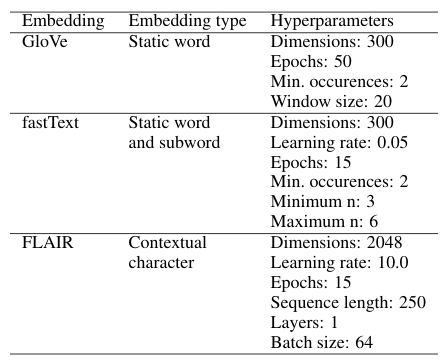
Table 2: Hyperparameter settings for embedding training
The quality of the embeddings trained on the different corpus sizes for the three languages is evaluated using a vanilla bidirectional LSTM-CRF POS tagger implemented as part of the FLAIR framework (Akbik et al., 2019). A separate POS tagger is trained for each of the embedding models, on the same GPU hardware used to train the embeddings. The main reason for using the FLAIR framework is the fact that it has built-in support for all of the different embedding architectures, thus ensuring that the results of the respective taggers can reasonably be compared. As with the embedding models, the hyperparameters are kept to the default settings (hidden size: 256, learning rate: 0.1, drop out: 0.05, epochs: 40). It should also be noted that because the POS training sets are relatively small, fine-tuning of the embeddings during the POS tagger training is not carried out. All taggers are evaluated using the Accuracy metric, and compared to the NCHLT Web Services POS taggers (Puttkammer et al., 2018) as a baseline for each language.
With such a large set of taggers (24 in total), the POS taggers were not trained multiple times with averaged scores. Doing so would once again substantially increase the required GPU hours (currently 82) required for the experiment, and cannot be justified, since the aim of the paper is not to create the best possible tagger, but rather to establish how the different embeddings influence the downstream results.
5 Results and discussion
We will now discuss the performance of the various embedding models with different data sizes for Afrikaans, isiZulu and Sesotho sa Leboa. A graphic representation of the performances on the POS tagging task can be found in Figures 1 (for Afrikaans), 2 (for isiZulu) and 3 (for Sesotho sa Leboa), with the full numerical results available in Table 3 in the appendix.
The first notable conclusion that can be drawn from inspecting the results is that even embeddings trained on very small corpora can benefit the quality of relatively simple downstream tasks, such as POS tagging, when compared to baseline systems. Specifically, the FLAIR contextual character embeddings produce downstream results that are surprisingly good, even for the conjunctively written isiZulu. It was expected that the character-based models would perform best with very small amounts of data, but the models trained on the smallest data sets actually perform comparably to the best results for any of the other embeddings. Conversely, although the FLAIR models perform best when trained with the largest data sets, there is not nearly the same level of improvement as there is for the other two architectures. One implication of these findings is that much smaller and faster models may perform well enough for certain purposes, if not necessarily attaining state-of-the-art results. This allows researchers and developers with limited hardware capacity to also benefit from using these types of embeddings.
As expected, GloVe embeddings consistently perform the worst of all the embedding types, especially so with the first couple of iterations of very small corpora, for two main reasons. Firstly, as these embeddings only generate representations for words in the vocabulary, all words in the tagging task that are not part of the vocabulary are represented by the same vector, and therefore do not have any distinctive representations. Secondly, since many words will only appear a small number of times in the training data, learning complex representations is difficult when a word is only seen in a small number of contexts. These problems are exacerbated for isiZulu where the conjunctive writing style causes a large number of distinctive co-occurrences for all words, especially less frequent words, and learning meaningful representations is almost impossible. For the disjunctively written Sesotho sa Leboa, however, the vocabulary is relatively representative even with a small corpus, and GloVe embeddings perform only slightly worse than the other embedding types.
The fastText models perform substantially better than the GloVe models with very small data sets, while still performing worse than the FLAIR embeddings. With the largest data sets, however, the fastText CBoW models perform either very similarly or better than the FLAIR models. Interestingly, with very small data sets the Skipgram models outperform the CBoW models for the first two or three data iterations, after which the CBoW models consistently perform better across all languages. It is not immediately obvious why this would be the case, but the fact that this occurs across all three languages definitively shows that with very small data sets Skipgrams are preferable over CBoW, whereas for any data set with more than 500,000 or a million tokens (corresponding to about 40,000 paragraphs in our data), the CBoW models generate better representations measured on the POS tagging task. This contradicts the initial findings of Mikolov et al. (2013), but is in line with the latest released fastText models which have also switched to CBoW models by default, as opposed to previously released models (Bojanowski et al., 2017).
Our results also clearly show that the writing system of the language plays a major part in how much data is required to train embeddings that are useful to any degree. For conjunctively written languages, as the token-level morphological complexity of the language increases, so does the amount of data required to create meaningful representations. In the two extreme cases of isiZulu and Sesotho sa Leboa, even the embeddings from the largest available corpora for isiZulu perform substantially worse than the embeddings based on the smallest Sesotho sa Leboa corpus, with accuracies between 4.28% and 15.19% lower depending on the model. Afrikaans, which is slightly more morphologically complex on token level than Sesotho sa Leboa, but not nearly as complex as isiZulu, also performs somewhere between the two languages when considering the different data sizes and embeddings.
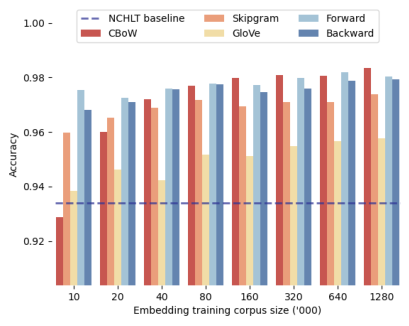
Figure 1: Accuracy of Afrikaans POS tagging using different embedding models with increasing data sizes
Apart from the general findings presented in the previous paragraphs, there are also certain language specific aspects of the results that warrant discussion. We include some broad linguistic error analysis for each of the languages to determine where the main focus of errors are for the best models for each language.
For Afrikaans, the fastText CBoW model performs the worst of all models on the smallest data set, but shows the largest degree of improvement as the data size increases, to the point where it is the best performing of all models on the largest data set. Also, the Afrikaans FLAIR Forward model performs at almost an identical level to the fastText CBoW model, while the FLAIR Backward model is slightly worse. When considering the tag error differences between the embeddings trained on the smallest and largest corpora, it becomes clear that the main source of improvements for both fastText and GloVe embeddings is the size of the data. As more words are included in the vocabulary, the relative error rates for nouns, verbs, adjectives, and adverbs are reduced by between 35% and 45%. The relative error rate reductions for the FLAIR models are not as uniform across all open word classes. As an example, the FLAIR Forward model reduces the percentage of errors for adjective and verbs by 43% and 72% respectively, while increasing the number of errors for nouns or adverbs. The FLAIR Backward model shows improvements for adjectives (25%) and verbs (61%) as well, but also substantial improvements for nouns (64%) and adverbs (48%).
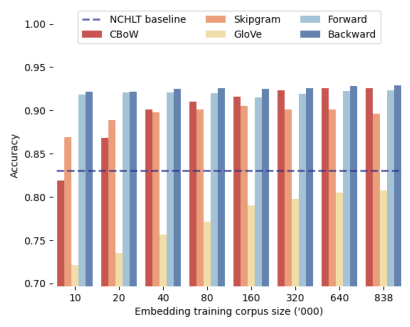
Figure 2: Accuracy of isiZulu POS tagging using different embedding models with increasing data sizes
In the case of isiZulu, the FLAIR Backward model performs best overall, although the FLAIR Forward performs comparably. This differentiation with Afrikaans is likely due to the fact that isiZulu uses prefixation more productively than suffixation, and processing data from the end of the text to the beginning leads to a slightly more informative model. The GloVe model for isiZulu is significantly worse than any of the other models trained in this investigation and is definitely a consequence of data sparsity during training as well as previously unseen words in the tagging task. This problem is less prevalent for the fastText models: Since the n-grams of previously unseen words can still generate a representation, and although not as informative to the task, these "subword" representations obviously have a substantial impact on the quality of the results. The CBoW and GloVe models show the largest error rate reductions across the major POS classes of between 17% and 77%, particularly for Possessives and Adverbs. The FLAIR models on the other hand do not show large improvements for any of the categories, and the improvements are counteracted by regressions in other classes, to which end the results remain relatively stable between the models trained on the smallest and largest corpora.
Even though the FLAIR embeddings perform best for isiZulu, there is very little improvement for these models as the size of the data increases. There are two possible, and related, reasons why this may be the case. Firstly, since most of the affixation in isiZulu is fairly regular, most of the morphological structure of the language may be encoded well with small amounts of data. This is supported by the fact that the most productive word classes (i.e. nouns, verbs, adverbs, possessives, and relatives) are tagged more accurately with a FLAIR model trained on the smallest amount of data, than for any of the other embedding models. The fastText CBoW model does perform similarly on these classes with the largest training set, and may possibly outperform the FLAIR models if more data is made available. The second possible reason is that the annotated POS training data is just too small for further improvements to be possible, and a substantially larger set is required to attain results comparable to those of Afrikaans or Sesotho sa Leboa.
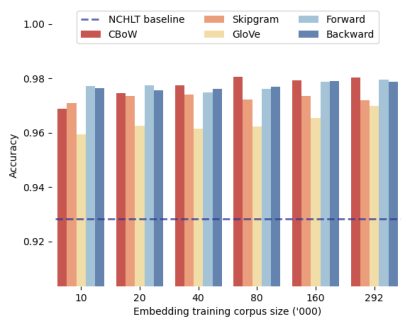
Figure 3: Accuracy of Sesotho sa Leboa POS tagging using different embedding models with increasing data sizes
All of the embedding models for Sesotho sa Leboa, with its disjunctive writing style, clearly already perform well with very small data sets. The improvements on the POS tagging task with larger data sets is also not nearly as large as for the other two languages. As with the other languages, the FLAIR models perform the best with very little data, while the fastText CBoW models generate the best overall results with more data. Surprisingly, the fastText Skipgram models do not show much improvement between the smallest and largest data sets, and there does not seem to be an easily identifiable reason for this result. As with both other languages, the GloVe embeddings generally show improvements with each iteration of larger data, and are likely to keep improving if more data were available to be included. For the GloVe and FLAIR models, the improvements in tag classes are much more moderate, between 8% and 46% for the noun, verb, concord, and adjective classes. Both of the FLAIR models also regress on the adverb class. The fastText models do show more substantial improvements for some of the classes, but for the Skipgram model the error reduction in one class is counteracted by an increase in errors in another class. For example, the noun class errors are reduced by 40%, but the adjective and concordial classes increase their errors by more than 40%, resulting in Accuracies that are very similar to the model trained on the smallest data sets.
Generalizing our findings for the type of embeddings to use with little data, the takeaway is that FLAIR models will produce decent results, especially with very little data. With slightly more data, fastText CBoW embeddings will also perform adequately. GloVe, however, needs large amounts of data to reach enough generalization power to be applied successfully to a morpho-syntactic downstream task.
Our analysis also shows that the influence of linguistic and orthographic differences between languages should not be underestimated. A language such as isiZulu with a complex morphology and large vocabulary (and consequently more data sparseness) will need more data to train representative language models. But a better language model alone is not sufficient. More task related annotated data is also needed to substantially increase the POS accuracy - again an effect of trying to learn from sparse data. It is important to acknowledge the influence of data sparseness in both the learned representations and the actual task to be learned on the final tagging results.
6 Conclusion and Future Work
In this paper, we investigated how the amount of available training data and the linguistic attributes of a language influence the quality of learned embeddings. Our case study consisted of training three different embedding architectures on varying amounts of data, and evaluating the embeddings extrinsically on the downstream task of POS tagging for three linguistically distinct South African languages (Afrikaans, isiZulu and Sesotho sa Leboa).
Our results indicate that under certain conditions even relatively little data can produce useful representations for a specific task. We explicitly show that with very little data (approximately 300,000 tokens) FLAIR embeddings generate representations that perform comparably to any of the other architectures trained on the largest data sets, irrespective of the morphological complexity of the language. The FLAIR models do not generally show the same level of improvements as the other embedding types when larger data sets are available, and in some cases are out-preformed by the fastText CBoW embeddings with the largest available training sets.
The results further reinforce the knowledge that for morphologically complex, conjunctively written languages, substantially more data is needed to achieve good results, not only unannotated text for training the language model, but also annotated training material for the task at hand. Overall we conclude that it is imperative to know the characteristics of the language you are working on to make linguistically informed choices about the amount of data and the type of embeddings to use.
Although these results are encouraging for the relatively simple task of POS tagging, the same may not be true for other, more complex tasks, especially where semantic attributes are of interest. We do however expect that the shortcomings apparent in the fastText Skipgram and GloVe models will remain in under-resourced settings regardless of the task they are applied to. With this in mind there are two areas for future investigation. Firstly, these embedding models should be applied to different tasks that may require different linguistic attributes. Secondly, a comparable experimental design should be applied to transformer models, such as RoBERTa, and to fine-tuning multi-lingual language models (e.g. mBERT, XLM-R) to determine whether similar encouraging results are possible with these more complex architectures.
7 Limitations
There are several limitations of the research reported on in this submission, some of which are explicitly stated in the paper, and others that are expressed in this section as they do not fit well within the discussions of the paper.
The first major limitation of the work relates to the fact that the reported results for the downstream task are not averages of multiple runs, and that there was no hyperparameter tuning performed. Due to the nature of the investigation, i.e. not attempting to achieve state-of-the-art results, and the number of separate runs required to address this limitation, the authors do not expect the results to change such that the conclusions would be significantly affected. For these reasons and the ethical implications of performing unnecessary runs the authors decided not to perform these additional experiments.
Secondly, even though the submission reports on three linguistically distinct languages, care should still be taken when interpreting and applying these findings to other languages, especially where those languages differ significantly from those described in the paper, such as for instance Dravidian and Sino-Tibetan languages.
Lastly, the results of this submission specifically target the relatively simple POS tagging task, and further investigations on the findings of this paper in more complex NLP tasks is necessary to support these findings.
Acknowledgements
This work was made possible with the financial support of the National Centre for Human Language Technology, an initiative of the South African Department of Sports, Arts and Culture. The authors would also like to thank Martin Puttkammer for feedback during the writing and revision of this work.
Notes
1 https://corpora.uni-leipzig.de/en
2 https://commoncrawl.org
a Please note that this data was sampled from a larger 430 million token corpus.
3 https://universaldependencies.org/u/pos/
4 See Table 3 in appendix for details.
5 https://github.com/flairNLP/flair
6 https://hlt.nwu.ac.za/
7 https://fasttext.cc/docs/en/crawl-vectors.html
8 Detailed information on the linguistic error analysis can be found in Tables 4, 5 and 6 in the appendix.
References
Alan Akbik, Tanja Bergmann, Duncan Blythe, Kashif Rasul, Stefan Schweter, and Roland Vollgraf. 2019. FLAIR: An easy-to-use framework for state-of-the-art NLP. In Proceedings of the 2019 Conference of the North American Chapter of the Association for Computational Linguistics (Demonstrations), pages 54-59, Minneapolis, Minnesota. Association for Computational Linguistics.
Alan Akbik, Duncan Blythe, and Roland Vollgraf. 2018. Contextual string embeddings for sequence labeling. In Proceedings of the 27th International Conference on Computational Linguistics, pages 1638-1649, Santa Fe, New Mexico, USA. Association for Computational Linguistics.
Jesujoba O. Alabi, David I. Adelani, Marius Mosbach, and Dietrich Klakow. 2022. Adapting pre-trained language models to African languages via multilingual adaptive fine-tuning. In Proceedings of the 29th International Conference on Computational Linguistics, pages 4336-4349, Gyeongju, Republic of Korea. International Committee on Computational Linguistics.
Laith Alzubaidi, Jinglan Zhang, Amjad J. Humaidi, Ayad Al-Dujaili, Ye Duan, Omran Al-Shamma, J. Santamaría, Mohammed A. Fadhel, Muthana Al-Amidie, and Laith Farhan. 2021. Review of deep learning: concepts, CNN architectures, challenges, applications, future directions. Journal of Big Data, 8(53).
Piotr Bojanowski, Edouard Grave, Armand Joulin, and Tomas Mikolov. 2017. Enriching word vectors with subword information. Transactions of the Association for Computational Linguistics, 5:135-146.
Alexis Conneau, Kartikay Khandelwal, Naman Goyal, Vishrav Chaudhary, Guillaume Wenzek, Francisco Guzmán, Edouard Grave, Myle Ott, Luke Zettlemoyer, and Veselin Stoyanov. 2020. Unsupervised cross-lingual representation learning at scale. In Proceedings of the 58th Annual Meeting of the Association for Computational Linguistics, pages 8440-8451, Online. Association for Computational Linguistics.
Jacob Devlin, Ming-Wei Chang, Kenton Lee, and Kristina Toutanova. 2019. BERT: Pre-training of deep bidirectional transformers for language understanding. In Proceedings of the 2019 Conference of the North American Chapter of the Association for Computational Linguistics: Human Language Technologies, Volume 1 (Long and Short Papers), pages 4171-4186, Minneapolis, Minnesota. Association for Computational Linguistics.
Sibonelo Dlamini, Edgar Jembere, Anban Pillay, and Brett van Niekerk. 2021. isiZulu word embeddings. In 2021 Conference on Information Communications Technology and Society (ICTAS), pages 121-126. IEEE.
Roald Eiselen and Martin Puttkammer. 2014. Developing text resources for ten South African languages. In Proceedings of the Ninth International Conference on Language Resources and Evaluation (LREC'14), pages 3698-3703, Reykjavik, Iceland. European Language Resources Association (ELRA).
Tanja Gaustad and Martin Puttkammer. 2022. Linguistically annotated dataset for four official South African languages with a conjunctive orthography: isiNdebele, isiXhosa, isiZulu, and Siswati. Data in Brief, 41.
Dirk Goldhahn, Thomas Eckart, and Uwe Quasthoff. 2012. Building large monolingual dictionaries at the Leipzig corpora collection: From 100 to 200 languages. In Proceedings of the Eighth International Conference on Language Resources and Evaluation (LREC'12), pages 759-765, Istanbul, Turkey. European Language Resources Association (ELRA).
Ridewaan Hanslo. 2021. Evaluation of neural network transformer models for named-entity recognition on low-resourced languages. In 16th Conference on Computer Science and Intelligence Systems (FedCSIS), pages 115-119. IEEE.
Michael A. Hedderich, David Adelani, Dawei Zhu, Jesujoba Alabi, Udia Markus, and Dietrich Klakow. 2020. Transfer learning and distant supervision for multilingual transformer models: A study on African languages. In Proceedings of the 2020 Conference on Empirical Methods in Natural Language Processing (EMNLP), pages 2580-2591, Online. Association for Computational Linguistics.
Nuette Heyns and Etienne Barnard. 2020. Optimising word embeddings for recognised multilingual speech. In 1st Southern African Conference for Artificial Intelligence Research, pages 102-116. Southern African Conference for Artificial Intelligence Research.
Justin Hocking. 2014. Language identification for South African languages. In Annual Pattern Recognition Association of South Africa and Robotics and Mechatronics International Conference (PRASA-RobMech). PRASA.
Pratik Joshi, Sebastin Santy, Amar Budhiraja, Kalika Bali, and Monojit Choudhury. 2020. The state and fate of linguistic diversity and inclusion in the NLP world. In Proceedings of the 58th Annual Meeting of the Association for Computational Linguistics, pages 6282-6293, Online. Association for Computational Linguistics.
Diksha Khurana, Aditya Koli, Kiran Khatter, and Sukhdev Singh. 2023. Natural language processing: state of the art, current trends and challenges. Multimedia Tools and Applications, 82:3713-3744.
Melinda Loubser and Martin Puttkammer. 2020. Viability of neural networks for core technologies for resource-scarce languages. Information, 11(1):41.
Louis Jacobus Louwrens and George Poulos. 2006. The status of the word in selected conventional writing systems - the case of disjunctive writing. Southern African Linguistics and Applied Language Studies, 24(3):389-401.
Vukosi Marivate, Tshephisho Sefara, Vongani Chabalala, Keamogetswe Makhaya, Tumisho Mokgonyane, Rethabile Mokoena, and Abiodun Modupe. 2020. Investigating an approach for low resource language dataset creation, curation and classification: Setswana and Sepedi. In Proceedings of the first workshop on Resources for African Indigenous Languages (RAIL), pages 15-20, Marseille, France. European Language Resources Association (ELRA).
Cindy McKellar. 2022a. Autshumato monolingual Afrikaans corpus. https://hdl.handle.net/20.500.12185/580. South African Centre for Digital Language Resources (SADiLaR).
Cindy McKellar. 2022b. Autshumato monolingual isiZulu corpus. https://hdl.handle.net/20.500.12185/581. South African Centre for Digital Language Resources (SADiLaR).
Cindy McKellar. 2022c. Autshumato monolingual Sepedi corpus. https://hdl.handle.net/20.500.12185/582. South African Centre for Digital Language Resources (SADiLaR).
Tomas Mikolov, Ken Chen, Greg Corrado, and Jeffrey Dean. 2013. Efficient estimation of word representations in vector space. In 1st International Conference on Learning Representations ICLR 2013, Workshop Track Proceedings, Scottsdale, Arizona, USA.
Tumi Moeng, Sheldon Reay, Aaron Daniels, and Jan Buys. 2022. Canonical and surface morphological segmentation for Nguni languages. In Artificial Intelligence Research. Second Southern African Conference, SACAIR 2021, pages 125-139, Durban, South Africa. Springer.
Jeffrey Pennington, Richard Socher, and Christopher Manning. 2014. GloVe: Global vectors for word representation. In Proceedings of the 2014 Conference on Empirical Methods in Natural Language Processing (EMNLP), pages 1532-1543, Doha, Qatar. Association for Computational Linguistics.
Martin Puttkammer, Roald Eiselen, Justin Hocking, and Frederik Koen. 2018. NLP web services for resource-scarce languages. In Proceedings of ACL 2018, System Demonstrations, pages 43-49, Melbourne, Australia. Association for Computational Linguistics.
Martin Puttkammer and Tanja Gaustad. 2021. Linguistically enriched corpora for conjunctively written South African languages. https://hdl.handle.net/20.500.12185/546. South African Centre for Digital Language Resources (SADiLaR).
Martin Puttkammer, Martin Schlemmer, and Ruan Bekker. 2014a. NCHLT Afrikaans annotated text corpora. https://hdl.handle.net/20.500.12185/296. South African Centre for Digital Language Resources (SADiLaR).
Martin Puttkammer, Martin Schlemmer, and Ruan Bekker. 2014b. NCHLT Sepedi annotated text corpora. https://hdl.handle.net/20.500.12185/325. South African Centre for Digital Language Resources (SADiLaR).
Martin Puttkammer, Martin Schlemmer, Wikus Pienaar, and Ruan Bekker. 2014c. NCHLT Afrikaans text corpora. https://hdl.handle.net/20.500.12185/293. South African Centre for Digital Language Resources (SADiLaR).
Martin Puttkammer, Martin Schlemmer, Wikus Pienaar, and Ruan Bekker. 2014d. NCHLT isiZulu text corpora. https://hdl.handle.net/20.500.12185/321. South African Centre for Digital Language Resources (SADiLaR).
Martin Puttkammer, Martin Schlemmer, Wikus Pienaar, and Ruan Bekker. 2014e. NCHLT Sepedi text corpora. https://hdl.handle.net/20.500.12185/330. South African Centre for Digital Language Resources (SADiLaR).
Sello Ralethe. 2020. Adaptation of deep bidirectional transformers for Afrikaans language. In Proceedings of the 12th Language Resources and Evaluation Conference, pages 2475-2478, Marseille, France. European Language Resources Association.
Mark van der Velde, Koen Bostoen, Derek Nurse, and Gérard Philippson, editors. 2022. The Bantu Languages, 2nd edition. Routledge.
A Appendix
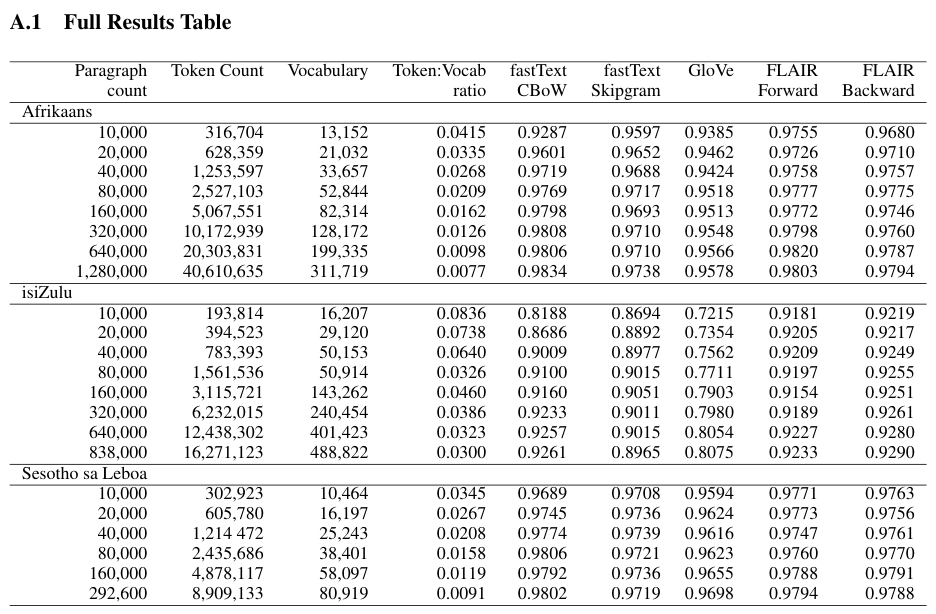
Table 3: Full results for Afrikaans, Sesotho sa Leboa and isiZulu on all types of embeddings with different input data sizes using a reduced POS tagset
A.2 POS Linguistic Analysis Tables
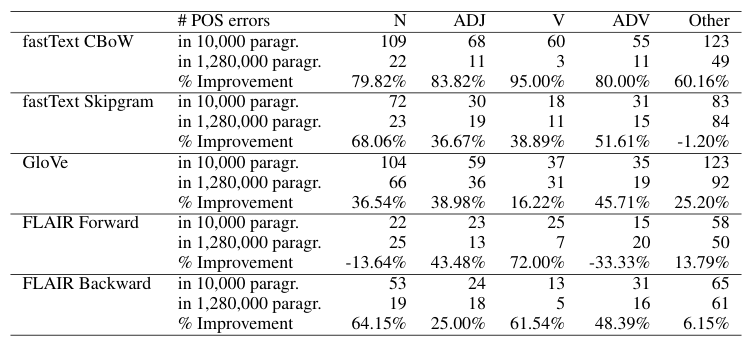
Table 4: Linguistic error analysis for Afrikaans POS
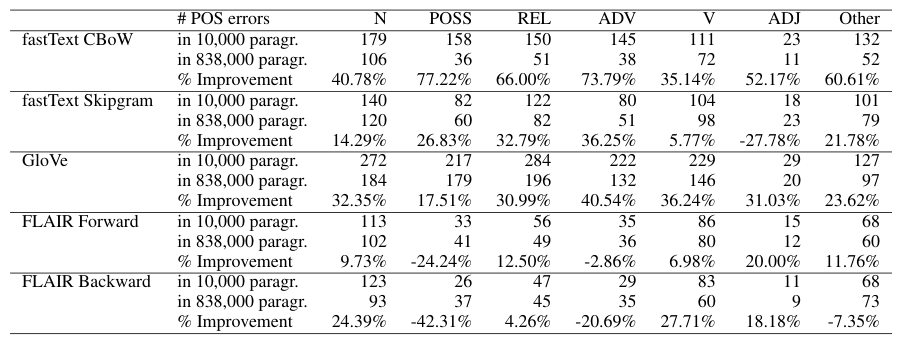
Table 5: Linguistic error analysis for isiZulu POS
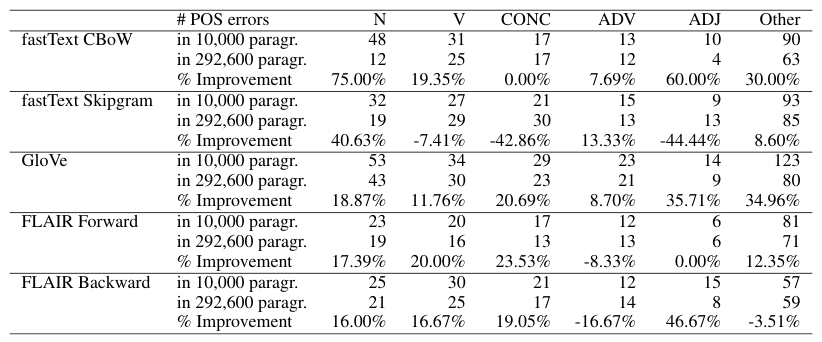
Table 6: Linguistic error analysis for Sesotho sa Leboa POS
Deep learning and low-resource languages: How much data is enough? A case study of three linguistically distinct South African languages
Apprentissage profond et langues peu dotées : Quelle quantité de données est suffisante ? Une étude de cas de trois langues sud-africaines linguistiquement distinctes
Affiliations
Roald Eiselen and Tanja Gaustad
Centre for Text Technology (CTexT)
North-West University
Potchefstroom, South Africa
,
Affiliations
Roald Eiselen and Tanja Gaustad
Centre for Text Technology (CTexT)
North-West University
Potchefstroom, South Africa
,
Abstract
Résumé
In this paper we present a case study for three under-resourced linguistically distinct South African languages (Afrikaans, isiZulu, and Sesotho sa Leboa) to investigate the influence of data size and linguistic nature of a language on the performance of different embedding types. Our experimental setup consists of training embeddings on increasing amounts of data and then evaluating the impact of data size for the downstream task of part of speech tagging. We find that relatively little data can produce useful representations for this specific task for all three languages. Our analysis also shows that the influence of linguistic and orthographic differences between languages should not be underestimated: morphologically complex, conjunctively written languages (isiZulu in our case) need substantially more data to achieve good results, while disjunctively written languages require substantially less data. This is not only the case with regard to the data for training the embedding model, but also annotated training material for the task at hand. It is therefore imperative to know the characteristics of the language you are working on to make linguistically informed choices about the amount of data and the type of embeddings to use.
Dans cet article, nous présentons une étude de cas pour trois langues sud-africaines distinctes et sous-dotées en ressources (afrikaans, isiZulu et Sesotho sa Leboa) afin d'étudier l'influence de la taille des données et de la nature linguistique d'une langue sur les performances de différents types d'embeddings. Notre configuration expérimentale consiste à entraîner des plongements sur des quantités croissantes de données, puis à évaluer l'impact de la taille des données pour la tâche en aval d'étiquetage morpho-syntaxique. Nous constatons que relativement peu de données peuvent produire des représentations utiles pour cette tâche spécifique pour les trois langues. Notre analyse montre également que l'influence des différences linguistiques et orthographiques entre les langues ne doit pas être sous-estimée : les langues morphologiquement complexes, écrites de manière conjonctive (isiZulu dans notre cas) nécessitent sensiblement plus de données pour obtenir de bons résultats, tandis que les langues écrites de manière disjonctive nécessitent sensiblement moins de données. Ce n'est pas seulement le cas en ce qui concerne les données pour l'entraînement du modèle d'embedding, mais aussi les matériaux d'entraînement annotés pour la tâche en question. Il est donc impératif de connaître les caractéristiques de la langue sur laquelle vous travaillez pour faire des choix éclairés sur la quantité de données et le type d'embeddings à utiliser.
1 Introduction
1 Introduction
Over the last decade vectorised word representations and the use of deep learning have become de facto standards in Natural Language Processing (NLP) (Alzubaidi et al., 2021; Khurana et al., 2023). There has also been a push to broaden the linguistic diversity in NLP research (Joshi et al., 2020). Both learning vectorised representations, a.k.a. embeddings, and deep learning are inherently data-driven procedures where models are trained from vast amounts of data to either represent language numerically or learn some downstream task. Including a bigger variety of languages than mainstream languages, such as English, Spanish, German, Japanese, etc., to achieve more linguistic diversity typically means studying low-resource or under-resourced languages.
Au cours de la dernière décennie, les représentations vectorielles de mots et l’utilisation de l’apprentissage profond sont devenues des normes de facto dans le traitement du langage naturel (Alzubaidi et al., 2021; Khurana et al., 2023). Il y a également eu une volonté d'élargir la diversité linguistique dans la recherche en TAL (Joshi et al., 2020). L'apprentissage de représentations vectorielles, également appelées embeddings, et l'apprentissage profond sont des procédures intrinsèquement basées sur les données, où les modèles sont entraînés à partir de vastes quantités de données pour représenter numériquement le langage ou apprendre une tâche en aval. Inclure une plus grande variété de langues que les langues dominantes, telles que l'anglais, l'espagnol, l'allemand, le japonais, etc., pour atteindre une plus grande diversité linguistique signifie généralement étudier des langues peu dotées en ressources ou sous-dotées en ressources.
This, however, leads to a dichotomy: High-performing deep learning models, like BERT, have been trained on billions of words. When developing models for languages other than English, lesser resourced languages (such as the South African languages) get left behind because there is very little available data. Also, evaluation of existing techniques is only partially applied to under-resourced languages and researchers typically assume that the generalisations achieved with training on a lot of data will mostly hold true with less data.
Cela conduit cependant à une dichotomie : les modèles d'apprentissage profond performants, comme BERT, ont été entraînés sur des milliards de mots. Lors de l'élaboration de modèles pour des langues autres que l'anglais, les langues moins dotées en ressources (telles que les langues sud-africaines) sont laissées pour compte parce qu'il y a très peu de données disponibles. De plus, l'évaluation des techniques existantes n'est que partiellement appliquée aux langues sous-dotées et les chercheurs supposent généralement que les généralisations obtenues avec un entraînement sur beaucoup de données seront pour la plupart vraies avec moins de données.
More recently there have been efforts to extend the usefulness of embeddings trained on well-resourced languages with languages that have substantially less data in so-called multi-lingual models, such as XLM-R (Conneau et al., 2020) and mBERT (Devlin et al., 2019). These models generate representations that are a combination of language specific information as well as information learned across all of the languages included in the model. Typically they are trained exclusively on web data like Common Crawl or Wikipedia, which have some inherent limitations (as discussed later in this paper), but also have limited availability for South African languages. For instance, isiNdebele has no Wikipedia data and is therefore not even present in Common Crawl. Consequently, most of the South African languages are not included in these multilingual models.
Plus récemment, il y a eu des efforts pour étendre l'utilité des embeddings entraînés sur des langues bien dotées à des langues disposant de beaucoup moins de données, dans ce qu'on appelle des modèles multilingues, tels que XLM-R (Conneau et al., 2020) et mBERT (Devlin et al., 2019). Ces modèles génèrent des représentations qui sont une combinaison d'informations spécifiques à la langue ainsi que d'informations apprises dans toutes les langues incluses dans le modèle. Typiquement, ils sont entraînés exclusivement sur des données web comme Common Crawl ou Wikipedia, qui présentent certaines limitations inhérentes (comme discuté plus loin dans cet article), mais ont également une disponibilité limitée pour les langues sud-africaines. Par exemple, isiNdebele n'a pas de données Wikipédia et n'est donc même pas présent dans Common Crawl. Par conséquent, la plupart des langues sud-africaines ne sont pas incluses dans ces modèles multilingues.
Doing NLP research on South African languages in this day and age then leads to the question of what the implications of working with very little data is on current standard techniques like embeddings and neural language models. Or in other words: how much data is needed for learning useful vector representations? The underlying assumption is that learning from less data will yield less representative and thus less useful models. It remains to be seen, however, if this is truly the case. From a linguistic diversity point of view, it is also relevant to know how the embedding models vary from each other for structurally different languages and how the amount of available data influences the learned representations for typographically different languages.
Faire des recherches en TALN sur les langues sud-africaines de nos jours amène alors à la question des implications de travailler avec très peu de données sur les techniques standards actuelles comme les embeddings et les modèles de langage neuronaux. Ou en d'autres mots : quelle quantité de données est nécessaire pour apprendre des représentations vectorielles utiles ? L'hypothèse sous-jacente est que l'apprentissage à partir de moins de données donnera des modèles moins représentatifs et donc moins utiles. Il reste toutefois à voir si tel est véritablement le cas. Du point de vue de la diversité linguistique, il est également pertinent de savoir comment les modèles de plongement varient les uns des autres pour des langues structurellement différentes et comment la quantité de données disponibles influence les représentations apprises pour des langues typographiquement différentes.
In this paper, we present a case study attempting to answer these questions. Our setup consists of training embeddings for three linguistically distinct South African languages (Afrikaans, isiZulu, and Sesotho sa Leboa) to evaluate the impact of embeddings trained on increasing amounts of data for a part of speech (POS) tagging downstream task. The goal is to determine the influence of data size on the performance of different embedding types and to describe the effects observed for different languages. The results of our experiments show that even relatively little data can be useful in some scenarios and that morphologically complex and conjunctively written languages require substantially more data, both for training the embeddings and the downstream task, especially when using full/sub word representations.
Dans cet article, nous présentons une étude de cas tentant de répondre à ces questions. Notre configuration consiste à entraîner des plongements pour trois langues sud-africaines linguistiquement distinctes (l'afrikaans, l'isiZulu et le sesotho sa Leboa) afin d'évaluer l'impact de plongements entraînés sur des quantités croissantes de données pour une tâche en aval d'étiquetage de catégorie grammaticale (POS). L'objectif est de déterminer l'influence de la taille des données sur les performances des différents types d'embeddings et de décrire les effets observés pour différentes langues. Les résultats de nos expériences montrent que même relativement peu de données peuvent être utiles dans certains scénarios et que les langues morphologiquement complexes et écrites de manière conjointe nécessitent sensiblement plus de données, tant pour l'entraînement des embeddings que pour la tâche en aval, surtout lorsqu'on utilise des représentations de mots entiers/sous-mots.
2 Background
2 Contexte
2.1 South African linguistic context
2.1 Contexte linguistique sud-africain
South Africa's eleven official languages include nine Niger-Congo-B (NCB) languages and two Germanic languages. The NCB languages (van der Velde et al., 2022) have a number of linguistic characteristics that make them substantially different from most Indo-European languages: all of them are tone languages; they use an elaborate system of noun classes with up to 21 classes; and their nominal and verbal morphology is highly agglutinative and very productive, which can result in a large vocabulary for those languages that follow the conjunctive writing system.
Les onze langues officielles de l'Afrique du Sud comprennent neuf langues Niger-Congo-B (NCB) et deux langues germaniques. Les langues NCB (van der Velde et al., 2022) présentent un certain nombre de caractéristiques linguistiques qui les distinguent sensiblement des langues indo-européennes : ce sont toutes des langues à tons ; elles utilisent un système élaboré de classes nominales pouvant comporter jusqu'à 21 classes ; et leur morphologie nominale et verbale est très agglutinante et très productive, ce qui peut entraîner un vocabulaire étendu pour les langues qui suivent le système d'écriture conjonctif.
For historic reasons, the South African NCB languages adopted two different writing systems, either conjunctive or disjunctive, where a distinction is generally made between linguistic words and orthographic words. For conjunctively written languages one orthographic word (token) corresponds to one or more linguistic words, whereas for the disjunctively written languages several orthographic words can correspond to one linguistic word (Louwrens and Poulos, 2006). The four Nguni languages, isiNdebele, isiXhosa, isiZulu, and Siswati, are written conjunctively, while the three Sotho languages, Sesotho, Sesotho sa Leboa (also known as Sepedi), and Setswana, Tshivenḓa, a Venda language, as well as Xitsonga, a Tswa-Ronga language, are disjunctively written. This is a marked difference from the two Germanic languages present in South Africa, Afrikaans and English, where mostly a linguistic word and an orthographic word coincide.
Pour des raisons historiques, les langues NCB d'Afrique du Sud ont adopté deux systèmes d'écriture différents, soit conjoint, soit disjoint, où une distinction est généralement faite entre les mots linguistiques et les mots orthographiques. Pour les langues écrites de manière conjointe, un mot orthographique (token) correspond à un ou plusieurs mots linguistiques, tandis que pour les langues écrites de manière disjointe, plusieurs mots orthographiques peuvent correspondre à un mot linguistique (Louwrens et Poulos, 2006). Les quatre langues nguni, isiNdebele, isiXhosa, isiZulu et Siswati, sont écrites de manière conjonctive, tandis que les trois langues sotho, Sesotho, Sesotho sa Leboa (également connu sous le nom de Sepedi) et Setswana, le Tshivenḓa, une langue venda, ainsi que le Xitsonga, une langue tswa-ronga, sont écrits de manière disjonctive. C'est une différence marquée par rapport aux deux langues germaniques présentes en Afrique du Sud, l'afrikaans et l'anglais, où la plupart du temps un mot linguistique et un mot orthographique coïncident.
The implication of these different writing systems is that multiple tokens in disjunctively written languages can correspond to a single token in the conjunctively written languages. This leads to sparse token frequency for the conjunctively written languages, while the opposite is true for the disjunctive languages. As an illustration, the parallel equivalents of a 50,000 word English corpus will have approximately 43,000 words for the conjunctively written languages, while the disjunctive languages will have approximately 60,000 tokens. This difference and its implications are discussed in more detail in Section 3.
La conséquence de ces différents systèmes d'écriture est que plusieurs jetons dans les langues écrites de manière disjonctive peuvent correspondre à un seul jeton dans les langues écrites de manière conjonctive. Cela entraîne une fréquence de jetons peu dense pour les langues écrites de manière conjonctive, tandis que l'inverse est vrai pour les langues disjonctives. À titre d'illustration, les équivalents parallèles d'un corpus de 50 000 mots en anglais comporteront environ 43 000 mots pour les langues écrites de manière conjonctive, tandis que les langues disjonctives comporteront environ 60 000 jetons. Cette différence et ses implications sont discutées plus en détail dans la Section 3.
One of the objectives of this paper is to investigate the influence of linguistic and orthographic differences in South African languages on using embedding models in NLP tasks, specifically POS tagging. To that purpose we have chosen one language from each family for our experiments: Afrikaans (Germanic), isiZulu (conjunctively written Nguni) and Sesotho sa Leboa (disjunctively written Sotho).
L'un des objectifs de cet article est d'étudier l'influence des différences linguistiques et orthographiques dans les langues sud-africaines sur l'utilisation de modèles de plongement dans les tâches de TAL, en particulier l'étiquetage POS. À cette fin, nous avons choisi une langue de chaque famille pour nos expériences : l'afrikaans (germanique), l'isiZulu (Nguni écrit de manière conjointe) et le Sesotho sa Leboa (Sotho écrit de manière disjointe).
2.2 Embedding models
2.2 Modèles de plongement
Since the introduction of the word2vec (Mikolov et al., 2013) and GloVe (Pennington et al., 2014) vectorised word representations, most (if not all) NLP tasks make use of learned vector representations, referred to as embeddings, to model the occurrences of words and their context. With these algorithms, embedding models are trained efficiently on large amounts of data and the learned representations, in combination with deep learning techniques, generally improve the results of downstream NLP tasks. In this paper we apply three embedding architectures, namely fastText (an extension of word2vec) and GloVe, two classical embeddings, and FLAIR embeddings, a character-based recurrent neural network.
Depuis l'introduction des représentations vectorisées de mots word2vec (Mikolov et al., 2013) et GloVe (Pennington et al., 2014), la plupart (sinon toutes) des tâches de TAL utilisent des représentations vectorielles apprises, appelées plongements, pour modéliser les occurrences des mots et leur contexte. Avec ces algorithmes, les modèles de plongement sont entraînés efficacement sur de grandes quantités de données et les représentations apprises, combinées aux techniques d'apprentissage profond, améliorent généralement les résultats des tâches de TAL en aval. Dans cet article, nous appliquons trois architectures de plongement, à savoir fastText (une extension de word2vec) et GloVe, deux plongements classiques, et les plongements FLAIR, un réseau de neurones artificiels récurrent basé sur les caractères.
GloVe embeddings (Pennington et al., 2014) learn representations of words using global co-occurrences to train a log-bilinear regression model. For each word in the vocabulary of the GloVe model a single n-dimensional vector is learned, while all unseen words generate the same vector representation. fastText embeddings (Bojanowski et al., 2017), an extension of word2vec (Mikolov et al., 2013), are based on local co-occurrences of words. In addition to the full word, the generation of the vector representations includes character n-grams, or "subwords", allowing these embeddings to also generate distinct representations for previously unseen words by combining the n-grams from the unseen word. fastText embeddings come in two variants, continuous bag-of-words (CBoW) and Skipgram models. Both GloVe and fastText learn a single vector representation for each word in the vocabulary. When retrieving this vector, the word will always receive the same vector, irrespective of the context in which the word appears.
Les embeddings GloVe (Pennington et al., 2014) apprennent des représentations de mots en utilisant des co-occurrences globales pour entraîner un modèle de régression log-bilinéaire. Pour chaque mot dans le vocabulaire du modèle GloVe, un seul vecteur n-dimensionnel est appris, tandis que tous les mots invisibles génèrent la même représentation vectorielle. Les embeddings fastText (Bojanowski et al., 2017), une extension de word2vec (Mikolov et al., 2013), sont basés sur les co-occurrences locales de mots. En plus du mot complet, la génération des représentations vectorielles inclut des n-grammes de caractères, ou « sous-mots », permettant à ces plongements de générer également des représentations distinctes pour des mots jamais vus auparavant en combinant les n-grammes du mot inconnu. Les embeddings fastText existent en deux variantes, les modèles continuous bag-of-words (CBoW) et Skipgram. GloVe et fastText apprennent tous deux une seule représentation vectorielle pour chaque mot du vocabulaire. Lors de la récupération de ce vecteur, le mot recevra toujours le même vecteur, indépendamment du contexte dans lequel le mot apparaît.
In contrast, FLAIR embeddings (Akbik et al., 2018, 2019) learn representations for character sequences by training a long-short-term-memory (LSTM) recurrent neural network. This means that a distinct word occurring in different contexts can have a different vector representation depending on the character sequences (context) around the word. Furthermore, all character sequences receive a representation whether a sequence has been seen during training or not. This can help with the representation of rare or misspelled words as well as with individual morphemes or morphologically complex words. FLAIR allows for two variants, namely Forward and Backward depending on the direction in which the text is processed - either from the start (forward) or from the end (backward).
En revanche, les embeddings FLAIR (Akbik et al., 2018, 2019) apprennent des représentations pour des séquences de caractères en entraînant un réseau de neurones récurrents à mémoire à long terme (LSTM). Cela signifie qu'un mot distinct se produisant dans des contextes différents peut avoir une représentation vectorielle différente en fonction des séquences de caractères (contexte) autour du mot. De plus, toutes les séquences de caractères reçoivent une représentation, qu'une séquence ait été vue pendant l'entraînement ou non. Cela peut aider avec la représentation de mots rares ou mal orthographiés ainsi qu'avec des morphèmes individuels ou des mots morphologiquement complexes. FLAIR permet deux variantes, à savoir en avant et en arrière en fonction de la direction dans laquelle le texte est traité - soit à partir du début (en avant) ou à partir de la fin (en arrière).
With the availability of these improved deep learning frameworks and an increased focus on linguistic diversity in the deep learning community, there has been a substantial rise in research on African languages. The focus of this work has been broad: From applications of embeddings and deep learning on individual languages and individual applications (Dlamini et al., 2021; Heyns and Barnard, 2020; Loubser and Puttkammer, 2020; Marivate et al., 2020; Ralethe, 2020), to investigations of multilingual embedding architectures for African languages (Alabi et al., 2022; Hanslo, 2021; Moeng et al., 2022) and transfer learning from well-resourced languages (Hedderich et al., 2020). The outcomes of these investigations have had mixed results, in some cases substantially improving technologies over previous best results, while other approaches show how the nature and quality of the data have a significant impact on the quality of the trained models. As far as we are aware, none of these studies have explicitly investigated the quality and nature of the embeddings when considering data size and morpho-syntactic attributes of African languages.
Avec la disponibilité de ces cadres d'apprentissage profond améliorés et une attention accrue portée à la diversité linguistique dans la communauté de l'apprentissage profond, il y a eu une augmentation substantielle de la recherche sur les langues africaines. Le focus de ce travail a été large : des applications des embeddings et de l'apprentissage profond sur des langues individuelles et des applications individuelles (Dlamini et al., 2021 ; Heyns et Barnard, 2020 ; Loubser et Puttkammer, 2020 ; Marivate et al., 2020 ; Ralethe, 2020), aux investigations des architectures d'embedding multilingues pour les langues africaines (Alabi et al., 2022 ; Hanslo, 2021 ; Moeng et al., 2022) et de l'apprentissage par transfert à partir de langues bien dotées (Hedderich et al., 2020). Les résultats de ces investigations ont été mitigés, améliorant dans certains cas les technologies par rapport aux meilleurs résultats précédents, tandis que d'autres approches montrent comment la nature et la qualité des données ont un impact significatif sur la qualité des modèles entraînés. À notre connaissance, aucune de ces études n'a explicitement examiné la qualité et la nature des embeddings en considérant la taille des données et les attributs morpho-syntaxiques des langues africaines.
3 Data
3 Données
The major prerequisite for training embeddings and language models for any language is the availability of large amounts of text data. Although there have been several efforts to create such corpora for the South African languages (Eiselen and Puttkammer, 2014; Goldhahn et al., 2012; Marivate et al., 2020), there is still relatively little data available for most of them. The data collected for this study is a combination of various open data sets (mostly CC-BY and CC-NC licenses), as well as some data only available to the authors with copyright restrictions prohibiting the distribution of the full corpora. The data included in the training corpora for the isiZulu and Sesotho sa Leboa embeddings are primarily from the NCHLT Text Corpora (Eiselen and Puttkammer, 2014; Puttkammer et al., 2014c,d,e), Autshumato Corpora (McKellar, 2022a,b,c), Leipzig Corpus Collection (Goldhahn et al., 2012), and Common Crawl corpus. All of these sources are also used in the Afrikaans training corpus, along with additional data from publishers and private sources, i.e. the NWU/Lapa Corpus, NWU/Protea Boekhuis Corpus, and NWU/ATKV-Taalgenoot Corpus.
Le prérequis majeur pour l'entraînement d'embeddings et de modèles linguistiques pour une langue donnée est la disponibilité de grandes quantités de données textuelles. Bien qu'il y ait eu plusieurs efforts pour créer de tels corpus pour les langues sud-africaines (Eiselen et Puttkammer, 2014 ; Goldhahn et al., 2012 ; Marivate et al., 2020), il y a encore relativement peu de données disponibles pour la plupart d'entre elles. Les données collectées pour cette étude sont une combinaison de divers ensembles de données ouvertes (principalement des licences CC-BY et CC-NC), ainsi que certaines données uniquement disponibles pour les auteurs avec des restrictions de copyright interdisant la distribution des corpus complets. Les données incluses dans les corpus d'entraînement pour les embeddings isiZulu et Sesotho sa Leboa proviennent principalement des NCHLT Text Corpora (Eiselen et Puttkammer, 2014 ; Puttkammer et al., 2014c,d,e), des Autshumato Corpora (McKellar, 2022a,b,c), de la Leipzig Corpus Collection (Goldhahn et al., 2012), et du Common Crawl corpus. Toutes ces sources sont également utilisées dans le corpus d'entraînement Afrikaans, ainsi que des données supplémentaires provenant de maisons d'édition et de sources privées, c'est-à-dire le NWU/Lapa Corpus, le NWU/Protea Boekhuis Corpus, et le NWU/ATKV-Taalgenoot Corpus.
Although the data in both the Leipzig and Common Crawl corpora are language identified, an initial investigation showed that a substantial amount of the data is incorrectly attributed to one of the languages. This is primarily due to the fact that all three languages in this study have related languages that share similar orthographic features which leads to misclassification of the language data, specifically:
Bien que les données des corpus Leipzig et Common Crawl soient identifiées par langue, une première investigation a montré qu'une quantité substantielle de ces données est incorrectement attribuée à l'une des langues. Cela est principalement dû au fait que les trois langues de cette étude ont des langues apparentées partageant des caractéristiques orthographiques similaires, ce qui conduit à une mauvaise classification des données linguistiques, spécifiquement :
Afrikaans ⇔ Dutch;
Afrikaans ⇔ néerlandais;
isiZulu ⇔ isiNdebele, isiXhosa, and Siswati;
isiZulu ⇔ isiNdebele, isiXhosa et Siswati;
Sesotho sa Leboa ⇔ Setswana and Sesotho.
Sesotho sa Leboa ⇔ Setswana et Sesotho.
Consequently, all of the data from the Leipzig and Common Crawl corpora were further cleaned with the NCHLT Language Identifier (Hocking, 2014; Puttkammer et al., 2018) at 80% confidence level. Since most of the data in the respective corpora originate from the web, all duplicates on paragraph level in the combined data are removed prior to training.
Par conséquent, toutes les données des corpus Leipzig et Common Crawl ont été nettoyées avec l’identifiant de langue NCHLT (Hocking, 2014; Puttkammer et al., 2018) à un niveau de confiance de 80%. Étant donné que la plupart des données dans les corpus respectifs proviennent du Web, tous les doublons au niveau des paragraphes dans les données combinées sont supprimés avant l'entraînement.
Table 1: Summary of data available for training embeddings and POS tagging
Tableau 1 : Résumé des données disponibles pour l'entraînement des plongements et l'étiquetage POS
A summary of the data available for training embeddings is presented in Table 1. As was discussed in Section 2.1, there is a marked difference in the number of tokens in the vocabulary for each of the three languages for the same corpus sizes. One way of representing the combined effects of these morphosyntactic and writing system differences is by adding the token-vocabulary ratio to the reported token counts: a text in the conjunctively written, morphologically complex language of isiZulu typically displays a higher token-vocabulary ratio than a text in Sesotho sa Leboa, where a number of morphemes are written separately and therefore count as multiple tokens. In Afrikaans, where one token typically corresponds to one orthographic word, the token-vocabulary ratio is somewhere between the two extremes of the disjunctive and conjunctive languages. The vocabulary for Afrikaans is still more sparse than is typical in English since compounding is very common in Afrikaans and leads to a larger number of unique tokens, although it is not nearly as productive as the conjunctively written isiZulu.
Un résumé des données disponibles pour l'entraînement des plongements est présenté dans le Tableau 1. Comme cela a été discuté dans la Section 2.1, il existe une différence marquée dans le nombre de tokens dans le vocabulaire pour chacune des trois langues pour les mêmes tailles de corpus. Une manière de représenter les effets combinés de ces différences morphosyntaxiques et de système d'écriture consiste à ajouter le rapport token-vocabulaire aux comptages de tokens rapportés : un texte en isiZulu, langue à écriture conjonctive et morphologiquement complexe, présente généralement un rapport token-vocabulaire plus élevé qu'un texte en Sesotho sa Leboa, où un certain nombre de morphèmes sont écrits séparément et comptent donc comme plusieurs tokens. En Afrikaans, où un token correspond typiquement à un mot orthographique, le ratio token-vocabulaire se situe quelque part entre les deux extrêmes des langues disjonctives et conjonctives. Le vocabulaire de l'afrikaans est encore plus clairsemé que ce qui est typique en anglais, car la composition est très courante en afrikaans et conduit à un plus grand nombre de tokens uniques, bien qu'elle ne soit pas aussi productive que l'isiZulu à écriture conjonctive.
The POS data used in this study is the NCHLT Annotated Corpora for Afrikaans and Sesotho sa Leboa (Puttkammer et al., 2014a,b), and the Linguistically enriched corpora for conjunctively written South African languages for isiZulu (Gaustad and Puttkammer, 2022; Puttkammer and Gaustad, 2021). Each annotated corpus consists of approximately 50,000 tokens for the training set, and a separate test set of approximately 5,000 tokens. Although the data is annotated on very fine-grained POS tag sets (typically consisting of 90+ tags), for this investigation we reduced the tag sets to between 12 and 17 tags by e.g. excluding class information and using only main POS classes. This makes the results between languages more comparable, but does not obscure the functional differences a conversion to UPOS would. An overview of the POS data and tags is presented in Table 1.
Les données d'étiquetage morpho-syntaxique (POS) utilisées dans cette étude proviennent des corpus annotés NCHLT pour l'afrikaans et le sesotho sa Leboa (Puttkammer et al., 2014a,b), ainsi que des corpus enrichis linguistiquement pour les langues sud-africaines écrites de manière conjointe pour l'isiZulu (Gaustad et Puttkammer, 2022; Puttkammer et Gaustad, 2021). Chaque corpus annoté se compose d'environ 50 000 tokens pour l'ensemble d'entraînement, et d'un ensemble de test séparé d'environ 5 000 tokens. Bien que les données soient annotées sur des ensembles de balises POS à grain très fin (généralement composés de plus de 90 balises), pour cette enquête, nous avons réduit les ensembles de balises à entre 12 et 17 balises, par exemple en excluant les informations de classe et en utilisant uniquement les classes POS principales. Cela rend les résultats entre les langues plus comparables, mais n'obscurcit pas les différences fonctionnelles qu'une conversion vers UPOS ferait. Un aperçu des données POS et des étiquettes est présenté dans le Tableau 1.
4 Experimental Design
4 Conception expérimentale
In order to determine the impact of different embedding architectures and morpho-syntactic attributes on the usefulness of embeddings in low-resource environments, we perform a set of experiments to establish how these attributes in combination with data size affect the quality of a single downstream task, namely POS tagging.
Afin de déterminer l'impact des différentes architectures de plongement et des attributs morpho-syntaxiques sur l'utilité des plongements dans des environnements à faibles ressources, nous effectuons un ensemble d'expériences pour établir comment ces attributs, en combinaison avec la taille des données, affectent la qualité d'une seule tâche en aval, à savoir l'étiquetage POS.
The first step in the process is generating embeddings in each of the chosen architectures - fastText, GloVe, and FLAIR - with different data set sizes. For each language a random selection of paragraphs from the available corpus is made in iteratively larger sizes, starting with 10,000 paragraphs and doubling the amount of data randomly for each iteration. For isiZulu and Sesotho sa Leboa this process is repeated up to the full available corpus (292,600 and 838,000 paragraphs respectively), while for Afrikaans we only select data up to one increment above the largest of the other two languages (1,280,000 paragraphs). Based on each data iteration, embeddings for all three architectures, including their different flavours, are trained.
La première étape du processus consiste à générer des embeddings dans chacune des architectures choisies - fastText, GloVe et FLAIR - avec différentes tailles de jeux de données. Pour chaque langue, une sélection aléatoire de paragraphes du corpus disponible est effectuée en tailles itérativement plus grandes, en commençant par 10 000 paragraphes et en doublant la quantité de données de manière aléatoire à chaque itération. Pour l'isiZulu et le Sesotho sa Leboa, ce processus est répété jusqu'au corpus complet disponible (292 600 et 838 000 paragraphes respectivement), tandis que pour l'afrikaans, nous ne sélectionnons des données que jusqu'à un incrément au-dessus de la plus grande des deux autres langues (1 280 000 paragraphes). Sur la base de chaque itération de données, des embeddings pour les trois architectures, y compris leurs différentes variantes, sont entraînés.
To make the comparison of models as consequent as possible, the hyperparameters for each of the architectures are kept the same (typically the default settings, see Table 2) and no hyperparameter tuning is performed. Consequently, there may be certain hyperparameter selections for the different data set sizes and languages, that could lead to slight improvements in the results presented in this work, but different hyperparameters would make the comparison and resultant conclusions less generally applicable. Furthermore, this would also substantially increase the number of experiments that need to be trained (probably into the thousands) and cannot be ethically and environmentally justified due to additional power consumption. In total 110 embedding models are trained on an Intel i79700 CPU and four NVIDIA GeForce RTX 2060 6Gb GPUs, totalling 30 CPU hours and 252 GPU hours.
Pour rendre la comparaison des modèles aussi cohérente que possible, les hyperparamètres de chacune des architectures sont conservés identiques (généralement les paramètres par défaut, voir le tableau 2) et aucun réglage des hyperparamètres n'est effectué. Par conséquent, il peut y avoir certaines sélections d'hyperparamètres pour les différentes tailles et langues des ensembles de données, qui pourraient conduire à de légères améliorations dans les résultats présentés dans ce travail, mais des hyperparamètres différents rendraient la comparaison et les conclusions résultantes moins généralement applicables. En outre, cela augmenterait également substantiellement le nombre d'expériences qui doivent être entraînées (probablement des milliers) et ne peut pas être justifié sur le plan éthique et environnemental en raison de la consommation d'énergie supplémentaire. Au total, 110 modèles de plongement sont entraînés sur un processeur Intel i79700 et quatre GPU NVIDIA GeForce RTX 2060 6 Go, totalisant 30 heures de processeur et 252 heures de GPU.
Table 2: Hyperparameter settings for embedding training
Tableau 2 : Réglages des hyperparamètres pour l'entraînement des plongements
The quality of the embeddings trained on the different corpus sizes for the three languages is evaluated using a vanilla bidirectional LSTM-CRF POS tagger implemented as part of the FLAIR framework (Akbik et al., 2019). A separate POS tagger is trained for each of the embedding models, on the same GPU hardware used to train the embeddings. The main reason for using the FLAIR framework is the fact that it has built-in support for all of the different embedding architectures, thus ensuring that the results of the respective taggers can reasonably be compared. As with the embedding models, the hyperparameters are kept to the default settings (hidden size: 256, learning rate: 0.1, drop out: 0.05, epochs: 40). It should also be noted that because the POS training sets are relatively small, fine-tuning of the embeddings during the POS tagger training is not carried out. All taggers are evaluated using the Accuracy metric, and compared to the NCHLT Web Services POS taggers (Puttkammer et al., 2018) as a baseline for each language.
La qualité des plongements entraînés sur les différentes tailles de corpus pour les trois langues est évaluée à l'aide d'un étiqueteur morphosyntaxique bidirectionnel LSTM-CRF vanilla implémenté dans le cadre du framework FLAIR (Akbik et al., 2019). Un étiqueteur POS distinct est entraîné pour chacun des modèles d'embedding, sur le même matériel GPU utilisé pour entraîner les embeddings. La raison principale d'utiliser le framework FLAIR est le fait qu'il prend en charge toutes les différentes architectures d'embedding, assurant ainsi que les résultats des étiqueteurs respectifs peuvent être raisonnablement comparés. Comme pour les modèles d'embedding, les hyperparamètres sont maintenus aux paramètres par défaut (taille cachée : 256, taux d'apprentissage : 0,1, drop out : 0,05, époques : 40). Il convient également de noter que, parce que les ensembles d'entraînement POS sont relativement petits, l'ajustement fin des embeddings pendant l'entraînement de l'étiqueteur POS n'est pas effectué. Tous les étiqueteurs sont évalués à l'aide de la métrique d'exactitude et comparés aux étiqueteurs morphosyntaxiques des services Web NCHLT (Puttkammer et al., 2018) comme référence pour chaque langue.
With such a large set of taggers (24 in total), the POS taggers were not trained multiple times with averaged scores. Doing so would once again substantially increase the required GPU hours (currently 82) required for the experiment, and cannot be justified, since the aim of the paper is not to create the best possible tagger, but rather to establish how the different embeddings influence the downstream results.
Avec un si grand ensemble d'étiqueteurs (24 au total), les étiqueteurs POS n'ont pas été entraînés plusieurs fois avec des scores moyens. Faire cela augmenterait une fois de plus de manière substantielle les heures d'utilisation de GPU (actuellement 82) nécessaires pour l'expérience, et ne peut être justifié, puisque l'objectif de l'article n'est pas de créer le meilleur étiqueteur possible, mais plutôt d'établir comment les différents embeddings influencent les résultats en aval.
5 Results and discussion
5 Résultats et discussion
We will now discuss the performance of the various embedding models with different data sizes for Afrikaans, isiZulu and Sesotho sa Leboa. A graphic representation of the performances on the POS tagging task can be found in Figures 1 (for Afrikaans), 2 (for isiZulu) and 3 (for Sesotho sa Leboa), with the full numerical results available in Table 3 in the appendix.
Nous allons maintenant discuter de la performance des différents modèles de plongement avec différentes tailles de données pour l'afrikaans, l'isiZulu et le Sesotho sa Leboa. Une représentation graphique des performances sur la tâche d'étiquetage POS peut être trouvée dans les figures 1 (pour l'afrikaans), 2 (pour isiZulu) et 3 (pour Sesotho sa Leboa), avec les résultats numériques complets disponibles dans le tableau 3 en annexe.
The first notable conclusion that can be drawn from inspecting the results is that even embeddings trained on very small corpora can benefit the quality of relatively simple downstream tasks, such as POS tagging, when compared to baseline systems. Specifically, the FLAIR contextual character embeddings produce downstream results that are surprisingly good, even for the conjunctively written isiZulu. It was expected that the character-based models would perform best with very small amounts of data, but the models trained on the smallest data sets actually perform comparably to the best results for any of the other embeddings. Conversely, although the FLAIR models perform best when trained with the largest data sets, there is not nearly the same level of improvement as there is for the other two architectures. One implication of these findings is that much smaller and faster models may perform well enough for certain purposes, if not necessarily attaining state-of-the-art results. This allows researchers and developers with limited hardware capacity to also benefit from using these types of embeddings.
La première conclusion notable qui peut être tirée de l'inspection des résultats est que même les embeddings entraînés sur des corpus très petits peuvent améliorer la qualité de tâches en aval relativement simples, telles que l'étiquetage POS, lorsqu'ils sont comparés aux systèmes de base. Plus précisément, les plongements contextuels de caractères FLAIR produisent des résultats en aval étonnamment bons, même pour l'isiZulu écrit de manière conjonctive. Il était attendu que les modèles basés sur les caractères fonctionnent le mieux avec de très petites quantités de données, mais les modèles entraînés sur les plus petits ensembles de données ont en réalité des performances comparables aux meilleurs résultats pour l'un des autres embeddings. À l'inverse, bien que les modèles FLAIR soient plus performants lorsqu'ils sont entraînés avec les plus grands ensembles de données, il n'y a pas le même niveau d'amélioration que pour les deux autres architectures. Une implication de ces résultats est que des modèles beaucoup plus petits et plus rapides peuvent fonctionner suffisamment bien pour certains usages, même s'ils n'atteignent pas nécessairement les résultats de l'état de l'art. Cela permet aux chercheurs et aux développeurs disposant de capacités matérielles limitées de bénéficier également de l'utilisation de ces types de plongements.
As expected, GloVe embeddings consistently perform the worst of all the embedding types, especially so with the first couple of iterations of very small corpora, for two main reasons. Firstly, as these embeddings only generate representations for words in the vocabulary, all words in the tagging task that are not part of the vocabulary are represented by the same vector, and therefore do not have any distinctive representations. Secondly, since many words will only appear a small number of times in the training data, learning complex representations is difficult when a word is only seen in a small number of contexts. These problems are exacerbated for isiZulu where the conjunctive writing style causes a large number of distinctive co-occurrences for all words, especially less frequent words, and learning meaningful representations is almost impossible. For the disjunctively written Sesotho sa Leboa, however, the vocabulary is relatively representative even with a small corpus, and GloVe embeddings perform only slightly worse than the other embedding types.
Comme prévu, les embeddings GloVe réalisent systématiquement les pires performances parmi tous les types d'embeddings, surtout lors des premières itérations de très petits corpus, pour deux raisons principales. Premièrement, comme ces embeddings ne génèrent des représentations que pour les mots du vocabulaire, tous les mots de la tâche d'étiquetage qui ne font pas partie du vocabulaire sont représentés par le même vecteur, et n'ont donc aucune représentation distinctive. Deuxièmement, étant donné que de nombreux mots n'apparaissent qu'un petit nombre de fois dans les données d'entraînement, l'apprentissage de représentations complexes est difficile lorsqu'un mot n'est vu que dans un petit nombre de contextes. Ces problèmes sont exacerbés pour isiZulu où le style d'écriture conjonctive provoque un grand nombre de co-occurrences distinctives pour tous les mots, en particulier les mots moins fréquents, et l'apprentissage des représentations significatives est presque impossible. Pour le Sesotho sa Leboa écrit de manière disjonctive, cependant, le vocabulaire est relativement représentatif même avec un petit corpus, et les embeddings GloVe ne fonctionnent que légèrement moins bien que les autres types d'embeddings.
The fastText models perform substantially better than the GloVe models with very small data sets, while still performing worse than the FLAIR embeddings. With the largest data sets, however, the fastText CBoW models perform either very similarly or better than the FLAIR models. Interestingly, with very small data sets the Skipgram models outperform the CBoW models for the first two or three data iterations, after which the CBoW models consistently perform better across all languages. It is not immediately obvious why this would be the case, but the fact that this occurs across all three languages definitively shows that with very small data sets Skipgrams are preferable over CBoW, whereas for any data set with more than 500,000 or a million tokens (corresponding to about 40,000 paragraphs in our data), the CBoW models generate better representations measured on the POS tagging task. This contradicts the initial findings of Mikolov et al. (2013), but is in line with the latest released fastText models which have also switched to CBoW models by default, as opposed to previously released models (Bojanowski et al., 2017).
Les modèles fastText sont nettement plus performants que les modèles GloVe avec de très petits jeux de données, tout en restant moins performants que les plongements FLAIR. Avec les plus grands ensembles de données, cependant, les modèles fastText CBoW fonctionnent soit de manière très similaire, soit mieux que les modèles FLAIR. Fait intéressant, avec de très petits ensembles de données, les modèles Skipgram surpassent les modèles CBoW pour les deux ou trois premières itérations de données, après quoi les modèles CBoW fonctionnent toujours mieux dans toutes les langues. Il n'est pas immédiatement évident pourquoi ce serait le cas, mais le fait que cela se produise dans les trois langues montre définitivement qu'avec de très petits ensembles de données, les skipgrams sont préférables aux CBoW, alors que pour tout ensemble de données avec plus de 500 000 ou un million de jetons (correspondant à environ 40 000 paragraphes dans nos données), les modèles CBoW génèrent de meilleures représentations mesurées sur la tâche d'étiquetage POS. Cela contredit les conclusions initiales de Mikolov et al. (2013), mais est conforme aux derniers modèles fastText publiés qui sont également passés aux modèles CBoW par défaut, par opposition aux modèles précédemment publiés (Bojanowski et al., 2017).
Our results also clearly show that the writing system of the language plays a major part in how much data is required to train embeddings that are useful to any degree. For conjunctively written languages, as the token-level morphological complexity of the language increases, so does the amount of data required to create meaningful representations. In the two extreme cases of isiZulu and Sesotho sa Leboa, even the embeddings from the largest available corpora for isiZulu perform substantially worse than the embeddings based on the smallest Sesotho sa Leboa corpus, with accuracies between 4.28% and 15.19% lower depending on the model. Afrikaans, which is slightly more morphologically complex on token level than Sesotho sa Leboa, but not nearly as complex as isiZulu, also performs somewhere between the two languages when considering the different data sizes and embeddings.
Nos résultats montrent également clairement que le système d'écriture de la langue joue un rôle majeur dans la quantité de données nécessaires pour entraîner des embeddings utiles à quelque degré que ce soit. Pour les langues écrites de manière conjointe, à mesure que la complexité morphologique au niveau du token de la langue augmente, la quantité de données nécessaires pour créer des représentations significatives augmente également. Dans les deux cas extrêmes de l'isiZulu et du Sesotho sa Leboa, même les embeddings des plus grands corpus disponibles pour l'isiZulu fonctionnent sensiblement moins bien que les embeddings basés sur le plus petit corpus de Sesotho sa Leboa, avec des précisions comprises entre 4,28 % et 15,19 % inférieures selon le modèle. Afrikaans, qui est légèrement plus complexe sur le plan morphologique au niveau du token que le Sesotho sa Leboa, mais pas aussi complexe que l'isiZulu, se situe également quelque part entre les deux langues lorsqu'on considère les différentes tailles de données et les embeddings.
Figure 1: Accuracy of Afrikaans POS tagging using different embedding models with increasing data sizes
Figure 1 : Exactitude de l'étiquetage POS en afrikaans en utilisant différents modèles de plongement avec des tailles de données croissantes
Apart from the general findings presented in the previous paragraphs, there are also certain language specific aspects of the results that warrant discussion. We include some broad linguistic error analysis for each of the languages to determine where the main focus of errors are for the best models for each language.
Outre les conclusions générales présentées dans les paragraphes précédents, certains aspects des résultats spécifiques à la langue méritent également d'être discutés. Nous incluons une analyse large des erreurs linguistiques pour chacune des langues afin de déterminer où se situent les principales erreurs pour les meilleurs modèles de chaque langue.
For Afrikaans, the fastText CBoW model performs the worst of all models on the smallest data set, but shows the largest degree of improvement as the data size increases, to the point where it is the best performing of all models on the largest data set. Also, the Afrikaans FLAIR Forward model performs at almost an identical level to the fastText CBoW model, while the FLAIR Backward model is slightly worse. When considering the tag error differences between the embeddings trained on the smallest and largest corpora, it becomes clear that the main source of improvements for both fastText and GloVe embeddings is the size of the data. As more words are included in the vocabulary, the relative error rates for nouns, verbs, adjectives, and adverbs are reduced by between 35% and 45%. The relative error rate reductions for the FLAIR models are not as uniform across all open word classes. As an example, the FLAIR Forward model reduces the percentage of errors for adjective and verbs by 43% and 72% respectively, while increasing the number of errors for nouns or adverbs. The FLAIR Backward model shows improvements for adjectives (25%) and verbs (61%) as well, but also substantial improvements for nouns (64%) and adverbs (48%).
Pour l'afrikaans, le modèle fastText CBoW est le moins performant de tous les modèles sur le plus petit ensemble de données, mais montre le plus grand degré d'amélioration à mesure que la taille des données augmente, au point où il est le plus performant de tous les modèles sur le plus grand ensemble de données. En outre, le modèle afrikaans FLAIR Forward fonctionne presque au même niveau que le modèle fastText CBoW, tandis que le modèle FLAIR Backward est légèrement pire. En considérant les différences d'erreurs de balisage entre les embeddings entraînés sur les plus petits et les plus grands corpus, il devient clair que la principale source d'améliorations pour les embeddings fastText et GloVe est la taille des données. Comme plus de mots sont inclus dans le vocabulaire, les taux d'erreur relatifs pour les noms, les verbes, les adjectifs et les adverbes sont réduits entre 35% et 45%. Les réductions des taux d'erreur relatifs pour les modèles FLAIR ne sont pas aussi uniformes à travers toutes les classes de mots ouverts. À titre d'exemple, le modèle FLAIR Forward réduit le pourcentage d'erreurs pour les adjectifs et les verbes de 43% et 72% respectivement, tout en augmentant le nombre d'erreurs pour les noms ou les adverbes. Le modèle FLAIR Backward montre des améliorations pour les adjectifs (25%) et les verbes (61%) également, mais aussi des améliorations substantielles pour les noms (64%) et les adverbes (48%).
Figure 2: Accuracy of isiZulu POS tagging using different embedding models with increasing data sizes
Figure 2 : Exactitude de l'étiquetage POS en isiZulu en utilisant différents modèles de plongement avec des tailles de données croissantes
In the case of isiZulu, the FLAIR Backward model performs best overall, although the FLAIR Forward performs comparably. This differentiation with Afrikaans is likely due to the fact that isiZulu uses prefixation more productively than suffixation, and processing data from the end of the text to the beginning leads to a slightly more informative model. The GloVe model for isiZulu is significantly worse than any of the other models trained in this investigation and is definitely a consequence of data sparsity during training as well as previously unseen words in the tagging task. This problem is less prevalent for the fastText models: Since the n-grams of previously unseen words can still generate a representation, and although not as informative to the task, these "subword" representations obviously have a substantial impact on the quality of the results. The CBoW and GloVe models show the largest error rate reductions across the major POS classes of between 17% and 77%, particularly for Possessives and Adverbs. The FLAIR models on the other hand do not show large improvements for any of the categories, and the improvements are counteracted by regressions in other classes, to which end the results remain relatively stable between the models trained on the smallest and largest corpora.
Dans le cas de l'isiZulu, le modèle FLAIR Backward est globalement le plus performant, bien que le FLAIR Forward obtienne des résultats comparables. Cette différenciation avec l'Afrikaans est probablement due au fait que l'isiZulu utilise la préfixation de manière plus productive que la suffixation, et le traitement des données de la fin du texte vers le début conduit à un modèle légèrement plus informatif. Le modèle GloVe pour l'isiZulu est nettement moins bon que tous les autres modèles entraînés dans cette étude et est certainement une conséquence de la rareté des données pendant l'entraînement ainsi que des mots jamais vus auparavant dans la tâche d'étiquetage. Ce problème est moins répandu pour les modèles fastText : puisque les n-grammes de mots non vus auparavant peuvent encore générer une représentation, et bien que moins informatifs pour la tâche, ces représentations de "sous-mots" ont évidemment un impact substantiel sur la qualité des résultats. Les modèles CBoW et GloVe montrent les plus grandes réductions des taux d'erreur parmi les principales classes POS, soit entre 17 % et 77 %, particulièrement pour les Possessifs et les Adverbes. Les modèles FLAIR, en revanche, ne montrent pas de grandes améliorations pour aucune des catégories, et les améliorations sont contrebalancées par des régressions dans d'autres classes, à la fin desquelles les résultats restent relativement stables entre les modèles entraînés sur les plus petits et les plus grands corpus.
Even though the FLAIR embeddings perform best for isiZulu, there is very little improvement for these models as the size of the data increases. There are two possible, and related, reasons why this may be the case. Firstly, since most of the affixation in isiZulu is fairly regular, most of the morphological structure of the language may be encoded well with small amounts of data. This is supported by the fact that the most productive word classes (i.e. nouns, verbs, adverbs, possessives, and relatives) are tagged more accurately with a FLAIR model trained on the smallest amount of data, than for any of the other embedding models. The fastText CBoW model does perform similarly on these classes with the largest training set, and may possibly outperform the FLAIR models if more data is made available. The second possible reason is that the annotated POS training data is just too small for further improvements to be possible, and a substantially larger set is required to attain results comparable to those of Afrikaans or Sesotho sa Leboa.
Même si les embeddings FLAIR donnent les meilleurs résultats pour l'isiZulu, il y a très peu d'amélioration pour ces modèles lorsque la taille des données augmente. Il y a deux raisons possibles, et liées, pour lesquelles cela peut être le cas. Tout d'abord, puisque la plupart des affixations en isiZulu sont assez régulières, la plupart de la structure morphologique de la langue peut être bien encodée avec de petites quantités de données. Ceci est étayé par le fait que les classes de mots les plus productives (c'est-à-dire les noms, les verbes, les adverbes, les possessifs et les relatifs) sont étiquetées plus précisément avec un modèle FLAIR entraîné sur la plus petite quantité de données, qu'avec n'importe lequel des autres modèles de plongement. Le modèle fastText CBoW fonctionne de manière similaire sur ces classes avec le plus grand ensemble d'entraînement, et pourrait éventuellement surpasser les modèles FLAIR si plus de données sont disponibles. La deuxième raison possible est que les données d'entraînement annotées en POS sont tout simplement trop petites pour que d'autres améliorations soient possibles, et qu'un ensemble nettement plus grand est nécessaire pour atteindre des résultats comparables à ceux de l'afrikaans ou du sesotho sa Leboa.
Figure 3: Accuracy of Sesotho sa Leboa POS tagging using different embedding models with increasing data sizes
Figure 3 : Exactitude de l'étiquetage POS du sesotho sa Leboa en utilisant différents modèles de plongement avec des tailles de données croissantes
All of the embedding models for Sesotho sa Leboa, with its disjunctive writing style, clearly already perform well with very small data sets. The improvements on the POS tagging task with larger data sets is also not nearly as large as for the other two languages. As with the other languages, the FLAIR models perform the best with very little data, while the fastText CBoW models generate the best overall results with more data. Surprisingly, the fastText Skipgram models do not show much improvement between the smallest and largest data sets, and there does not seem to be an easily identifiable reason for this result. As with both other languages, the GloVe embeddings generally show improvements with each iteration of larger data, and are likely to keep improving if more data were available to be included. For the GloVe and FLAIR models, the improvements in tag classes are much more moderate, between 8% and 46% for the noun, verb, concord, and adjective classes. Both of the FLAIR models also regress on the adverb class. The fastText models do show more substantial improvements for some of the classes, but for the Skipgram model the error reduction in one class is counteracted by an increase in errors in another class. For example, the noun class errors are reduced by 40%, but the adjective and concordial classes increase their errors by more than 40%, resulting in Accuracies that are very similar to the model trained on the smallest data sets.
Tous les modèles de plongement pour le sesotho sa Leboa, avec son style d'écriture disjonctif, fonctionnent clairement déjà bien avec de très petits jeux de données. Les améliorations apportées à la tâche de balisage POS avec de plus grands ensembles de données ne sont pas non plus aussi importantes que pour les deux autres langues. Comme pour les autres langues, les modèles FLAIR fonctionnent le mieux avec très peu de données, tandis que les modèles fastText CBoW génèrent les meilleurs résultats globaux avec plus de données. De manière surprenante, les modèles fastText Skipgram ne montrent pas beaucoup d'amélioration entre les ensembles de données les plus petits et les plus grands, et il ne semble pas y avoir une raison facilement identifiable pour ce résultat. Comme pour les deux autres langues, les plongements GloVe montrent généralement des améliorations à chaque itération de données plus importantes, et sont susceptibles de continuer à s'améliorer si davantage de données étaient disponibles pour être incluses. Pour les modèles GloVe et FLAIR, les améliorations dans les classes d'étiquettes sont beaucoup plus modérées, entre 8 % et 46 % pour les classes nom, verbe, accord et adjectif. Les deux modèles FLAIR régressent également sur la classe des adverbes. Les modèles fastText montrent des améliorations plus substantielles pour certaines des classes, mais pour le modèle Skipgram, la réduction des erreurs dans une classe est contrebalancée par une augmentation des erreurs dans une autre classe. Par exemple, les erreurs de classes nominales sont réduites de 40%, mais les classes adjectifs et concordiales augmentent leurs erreurs de plus de 40%, ce qui donne des performances très similaires au modèle entraîné sur les plus petits ensembles de données.
Generalizing our findings for the type of embeddings to use with little data, the takeaway is that FLAIR models will produce decent results, especially with very little data. With slightly more data, fastText CBoW embeddings will also perform adequately. GloVe, however, needs large amounts of data to reach enough generalization power to be applied successfully to a morpho-syntactic downstream task.
En généralisant nos résultats pour le type d'embeddings à utiliser avec peu de données, la conclusion est que les modèles FLAIR produiront des résultats décents, surtout avec très peu de données. Avec un peu plus de données, les embeddings fastText CBoW fonctionneront également de manière adéquate. GloVe, cependant, a besoin de grandes quantités de données pour atteindre une puissance de généralisation suffisante pour être appliqué avec succès à une tâche en aval morpho-syntaxique.
Our analysis also shows that the influence of linguistic and orthographic differences between languages should not be underestimated. A language such as isiZulu with a complex morphology and large vocabulary (and consequently more data sparseness) will need more data to train representative language models. But a better language model alone is not sufficient. More task related annotated data is also needed to substantially increase the POS accuracy - again an effect of trying to learn from sparse data. It is important to acknowledge the influence of data sparseness in both the learned representations and the actual task to be learned on the final tagging results.
Notre analyse montre également que l'influence des différences linguistiques et orthographiques entre les langues ne doit pas être sous-estimée. Une langue comme l'isiZulu, avec une morphologie complexe et un vocabulaire étendu (et par conséquent une plus grande rareté des données) nécessitera plus de données pour entraîner des modèles de langage représentatifs. Mais un meilleur modèle de langage seul n'est pas suffisant. Plus de données annotées liées à la tâche sont également nécessaires pour augmenter considérablement la précision du POS - encore une fois un effet d'essayer d'apprendre à partir de données éparses. Il est important de reconnaître l'influence de la rareté des données à la fois dans les représentations apprises et dans la tâche réelle à apprendre sur les résultats finaux d'étiquetage.
6 Conclusion and Future Work
6 Conclusion et travaux futurs
In this paper, we investigated how the amount of available training data and the linguistic attributes of a language influence the quality of learned embeddings. Our case study consisted of training three different embedding architectures on varying amounts of data, and evaluating the embeddings extrinsically on the downstream task of POS tagging for three linguistically distinct South African languages (Afrikaans, isiZulu and Sesotho sa Leboa).
Dans cet article, nous avons étudié comment la quantité de données d'entraînement disponibles et les attributs linguistiques d'une langue influencent la qualité des embeddings appris. Notre étude de cas a consisté à entraîner trois architectures d'embedding différentes sur des quantités variables de données, et à évaluer les embeddings de manière extrinsèque sur la tâche en aval d'étiquetage POS pour trois langues sud-africaines linguistiquement distinctes (afrikaans, isiZulu et Sesotho sa Leboa).
Our results indicate that under certain conditions even relatively little data can produce useful representations for a specific task. We explicitly show that with very little data (approximately 300,000 tokens) FLAIR embeddings generate representations that perform comparably to any of the other architectures trained on the largest data sets, irrespective of the morphological complexity of the language. The FLAIR models do not generally show the same level of improvements as the other embedding types when larger data sets are available, and in some cases are out-preformed by the fastText CBoW embeddings with the largest available training sets.
Nos résultats indiquent que dans certaines conditions, même relativement peu de données peuvent produire des représentations utiles pour une tâche spécifique. Nous montrons explicitement qu'avec très peu de données (environ 300 000 tokens), les plongements FLAIR génèrent des représentations qui se comportent de manière comparable à n'importe laquelle des autres architectures entraînées sur les plus grands jeux de données, indépendamment de la complexité morphologique de la langue. Les modèles FLAIR ne montrent généralement pas le même niveau d'améliorations que les autres types d'embeddings lorsque des ensembles de données plus importants sont disponibles, et dans certains cas, sont dépassés par les embeddings fastText CBoW avec les ensembles d'entraînement les plus importants.
The results further reinforce the knowledge that for morphologically complex, conjunctively written languages, substantially more data is needed to achieve good results, not only unannotated text for training the language model, but also annotated training material for the task at hand. Overall we conclude that it is imperative to know the characteristics of the language you are working on to make linguistically informed choices about the amount of data and the type of embeddings to use.
Les résultats renforcent en outre le constat que, pour les langues morphologiquement complexes et à écriture conjonctive, il faut nettement plus de données pour obtenir de bons résultats, non seulement du texte non annoté pour l'entraînement du modèle de langage, mais aussi du matériel d'entraînement annoté pour la tâche considérée. Dans l'ensemble, nous concluons qu'il est impératif de connaître les caractéristiques de la langue sur laquelle on travaille pour faire des choix linguistiquement informés concernant la quantité de données et le type d'embeddings à utiliser.
Although these results are encouraging for the relatively simple task of POS tagging, the same may not be true for other, more complex tasks, especially where semantic attributes are of interest. We do however expect that the shortcomings apparent in the fastText Skipgram and GloVe models will remain in under-resourced settings regardless of the task they are applied to. With this in mind there are two areas for future investigation. Firstly, these embedding models should be applied to different tasks that may require different linguistic attributes. Secondly, a comparable experimental design should be applied to transformer models, such as RoBERTa, and to fine-tuning multi-lingual language models (e.g. mBERT, XLM-R) to determine whether similar encouraging results are possible with these more complex architectures.
Bien que ces résultats soient encourageants pour la tâche relativement simple d'étiquetage morphosyntaxique (POS tagging), il n'en va peut-être pas de même pour d'autres tâches plus complexes, en particulier lorsque des attributs sémantiques sont concernés. Nous nous attendons cependant à ce que les lacunes apparentes des modèles fastText Skipgram et GloVe subsistent dans les contextes sous-dotés en ressources, quelle que soit la tâche à laquelle ils sont appliqués. En gardant cela à l'esprit, il y a deux domaines à explorer pour les recherches futures. Premièrement, ces modèles de plongement devraient être appliqués à différentes tâches pouvant nécessiter différents attributs linguistiques. Deuxièmement, un plan expérimental comparable devrait être appliqué aux modèles transformeurs, tels que RoBERTa, et à l'ajustement fin de modèles de langage multilingues (par exemple mBERT, XLM-R) afin de déterminer si des résultats encourageants similaires sont possibles avec ces architectures plus complexes.
7 Limitations
7 Limites
There are several limitations of the research reported on in this submission, some of which are explicitly stated in the paper, and others that are expressed in this section as they do not fit well within the discussions of the paper.
Il existe plusieurs limitations de la recherche rapportée dans cette soumission, dont certaines sont explicitement mentionnées dans l'article, et d'autres qui sont exprimées dans cette section car elles ne s'intègrent pas bien dans les discussions de l'article.
The first major limitation of the work relates to the fact that the reported results for the downstream task are not averages of multiple runs, and that there was no hyperparameter tuning performed. Due to the nature of the investigation, i.e. not attempting to achieve state-of-the-art results, and the number of separate runs required to address this limitation, the authors do not expect the results to change such that the conclusions would be significantly affected. For these reasons and the ethical implications of performing unnecessary runs the authors decided not to perform these additional experiments.
La première limitation majeure de ce travail est liée au fait que les résultats rapportés pour la tâche en aval ne sont pas des moyennes de plusieurs exécutions, et qu'aucun réglage des hyperparamètres n'a été effectué. En raison de la nature de l'enquête, c'est-à-dire ne pas tenter d'obtenir des résultats de pointe, et du nombre d'essais distincts requis pour remédier à cette limitation, les auteurs ne s'attendent pas à ce que les résultats changent de sorte que les conclusions seraient considérablement affectées. Pour ces raisons et les implications éthiques de la réalisation d'exécutions inutiles, les auteurs ont décidé de ne pas effectuer ces expériences supplémentaires.
Secondly, even though the submission reports on three linguistically distinct languages, care should still be taken when interpreting and applying these findings to other languages, especially where those languages differ significantly from those described in the paper, such as for instance Dravidian and Sino-Tibetan languages.
Deuxièmement, même si la soumission rapporte des résultats pour trois langues linguistiquement distinctes, il convient néanmoins de faire preuve de prudence lors de l'interprétation et de l'application de ces résultats à d'autres langues, en particulier lorsque ces langues diffèrent significativement de celles décrites dans l'article, comme par exemple les langues dravidiennes et les langues sino-tibétaines.
Lastly, the results of this submission specifically target the relatively simple POS tagging task, and further investigations on the findings of this paper in more complex NLP tasks is necessary to support these findings.
Enfin, les résultats de cette soumission visent spécifiquement la tâche relativement simple d'étiquetage morpho-syntaxique (POS), et des investigations supplémentaires sur les résultats de cet article dans des tâches de TAL plus complexes sont nécessaires pour soutenir ces résultats.
Acknowledgements
Remerciements
This work was made possible with the financial support of the National Centre for Human Language Technology, an initiative of the South African Department of Sports, Arts and Culture. The authors would also like to thank Martin Puttkammer for feedback during the writing and revision of this work.
Ce travail a été rendu possible grâce au soutien financier du National Centre for Human Language Technology, une initiative du Département sud-africain des sports, des arts et de la culture. Les auteurs tiennent également à remercier Martin Puttkammer pour ses commentaires lors de la rédaction et de la révision de ce travail.
Notes
Notes
1 https://corpora.uni-leipzig.de/en
2 https://commoncrawl.org
a Please note that this data was sampled from a larger 430 million token corpus.
a Veuillez noter que ces données ont été échantillonnées à partir d’un corpus plus important de 430 millions de jetons.
3 https://universaldependencies.org/u/pos/
4 See Table 3 in appendix for details.
4 Voir le tableau 3 en annexe pour plus de détails.
5 https://github.com/flairNLP/flair
6 https://hlt.nwu.ac.za/
7 https://fasttext.cc/docs/en/crawl-vectors.html
8 Detailed information on the linguistic error analysis can be found in Tables 4, 5 and 6 in the appendix.
8 Des renseignements détaillés sur l'analyse des erreurs linguistiques se trouvent aux tableaux 4, 5 et 6 de l'annexe.
References
Références
Alan Akbik, Tanja Bergmann, Duncan Blythe, Kashif Rasul, Stefan Schweter, and Roland Vollgraf. 2019. FLAIR: An easy-to-use framework for state-of-the-art NLP. In Proceedings of the 2019 Conference of the North American Chapter of the Association for Computational Linguistics (Demonstrations), pages 54-59, Minneapolis, Minnesota. Association for Computational Linguistics.
Alan Akbik, Duncan Blythe, and Roland Vollgraf. 2018. Contextual string embeddings for sequence labeling. In Proceedings of the 27th International Conference on Computational Linguistics, pages 1638-1649, Santa Fe, New Mexico, USA. Association for Computational Linguistics.
Jesujoba O. Alabi, David I. Adelani, Marius Mosbach, and Dietrich Klakow. 2022. Adapting pre-trained language models to African languages via multilingual adaptive fine-tuning. In Proceedings of the 29th International Conference on Computational Linguistics, pages 4336-4349, Gyeongju, Republic of Korea. International Committee on Computational Linguistics.
Laith Alzubaidi, Jinglan Zhang, Amjad J. Humaidi, Ayad Al-Dujaili, Ye Duan, Omran Al-Shamma, J. Santamaría, Mohammed A. Fadhel, Muthana Al-Amidie, and Laith Farhan. 2021. Review of deep learning: concepts, CNN architectures, challenges, applications, future directions. Journal of Big Data, 8(53).
Piotr Bojanowski, Edouard Grave, Armand Joulin, and Tomas Mikolov. 2017. Enriching word vectors with subword information. Transactions of the Association for Computational Linguistics, 5:135-146.
Alexis Conneau, Kartikay Khandelwal, Naman Goyal, Vishrav Chaudhary, Guillaume Wenzek, Francisco Guzmán, Edouard Grave, Myle Ott, Luke Zettlemoyer, and Veselin Stoyanov. 2020. Unsupervised cross-lingual representation learning at scale. In Proceedings of the 58th Annual Meeting of the Association for Computational Linguistics, pages 8440-8451, Online. Association for Computational Linguistics.
Jacob Devlin, Ming-Wei Chang, Kenton Lee, and Kristina Toutanova. 2019. BERT: Pre-training of deep bidirectional transformers for language understanding. In Proceedings of the 2019 Conference of the North American Chapter of the Association for Computational Linguistics: Human Language Technologies, Volume 1 (Long and Short Papers), pages 4171-4186, Minneapolis, Minnesota. Association for Computational Linguistics.
Sibonelo Dlamini, Edgar Jembere, Anban Pillay, and Brett van Niekerk. 2021. isiZulu word embeddings. In 2021 Conference on Information Communications Technology and Society (ICTAS), pages 121-126. IEEE.
Roald Eiselen and Martin Puttkammer. 2014. Developing text resources for ten South African languages. In Proceedings of the Ninth International Conference on Language Resources and Evaluation (LREC'14), pages 3698-3703, Reykjavik, Iceland. European Language Resources Association (ELRA).
Tanja Gaustad and Martin Puttkammer. 2022. Linguistically annotated dataset for four official South African languages with a conjunctive orthography: isiNdebele, isiXhosa, isiZulu, and Siswati. Data in Brief, 41.
Dirk Goldhahn, Thomas Eckart, and Uwe Quasthoff. 2012. Building large monolingual dictionaries at the Leipzig corpora collection: From 100 to 200 languages. In Proceedings of the Eighth International Conference on Language Resources and Evaluation (LREC'12), pages 759-765, Istanbul, Turkey. European Language Resources Association (ELRA).
Ridewaan Hanslo. 2021. Evaluation of neural network transformer models for named-entity recognition on low-resourced languages. In 16th Conference on Computer Science and Intelligence Systems (FedCSIS), pages 115-119. IEEE.
Michael A. Hedderich, David Adelani, Dawei Zhu, Jesujoba Alabi, Udia Markus, and Dietrich Klakow. 2020. Transfer learning and distant supervision for multilingual transformer models: A study on African languages. In Proceedings of the 2020 Conference on Empirical Methods in Natural Language Processing (EMNLP), pages 2580-2591, Online. Association for Computational Linguistics.
Nuette Heyns and Etienne Barnard. 2020. Optimising word embeddings for recognised multilingual speech. In 1st Southern African Conference for Artificial Intelligence Research, pages 102-116. Southern African Conference for Artificial Intelligence Research.
Justin Hocking. 2014. Language identification for South African languages. In Annual Pattern Recognition Association of South Africa and Robotics and Mechatronics International Conference (PRASA-RobMech). PRASA.
Pratik Joshi, Sebastin Santy, Amar Budhiraja, Kalika Bali, and Monojit Choudhury. 2020. The state and fate of linguistic diversity and inclusion in the NLP world. In Proceedings of the 58th Annual Meeting of the Association for Computational Linguistics, pages 6282-6293, Online. Association for Computational Linguistics.
Diksha Khurana, Aditya Koli, Kiran Khatter, and Sukhdev Singh. 2023. Natural language processing: state of the art, current trends and challenges. Multimedia Tools and Applications, 82:3713-3744.
Melinda Loubser and Martin Puttkammer. 2020. Viability of neural networks for core technologies for resource-scarce languages. Information, 11(1):41.
Louis Jacobus Louwrens and George Poulos. 2006. The status of the word in selected conventional writing systems - the case of disjunctive writing. Southern African Linguistics and Applied Language Studies, 24(3):389-401.
Vukosi Marivate, Tshephisho Sefara, Vongani Chabalala, Keamogetswe Makhaya, Tumisho Mokgonyane, Rethabile Mokoena, and Abiodun Modupe. 2020. Investigating an approach for low resource language dataset creation, curation and classification: Setswana and Sepedi. In Proceedings of the first workshop on Resources for African Indigenous Languages (RAIL), pages 15-20, Marseille, France. European Language Resources Association (ELRA).
Cindy McKellar. 2022a. Autshumato monolingual Afrikaans corpus. https://hdl.handle.net/20.500.12185/580. South African Centre for Digital Language Resources (SADiLaR).
Cindy McKellar. 2022b. Autshumato monolingual isiZulu corpus. https://hdl.handle.net/20.500.12185/581. South African Centre for Digital Language Resources (SADiLaR).
Cindy McKellar. 2022c. Autshumato monolingual Sepedi corpus. https://hdl.handle.net/20.500.12185/582. South African Centre for Digital Language Resources (SADiLaR).
Tomas Mikolov, Ken Chen, Greg Corrado, and Jeffrey Dean. 2013. Efficient estimation of word representations in vector space. In 1st International Conference on Learning Representations ICLR 2013, Workshop Track Proceedings, Scottsdale, Arizona, USA.
Tumi Moeng, Sheldon Reay, Aaron Daniels, and Jan Buys. 2022. Canonical and surface morphological segmentation for Nguni languages. In Artificial Intelligence Research. Second Southern African Conference, SACAIR 2021, pages 125-139, Durban, South Africa. Springer.
Jeffrey Pennington, Richard Socher, and Christopher Manning. 2014. GloVe: Global vectors for word representation. In Proceedings of the 2014 Conference on Empirical Methods in Natural Language Processing (EMNLP), pages 1532-1543, Doha, Qatar. Association for Computational Linguistics.
Martin Puttkammer, Roald Eiselen, Justin Hocking, and Frederik Koen. 2018. NLP web services for resource-scarce languages. In Proceedings of ACL 2018, System Demonstrations, pages 43-49, Melbourne, Australia. Association for Computational Linguistics.
Martin Puttkammer and Tanja Gaustad. 2021. Linguistically enriched corpora for conjunctively written South African languages. https://hdl.handle.net/20.500.12185/546. South African Centre for Digital Language Resources (SADiLaR).
Martin Puttkammer, Martin Schlemmer, and Ruan Bekker. 2014a. NCHLT Afrikaans annotated text corpora. https://hdl.handle.net/20.500.12185/296. South African Centre for Digital Language Resources (SADiLaR).
Martin Puttkammer, Martin Schlemmer, and Ruan Bekker. 2014b. NCHLT Sepedi annotated text corpora. https://hdl.handle.net/20.500.12185/325. South African Centre for Digital Language Resources (SADiLaR).
Martin Puttkammer, Martin Schlemmer, Wikus Pienaar, and Ruan Bekker. 2014c. NCHLT Afrikaans text corpora. https://hdl.handle.net/20.500.12185/293. South African Centre for Digital Language Resources (SADiLaR).
Martin Puttkammer, Martin Schlemmer, Wikus Pienaar, and Ruan Bekker. 2014d. NCHLT isiZulu text corpora. https://hdl.handle.net/20.500.12185/321. South African Centre for Digital Language Resources (SADiLaR).
Martin Puttkammer, Martin Schlemmer, Wikus Pienaar, and Ruan Bekker. 2014e. NCHLT Sepedi text corpora. https://hdl.handle.net/20.500.12185/330. South African Centre for Digital Language Resources (SADiLaR).
Sello Ralethe. 2020. Adaptation of deep bidirectional transformers for Afrikaans language. In Proceedings of the 12th Language Resources and Evaluation Conference, pages 2475-2478, Marseille, France. European Language Resources Association.
Mark van der Velde, Koen Bostoen, Derek Nurse, and Gérard Philippson, editors. 2022. The Bantu Languages, 2nd edition. Routledge.
A Appendix
A Annexe
Table 3: Full results for Afrikaans, Sesotho sa Leboa and isiZulu on all types of embeddings with different input data sizes using a reduced POS tagset
Tableau 3 : Résultats complets pour l'afrikaans, le Sesotho sa Leboa et l'isiZulu sur tous les types de plongements avec différentes tailles de données d'entrée en utilisant un jeu d'étiquettes POS réduit
A.2 POS Linguistic Analysis Tables
A.2 Tableaux d'analyse linguistique POS
Table 4: Linguistic error analysis for Afrikaans POS
Tableau 4 : Analyse des erreurs linguistiques pour les POS en afrikaans
Table 5: Linguistic error analysis for isiZulu POS
Tableau 5 : Analyse des erreurs linguistiques pour isiZulu POS
Table 6: Linguistic error analysis for Sesotho sa Leboa POS
Tableau 6 : Analyse des erreurs linguistiques pour Sesotho sa Leboa POS
Deep learning and low-resource languages: How much data is enough? A case study of three linguistically distinct South African languages
Ujifunzajikina na lugha zenye rasilimali chache: Data kiasi gani inatosha? Uchunguzi kifani wa lugha tatu za Afrika Kusini zilizo tofauti kisarufi
Affiliations
Roald Eiselen and Tanja Gaustad
Centre for Text Technology (CTexT)
North-West University
Potchefstroom, South Africa
,
Taasisi
Roald Eiselen and Tanja Gaustad
Centre for Text Technology (CTexT)
North-West University
Potchefstroom, South Africa
,
Abstract
Muhtasari
In this paper we present a case study for three under-resourced linguistically distinct South African languages (Afrikaans, isiZulu, and Sesotho sa Leboa) to investigate the influence of data size and linguistic nature of a language on the performance of different embedding types. Our experimental setup consists of training embeddings on increasing amounts of data and then evaluating the impact of data size for the downstream task of part of speech tagging. We find that relatively little data can produce useful representations for this specific task for all three languages. Our analysis also shows that the influence of linguistic and orthographic differences between languages should not be underestimated: morphologically complex, conjunctively written languages (isiZulu in our case) need substantially more data to achieve good results, while disjunctively written languages require substantially less data. This is not only the case with regard to the data for training the embedding model, but also annotated training material for the task at hand. It is therefore imperative to know the characteristics of the language you are working on to make linguistically informed choices about the amount of data and the type of embeddings to use.
Katika makala haya tunawasilisha uchunguzi kifani wa lugha tatu za Afrika Kusini zenye rasilimali duni na zilizo tofauti kisarufi (Kiafrikana, isiZulu, na Sesotho sa Leboa) ili kuchunguza ushawishi wa ukubwa wa data na asili ya kiisimu ya lugha kwenye utendaji wa aina tofauti za upachikaji. Mpangilio wetu wa majaribio unajumuisha kufunza upachikaji kwenye viwango vinavyoongezeka vya data na kisha kutathmini athari ya ukubwa wa data kwa kazi inayofuata ya kuweka tagi za aina za maneno. Tunagundua kuwa data ndogo inaweza kuzalisha maelezo yanayofaa kwa kazi hii maalum kwa lugha zote tatu. Uchambuzi wetu pia unaonyesha kuwa ushawishi wa tofauti za kiisimu na kiothografia kati ya lugha haupaswi kupuuzwa: lugha zenye mofolojia changamano, zilizoandikwa kwa namna ya kuunganisha (isiZulu katika kisa chetu) zinahitaji data zaidi kwa kiasi kikubwa ili kufikia matokeo mazuri, huku lugha zilizoandikwa kwa namna ya kutenganisha zikihitaji data kidogo zaidi kwa kiasi kikubwa. Hii si tu suala la data ya kufunza modeli ya embedding, bali pia nyenzo za mafunzo zilizochorwa kwa kazi inayohusika. Kwa hivyo ni muhimu kujua sifa za lugha unayofanyia kazi ili kufanya maamuzi yenye ufahamu wa kiisimu kuhusu kiasi cha data na aina ya upachikaji wa kutumia.
1 Introduction
1 Utangulizi
Over the last decade vectorised word representations and the use of deep learning have become de facto standards in Natural Language Processing (NLP) (Alzubaidi et al., 2021; Khurana et al., 2023). There has also been a push to broaden the linguistic diversity in NLP research (Joshi et al., 2020). Both learning vectorised representations, a.k.a. embeddings, and deep learning are inherently data-driven procedures where models are trained from vast amounts of data to either represent language numerically or learn some downstream task. Including a bigger variety of languages than mainstream languages, such as English, Spanish, German, Japanese, etc., to achieve more linguistic diversity typically means studying low-resource or under-resourced languages.
Katika muongo uliopita, uwakilishi wa maneno uliowekwa kwenye vekta na matumizi ya Ujifunzajikina yamekuwa viwango vya kimsingi katika uchakataji wa lugha asilia (NLP) (Alzubaidi et al., 2021; Khurana et al., 2023). Kumekuwepo pia na msukumo wa kupanua utofauti wa lugha katika utafiti wa NLP (Joshi et al., 2020). Zote mbili, kujifunza mawakilishi yaliyowekwa kwenye vekta, yaani embeddings, na kujifunza kina ni mchakato unaotegemea data ambapo mifano hujiendeleza kutoka kwa kiasi kikubwa cha data ili kuwakilisha lugha kwa nambari au kujifunza kazi fulani ya mbele. Kujumuisha aina kubwa zaidi ya lugha kuliko lugha kuu, kama vile Kiingereza, Kihispania, Kijerumani, Kijapani, n.k., ili kufikia utofauti zaidi wa lugha kwa kawaida kunamaanisha kuchunguza lugha zenye rasilimali chache au zisizo na rasilimali za kutosha.
This, however, leads to a dichotomy: High-performing deep learning models, like BERT, have been trained on billions of words. When developing models for languages other than English, lesser resourced languages (such as the South African languages) get left behind because there is very little available data. Also, evaluation of existing techniques is only partially applied to under-resourced languages and researchers typically assume that the generalisations achieved with training on a lot of data will mostly hold true with less data.
Hii, hata hivyo, inaleta mgawanyiko: Miundo ya ujifunzaji wa kina yenye utendaji wa juu, kama BERT, imefunzwa kwa mabilioni ya maneno. Wakati wa kuendeleza mifano kwa lugha nyingine isipokuwa Kiingereza, lugha zenye rasilimali chache (kama vile lugha za Afrika Kusini) huachwa nyuma kwa sababu kuna takwimu chache sana zinazopatikana. Pia, ukadiriaji wa mbinu zilizopo umetumika kwa sehemu tu kwa lugha zisizo na vifaa vya kutosha na watafiti kwa kawaida hudhania kwamba ubunifu wa umma utakaofanywa kwa mafunzo ya data nyingi utathibitika kuwa wa kweli hasa kwa kutumia data chache.
More recently there have been efforts to extend the usefulness of embeddings trained on well-resourced languages with languages that have substantially less data in so-called multi-lingual models, such as XLM-R (Conneau et al., 2020) and mBERT (Devlin et al., 2019). These models generate representations that are a combination of language specific information as well as information learned across all of the languages included in the model. Typically they are trained exclusively on web data like Common Crawl or Wikipedia, which have some inherent limitations (as discussed later in this paper), but also have limited availability for South African languages. For instance, isiNdebele has no Wikipedia data and is therefore not even present in Common Crawl. Consequently, most of the South African languages are not included in these multilingual models.
Hivi karibuni zaidi kumekuwepo na jitihada za kupanua umuhimu wa upachikaji uliofunzwa kwa lugha zenye rasilimali nyingi kwa lugha zenye data ndogo sana katika kile kinachoitwa modeli za lugha nyingi, kama vile XLM-R (Conneau et al., 2020) na mBERT (Devlin et al., 2019). Modeli hizi huzalisha viwakilishi ambavyo ni mchanganyiko wa taarifa mahususi za lugha pamoja na taarifa iliyojifunzwa katika lugha zote zilizojumuishwa kwenye modeli. Kwa kawaida hufunzwa kwa kutumia data ya mtandaoni pekee kama vile Common Crawl au Wikipedia, ambazo zina vikwazo fulani vya asili (kama itakavyojadiliwa baadaye katika makala haya), lakini pia zina upatikanaji mdogo kwa Lugha za Afrika Kusini. Kwa mfano, isiNdebele haina data ya Wikipedia na kwa hiyo hata haijapatikana katika Common Crawl. Kwa hiyo, lugha nyingi za Afrika Kusini hazijajumuishwa katika mifano hii ya kielu.
Doing NLP research on South African languages in this day and age then leads to the question of what the implications of working with very little data is on current standard techniques like embeddings and neural language models. Or in other words: how much data is needed for learning useful vector representations? The underlying assumption is that learning from less data will yield less representative and thus less useful models. It remains to be seen, however, if this is truly the case. From a linguistic diversity point of view, it is also relevant to know how the embedding models vary from each other for structurally different languages and how the amount of available data influences the learned representations for typographically different languages.
Kufanya utafiti wa NLP kuhusu lugha za Afrika Kusini katika zama hizi basi kunaleta swali la nini athari za kufanya kazi na data ndogo sana kwenye mbinu za sasa za kawaida kama vile upachikaji na miundo ya lugha ya neva. Au kwa maneno mengine: data ngapi inahitajika kwa kujifunza maelezo ya vekta yenye faida? Dhana ya msingi ni kwamba kujifunza kutoka kwa data ndogo kutatoa miundo isiyowakilisha vizuri na hivyo isiyo na manufaa. Hata hivyo, bado inabakia kuonekana ikiwa hili ni kweli kweli. Kwa mtazamo wa utofauti wa lugha, ni muhimu pia kujua jinsi miundo ya upachikaji inavyotofautiana kwa lugha zenye miundo tofauti na jinsi kiasi cha data kinachopatikana kinavyoathiri uwakilishi uliojifunza kwa lugha zenye tofauti za kimaandishi.
In this paper, we present a case study attempting to answer these questions. Our setup consists of training embeddings for three linguistically distinct South African languages (Afrikaans, isiZulu, and Sesotho sa Leboa) to evaluate the impact of embeddings trained on increasing amounts of data for a part of speech (POS) tagging downstream task. The goal is to determine the influence of data size on the performance of different embedding types and to describe the effects observed for different languages. The results of our experiments show that even relatively little data can be useful in some scenarios and that morphologically complex and conjunctively written languages require substantially more data, both for training the embeddings and the downstream task, especially when using full/sub word representations.
Katika makala haya, tunawasilisha uchunguzi kifani unaojaribu kujibu maswali haya. Mpangilio wetu unajumuisha kufunza upachikaji kwa lugha tatu za Afrika Kusini zilizo tofauti kisarufi (Kiafrikana, isiZulu, na Sesotho sa Leboa) ili kutathmini athari za upachikaji uliofunzwa kwa viwango vinavyoongezeka vya data kwa kazi ya mtiririko wa chini ya kuweka tagi za aina za maneno (POS). Lengo ni kubainisha ushawishi wa ukubwa wa data kwenye utendaji wa aina tofauti za upachikaji na kuelezea athari zinazozingatiwa kwa lugha tofauti. Matokeo ya majaribio yetu yanaonyesha kwamba hata data ndogo kiasi inaweza kuwa na manufaa katika baadhi ya mazingira na kwamba lugha zenye mofolojia changamano na zinazoandikwa kwa unganishi zinahitaji data nyingi zaidi, kwa kufunza upachikaji na kazi ya mtiririko wa chini, hasa wakati wa kutumia uwakilishi wa neno kamili/kisehemu cha neno.
2 Background
2 Usuli
2.1 South African linguistic context
2.1 Muktadha wa lugha wa Afrika Kusini
South Africa's eleven official languages include nine Niger-Congo-B (NCB) languages and two Germanic languages. The NCB languages (van der Velde et al., 2022) have a number of linguistic characteristics that make them substantially different from most Indo-European languages: all of them are tone languages; they use an elaborate system of noun classes with up to 21 classes; and their nominal and verbal morphology is highly agglutinative and very productive, which can result in a large vocabulary for those languages that follow the conjunctive writing system.
Lugha rasmi kumi na moja za Afrika Kusini zinajumuisha lugha tisa za Niger-Kongo-B (NCB) na lugha mbili za Kijerumaniki. Lugha za NCB (van der Velde et al., 2022) zina idadi ya sifa za kiisimu zinazozifanya ziwe tofauti kwa kiasi kikubwa na lugha nyingi za Kihindi-Kiulaya: zote ni lugha za toni; zinatumia mfumo tata wa ngeli zenye hadi ngeli 21; na mofolojia yao ya nomino na vitenzi ina uambishaji mkubwa na uzalishaji mkubwa, jambo ambalo linaweza kusababisha msamiati mkubwa kwa lugha zile zinazofuata mfumo wa uandishi wa kiunganishi.
For historic reasons, the South African NCB languages adopted two different writing systems, either conjunctive or disjunctive, where a distinction is generally made between linguistic words and orthographic words. For conjunctively written languages one orthographic word (token) corresponds to one or more linguistic words, whereas for the disjunctively written languages several orthographic words can correspond to one linguistic word (Louwrens and Poulos, 2006). The four Nguni languages, isiNdebele, isiXhosa, isiZulu, and Siswati, are written conjunctively, while the three Sotho languages, Sesotho, Sesotho sa Leboa (also known as Sepedi), and Setswana, Tshivenḓa, a Venda language, as well as Xitsonga, a Tswa-Ronga language, are disjunctively written. This is a marked difference from the two Germanic languages present in South Africa, Afrikaans and English, where mostly a linguistic word and an orthographic word coincide.
Kwa sababu za kihistoria, lugha za NCB za Afrika Kusini zilipitisha mifumo miwili tofauti ya uandishi, ama ya kiunganishi au ya kitenganishi, ambapo kwa kawaida tofauti hufanywa kati ya maneno ya kiisimu na maneno ya kiothografia. Kwa lugha zinazoandikwa kwa namna ya kuunganisha, neno moja la kiothografia (tokeni) hulingana na neno moja au zaidi za kiisimu, ilhali kwa lugha zinazoandikwa kwa namna ya kutenganisha, maneno kadhaa ya kiothografia yanaweza kulingana na neno moja la kiisimu (Louwrens na Poulos, 2006). Lugha nne za Kinguni, isiNdebele, isiXhosa, isiZulu, na Siswati, huandikwa kwa namna ya kuunganisha, ilhali lugha tatu za Kisotho, Sesotho, Sesotho sa Leboa (inayojulikana pia kama Sepedi), na Setswana, Tshivenḓa, lugha ya Kivenda, pamoja na Xitsonga, lugha ya Tswa-Ronga, huandikwa kwa namna ya kutenganisha. Hii ni tofauti kubwa kutoka kwa lugha mbili za Kijerumaniki zilizopo Afrika Kusini, Kiafrikana na Kiingereza, ambapo mara nyingi neno la kiisimu na neno la kiothografia hulingana.
The implication of these different writing systems is that multiple tokens in disjunctively written languages can correspond to a single token in the conjunctively written languages. This leads to sparse token frequency for the conjunctively written languages, while the opposite is true for the disjunctive languages. As an illustration, the parallel equivalents of a 50,000 word English corpus will have approximately 43,000 words for the conjunctively written languages, while the disjunctive languages will have approximately 60,000 tokens. This difference and its implications are discussed in more detail in Section 3.
Maana ya mifumo hii tofauti ya uandishi ni kwamba tokeni nyingi katika lugha zinazoandikwa kwa namna ya kutenganisha zinaweza kulingana na tokeni moja katika lugha zinazoandikwa kwa namna ya kuunganisha. Hii husababisha ufinyu wa marudio ya tokeni kwa lugha zinazoandikwa kwa namna ya kuunganisha, ilhali kinyume chake ni kweli kwa lugha za kutenganisha. Kama kielelezo, vilinganifu sambamba vya korasi ya Kiingereza yenye maneno 50,000 vitakuwa na takriban maneno 43,000 kwa lugha zinazoandikwa kwa namna ya kuunganisha, ilhali lugha za kutenganisha zitakuwa na takriban tokeni 60,000. Tofauti hii na athari zake zimejadiliwa kwa undani zaidi katika Sehemu ya 3.
One of the objectives of this paper is to investigate the influence of linguistic and orthographic differences in South African languages on using embedding models in NLP tasks, specifically POS tagging. To that purpose we have chosen one language from each family for our experiments: Afrikaans (Germanic), isiZulu (conjunctively written Nguni) and Sesotho sa Leboa (disjunctively written Sotho).
Moja ya malengo ya makala hii ni kuchunguza ushawishi wa tofauti za kiisimu na kiothografia katika lugha za Afrika Kusini juu ya kutumia miundo ya upachikaji katika kazi za NLP, hasa uwekaji tagi za POS. Kwa lengo hilo tumechagua lugha moja kutoka kila familia kwa majaribio yetu: Afrikaans (Kijerumaniki), isiZulu (Nguni iliyoandikwa kwa muunganiko) na Sesotho sa Leboa (Sotho iliyoandikwa kwa kutengana).
2.2 Embedding models
2.2 Miundo ya upachikaji
Since the introduction of the word2vec (Mikolov et al., 2013) and GloVe (Pennington et al., 2014) vectorised word representations, most (if not all) NLP tasks make use of learned vector representations, referred to as embeddings, to model the occurrences of words and their context. With these algorithms, embedding models are trained efficiently on large amounts of data and the learned representations, in combination with deep learning techniques, generally improve the results of downstream NLP tasks. In this paper we apply three embedding architectures, namely fastText (an extension of word2vec) and GloVe, two classical embeddings, and FLAIR embeddings, a character-based recurrent neural network.
Tangu kuanzishwa kwa uwakilishi wa maneno wa vekta wa word2vec (Mikolov et al., 2013) na GloVe (Pennington et al., 2014), kazi nyingi (kama si zote) za NLP hutumia uwakilishi wa vekta uliojifunza, unaojulikana kama upachikaji, ili kuiga matukio ya maneno na muktadha wake. Kwa algoriti hizi, miundo ya upachikaji hufunzwa kwa ufanisi kwenye kiasi kikubwa cha data na uwakilishi uliojifunza, pamoja na mbinu za Ujifunzajikina, kwa ujumla huboresha matokeo ya kazi za NLP za mkondo wa chini. Katika makala hii tunatumia usanifu tatu wa upachikaji, yaani fastText (kiendelezi cha word2vec) na GloVe, upachikaji wa kawaida, na upachikaji wa FLAIR, mtandao wa neva unaojirudia unaotegemea herufi.
GloVe embeddings (Pennington et al., 2014) learn representations of words using global co-occurrences to train a log-bilinear regression model. For each word in the vocabulary of the GloVe model a single n-dimensional vector is learned, while all unseen words generate the same vector representation. fastText embeddings (Bojanowski et al., 2017), an extension of word2vec (Mikolov et al., 2013), are based on local co-occurrences of words. In addition to the full word, the generation of the vector representations includes character n-grams, or "subwords", allowing these embeddings to also generate distinct representations for previously unseen words by combining the n-grams from the unseen word. fastText embeddings come in two variants, continuous bag-of-words (CBoW) and Skipgram models. Both GloVe and fastText learn a single vector representation for each word in the vocabulary. When retrieving this vector, the word will always receive the same vector, irrespective of the context in which the word appears.
Upachikaji wa GloVe (Pennington et al., 2014) hujifunza uwakilishi wa maneno kwa kutumia utokeaji-pamoja wa jumla kufunza muundo wa urejeleaji wa log-bilinear. Kwa kila neno katika msamiati wa muundo wa GloVe vekta moja ya n-dimensional hujifunzwa, wakati maneno yote ambayo hayajaonekana huzalisha uwakilishi sawa wa vekta. Viingizo vya fastText (Bojanowski et al., 2017), upanuzi wa word2vec (Mikolov et al., 2013), vinategemea matukio ya pamoja ya maneno. Mbali na neno kamili, uzalishaji wa viwakilishi vya vekta hujumuisha n-gramu za herufi, au "maneno madogo", kuruhusu upachikaji huu pia kuzalisha viwakilishi tofauti kwa maneno ambayo hayajaonekana hapo awali kwa kuchanganya n-gramu kutoka kwa neno lisiloonekana. Upachikaji wa fastText unakuja katika vibadala viwili, mifuko ya maneno endelevu (CBoW) na mifano ya Skipgram. GloVe na fastText zote hujifunza kiwakilishi kimoja cha vekta kwa kila neno katika msamiati. Wakati wa kurejesha vekta hii, neno litapokea vekta ileile kila wakati, bila kujali muktadha ambamo neno hilo linatokea.
In contrast, FLAIR embeddings (Akbik et al., 2018, 2019) learn representations for character sequences by training a long-short-term-memory (LSTM) recurrent neural network. This means that a distinct word occurring in different contexts can have a different vector representation depending on the character sequences (context) around the word. Furthermore, all character sequences receive a representation whether a sequence has been seen during training or not. This can help with the representation of rare or misspelled words as well as with individual morphemes or morphologically complex words. FLAIR allows for two variants, namely Forward and Backward depending on the direction in which the text is processed - either from the start (forward) or from the end (backward).
Kinyume chake, upachikaji wa FLAIR (Akbik et al., 2018, 2019) hujifunza viwakilishi kwa mfuatano wa herufi kwa kufunza mtandao wa neva wa kumbukumbu ya muda mfupi-ndefu (LSTM) unaojirudia. Hii inamaanisha kuwa neno tofauti linalotokea katika miktadha tofauti linaweza kuwa na kiwakilishi tofauti cha vekta kulingana na mfuatano wa herufi (muktadha) unaolizunguka neno hilo. Zaidi ya hayo, milolongo yote ya herufi hupokea uwakilishi iwe mlolongo umeshuhudiwa wakati wa mafunzo au la. Hii inaweza kusaidia katika uwakilishi wa maneno nadra au yaliyoandikwa vibaya pamoja na morfemi binafsi au maneno yenye utata wa kimorfolojia. FLAIR inaruhusu tofauti mbili, yaani Forward na Backward, kulingana na mwelekeo ambao maandishi huchakatawa – au kutoka mwanzo (forward) au kutoka mwisho (backward).
With the availability of these improved deep learning frameworks and an increased focus on linguistic diversity in the deep learning community, there has been a substantial rise in research on African languages. The focus of this work has been broad: From applications of embeddings and deep learning on individual languages and individual applications (Dlamini et al., 2021; Heyns and Barnard, 2020; Loubser and Puttkammer, 2020; Marivate et al., 2020; Ralethe, 2020), to investigations of multilingual embedding architectures for African languages (Alabi et al., 2022; Hanslo, 2021; Moeng et al., 2022) and transfer learning from well-resourced languages (Hedderich et al., 2020). The outcomes of these investigations have had mixed results, in some cases substantially improving technologies over previous best results, while other approaches show how the nature and quality of the data have a significant impact on the quality of the trained models. As far as we are aware, none of these studies have explicitly investigated the quality and nature of the embeddings when considering data size and morpho-syntactic attributes of African languages.
Kwa kupatikana kwa mifumo hii iliyoboreshwa ya Ujifunzajikina na kuongezeka kwa mkazo katika utofauti wa lugha katika jamii ya Ujifunzajikina, kumekuwa na ongezeko kubwa la utafiti kuhusu Lugha za Afrika. Lengo la kazi hii limekuwa pana: Kutoka kwa matumizi ya upachikaji na Ujifunzajikina kwa lugha binafsi na matumizi binafsi (Dlamini et al., 2021; Heyns and Barnard, 2020; Loubser and Puttkammer, 2020; Marivate et al., 2020; Ralethe, 2020), hadi uchunguzi wa usanifu wa upachikaji wa lugha nyingi kwa Lugha za Afrika (Alabi et al., 2022; Hanslo, 2021; Moeng et al., 2022) na Ujifunzaji hamishi kutoka lugha zenye rasilimali nyingi (Hedderich et al., 2020). Matokeo ya uchunguzi huu yamekuwa na matokeo mchanganyiko, katika baadhi ya matukio yakiboresha kwa kiasi kikubwa teknolojia kuliko matokeo bora ya awali, huku mbinu nyingine zikionyesha jinsi asili na ubora wa data unavyoathiri kwa kiasi kikubwa ubora wa modeli zilizofunzwa. Kadiri tunavyofahamu, hakuna kati ya tafiti hizi zilizochunguza kwa uwazi ubora na asili ya upachikaji wakati wa kuzingatia ukubwa wa data na sifa za kimofolojia-sintaksia za Lugha za Afrika.
3 Data
3 Data
The major prerequisite for training embeddings and language models for any language is the availability of large amounts of text data. Although there have been several efforts to create such corpora for the South African languages (Eiselen and Puttkammer, 2014; Goldhahn et al., 2012; Marivate et al., 2020), there is still relatively little data available for most of them. The data collected for this study is a combination of various open data sets (mostly CC-BY and CC-NC licenses), as well as some data only available to the authors with copyright restrictions prohibiting the distribution of the full corpora. The data included in the training corpora for the isiZulu and Sesotho sa Leboa embeddings are primarily from the NCHLT Text Corpora (Eiselen and Puttkammer, 2014; Puttkammer et al., 2014c,d,e), Autshumato Corpora (McKellar, 2022a,b,c), Leipzig Corpus Collection (Goldhahn et al., 2012), and Common Crawl corpus. All of these sources are also used in the Afrikaans training corpus, along with additional data from publishers and private sources, i.e. the NWU/Lapa Corpus, NWU/Protea Boekhuis Corpus, and NWU/ATKV-Taalgenoot Corpus.
Sharti kuu la kufunza upachikaji na modeli za lugha kwa lugha yoyote ni kupatikana kwa kiasi kikubwa cha data ya maandishi. Ingawa kumekuwa na juhudi kadhaa za kuunda korasi kama hizo kwa Lugha za Afrika Kusini (Eiselen and Puttkammer, 2014; Goldhahn et al., 2012; Marivate et al., 2020), bado kuna data kidogo kiasi inayopatikana kwa nyingi kati yazo. Data iliyokusanywa kwa ajili ya utafiti huu ni mchanganyiko wa seti mbalimbali za data za wazi (zaidi leseni za CC-BY na CC-NC), pamoja na baadhi ya data inayopatikana kwa waandishi pekee yenye vizuizi vya hakimiliki vinavyokataza usambazaji wa korasi kamili. Data iliyojumuishwa katika korasi za mafunzo kwa ajili ya upachikaji wa isiZulu na Sesotho sa Leboa kimsingi inatoka kwenye Korasi za Maandishi za NCHLT (Eiselen na Puttkammer, 2014; Puttkammer et al., 2014c,d,e), Korasi za Autshumato (McKellar, 2022a,b,c), Mkusanyiko wa Korasi wa Leipzig (Goldhahn et al., 2012), na korasi ya Common Crawl. Vyanzo hivi vyote vinatumika pia katika korasi ya mafunzo ya Kiafrikana, pamoja na data ya ziada kutoka kwa wachapishaji na vyanzo vya kibinafsi, yaani NWU/Lapa Corpus, NWU/Protea Boekhuis Corpus, na NWU/ATKV-Taalgenoot Corpus.
Although the data in both the Leipzig and Common Crawl corpora are language identified, an initial investigation showed that a substantial amount of the data is incorrectly attributed to one of the languages. This is primarily due to the fact that all three languages in this study have related languages that share similar orthographic features which leads to misclassification of the language data, specifically:
Ijapokuwa data katika korasi zote mbili za Leipzig na Common Crawl zimetambulishwa lugha, uchunguzi wa awali ulionyesha kuwa kiasi kikubwa cha data kimehusishwa kimakosa na mojawapo ya lugha hizo. Hii inatokana hasa na ukweli kwamba lugha zote tatu katika utafiti huu zina lugha zinazohusiana ambazo zinashiriki vipengele sawa vya othografia jambo ambalo husababisha uainishaji mbaya wa data ya lugha, haswa:
Afrikaans ⇔ Dutch;
Afrikaans ⇔ Kiholanzi;
isiZulu ⇔ isiNdebele, isiXhosa, and Siswati;
isiZulu ⇔ isiNdebele, isiXhosa, na Siswati;
Sesotho sa Leboa ⇔ Setswana and Sesotho.
Sesotho sa Leboa ⇔ Setswana na Sesotho.
Consequently, all of the data from the Leipzig and Common Crawl corpora were further cleaned with the NCHLT Language Identifier (Hocking, 2014; Puttkammer et al., 2018) at 80% confidence level. Since most of the data in the respective corpora originate from the web, all duplicates on paragraph level in the combined data are removed prior to training.
Kwa hiyo, data yote kutoka korasi za Leipzig na Common Crawl ilisafishwa zaidi kwa kutumia Kitambulishi cha Lugha cha NCHLT (Hocking, 2014; Puttkammer et al., 2018) kwa kiwango cha uhakika cha 80%. Kwa kuwa data nyingi katika korasi husika zinatoka kwenye wavuti, nakala zote zinazojirudia katika kiwango cha aya katika data iliyounganishwa huondolewa kabla ya mafunzo.
Table 1: Summary of data available for training embeddings and POS tagging
Jedwali la 1: Muhtasari wa data inayopatikana kwa ajili ya mafunzo ya upachikaji na uwekaji tagi wa POS
A summary of the data available for training embeddings is presented in Table 1. As was discussed in Section 2.1, there is a marked difference in the number of tokens in the vocabulary for each of the three languages for the same corpus sizes. One way of representing the combined effects of these morphosyntactic and writing system differences is by adding the token-vocabulary ratio to the reported token counts: a text in the conjunctively written, morphologically complex language of isiZulu typically displays a higher token-vocabulary ratio than a text in Sesotho sa Leboa, where a number of morphemes are written separately and therefore count as multiple tokens. In Afrikaans, where one token typically corresponds to one orthographic word, the token-vocabulary ratio is somewhere between the two extremes of the disjunctive and conjunctive languages. The vocabulary for Afrikaans is still more sparse than is typical in English since compounding is very common in Afrikaans and leads to a larger number of unique tokens, although it is not nearly as productive as the conjunctively written isiZulu.
Muhtasari wa data inayopatikana kwa ajili ya mafunzo ya upachikaji umewasilishwa katika Jedwali la 1. Kama ilivyojadiliwa katika Sehemu ya 2.1, kuna tofauti kubwa katika idadi ya tokeni katika msamiati kwa kila moja ya lugha tatu kwa ukubwa sawa wa korasi. Njia moja ya kuwakilisha athari za pamoja za tofauti hizi za kimofosintaksia na mfumo wa uandishi ni kwa kuongeza uwiano wa tokeni na msamiati kwenye hesabu za tokeni zilizoripotiwa: maandishi katika lugha ya isiZulu iliyoandikwa kwa kuunganisha na yenye mofolojia changamano kwa kawaida huonyesha uwiano wa juu wa tokeni na msamiati kuliko maandishi katika Sesotho sa Leboa, ambapo idadi fulani ya mofimu huandikwa kando na kwa hiyo huhesabiwa kama tokeni nyingi. Katika Kiafrikana, ambapo tokeni moja kwa kawaida inalingana na neno moja la kiothografia, uwiano wa tokeni na msamiati uko katikati ya mipaka miwili ya lugha zenye uandishi wa kutenganisha na wa kuunganisha. Msamiati wa Kiafrikana bado ni mchache zaidi kuliko ilivyo kawaida katika Kiingereza kwa kuwa maneno ambatani ni ya kawaida sana katika Kiafrikana na husababisha idadi kubwa zaidi ya tokeni za kipekee, ingawa sio wenye tija kama isiZulu iliyoandikwa kwa kuunganisha.
The POS data used in this study is the NCHLT Annotated Corpora for Afrikaans and Sesotho sa Leboa (Puttkammer et al., 2014a,b), and the Linguistically enriched corpora for conjunctively written South African languages for isiZulu (Gaustad and Puttkammer, 2022; Puttkammer and Gaustad, 2021). Each annotated corpus consists of approximately 50,000 tokens for the training set, and a separate test set of approximately 5,000 tokens. Although the data is annotated on very fine-grained POS tag sets (typically consisting of 90+ tags), for this investigation we reduced the tag sets to between 12 and 17 tags by e.g. excluding class information and using only main POS classes. This makes the results between languages more comparable, but does not obscure the functional differences a conversion to UPOS would. An overview of the POS data and tags is presented in Table 1.
Data ya POS iliyotumika katika utafiti huu ni NCHLT Annotated Corpora kwa Afrikaans na Sesotho sa Leboa (Puttkammer et al., 2014a,b), na Linguistically enriched corpora kwa lugha za Afrika Kusini zilizoundwa kwa pamoja kwa isiZulu (Gaustad and Puttkammer, 2022; Puttkammer and Gaustad, 2021). Kila korasi iliyo na maelezo ina takriban tokeni 50,000 kwa seti ya mafunzo, na seti tofauti ya majaribio ya takriban tokeni 5,000. Ingawa data imechorwa kwenye seti za tagi za POS zenye maelezo ya kina sana (kawaida zikiwa na tagi 90+), kwa utafiti huu tulipunguza seti za tagi hadi kati ya 12 na 17 kwa mfano kwa kutojumlisha habari ya daraja na kutumia tu daraja kuu za POS. Hii inafanya matokeo kati ya lugha yaweze kulinganishwa zaidi, lakini haifichi tofauti za kiutendaji ambazo ubadilishaji hadi UPOS ungefanya. Muhtasari wa data na lebo za POS umetolewa kwenye Jedwali 1.
4 Experimental Design
4 Muundo wa Majaribio
In order to determine the impact of different embedding architectures and morpho-syntactic attributes on the usefulness of embeddings in low-resource environments, we perform a set of experiments to establish how these attributes in combination with data size affect the quality of a single downstream task, namely POS tagging.
Ili kubaini athari za usanifu tofauti wa upachikaji na sifa za kimofosintaksia kwenye umuhimu wa upachikaji katika mazingira yenye rasilimali chache, tunafanya seti ya majaribio ili kubaini jinsi sifa hizi pamoja na ukubwa wa data zinavyoathiri ubora wa kazi moja ya mkondo wa chini, yaani uwekaji lebo za POS.
The first step in the process is generating embeddings in each of the chosen architectures - fastText, GloVe, and FLAIR - with different data set sizes. For each language a random selection of paragraphs from the available corpus is made in iteratively larger sizes, starting with 10,000 paragraphs and doubling the amount of data randomly for each iteration. For isiZulu and Sesotho sa Leboa this process is repeated up to the full available corpus (292,600 and 838,000 paragraphs respectively), while for Afrikaans we only select data up to one increment above the largest of the other two languages (1,280,000 paragraphs). Based on each data iteration, embeddings for all three architectures, including their different flavours, are trained.
Hatua ya kwanza katika mchakato ni kuzalisha upachikaji katika kila usanifu uliochaguliwa - fastText, GloVe, na FLAIR - kwa ukubwa tofauti wa seti ya data. Kwa kila lugha uteuzi nasibu wa aya kutoka korasi inayopatikana unafanywa kwa ukubwa unaoongezeka kwa kurudia, ukianza na aya 10,000 na kuongeza maradufu kiwango cha data kwa nasibu kwa kila rudio. Kwa isiZulu na Sesotho sa Leboa mchakato huu unarudiwa hadi kufikia korasi nzima inayopatikana (vifungu 292,600 na 838,000 mtawalia), wakati kwa Kiafrikana tunachagua data hadi nyongeza moja juu ya lugha kubwa zaidi kati ya hizo mbili (vifungu 1,280,000). Kulingana na kila marudio ya data, upachikaji wa usanifu wote watatu, zikiwemo aina zao tofauti, unafunzwa.
To make the comparison of models as consequent as possible, the hyperparameters for each of the architectures are kept the same (typically the default settings, see Table 2) and no hyperparameter tuning is performed. Consequently, there may be certain hyperparameter selections for the different data set sizes and languages, that could lead to slight improvements in the results presented in this work, but different hyperparameters would make the comparison and resultant conclusions less generally applicable. Furthermore, this would also substantially increase the number of experiments that need to be trained (probably into the thousands) and cannot be ethically and environmentally justified due to additional power consumption. In total 110 embedding models are trained on an Intel i79700 CPU and four NVIDIA GeForce RTX 2060 6Gb GPUs, totalling 30 CPU hours and 252 GPU hours.
Ili kufanya ulinganisho wa modeli uwe thabiti iwezekanavyo, Parameta juu kwa kila usanifu zinawekwa sawa (kwa kawaida mipangilio chaguomsingi, angalia Jedwali 2) na hakuna urekebishaji wa Parameta juu unaofanywa. Kwa hiyo, kunaweza kuwa na uteuzi fulani wa Parameta juu kwa ukubwa tofauti wa seti ya data na lugha, ambao unaweza kusababisha maboresho madogo katika matokeo yaliyowasilishwa katika kazi hii, lakini Parameta juu tofauti zingefanya ulinganisho na hitimisho linalotokana lisiwe na utumikaji wa jumla. Zaidi ya hayo, hii pia ingeongeza kwa kiasi kikubwa idadi ya majaribio yanayohitaji kufunzwa (pengine hadi maelfu) na haiwezi kuhalalishwa kimaadili na kimazingira kutokana na matumizi ya ziada ya nishati. Kwa jumla modeli 110 za upachikaji zinafunzwa kwenye Intel i79700 CPU na NVIDIA GeForce RTX 2060 6Gb GPU nne, zikijumlisha saa 30 za CPU na saa 252 za GPU.
Table 2: Hyperparameter settings for embedding training
Jedwali 2: Mipangilio ya Parameta juu kwa mafunzo ya upachikaji
The quality of the embeddings trained on the different corpus sizes for the three languages is evaluated using a vanilla bidirectional LSTM-CRF POS tagger implemented as part of the FLAIR framework (Akbik et al., 2019). A separate POS tagger is trained for each of the embedding models, on the same GPU hardware used to train the embeddings. The main reason for using the FLAIR framework is the fact that it has built-in support for all of the different embedding architectures, thus ensuring that the results of the respective taggers can reasonably be compared. As with the embedding models, the hyperparameters are kept to the default settings (hidden size: 256, learning rate: 0.1, drop out: 0.05, epochs: 40). It should also be noted that because the POS training sets are relatively small, fine-tuning of the embeddings during the POS tagger training is not carried out. All taggers are evaluated using the Accuracy metric, and compared to the NCHLT Web Services POS taggers (Puttkammer et al., 2018) as a baseline for each language.
Ubora wa upachikaji uliofunzwa kwenye ukubwa tofauti wa korasi kwa lugha hizo tatu unatathminiwa kwa kutumia kitambulishi cha POS cha LSTM-CRF cha pande mbili cha kawaida kilichotekelezwa kama sehemu ya mfumo wa FLAIR (Akbik et al., 2019). Kifaa cha POS tofauti hufundishwa kwa kila moja ya mifano ya kuingizwa, kwenye vifaa sawa vya GPU vinavyotumiwa kufundisha kuingizwa. Sababu kuu ya kutumia mfumo wa FLAIR ni ukweli kwamba una usaidizi wa kujengwa ndani kwa usanifu wote tofauti wa upachikaji, hivyo kuhakikisha kwamba matokeo ya vitambulishi husika yanaweza kulinganishwa kwa njia inayofaa. Kama ilivyo kwa miundo ya upachikaji, parameta juu zinahifadhiwa kwenye mipangilio chaguomsingi (ukubwa uliofichwa: 256, kiwango cha ujifunzaji: 0.1, dropout: 0.05, epoka: 40). Inapaswa pia kubainishwa kwamba kwa sababu seti za mafunzo za POS ni ndogo kiasi, uboreshaji modeli wa upachikaji wakati wa mafunzo ya kitambulishi cha POS haufanywi. Tagari zote zinathibitishwa kwa kutumia kipimo cha Usahihi, na kulinganishwa na tagari za POS za Huduma za Mtandao za NCHLT (Puttkammer et al., 2018) kama msingi kwa kila lugha.
With such a large set of taggers (24 in total), the POS taggers were not trained multiple times with averaged scores. Doing so would once again substantially increase the required GPU hours (currently 82) required for the experiment, and cannot be justified, since the aim of the paper is not to create the best possible tagger, but rather to establish how the different embeddings influence the downstream results.
Kutokana na idadi kubwa ya wapiga alama (24 kwa jumla), wapiga alama wa POS hawakufundishwa mara nyingi na alama za wastani. Kufanya hivyo kungeongeza tena kwa kiasi kikubwa saa za GPU zinazohitajika (kwa sasa 82) kwa jaribio, na haiwezi kuhalalishwa, kwa kuwa lengo la makala si kuunda kitambulishi bora zaidi iwezekanavyo, bali kubaini jinsi upachikaji tofauti unavyoathiri matokeo ya mkondo wa chini.
5 Results and discussion
5 Matokeo na Mjadala
We will now discuss the performance of the various embedding models with different data sizes for Afrikaans, isiZulu and Sesotho sa Leboa. A graphic representation of the performances on the POS tagging task can be found in Figures 1 (for Afrikaans), 2 (for isiZulu) and 3 (for Sesotho sa Leboa), with the full numerical results available in Table 3 in the appendix.
Sasa tutazungumzia ufanisi wa mifano mbalimbali ya embedding kwa ukubwa tofauti wa data kwa Afrikaans, isiZulu na Sesotho sa Leboa. Uwakilishi wa kielelezo wa utendaji kwenye kazi ya kuweka lebo za POS unaweza kupatikana katika Kielelezo 1 (kwa Kiafrikana), 2 (kwa isiZulu) na 3 (kwa Sesotho sa Leboa), huku matokeo kamili ya nambari yakipatikana katika Jedwali 3 katika kiambatisho.
The first notable conclusion that can be drawn from inspecting the results is that even embeddings trained on very small corpora can benefit the quality of relatively simple downstream tasks, such as POS tagging, when compared to baseline systems. Specifically, the FLAIR contextual character embeddings produce downstream results that are surprisingly good, even for the conjunctively written isiZulu. It was expected that the character-based models would perform best with very small amounts of data, but the models trained on the smallest data sets actually perform comparably to the best results for any of the other embeddings. Conversely, although the FLAIR models perform best when trained with the largest data sets, there is not nearly the same level of improvement as there is for the other two architectures. One implication of these findings is that much smaller and faster models may perform well enough for certain purposes, if not necessarily attaining state-of-the-art results. This allows researchers and developers with limited hardware capacity to also benefit from using these types of embeddings.
Hitimisho la kwanza mashuhuri linaloweza kutolewa kutokana na kukagua matokeo ni kwamba hata upachikaji uliofunzwa kwenye korasi ndogo sana unaweza kuinua ubora wa kazi za mkondo wa chini ambazo ni rahisi kiasi, kama vile kuweka lebo za POS, ikilinganishwa na mifumo ya msingi. Hasa, upachikaji wa kimuktadha wa herufi wa FLAIR unatoa matokeo ya mkondo wa chini ambayo ni mazuri kwa kushangaza, hata kwa isiZulu inayoandikwa kwa kuunganisha. Ilitarajiwa kwamba miundo inayotegemea herufi ingefanya vizuri zaidi kwa kiasi kidogo sana cha data, lakini miundo iliyofunzwa kwenye seti ndogo zaidi za data kwa kweli inafanya kazi kwa kulinganishwa na matokeo bora kwa upachikaji mwingine wowote. Kinyume chake, ingawa modeli za FLAIR zinafanya kazi vizuri zaidi zinapofundishwa na data sets kubwa zaidi, hakuna kiwango sawa cha uboreshaji kama ilivyo kwa miundo miwili mingine. Moja ya maana ya uchunguzi huu ni kwamba modeli ndogo na haraka zaidi zinaweza kufanya kazi vizuri kwa matumizi fulani, ingawa si lazima zifikie matokeo ya hali ya sasa. Hii inawaruhusu watafiti na wasanidi programu wenye uwezo mdogo wa vifaa pia kunufaika kwa kutumia aina hizi za upachikaji.
As expected, GloVe embeddings consistently perform the worst of all the embedding types, especially so with the first couple of iterations of very small corpora, for two main reasons. Firstly, as these embeddings only generate representations for words in the vocabulary, all words in the tagging task that are not part of the vocabulary are represented by the same vector, and therefore do not have any distinctive representations. Secondly, since many words will only appear a small number of times in the training data, learning complex representations is difficult when a word is only seen in a small number of contexts. These problems are exacerbated for isiZulu where the conjunctive writing style causes a large number of distinctive co-occurrences for all words, especially less frequent words, and learning meaningful representations is almost impossible. For the disjunctively written Sesotho sa Leboa, however, the vocabulary is relatively representative even with a small corpus, and GloVe embeddings perform only slightly worse than the other embedding types.
Kama ilivyotarajiwa, upachikaji wa GloVe mara kwa mara unafanya vibaya zaidi kati ya aina zote za upachikaji, hasa zaidi kwa marudio mawili ya kwanza ya korasi ndogo sana, kwa sababu kuu mbili. Kwanza, kwa vile upachikaji huu unazalisha tu viwakilishi vya maneno yaliyo katika msamiati, maneno yote katika kazi ya kuweka lebo ambayo si sehemu ya msamiati yanawakilishwa na vekta ileile, na kwa hiyo hayana viwakilishi vyovyote vya kutofautisha. Pili, kwa kuwa maneno mengi hutokea mara chache tu katika data ya mafunzo, kujifunza maelezo magumu ni changamoto wakati neno linapoonekana katika muktadha chache tu. Matatizo haya yanaongezeka kwa lugha ya Kizulu ambapo mtindo wa kuandika kwa kuunganisha husababisha idadi kubwa ya matukio tofauti kwa maneno yote, hasa maneno yasiyo ya mara kwa mara, na kujifunza kuwakilisha maana ni karibu haiwezekani. Kwa Sesotho sa Leboa iliyoandikwa kwa mtengano, hata hivyo, msamiati unawakilisha kiasi hata kwa korasi ndogo, na upachikaji wa GloVe unafanya vibaya kidogo tu kuliko aina nyingine za upachikaji.
The fastText models perform substantially better than the GloVe models with very small data sets, while still performing worse than the FLAIR embeddings. With the largest data sets, however, the fastText CBoW models perform either very similarly or better than the FLAIR models. Interestingly, with very small data sets the Skipgram models outperform the CBoW models for the first two or three data iterations, after which the CBoW models consistently perform better across all languages. It is not immediately obvious why this would be the case, but the fact that this occurs across all three languages definitively shows that with very small data sets Skipgrams are preferable over CBoW, whereas for any data set with more than 500,000 or a million tokens (corresponding to about 40,000 paragraphs in our data), the CBoW models generate better representations measured on the POS tagging task. This contradicts the initial findings of Mikolov et al. (2013), but is in line with the latest released fastText models which have also switched to CBoW models by default, as opposed to previously released models (Bojanowski et al., 2017).
Mifano ya fastText inafanya vizuri zaidi kwa kiasi kikubwa kuliko mifano ya GloVe kwa seti ndogo sana za data, huku bado ikifanya vibaya zaidi kuliko upachikaji wa FLAIR. Kwa seti kubwa zaidi za data, hata hivyo, mifano ya fastText CBoW inafanya ama sawa sana au vizuri zaidi kuliko mifano ya FLAIR. Kwa kuvutia, kwa seti ndogo sana za data mifano ya Skipgram inashinda mifano ya CBoW kwa marudio mawili au matatu ya kwanza ya data, baada ya hapo mifano ya CBoW inafanya vizuri zaidi mara kwa mara katika lugha zote. Si dhahiri mara moja kwa nini hii ingekuwa hivyo, lakini ukweli kwamba hii inatokea katika lugha zote tatu unaonyesha kwa uthabiti kwamba kwa seti ndogo sana za data Skipgram zinapendekezwa kuliko CBoW, ilhali kwa seti yoyote ya data yenye zaidi ya tokeni 500,000 au milioni moja (zinazolingana na takriban aya 40,000 katika data yetu), mifano ya CBoW inazalisha viwakilishi bora zaidi vinavyopimwa kwenye kazi ya kuweka lebo ya POS. Hili linapingana na matokeo ya awali ya Mikolov et al. (2013), lakini linapatana na matoleo ya hivi karibuni ya modeli za fastText ambazo pia zimebadilisha hadi modeli za CBoW kwa chaguo-msingi, tofauti na modeli zilizotolewa awali (Bojanowski et al., 2017).
Our results also clearly show that the writing system of the language plays a major part in how much data is required to train embeddings that are useful to any degree. For conjunctively written languages, as the token-level morphological complexity of the language increases, so does the amount of data required to create meaningful representations. In the two extreme cases of isiZulu and Sesotho sa Leboa, even the embeddings from the largest available corpora for isiZulu perform substantially worse than the embeddings based on the smallest Sesotho sa Leboa corpus, with accuracies between 4.28% and 15.19% lower depending on the model. Afrikaans, which is slightly more morphologically complex on token level than Sesotho sa Leboa, but not nearly as complex as isiZulu, also performs somewhere between the two languages when considering the different data sizes and embeddings.
Matokeo yetu pia yanaonyesha wazi kwamba mfumo wa uandishi wa lugha una sehemu kubwa katika kiasi cha data kinachohitajika kufunza upachikaji ambao ni muhimu kwa kiwango chochote. Kwa lugha zilizoandikwa kwa kuunganisha, kadri ugumu wa kimofolojia katika kiwango cha tokeni unavyoongezeka, ndivyo kiasi cha data kinachohitajika kuunda uwakilishi wenye maana kinavyoongezeka. Katika hali mbili kali za isiZulu na Sesotho sa Leboa, hata upachikaji kutoka kwenye korasi kubwa zaidi inayopatikana ya isiZulu unafanya vibaya zaidi kuliko upachikaji unaotokana na korasi ndogo zaidi ya Sesotho sa Leboa, kwa usahihi ulio chini kati ya 4.28% na 15.19% kutegemea na modeli. Kiafrikana, ambacho ni kigumu zaidi kidogo kimofolojia katika kiwango cha tokeni kuliko Sesotho sa Leboa, lakini si kigumu karibu kama isiZulu, pia kinafanya kazi mahali fulani kati ya lugha hizo mbili wakati wa kuzingatia ukubwa tofauti wa data na upachikaji.
Figure 1: Accuracy of Afrikaans POS tagging using different embedding models with increasing data sizes
Kielelezo 1: Usahihi wa utambulishaji wa POS wa Kiafrikana kwa kutumia modeli tofauti za upachikaji na ukubwa unaoongezeka wa data
Apart from the general findings presented in the previous paragraphs, there are also certain language specific aspects of the results that warrant discussion. We include some broad linguistic error analysis for each of the languages to determine where the main focus of errors are for the best models for each language.
Mbali na matokeo ya jumla yaliyotolewa katika aya zilizotangulia, kuna pia vipengele fulani vya lugha maalumu vya matokeo ambayo yanastahili kujadiliwa. Tunajumuisha uchambuzi mpana wa makosa ya kilugha kwa kila lugha ili kubaini lengo kuu la makosa liko wapi kwa modeli bora zaidi kwa kila lugha.
For Afrikaans, the fastText CBoW model performs the worst of all models on the smallest data set, but shows the largest degree of improvement as the data size increases, to the point where it is the best performing of all models on the largest data set. Also, the Afrikaans FLAIR Forward model performs at almost an identical level to the fastText CBoW model, while the FLAIR Backward model is slightly worse. When considering the tag error differences between the embeddings trained on the smallest and largest corpora, it becomes clear that the main source of improvements for both fastText and GloVe embeddings is the size of the data. As more words are included in the vocabulary, the relative error rates for nouns, verbs, adjectives, and adverbs are reduced by between 35% and 45%. The relative error rate reductions for the FLAIR models are not as uniform across all open word classes. As an example, the FLAIR Forward model reduces the percentage of errors for adjective and verbs by 43% and 72% respectively, while increasing the number of errors for nouns or adverbs. The FLAIR Backward model shows improvements for adjectives (25%) and verbs (61%) as well, but also substantial improvements for nouns (64%) and adverbs (48%).
Kwa Kiafrikana, modeli ya fastText CBoW inafanya vibaya zaidi kuliko modeli zote kwenye seti ndogo zaidi ya data, lakini inaonyesha kiwango kikubwa zaidi cha uboreshaji kadri ukubwa wa data unavyoongezeka, hadi kufikia hatua ambapo inafanya vizuri zaidi kuliko modeli zote kwenye seti kubwa zaidi ya data. Pia, modeli ya Kiafrikana ya FLAIR Forward inafanya kazi kwa kiwango kinachokaribia kufanana kabisa na modeli ya fastText CBoW, wakati modeli ya FLAIR Backward ni mbaya kidogo. Wakati wa kuzingatia tofauti za makosa ya tagi kati ya upachikaji uliofunzwa kwenye korasi ndogo na kubwa zaidi, inakuwa wazi kwamba chanzo kikuu cha maboresho kwa upachikaji wote wa fastText na GloVe ni ukubwa wa data. Kadri maneno zaidi yanavyojumuishwa katika msamiati, viwango vya makosa vya kulinganisha kwa nomino, vitenzi, vivumishi, na vielezi hupunguzwa kwa kati ya 35% na 45%. Upunguzaji wa kiwango cha makosa vya kulinganisha kwa modeli za FLAIR sio sawa katika madarasa yote ya maneno wazi. Kama mfano, modeli ya FLAIR Forward inapunguza asilimia ya makosa kwa kivumishi na vitenzi kwa 43% na 72% mtawalia, huku ikiongeza idadi ya makosa kwa nomino au vielezi. Modeli ya FLAIR Backward inaonyesha maboresho kwa vivumishi (25%) na vitenzi (61%) pia, lakini pia maboresho makubwa kwa nomino (64%) na vielezi (48%).
Figure 2: Accuracy of isiZulu POS tagging using different embedding models with increasing data sizes
Kielelezo 2: Usahihi wa utambulishaji wa POS wa isiZulu kwa kutumia modeli tofauti za upachikaji na ukubwa wa data unaoongezeka
In the case of isiZulu, the FLAIR Backward model performs best overall, although the FLAIR Forward performs comparably. This differentiation with Afrikaans is likely due to the fact that isiZulu uses prefixation more productively than suffixation, and processing data from the end of the text to the beginning leads to a slightly more informative model. The GloVe model for isiZulu is significantly worse than any of the other models trained in this investigation and is definitely a consequence of data sparsity during training as well as previously unseen words in the tagging task. This problem is less prevalent for the fastText models: Since the n-grams of previously unseen words can still generate a representation, and although not as informative to the task, these "subword" representations obviously have a substantial impact on the quality of the results. The CBoW and GloVe models show the largest error rate reductions across the major POS classes of between 17% and 77%, particularly for Possessives and Adverbs. The FLAIR models on the other hand do not show large improvements for any of the categories, and the improvements are counteracted by regressions in other classes, to which end the results remain relatively stable between the models trained on the smallest and largest corpora.
Kwa upande wa isiZulu, modeli ya FLAIR Backward inafanya vizuri zaidi kwa jumla, ingawa FLAIR Forward inafanya vizuri kwa kulinganishwa. Tofauti hii na Kiafrikana inawezekana kutokana na ukweli kwamba Kizulu hutumia kiambishi awali kwa ufanisi zaidi kuliko kiambishi tamati, na kuchakata data kutoka mwisho wa maandishi hadi mwanzo kunapelekea mfano wenye taarifa kidogo zaidi. Modeli ya GloVe kwa isiZulu ni mbaya zaidi kwa kiasi kikubwa kuliko modeli nyingine zozote zilizofunzwa katika uchunguzi huu na kwa hakika ni matokeo ya uchache wa data wakati wa mafunzo pamoja na maneno ambayo hayajaonekana hapo awali katika kazi ya kuweka tagi. Tatizo hili halipo sana kwa modeli za fastText: Kwa kuwa n-gramu za maneno ambayo hayajaonekana hapo awali bado zinaweza kuzalisha uwakilishi, na ingawa sio na taarifa nyingi kwa kazi hiyo, uwakilishi huu wa 'sehemu ndogo za neno' kwa wazi una athari kubwa kwa ubora wa matokeo. Modeli za CBoW na GloVe zinaonyesha upunguzaji mkubwa zaidi wa kiwango cha makosa katika madaraja makuu ya POS ya kati ya 17% na 77%, hasa kwa Vimilikishi na Vielezi. Modeli za FLAIR kwa upande mwingine hazionyeshi maboresho makubwa kwa kategoria zozote, na maboresho hayo yanapingwa na kurudi nyuma katika madaraja mengine, na hivyo matokeo yanabaki thabiti kiasi kati ya modeli zilizofunzwa kwenye korasi ndogo na kubwa zaidi.
Even though the FLAIR embeddings perform best for isiZulu, there is very little improvement for these models as the size of the data increases. There are two possible, and related, reasons why this may be the case. Firstly, since most of the affixation in isiZulu is fairly regular, most of the morphological structure of the language may be encoded well with small amounts of data. This is supported by the fact that the most productive word classes (i.e. nouns, verbs, adverbs, possessives, and relatives) are tagged more accurately with a FLAIR model trained on the smallest amount of data, than for any of the other embedding models. The fastText CBoW model does perform similarly on these classes with the largest training set, and may possibly outperform the FLAIR models if more data is made available. The second possible reason is that the annotated POS training data is just too small for further improvements to be possible, and a substantially larger set is required to attain results comparable to those of Afrikaans or Sesotho sa Leboa.
Ingawa upachikaji wa FLAIR unafanya vizuri zaidi kwa isiZulu, kuna uboreshaji mdogo sana kwa modeli hizi kadri ukubwa wa data unavyoongezeka. Kuna sababu mbili zinazowezekana, na zinazohusiana, kwa nini hii inaweza kuwa hivyo. Kwanza, kwa kuwa uambishaji mwingi katika isiZulu ni wa kawaida, muundo mwingi wa kimofolojia wa lugha hiyo unaweza kusimbwa vizuri kwa kiasi kidogo cha data. Hili linathibitishwa na ukweli kwamba ngeli za maneno zenye tija zaidi (yaani, nomino, vitenzi, vielezi, vimilikishi, na virejeshi) zinatambulishwa kwa usahihi zaidi kwa modeli ya FLAIR iliyofunzwa kwa kiasi kidogo zaidi cha data, kuliko modeli nyingine zozote za upachikaji. Modeli ya fastText CBoW inafanya kazi vivyo hivyo kwenye ngeli hizi kwa seti ya mafunzo kubwa zaidi, na inaweza kuzishinda modeli za FLAIR ikiwa data zaidi itapatikana. Sababu nyingine inayowezekana ni kwamba data za mafunzo za POS zilizochorwa ni ndogo sana kwa kiasi cha kufanya uboreshaji zaidi uwezekane, na seti kubwa zaidi inahitajika ili kupata matoano yanayolingana na hayo ya Afrikaans au Sesotho sa Leboa.
Figure 3: Accuracy of Sesotho sa Leboa POS tagging using different embedding models with increasing data sizes
Kielelezo 3: Usahihi wa utambulishaji wa POS wa Sesotho sa Leboa kwa kutumia modeli tofauti za upachikaji na ukubwa wa data unaoongezeka
All of the embedding models for Sesotho sa Leboa, with its disjunctive writing style, clearly already perform well with very small data sets. The improvements on the POS tagging task with larger data sets is also not nearly as large as for the other two languages. As with the other languages, the FLAIR models perform the best with very little data, while the fastText CBoW models generate the best overall results with more data. Surprisingly, the fastText Skipgram models do not show much improvement between the smallest and largest data sets, and there does not seem to be an easily identifiable reason for this result. As with both other languages, the GloVe embeddings generally show improvements with each iteration of larger data, and are likely to keep improving if more data were available to be included. For the GloVe and FLAIR models, the improvements in tag classes are much more moderate, between 8% and 46% for the noun, verb, concord, and adjective classes. Both of the FLAIR models also regress on the adverb class. The fastText models do show more substantial improvements for some of the classes, but for the Skipgram model the error reduction in one class is counteracted by an increase in errors in another class. For example, the noun class errors are reduced by 40%, but the adjective and concordial classes increase their errors by more than 40%, resulting in Accuracies that are very similar to the model trained on the smallest data sets.
Modeli zote za upachikaji za Sesotho sa Leboa, pamoja na mtindo wake wa uandishi wa kutenganisha, tayari zinafanya kazi vizuri kwa seti ndogo sana za data. Maboresho kwenye kazi ya utambulishaji wa POS kwa seti kubwa za data pia si makubwa karibu kama kwa lugha zile nyingine mbili. Kama ilivyo kwa lugha nyingine, modeli za FLAIR zinafanya kazi vizuri zaidi kwa data kidogo sana, wakati modeli za fastText CBoW zinazalisha matokeo bora zaidi kwa jumla kwa data zaidi. Kwa kushangaza, mifano ya fastText Skipgram haionyeshi uboreshaji mwingi kati ya seti ndogo na kubwa za data, na haionekani kuwa sababu inayotambulika kwa urahisi kwa matokeo haya. Kama ilivyo kwa lugha nyingine zote mbili, upachikaji wa GloVe kwa ujumla unaonyesha uboreshaji kwa kila marudio ya data kubwa zaidi, na una uwezekano wa kuendelea kuboreshwa ikiwa data zaidi ingepatikana kujumuishwa. Kwa miundo ya GloVe na FLAIR, maboresho katika madarasa ya tagi ni ya wastani zaidi, kati ya 8% na 46% kwa madarasa ya nomino, kitenzi, upatanisho, na kivumishi. Miundo yote miwili ya FLAIR pia inarudi nyuma kwenye darasa la kielezi. Miundo ya fastText inaonyesha maboresho makubwa zaidi kwa baadhi ya madarasa, lakini kwa muundo wa Skipgram kupungua kwa makosa katika darasa moja kunapingwa na ongezeko la makosa katika darasa lingine. Kwa mfano, makosa ya ngeli ya nomino yanapunguzwa kwa 40%, lakini madarasa ya kivumishi na upatanisho yanaongeza makosa yao kwa zaidi ya 40%, na kusababisha Usahihi ambao unafanana sana na muundo uliofunzwa kwenye seti ndogo zaidi za data.
Generalizing our findings for the type of embeddings to use with little data, the takeaway is that FLAIR models will produce decent results, especially with very little data. With slightly more data, fastText CBoW embeddings will also perform adequately. GloVe, however, needs large amounts of data to reach enough generalization power to be applied successfully to a morpho-syntactic downstream task.
Kujumlisha matokeo yetu kwa aina ya upachikaji wa kutumia na data kidogo, hitimisho ni kwamba miundo ya FLAIR itatoa matokeo mazuri, hasa kwa data kidogo sana. Kwa data kidogo zaidi, upachikaji wa fastText CBoW pia utafanya kazi kwa kutosha. GloVe, hata hivyo, inahitaji kiasi kikubwa cha data ili kufikia uwezo wa kutosha wa kujumlisha ili itumike kwa mafanikio kwenye kazi ya mkondo wa chini ya kimofolojia-kisintaksia.
Our analysis also shows that the influence of linguistic and orthographic differences between languages should not be underestimated. A language such as isiZulu with a complex morphology and large vocabulary (and consequently more data sparseness) will need more data to train representative language models. But a better language model alone is not sufficient. More task related annotated data is also needed to substantially increase the POS accuracy - again an effect of trying to learn from sparse data. It is important to acknowledge the influence of data sparseness in both the learned representations and the actual task to be learned on the final tagging results.
Uchambuzi wetu pia unaonyesha kwamba ushawishi wa tofauti za kiisimu na kimaandishi kati ya lugha haupaswi kupuuzwa. Lugha kama isiZulu yenye umbo la neno changamano na istilahi kubwa (na kwa hiyo upungufu mkubwa wa data) itahitaji data zaidi ili kufundisha mifano ya lugha inayowakilisha. Lakini mfano bora wa lugha peke yake si wa kutosha. Data zaidi iliyo na maelezo yanayohusiana na kazi pia inahitajika ili kuongeza kwa kiasi kikubwa Usahihi wa POS - tena athari ya kujaribu kujifunza kutoka kwa data chache. Ni muhimu kutambua athari ya upungufu wa data katika uwakilishi uliojifunza na kazi halisi inayojifunza kwenye matokeo ya mwisho ya lebo.
6 Conclusion and Future Work
6 Hitimisho na Kazi za Baadaye
In this paper, we investigated how the amount of available training data and the linguistic attributes of a language influence the quality of learned embeddings. Our case study consisted of training three different embedding architectures on varying amounts of data, and evaluating the embeddings extrinsically on the downstream task of POS tagging for three linguistically distinct South African languages (Afrikaans, isiZulu and Sesotho sa Leboa).
Katika makala hii, tulichunguza jinsi kiasi cha data ya mafunzo inayopatikana na sifa za kiisimu za lugha zinavyoathiri ubora wa upachikaji uliojifunzwa. Uchunguzi wetu kifani ulihusisha kufunza usanifu tatu tofauti wa upachikaji kwenye viwango tofauti vya data, na kutathmini upachikaji huo kwa nje kwenye kazi ya chini ya mkondo ya kuweka lebo za POS kwa lugha tatu za Afrika Kusini zilizo tofauti kiisimu (Afrikaans, isiZulu na Sesotho sa Leboa).
Our results indicate that under certain conditions even relatively little data can produce useful representations for a specific task. We explicitly show that with very little data (approximately 300,000 tokens) FLAIR embeddings generate representations that perform comparably to any of the other architectures trained on the largest data sets, irrespective of the morphological complexity of the language. The FLAIR models do not generally show the same level of improvements as the other embedding types when larger data sets are available, and in some cases are out-preformed by the fastText CBoW embeddings with the largest available training sets.
Matokeo yetu yanaonyesha kuwa chini ya hali fulani hata data ndogo kidogo inaweza kuzalisha maelezo yanayofaa kwa kazi maalum. Tunaonyesha waziwazi kwamba kwa data ndogo sana (takriban tokeni 300,000) upachikaji wa FLAIR huzalisha uwakilishi unaofanya kazi kwa kulinganishwa na usanifu mwingine wowote uliofunzwa kwenye seti kubwa zaidi za data, bila kujali uchangamano wa kimofolojia wa lugha. Miundo ya FLAIR kwa ujumla haionyeshi kiwango sawa cha maboresho kama aina nyingine za upachikaji wakati seti kubwa zaidi za data zinapatikana, na katika baadhi ya matukio inashindwa na upachikaji wa fastText CBoW wenye seti kubwa zaidi za mafunzo zinazopatikana.
The results further reinforce the knowledge that for morphologically complex, conjunctively written languages, substantially more data is needed to achieve good results, not only unannotated text for training the language model, but also annotated training material for the task at hand. Overall we conclude that it is imperative to know the characteristics of the language you are working on to make linguistically informed choices about the amount of data and the type of embeddings to use.
Matokeo yanaimarisha zaidi ujuzi kwamba kwa lugha zenye uchangamano wa kimofolojia, zilizoandikwa kwa kuunganisha, data nyingi zaidi inahitajika ili kupata matokeo mazuri, si tu maandishi yasiyo na maelezo kwa ajili ya kufunza modeli ya lugha, bali pia nyenzo za mafunzo zilizo na maelezo kwa kazi inayohusika. Kwa ujumla tunahitimisha kwamba ni muhimu kujua sifa za lugha unayofanyia kazi ili kufanya maamuzi yenye taarifa za kilugha kuhusu kiasi cha data na aina ya upachikaji wa kutumia.
Although these results are encouraging for the relatively simple task of POS tagging, the same may not be true for other, more complex tasks, especially where semantic attributes are of interest. We do however expect that the shortcomings apparent in the fastText Skipgram and GloVe models will remain in under-resourced settings regardless of the task they are applied to. With this in mind there are two areas for future investigation. Firstly, these embedding models should be applied to different tasks that may require different linguistic attributes. Secondly, a comparable experimental design should be applied to transformer models, such as RoBERTa, and to fine-tuning multi-lingual language models (e.g. mBERT, XLM-R) to determine whether similar encouraging results are possible with these more complex architectures.
Ingawa matokeo haya yanatia moyo kwa kazi rahisi kiasi ya kuweka tagi za POS, huenda isiwe hivyo kwa kazi nyingine, ngumu zaidi, hasa pale ambapo sifa za semantiki zinavutia. Hata hivyo, tunatarajia kuwa mapungufu yanayoonekana katika mifano ya fastText Skipgram na GloVe yataendelea kuwepo katika mazingira yenye rasilimali chini bila kujali kazi gani yanatumika. Kwa kuzingatia hili kuna maeneo mawili ya uchunguzi wa baadaye. Kwanza, mifano hii ya kuingizwa inapaswa kutumika kwa kazi tofauti ambazo zinaweza kuhitaji sifa tofauti za lugha. Pili, muundo wa majaribio sawa unapaswa kutumika kwa mifano ya transformer, kama vile RoBERTa, na kwa kurekebisha mifano ya lugha ya kielimu (k.m. mBERT, XLM-R) ili kubaini kama matokeo yanayotishia matumaini yanayofanana yanawezekana na miundo hii ngumu zaidi.
7 Limitations
7 Mapungufu
There are several limitations of the research reported on in this submission, some of which are explicitly stated in the paper, and others that are expressed in this section as they do not fit well within the discussions of the paper.
Kuna vikwazo kadhaa vya utafiti ulioripotiwa katika uwasilishaji huu, baadhi yake yameelezwa wazi katika makala, na mengine yameelezwa katika sehemu hii kwani hayatoshei vizuri ndani ya mijadala ya makala.
The first major limitation of the work relates to the fact that the reported results for the downstream task are not averages of multiple runs, and that there was no hyperparameter tuning performed. Due to the nature of the investigation, i.e. not attempting to achieve state-of-the-art results, and the number of separate runs required to address this limitation, the authors do not expect the results to change such that the conclusions would be significantly affected. For these reasons and the ethical implications of performing unnecessary runs the authors decided not to perform these additional experiments.
Upungufu mkubwa wa kwanza wa kazi unahusiana na ukweli kwamba matokeo yaliyoripotiwa kwa ajili ya kazi ya chini ya mkondo si wastani wa mbio nyingi, na kwamba hakukuwa na hyperparameter tuning uliofanywa. Kutokana na asili ya uchunguzi, yaani kutojaribu kufikia matokeo ya hali ya juu, na idadi ya marudio tofauti yanayohitajika kushughulikia kikwazo hiki, waandishi hawatarajii matokeo kubadilika kiasi kwamba hitimisho litaathiriwa kwa kiasi kikubwa. Kwa sababu hizi na athari za kimaadili za kufanya majaribio yasiyohitajika waandishi waliamua kutofanya majaribio haya ya ziada.
Secondly, even though the submission reports on three linguistically distinct languages, care should still be taken when interpreting and applying these findings to other languages, especially where those languages differ significantly from those described in the paper, such as for instance Dravidian and Sino-Tibetan languages.
Pili, ingawa uwasilishaji unaripoti kuhusu lugha tatu tofauti za kiisimu, tahadhari inapaswa kuchukuliwa wakati wa kutafsiri na kutumia matokeo haya kwa lugha nyingine, hasa pale ambapo lugha hizo zinatofautiana kwa kiasi kikubwa na zile zilizoelezwa katika makala, kama vile kwa mfano lugha za Dravidian na Sino-Tibetan.
Lastly, the results of this submission specifically target the relatively simple POS tagging task, and further investigations on the findings of this paper in more complex NLP tasks is necessary to support these findings.
Mwisho, matokeo ya uwasilishaji huu yanalenga hasa kazi rahisi ya kuweka tagi za POS, na uchunguzi zaidi juu ya matokeo ya makala hii katika kazi changamano zaidi za NLP ni muhimu ili kuunga mkono matokeo haya.
Acknowledgements
Shukrani
This work was made possible with the financial support of the National Centre for Human Language Technology, an initiative of the South African Department of Sports, Arts and Culture. The authors would also like to thank Martin Puttkammer for feedback during the writing and revision of this work.
Kazi hii iliwezekana kwa msaada wa kifedha wa Kituo cha Kitaifa cha Teknolojia ya Lugha ya Binadamu, mpango wa Wizara ya Michezo, Sanaa na Utamaduni ya Afrika Kusini. Waandishi pia wangependa kumshukuru Martin Puttkammer kwa maoni wakati wa uandishi na marekebisho ya kazi hii.
Notes
Maelezo
1 https://corpora.uni-leipzig.de/en
2 https://commoncrawl.org
a Please note that this data was sampled from a larger 430 million token corpus.
a Tafadhali kumbuka kuwa data hii ilichukuliwa sampuli kutoka kwa korasi kubwa zaidi ya tokeni milioni 430.
3 https://universaldependencies.org/u/pos/
4 See Table 3 in appendix for details.
4 Angalia Jedwali 3 katika nyongeza kwa maelezo zaidi.
5 https://github.com/flairNLP/flair
6 https://hlt.nwu.ac.za/
7 https://fasttext.cc/docs/en/crawl-vectors.html
8 Detailed information on the linguistic error analysis can be found in Tables 4, 5 and 6 in the appendix.
8 Maelezo ya kina juu ya uchambuzi wa makosa ya lugha yanaweza kupatikana katika meza 4, 5 na 6 katika nyongeza.
References
Marejeo
Alan Akbik, Tanja Bergmann, Duncan Blythe, Kashif Rasul, Stefan Schweter, and Roland Vollgraf. 2019. FLAIR: An easy-to-use framework for state-of-the-art NLP. In Proceedings of the 2019 Conference of the North American Chapter of the Association for Computational Linguistics (Demonstrations), pages 54-59, Minneapolis, Minnesota. Association for Computational Linguistics.
Alan Akbik, Duncan Blythe, and Roland Vollgraf. 2018. Contextual string embeddings for sequence labeling. In Proceedings of the 27th International Conference on Computational Linguistics, pages 1638-1649, Santa Fe, New Mexico, USA. Association for Computational Linguistics.
Jesujoba O. Alabi, David I. Adelani, Marius Mosbach, and Dietrich Klakow. 2022. Adapting pre-trained language models to African languages via multilingual adaptive fine-tuning. In Proceedings of the 29th International Conference on Computational Linguistics, pages 4336-4349, Gyeongju, Republic of Korea. International Committee on Computational Linguistics.
Laith Alzubaidi, Jinglan Zhang, Amjad J. Humaidi, Ayad Al-Dujaili, Ye Duan, Omran Al-Shamma, J. Santamaría, Mohammed A. Fadhel, Muthana Al-Amidie, and Laith Farhan. 2021. Review of deep learning: concepts, CNN architectures, challenges, applications, future directions. Journal of Big Data, 8(53).
Piotr Bojanowski, Edouard Grave, Armand Joulin, and Tomas Mikolov. 2017. Enriching word vectors with subword information. Transactions of the Association for Computational Linguistics, 5:135-146.
Alexis Conneau, Kartikay Khandelwal, Naman Goyal, Vishrav Chaudhary, Guillaume Wenzek, Francisco Guzmán, Edouard Grave, Myle Ott, Luke Zettlemoyer, and Veselin Stoyanov. 2020. Unsupervised cross-lingual representation learning at scale. In Proceedings of the 58th Annual Meeting of the Association for Computational Linguistics, pages 8440-8451, Online. Association for Computational Linguistics.
Jacob Devlin, Ming-Wei Chang, Kenton Lee, and Kristina Toutanova. 2019. BERT: Pre-training of deep bidirectional transformers for language understanding. In Proceedings of the 2019 Conference of the North American Chapter of the Association for Computational Linguistics: Human Language Technologies, Volume 1 (Long and Short Papers), pages 4171-4186, Minneapolis, Minnesota. Association for Computational Linguistics.
Sibonelo Dlamini, Edgar Jembere, Anban Pillay, and Brett van Niekerk. 2021. isiZulu word embeddings. In 2021 Conference on Information Communications Technology and Society (ICTAS), pages 121-126. IEEE.
Roald Eiselen and Martin Puttkammer. 2014. Developing text resources for ten South African languages. In Proceedings of the Ninth International Conference on Language Resources and Evaluation (LREC'14), pages 3698-3703, Reykjavik, Iceland. European Language Resources Association (ELRA).
Tanja Gaustad and Martin Puttkammer. 2022. Linguistically annotated dataset for four official South African languages with a conjunctive orthography: isiNdebele, isiXhosa, isiZulu, and Siswati. Data in Brief, 41.
Dirk Goldhahn, Thomas Eckart, and Uwe Quasthoff. 2012. Building large monolingual dictionaries at the Leipzig corpora collection: From 100 to 200 languages. In Proceedings of the Eighth International Conference on Language Resources and Evaluation (LREC'12), pages 759-765, Istanbul, Turkey. European Language Resources Association (ELRA).
Ridewaan Hanslo. 2021. Evaluation of neural network transformer models for named-entity recognition on low-resourced languages. In 16th Conference on Computer Science and Intelligence Systems (FedCSIS), pages 115-119. IEEE.
Michael A. Hedderich, David Adelani, Dawei Zhu, Jesujoba Alabi, Udia Markus, and Dietrich Klakow. 2020. Transfer learning and distant supervision for multilingual transformer models: A study on African languages. In Proceedings of the 2020 Conference on Empirical Methods in Natural Language Processing (EMNLP), pages 2580-2591, Online. Association for Computational Linguistics.
Nuette Heyns and Etienne Barnard. 2020. Optimising word embeddings for recognised multilingual speech. In 1st Southern African Conference for Artificial Intelligence Research, pages 102-116. Southern African Conference for Artificial Intelligence Research.
Justin Hocking. 2014. Language identification for South African languages. In Annual Pattern Recognition Association of South Africa and Robotics and Mechatronics International Conference (PRASA-RobMech). PRASA.
Pratik Joshi, Sebastin Santy, Amar Budhiraja, Kalika Bali, and Monojit Choudhury. 2020. The state and fate of linguistic diversity and inclusion in the NLP world. In Proceedings of the 58th Annual Meeting of the Association for Computational Linguistics, pages 6282-6293, Online. Association for Computational Linguistics.
Diksha Khurana, Aditya Koli, Kiran Khatter, and Sukhdev Singh. 2023. Natural language processing: state of the art, current trends and challenges. Multimedia Tools and Applications, 82:3713-3744.
Melinda Loubser and Martin Puttkammer. 2020. Viability of neural networks for core technologies for resource-scarce languages. Information, 11(1):41.
Louis Jacobus Louwrens and George Poulos. 2006. The status of the word in selected conventional writing systems - the case of disjunctive writing. Southern African Linguistics and Applied Language Studies, 24(3):389-401.
Vukosi Marivate, Tshephisho Sefara, Vongani Chabalala, Keamogetswe Makhaya, Tumisho Mokgonyane, Rethabile Mokoena, and Abiodun Modupe. 2020. Investigating an approach for low resource language dataset creation, curation and classification: Setswana and Sepedi. In Proceedings of the first workshop on Resources for African Indigenous Languages (RAIL), pages 15-20, Marseille, France. European Language Resources Association (ELRA).
Cindy McKellar. 2022a. Autshumato monolingual Afrikaans corpus. https://hdl.handle.net/20.500.12185/580. South African Centre for Digital Language Resources (SADiLaR).
Cindy McKellar. 2022b. Autshumato monolingual isiZulu corpus. https://hdl.handle.net/20.500.12185/581. South African Centre for Digital Language Resources (SADiLaR).
Cindy McKellar. 2022c. Autshumato monolingual Sepedi corpus. https://hdl.handle.net/20.500.12185/582. South African Centre for Digital Language Resources (SADiLaR).
Tomas Mikolov, Ken Chen, Greg Corrado, and Jeffrey Dean. 2013. Efficient estimation of word representations in vector space. In 1st International Conference on Learning Representations ICLR 2013, Workshop Track Proceedings, Scottsdale, Arizona, USA.
Tumi Moeng, Sheldon Reay, Aaron Daniels, and Jan Buys. 2022. Canonical and surface morphological segmentation for Nguni languages. In Artificial Intelligence Research. Second Southern African Conference, SACAIR 2021, pages 125-139, Durban, South Africa. Springer.
Jeffrey Pennington, Richard Socher, and Christopher Manning. 2014. GloVe: Global vectors for word representation. In Proceedings of the 2014 Conference on Empirical Methods in Natural Language Processing (EMNLP), pages 1532-1543, Doha, Qatar. Association for Computational Linguistics.
Martin Puttkammer, Roald Eiselen, Justin Hocking, and Frederik Koen. 2018. NLP web services for resource-scarce languages. In Proceedings of ACL 2018, System Demonstrations, pages 43-49, Melbourne, Australia. Association for Computational Linguistics.
Martin Puttkammer and Tanja Gaustad. 2021. Linguistically enriched corpora for conjunctively written South African languages. https://hdl.handle.net/20.500.12185/546. South African Centre for Digital Language Resources (SADiLaR).
Martin Puttkammer, Martin Schlemmer, and Ruan Bekker. 2014a. NCHLT Afrikaans annotated text corpora. https://hdl.handle.net/20.500.12185/296. South African Centre for Digital Language Resources (SADiLaR).
Martin Puttkammer, Martin Schlemmer, and Ruan Bekker. 2014b. NCHLT Sepedi annotated text corpora. https://hdl.handle.net/20.500.12185/325. South African Centre for Digital Language Resources (SADiLaR).
Martin Puttkammer, Martin Schlemmer, Wikus Pienaar, and Ruan Bekker. 2014c. NCHLT Afrikaans text corpora. https://hdl.handle.net/20.500.12185/293. South African Centre for Digital Language Resources (SADiLaR).
Martin Puttkammer, Martin Schlemmer, Wikus Pienaar, and Ruan Bekker. 2014d. NCHLT isiZulu text corpora. https://hdl.handle.net/20.500.12185/321. South African Centre for Digital Language Resources (SADiLaR).
Martin Puttkammer, Martin Schlemmer, Wikus Pienaar, and Ruan Bekker. 2014e. NCHLT Sepedi text corpora. https://hdl.handle.net/20.500.12185/330. South African Centre for Digital Language Resources (SADiLaR).
Sello Ralethe. 2020. Adaptation of deep bidirectional transformers for Afrikaans language. In Proceedings of the 12th Language Resources and Evaluation Conference, pages 2475-2478, Marseille, France. European Language Resources Association.
Mark van der Velde, Koen Bostoen, Derek Nurse, and Gérard Philippson, editors. 2022. The Bantu Languages, 2nd edition. Routledge.
A Appendix
A Kiambatisho
Table 3: Full results for Afrikaans, Sesotho sa Leboa and isiZulu on all types of embeddings with different input data sizes using a reduced POS tagset
Jedwali la 3: Matokeo kamili kwa Kiafrikana, Sesotho sa Leboa na isiZulu kwa aina zote za embeddings zenye ukubwa tofauti wa data ya pembejeo kwa kutumia seti iliyopunguzwa ya tagi za POS
A.2 POS Linguistic Analysis Tables
A.2 Majedwali ya Uchambuzi wa Lugha wa POS
Table 4: Linguistic error analysis for Afrikaans POS
Jedwali 4: Uchambuzi wa makosa ya lugha kwa POS ya Afrikaans
Table 5: Linguistic error analysis for isiZulu POS
Jedwali 5: Uchambuzi wa makosa ya lugha kwa POS ya isiZulu
Table 6: Linguistic error analysis for Sesotho sa Leboa POS
Jedwali 6: Uchambuzi wa makosa ya lugha kwa POS ya Sesotho sa Leboa
How to cite
Cite the original paper for its content and results. Cite the translation when you quote the translated wording.
Cite the original paper
Eiselen, R., & Gaustad, T. (2023). Deep learning and low-resource languages: How much data is enough? A case study of three linguistically distinct South African languages. In Proceedings of the Fourth workshop on Resources for African Indigenous Languages (RAIL 2023) (pp. 42-53). https://doi.org/10.18653/v1/2023.rail-1.6
@inproceedings{eiselen-gaustad-2023-deep,
    title = "Deep learning and low-resource languages: How much data is enough? A case study of three linguistically distinct {S}outh {A}frican languages",
    author = "Eiselen, Roald  and
      Gaustad, Tanja",
    editor = "Mabuya, Rooweither  and
      Mthobela, Don  and
      Setaka, Mmasibidi  and
      Van Zaanen, Menno",
    booktitle = "Proceedings of the Fourth workshop on Resources for {A}frican Indigenous Languages ({RAIL} 2023)",
    month = may,
    year = "2023",
    address = "Dubrovnik, Croatia",
    publisher = "Association for Computational Linguistics",
    url = "https://aclanthology.org/2023.rail-1.6/",
    doi = "10.18653/v1/2023.rail-1.6",
    pages = "42--53"
}TY - CONF AU - Eiselen, Roald AU - Gaustad, Tanja TI - Deep learning and low-resource languages: How much data is enough? A case study of three linguistically distinct South African languages T2 - Proceedings of the Fourth workshop on Resources for African Indigenous Languages (RAIL 2023) PY - 2023 SP - 42 EP - 53 DO - 10.18653/v1/2023.rail-1.6 UR - https://aclanthology.org/2023.rail-1.6/ LA - en ER -
Translations have their own pages, each with a citation.