RAIL 2023Original text
SpeechReporting Corpus: annotated corpora of West African traditional narratives
This is the original text of the paper. Translations are linked above.
Proceedings of the Fourth workshop on Resources for African Indigenous Languages (RAIL 2023).
Original text, shown under its licence (CC BY 4.0). Reuse allowed, including commercial, with attribution. The translations on this site are by Ernst van Gassen (Arktos AI Lab).
Plain text for reuse, with its licence: English · LICENSE
Affiliations
Katya Aplonova
Izabela Jordanoska
Timofey Arkhangelsky
Tatiana Nikitina
LLACAN, CNRS
LACITO, CNRS
Universität Hamburg
LACITO, CNRS
E-mail addresses removed for privacy. They are in the original PDF.
Abstract
This paper describes the SpeechReporting Corpus, an online collection of corpora annotated for a range of discourse phenomena. The corpora contain folktales from 7 lesser-studied West African languages. Apart from its value for theoretical linguistics, especially for the study of reported speech, the database is an important resource for the preservation of intangible cultural heritage of minority languages and the development and testing of crosslinguistically applicable computational tools.
1 Introduction
Recent decades have seen an upsurge of interest in issues of language extinction, leading to increased efforts to describe and document the world's endangered languages. The major adverse effects of language endangerment are also associated with loss of different forms of traditional knowledge (Hale, 1992).
The SpeechReporting Corpus (Nikitina et al., 2022) explores the relationship between specific discourse practices that represent the nucleus of the transmission of traditional knowledge and the linguistic strategies associated with it, centering on one particular problem: discourse reporting in traditional oral storytelling in West Africa, the "oral continent par excellence" and the homeland of a rich and vibrant oral tradition (Scheub, 1985; Finnegan, 2007, inter alia).
The article is structured as follows: in Section 2 we discuss why the SpeechReporting database is particularly relevant for West Africa. Section 3 is dedicated to database composition. Our workflow and tools are described in Section 4, while Section 5 shows some basic principles of annotation of reported discourse. In Section 6, we show how the online interface of the corpus works. In Section 7, we illustrate how the corpus can be used for dissemination among linguistic communities in order to archive and help preserve intangible cultural heritage. Section 8 concludes the paper.
2 West African storytelling traditions
In traditional rural societies of West Africa, the acute feeling of loss is related to the diminishing role played by culturally significant discourse practices: even in communities that retain traditional social organization and economy, modern Western cultural practices seep into daily life with new forms of entertainment (television, radio broadcasts) and education (compulsory Western-style schooling). Under the pressure from these new practices, traditional forms of knowledge transmission - including techniques of storytelling and instruction - become unimportant, and may eventually go out of use.
In many local communities across Africa, storytelling is more than a favorite pastime. Viewed as a vital part of cultural heritage, it serves as a central medium for the transmission of cultural knowledge. Storytelling traditions have accumulated special linguistic techniques that respond to the needs of specific practices of textual production and performance. As storytelling traditions vanish with older generations of speakers, they take along with them an array of linguistic tools on which such specialized techniques relied (Nikitina, 2018).
While oral traditions of West Africa have received considerable attention from anthropologists (Finnegan, 1970, 2012), their linguistic aspects have not been subject to systematic investigation. Our knowledge of the special ways in which language is used in traditional genres is largely limited to observations of frequent use of special vocabulary and opening/closing formulae (Cosentino, 1980), singing (Innes, 1965; Burnim, 1976; Azuonye, 1999), and various forms of repetition (Finnegan, 1967, 1977). The goal of our database is to start filling this gap using an interdisciplinary approach combining rigorous analysis of primary data with meticulous attention to genre characteristics and culture-specific contexts of textual production.
3 Database composition
The SpeechReporting Corpus contains multiple sub-corpora of traditional folk stories, annotated for a number of discourse phenomena using the ELAN-CorpA software and tools (Chanard, 2015; Nikitina et al., 2019). It is updated regularly with newly available data, including data from new languages. The project currently involves 11 different languages, of which 7 are spoken in West Africa. All texts are transcribed, glossed, translated, and annotated. Table 1 lists the West African languages in the database, their genetic affiliation and country where they are spoken.
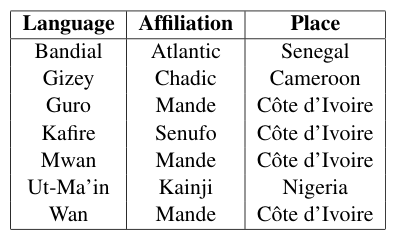
Table 1: West African languages in the SpeechReporting database
In the project, we work with texts (both oral and written) and not with elicited data. This helps to avoid the influence of the working language, and speakers' potential judgment about 'proper language use'. For example, logophoric pronouns, repetitions and some interjections and ideophones are very hard to elicit, though they do occur frequently in narratives.
We also restricted the genre of the texts we work with. The corpus is annotated for reported discourse (see Section 6), and thus, we chose fairy tales as a main data source, since in most fairy tales the driving force of the narration is the communication among characters.
Despite trying to keep the genre consistent across languages, the data are still very diverse. For example, it includes archived transcriptions, data from the field, recordings of professional storytellers as well as of regular people, one or multiple participants. Table 2 contains information about the composition of the corpus.
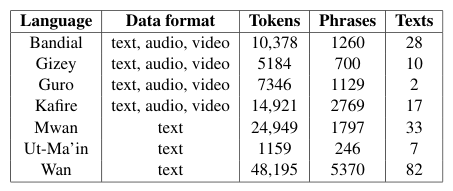
Table 2: Composition of the Discourse Reporting database (West African languages only)
In the table, 'Data format' refers to the modality of the data. For some languages, we have audio files, video files and corresponding written transcriptions, while for others, we only have the written transcriptions. While 'Tokens' refers to the number of tokens, 'Phrases' refers to the total number of intonational units into which the texts of that language are segmented. 'Texts' refers to the number of separate ELAN files per language, each corresponding to one narrative.
We transcribe texts using orthographies based on the International Phonetic Alphabet. The African languages in the database do not have a standardized orthography which is widely used by native speakers. Published materials are scarce and, in the majority of cases, were developed by the authors of the corpora and rely on the same or similar orthography.
4 Workflow and tools
The project unites multiple collaborators that work in different frameworks and use different tools for data documentation and analysis. As a result, we had two basic workflows. In one, segmentation and transcription are done in SayMore (Hatton, 2013) or ELAN (n.a., 2022; Sloetjes and Wittenburg, 2008). Segmented and transcribed texts are glossed in Toolbox or Flex and then imported to ELAN in order to add annotations of reported discourse. The other workflow allows researchers to use only one software product, ELAN-CorpA for segmentation, transcription, glossing and annotation of reported discourse.
Annotated files are checked manually and by using ELAN Tools (Chanard, 2019), a collection of scripts that checks the consistency of labels and the structure of the ELAN files. The manual checking consists of, among other things, proofreading the free translations and looking out for irregularities in the glosses and the morphemic analysis. Double-checked files are uploaded to Tsakorpus.
Collaborators could contribute to the project in various ways. Since 2019, we have had 4 postdocs, 2 PhD students, 6 research assistants and 8 non-contractual academic visitors working on the corpus.
5 Annotation of reported discourse
Annotation of reported discourse consists of four levels: the function of the construction's elements; the construction's syntactic type; the semantic type of the discourse report; and the encoding of participants within the discourse report. They correspond to four additional ELAN tiers (in our template, qt, rp, typ and par, respectively). Figure 1 is an example of our annotation of a Gizey sentence in an ELAN file.
Explained below are the basic principles of annotation that are relevant to searching in the corpus interface.
A reported speech construction consists of different elements; for example, in John said: Hello! the reported utterance (Hello!) is introduced by a clause describing the speech event (John said). In the Gizey example in Figure 1, "she says" is expressed by a Quotative, while "give millet; this red mare of mine..." is a Discourse report. The semantic type of the Discourse report is Command.
Different syntactic types of reported discourse constructions are visually represented by different frames. The types are defined by the elements the construction consists of. The syntactic type in the Gizey example is Quotative + Discourse report.
The elements referring to participants in the current or reported speech event are annotated in the Participant tier. The Gizey example contains a reference to the Reported Speaker (RS).
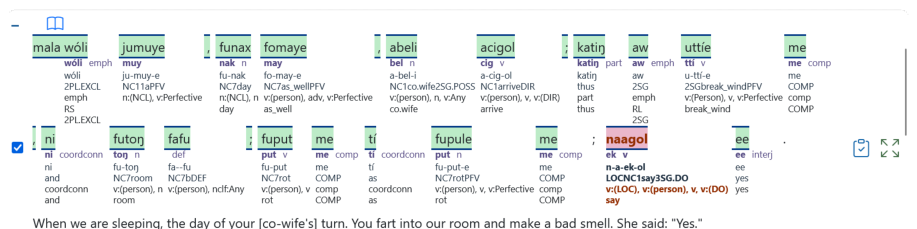
In the Tsakorpus interface, these annotations are reflected by background colors, frames, and pop-up windows. This is illustrated in Figure 2 for a sentence in Bandial (also known as Jóola Eegima), where the reported segment is in green and the speech event is in red.
6 Searching in Tsakorpus
Equipping the annotated corpora with a web-based search interface makes them more accessible both to linguists and to language communities. We made our corpora available online with the help of the Tsakorpus platform. The platform was mostly developed independently of the project. However, a number of features were added specifically to accommodate the needs of the SpeechReporting database.
Search queries in the online interface are formed by clicking on buttons and filling out text fields. A single-word query can include constraints on the word, its lemma, its part of speech and/or its glosses. All fields can handle Boolean functions (, for AND, | for OR, ~ for NOT). Word and lemma search can include regular expressions and provide instant suggestions when the user starts typing. Multi-word queries consist of several single-word queries with additional distance constraints.
When clicking "Search sentences", the user gets randomly ordered search hits, split into pages. The sound associated with a particular search hit, if any, can be played by clicking on that hit.
One limitation of Tsakorpus is that its basic search unit is a sentence (or any sentence-like segment of text). It is not possible to search for units that are either larger than a "sentence", or smaller than a "sentence" but larger than a word. ELAN segments (which normally represent intonational units) were reinterpreted as "sentences" in Tsakorpus. However, our discourse annotation often consists of multi-word spans that are either smaller than a sentence or transcend the segment sentence. In order to make them searchable, we add values of all discourse annotations that appear anywhere within a sentence as sentence-level metadata. This way, a query like "Quotative AND a word glossed as say" will return all sentences that contain both a Quotative span and a word glossed as "say", but they will not necessarily overlap. This option was added to Tsakorpus in the course of the project. Nevertheless, the exact spans inside sentences that have discourse annotations are highlighted with different colors in the search hits.
Figure 1: Example of an annotated Gizey sentence in ELAN
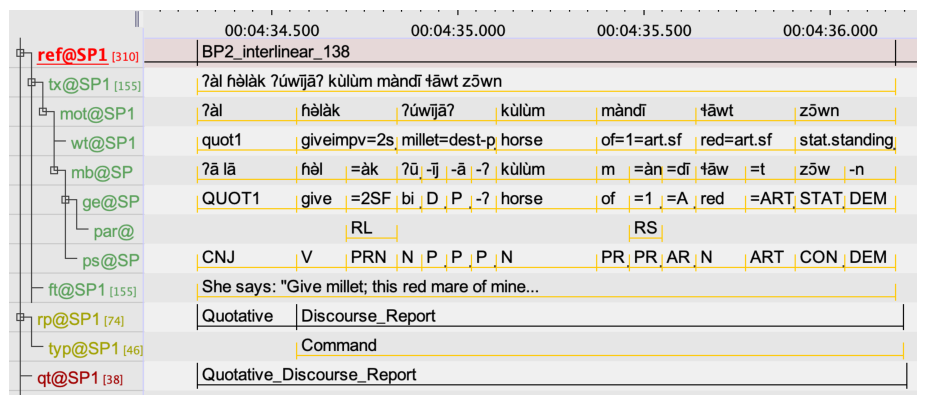
Figure 2: Example of search within Tsakorpus, a sentence in Bandial (Jóola Eegima)
The online corpus contains all languages present in the Discourse reporting database. When searching in the corpora, the user can choose between selecting a specific language and searching in all language sub-corpora at once. In the latter case, the search query must include annotation that is uniform across the sub-corpora. This includes annotation of reported discourse (see Section 5) and part-of-speech tags in the UD format (de Marneffe et al., 2021).
Currently, the corpus interface is available in English and Russian. The French interface is under construction.
7 Dissemination
Target users of the SpeechReporting Corpus are linguists and anthropologists who are interested in traditional narratives.
Besides academic uses, this corpus is a valuable source of materials for language communities to keep their languages and linguistic traditions alive; first of all, by simply having online access to recorded narration sessions of some of their folktales. In addition, we make materials, such as story-books, that the communities can use for educational purposes. Moreover, our project has received additional funding from the Humanités Numériques et Science Ouverte program of the Sorbonne Nouvelle in Paris for producing animated YouTube videos of the recorded folktales and spreading them among the linguistic communities and wider audiences.
Furthermore, the availability of open-access annotated linguistic data of minority African languages is important for the development of machine learning based technologies, which currently under-represent these languages.
8 Concluding remarks
The SpeechReporting Corpus provides meticulously annotated corpora of low-resourced indigenous languages spoken in West Africa. It also offers a digital representation of reported speech constructions on different levels of analysis (morphology, syntax and semantics), which opens a potential of a new understanding of a range of discursive phenomena. The SpeechReporting Corpus offers open access tools for comparable annotation of data from different languages. It contributes to the accessibility of previously unpublished traditional narratives in indigenous languages spoken in West Africa.
Limitations
One limitation of this corpus is the difficulty of comparing between the different languages. It is hard to identify typologically applicable categories based on limited amounts of data. For example, when deciding on which discourse categories to annotate, we had to make sure that we could use the same vocabulary for all the languages in our sample.
An additional limitation is the possible lack of consistency between the different sub-corpora. The cross-checking of the data is done manually. This is a tedious task that is susceptible to human error, but it is necessary to improve the quality of individual data sets.
Furthermore, we have discovered that it is challenging to bring together a perfect team for a project that is both linguistic and technological in nature.
Another possible limitation is related to transparency. Considering possible future uses of our corpora, we have tried to make the annotations as transparent as possible and have documented them all on our website.
Interdisciplinarity is another challenge: the kind of data that is suitable for dissemination in the communities is slightly different from the kind of data that is of primary interest from the point of view of linguistic theory.
Notes
1 In addition to describing strategies for reporting discourse employed in oral traditions of selected West African cultures, the project sets out to compare them to their functional counterparts from a geographically and historically unrelated area. Therefore, the database contains some languages spoken in Eurasia that will not be discussed in this article.
2 ELAN-CorpA is a fork-version of ELAN, developed by Christian Chanard, check this link https://llacan.cnrs.fr/res_ELAN-CorpA_en.php for more information.
3 A detailed description of the annotation principles can be found on the project website http://discoursereporting.huma-num.fr/annotation.pdf
4 The terminology used in the annotation of the syntactic and semantic elements in speech reporting comes from Spronck and Nikitina (2019).
5 http://discoursereporting.huma-num.fr/corpus/search
References
Chukwuma Azuonye. 1999. Igbo stories and storytelling. Traditional Storytelling Today: An International Sourcebook, pages 33-40.
Mellonee Victoria Burnim. 1976. Songs in Mende Folktales. Madison: University of Wisconsin.
Christian Chanard. 2015. ELAN-CorpA: Lexicon-aided annotation in ELAN. In Corpus-based Studies of Lesser-described Languages, pages 311-332. John Benjamins.
Christian Chanard. 2019. ELAN Tools: Python tools for ELAN. Online access: https://llacan.cnrs.fr/res_manuels_en.php, last accessed 13/02/2023.
Donald J Cosentino. 1980. Lele Gbomba and the style of Mende baroque. African Arts, 13(3):54-55.
Marie-Catherine de Marneffe, Christopher D. Manning, Joakim Nivre, and Daniel Zeman. 2021. Universal Dependencies. Computational Linguistics, 47(2):255-308.
Ruth Finnegan. 1967. Limba stories and story-telling. Oxford: Clarendon Press.
Ruth Finnegan. 1970. A note on oral tradition and historical evidence. History and Theory, 9(2):195-201.
Ruth Finnegan. 1977. Oral poetry: Its nature, significance and social context.
Ruth Finnegan. 2007. The oral and beyond: doing things with words in Africa. James Currey/University of Chicago Press.
Ruth Finnegan. 2012. Oral literature in Africa. Open Book Publishers.
Ken Hale. 1992. Endangered languages: On endangered languages and the safeguarding of diversity. language, 68(1):1-42.
John Hatton. 2013. Saymore: Language documentation productivity [Computer software].
Gordon Innes. 1965. The function of the song in Mende folktales. Sierra Leone Language Review, 4:54-63.
n.a. 2022. ELAN (Version 6.4) [Computer software].
Tatiana Nikitina. 2018. When linguists and speakers do not agree: The endangered grammar of verbal art in West Africa. Journal of Linguistic Anthropology, pages 197-220.
Tatiana Nikitina, Ekaterina Aplonova, Abbie Jordanoska, Izabela andHantgan-Sonko, Guillaume Guitang, Olga Kuznetsova, Elena Perekhvalskaya, and Lacina Silué. 2022. The speechreporting corpus: Discourse reporting in storytelling.
Tatiana Nikitina, Abbie Hantgan, and Christian Chanard. 2019. Reported speech annotation template for ELAN. (The SpeechReporting Corpus). Online access: http://discoursereporting.huma-num.fr/annotation.pdf, last accesed 16/03/2023.
Harold Scheub. 1985. A review of African oral traditions and literature. African Studies Review, 28(2-3):1-72.
Han Sloetjes and Peter Wittenburg. 2008. Annotation by category-ELAN and ISO DCR. In 6th international Conference on Language Resources and Evaluation (LREC 2008).
Stef Spronck and Tatiana Nikitina. 2019. Reported speech forms a dedicated syntactic domain. Linguistic Typology, 23:119-159.
SpeechReporting Corpus: annotated corpora of West African traditional narratives
SpeechReporting Corpus: corpus annotés de récits traditionnels ouest-africains
Affiliations
Katya Aplonova
Izabela Jordanoska
Timofey Arkhangelsky
Tatiana Nikitina
LLACAN, CNRS
LACITO, CNRS
Universität Hamburg
LACITO, CNRS
Affiliations
Katya Aplonova
Izabela Jordanoska
Timofey Arkhangelsky
Tatiana Nikitina
LLACAN, CNRS
LACITO, CNRS
Universität Hamburg
LACITO, CNRS
Abstract
Résumé
This paper describes the SpeechReporting Corpus, an online collection of corpora annotated for a range of discourse phenomena. The corpora contain folktales from 7 lesser-studied West African languages. Apart from its value for theoretical linguistics, especially for the study of reported speech, the database is an important resource for the preservation of intangible cultural heritage of minority languages and the development and testing of crosslinguistically applicable computational tools.
Cet article décrit le SpeechReporting Corpus, une collection en ligne de corpus annotés pour une gamme de phénomènes de discours. Les corpus contiennent des contes populaires de 7 langues ouest-africaines moins étudiées. Outre sa valeur pour la linguistique théorique, en particulier pour l'étude du discours rapporté, la base de données est une ressource importante pour la préservation du patrimoine culturel immatériel des langues minoritaires et le développement et la mise à l'essai d'outils informatiques applicables à plusieurs langues.
1 Introduction
1 Introduction
Recent decades have seen an upsurge of interest in issues of language extinction, leading to increased efforts to describe and document the world's endangered languages. The major adverse effects of language endangerment are also associated with loss of different forms of traditional knowledge (Hale, 1992).
Les dernières décennies ont vu un regain d'intérêt pour les questions d'extinction des langues, conduisant à des efforts accrus pour décrire et documenter les langues en voie de disparition dans le monde. Les principaux effets néfastes de la mise en péril des langues sont également associés à la perte de différentes formes de connaissances traditionnelles (Hale, 1992).
The SpeechReporting Corpus (Nikitina et al., 2022) explores the relationship between specific discourse practices that represent the nucleus of the transmission of traditional knowledge and the linguistic strategies associated with it, centering on one particular problem: discourse reporting in traditional oral storytelling in West Africa, the "oral continent par excellence" and the homeland of a rich and vibrant oral tradition (Scheub, 1985; Finnegan, 2007, inter alia).
Le corpus SpeechReporting (Nikitina et al., 2022) explore la relation entre des pratiques discursives spécifiques qui représentent le noyau de la transmission des connaissances traditionnelles et les stratégies linguistiques qui lui sont associées, en se centrant sur un problème particulier : le rapport de discours dans les récits traditionnels oraux en Afrique de l'Ouest, le "continent oral par excellence" et le berceau d'une tradition orale riche et vibrante (Scheub, 1985; Finnegan, 2007, inter alia).
The article is structured as follows: in Section 2 we discuss why the SpeechReporting database is particularly relevant for West Africa. Section 3 is dedicated to database composition. Our workflow and tools are described in Section 4, while Section 5 shows some basic principles of annotation of reported discourse. In Section 6, we show how the online interface of the corpus works. In Section 7, we illustrate how the corpus can be used for dissemination among linguistic communities in order to archive and help preserve intangible cultural heritage. Section 8 concludes the paper.
L'article est structuré comme suit: dans la section 2, nous discutons des raisons pour lesquelles la base de données SpeechReporting est particulièrement pertinente pour l'Afrique de l'Ouest. La section 3 est consacrée à la composition de la base de données. Notre flux de travail et nos outils sont décrits à la section 4, tandis que la section 5 montre quelques principes de base de l'annotation du discours rapporté. Dans la section 6, nous montrons comment fonctionne l'interface en ligne du corpus. Dans la section 7, nous illustrons comment le corpus peut être utilisé pour la diffusion parmi les communautés linguistiques afin d'archiver et d'aider à préserver le patrimoine culturel immatériel. La section 8 conclut le document.
2 West African storytelling traditions
2 Les traditions de narration ouest-africaines
In traditional rural societies of West Africa, the acute feeling of loss is related to the diminishing role played by culturally significant discourse practices: even in communities that retain traditional social organization and economy, modern Western cultural practices seep into daily life with new forms of entertainment (television, radio broadcasts) and education (compulsory Western-style schooling). Under the pressure from these new practices, traditional forms of knowledge transmission - including techniques of storytelling and instruction - become unimportant, and may eventually go out of use.
Dans les sociétés rurales traditionnelles d'Afrique de l'Ouest, le sentiment aigu de perte est lié au rôle décroissant joué par les pratiques de discours culturellement significatives: même dans les communautés qui conservent l'organisation sociale et l'économie traditionnelles, les pratiques culturelles occidentales modernes s'infiltrent dans la vie quotidienne avec de nouvelles formes de divertissement (télévision, émissions de radio) et d'éducation (école obligatoire de style occidental). Sous la pression de ces nouvelles pratiques, les formes traditionnelles de transmission des connaissances - y compris les techniques de narration et d'instruction - deviennent insignifiantes, et peuvent éventuellement tomber en désuétude.
In many local communities across Africa, storytelling is more than a favorite pastime. Viewed as a vital part of cultural heritage, it serves as a central medium for the transmission of cultural knowledge. Storytelling traditions have accumulated special linguistic techniques that respond to the needs of specific practices of textual production and performance. As storytelling traditions vanish with older generations of speakers, they take along with them an array of linguistic tools on which such specialized techniques relied (Nikitina, 2018).
Dans de nombreuses communautés locales à travers l'Afrique, la narration d'histoires est bien plus qu'un passe-temps favori. Considéré comme un élément essentiel du patrimoine culturel, il sert de moyen central pour la transmission du savoir culturel. Les traditions de narration ont accumulé des techniques linguistiques particulières qui répondent aux besoins de pratiques spécifiques de production et de performance textuelles. Au fur et à mesure que les traditions de narration disparaissent avec les générations plus âgées de locuteurs, elles emportent avec elles une gamme d’outils linguistiques sur lesquels reposaient ces techniques spécialisées (Nikitina, 2018).
While oral traditions of West Africa have received considerable attention from anthropologists (Finnegan, 1970, 2012), their linguistic aspects have not been subject to systematic investigation. Our knowledge of the special ways in which language is used in traditional genres is largely limited to observations of frequent use of special vocabulary and opening/closing formulae (Cosentino, 1980), singing (Innes, 1965; Burnim, 1976; Azuonye, 1999), and various forms of repetition (Finnegan, 1967, 1977). The goal of our database is to start filling this gap using an interdisciplinary approach combining rigorous analysis of primary data with meticulous attention to genre characteristics and culture-specific contexts of textual production.
Bien que les traditions orales de l'Afrique de l'Ouest aient reçu une attention considérable de la part des anthropologues (Finnegan, 1970, 2012), leurs aspects linguistiques n'ont pas fait l'objet d'une investigation systématique. Nos connaissances sur les façons particulières dont la langue est utilisée dans les genres traditionnels sont largement limitées à des observations de l'utilisation fréquente de vocabulaire spécial et de formules d'ouverture/fermeture (Cosentino, 1980), de chant (Innes, 1965; Burnim, 1976; Azuonye, 1999), et de diverses formes de répétition (Finnegan, 1967, 1977). L'objectif de notre base de données est de commencer à combler cette lacune en utilisant une approche interdisciplinaire combinant une analyse rigoureuse des données primaires avec une attention méticuleuse aux caractéristiques de genre et aux contextes culturels spécifiques de la production textuelle.
3 Database composition
3 Composition de la base de données
The SpeechReporting Corpus contains multiple sub-corpora of traditional folk stories, annotated for a number of discourse phenomena using the ELAN-CorpA software and tools (Chanard, 2015; Nikitina et al., 2019). It is updated regularly with newly available data, including data from new languages. The project currently involves 11 different languages, of which 7 are spoken in West Africa. All texts are transcribed, glossed, translated, and annotated. Table 1 lists the West African languages in the database, their genetic affiliation and country where they are spoken.
Le SpeechReporting Corpus contient plusieurs sous-corpus d'histoires traditionnelles, annotés pour un certain nombre de phénomènes discursifs à l'aide du logiciel et des outils ELAN-CorpA (Chanard, 2015; Nikitina et al., 2019). Il est mis à jour régulièrement avec les nouvelles données disponibles, y compris les données provenant de nouvelles langues. Le projet implique actuellement 11 langues différentes, dont 7 sont parlées en Afrique de l'Ouest. Tous les textes sont transcrits, glossés, traduits et annotés. Le tableau 1 répertorie les langues ouest-africaines dans la base de données, leur affiliation génétique et le pays où elles sont parlées.
Table 1: West African languages in the SpeechReporting database
Tableau 1: Langues ouest-africaines dans la base de données SpeechReporting
In the project, we work with texts (both oral and written) and not with elicited data. This helps to avoid the influence of the working language, and speakers' potential judgment about 'proper language use'. For example, logophoric pronouns, repetitions and some interjections and ideophones are very hard to elicit, though they do occur frequently in narratives.
Dans le cadre du projet, nous travaillons avec des textes (oraux et écrits) et non avec des données recueillies par élicitation. Cela permet d'éviter l'influence de la langue de travail, et le jugement potentiel des locuteurs sur « l'usage approprié de la langue ». Par exemple, les pronoms logophoriques, les répétitions et certaines interjections et idéophones sont très difficiles à éliciter, bien qu'ils apparaissent fréquemment dans les récits.
We also restricted the genre of the texts we work with. The corpus is annotated for reported discourse (see Section 6), and thus, we chose fairy tales as a main data source, since in most fairy tales the driving force of the narration is the communication among characters.
Nous avons également restreint le genre des textes avec lesquels nous travaillons. Le corpus est annoté pour le discours rapporté (voir Section 6), et ainsi, nous avons choisi les contes de fées comme source de données principale, puisque dans la plupart des contes de fées la force motrice de la narration est la communication entre les personnages.
Despite trying to keep the genre consistent across languages, the data are still very diverse. For example, it includes archived transcriptions, data from the field, recordings of professional storytellers as well as of regular people, one or multiple participants. Table 2 contains information about the composition of the corpus.
Malgré les efforts pour maintenir la cohérence du genre entre les langues, les données restent très diverses. Par exemple, il comprend des transcriptions archivées, des données du terrain, des enregistrements de conteurs professionnels ainsi que de personnes ordinaires, un ou plusieurs participants. Le tableau 2 contient des informations sur la composition du corpus.
Table 2: Composition of the Discourse Reporting database (West African languages only)
Tableau 2 : Composition de la base de données Discourse Reporting (langues ouest-africaines uniquement)
In the table, 'Data format' refers to the modality of the data. For some languages, we have audio files, video files and corresponding written transcriptions, while for others, we only have the written transcriptions. While 'Tokens' refers to the number of tokens, 'Phrases' refers to the total number of intonational units into which the texts of that language are segmented. 'Texts' refers to the number of separate ELAN files per language, each corresponding to one narrative.
Dans le tableau, le « format de données » fait référence à la modalité des données. Pour certaines langues, nous avons des fichiers audio, des fichiers vidéo et des transcriptions écrites correspondantes, tandis que pour d'autres, nous n'avons que les transcriptions écrites. Alors que 'Tokens' se réfère au nombre de jetons, 'Phrases' se réfère au nombre total d'unités intonatives dans lesquelles les textes de cette langue sont segmentés. 'Textes' fait référence au nombre de fichiers ELAN distincts par langue, chacun correspondant à un récit.
We transcribe texts using orthographies based on the International Phonetic Alphabet. The African languages in the database do not have a standardized orthography which is widely used by native speakers. Published materials are scarce and, in the majority of cases, were developed by the authors of the corpora and rely on the same or similar orthography.
Nous transcrivons les textes en utilisant des orthographes basées sur l'alphabet phonétique international. Les langues africaines dans la base de données n'ont pas une orthographe standardisée qui est largement utilisée par les locuteurs natifs. Les matériaux publiés sont rares et, dans la majorité des cas, ont été développés par les auteurs des corpus et reposent sur une orthographe identique ou similaire.
4 Workflow and tools
4 Flux de travail et outils
The project unites multiple collaborators that work in different frameworks and use different tools for data documentation and analysis. As a result, we had two basic workflows. In one, segmentation and transcription are done in SayMore (Hatton, 2013) or ELAN (n.a., 2022; Sloetjes and Wittenburg, 2008). Segmented and transcribed texts are glossed in Toolbox or Flex and then imported to ELAN in order to add annotations of reported discourse. The other workflow allows researchers to use only one software product, ELAN-CorpA for segmentation, transcription, glossing and annotation of reported discourse.
Le projet unit plusieurs collaborateurs qui travaillent dans différents cadres et utilisent différents outils pour la documentation et l'analyse des données. En conséquence, nous avions deux flux de travail de base. Dans l'un, la segmentation et la transcription sont réalisées dans SayMore (Hatton, 2013) ou ELAN (n.a., 2022; Sloetjes et Wittenburg, 2008). Les textes segmentés et transcrits sont glossés dans Toolbox ou Flex, puis importés dans ELAN afin d'ajouter des annotations de discours rapporté. L'autre flux de travail permet aux chercheurs d'utiliser un seul produit logiciel, ELAN-CorpA pour la segmentation, la transcription, le glossing et l'annotation du discours rapporté.
Annotated files are checked manually and by using ELAN Tools (Chanard, 2019), a collection of scripts that checks the consistency of labels and the structure of the ELAN files. The manual checking consists of, among other things, proofreading the free translations and looking out for irregularities in the glosses and the morphemic analysis. Double-checked files are uploaded to Tsakorpus.
Les fichiers annotés sont vérifiés manuellement et à l'aide des ELAN Tools (Chanard, 2019), une collection de scripts qui vérifie la cohérence des étiquettes et la structure des fichiers ELAN. La vérification manuelle consiste, entre autres, à relire les traductions libres et à rechercher les irrégularités dans les glosses et l'analyse morphémique. Les fichiers doublement vérifiés sont téléchargés sur Tsakorpus.
Collaborators could contribute to the project in various ways. Since 2019, we have had 4 postdocs, 2 PhD students, 6 research assistants and 8 non-contractual academic visitors working on the corpus.
Les collaborateurs pouvaient contribuer au projet de diverses manières. Depuis 2019, nous avons eu 4 postdoctorants, 2 doctorants, 6 assistants de recherche et 8 visiteurs académiques non contractuels travaillant sur le corpus.
5 Annotation of reported discourse
5 Annotation du discours rapporté
Annotation of reported discourse consists of four levels: the function of the construction's elements; the construction's syntactic type; the semantic type of the discourse report; and the encoding of participants within the discourse report. They correspond to four additional ELAN tiers (in our template, qt, rp, typ and par, respectively). Figure 1 is an example of our annotation of a Gizey sentence in an ELAN file.
L'annotation du discours rapporté se compose de quatre niveaux: la fonction des éléments de la construction; le type syntaxique de la construction; le type sémantique du rapport de discours; et l'encodage des participants dans le rapport de discours. Ils correspondent à quatre niveaux ELAN supplémentaires (dans notre modèle, qt, rp, typ et par, respectivement). La figure 1 est un exemple de notre annotation d'une phrase de Gizey dans un fichier ELAN.
Explained below are the basic principles of annotation that are relevant to searching in the corpus interface.
Nous expliquons ci-dessous les principes de base de l'annotation qui sont pertinents pour la recherche dans l'interface du corpus.
A reported speech construction consists of different elements; for example, in John said: Hello! the reported utterance (Hello!) is introduced by a clause describing the speech event (John said). In the Gizey example in Figure 1, "she says" is expressed by a Quotative, while "give millet; this red mare of mine..." is a Discourse report. The semantic type of the Discourse report is Command.
Une construction de discours rapporté est composée de différents éléments ; par exemple, dans John said: Hello! l'énoncé rapporté (Hello!) est introduit par une proposition décrivant l'événement de parole (John said). Dans l'exemple de Gizey dans la Figure 1, "elle dit" est exprimé par un Quotatif, tandis que "donne du millet; cette jument rouge de la mienne..." est un rapport de Discours. Le type sémantique du rapport Discours est Commande.
Different syntactic types of reported discourse constructions are visually represented by different frames. The types are defined by the elements the construction consists of. The syntactic type in the Gizey example is Quotative + Discourse report.
Les différents types syntaxiques de constructions de discours rapporté sont représentés visuellement par différents cadres. Les types sont définis par les éléments dont la construction est composée. Le type syntaxique dans l'exemple de Gizey est Quotatif + Rapport de discours.
The elements referring to participants in the current or reported speech event are annotated in the Participant tier. The Gizey example contains a reference to the Reported Speaker (RS).
Les éléments se référant aux participants de l'événement de parole actuel ou rapporté sont annotés dans le niveau Participant. L'exemple de Gizey contient une référence au Locuteur Rapporté (LR).
In the Tsakorpus interface, these annotations are reflected by background colors, frames, and pop-up windows. This is illustrated in Figure 2 for a sentence in Bandial (also known as Jóola Eegima), where the reported segment is in green and the speech event is in red.
Dans l'interface Tsakorpus, ces annotations sont reflétées par les couleurs d'arrière-plan, les cadres et les fenêtres contextuelles. Cela est illustré dans la Figure 2 pour une phrase en Bandial (également connu sous le nom de Jóola Eegima), où le segment rapporté est en vert et l'événement de parole est en rouge.
6 Searching in Tsakorpus
6 Recherche dans Tsakorpus
Equipping the annotated corpora with a web-based search interface makes them more accessible both to linguists and to language communities. We made our corpora available online with the help of the Tsakorpus platform. The platform was mostly developed independently of the project. However, a number of features were added specifically to accommodate the needs of the SpeechReporting database.
Équiper les corpus annotés d'une interface de recherche basée sur le web les rend plus accessibles aux linguistes ainsi qu'aux communautés linguistiques. Nous avons mis nos corpus en ligne grâce à la plateforme Tsakorpus. La plateforme a été principalement développée indépendamment du projet. Cependant, un certain nombre de fonctionnalités ont été ajoutées spécifiquement pour répondre aux besoins de la base de données SpeechReporting.
Search queries in the online interface are formed by clicking on buttons and filling out text fields. A single-word query can include constraints on the word, its lemma, its part of speech and/or its glosses. All fields can handle Boolean functions (, for AND, | for OR, ~ for NOT). Word and lemma search can include regular expressions and provide instant suggestions when the user starts typing. Multi-word queries consist of several single-word queries with additional distance constraints.
Les requêtes de recherche dans l'interface en ligne sont formées en cliquant sur les boutons et en remplissant les champs de texte. Une requête à mot unique peut inclure des contraintes sur le mot, son lemme, sa partie du discours et/ou ses glosses. Tous les champs peuvent gérer des fonctions booléennes (, pour AND, | pour OR, ~ pour NOT). La recherche de mots et de lemmes peut inclure des expressions régulières et fournir des suggestions instantanées lorsque l'utilisateur commence à taper. Les requêtes multi-mots se composent de plusieurs requêtes mono-mots avec des contraintes de distance supplémentaires.
When clicking "Search sentences", the user gets randomly ordered search hits, split into pages. The sound associated with a particular search hit, if any, can be played by clicking on that hit.
Lors du clic sur "Rechercher des phrases", l'utilisateur obtient des résultats de recherche classés aléatoirement, divisés en pages. Le son associé à un résultat de recherche particulier, s'il y en a un, peut être joué en cliquant sur ce résultat.
One limitation of Tsakorpus is that its basic search unit is a sentence (or any sentence-like segment of text). It is not possible to search for units that are either larger than a "sentence", or smaller than a "sentence" but larger than a word. ELAN segments (which normally represent intonational units) were reinterpreted as "sentences" in Tsakorpus. However, our discourse annotation often consists of multi-word spans that are either smaller than a sentence or transcend the segment sentence. In order to make them searchable, we add values of all discourse annotations that appear anywhere within a sentence as sentence-level metadata. This way, a query like "Quotative AND a word glossed as say" will return all sentences that contain both a Quotative span and a word glossed as "say", but they will not necessarily overlap. This option was added to Tsakorpus in the course of the project. Nevertheless, the exact spans inside sentences that have discourse annotations are highlighted with different colors in the search hits.
Une limitation de Tsakorpus est que son unité de recherche de base est une phrase (ou tout segment de texte ressemblant à une phrase). Il n'est pas possible de rechercher des unités qui sont soit plus grandes qu'une "phrase", soit plus petites qu'une "phrase" mais plus grandes qu'un mot. Les segments ELAN (qui représentent normalement des unités intonationnelles) ont été réinterprétés comme des "phrases" dans Tsakorpus. Cependant, notre annotation de discours consiste souvent en des segments de plusieurs mots qui sont soit plus petits qu'une phrase, soit transcendent la phrase segmentée. Afin de les rendre recherchables, nous ajoutons les valeurs de toutes les annotations de discours qui apparaissent n'importe où dans une phrase en tant que métadonnées au niveau de la phrase. De cette façon, une requête comme "Quotative AND un mot glossé comme say" retournera toutes les phrases qui contiennent à la fois une étendue Quotative et un mot glossé comme "say", mais elles ne se chevaucheront pas nécessairement. Cette option a été ajoutée à Tsakorpus au cours du projet. Néanmoins, les portées exactes à l'intérieur des phrases qui ont des annotations de discours sont mises en évidence avec différentes couleurs dans les résultats de recherche.
Figure 1: Example of an annotated Gizey sentence in ELAN
Figure 1 : Exemple d’une phrase annotée de Gizey dans ELAN
Figure 2: Example of search within Tsakorpus, a sentence in Bandial (Jóola Eegima)
Figure 2: Exemple de recherche dans Tsakorpus, une phrase en Bandial (Jóola Eegima)
The online corpus contains all languages present in the Discourse reporting database. When searching in the corpora, the user can choose between selecting a specific language and searching in all language sub-corpora at once. In the latter case, the search query must include annotation that is uniform across the sub-corpora. This includes annotation of reported discourse (see Section 5) and part-of-speech tags in the UD format (de Marneffe et al., 2021).
Le corpus en ligne contient toutes les langues présentes dans la base de données Discourse reporting. Lors de la recherche dans les corpus, l'utilisateur peut choisir entre sélectionner une langue spécifique et rechercher dans tous les sous-corpus linguistiques en même temps. Dans ce dernier cas, la requête de recherche doit inclure une annotation uniforme dans les sous-corpus. Cela inclut l'annotation du discours rapporté (voir Section 5) et les étiquettes de partie du discours au format UD (de Marneffe et al., 2021).
Currently, the corpus interface is available in English and Russian. The French interface is under construction.
Actuellement, l'interface du corpus est disponible en anglais et en russe. L'interface française est en cours de construction.
7 Dissemination
7 Diffusion
Target users of the SpeechReporting Corpus are linguists and anthropologists who are interested in traditional narratives.
Les utilisateurs cibles du SpeechReporting Corpus sont les linguistes et les anthropologues qui s'intéressent aux récits traditionnels.
Besides academic uses, this corpus is a valuable source of materials for language communities to keep their languages and linguistic traditions alive; first of all, by simply having online access to recorded narration sessions of some of their folktales. In addition, we make materials, such as story-books, that the communities can use for educational purposes. Moreover, our project has received additional funding from the Humanités Numériques et Science Ouverte program of the Sorbonne Nouvelle in Paris for producing animated YouTube videos of the recorded folktales and spreading them among the linguistic communities and wider audiences.
Outre les usages académiques, ce corpus est une source précieuse de matériaux pour les communautés linguistiques afin de maintenir leurs langues et leurs traditions linguistiques vivantes ; d'abord, en ayant simplement un accès en ligne aux sessions d'enregistrement de narration de certains de leurs contes populaires. De plus, nous produisons des matériaux, tels que des livres d'histoires, que les communautés peuvent utiliser à des fins éducatives. De plus, notre projet a reçu un financement supplémentaire du programme Humanités Numériques et Science Ouverte de la Sorbonne Nouvelle à Paris pour produire des vidéos YouTube animées des contes folkloriques enregistrés et les diffuser parmi les communautés linguistiques et un public plus large.
Furthermore, the availability of open-access annotated linguistic data of minority African languages is important for the development of machine learning based technologies, which currently under-represent these languages.
En outre, la disponibilité de données linguistiques annotées en libre accès des langues africaines minoritaires est importante pour le développement de technologies basées sur l'apprentissage automatique, qui sous-représentent actuellement ces langues.
8 Concluding remarks
8 Remarques conclusives
The SpeechReporting Corpus provides meticulously annotated corpora of low-resourced indigenous languages spoken in West Africa. It also offers a digital representation of reported speech constructions on different levels of analysis (morphology, syntax and semantics), which opens a potential of a new understanding of a range of discursive phenomena. The SpeechReporting Corpus offers open access tools for comparable annotation of data from different languages. It contributes to the accessibility of previously unpublished traditional narratives in indigenous languages spoken in West Africa.
Le SpeechReporting Corpus fournit des corpus méticuleusement annotés de langues indigènes peu dotées en ressources et parlées en Afrique de l'Ouest. Il propose également une représentation numérique des constructions de discours rapporté à différents niveaux d'analyse (morphologie, syntaxe et sémantique), ce qui ouvre un potentiel de nouvelle compréhension d'une gamme de phénomènes discursifs. Le SpeechReporting Corpus offre des outils en libre accès pour une annotation comparable des données de différentes langues. Il contribue à l'accessibilité de récits traditionnels auparavant non publiés dans des langues indigènes parlées en Afrique de l'Ouest.
Limitations
Limites
One limitation of this corpus is the difficulty of comparing between the different languages. It is hard to identify typologically applicable categories based on limited amounts of data. For example, when deciding on which discourse categories to annotate, we had to make sure that we could use the same vocabulary for all the languages in our sample.
Une limite de ce corpus est la difficulté de comparer entre les différentes langues. Il est difficile d'identifier les catégories typologiquement applicables sur la base de quantités limitées de données. Par exemple, en décidant quelles catégories de discours annoter, nous devions nous assurer que nous pouvions utiliser le même vocabulaire pour toutes les langues de notre échantillon.
An additional limitation is the possible lack of consistency between the different sub-corpora. The cross-checking of the data is done manually. This is a tedious task that is susceptible to human error, but it is necessary to improve the quality of individual data sets.
Une limitation supplémentaire est le manque possible de cohérence entre les différents sous-corpus. La vérification croisée des données est effectuée manuellement. Il s'agit d'une tâche fastidieuse susceptible d'erreurs humaines, mais elle est nécessaire pour améliorer la qualité des ensembles de données individuels.
Furthermore, we have discovered that it is challenging to bring together a perfect team for a project that is both linguistic and technological in nature.
Par ailleurs, nous avons découvert qu'il est difficile de réunir une équipe parfaite pour un projet à la fois linguistique et technologique.
Another possible limitation is related to transparency. Considering possible future uses of our corpora, we have tried to make the annotations as transparent as possible and have documented them all on our website.
Une autre limitation possible est liée à la transparence. En considérant les utilisations futures possibles de nos corpus, nous avons essayé de rendre les annotations aussi transparentes que possible et les avons toutes documentées sur notre site web.
Interdisciplinarity is another challenge: the kind of data that is suitable for dissemination in the communities is slightly different from the kind of data that is of primary interest from the point of view of linguistic theory.
L’interdisciplinarité est un autre défi : le type de données qui convient à la diffusion dans les communautés est légèrement différent du type de données qui présente un intérêt primordial du point de vue de la théorie linguistique.
Notes
Notes
1 In addition to describing strategies for reporting discourse employed in oral traditions of selected West African cultures, the project sets out to compare them to their functional counterparts from a geographically and historically unrelated area. Therefore, the database contains some languages spoken in Eurasia that will not be discussed in this article.
1 En plus de décrire les stratégies de rapport de discours employées dans les traditions orales de certaines cultures d'Afrique de l'Ouest, le projet vise à les comparer à leurs équivalents fonctionnels issus d'une zone géographiquement et historiquement non apparentée. Par conséquent, la base de données contient certaines langues parlées en Eurasie qui ne seront pas discutées dans cet article.
2 ELAN-CorpA is a fork-version of ELAN, developed by Christian Chanard, check this link https://llacan.cnrs.fr/res_ELAN-CorpA_en.php for more information.
2 ELAN-CorpA est une version dérivée de ELAN, développée par Christian Chanard, consultez ce lien https://llacan.cnrs.fr/res_ELAN-CorpA_en.php pour plus d'informations.
3 A detailed description of the annotation principles can be found on the project website http://discoursereporting.huma-num.fr/annotation.pdf
3 Une description détaillée des principes d'annotation peut être trouvée sur le site web du projet http://discoursereporting.huma-num.fr/annotation.pdf
4 The terminology used in the annotation of the syntactic and semantic elements in speech reporting comes from Spronck and Nikitina (2019).
4 La terminologie utilisée dans l'annotation des éléments syntaxiques et sémantiques dans la parole rapportée provient de Spronck et Nikitina (2019).
5 http://discoursereporting.huma-num.fr/corpus/search
References
Références
Chukwuma Azuonye. 1999. Igbo stories and storytelling. Traditional Storytelling Today: An International Sourcebook, pages 33-40.
Mellonee Victoria Burnim. 1976. Songs in Mende Folktales. Madison: University of Wisconsin.
Christian Chanard. 2015. ELAN-CorpA: Lexicon-aided annotation in ELAN. In Corpus-based Studies of Lesser-described Languages, pages 311-332. John Benjamins.
Christian Chanard. 2019. ELAN Tools: Python tools for ELAN. Online access: https://llacan.cnrs.fr/res_manuels_en.php, last accessed 13/02/2023.
Donald J Cosentino. 1980. Lele Gbomba and the style of Mende baroque. African Arts, 13(3):54-55.
Marie-Catherine de Marneffe, Christopher D. Manning, Joakim Nivre, and Daniel Zeman. 2021. Universal Dependencies. Computational Linguistics, 47(2):255-308.
Ruth Finnegan. 1967. Limba stories and story-telling. Oxford: Clarendon Press.
Ruth Finnegan. 1970. A note on oral tradition and historical evidence. History and Theory, 9(2):195-201.
Ruth Finnegan. 1977. Oral poetry: Its nature, significance and social context.
Ruth Finnegan. 2007. The oral and beyond: doing things with words in Africa. James Currey/University of Chicago Press.
Ruth Finnegan. 2012. Oral literature in Africa. Open Book Publishers.
Ken Hale. 1992. Endangered languages: On endangered languages and the safeguarding of diversity. language, 68(1):1-42.
John Hatton. 2013. Saymore: Language documentation productivity [Computer software].
Gordon Innes. 1965. The function of the song in Mende folktales. Sierra Leone Language Review, 4:54-63.
n.a. 2022. ELAN (Version 6.4) [Computer software].
Tatiana Nikitina. 2018. When linguists and speakers do not agree: The endangered grammar of verbal art in West Africa. Journal of Linguistic Anthropology, pages 197-220.
Tatiana Nikitina, Ekaterina Aplonova, Abbie Jordanoska, Izabela andHantgan-Sonko, Guillaume Guitang, Olga Kuznetsova, Elena Perekhvalskaya, and Lacina Silué. 2022. The speechreporting corpus: Discourse reporting in storytelling.
Tatiana Nikitina, Abbie Hantgan, and Christian Chanard. 2019. Reported speech annotation template for ELAN. (The SpeechReporting Corpus). Online access: http://discoursereporting.huma-num.fr/annotation.pdf, last accesed 16/03/2023.
Harold Scheub. 1985. A review of African oral traditions and literature. African Studies Review, 28(2-3):1-72.
Han Sloetjes and Peter Wittenburg. 2008. Annotation by category-ELAN and ISO DCR. In 6th international Conference on Language Resources and Evaluation (LREC 2008).
Stef Spronck and Tatiana Nikitina. 2019. Reported speech forms a dedicated syntactic domain. Linguistic Typology, 23:119-159.
SpeechReporting Corpus: annotated corpora of West African traditional narratives
SpeechReporting Corpus: korasi zilizofafanuliwa za masimulizi ya kitamaduni ya Afrika Magharibi
Affiliations
Katya Aplonova
Izabela Jordanoska
Timofey Arkhangelsky
Tatiana Nikitina
LLACAN, CNRS
LACITO, CNRS
Universität Hamburg
LACITO, CNRS
Taasisi
Katya Aplonova
Izabela Jordanoska
Timofey Arkhangelsky
Tatiana Nikitina
LLACAN, CNRS
LACITO, CNRS
Universität Hamburg
LACITO, CNRS
Abstract
Muhtasari
This paper describes the SpeechReporting Corpus, an online collection of corpora annotated for a range of discourse phenomena. The corpora contain folktales from 7 lesser-studied West African languages. Apart from its value for theoretical linguistics, especially for the study of reported speech, the database is an important resource for the preservation of intangible cultural heritage of minority languages and the development and testing of crosslinguistically applicable computational tools.
Makala haya yanaelezea SpeechReporting Corpus, mkusanyiko wa mtandaoni wa korasi zilizofafanuliwa kwa ajili ya aina mbalimbali za matukio ya mazungumzo. Korasi hizo zina hadithi za kimapokeo kutoka lugha 7 za Afrika Magharibi ambazo hazijasomwa sana. Mbali na thamani yake kwa isimu ya kinadharia, hasa kwa ajili ya utafiti wa usemi ulioripotiwa, hifadhidata hii ni rasilimali muhimu kwa ajili ya uhifadhi wa urithi wa kitamaduni usioonekana wa lugha za wachache na kwa ajili ya kuendeleza na kujaribu zana za kikompyuta zinazoweza kutumika kwa lugha mbalimbali.
1 Introduction
1 Utangulizi
Recent decades have seen an upsurge of interest in issues of language extinction, leading to increased efforts to describe and document the world's endangered languages. The major adverse effects of language endangerment are also associated with loss of different forms of traditional knowledge (Hale, 1992).
Miaka hamsini ya hivi karibuni yameona ongezeko la nia katika masuala ya kutoweka kwa lugha, jambo ambalo limesababisha juhudi kubwa zaidi za kuelezea na kuhifadhi lugha zinazokabiliwa na hatari duniani. Madhara makuu mabaya ya kuhatarishwa kwa lugha pia yanahusishwa na upotevu wa aina tofauti za maarifa ya kimapokeo (Hale, 1992).
The SpeechReporting Corpus (Nikitina et al., 2022) explores the relationship between specific discourse practices that represent the nucleus of the transmission of traditional knowledge and the linguistic strategies associated with it, centering on one particular problem: discourse reporting in traditional oral storytelling in West Africa, the "oral continent par excellence" and the homeland of a rich and vibrant oral tradition (Scheub, 1985; Finnegan, 2007, inter alia).
SpeechReporting Corpus (Nikitina et al., 2022) inachunguza uhusiano kati ya mazoea mahususi ya mazungumzo ambayo yanawakilisha kiini cha upitishaji wa maarifa ya kimapokeo na mikakati ya kiisimu inayohusishwa nayo, ikizingatia tatizo moja mahususi: kuripoti kwa mazungumzo katika usimuliaji wa kimapokeo wa mdomo katika Afrika Magharibi, "bara la mdomo kwa ubora" na makao ya utamaduni wa mdomo tajiri na changamfu (Scheub, 1985; Finnegan, 2007, inter alia).
The article is structured as follows: in Section 2 we discuss why the SpeechReporting database is particularly relevant for West Africa. Section 3 is dedicated to database composition. Our workflow and tools are described in Section 4, while Section 5 shows some basic principles of annotation of reported discourse. In Section 6, we show how the online interface of the corpus works. In Section 7, we illustrate how the corpus can be used for dissemination among linguistic communities in order to archive and help preserve intangible cultural heritage. Section 8 concludes the paper.
Makala hii imepangwa kama ifuatavyo: katika Sehemu ya 2 tunajadili kwa nini database ya SpeechReporting ni muhimu hasa kwa Afrika ya Magharibi. Sehemu ya 3 imejitolea kwa utungaji wa hifadhidata. Mtiririko wetu wa kazi na zana zinaelezewa katika Sehemu ya 4, wakati Sehemu ya 5 inaonyesha baadhi ya kanuni za msingi za ufafanuzi wa mazungumzo yaliyoripotiwa. Katika Sehemu 6, twaonyesha jinsi sehemu ya mahusiano ya mtandaoni ya corpus inavyofanya kazi. Katika Sehemu ya 7, twatoa kielezi juu ya jinsi corpus iwezavyo kutumiwa kwa ajili ya kusambazwa miongoni mwa jumuiya za lugha ili kuhifadhi na kusaidia kuhifadhi urithi wa kitamaduni usioharibika. Sehemu ya 8 inahitimisha makala.
2 West African storytelling traditions
2 Tamaduni za usimuliaji hadithi za Afrika Magharibi
In traditional rural societies of West Africa, the acute feeling of loss is related to the diminishing role played by culturally significant discourse practices: even in communities that retain traditional social organization and economy, modern Western cultural practices seep into daily life with new forms of entertainment (television, radio broadcasts) and education (compulsory Western-style schooling). Under the pressure from these new practices, traditional forms of knowledge transmission - including techniques of storytelling and instruction - become unimportant, and may eventually go out of use.
Katika jamii za jadi za vijijini za Afrika Magharibi, hisia kali ya upotezaji inahusiana na kupungua kwa jukumu linalochukuliwa na mazoea ya mawasiliano yenye umuhimu wa kitamaduni: hata katika jamii zinazobaki na utaratibu wa kijamii na uchumi wa jadi, mazoea ya kitamaduni ya Magharibi ya kisasa yanaingia katika maisha ya kila siku kwa aina mpya za burudani (runinga, redio) na elimu (masomo ya aina ya Magharibi yanayolazimishwa). Chini ya shinikizo kutoka kwa mazoea mapya haya, aina za jadi za usambazaji wa maarifa – ikiwa ni pamoja na mbinu za kusimulia hadithi na kufundisha – hupoteza umuhimu, na hatimaye zinaweza kuacha kutumika.
In many local communities across Africa, storytelling is more than a favorite pastime. Viewed as a vital part of cultural heritage, it serves as a central medium for the transmission of cultural knowledge. Storytelling traditions have accumulated special linguistic techniques that respond to the needs of specific practices of textual production and performance. As storytelling traditions vanish with older generations of speakers, they take along with them an array of linguistic tools on which such specialized techniques relied (Nikitina, 2018).
Katika jamii nyingi za kienyeji kote Afrika, usimulizi wa hadithi ni zaidi ya burudani pendwa. Ukizingatiwa kama sehemu muhimu ya urithi wa kitamaduni, hutumika kama chombo kikuu cha upitishaji wa maarifa ya kitamaduni. Maadili ya kusimulia hadithi yamekusanya mbinu maalum za lugha zinazojibu mahitaji ya mazoezi maalum ya uzalishaji na utendaji wa maandishi. Kadiri tamaduni za usimulizi wa hadithi zinavyotoweka pamoja na vizazi vya wazee wa wazungumzaji, hubeba pamoja nazo safu ya zana za kiisimu ambazo mbinu hizo maalum zilitegemea (Nikitina, 2018).
While oral traditions of West Africa have received considerable attention from anthropologists (Finnegan, 1970, 2012), their linguistic aspects have not been subject to systematic investigation. Our knowledge of the special ways in which language is used in traditional genres is largely limited to observations of frequent use of special vocabulary and opening/closing formulae (Cosentino, 1980), singing (Innes, 1965; Burnim, 1976; Azuonye, 1999), and various forms of repetition (Finnegan, 1967, 1977). The goal of our database is to start filling this gap using an interdisciplinary approach combining rigorous analysis of primary data with meticulous attention to genre characteristics and culture-specific contexts of textual production.
Ingawa mila za mdomo za Afrika Magharibi zimepata umakini mkubwa kutoka kwa wanaanthropolojia (Finnegan, 1970, 2012), vipengele vyao vya lugha havijafanyiwa uchunguzi wa kimfumo. Uelele wetu wa njia maalum ambazo lugha hutumika katika aina za jadi unazuiwa kwa kiasi kikubwa kwa uchunguzi wa matumizi mara kwa mara ya istilahi maalum na fomula za kufungua/kufunga (Cosentino, 1980), uimbaji (Innes, 1965; Burnim, 1976; Azuonye, 1999), na aina mbalimbali za kurudia (Finnegan, 1967, 1977). Lengo la database yetu ni kuanza kujaza pengo hili kwa kutumia mbinu ya kisayansi inayounganisha uchambuzi wa kina wa data ya msingi na kuzingatia kwa makini sifa za aina na muktadha maalum wa utamaduni wa uzalishaji wa maandishi.
3 Database composition
3 Muundo wa hifadhidata
The SpeechReporting Corpus contains multiple sub-corpora of traditional folk stories, annotated for a number of discourse phenomena using the ELAN-CorpA software and tools (Chanard, 2015; Nikitina et al., 2019). It is updated regularly with newly available data, including data from new languages. The project currently involves 11 different languages, of which 7 are spoken in West Africa. All texts are transcribed, glossed, translated, and annotated. Table 1 lists the West African languages in the database, their genetic affiliation and country where they are spoken.
Korasi ya SpeechReporting ina korasi ndogo nyingi za hadithi za kitamaduni za watu, zilizofafanuliwa kwa idadi ya matukio ya mazungumzo kwa kutumia programu na zana za ELAN-CorpA (Chanard, 2015; Nikitina et al., 2019). Inasasishwa mara kwa mara na data mpya zinazopatikana, ikiwa ni pamoja na data kutoka kwa lugha mpya. Mradi kwa sasa unahusisha lugha 11 tofauti, ambapo 7 zinazungumzwa Afrika Magharibi. Maandishi yote yamenakiliwa, yamefafanuliwa kwa maelezo mafupi, yametafsiriwa, na yamefafanuliwa. Jedwali la 1 linaorodhesha Lugha za Afrika Magharibi katika hifadhidata, uhusiano wao wa kijenetiki na nchi ambako zinazungumzwa.
Table 1: West African languages in the SpeechReporting database
Jedwali la 1: Lugha za Afrika Magharibi katika hifadhidata ya SpeechReporting
In the project, we work with texts (both oral and written) and not with elicited data. This helps to avoid the influence of the working language, and speakers' potential judgment about 'proper language use'. For example, logophoric pronouns, repetitions and some interjections and ideophones are very hard to elicit, though they do occur frequently in narratives.
Katika mradi, tunafanya kazi na maandishi (ya mdomo na ya maandishi) na si kwa data iliyopatikana kwa kuwahoji wazungumzaji. Hii inasaidia kuepuka ushawishi wa lugha ya kazi, na uamuzi unaowezekana wa wazungumzaji kuhusu 'matumizi sahihi ya lugha'. Kwa mfano, viwakilishi vya kilogofori, kurudia na baadhi ya maneno ya kuingilia na ideofoni ni vigumu sana kupata, ingawa mara nyingi hutokea katika hadithi.
We also restricted the genre of the texts we work with. The corpus is annotated for reported discourse (see Section 6), and thus, we chose fairy tales as a main data source, since in most fairy tales the driving force of the narration is the communication among characters.
Pia tulibana aina ya matini tunazozifanyia kazi. Korasi hiyo imefafanuliwa kwa mazungumzo yaliyoripotiwa (tazama Sehemu ya 6), na hivyo, tulichagua hadithi za kichawi kama chanzo kikuu cha data, kwa kuwa katika hadithi nyingi za kichawi nguvu inayoendesha masimulizi ni mawasiliano kati ya wahusika.
Despite trying to keep the genre consistent across languages, the data are still very diverse. For example, it includes archived transcriptions, data from the field, recordings of professional storytellers as well as of regular people, one or multiple participants. Table 2 contains information about the composition of the corpus.
Licha ya kujaribu kuweka aina ya matini ikiwa thabiti katika lugha zote, data bado ni tofauti sana. Kwa mfano, inajumuisha manukuu yaliyohifadhiwa, data kutoka uwandani, rekodi za wasimuliaji wa kitaalamu na vilevile za watu wa kawaida, mshiriki mmoja au wengi. Jedwali 2 lina habari kuhusu muundo wa korpusi.
Table 2: Composition of the Discourse Reporting database (West African languages only)
Jedwali 2: Muundo wa hifadhidata ya Ripoti za Mjadala (lugha za Afrika Magharibi pekee)
In the table, 'Data format' refers to the modality of the data. For some languages, we have audio files, video files and corresponding written transcriptions, while for others, we only have the written transcriptions. While 'Tokens' refers to the number of tokens, 'Phrases' refers to the total number of intonational units into which the texts of that language are segmented. 'Texts' refers to the number of separate ELAN files per language, each corresponding to one narrative.
Katika jedwali, 'Data format' inarejelea muundo wa data. Kwa baadhi ya lugha, tuna faili za sauti, faili za video na nakala zilizoandikwa zinazolingana, wakati kwa zingine, tuna nakala zilizoandikwa tu. Wakati 'Tokens' inarejelea idadi ya tokens, 'Phrases' inarejelea jumla ya idadi ya vitengo vya intonation ambavyo maandishi ya lugha hiyo yamegawanywa. "Maandishi" inamaanisha idadi ya faili tofauti za ELAN kwa kila lugha, kila moja ikihusiana na hadithi moja.
We transcribe texts using orthographies based on the International Phonetic Alphabet. The African languages in the database do not have a standardized orthography which is widely used by native speakers. Published materials are scarce and, in the majority of cases, were developed by the authors of the corpora and rely on the same or similar orthography.
Tunanakili maandishi kwa kutumia tahajia zinazotegemea Alfabeti ya Kifonetiki ya Kimataifa. Lugha za Kiafrika katika orodha hii hazina mwandiko wa kawaida unaotumiwa sana na wasemaji asilia. Nyenzo zilizochapishwa ni chache na, katika hali nyingi, zilitengenezwa na waandishi wa korasi na zinategemea tahajia ileile au inayofanana.
4 Workflow and tools
4 Mchakato wa kazi na zana
The project unites multiple collaborators that work in different frameworks and use different tools for data documentation and analysis. As a result, we had two basic workflows. In one, segmentation and transcription are done in SayMore (Hatton, 2013) or ELAN (n.a., 2022; Sloetjes and Wittenburg, 2008). Segmented and transcribed texts are glossed in Toolbox or Flex and then imported to ELAN in order to add annotations of reported discourse. The other workflow allows researchers to use only one software product, ELAN-CorpA for segmentation, transcription, glossing and annotation of reported discourse.
Mradi huu unaunganisha washiriki wengi ambao hufanya kazi katika mifumo tofauti na kutumia zana tofauti kwa ajili ya nyaraka za data na uchambuzi. Kama matokeo, tulikuwa na workflows mbili za msingi. Katika mojawapo, ugawaji na unukuzi hufanywa katika SayMore (Hatton, 2013) au ELAN (n.a., 2022; Sloetjes na Wittenburg, 2008). Maandishi yaliyogawanywa na kunukuliwa hupewa glosi katika Toolbox au Flex na kisha huingizwa kwenye ELAN ili kuongeza vidokezo vya usemi ulioripotiwa. Mtiririko mwingine wa kazi huwaruhusu watafiti kutumia bidhaa moja tu ya programu, ELAN-CorpA kwa ugawaji, unukuzi, uwekaji glosi na ufafanuzi wa usemi ulioripotiwa.
Annotated files are checked manually and by using ELAN Tools (Chanard, 2019), a collection of scripts that checks the consistency of labels and the structure of the ELAN files. The manual checking consists of, among other things, proofreading the free translations and looking out for irregularities in the glosses and the morphemic analysis. Double-checked files are uploaded to Tsakorpus.
Faili zilizofafanuliwa hukaguliwa kwa mikono na kwa kutumia ELAN Tools (Chanard, 2019), mkusanyiko wa skripti unaokagua uthabiti wa lebo na muundo wa faili za ELAN. Ukaguzi wa kwa mikono unajumuisha, miongoni mwa mambo mengine, kusahihisha tafsiri huru na kuangalia kasoro katika glosi na uchanganuzi wa mofimu. Faili zilizokaguliwa mara mbili hupakiwa kwenye Tsakorpus.
Collaborators could contribute to the project in various ways. Since 2019, we have had 4 postdocs, 2 PhD students, 6 research assistants and 8 non-contractual academic visitors working on the corpus.
Washirika wanaweza kuchangia mradi kwa njia mbalimbali. Tangu 2019, tumekuwa na watafiti 4 wa baada ya udaktari, wanafunzi 2 wa PhD, wasaidizi 6 wa utafiti na wageni 8 wa kitaaluma wasio na mkataba wanaofanya kazi kwenye korasi.
5 Annotation of reported discourse
5 Ufafanuzi wa usemi ulioripotiwa
Annotation of reported discourse consists of four levels: the function of the construction's elements; the construction's syntactic type; the semantic type of the discourse report; and the encoding of participants within the discourse report. They correspond to four additional ELAN tiers (in our template, qt, rp, typ and par, respectively). Figure 1 is an example of our annotation of a Gizey sentence in an ELAN file.
Uchambuzi wa maelezo yaliyoripotiwa unajumuisha viwango vinne: kazi ya vipengele vya muundo; aina ya sintaksia ya muundo; aina ya maana ya ripoti ya maelezo; na uandishi wa washiriki ndani ya ripoti ya maelezo. Hizi zinalingana na ngazi nne za ziada za ELAN (kwenye mfano wetu, qt, rp, typ na par, mtawalia). Kielelezo 1 ni mfano wa ufafanuzi wetu wa sentensi ya Kigizey katika faili ya ELAN.
Explained below are the basic principles of annotation that are relevant to searching in the corpus interface.
Yaliyoelezwa hapa chini ni kanuni za msingi za ufafanuzi ambazo zinafaa kwa utafutaji katika kiolesura cha korasi.
A reported speech construction consists of different elements; for example, in John said: Hello! the reported utterance (Hello!) is introduced by a clause describing the speech event (John said). In the Gizey example in Figure 1, "she says" is expressed by a Quotative, while "give millet; this red mare of mine..." is a Discourse report. The semantic type of the Discourse report is Command.
Muundo wa usemi ulioripotiwa unajumuisha vipengele tofauti; kwa mfano, katika John alisema: Hello! usemi ulioripotiwa (Hello!) unatambulishwa na kishazi kinachoelezea tukio la usemi (John alisema). Katika mfano wa Gizey katika Kielelezo 1, "anasema" inaonyeshwa na Quotative, wakati "toa mchele; hii nyekundu mare yangu..." ni ripoti ya hotuba. Aina ya semantiki ya ripoti ya Diskosi ni Amri.
Different syntactic types of reported discourse constructions are visually represented by different frames. The types are defined by the elements the construction consists of. The syntactic type in the Gizey example is Quotative + Discourse report.
Aina tofauti za kisintaksia za miundo ya diskosi iliyoripotiwa zinawakilishwa kwa michoro kwa fremu tofauti. Aina hizi hutambuliwa na vipengele ambavyo ujenzi unajumuisha. Aina ya kisintaksia katika mfano wa Gizey ni Kinukuu + ripoti ya Diskosi.
The elements referring to participants in the current or reported speech event are annotated in the Participant tier. The Gizey example contains a reference to the Reported Speaker (RS).
Vipengele vinavyorejelea washiriki katika tukio la sasa la usemi au lile lililoripotiwa vimefafanuliwa katika daraja la Mshiriki. Mfano wa Gizey una rejeleo la Mzungumzaji Aliyeripotiwa (RS).
In the Tsakorpus interface, these annotations are reflected by background colors, frames, and pop-up windows. This is illustrated in Figure 2 for a sentence in Bandial (also known as Jóola Eegima), where the reported segment is in green and the speech event is in red.
Katika kiolesura cha Tsakorpus, ufafanuzi huu unaakisiwa kwa rangi za mandharinyuma, fremu, na madirisha ibukizi. Hili linaonyeshwa katika Kielelezo cha 2 kwa sentensi katika Bandial (pia inajulikana kama Jóola Eegima), ambapo sehemu iliyoripotiwa iko katika rangi ya kijani na tukio la usemi liko katika rangi nyekundu.
6 Searching in Tsakorpus
6 Kutafuta katika Tsakorpus
Equipping the annotated corpora with a web-based search interface makes them more accessible both to linguists and to language communities. We made our corpora available online with the help of the Tsakorpus platform. The platform was mostly developed independently of the project. However, a number of features were added specifically to accommodate the needs of the SpeechReporting database.
Kuwapa korasi zilizofafanuliwa kiolesura cha utafutaji cha wavuti huwafanya zipatikane kwa urahisi zaidi kwa wanaisimu na kwa jamii za lugha. Tuliweka korasi zetu mtandaoni kwa msaada wa jukwaa la Tsakorpus. Sehemu kubwa ya jukwaa hilo ilibuniwa bila kutegemea mradi huo. Hata hivyo, vipengele kadhaa viliongezwa mahususi ili kukidhi mahitaji ya hifadhidata ya SpeechReporting.
Search queries in the online interface are formed by clicking on buttons and filling out text fields. A single-word query can include constraints on the word, its lemma, its part of speech and/or its glosses. All fields can handle Boolean functions (, for AND, | for OR, ~ for NOT). Word and lemma search can include regular expressions and provide instant suggestions when the user starts typing. Multi-word queries consist of several single-word queries with additional distance constraints.
Hoja za utafutaji katika kiolesura cha mtandaoni huundwa kwa kubofya vitufe na kujaza sehemu za maandishi. Hoja ya neno moja inaweza kujumuisha vikwazo kuhusu neno, lemma yake, aina zake za maneno na/au maelezo yake. Sehemu zote zinaweza kushughulikia vitendakazi vya Boolean (, kwa AND, | kwa OR, ~ kwa NOT). Utafutaji wa neno na lemma unaweza kujumuisha semi za kawaida na kutoa mapendekezo ya papo hapo wakati mtumiaji anapoanza kuandika. Maswali ya maneno mengi yanajumuisha maswali kadhaa ya neno moja pamoja na vikwazo vya umbali vya ziada.
When clicking "Search sentences", the user gets randomly ordered search hits, split into pages. The sound associated with a particular search hit, if any, can be played by clicking on that hit.
Unapo bonyeza "Tafuta sentensi", mtumiaji hupata matokeo ya utafutaji yaliyopangwa kwa nasibu, yakigawanywa katika kurasa. Sauti inayohusishwa na hit fulani ya utafutaji, kama ipo, inaweza kuchezwa kwa kubofya kwenye hit hiyo.
One limitation of Tsakorpus is that its basic search unit is a sentence (or any sentence-like segment of text). It is not possible to search for units that are either larger than a "sentence", or smaller than a "sentence" but larger than a word. ELAN segments (which normally represent intonational units) were reinterpreted as "sentences" in Tsakorpus. However, our discourse annotation often consists of multi-word spans that are either smaller than a sentence or transcend the segment sentence. In order to make them searchable, we add values of all discourse annotations that appear anywhere within a sentence as sentence-level metadata. This way, a query like "Quotative AND a word glossed as say" will return all sentences that contain both a Quotative span and a word glossed as "say", but they will not necessarily overlap. This option was added to Tsakorpus in the course of the project. Nevertheless, the exact spans inside sentences that have discourse annotations are highlighted with different colors in the search hits.
Kizuizi kimoja cha Tsakorpus ni kwamba kitengo chake cha msingi cha utafutaji ni sentensi (au sehemu yoyote ya maandishi inayofanana na sentensi). Haiwezekani kutafuta vitengo ambavyo ni vikubwa kuliko "sentensi", au vidogo kuliko "sentensi" lakini vikubwa kuliko neno. Sehemu za ELAN (ambazo kwa kawaida zinawakilisha vitengo vya kiimbo) zilifasiriwa upya kama "sentensi" katika Tsakorpus. Hata hivyo, ufafanuzi wetu wa mazungumzo mara nyingi unajumuisha vipindi vya maneno mengi ambavyo ni vidogo kuliko sentensi au vinavuka sentensi ya sehemu. Ili kuzifanya ziweze kutafutwa, tunaongeza thamani za maelezo yote ya diskosi yanayojitokeza popote ndani ya sentensi kama metadata ya kiwango cha sentensi. Kwa njia hii, swali kama "Quotative NA neno lenye glosi ya say" litarudisha sentensi zote zilizo na kipande cha Quotative na neno lenye glosi ya "say", lakini si lazima vipishane. Chaguo hili liliongezwa kwenye Tsakorpus wakati wa mradi. Hata hivyo, mistari hususa iliyo ndani ya sentensi zenye maelezo ya hotuba inakaziwa kwa rangi tofauti - tofauti katika sehemu za utafutaji.
Figure 1: Example of an annotated Gizey sentence in ELAN
Kielelezo 1: Mfano wa sentensi ya Gizey iliyoelezwa katika ELAN
Figure 2: Example of search within Tsakorpus, a sentence in Bandial (Jóola Eegima)
Picha 2: Mfano wa utafutaji ndani ya Tsakorpus, sentensi katika Bandial (Jóola Eegima)
The online corpus contains all languages present in the Discourse reporting database. When searching in the corpora, the user can choose between selecting a specific language and searching in all language sub-corpora at once. In the latter case, the search query must include annotation that is uniform across the sub-corpora. This includes annotation of reported discourse (see Section 5) and part-of-speech tags in the UD format (de Marneffe et al., 2021).
Korpusi ya mtandaoni inajumuisha lugha zote zinazopatikana katika hifadhidata ya ripoti za Discourse. Wakati wa kutafuta katika korasi, mtumiaji anaweza kuchagua kati ya kuchagua lugha maalum na kutafuta katika korasi ndogo zote za lugha kwa wakati mmoja. Katika hali ya pili, hoja ya utafutaji lazima ijumuishe ufafanuzi ambao ni sawa katika korasi ndogo zote. Hii inajumuisha ufafanuzi wa usemi ulioripotiwa (tazama Sehemu ya 5) na vitambulisho vya aina za maneno katika muundo wa UD (de Marneffe et al., 2021).
Currently, the corpus interface is available in English and Russian. The French interface is under construction.
Kwa sasa, kiolesura cha korasi kinapatikana kwa Kiingereza na Kirusi. Kiolesura cha Kifaransa kiko katika ujenzi.
7 Dissemination
7 Usambazaji
Target users of the SpeechReporting Corpus are linguists and anthropologists who are interested in traditional narratives.
Watumiaji walengwa wa SpeechReporting Corpus ni wanaisimu na wanaanthropolojia ambao wanavutiwa na masimulizi ya kimapokeo.
Besides academic uses, this corpus is a valuable source of materials for language communities to keep their languages and linguistic traditions alive; first of all, by simply having online access to recorded narration sessions of some of their folktales. In addition, we make materials, such as story-books, that the communities can use for educational purposes. Moreover, our project has received additional funding from the Humanités Numériques et Science Ouverte program of the Sorbonne Nouvelle in Paris for producing animated YouTube videos of the recorded folktales and spreading them among the linguistic communities and wider audiences.
Mbali na matumizi ya kitaaluma, korasi hii ni chanzo muhimu cha nyenzo kwa jamii za lugha ili kudumisha lugha zao na mila zao za lugha; kwanza kabisa, kwa kuwa na ufikiaji wa mtandaoni wa vipindi vya masimulizi vilivyorekodiwa vya baadhi ya hadithi zao za kale. Aidha, tunatengeneza vifaa, kama vile vitabu vya hadithi, ambavyo jamii zinaweza kutumia kwa madhumuni ya elimu. Zaidi ya hayo, mradi wetu umepokea ufadhili wa ziada kutoka kwa programu ya Humanités Numériques et Science Ouverte ya Sorbonne Nouvelle huko Paris kwa kutengeneza video za YouTube zenye uhuishaji wa hadithi za watu zilizorekodiwa na kueneza kati ya jamii za lugha na wasikilizaji wengi zaidi.
Furthermore, the availability of open-access annotated linguistic data of minority African languages is important for the development of machine learning based technologies, which currently under-represent these languages.
Zaidi ya hayo, upatikanaji wa data za kiisimu zilizofunguliwa na zilizo na maelezo ya lugha za Afrika za wachache ni muhimu kwa maendeleo ya teknolojia zinazotegemea ujifunzaji wa mashine, ambazo kwa sasa hazina uwakilishi wa kutosha wa lugha hizi.
8 Concluding remarks
8 Kuhitimisha maoni
The SpeechReporting Corpus provides meticulously annotated corpora of low-resourced indigenous languages spoken in West Africa. It also offers a digital representation of reported speech constructions on different levels of analysis (morphology, syntax and semantics), which opens a potential of a new understanding of a range of discursive phenomena. The SpeechReporting Corpus offers open access tools for comparable annotation of data from different languages. It contributes to the accessibility of previously unpublished traditional narratives in indigenous languages spoken in West Africa.
Korasi ya SpeechReporting inatoa korasi zilizofafanuliwa kwa makini za lugha za kiasili zenye rasilimali chache zinazozungumzwa Afrika Magharibi. Pia inatoa uwakilishi wa kidigitali wa miundo ya hotuba iliyoripotiwa katika ngazi tofauti za uchambuzi (morfolojia, sintaksia na semantiki), ambayo inafungua uwezo wa uelewa mpya wa aina mbalimbali za matukio ya mazungumzo. Korasi ya SpeechReporting inatoa zana za ufikiaji huria kwa ajili ya ufafanuzi unaolinganishwa wa data kutoka lugha tofauti. Huchangia kupatikana kwa masimulizi ya kitamaduni ambayo hapo awali hayakuchapishwa katika lugha za wenyeji zinazozungumzwa Afrika Magharibi.
Limitations
Mapungufu
One limitation of this corpus is the difficulty of comparing between the different languages. It is hard to identify typologically applicable categories based on limited amounts of data. For example, when deciding on which discourse categories to annotate, we had to make sure that we could use the same vocabulary for all the languages in our sample.
Kizuizi kimoja cha korasi hii ni ugumu wa kulinganisha kati ya lugha tofauti. Ni vigumu kutambua kategoria zinazoweza kutumika kitipolojia kwa kuzingatia kiasi kidogo cha data. Kwa mfano, wakati wa kuamua ni kategoria zipi za mazungumzo za kufafanua, ilitubidi kuhakikisha kwamba tunaweza kutumia msamiati uleule kwa lugha zote katika sampuli yetu.
An additional limitation is the possible lack of consistency between the different sub-corpora. The cross-checking of the data is done manually. This is a tedious task that is susceptible to human error, but it is necessary to improve the quality of individual data sets.
Kizuizi cha ziada ni uwezekano wa ukosefu wa uthabiti kati ya korasi ndogo tofauti. Ukaguzi wa data unafanywa kwa mikono. Hii ni kazi yenye kuchosha ambayo inaweza kukumbwa na makosa ya kibinadamu, lakini ni muhimu ili kuboresha ubora wa seti za data binafsi.
Furthermore, we have discovered that it is challenging to bring together a perfect team for a project that is both linguistic and technological in nature.
Zaidi ya hayo, tumegundua kwamba ni vigumu kuleta kikundi kikamilifu kwa ajili ya mradi ambao ni wa kilugha na wa kitekinolojia.
Another possible limitation is related to transparency. Considering possible future uses of our corpora, we have tried to make the annotations as transparent as possible and have documented them all on our website.
Kikwazo kingine kinachowezekana kinahusiana na uwazi. Kwa kuzingatia matumizi ya baadaye ya korasi zetu, tumejaribu kufanya ufafanuzi uwe wazi iwezekanavyo na tumeyaandika yote kwenye tovuti yetu.
Interdisciplinarity is another challenge: the kind of data that is suitable for dissemination in the communities is slightly different from the kind of data that is of primary interest from the point of view of linguistic theory.
Uwiano wa masomo mbalimbali ni changamoto nyingine: aina ya data inayofaa kwa usambazaji katika jamii ni tofauti kidogo na aina ya data inayokuwa na umuhimu wa kwanza kutoka kwa mtazamo wa nadharia ya lugha.
Notes
Maelezo
1 In addition to describing strategies for reporting discourse employed in oral traditions of selected West African cultures, the project sets out to compare them to their functional counterparts from a geographically and historically unrelated area. Therefore, the database contains some languages spoken in Eurasia that will not be discussed in this article.
1 Mbali na kuelezea mbinu za kuripoti mazungumzo zinazotumika katika mila za mdomo za tamaduni zilizochaguliwa za Afrika Magharibi, mradi huu unakusudia kuzilinganisha na zile zinazotumika katika maeneo yasiyohusiana kijiografia na kihistoria. Kwa hivyo, hifadhidata inajumuisha lugha nyingine zinazozungumzwa katika Eurasia ambazo hazitatajwa katika makala hii.
2 ELAN-CorpA is a fork-version of ELAN, developed by Christian Chanard, check this link https://llacan.cnrs.fr/res_ELAN-CorpA_en.php for more information.
2 ELAN-CorpA ni fork-version ya ELAN, iliyoundwa na Christian Chanard, angalia kiungo hiki https://llacan.cnrs.fr/res_ELAN-CorpA_en.php kwa habari zaidi.
3 A detailed description of the annotation principles can be found on the project website http://discoursereporting.huma-num.fr/annotation.pdf
3 Maelezo ya kina ya kanuni za ufafanuzi yanapatikana kwenye tovuti ya mradi http://discoursereporting.huma-num.fr/annotation.pdf
4 The terminology used in the annotation of the syntactic and semantic elements in speech reporting comes from Spronck and Nikitina (2019).
4 Istilahi iliyotumika katika ufafanuzi wa vipengele vya kisintaksia na semantiki katika kuripoti usemi inatokana na Spronck na Nikitina (2019).
5 http://discoursereporting.huma-num.fr/corpus/search
References
Marejeo
Chukwuma Azuonye. 1999. Igbo stories and storytelling. Traditional Storytelling Today: An International Sourcebook, pages 33-40.
Mellonee Victoria Burnim. 1976. Songs in Mende Folktales. Madison: University of Wisconsin.
Christian Chanard. 2015. ELAN-CorpA: Lexicon-aided annotation in ELAN. In Corpus-based Studies of Lesser-described Languages, pages 311-332. John Benjamins.
Christian Chanard. 2019. ELAN Tools: Python tools for ELAN. Online access: https://llacan.cnrs.fr/res_manuels_en.php, last accessed 13/02/2023.
Donald J Cosentino. 1980. Lele Gbomba and the style of Mende baroque. African Arts, 13(3):54-55.
Marie-Catherine de Marneffe, Christopher D. Manning, Joakim Nivre, and Daniel Zeman. 2021. Universal Dependencies. Computational Linguistics, 47(2):255-308.
Ruth Finnegan. 1967. Limba stories and story-telling. Oxford: Clarendon Press.
Ruth Finnegan. 1970. A note on oral tradition and historical evidence. History and Theory, 9(2):195-201.
Ruth Finnegan. 1977. Oral poetry: Its nature, significance and social context.
Ruth Finnegan. 2007. The oral and beyond: doing things with words in Africa. James Currey/University of Chicago Press.
Ruth Finnegan. 2012. Oral literature in Africa. Open Book Publishers.
Ken Hale. 1992. Endangered languages: On endangered languages and the safeguarding of diversity. language, 68(1):1-42.
John Hatton. 2013. Saymore: Language documentation productivity [Computer software].
Gordon Innes. 1965. The function of the song in Mende folktales. Sierra Leone Language Review, 4:54-63.
n.a. 2022. ELAN (Version 6.4) [Computer software].
Tatiana Nikitina. 2018. When linguists and speakers do not agree: The endangered grammar of verbal art in West Africa. Journal of Linguistic Anthropology, pages 197-220.
Tatiana Nikitina, Ekaterina Aplonova, Abbie Jordanoska, Izabela andHantgan-Sonko, Guillaume Guitang, Olga Kuznetsova, Elena Perekhvalskaya, and Lacina Silué. 2022. The speechreporting corpus: Discourse reporting in storytelling.
Tatiana Nikitina, Abbie Hantgan, and Christian Chanard. 2019. Reported speech annotation template for ELAN. (The SpeechReporting Corpus). Online access: http://discoursereporting.huma-num.fr/annotation.pdf, last accesed 16/03/2023.
Harold Scheub. 1985. A review of African oral traditions and literature. African Studies Review, 28(2-3):1-72.
Han Sloetjes and Peter Wittenburg. 2008. Annotation by category-ELAN and ISO DCR. In 6th international Conference on Language Resources and Evaluation (LREC 2008).
Stef Spronck and Tatiana Nikitina. 2019. Reported speech forms a dedicated syntactic domain. Linguistic Typology, 23:119-159.
How to cite
Cite the original paper for its content and results. Cite the translation when you quote the translated wording.
Cite the original paper
Aplonova, K., Jordanoska, I., Arkhangelsky, T., & Nikitina, T. (2023). SpeechReporting Corpus: annotated corpora of West African traditional narratives. In Proceedings of the Fourth workshop on Resources for African Indigenous Languages (RAIL 2023) (pp. 26-31). https://doi.org/10.18653/v1/2023.rail-1.4
@inproceedings{aplonova-etal-2023-speechreporting,
    title = "{S}peech{R}eporting Corpus: annotated corpora of {W}est {A}frican traditional narratives",
    author = "Aplonova, Ekaterina  and
      Jordanoska, Izabela  and
      Arkhangelskiy, Timofey  and
      Nikitina, Tatiana",
    editor = "Mabuya, Rooweither  and
      Mthobela, Don  and
      Setaka, Mmasibidi  and
      Van Zaanen, Menno",
    booktitle = "Proceedings of the Fourth workshop on Resources for {A}frican Indigenous Languages ({RAIL} 2023)",
    month = may,
    year = "2023",
    address = "Dubrovnik, Croatia",
    publisher = "Association for Computational Linguistics",
    url = "https://aclanthology.org/2023.rail-1.4/",
    doi = "10.18653/v1/2023.rail-1.4",
    pages = "26--31"
}TY - CONF AU - Aplonova, Katya AU - Jordanoska, Izabela AU - Arkhangelsky, Timofey AU - Nikitina, Tatiana TI - SpeechReporting Corpus: annotated corpora of West African traditional narratives T2 - Proceedings of the Fourth workshop on Resources for African Indigenous Languages (RAIL 2023) PY - 2023 SP - 26 EP - 31 DO - 10.18653/v1/2023.rail-1.4 UR - https://aclanthology.org/2023.rail-1.4/ LA - en ER -
Translations have their own pages, each with a citation.