RAIL 2023Original text
Preparing the Vuk’uzenzele and ZA-gov-multilingual South African multilingual corpora
This is the original text of the paper. Translations are linked above.
Proceedings of the Fourth workshop on Resources for African Indigenous Languages (RAIL 2023).
Original text, shown under its licence (CC BY 4.0). Reuse allowed, including commercial, with attribution. The translations on this site are by Ernst van Gassen (Arktos AI Lab).
Plain text for reuse, with its licence: English · LICENSE
Affiliations
Richard Lastrucci1, Isheanesu Dzingirai1, Jenalea Rajab2, Andani Madodonga1
Matimba Shingange1, Daniel Njini1, Vukosi Marivate1,3
1Department of Computer Science, University of Pretoria
2School of Computer Science and Applied Mathematics, University of the Witwatersrand
3Lelapa AI
E-mail addresses removed for privacy. They are in the original PDF.
Abstract
This paper introduces two multilingual government themed corpora in various South African languages. The corpora were collected by gathering the South African Government newspaper (Vuk'uzenzele), as well as South African government speeches (ZA-gov-multilingual), that are translated into all 11 South African official languages. The corpora can be used for a myriad of downstream NLP tasks. The corpora were created to allow researchers to study the language used in South African government publications, with a focus on understanding how South African government officials communicate with their constituents.
In this paper we highlight the process of gathering, cleaning and making available the corpora. We create parallel sentence corpora for Neural Machine Translation (NMT) tasks using Language-Agnostic Sentence Representations (LASER) embeddings. With these aligned sentences we then provide NMT benchmarks for 9 indigenous languages by fine-tuning a massively multilingual pre-trained language model.
1 Introduction
The advancement of Natural Language Processing (NLP) research in Africa is impeded due to the scarcity of data for training models for various NLP tasks (Nekoto et al., 2020) as well as availability of benchmarks and ways to reproduce them (Martinus and Abbott, 2019). For many South African languages there are still challenges finding easily available textual datasets (Marivate et al., 2020) even if there are many speakers for those languages (Ranathunga and de Silva, 2022). There is a need to focus on development of local language (Joshi et al., 2020) NLP resources.
This paper builds upon the work of Autshumato (Groenewald and Fourie, 2009; Groenewald and du Plooy, 2010) by creating automatically aligned parallel corpora from government textual data in the 11 official languages of South Africa. While the
Autshumato project focused on creating Machine Translation tools for five indigenous languages, the resulting corpora lacked information about its origin or context, limiting its usefulness for other NLP tasks such as categorisation, topic modelling over time and other tasks that require contextual information of the content. Our approach provides more comprehensive data that can support a wider range of NLP applications.
Our belief is that there is a significant opportunity to create a more user-friendly data collection process that can be easily maintained and provide extraction tools for others. It is essential to preserve the data source and structure it in a way that enables extensions. Our goal is to enhance Neural Machine Translation (NMT) resources in the government data domain by including all indigenous languages and broadening the translation directions beyond English as the source language. Additionally, we recognise the importance of providing aligned data across all South African languages beyond English.
Further, this paper introduces parallel corpora datasets in the 11 official languages of South Africa, created from text data obtained from the government. These datasets are designed to facilitate the development of NMT models. The corpora are automatically aligned, and are expected to serve as a valuable resource for researchers and practitioners working in the field of machine learning.
The parallel corpora were generated using LASER encoders (Schwenk and Douze, 2017), facilitating the one-to-one alignment of tokenised sentence data. The data was sourced from credible sources such as newspapers and academic journals and covers diverse topics including health, finance, and politics.
We also provide NMT benchmarks for the parallel corpora by fine-tuning a massively multilingual model (M2M100 (Fan et al., 2021)) building on the work of Adelani et al. (2022).
This paper is structured as follows. In the following section, we detail the datasets that we have compiled, including their compilation methodology and the information they contain. We then describe how we have aligned and created parallel corpora using these datasets. The subsequent section presents our NMT experiments and provides an analysis of the results obtained. Finally, we conclude the paper with our findings and make recommendations for future research.
2 Main Datasets
2.1 The Vuk'uzenzele South African Multilingual Corpus
The Vuk'uzenzele dataset was constructed from editions of the South African government magazine Vuk'uzenzele. Being a magazine, the text focuses mainly on current events, politics, entertainment, and other topics related to a magazine publication. The Vuk'uzenzele dataset provides a comprehensive view of the language and topics of discussion in South Africa during the respective period, giving researchers insight into the history and culture of South Africa. The Vuk'uzenzele dataset is thus a rich resource for any researcher wanting to analyse South African politics, current events, and popular culture.
2.1.1 Creation of Vuk'uzenzele
The raw Vuk'uzenzele data is scraped from PDF editions of the magazine. The main Vuk'uzenzele edition is in the English language. Only a few of these English articles are translated into the other 10 official South African languages (Afrikaans, isiNdebele, isiXhosa, IsiZulu, Sepedi, Sesotho, siSwati, Tshivenda, Xitsonga and Setswana). As such, we created a pipeline to identify which articles should be extracted from each language pdf from a specific edition. Individual articles were extracted and placed into text files. The extracted text files still have some challenges due to PDF extraction. To clean it, a team member goes through each extracted text file and formats it as follows:
- Line 1: Title of article (in language)
- Line 2: empty line
- Line 3: Author of article (if available. If not, defaults to Vukuzenzele Unnamed)
- Line 4: empty line
· Line 5-end: body of article
The data is easier to analyse and visualise after being manually reviewed. The labour-intensive effort was necessary to provide a comprehensive and meaningful analysis of the magazine's content. The time-consuming process of manual review and extraction was ultimately worth it, as it provides an opportunity to create a deeper understanding of the content within Vuk'uzenzele. As of writing we have 53 editions of the newspaper spanning January 2020 to July 2022. More additions will be added in time by the team. Automations have been built to download and archive the PDFs, however manual effort is still required to extract and identify translated articles. The dataset, code and automated scrapers are available at at https://github.com/dsfsi/vukuzenzele-nlp and Zenodo (Marivate et al., 2023a). We make it available in a format that allows other researchers to extend, remix and add onto it (CC-4.0-BY-SA licence for data and MIT License for code).
2.2 The ZA-Gov Multilingual South African corpus
The ZA-Gov Multilingual corpus dataset was constructed from the speeches following cabinet meetings of the SA government. As such, the dataset carries a variety of topics including energy, labour, service delivery, crime, COVID, international relations, the environment, and government affairs such as government appointments, cabinet decisions, etc. This provides an eye into the workings of the South African government and how it has dealt with various challenges, both internal and external.
2.2.1 Creation of ZA-Gov-multilingual
The raw ZA-Gov Multilingual data is scraped from the the South African government website (https://www.gov.za/), where all cabinet statements, and their translations, are posted. The data was extracted and structured into a JSON format. The JSON payload for each speech records:
- Date,
- Datetime,
- Title (in English),
- Url (top url for speech),
- Language payload for each language (eng, afr, nbl, xho, zul, nso, sep, tsn, ssw, ven, tso).
- Title (in language),
- Text (in language),
- Url (for the translation).
This structure makes it convenient for researchers and analysts to perform various natural language processing, data mining and machine learning tasks such as sentiment analysis, topic modelling, categorisation, language modelling and more. For instance, through sentiment analysis and text mining, analysts can investigate opinions of cabinet members' statements and track the evolution of these topics over time. As of writing, the dataset contains 162 cabinet statements spanning 2 May 2013 to 1 December 2022. The dataset will update automatically when new, translated, statements are available on the gov.za website. The dataset, code and automated scrapers are available at at https://github.com/dsfsi/gov-za-multilingual and Zenodo (Marivate et al., 2023b). We make it available in such a way that other researchers can extend, remix and add onto it (CC-4.0-BY-SA licence for data and MIT License for code).
3 The corpora as a foundation for other NLP tasks and further study
In addition to supporting the creation of NMT models (discussed in the proceeding section), our datasets have the potential to serve as a foundation for many other NLP tasks beyond translation. We believe that these datasets will be a valuable resource for the study of South African government communication, and that it can be used for direct creation of multilingual document categorisation/classification (Schwenk and Li, 2018), simplification (Lu et al., 2021; Siddharthan, 2014; Martin et al., 2022), entity extraction (Tedeschi et al., 2021; Chen et al., 2018; Pappu et al., 2017; Emelyanov and Artemova, 2019), and other NLP tasks. To further extend the dataset's usefulness, we recommend looking at work such as the Parallel Meaning Bank (Abzianidze et al., 2017), which can act as an inspiration for transferring knowledge from one language to another and provide new benchmarks that may be helpful for Southern African languages beyond South Africa. We envision these datasets as a starting point for further research in the area of multilingual NLP for South African and African languages.
4 Methods for Processing and Compilation
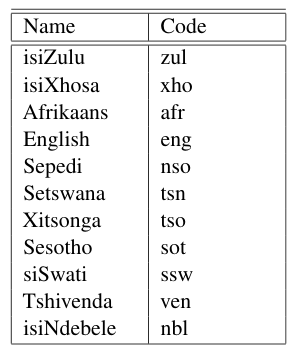
The datasets are a two way parallel corpus of the 11 official languages of South Africa, which are listed in Table 1 with their corresponding ISO 639-2code. The datasets contain texts written in the official languages of South Africa, including Afrikaans, English, isiNdebele, isiXhosa, isiZulu, siSwati, Sepedi, Xitsonga, siSwati, Tshivenda, and Setswana. As such, there are 55 ways of combining these languages into pairs, producing 55 distinct corpora in each of the datasets. The dataset uses the ISO 639-2 language codes in its naming convention, i.e., 'aligned-afr-zul.csv'. By nature of compilation, some datasets have more observations than others, which could lead to varying results, i.e., if used for NMT, then a better model can be produced for two languages from a dataset with more observations as opposed to one with fewer observations. This compilation of data allows for further exploration into the complexities of South African language and discourse, creating a multi-dimensional representation of how language is used and interpreted in South Africa. Through these datasets, the range of language usage in South Africa can be explored, providing insights into how different languages interact.
Table 1: Language List with ISO 639-2 codes
4.1 Preprocessing
Preprocessing was required to refine the raw scraped data prior to LASER encoding and alignment. The preprocessing steps are listed below and differ slightly as the source data and method of scraping has an outcome on the data obtained. For example, ZA-Gov-Multilinguals involve a lot of nested points, i.e., 2.1.2, which needed to be removed, while in contrast the Vuk'uzenzele data uses bullet points for listing.
4.1.1 Vuk'uzenzele
The raw text from the collected data was pre-processed in the following way:
- The text was set to lowercase.
- Hyphens and bullet points were removed.
- Double spaces, tabs, and newlines were replaced with a single space.
- The standard apostrophe, i.e., ", took the place of Unicode apostrophes.
4.1.2 ZA-Gov-multilingual
The raw text from the collected data was pre-processed in the following way:
- Removing the dots (or single- or multi-digit numbers) that began a line
- Inserting a period after a series of numbers in the format x · y.
- Adding a period after a string of numbers in the format x.
- Replacing a sequence of punctuation marks, such as a period, colon, semi-colon, or a combination of these, followed by a letter with a single period.
4.2 Corpora Alignment
Once pre-processed, the text was passed to the NLTK tokeniser "punkt" which returns a vector of sentence tokens. The n tokenised sentences were sent to LASER encoder which encodes it into n sentence vectors, each of length 1024. The sentence vectors are compared and a cosine similarity algorithm was performed to produce a score from 0 to 1 on the similarity of the two vectors as described in section 4.2.1.
4.2.1 LASER Encodings
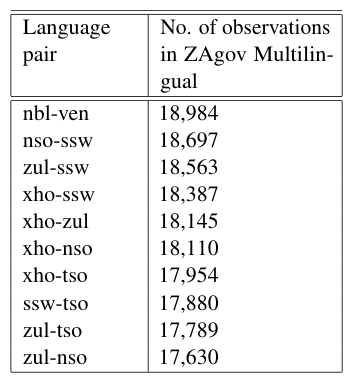
In order to compare the text for similarity, LASER encoders were utilised. LASER, which stands for Language-Agnostic Sentence Representations, is a research project by Facebook AI Research. LASER generates sentence representations by encoding sentences into a vector. The vectors serve as a machine representation of the sentence. The vectors can be compared using cosine similarity which outputs a score between zero and one. Cosine scores closer to one indicate high similarity. This score is recorded in the LASER datasets (available in the dataset repository). The observations present in each dataset with a score above 0.65, or 65% similarity, are listed in the following tables 2 and 3. Entire tables featuring the number of observations present in all datasets are featured on the READMEs of the dataset repos, https://github.com/dsfsi/gov-za-multilingual for ZA-Gov-Multilingual and https://github.com/dsfsi/vukuzenzele-nlp for Vuk'uzenzele.
Table 2: Top ten datasets with the most observations with a cosine score greater than or equal to 0.65 in Vuk'uzenzele.
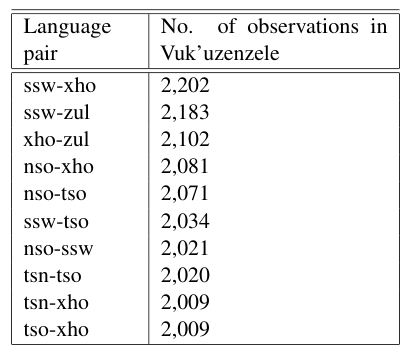
Table 3: Top ten datasets with the most observations with a cosine score greater than or equal to 0.65
4.3 Postprocessing
For the LASER datasets the source sentence, target sentence, and cosine score for the aligned data was written to a csv file with the naming convention 'aligned-{src_lang_code}- {tgt_lang_code}. csv', i.e. 'aligned-afr-zul.csv'. Refer to the language list in 1 for language codes used in naming the datasets.
For the simple aligned datasets the source sentence and the target sentence were written to a csv file with the same naming structure as the LASER datasets.
5 NMT Benchmarks
Minimal aligned sentence corpora, for low-resourced African languages, hinder the quality of NMT models trained from scratch (Martinus and Abbott, 2019; Nekoto et al., 2020; Adelani et al., 2022). Recently Adelani et al. (2022) approached this problem by fine-tuning massively multilingual models, including the M2M100 model (Fan et al., 2021), on a small number of aligned sentences. The M2M100 model is a Many-toMany non-English centric language model trained to translate directly between 100 languages, including five South African official languages (Fan et al., 2021). Adelani et al. (2022) demonstrated how to effectively leverage this model for small quantities of data, to create NMT systems for languages and domains not included in pre-training.
Building on their work, we create baseline translation benchmarks for the Vuk'uzenzele and ZA-gov-multilingual datasets, in the government publication domain, by fine-tuning the M2M100 model. To provide our results in context and for comparison purposes we also fine-tune the M2M100 model on subsets of the existing Autshumato parallel corpora obtained from the South African Centre for Digital Language Resources (McKellar, (2021,2,2,2,0,2) (https://sadilar.org). We focus our efforts on providing NMT benchmarks for the low resource African languages in the datasets, as such Afrikaans translations are not included due to the relatively high availability of digital datasets in this language, and we leave this for future work.
5.1 Pre-processing
The aligned datasets were processed to remove duplicate and conflicting translations (in both the source and target sentences) then shuffled to remove any order bias before the train, test and dev set were created. The data splits are defined as 70% training, 20% test and 10% dev sets. For comparison, all models are fine-tuned using the 'xxx-eng' translation direction where 'xxx' represents the indigenous African source language and 'eng' is the English translation target.
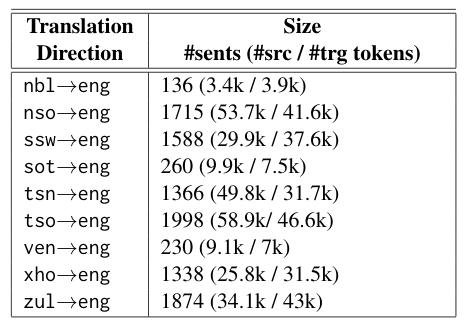
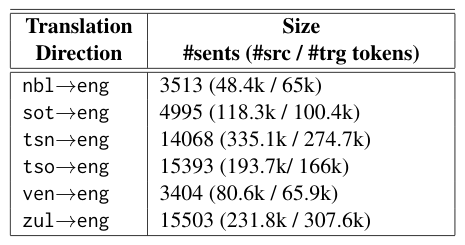
The available Aushumato parallel corpora (extracted from various government resources and web-crawls (Groenewald and Fourie, 2009)) are comparable in domain to the ZA-gov-multilingual parallel corpora created, however the dataset sizes are currently much larger. We therefore extract the same number for pre-processed aligned sentences as the ZA-gov-multilingual corpora in the 'xxx-eng' translation direction, for direct NMT result comparison. The sentence and token counts of the corpora used for NMT benchmarking are provided in Appendix A.1 tables 5, 6 and 7.
5.2 Results
The M2M100 fine-tuning benchmark results for the Vuk'uzenzele, ZA-gov-multilingual and subsets of the available Autshumato parallel corpora are provided in table 4. The fine-tuning translation directions are provided, and any source languages which were not including in the original M2M100 pre-training are highlighted for references purposes. Additionally the highest BLEU score result achieved across the datasets is shown in bold. Cases where the Autshumato parallel corpora were not accessible or did not exist for a particular language are shown with a '-' symbol.
Table 4: BLEU scores for Massively Multilingual Transfer on xxx-eng translations using the Vuk'uzenzele (Vuk.), ZA-gov-multilingual (Gov.) and subsets of the available Autshumato datasets (Aut.)
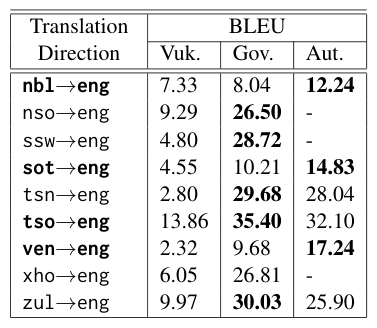
Fine-tuning on the Vuk'uzenzele datasets achieved the lowest overall BLEU scores, this is expected due to the small size of the aligned datasets in comparison to those of the ZA-gov-multilingual and Autshumato datasets. The highest BLEU scores are distributed inconsistently across the ZA-gov-multilingual and Autshumato NMT models, with the ZA-gov-multilingual models achieving a higher score for Setswana, Xitsonga and isiZulu. This could be due to the random subset selections from the Autshumato datasets, as well as a result of variations in source combinations and cleaning methods used by the Autshumato project when creating the aligned corpora. It is noted that variations in the subset selections will yield different results and an in-depth analysis is left for future work.
We achieve the highest benchmark result for Xitsonga ('tso-eng') across all datasets, which is a language that the M2M100 model has not been pre-trained on, demonstrating the effectiveness of transfer learning for new low-resource language datasets.
It is also noted that current NMT resources for the Autshumato datasets exist only in the 'eng-xxx' translation direction for Xitsonga, Setswana, Sepedi, Sesotho and isiZulu (Skosana and Mlambo, 2021). Our contributions therefore extend the benchmark translation resources (in the government data domain) to isiNdebele, isiXhosa, siSwati and Tshivenda; and broaden the translation direction beyond English as the source language.
6 Conclusion
Finally, this paper presented two multilingual corpora that are automatically aligned to facilitate the translation of texts between languages. These datasets contribute to an expanding collection of corpora for training African language NMT models that are left out or under-resourced in contemporary NLP research. It is the hope of the authors that these datasets will aid in creating NMT models for low-resource African languages and that the models can be used to facilitate access to translation services, empowering African speakers and writers to communicate more effectively in their native languages. It is also hoped that the datasets will further NLP research into the multilingualism of African languages and contribute to an understanding of the various dialects present in Africa.
7 Limitations
The NMT models discussed have been created for benchmarking the described datatsets and have not been exhaustively quality tested for production purposes. We also only tested the effectiveness of fine-tuning the M2M100 model with English as a target language and have have not extended the NMT systems to translations between indigenous South African languages, therefore further benchmarking still needs to be implemented. We would like to extend testing to include the evaluation set created by (McKellar and Puttkammer, 2020), which contains data (excluded from the Autshumato corpora) for all 11 official South African languages and could provide a more accurate comparison of the NMT models. It is noted that while the BLEU score results are promising, a qualitative linguistic analysis still needs to done on the translation models to determine if the BLEU scores for certain language translations (i.e. 'tso-eng') correlate to accurate translations within our domain. As future work we hope to collaborate with respective linguists to improve the quality and effectiveness of such NMT systems for South African Languages (Skosana and Mlambo, 2021).
8 Ethics Statement
The datasets created and used for the translation model benchmarks are taken solely from South African government resources. Therefore it is highlighted that if these models are used in production, they might ignore certain social/societal structures and will be representative of the dominant political party at the time the datasets were sourced (Bender et al., 2021). We also note that the benchmark models and datasets have not been curated to determine any biases that are present. As such, any existing biases in the system might have the potential to harm specific groups, when used in NLP downstream production tasks (Bender et al., 2021).
9 Acknowledgements
We would like to acknowledge funding from the ABSA Chair of Data Science, the Google Research scholar program, TensorFlow Award for Machine Learning Grant and the NVIDIA Corporation hardware Grant. Many thanks to all the anonymous RAIL reviewers for their valuable feedback.
Notes
1 https://www.vukuzenzele.gov.za/
2 https://doi.org/10.5281/zenodo.7598539
3 https://doi.org/10.5281/zenodo.7635167
References
Lasha Abzianidze, Johannes Bjerva, Kilian Evang, Hessel Haagsma, Rik van Noord, Pierre Ludmann, DucDuy Nguyen, and Johan Bos. 2017. The parallel meaning bank: Towards a multilingual corpus of translations annotated with compositional meaning representations. In Proceedings of the 15th Conference of the European Chapter of the Association for Computational Linguistics: Volume 2, Short Papers, pages 242-247.
David Adelani, Jesujoba Alabi, Angela Fan, Julia Kreutzer, Xiaoyu Shen, Machel Reid, Dana Ruiter, Dietrich Klakow, Peter Nabende, Ernie Chang, Tajuddeen Gwadabe, Freshia Sackey, Bonaventure F. P. Dossou, Chris Emezue, Colin Leong, Michael Beukman, Shamsuddeen Muhammad, Guyo Jarso, Oreen Yousuf, Andre Niyongabo Rubungo, Gilles Hacheme, Eric Peter Wairagala, Muhammad Umair Nasir, Benjamin Ajibade, Tunde Ajayi, Yvonne Gitau, Jade Abbott, Mohamed Ahmed, Millicent Ochieng, Anuoluwapo Aremu, Perez Ogayo, Jonathan Mukiibi, Fatoumata Ouoba Kabore, Godson Kalipe, Derguene Mbaye, Allahsera Auguste Tapo, Victoire Memdjokam Koagne, Edwin Munkoh-Buabeng, Valencia Wagner, Idris Abdulmumin, Ayodele Awokoya, Happy Buzaaba, Blessing Sibanda, Andiswa Bukula, and Sam Manthalu. 2022. A few thousand translations go a long way! leveraging pre-trained models for African news translation. In Proceedings of the 2022 Conference of the North American Chapter of the Association for Computational Linguistics: Human Language Technologies, pages 3053-3070, Seattle, United States. Association for Computational Linguistics.
Emily M. Bender, Timnit Gebru, Angelina McMillanMajor, and Shmargaret Shmitchell. 2021. On the dangers of stochastic parrots: Can language models be too big? In Proceedings of the 2021 ACM Conference on Fairness, Accountability, and Transparency, FAccT '21, pages 610-623, New York, NY, USA. Association for Computing Machinery.
Muhao Chen, Yingtao Tian, Kai-Wei Chang, Steven Skiena, and Carlo Zaniolo. 2018. Co-training embeddings of knowledge graphs and entity descriptions for cross-lingual entity alignment. arXiv preprint arXiv: Arxiv-1806.06478.
Anton A. Emelyanov and E. Artemova. 2019. Multilingual named entity recognition using pre-trained embeddings, attention mechanism and ncrf. BSNLP@ACL.
Angela Fan, Shruti Bhosale, Holger Schwenk, Zhiyi Ma, Ahmed El-Kishky, Siddharth Goyal, Mandeep Baines, Onur Celebi, Guillaume Wenzek, Vishrav Chaudhary, et al. 2021. Beyond english-centric multilingual machine translation. Journal of Machine Learning Research, 22(107):1-48.
Hendrik J Groenewald and Liza du Plooy. 2010. Processing parallel text corpora for three south african language pairs in the autshumato project. AfLaT 2010, page 27.
Hendrik Johannes Groenewald and Wildrich Fourie. 2009. Introducing the autshumato integrated translation environment. In Proceedings of the 13th Annual conference of the European Association for Machine Translation.
Pratik Joshi, Sebastin Santy, Amar Budhiraja, Kalika Bali, and Monojit Choudhury. 2020. The state and fate of linguistic diversity and inclusion in the NLP world. In Proceedings of the 58th Annual Meeting of the Association for Computational Linguistics, pages 6282-6293, Online. Association for Computational Linguistics.
Xinyu Lu, Jipeng Qiang, Yun Li, Yunhao Yuan, and Yi Zhu. 2021. An unsupervised method for building sentence simplification corpora in multiple languages. Conference On Empirical Methods In Natural Language Processing.
Vukosi Marivate, Daniel Njini, Andani Madodonga, Richard Lastrucci, Isheanesu Dzingirai, and Jenalea Rajab. 2023a. The Vuk'uzenzele South African multilingual corpus.
Vukosi Marivate, Tshephisho Sefara, Vongani Chabalala, Keamogetswe Makhaya, Tumisho Mokgonyane, Rethabile Mokoena, and Abiodun Modupe. 2020. Investigating an approach for low resource language dataset creation, curation and classification: Setswana and sepedi. In Proceedings of the first workshop on Resources for African Indigenous Languages, pages 15-20.
Vukosi Marivate, Matimba Shingange, Richard Lastrucci, Isheanesu Dzingirai, and Jenalea Rajab. 2023b. The South African Gov-za multilingual corpus.
Louis Martin, Angela Fan, Eric Villemonte de la Clergerie, Antoine Bordes, and Benoît Sagot. 2022. Muss: Multilingual unsupervised sentence simplification by mining paraphrases. International Conference On Language Resources And Evaluation.
Laura Martinus and Jade Z Abbott. 2019. A focus on neural machine translation for african languages. arXiv preprint arXiv:1906.05685.
Cindy McKellar. (2020). Autshumato english-tshivenda parallel corpora, version 1.0, [multilingual text corpora: Aligned]. Retrieved From https://hdl.handle.net/20.500.12185/569.
Cindy McKellar. (2021). Autshumato englishisindebele parallel corpora, version 1.0, [multilingual text corpora: Aligned]. Retrieved From https://hdl.handle.net/20.500.12185/572.
Cindy McKellar. (2022)a. Autshumato english-isizulu parallel corpora, version 2.0, [multilingual text corpora: Aligned]. Retrieved From https://hdl.handle.net/20.500.12185/575.
Cindy McKellar. (2022)b. Autshumato english-sesotho parallel corpora, version 1.0, [multilingual text corpora: Aligned]. Retrieved From https://hdl.handle.net/20.500.12185/577.
Cindy McKellar. (2022)c. Autshumato englishsetswana parallel corpora, version 2.0, [multilingual text corpora: Aligned]. Retrieved From https://hdl.handle.net/20.500.12185/578.
Cindy McKellar. (2022)d. Autshumato english-xitsonga parallel corpora, version 2.0, [multilingual text corpora: Aligned]. Retrieved From https://hdl.handle.net/20.500.12185/579.
Cindy A McKellar and Martin J Puttkammer. 2020. Dataset for comparable evaluation of machine translation between 11 south african languages. Data Brief, 29:105146.
Wilhelmina Nekoto, Vukosi Marivate, Tshinondiwa Matsila, Timi Fasubaa, Taiwo Fagbohungbe, Solomon Oluwole Akinola, Shamsuddeen Muhammad, Salomon Kabongo Kabenamualu, Salomey Osei, Freshia Sackey, et al. 2020. Participatory research for low-resourced machine translation: A case study in african languages. In Findings of the Association for Computational Linguistics: EMNLP 2020, pages 2144-2160.
Aasish Pappu, Roi Blanco, Yashar Mehdad, Amanda Stent, and Kapil Thadani. 2017. Lightweight multilingual entity extraction and linking. In Proceedings of the Tenth ACM International Conference on Web Search and Data Mining, pages 365-374.
Surangika Ranathunga and Nisansa de Silva. 2022. Some languages are more equal than others: Probing deeper into the linguistic disparity in the NLP world. In Proceedings of the 2nd Conference of the Asia-Pacific Chapter of the Association for Computational Linguistics and the 12th International Joint Conference on Natural Language Processing (Volume 1: Long Papers), pages 823-848, Online only. Association for Computational Linguistics.
Holger Schwenk and Matthijs Douze. 2017. Learning joint multilingual sentence representations with neural machine translation. ACL 2017, page 157.
Holger Schwenk and Xian Li. 2018. A corpus for multilingual document classification in eight languages. International Conference On Language Resources And Evaluation.
Advaith Siddharthan. 2014. A survey of research on text simplification. ITL-International Journal of Applied Linguistics, 165(2):259-298.
Nomsa Skosana and Respect Mlambo. 2021. A brief study of the autshumato machine translation web service for south african languages. Literator, 42(1):7.
Simone Tedeschi, Valentino Maiorca, Niccolò Campolungo, Francesco Cecconi, and Roberto Navigli. 2021. WikiNEuRal: Combined neural and knowledge-based silver data creation for multilingual NER. In Findings of the Association for Computational Linguistics: EMNLP 2021, pages 2521-2533, Punta Cana, Dominican Republic. Association for Computational Linguistics.
A Appendix
A.1 Data Statistics
The data statistics for the datasets used for NMT bench-marking are provided in Tables 5, 6 and 7.
Table 5: Characteristics of the translation data for the Vuk'uzenzele (Vuk.) datasets
zul→eng zul→eng
Table 6: Characteristics of the translation data for the ZA-gov-multilingual (Gov.) datasets
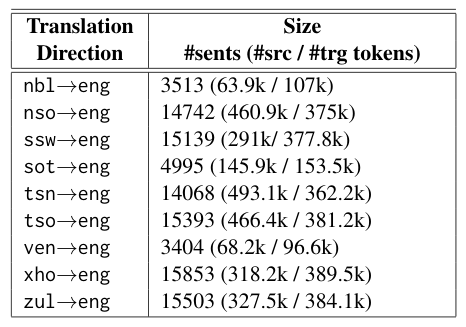
Table 7: Characteristics of the translation data for the subsets of the available Autshumato datasets (Aut.)
Preparing the Vuk’uzenzele and ZA-gov-multilingual South African multilingual corpora
Préparation des corpus multilingues sud-africains Vuk'uzenzele et ZA-gov-multilingual
Affiliations
Richard Lastrucci1, Isheanesu Dzingirai1, Jenalea Rajab2, Andani Madodonga1,
Matimba Shingange1, Daniel Njini1, Vukosi Marivate1,3
1Department of Computer Science, University of Pretoria
2School of Computer Science and Applied Mathematics, University of the Witwatersrand
3Lelapa AI
, , ,
, ,
Abstract
Résumé
This paper introduces two multilingual government themed corpora in various South African languages. The corpora were collected by gathering the South African Government newspaper (Vuk'uzenzele), as well as South African government speeches (ZA-gov-multilingual), that are translated into all 11 South African official languages. The corpora can be used for a myriad of downstream NLP tasks. The corpora were created to allow researchers to study the language used in South African government publications, with a focus on understanding how South African government officials communicate with their constituents.
Cet article présente deux corpus multilingues à thème gouvernemental dans diverses langues sud-africaines. Les corpus ont été collectés en rassemblant le journal gouvernemental sud-africain (Vuk'uzenzele), ainsi que les discours du gouvernement sud-africain (ZA-gov-multilingual), qui sont traduits dans les 11 langues officielles sud-africaines. Les corpus peuvent être utilisés pour une myriade de tâches NLP en aval. Les corpus ont été créés pour permettre aux chercheurs d'étudier le langage utilisé dans les publications du gouvernement sud-africain, en mettant l'accent sur la compréhension de la façon dont les fonctionnaires sud-africains communiquent avec leurs électeurs.
In this paper we highlight the process of gathering, cleaning and making available the corpora. We create parallel sentence corpora for Neural Machine Translation (NMT) tasks using Language-Agnostic Sentence Representations (LASER) embeddings. With these aligned sentences we then provide NMT benchmarks for 9 indigenous languages by fine-tuning a massively multilingual pre-trained language model.
Dans cet article, nous mettons en avant le processus de collecte, de nettoyage et de mise à disposition des corpus. Nous créons des corpus de phrases parallèles pour des tâches de traduction automatique neuronale (NMT) en utilisant des embeddings LASER (Language-Agnostic Sentence Representations). Avec ces phrases alignées, nous fournissons ensuite des benchmarks de NMT pour 9 langues indigènes en ajustant finement un modèle de langage pré-entraîné massivement multilingue.
1 Introduction
1 Introduction
The advancement of Natural Language Processing (NLP) research in Africa is impeded due to the scarcity of data for training models for various NLP tasks (Nekoto et al., 2020) as well as availability of benchmarks and ways to reproduce them (Martinus and Abbott, 2019). For many South African languages there are still challenges finding easily available textual datasets (Marivate et al., 2020) even if there are many speakers for those languages (Ranathunga and de Silva, 2022). There is a need to focus on development of local language (Joshi et al., 2020) NLP resources.
L'avancement de la recherche en traitement automatique du langage naturel (TALN) en Afrique est entravé en raison de la rareté des données pour l'entraînement de modèles pour diverses tâches de TALN (Nekoto et al., 2020) ainsi que de la disponibilité de benchmarks et des moyens de les reproduire (Martinus et Abbott, 2019). Pour de nombreuses langues sud-africaines, il existe encore des défis pour trouver des jeux de données textuels facilement disponibles (Marivate et al., 2020) même s'il y a de nombreux locuteurs pour ces langues (Ranathunga et de Silva, 2022). Il est nécessaire de se concentrer sur le développement de ressources de TAL en langues locales (Joshi et al., 2020).
This paper builds upon the work of Autshumato (Groenewald and Fourie, 2009; Groenewald and du Plooy, 2010) by creating automatically aligned parallel corpora from government textual data in the 11 official languages of South Africa. While the
Cet article s'appuie sur les travaux d'Autshumato (Groenewald et Fourie, 2009 ; Groenewald et du Plooy, 2010) en créant des corpus parallèles automatiquement alignés à partir de données textuelles gouvernementales dans les 11 langues officielles d'Afrique du Sud. Alors que le
Autshumato project focused on creating Machine Translation tools for five indigenous languages, the resulting corpora lacked information about its origin or context, limiting its usefulness for other NLP tasks such as categorisation, topic modelling over time and other tasks that require contextual information of the content. Our approach provides more comprehensive data that can support a wider range of NLP applications.
Le projet Autshumato s'est concentré sur la création d'outils de traduction automatique pour cinq langues autochtones, mais les corpus résultants manquaient d'informations sur leur origine ou leur contexte, limitant leur utilité pour d'autres tâches de TAL telles que la catégorisation, la modélisation thématique au fil du temps et d'autres tâches nécessitant des informations contextuelles sur le contenu. Notre approche fournit des données plus complètes qui peuvent prendre en charge un éventail plus large d'applications NLP.
Our belief is that there is a significant opportunity to create a more user-friendly data collection process that can be easily maintained and provide extraction tools for others. It is essential to preserve the data source and structure it in a way that enables extensions. Our goal is to enhance Neural Machine Translation (NMT) resources in the government data domain by including all indigenous languages and broadening the translation directions beyond English as the source language. Additionally, we recognise the importance of providing aligned data across all South African languages beyond English.
Notre conviction est qu'il existe une opportunité significative de créer un processus de collecte de données plus convivial, facilement maintenable et offrant des outils d'extraction pour les autres. Il est essentiel de préserver la source des données et de la structurer de manière à permettre des extensions. Notre objectif est d'améliorer les ressources de Traduction Automatique Neuronale (NMT) dans le domaine des données gouvernementales en incluant toutes les langues indigènes et en élargissant les directions de traduction au-delà de l'anglais comme langue source. De plus, nous reconnaissons l'importance de fournir des données alignées pour toutes les langues sud-africaines au-delà de l'anglais.
Further, this paper introduces parallel corpora datasets in the 11 official languages of South Africa, created from text data obtained from the government. These datasets are designed to facilitate the development of NMT models. The corpora are automatically aligned, and are expected to serve as a valuable resource for researchers and practitioners working in the field of machine learning.
En outre, cet article présente des ensembles de données de corpus parallèles dans les 11 langues officielles de l'Afrique du Sud, créés à partir de données textuelles obtenues du gouvernement. Ces ensembles de données sont conçus pour faciliter le développement de modèles NMT. Les corpus sont alignés automatiquement, et devraient servir de ressource précieuse pour les chercheurs et les praticiens travaillant dans le domaine de l'apprentissage automatique.
The parallel corpora were generated using LASER encoders (Schwenk and Douze, 2017), facilitating the one-to-one alignment of tokenised sentence data. The data was sourced from credible sources such as newspapers and academic journals and covers diverse topics including health, finance, and politics.
Les corpus parallèles ont été générés à l'aide des encodeurs LASER (Schwenk et Douze, 2017), facilitant l'alignement un-à-un des données de phrases tokenisées. Les données provenaient de sources fiables telles que les journaux et les revues académiques et couvraient divers sujets, notamment la santé, la finance et la politique.
We also provide NMT benchmarks for the parallel corpora by fine-tuning a massively multilingual model (M2M100 (Fan et al., 2021)) building on the work of Adelani et al. (2022).
Nous fournissons également des benchmarks de NMT pour les corpus parallèles en ajustant finement un modèle massivement multilingue (M2M100 (Fan et al., 2021)) en nous appuyant sur les travaux de Adelani et al. (2022).
This paper is structured as follows. In the following section, we detail the datasets that we have compiled, including their compilation methodology and the information they contain. We then describe how we have aligned and created parallel corpora using these datasets. The subsequent section presents our NMT experiments and provides an analysis of the results obtained. Finally, we conclude the paper with our findings and make recommendations for future research.
Le présent document est structuré comme suit. Dans la section suivante, nous détaillons les ensembles de données que nous avons compilés, y compris leur méthodologie de compilation et les informations qu'ils contiennent. Nous décrivons ensuite comment nous avons aligné et créé des corpus parallèles en utilisant ces ensembles de données. La section suivante présente nos expériences de NMT et fournit une analyse des résultats obtenus. Enfin, nous concluons le document avec nos conclusions et formulons des recommandations pour de futures recherches.
2 Main Datasets
2 jeux de données principaux
2.1 The Vuk'uzenzele South African Multilingual Corpus
2.1 Le Corpus multilingue sud-africain Vuk'uzenzele
The Vuk'uzenzele dataset was constructed from editions of the South African government magazine Vuk'uzenzele. Being a magazine, the text focuses mainly on current events, politics, entertainment, and other topics related to a magazine publication. The Vuk'uzenzele dataset provides a comprehensive view of the language and topics of discussion in South Africa during the respective period, giving researchers insight into the history and culture of South Africa. The Vuk'uzenzele dataset is thus a rich resource for any researcher wanting to analyse South African politics, current events, and popular culture.
L'ensemble de données Vuk'uzenzele a été construit à partir des éditions du magazine gouvernemental sud-africain Vuk'uzenzele. Étant un magazine, le texte se concentre principalement sur les événements actuels, la politique, le divertissement et d'autres sujets liés à une publication de magazine. Le jeu de données Vuk'uzenzele offre une vue d'ensemble de la langue et des sujets de discussion en Afrique du Sud durant la période respective, donnant aux chercheurs un aperçu de l'histoire et de la culture de l'Afrique du Sud. L'ensemble de données Vuk'uzenzele est donc une riche ressource pour tout chercheur souhaitant analyser la politique sud-africaine, les événements actuels et la culture populaire.
2.1.1 Creation of Vuk'uzenzele
2.1.1 Création de Vuk'uzenzele
The raw Vuk'uzenzele data is scraped from PDF editions of the magazine. The main Vuk'uzenzele edition is in the English language. Only a few of these English articles are translated into the other 10 official South African languages (Afrikaans, isiNdebele, isiXhosa, IsiZulu, Sepedi, Sesotho, siSwati, Tshivenda, Xitsonga and Setswana). As such, we created a pipeline to identify which articles should be extracted from each language pdf from a specific edition. Individual articles were extracted and placed into text files. The extracted text files still have some challenges due to PDF extraction. To clean it, a team member goes through each extracted text file and formats it as follows:
Les données brutes de Vuk'uzenzele sont extraites des éditions PDF du magazine. L'édition principale de Vuk'uzenzele est en langue anglaise. Seuls quelques-uns de ces articles en anglais sont traduits dans les 10 autres langues officielles sud-africaines (Afrikaans, isiNdebele, isiXhosa, IsiZulu, Sepedi, Sesotho, siSwati, Tshivenda, Xitsonga et Setswana). Ainsi, nous avons créé un pipeline pour identifier quels articles devaient être extraits de chaque PDF linguistique d’une édition spécifique. Les articles individuels ont été extraits et placés dans des fichiers texte. Les fichiers texte extraits présentent encore quelques défis dus à l’extraction PDF. Pour le nettoyer, un membre de l'équipe parcourt chaque fichier texte extrait et le formate comme suit :
Line 1: Title of article (in language)
Ligne 1 : Titre de l'article (dans la langue)
Line 2: empty line
Ligne 2: ligne vide
Line 3: Author of article (if available. If not, defaults to Vukuzenzele Unnamed)
Ligne 3 : Auteur de l'article (si disponible. Sinon, la valeur par défaut est Vukuzenzele Unnamed)
Line 4: empty line
Ligne 4: ligne vide
· Line 5-end: body of article
· Ligne 5-fin : corps de l'article
The data is easier to analyse and visualise after being manually reviewed. The labour-intensive effort was necessary to provide a comprehensive and meaningful analysis of the magazine's content. The time-consuming process of manual review and extraction was ultimately worth it, as it provides an opportunity to create a deeper understanding of the content within Vuk'uzenzele. As of writing we have 53 editions of the newspaper spanning January 2020 to July 2022. More additions will be added in time by the team. Automations have been built to download and archive the PDFs, however manual effort is still required to extract and identify translated articles. The dataset, code and automated scrapers are available at at https://github.com/dsfsi/vukuzenzele-nlp and Zenodo (Marivate et al., 2023a). We make it available in a format that allows other researchers to extend, remix and add onto it (CC-4.0-BY-SA licence for data and MIT License for code).
Les données sont plus faciles à analyser et à visualiser après avoir été revues manuellement. L'effort intensif en main-d'œuvre était nécessaire pour fournir une analyse complète et significative du contenu du magazine. Le processus long et fastidieux de revue et d'extraction manuelle en valait finalement la peine, car il offre l'opportunité de créer une compréhension plus approfondie du contenu de Vuk'uzenzele. Au moment de la rédaction, nous avons 53 éditions du journal couvrant la période allant de janvier 2020 à juillet 2022. D'autres ajouts seront ajoutés dans le temps par l'équipe. Des automatisations ont été mises en place pour télécharger et archiver les PDF, mais un effort manuel est encore nécessaire pour extraire et identifier les articles traduits. Le jeu de données, le code et les outils d'extraction automatisés sont disponibles à l'adresse https://github.com/dsfsi/vukuzenzele-nlp et sur Zenodo (Marivate et al., 2023a). Nous le mettons à disposition dans un format qui permet à d'autres chercheurs de l'étendre, de le remixer et d'y ajouter des éléments (licence CC-4.0-BY-SA pour les données et licence MIT pour le code).
2.2 The ZA-Gov Multilingual South African corpus
2.2 Le corpus sud-africain multilingue ZA-Gov
The ZA-Gov Multilingual corpus dataset was constructed from the speeches following cabinet meetings of the SA government. As such, the dataset carries a variety of topics including energy, labour, service delivery, crime, COVID, international relations, the environment, and government affairs such as government appointments, cabinet decisions, etc. This provides an eye into the workings of the South African government and how it has dealt with various challenges, both internal and external.
Le jeu de données du corpus multilingue ZA-Gov a été construit à partir des discours suivant les réunions du cabinet du gouvernement sud-africain. Ainsi, le jeu de données couvre une variété de sujets, notamment l'énergie, le travail, la prestation de services, la criminalité, la COVID, les relations internationales, l'environnement, ainsi que les affaires gouvernementales telles que les nominations gouvernementales, les décisions du cabinet, etc. Cela offre un aperçu du fonctionnement du gouvernement sud-africain et de la manière dont il a traité divers défis, tant internes qu'externes.
2.2.1 Creation of ZA-Gov-multilingual
2.2.1 Création de ZA-Gov-multilingue
The raw ZA-Gov Multilingual data is scraped from the the South African government website (https://www.gov.za/), where all cabinet statements, and their translations, are posted. The data was extracted and structured into a JSON format. The JSON payload for each speech records:
Les données brutes ZA-Gov Multilingual sont extraites du site web du gouvernement sud-africain (https://www.gov.za/), où toutes les déclarations du cabinet et leurs traductions sont publiées. Les données ont été extraites et structurées dans un format JSON. La charge utile JSON pour chaque enregistrement vocal :
Date,
Date,
Datetime,
Datetime,
Title (in English),
Titre (en anglais),
Url (top url for speech),
Url (url principale du discours),
Language payload for each language (eng, afr, nbl, xho, zul, nso, sep, tsn, ssw, ven, tso).
Charge utile linguistique pour chaque langue (eng, afr, nbl, xho, zul, nso, sep, tsn, ssw, ven, tso).
Title (in language),
Titre (en langue),
Text (in language),
Texte (en langue),
Url (for the translation).
Url (pour la traduction).
This structure makes it convenient for researchers and analysts to perform various natural language processing, data mining and machine learning tasks such as sentiment analysis, topic modelling, categorisation, language modelling and more. For instance, through sentiment analysis and text mining, analysts can investigate opinions of cabinet members' statements and track the evolution of these topics over time. As of writing, the dataset contains 162 cabinet statements spanning 2 May 2013 to 1 December 2022. The dataset will update automatically when new, translated, statements are available on the gov.za website. The dataset, code and automated scrapers are available at at https://github.com/dsfsi/gov-za-multilingual and Zenodo (Marivate et al., 2023b). We make it available in such a way that other researchers can extend, remix and add onto it (CC-4.0-BY-SA licence for data and MIT License for code).
Cette structure permet aux chercheurs et analystes d'effectuer facilement diverses tâches de traitement automatique des langues, d'exploration de données et d'apprentissage automatique telles que l'analyse de sentiments, la modélisation thématique, la catégorisation, la modélisation du langage et plus encore. Par exemple, grâce à l'analyse des sentiments et à l'exploration de texte, les analystes peuvent étudier les opinions sur les déclarations des membres du cabinet et suivre l'évolution de ces sujets au fil du temps. Au moment de la rédaction, l’ensemble de données contient 162 déclarations du Cabinet couvrant la période du 2 mai 2013 au 1er décembre 2022. Le jeu de données se mettra à jour automatiquement lorsque de nouvelles déclarations traduites seront disponibles sur le site gov.za. Le jeu de données, le code et les robots d'extraction automatisés sont disponibles à l'adresse https://github.com/dsfsi/gov-za-multilingual et Zenodo (Marivate et al., 2023b). Nous le mettons à disposition de manière à ce que d'autres chercheurs puissent l'étendre, le remixer et y ajouter des éléments (licence CC-4.0-BY-SA pour les données et licence MIT pour le code).
3 The corpora as a foundation for other NLP tasks and further study
3 Les corpus comme fondement pour d'autres tâches de TAL et pour des études ultérieures
In addition to supporting the creation of NMT models (discussed in the proceeding section), our datasets have the potential to serve as a foundation for many other NLP tasks beyond translation. We believe that these datasets will be a valuable resource for the study of South African government communication, and that it can be used for direct creation of multilingual document categorisation/classification (Schwenk and Li, 2018), simplification (Lu et al., 2021; Siddharthan, 2014; Martin et al., 2022), entity extraction (Tedeschi et al., 2021; Chen et al., 2018; Pappu et al., 2017; Emelyanov and Artemova, 2019), and other NLP tasks. To further extend the dataset's usefulness, we recommend looking at work such as the Parallel Meaning Bank (Abzianidze et al., 2017), which can act as an inspiration for transferring knowledge from one language to another and provide new benchmarks that may be helpful for Southern African languages beyond South Africa. We envision these datasets as a starting point for further research in the area of multilingual NLP for South African and African languages.
En plus de soutenir la création de modèles de NMT (abordés dans la section suivante), nos ensembles de données ont le potentiel de servir de base à de nombreuses autres tâches de NLP au-delà de la traduction. Nous croyons que ces jeux de données seront une ressource précieuse pour l'étude de la communication gouvernementale sud-africaine, et qu'ils peuvent être utilisés pour la création directe de catégorisation/classification de documents multilingues (Schwenk et Li, 2018), de simplification (Lu et al., 2021; Siddharthan, 2014; Martin et al., 2022), d'extraction d'entités (Tedeschi et al., 2021; Chen et al., 2018; Pappu et al., 2017; Emelyanov et Artemova, 2019), et d'autres tâches de TAL. Pour étendre davantage l'utilité du jeu de données, nous recommandons d'examiner des travaux tels que le Parallel Meaning Bank (Abzianidze et al., 2017), qui peut servir d'inspiration pour transférer des connaissances d'une langue à une autre et fournir de nouveaux benchmarks qui pourraient être utiles pour les langues d'Afrique australe au-delà de l'Afrique du Sud. Nous envisageons ces jeux de données comme un point de départ pour des recherches supplémentaires dans le domaine du TAL multilingue pour les langues sud-africaines et africaines.
4 Methods for Processing and Compilation
4 Méthodes de traitement et de compilation
The datasets are a two way parallel corpus of the 11 official languages of South Africa, which are listed in Table 1 with their corresponding ISO 639-2code. The datasets contain texts written in the official languages of South Africa, including Afrikaans, English, isiNdebele, isiXhosa, isiZulu, siSwati, Sepedi, Xitsonga, siSwati, Tshivenda, and Setswana. As such, there are 55 ways of combining these languages into pairs, producing 55 distinct corpora in each of the datasets. The dataset uses the ISO 639-2 language codes in its naming convention, i.e., 'aligned-afr-zul.csv'. By nature of compilation, some datasets have more observations than others, which could lead to varying results, i.e., if used for NMT, then a better model can be produced for two languages from a dataset with more observations as opposed to one with fewer observations. This compilation of data allows for further exploration into the complexities of South African language and discourse, creating a multi-dimensional representation of how language is used and interpreted in South Africa. Through these datasets, the range of language usage in South Africa can be explored, providing insights into how different languages interact.
Les ensembles de données sont un corpus parallèle bidirectionnel des 11 langues officielles de l'Afrique du Sud, qui sont énumérées dans le tableau 1 avec leur code ISO 639-2 correspondant. Les ensembles de données contiennent des textes rédigés dans les langues officielles d'Afrique du Sud, y compris l'afrikaans, l'anglais, l'isiNdebele, l'isiXhosa, l'isiZulu, le siSwati, le Sepedi, le Xitsonga, le siSwati, le Tshivenda, et le Setswana. Ainsi, il existe 55 façons de combiner ces langues en paires, produisant 55 corpus distincts dans chacun des ensembles de données. Le jeu de données utilise les codes de langue ISO 639-2 dans sa convention de nommage, c'est-à-dire 'aligned-afr-zul.csv'. Par nature de compilation, certains ensembles de données ont plus d'observations que d'autres, ce qui pourrait conduire à des résultats variables, c'est-à-dire, si utilisé pour NMT, alors un meilleur modèle peut être produit pour deux langues à partir d'un ensemble de données avec plus d'observations par opposition à un avec moins d'observations. Cette compilation de données permet une exploration plus approfondie des complexités de la langue et du discours sud-africains, créant une représentation multidimensionnelle de l'utilisation et de l'interprétation de la langue en Afrique du Sud. Grâce à ces ensembles de données, la gamme d'utilisation des langues en Afrique du Sud peut être explorée, fournissant des informations sur la manière dont les différentes langues interagissent.
Table 1: Language List with ISO 639-2 codes
Tableau 1 : Liste des langues avec codes ISO 639-2
4.1 Preprocessing
4.1 Prétraitement
Preprocessing was required to refine the raw scraped data prior to LASER encoding and alignment. The preprocessing steps are listed below and differ slightly as the source data and method of scraping has an outcome on the data obtained. For example, ZA-Gov-Multilinguals involve a lot of nested points, i.e., 2.1.2, which needed to be removed, while in contrast the Vuk'uzenzele data uses bullet points for listing.
Un prétraitement était nécessaire pour affiner les données brutes extraites avant le codage et l'alignement LASER. Les étapes de prétraitement sont listées ci-dessous et diffèrent légèrement car les données sources et la méthode de moissonnage ont un impact sur les données obtenues. Par exemple, ZA-Gov-Multilinguals implique beaucoup de points imbriqués, c'est-à-dire 2.1.2, qui devaient être supprimés, alors qu'en revanche les données de Vuk'uzenzele utilisent des puces pour la liste.
4.1.1 Vuk'uzenzele
4.1.1 Vuk'uzenzele
The raw text from the collected data was pre-processed in the following way:
Le texte brut issu des données collectées a été pré-traité de la manière suivante :
The text was set to lowercase.
Le texte a été mis en minuscules.
Hyphens and bullet points were removed.
Les traits d'union et les puces ont été supprimés.
Double spaces, tabs, and newlines were replaced with a single space.
Les espaces doubles, les tabulations et les sauts de ligne ont été remplacés par un espace simple.
The standard apostrophe, i.e., ", took the place of Unicode apostrophes.
L'apostrophe standard, c'est-à-dire ", a pris la place des apostrophes Unicode.
4.1.2 ZA-Gov-multilingual
4.1.2 ZA-Gov-multilingue
The raw text from the collected data was pre-processed in the following way:
Le texte brut issu des données collectées a été pré-traité de la manière suivante :
Removing the dots (or single- or multi-digit numbers) that began a line
Supprimer les points (ou les nombres à un ou plusieurs chiffres) qui commençaient une ligne
Inserting a period after a series of numbers in the format x · y.
Insérer une période après une série de nombres au format x · y.
Adding a period after a string of numbers in the format x.
Ajoutant une période après une chaîne de nombres au format x.
Replacing a sequence of punctuation marks, such as a period, colon, semi-colon, or a combination of these, followed by a letter with a single period.
Remplacer une séquence de signes de ponctuation, tels qu'une période, un deux-points, un point-virgule, ou une combinaison de ceux-ci, suivie d'une lettre par une seule période.
4.2 Corpora Alignment
4.2 Alignement de corpus
Once pre-processed, the text was passed to the NLTK tokeniser "punkt" which returns a vector of sentence tokens. The n tokenised sentences were sent to LASER encoder which encodes it into n sentence vectors, each of length 1024. The sentence vectors are compared and a cosine similarity algorithm was performed to produce a score from 0 to 1 on the similarity of the two vectors as described in section 4.2.1.
Une fois pré-traité, le texte a été transmis au tokeniseur "punkt" de NLTK qui retourne un vecteur de jetons de phrase. Les n phrases tokenisées ont été envoyées à l'encodeur LASER qui les encode en n vecteurs de phrases, chacun de longueur 1024. Les vecteurs de phrase sont comparés et un algorithme de similarité cosinus a été effectué pour produire un score de 0 à 1 sur la similarité des deux vecteurs comme décrit dans la section 4.2.1.
4.2.1 LASER Encodings
4.2.1 Encodages LASER
In order to compare the text for similarity, LASER encoders were utilised. LASER, which stands for Language-Agnostic Sentence Representations, is a research project by Facebook AI Research. LASER generates sentence representations by encoding sentences into a vector. The vectors serve as a machine representation of the sentence. The vectors can be compared using cosine similarity which outputs a score between zero and one. Cosine scores closer to one indicate high similarity. This score is recorded in the LASER datasets (available in the dataset repository). The observations present in each dataset with a score above 0.65, or 65% similarity, are listed in the following tables 2 and 3. Entire tables featuring the number of observations present in all datasets are featured on the READMEs of the dataset repos, https://github.com/dsfsi/gov-za-multilingual for ZA-Gov-Multilingual and https://github.com/dsfsi/vukuzenzele-nlp for Vuk'uzenzele.
Afin de comparer le texte pour la similitude, des encodeurs LASER ont été utilisés. LASER, qui signifie Language-Agnostic Sentence Representations, est un projet de recherche de Facebook AI Research. LASER génère des représentations de phrases en codant les phrases dans un vecteur. Les vecteurs servent de représentation machine de la phrase. Les vecteurs peuvent être comparés à l'aide de la similarité cosinus qui produit un score compris entre zéro et un. Les scores cosinus plus proches d'un indiquent une forte similarité. Ce score est enregistré dans les ensembles de données LASER (disponibles dans le référentiel des ensembles de données). Les observations présentes dans chaque ensemble de données avec un score supérieur à 0,65, ou une similitude de 65 %, sont énumérées dans les tableaux 2 et 3 suivants. Des tableaux complets présentant le nombre d'observations présentes dans tous les ensembles de données sont présentés dans les fichiers README des dépôts d'ensembles de données, https://github.com/dsfsi/gov-za-multilingual pour ZA-Gov-Multilingual et https://github.com/dsfsi/vukuzenzele-nlp pour Vuk'uzenzele.
Table 2: Top ten datasets with the most observations with a cosine score greater than or equal to 0.65 in Vuk'uzenzele.
Tableau 2 : Les dix ensembles de données comptant le plus grand nombre d'observations avec un score de cosinus supérieur ou égal à 0,65 à Vuk'uzenzele.
Table 3: Top ten datasets with the most observations with a cosine score greater than or equal to 0.65
Tableau 3 : Les dix ensembles de données ayant le plus d’observations avec un score de cosinus supérieur ou égal à 0,65
4.3 Postprocessing
4.3 Post-traitement
For the LASER datasets the source sentence, target sentence, and cosine score for the aligned data was written to a csv file with the naming convention 'aligned-{src_lang_code}- {tgt_lang_code}. csv', i.e. 'aligned-afr-zul.csv'. Refer to the language list in 1 for language codes used in naming the datasets.
Pour les jeux de données LASER, la phrase source, la phrase cible et le score cosinus des données alignées ont été écrits dans un fichier csv avec la convention de nommage 'aligned-{src_lang_code}-{tgt_lang_code}.csv'. csv', c'est-à-dire 'aligned-afr-zul.csv'. Reportez-vous à la liste des langues dans 1 pour connaître les codes linguistiques utilisés pour nommer les ensembles de données.
For the simple aligned datasets the source sentence and the target sentence were written to a csv file with the same naming structure as the LASER datasets.
Pour les ensembles de données alignés simples, la phrase source et la phrase cible ont été écrites dans un fichier csv avec la même structure de nommage que les ensembles de données LASER.
5 NMT Benchmarks
5 NMT Benchmarks
Minimal aligned sentence corpora, for low-resourced African languages, hinder the quality of NMT models trained from scratch (Martinus and Abbott, 2019; Nekoto et al., 2020; Adelani et al., 2022). Recently Adelani et al. (2022) approached this problem by fine-tuning massively multilingual models, including the M2M100 model (Fan et al., 2021), on a small number of aligned sentences. The M2M100 model is a Many-toMany non-English centric language model trained to translate directly between 100 languages, including five South African official languages (Fan et al., 2021). Adelani et al. (2022) demonstrated how to effectively leverage this model for small quantities of data, to create NMT systems for languages and domains not included in pre-training.
Les corpus de phrases alignés minimaux, pour les langues africaines à faibles ressources, entravent la qualité des modèles de NMT entraînés à partir de zéro (Martinus et Abbott, 2019; Nekoto et al., 2020; Adelani et al., 2022). Récemment, Adelani et al. (2022) ont abordé ce problème en ajustant finement des modèles massivement multilingues, y compris le modèle M2M100 (Fan et al., 2021), sur un petit nombre de phrases alignées. Le modèle M2M100 est un modèle de langage plusieurs-à-plusieurs non centré sur l'anglais, entraîné pour traduire directement entre 100 langues, dont cinq langues officielles sud-africaines (Fan et al., 2021). Adelani et al. (2022) ont démontré comment tirer efficacement parti de ce modèle pour de petites quantités de données, afin de créer des systèmes de NMT pour les langues et les domaines non inclus dans le pré-entraînement.
Building on their work, we create baseline translation benchmarks for the Vuk'uzenzele and ZA-gov-multilingual datasets, in the government publication domain, by fine-tuning the M2M100 model. To provide our results in context and for comparison purposes we also fine-tune the M2M100 model on subsets of the existing Autshumato parallel corpora obtained from the South African Centre for Digital Language Resources (McKellar, (2021,2,2,2,0,2) (https://sadilar.org). We focus our efforts on providing NMT benchmarks for the low resource African languages in the datasets, as such Afrikaans translations are not included due to the relatively high availability of digital datasets in this language, and we leave this for future work.
S'appuyant sur leur travail, nous créons des repères de traduction de base pour les ensembles de données multilingues Vuk'uzenzele et ZA-gov, dans le domaine des publications gouvernementales, en peaufinant le modèle M2M100. Pour fournir nos résultats dans le contexte et à des fins de comparaison, nous avons également affiné le modèle M2M100 sur des sous-ensembles du corpus parallèle Autshumato existant obtenu du Centre sud-africain pour les ressources linguistiques numériques (McKellar, (2021,2,2,2,0,2) (https://sadilar.org). Nous concentrons nos efforts sur la fourniture de repères NMT pour les langues africaines à faible ressource dans les ensembles de données, car ces traductions en afrikaans ne sont pas incluses en raison de la disponibilité relativement élevée des ensembles de données numériques dans cette langue, et nous laissons cela pour des travaux futurs.
5.1 Pre-processing
5.1 Prétraitement
The aligned datasets were processed to remove duplicate and conflicting translations (in both the source and target sentences) then shuffled to remove any order bias before the train, test and dev set were created. The data splits are defined as 70% training, 20% test and 10% dev sets. For comparison, all models are fine-tuned using the 'xxx-eng' translation direction where 'xxx' represents the indigenous African source language and 'eng' is the English translation target.
Les ensembles de données alignés ont été traités pour supprimer les doublons et les traductions contradictoires (dans les phrases source et cible), puis mélangés pour éliminer tout biais d'ordre avant la création des ensembles d'entraînement, de test et de développement. La répartition des données est définie comme suit : 70 % pour l'entraînement, 20 % pour les tests et 10 % pour les ensembles de développement. À titre de comparaison, tous les modèles sont ajustés en utilisant la direction de traduction 'xxx-eng' où 'xxx' représente la langue source africaine indigène et 'eng' est la cible de traduction en anglais.
The available Aushumato parallel corpora (extracted from various government resources and web-crawls (Groenewald and Fourie, 2009)) are comparable in domain to the ZA-gov-multilingual parallel corpora created, however the dataset sizes are currently much larger. We therefore extract the same number for pre-processed aligned sentences as the ZA-gov-multilingual corpora in the 'xxx-eng' translation direction, for direct NMT result comparison. The sentence and token counts of the corpora used for NMT benchmarking are provided in Appendix A.1 tables 5, 6 and 7.
Les corpus parallèles Aushumato disponibles (extraits de diverses ressources gouvernementales et de web-crawls (Groenewald et Fourie, 2009)) sont comparables en domaine aux corpus parallèles ZA-gov-multilingual créés, cependant les tailles des jeux de données sont actuellement beaucoup plus grandes. Nous extrayons donc le même nombre pour les phrases alignées pré-traitées que les corpus ZA-gov-multilingual dans la direction de traduction 'xxx-eng', pour la comparaison directe des résultats NMT. Les comptages de phrases et de jetons des corpus utilisés pour le benchmarking de la NMT sont fournis dans les tableaux 5, 6 et 7 de l'annexe A.1.
5.2 Results
5.2 Résultats
The M2M100 fine-tuning benchmark results for the Vuk'uzenzele, ZA-gov-multilingual and subsets of the available Autshumato parallel corpora are provided in table 4. The fine-tuning translation directions are provided, and any source languages which were not including in the original M2M100 pre-training are highlighted for references purposes. Additionally the highest BLEU score result achieved across the datasets is shown in bold. Cases where the Autshumato parallel corpora were not accessible or did not exist for a particular language are shown with a '-' symbol.
Les résultats du benchmark de réglage fin M2M100 pour le Vuk'uzenzele, ZA-gov-multilingual et les sous-ensembles des corpus parallèles Autshumato disponibles sont présentés dans le tableau 4. Les directions de traduction d'ajustement fin sont fournies, et les langues sources qui n'étaient pas incluses dans le pré-entraînement original de M2M100 sont mises en évidence à des fins de référence. De plus, le score BLEU le plus élevé obtenu sur l'ensemble des ensembles de données est affiché en caractères gras. Les cas où les corpus parallèles Autshumato n'étaient pas accessibles ou n'existaient pas pour une langue particulière sont indiqués par un symbole '-'.
Table 4: BLEU scores for Massively Multilingual Transfer on xxx-eng translations using the Vuk'uzenzele (Vuk.), ZA-gov-multilingual (Gov.) and subsets of the available Autshumato datasets (Aut.)
Tableau 4 : Scores BLEU pour le transfert massivement multilingue sur les traductions xxx-eng en utilisant Vuk'uzenzele (Vuk.), ZA-gov-multilingual (Gov.) et des sous-ensembles des jeux de données Autshumato disponibles (Aut.)
Fine-tuning on the Vuk'uzenzele datasets achieved the lowest overall BLEU scores, this is expected due to the small size of the aligned datasets in comparison to those of the ZA-gov-multilingual and Autshumato datasets. The highest BLEU scores are distributed inconsistently across the ZA-gov-multilingual and Autshumato NMT models, with the ZA-gov-multilingual models achieving a higher score for Setswana, Xitsonga and isiZulu. This could be due to the random subset selections from the Autshumato datasets, as well as a result of variations in source combinations and cleaning methods used by the Autshumato project when creating the aligned corpora. It is noted that variations in the subset selections will yield different results and an in-depth analysis is left for future work.
Le réglage fin sur les ensembles de données Vuk'uzenzele a donné les scores BLEU globaux les plus faibles, ce qui est attendu en raison de la petite taille des ensembles de données alignés en comparaison de ceux des ensembles de données ZA-gov-multilingual et Autshumato. Les scores BLEU les plus élevés sont répartis de manière incohérente entre les modèles ZA-gov-multilingual et Autshumato NMT, les modèles ZA-gov-multilingual atteignant un score plus élevé pour Setswana, Xitsonga et isiZulu. Cela pourrait être dû aux sélections aléatoires de sous-ensembles des jeux de données Autshumato, ainsi qu'à une conséquence des variations dans les combinaisons de sources et les méthodes de nettoyage utilisées par le projet Autshumato lors de la création des corpus alignés. Il est noté que des variations dans les sélections de sous-ensembles donneront des résultats différents et une analyse approfondie est laissée pour les travaux futurs.
We achieve the highest benchmark result for Xitsonga ('tso-eng') across all datasets, which is a language that the M2M100 model has not been pre-trained on, demonstrating the effectiveness of transfer learning for new low-resource language datasets.
Nous obtenons le résultat de référence le plus élevé pour le Xitsonga ('tso-eng') dans tous les ensembles de données, qui est une langue sur laquelle le modèle M2M100 n'a pas été pré-entraîné, démontrant l'efficacité de l'apprentissage par transfert pour les nouveaux ensembles de données linguistiques à faibles ressources.
It is also noted that current NMT resources for the Autshumato datasets exist only in the 'eng-xxx' translation direction for Xitsonga, Setswana, Sepedi, Sesotho and isiZulu (Skosana and Mlambo, 2021). Our contributions therefore extend the benchmark translation resources (in the government data domain) to isiNdebele, isiXhosa, siSwati and Tshivenda; and broaden the translation direction beyond English as the source language.
Il est également noté que les ressources NMT actuelles pour les ensembles de données Autshumato n'existent que dans la direction de traduction 'eng-xxx' pour Xitsonga, Setswana, Sepedi, Sesotho et isiZulu (Skosana et Mlambo, 2021). Nos contributions étendent donc les ressources de référence de traduction (dans le domaine des données gouvernementales) à l'isiNdebele, l'isiXhosa, le siSwati et le Tshivenda ; et élargissent la direction de traduction au-delà de l'anglais comme langue source.
6 Conclusion
6 Conclusion
Finally, this paper presented two multilingual corpora that are automatically aligned to facilitate the translation of texts between languages. These datasets contribute to an expanding collection of corpora for training African language NMT models that are left out or under-resourced in contemporary NLP research. It is the hope of the authors that these datasets will aid in creating NMT models for low-resource African languages and that the models can be used to facilitate access to translation services, empowering African speakers and writers to communicate more effectively in their native languages. It is also hoped that the datasets will further NLP research into the multilingualism of African languages and contribute to an understanding of the various dialects present in Africa.
Enfin, ce document a présenté deux corpus multilingues qui sont automatiquement alignés pour faciliter la traduction des textes entre les langues. Ces jeux de données contribuent à une collection croissante de corpus pour l'entraînement de modèles NMT de langues africaines qui sont laissés de côté ou sous-dotés dans la recherche contemporaine en TAL. Les auteurs espèrent que ces ensembles de données aideront à créer des modèles NMT pour les langues africaines à faibles ressources et que ces modèles pourront être utilisés pour faciliter l’accès aux services de traduction, permettant ainsi aux locuteurs et aux écrivains africains de communiquer plus efficacement dans leur langue maternelle. Il est également espéré que les jeux de données feront progresser la recherche en TAL sur le multilinguisme des langues africaines et contribueront à une compréhension des divers dialectes présents en Afrique.
7 Limitations
7 Limites
The NMT models discussed have been created for benchmarking the described datatsets and have not been exhaustively quality tested for production purposes. We also only tested the effectiveness of fine-tuning the M2M100 model with English as a target language and have have not extended the NMT systems to translations between indigenous South African languages, therefore further benchmarking still needs to be implemented. We would like to extend testing to include the evaluation set created by (McKellar and Puttkammer, 2020), which contains data (excluded from the Autshumato corpora) for all 11 official South African languages and could provide a more accurate comparison of the NMT models. It is noted that while the BLEU score results are promising, a qualitative linguistic analysis still needs to done on the translation models to determine if the BLEU scores for certain language translations (i.e. 'tso-eng') correlate to accurate translations within our domain. As future work we hope to collaborate with respective linguists to improve the quality and effectiveness of such NMT systems for South African Languages (Skosana and Mlambo, 2021).
Les modèles de NMT discutés ont été créés pour comparer les ensembles de données décrits et n'ont pas été exhaustivement testés en termes de qualité à des fins de production. Nous n’avons également testé l’efficacité de l’ajustement du modèle M2M100 qu’avec l’anglais comme langue cible et n’avons pas étendu les systèmes NMT aux traductions entre les langues indigènes sud-africaines. Par conséquent, d’autres tests comparatifs doivent encore être mis en œuvre. Nous aimerions étendre les tests pour inclure l'ensemble d'évaluation créé par (McKellar et Puttkammer, 2020), qui contient des données (exclues des corpus Autshumato) pour les 11 langues officielles sud-africaines et pourrait fournir une comparaison plus précise des modèles NMT. Il est noté que bien que les résultats des scores BLEU soient prometteurs, une analyse linguistique qualitative doit encore être effectuée sur les modèles de traduction pour déterminer si les scores BLEU pour certaines traductions de langues (c'est-à-dire 'tso-eng') correspondent à des traductions précises dans notre domaine. Dans le cadre de nos travaux futurs, nous espérons collaborer avec des linguistes respectifs pour améliorer la qualité et l’efficacité de ces systèmes NMT pour les langues sud-africaines (Skosana et Mlambo, 2021).
8 Ethics Statement
8 Déclaration éthique
The datasets created and used for the translation model benchmarks are taken solely from South African government resources. Therefore it is highlighted that if these models are used in production, they might ignore certain social/societal structures and will be representative of the dominant political party at the time the datasets were sourced (Bender et al., 2021). We also note that the benchmark models and datasets have not been curated to determine any biases that are present. As such, any existing biases in the system might have the potential to harm specific groups, when used in NLP downstream production tasks (Bender et al., 2021).
Les jeux de données créés et utilisés pour les benchmarks des modèles de traduction proviennent exclusivement de ressources gouvernementales sud-africaines. Par conséquent, il est souligné que si ces modèles sont utilisés dans la production, ils pourraient ignorer certaines structures sociales / sociétales et seront représentatifs du parti politique dominant au moment de la source des ensembles de données (Bender et al., 2021). Nous notons également que les modèles et jeux de données de référence n'ont pas été curatés pour déterminer les biais éventuellement présents. Ainsi, les biais existants dans le système pourraient avoir le potentiel de nuire à des groupes spécifiques, lorsqu'ils sont utilisés dans des tâches de production en aval de traitement automatique du langage naturel (Bender et al., 2021).
9 Acknowledgements
9 Remerciements
We would like to acknowledge funding from the ABSA Chair of Data Science, the Google Research scholar program, TensorFlow Award for Machine Learning Grant and the NVIDIA Corporation hardware Grant. Many thanks to all the anonymous RAIL reviewers for their valuable feedback.
Nous aimerions reconnaître le financement de la Chaire ABSA de Data Science, le programme de bourses de recherche Google, la subvention TensorFlow pour le Machine Learning Grant et la subvention matérielle de la NVIDIA Corporation. Nos sincères remerciements à tous les évaluateurs anonymes de RAIL pour leurs précieux retours.
Notes
Notes
1 https://www.vukuzenzele.gov.za/
2 https://doi.org/10.5281/zenodo.7598539
3 https://doi.org/10.5281/zenodo.7635167
References
Références
Lasha Abzianidze, Johannes Bjerva, Kilian Evang, Hessel Haagsma, Rik van Noord, Pierre Ludmann, DucDuy Nguyen, and Johan Bos. 2017. The parallel meaning bank: Towards a multilingual corpus of translations annotated with compositional meaning representations. In Proceedings of the 15th Conference of the European Chapter of the Association for Computational Linguistics: Volume 2, Short Papers, pages 242-247.
David Adelani, Jesujoba Alabi, Angela Fan, Julia Kreutzer, Xiaoyu Shen, Machel Reid, Dana Ruiter, Dietrich Klakow, Peter Nabende, Ernie Chang, Tajuddeen Gwadabe, Freshia Sackey, Bonaventure F. P. Dossou, Chris Emezue, Colin Leong, Michael Beukman, Shamsuddeen Muhammad, Guyo Jarso, Oreen Yousuf, Andre Niyongabo Rubungo, Gilles Hacheme, Eric Peter Wairagala, Muhammad Umair Nasir, Benjamin Ajibade, Tunde Ajayi, Yvonne Gitau, Jade Abbott, Mohamed Ahmed, Millicent Ochieng, Anuoluwapo Aremu, Perez Ogayo, Jonathan Mukiibi, Fatoumata Ouoba Kabore, Godson Kalipe, Derguene Mbaye, Allahsera Auguste Tapo, Victoire Memdjokam Koagne, Edwin Munkoh-Buabeng, Valencia Wagner, Idris Abdulmumin, Ayodele Awokoya, Happy Buzaaba, Blessing Sibanda, Andiswa Bukula, and Sam Manthalu. 2022. A few thousand translations go a long way! leveraging pre-trained models for African news translation. In Proceedings of the 2022 Conference of the North American Chapter of the Association for Computational Linguistics: Human Language Technologies, pages 3053-3070, Seattle, United States. Association for Computational Linguistics.
Emily M. Bender, Timnit Gebru, Angelina McMillanMajor, and Shmargaret Shmitchell. 2021. On the dangers of stochastic parrots: Can language models be too big? In Proceedings of the 2021 ACM Conference on Fairness, Accountability, and Transparency, FAccT '21, pages 610-623, New York, NY, USA. Association for Computing Machinery.
Muhao Chen, Yingtao Tian, Kai-Wei Chang, Steven Skiena, and Carlo Zaniolo. 2018. Co-training embeddings of knowledge graphs and entity descriptions for cross-lingual entity alignment. arXiv preprint arXiv: Arxiv-1806.06478.
Anton A. Emelyanov and E. Artemova. 2019. Multilingual named entity recognition using pre-trained embeddings, attention mechanism and ncrf. BSNLP@ACL.
Angela Fan, Shruti Bhosale, Holger Schwenk, Zhiyi Ma, Ahmed El-Kishky, Siddharth Goyal, Mandeep Baines, Onur Celebi, Guillaume Wenzek, Vishrav Chaudhary, et al. 2021. Beyond english-centric multilingual machine translation. Journal of Machine Learning Research, 22(107):1-48.
Hendrik J Groenewald and Liza du Plooy. 2010. Processing parallel text corpora for three south african language pairs in the autshumato project. AfLaT 2010, page 27.
Hendrik Johannes Groenewald and Wildrich Fourie. 2009. Introducing the autshumato integrated translation environment. In Proceedings of the 13th Annual conference of the European Association for Machine Translation.
Pratik Joshi, Sebastin Santy, Amar Budhiraja, Kalika Bali, and Monojit Choudhury. 2020. The state and fate of linguistic diversity and inclusion in the NLP world. In Proceedings of the 58th Annual Meeting of the Association for Computational Linguistics, pages 6282-6293, Online. Association for Computational Linguistics.
Xinyu Lu, Jipeng Qiang, Yun Li, Yunhao Yuan, and Yi Zhu. 2021. An unsupervised method for building sentence simplification corpora in multiple languages. Conference On Empirical Methods In Natural Language Processing.
Vukosi Marivate, Daniel Njini, Andani Madodonga, Richard Lastrucci, Isheanesu Dzingirai, and Jenalea Rajab. 2023a. The Vuk'uzenzele South African multilingual corpus.
Vukosi Marivate, Tshephisho Sefara, Vongani Chabalala, Keamogetswe Makhaya, Tumisho Mokgonyane, Rethabile Mokoena, and Abiodun Modupe. 2020. Investigating an approach for low resource language dataset creation, curation and classification: Setswana and sepedi. In Proceedings of the first workshop on Resources for African Indigenous Languages, pages 15-20.
Vukosi Marivate, Matimba Shingange, Richard Lastrucci, Isheanesu Dzingirai, and Jenalea Rajab. 2023b. The South African Gov-za multilingual corpus.
Louis Martin, Angela Fan, Eric Villemonte de la Clergerie, Antoine Bordes, and Benoît Sagot. 2022. Muss: Multilingual unsupervised sentence simplification by mining paraphrases. International Conference On Language Resources And Evaluation.
Laura Martinus and Jade Z Abbott. 2019. A focus on neural machine translation for african languages. arXiv preprint arXiv:1906.05685.
Cindy McKellar. (2020). Autshumato english-tshivenda parallel corpora, version 1.0, [multilingual text corpora: Aligned]. Retrieved From https://hdl.handle.net/20.500.12185/569.
Cindy McKellar. (2021). Autshumato englishisindebele parallel corpora, version 1.0, [multilingual text corpora: Aligned]. Retrieved From https://hdl.handle.net/20.500.12185/572.
Cindy McKellar. (2022)a. Autshumato english-isizulu parallel corpora, version 2.0, [multilingual text corpora: Aligned]. Retrieved From https://hdl.handle.net/20.500.12185/575.
Cindy McKellar. (2022)b. Autshumato english-sesotho parallel corpora, version 1.0, [multilingual text corpora: Aligned]. Retrieved From https://hdl.handle.net/20.500.12185/577.
Cindy McKellar. (2022)c. Autshumato englishsetswana parallel corpora, version 2.0, [multilingual text corpora: Aligned]. Retrieved From https://hdl.handle.net/20.500.12185/578.
Cindy McKellar. (2022)d. Autshumato english-xitsonga parallel corpora, version 2.0, [multilingual text corpora: Aligned]. Retrieved From https://hdl.handle.net/20.500.12185/579.
Cindy A McKellar and Martin J Puttkammer. 2020. Dataset for comparable evaluation of machine translation between 11 south african languages. Data Brief, 29:105146.
Wilhelmina Nekoto, Vukosi Marivate, Tshinondiwa Matsila, Timi Fasubaa, Taiwo Fagbohungbe, Solomon Oluwole Akinola, Shamsuddeen Muhammad, Salomon Kabongo Kabenamualu, Salomey Osei, Freshia Sackey, et al. 2020. Participatory research for low-resourced machine translation: A case study in african languages. In Findings of the Association for Computational Linguistics: EMNLP 2020, pages 2144-2160.
Aasish Pappu, Roi Blanco, Yashar Mehdad, Amanda Stent, and Kapil Thadani. 2017. Lightweight multilingual entity extraction and linking. In Proceedings of the Tenth ACM International Conference on Web Search and Data Mining, pages 365-374.
Surangika Ranathunga and Nisansa de Silva. 2022. Some languages are more equal than others: Probing deeper into the linguistic disparity in the NLP world. In Proceedings of the 2nd Conference of the Asia-Pacific Chapter of the Association for Computational Linguistics and the 12th International Joint Conference on Natural Language Processing (Volume 1: Long Papers), pages 823-848, Online only. Association for Computational Linguistics.
Holger Schwenk and Matthijs Douze. 2017. Learning joint multilingual sentence representations with neural machine translation. ACL 2017, page 157.
Holger Schwenk and Xian Li. 2018. A corpus for multilingual document classification in eight languages. International Conference On Language Resources And Evaluation.
Advaith Siddharthan. 2014. A survey of research on text simplification. ITL-International Journal of Applied Linguistics, 165(2):259-298.
Nomsa Skosana and Respect Mlambo. 2021. A brief study of the autshumato machine translation web service for south african languages. Literator, 42(1):7.
Simone Tedeschi, Valentino Maiorca, Niccolò Campolungo, Francesco Cecconi, and Roberto Navigli. 2021. WikiNEuRal: Combined neural and knowledge-based silver data creation for multilingual NER. In Findings of the Association for Computational Linguistics: EMNLP 2021, pages 2521-2533, Punta Cana, Dominican Republic. Association for Computational Linguistics.
A Appendix
A Annexe
A.1 Data Statistics
A.1 Statistiques des données
The data statistics for the datasets used for NMT bench-marking are provided in Tables 5, 6 and 7.
Les statistiques sur les ensembles de données utilisés pour l'étalonnage des TMN sont présentées dans les tableaux 5, 6 et 7.
Table 5: Characteristics of the translation data for the Vuk'uzenzele (Vuk.) datasets
Tableau 5 : Caractéristiques des données de traduction pour les ensembles de données Vuk'uzenzele (Vuk.)
zul→eng zul→eng
zul→eng zul→eng
Table 6: Characteristics of the translation data for the ZA-gov-multilingual (Gov.) datasets
Tableau 6 : Caractéristiques des données de traduction pour les ensembles de données ZA-gov-multilingual (Gov.)
Table 7: Characteristics of the translation data for the subsets of the available Autshumato datasets (Aut.)
Tableau 7: Caractéristiques des données de traduction pour les sous-ensembles des ensembles de données Autshumato disponibles (Aut.)
Preparing the Vuk’uzenzele and ZA-gov-multilingual South African multilingual corpora
Kutayarisha korpora za lugha nyingi za Vuk'uzenzele na ZA-gov-multilingual za Afrika Kusini
Affiliations
Richard Lastrucci1, Isheanesu Dzingirai1, Jenalea Rajab2, Andani Madodonga1,
Matimba Shingange1, Daniel Njini1, Vukosi Marivate1,3
1Department of Computer Science, University of Pretoria
2School of Computer Science and Applied Mathematics, University of the Witwatersrand
3Lelapa AI
, , ,
, ,
Taasisi
Richard Lastrucci1, Isheanesu Dzingirai1, Jenalea Rajab2, Andani Madodonga1,
Matimba Shingange1, Daniel Njini1, Vukosi Marivate1,3
1Department of Computer Science, University of Pretoria
2School of Computer Science and Applied Mathematics, University of the Witwatersrand
3Lelapa AI
, , ,
, ,
Abstract
Muhtasari
This paper introduces two multilingual government themed corpora in various South African languages. The corpora were collected by gathering the South African Government newspaper (Vuk'uzenzele), as well as South African government speeches (ZA-gov-multilingual), that are translated into all 11 South African official languages. The corpora can be used for a myriad of downstream NLP tasks. The corpora were created to allow researchers to study the language used in South African government publications, with a focus on understanding how South African government officials communicate with their constituents.
Makala hii inatambulisha makusanyo mawili yenye mada ya serikali yenye lugha nyingi katika lugha mbalimbali za Afrika Kusini. Korpora zilikusanywa kwa kukusanya gazeti la Serikali ya Afrika Kusini (Vuk'uzenzele), pamoja na hotuba za serikali ya Afrika Kusini (ZA-gov-multilingual), ambazo zinatafsiriwa katika lugha rasmi zote 11 za Afrika Kusini. Maktaba hizo zinaweza kutumika kwa shughuli nyingi za NLP zinazofuata. Korpora ziliundwa ili kuruhusu watafiti kuchunguza lugha inayotumika katika machapisho ya serikali ya Afrika Kusini, kwa lengo la kuelewa jinsi maafisa wa serikali ya Afrika Kusini wanavyowasiliana na wapiga kura wao.
In this paper we highlight the process of gathering, cleaning and making available the corpora. We create parallel sentence corpora for Neural Machine Translation (NMT) tasks using Language-Agnostic Sentence Representations (LASER) embeddings. With these aligned sentences we then provide NMT benchmarks for 9 indigenous languages by fine-tuning a massively multilingual pre-trained language model.
Katika karatasi hii tunaangazia mchakato wa kukusanya, kusafisha na kufanya korpora zipatikane. Tunaunda korpora za sentensi sambamba kwa ajili ya kazi za Tafsiri ya Mashine ya Neva (NMT) kwa kutumia viambatanisho vya Language-Agnostic Sentence Representations (LASER). Kwa sentensi hizi zilizolinganishwa kisha tunatoa viwango vya NMT kwa lugha 9 za asili kwa kurekebisha modeli ya lugha iliyofundishwa awali yenye lugha nyingi sana.
1 Introduction
1 Utangulizi
The advancement of Natural Language Processing (NLP) research in Africa is impeded due to the scarcity of data for training models for various NLP tasks (Nekoto et al., 2020) as well as availability of benchmarks and ways to reproduce them (Martinus and Abbott, 2019). For many South African languages there are still challenges finding easily available textual datasets (Marivate et al., 2020) even if there are many speakers for those languages (Ranathunga and de Silva, 2022). There is a need to focus on development of local language (Joshi et al., 2020) NLP resources.
Maendeleo ya utafiti wa Uchakataji wa Lugha Asilia (NLP) barani Afrika yanakwamishwa kutokana na uhaba wa data kwa ajili ya kufunza modeli kwa kazi mbalimbali za NLP (Nekoto et al., 2020) pamoja na upatikanaji wa vigezo na njia za kuzizalisha tena (Martinus na Abbott, 2019). Kwa Lugha nyingi za Afrika Kusini bado kuna changamoto kupata seti za data za kimaandishi zinazopatikana kwa urahisi (Marivate et al., 2020) hata kama kuna wazungumzaji wengi wa lugha hizo (Ranathunga na de Silva, 2022). Kuna haja ya kulenga katika uundaji wa rasilimali za NLP za lugha za kienyeji (Joshi et al., 2020).
This paper builds upon the work of Autshumato (Groenewald and Fourie, 2009; Groenewald and du Plooy, 2010) by creating automatically aligned parallel corpora from government textual data in the 11 official languages of South Africa. While the
Karatasi hii inajenga juu ya kazi ya Autshumato (Groenewald na Fourie, 2009; Groenewald na du Plooy, 2010) kwa kuunda kopora sambamba zilizopangiliwa kiotomatiki kutoka kwa data za kimaandishi za serikali katika lugha rasmi 11 za Afrika Kusini. Wakati
Autshumato project focused on creating Machine Translation tools for five indigenous languages, the resulting corpora lacked information about its origin or context, limiting its usefulness for other NLP tasks such as categorisation, topic modelling over time and other tasks that require contextual information of the content. Our approach provides more comprehensive data that can support a wider range of NLP applications.
Mradi wa Autshumato ulilenga kuunda zana za Tafsiri ya Mashine kwa lugha tano za kiasili, kopora zilizotokana zilikosa taarifa kuhusu asili au muktadha wake, na hivyo kupunguza umuhimu wake kwa kazi nyingine za NLP kama vile uainishaji, uigaji wa mada kwa muda na kazi nyingine zinazohitaji taarifa za muktadha wa maudhui. Mbinu yetu inatoa data pana zaidi inayoweza kusaidia wigo mpana wa matumizi ya NLP.
Our belief is that there is a significant opportunity to create a more user-friendly data collection process that can be easily maintained and provide extraction tools for others. It is essential to preserve the data source and structure it in a way that enables extensions. Our goal is to enhance Neural Machine Translation (NMT) resources in the government data domain by including all indigenous languages and broadening the translation directions beyond English as the source language. Additionally, we recognise the importance of providing aligned data across all South African languages beyond English.
Imani yetu ni kwamba kuna fursa muhimu ya kuunda mchakato wa ukusanyaji wa data unaofaa mtumiaji zaidi ambao unaweza kudumishwa kwa urahisi na kutoa zana za uchimbaji kwa wengine. Ni muhimu kuhifadhi chanzo cha data na kukiunda kwa njia inayowezesha upanuzi. Lengo letu ni kuimarisha rasilimali za tafsiri ya mashine ya neva (NMT) katika kikoa cha data za serikali kwa kujumuisha lugha zote za kiasili na kupanua mwelekeo wa tafsiri zaidi ya Kiingereza kama lugha chanzo. Zaidi ya hayo, tunatambua umuhimu wa kutoa data iliyolingana katika lugha zote za Afrika Kusini zaidi ya Kiingereza.
Further, this paper introduces parallel corpora datasets in the 11 official languages of South Africa, created from text data obtained from the government. These datasets are designed to facilitate the development of NMT models. The corpora are automatically aligned, and are expected to serve as a valuable resource for researchers and practitioners working in the field of machine learning.
Zaidi ya hayo, karatasi hii inatanguliza seti za data za korasi sambamba katika lugha rasmi 11 za Afrika Kusini, zilizoundwa kutoka kwa data za maandishi zilizopatikana kutoka serikalini. Seti hizi za data zimeundwa ili kuwezesha uundaji wa miundo ya NMT. Korasi hizo zimepangwa kiotomatiki, na zinatarajiwa kutumika kama rasilimali muhimu kwa watafiti na wataalamu wanaofanya kazi katika uwanja wa ujifunzaji wa mashine.
The parallel corpora were generated using LASER encoders (Schwenk and Douze, 2017), facilitating the one-to-one alignment of tokenised sentence data. The data was sourced from credible sources such as newspapers and academic journals and covers diverse topics including health, finance, and politics.
Korasi sambamba zilizalishwa kwa kutumia visimbuzi vya LASER (Schwenk na Douze, 2017), kuwezesha ulinganishaji wa moja kwa moja wa data za sentensi zilizogawanywa vipande. Data hizo zilipatikana kutoka kwa vyanzo vya kuaminika kama vile magazeti na majarida ya kitaaluma na zinashughulikia mada mbalimbali zikiwemo afya, fedha, na siasa.
We also provide NMT benchmarks for the parallel corpora by fine-tuning a massively multilingual model (M2M100 (Fan et al., 2021)) building on the work of Adelani et al. (2022).
Pia tunatoa vigezo vya NMT kwa kopora sambamba kwa kuboresha modeli ya lugha nyingi kwa kiasi kikubwa (M2M100 (Fan et al., 2021)) tukijenga juu ya kazi ya Adelani et al. (2022).
This paper is structured as follows. In the following section, we detail the datasets that we have compiled, including their compilation methodology and the information they contain. We then describe how we have aligned and created parallel corpora using these datasets. The subsequent section presents our NMT experiments and provides an analysis of the results obtained. Finally, we conclude the paper with our findings and make recommendations for future research.
Karatasi hii imeundwa kama ifuatavyo. Katika sehemu inayofuata, tunafafanua kwa kina seti za data ambazo tumeikusanya, ikiwa ni pamoja na mbinu ya ukusanyaji wake na taarifa zilizomo. Kisha tunaeleza jinsi tulivyopatanisha na kuunda kopora sambamba kwa kutumia seti hizi za data. Sehemu inayofuata inawasilisha majaribio yetu ya NMT na kutoa uchambuzi wa matokeo yaliyopatikana. Hatimaye, tunahitimisha karatasi kwa matokeo yetu na kutoa mapendekezo kwa utafiti wa baadaye.
2 Main Datasets
2 Sehemu Kuu za Data
2.1 The Vuk'uzenzele South African Multilingual Corpus
2.1 Koposi ya Lugha Nyingi ya Afrika Kusini ya Vuk'uzenzele
The Vuk'uzenzele dataset was constructed from editions of the South African government magazine Vuk'uzenzele. Being a magazine, the text focuses mainly on current events, politics, entertainment, and other topics related to a magazine publication. The Vuk'uzenzele dataset provides a comprehensive view of the language and topics of discussion in South Africa during the respective period, giving researchers insight into the history and culture of South Africa. The Vuk'uzenzele dataset is thus a rich resource for any researcher wanting to analyse South African politics, current events, and popular culture.
Seti ya data ya Vuk'uzenzele iliundwa kutokana na matoleo ya jarida la serikali ya Afrika Kusini Vuk'uzenzele. Kwa kuwa ni jarida, maandishi yanalenga hasa matukio ya sasa, siasa, burudani, na mada nyingine zinazohusiana na uchapishaji wa jarida. Seti ya data ya Vuk'uzenzele inatoa mtazamo wa kina wa lugha na mada za majadiliano nchini Afrika Kusini katika kipindi husika, ikiwapa watafiti ufahamu kuhusu historia na utamaduni wa Afrika Kusini. Kwa hivyo, seti ya data ya Vuk'uzenzele ni rasilimali tajiri kwa mtafiti yeyote anayependa kuchambua siasa za Afrika Kusini, matukio ya sasa, na utamaduni wa watu.
2.1.1 Creation of Vuk'uzenzele
2.1.1 Uundaji wa Vuk'uzenzele
The raw Vuk'uzenzele data is scraped from PDF editions of the magazine. The main Vuk'uzenzele edition is in the English language. Only a few of these English articles are translated into the other 10 official South African languages (Afrikaans, isiNdebele, isiXhosa, IsiZulu, Sepedi, Sesotho, siSwati, Tshivenda, Xitsonga and Setswana). As such, we created a pipeline to identify which articles should be extracted from each language pdf from a specific edition. Individual articles were extracted and placed into text files. The extracted text files still have some challenges due to PDF extraction. To clean it, a team member goes through each extracted text file and formats it as follows:
Data ghafi ya Vuk'uzenzele inakusanywa kutoka kwa matoleo ya PDF ya jarida hilo. Toleo kuu la Vuk'uzenzele liko katika lugha ya Kiingereza. Ni makala chache tu kati ya hizi za Kiingereza zinazotafsiriwa katika Lugha za Afrika nyingine 10 rasmi za Afrika Kusini (Afrikaans, isiNdebele, isiXhosa, IsiZulu, Sepedi, Sesotho, siSwati, Tshivenda, Xitsonga na Setswana). Kwa hivyo, tuliunda bomba la kazi ili kutambua ni makala zipi zinapaswa kutolewa kutoka kwa pdf ya kila lugha kutoka toleo maalum. Makala binafsi zilitolewa na kuwekwa kwenye faili za maandishi. Faili za maandishi zilizotolewa bado zina changamoto fulani kutokana na utoaji wa PDF. Ili kuzisafisha, mwanachama wa timu hupitia kila faili ya maandishi iliyotolewa na kuiunda kama ifuatavyo:
Line 1: Title of article (in language)
Mstari wa 1: Kichwa cha makala (kwa lugha)
Line 2: empty line
Mstari wa 2: mstari tupu
Line 3: Author of article (if available. If not, defaults to Vukuzenzele Unnamed)
Mstari wa 3: Mwandishi wa makala (ikiwa anapatikana. Ikiwa hapatikani, chaguo-msingi ni Vukuzenzele Unnamed)
Line 4: empty line
Mstari wa 4: mstari tupu
· Line 5-end: body of article
· Mstari wa 5-mwisho: mwili wa makala
The data is easier to analyse and visualise after being manually reviewed. The labour-intensive effort was necessary to provide a comprehensive and meaningful analysis of the magazine's content. The time-consuming process of manual review and extraction was ultimately worth it, as it provides an opportunity to create a deeper understanding of the content within Vuk'uzenzele. As of writing we have 53 editions of the newspaper spanning January 2020 to July 2022. More additions will be added in time by the team. Automations have been built to download and archive the PDFs, however manual effort is still required to extract and identify translated articles. The dataset, code and automated scrapers are available at at https://github.com/dsfsi/vukuzenzele-nlp and Zenodo (Marivate et al., 2023a). We make it available in a format that allows other researchers to extend, remix and add onto it (CC-4.0-BY-SA licence for data and MIT License for code).
Data ni rahisi kuchanganua na kuibua taswira baada ya kupitiwa kwa mikono. Juhudi hiyo iliyohitaji nguvu kazi kubwa ilikuwa muhimu ili kutoa uchanganuzi wa kina na wenye maana wa maudhui ya jarida. Mchakato uliochukua muda mrefu wa upitiaji na uchimbaji wa kutumia mikono hatimaye ulikuwa na thamani, kwani unatoa fursa ya kuunda uelewa wa kina wa maudhui ndani ya Vuk'uzenzele. Kufikia wakati wa kuandika tuna matoleo 53 ya gazeti yanayoanzia Januari 2020 hadi Julai 2022. Nyongeza zaidi zitaongezwa kwa wakati na timu. Otomatiki zimejengwa ili kupakua na kuhifadhi PDF, hata hivyo juhudi za kutumia mikono bado zinahitajika ili kuchimbua na kutambua makala zilizotafsiriwa. Seti ya data, msimbo na vichakuzi otomatiki vinapatikana katika https://github.com/dsfsi/vukuzenzele-nlp na Zenodo (Marivate et al., 2023a). Tunaiweka katika muundo unaowawezesha watafiti wengine kuiongezea, kuichanganya na kuongeza juu yake (leseni ya CC-4.0-BY-SA kwa data na Leseni ya MIT kwa msimbo).
2.2 The ZA-Gov Multilingual South African corpus
2.2 Kopus ya ZA-Gov Multilingual ya Afrika Kusini
The ZA-Gov Multilingual corpus dataset was constructed from the speeches following cabinet meetings of the SA government. As such, the dataset carries a variety of topics including energy, labour, service delivery, crime, COVID, international relations, the environment, and government affairs such as government appointments, cabinet decisions, etc. This provides an eye into the workings of the South African government and how it has dealt with various challenges, both internal and external.
Seti ya data ya kopus ya ZA-Gov Multilingual iliundwa kutokana na hotuba zilizofuata mikutano ya baraza la mawaziri la serikali ya SA. Kwa hivyo, seti ya data inabeba mada mbalimbali ikiwemo nishati, kazi, utoaji huduma, uhalifu, COVID, mahusiano ya kimataifa, mazingira, na masuala ya serikali kama vile uteuzi wa serikali, maamuzi ya baraza la mawaziri, n.k. Hii inatoa mwanga katika utendaji kazi wa serikali ya Afrika Kusini na jinsi ilivyoshughulikia changamoto mbalimbali, za ndani na za nje.
2.2.1 Creation of ZA-Gov-multilingual
2.2.1 Uundaji wa ZA-Gov-multilingual
The raw ZA-Gov Multilingual data is scraped from the the South African government website (https://www.gov.za/), where all cabinet statements, and their translations, are posted. The data was extracted and structured into a JSON format. The JSON payload for each speech records:
Data ghafi ya ZA-Gov Multilingual inakwaruzwa kutoka kwenye tovuti ya serikali ya Afrika Kusini (https://www.gov.za/), ambapo taarifa zote za baraza la mawaziri, na tafsiri zake, huchapishwa. Data ilitolewa na kupangwa katika muundo wa JSON. Mzigo wa JSON kwa kila rekodi ya hotuba:
Date,
Tarehe,
Datetime,
Datetime,
Title (in English),
Title (kwa Kiingereza),
Url (top url for speech),
Url (url ya juu kwa hotuba),
Language payload for each language (eng, afr, nbl, xho, zul, nso, sep, tsn, ssw, ven, tso).
Mzigo wa lugha kwa kila lugha (eng, afr, nbl, xho, zul, nso, sep, tsn, ssw, ven, tso).
Title (in language),
Kichwa (katika lugha),
Text (in language),
Maandishi (katika lugha),
Url (for the translation).
Url (kwa tafsiri).
This structure makes it convenient for researchers and analysts to perform various natural language processing, data mining and machine learning tasks such as sentiment analysis, topic modelling, categorisation, language modelling and more. For instance, through sentiment analysis and text mining, analysts can investigate opinions of cabinet members' statements and track the evolution of these topics over time. As of writing, the dataset contains 162 cabinet statements spanning 2 May 2013 to 1 December 2022. The dataset will update automatically when new, translated, statements are available on the gov.za website. The dataset, code and automated scrapers are available at at https://github.com/dsfsi/gov-za-multilingual and Zenodo (Marivate et al., 2023b). We make it available in such a way that other researchers can extend, remix and add onto it (CC-4.0-BY-SA licence for data and MIT License for code).
Muundo huu unafanya iwe rahisi kwa watafiti na wachambuzi kufanya kazi mbalimbali za uchakataji wa lugha asilia, uchimbaji wa data na ujifunzaji wa mashine kama vile uchambuzi wa hisia, uundaji wa mada, uainishaji, uundaji wa lugha na zaidi. Kwa mfano, kupitia uchambuzi wa hisia na uchimbaji wa maandishi, wachambuzi wanaweza kuchunguza maoni ya taarifa za wajumbe wa baraza la mawaziri na kufuatilia mabadiliko ya mada hizi kwa muda. Kufikia wakati wa kuandika, seti ya data ina taarifa 162 za baraza la mawaziri kuanzia 2 Mei 2013 hadi 1 Desemba 2022. Seti ya data itasasishwa kiotomatiki wakati taarifa mpya, zilizotafsiriwa, zinapatikana kwenye tovuti ya gov.za. Seti ya data, msimbo na vichakuzi vya kiotomatiki vinapatikana katika https://github.com/dsfsi/gov-za-multilingual na Zenodo (Marivate et al., 2023b). Tunaifanya ipatikane kwa namna ambayo watafiti wengine wanaweza kuipanua, kuichanganya na kuiongezea (leseni ya CC-4.0-BY-SA kwa data na Leseni ya MIT kwa msimbo).
3 The corpora as a foundation for other NLP tasks and further study
3 Kumbukumbu za maandishi kama msingi wa kazi nyingine za NLP na utafiti zaidi
In addition to supporting the creation of NMT models (discussed in the proceeding section), our datasets have the potential to serve as a foundation for many other NLP tasks beyond translation. We believe that these datasets will be a valuable resource for the study of South African government communication, and that it can be used for direct creation of multilingual document categorisation/classification (Schwenk and Li, 2018), simplification (Lu et al., 2021; Siddharthan, 2014; Martin et al., 2022), entity extraction (Tedeschi et al., 2021; Chen et al., 2018; Pappu et al., 2017; Emelyanov and Artemova, 2019), and other NLP tasks. To further extend the dataset's usefulness, we recommend looking at work such as the Parallel Meaning Bank (Abzianidze et al., 2017), which can act as an inspiration for transferring knowledge from one language to another and provide new benchmarks that may be helpful for Southern African languages beyond South Africa. We envision these datasets as a starting point for further research in the area of multilingual NLP for South African and African languages.
Mbali na kusaidia uundaji wa miundo ya NMT (iliyojadiliwa katika sehemu inayofuata), seti zetu za data zina uwezo wa kutumika kama msingi wa kazi nyingine nyingi za NLP zaidi ya tafsiri. Tunaamini kwamba seti hizi za data zitakuwa rasilimali muhimu kwa ajili ya utafiti wa mawasiliano ya serikali ya Afrika Kusini, na kwamba zinaweza kutumika kwa uundaji wa moja kwa moja wa uainishaji/uainishaji wa nyaraka za lugha nyingi (Schwenk na Li, 2018), kurahisisha (Lu et al., 2021; Siddharthan, 2014; Martin et al., 2022), uchimbaji wa huluki (Tedeschi et al., 2021; Chen et al., 2018; Pappu et al., 2017; Emelyanov na Artemova, 2019), na kazi nyingine za NLP. Ili kupanua zaidi manufaa ya seti ya data, tunapendekeza kuangalia kazi kama vile Parallel Meaning Bank (Abzianidze et al., 2017), ambayo inaweza kutumika kama msukumo wa kuhamisha maarifa kutoka lugha moja hadi nyingine na kutoa vigezo vipya ambavyo vinaweza kusaidia Lugha za Afrika Kusini mwa Afrika zaidi ya Afrika Kusini. Tunatazamia seti hizi za data kuwa kianzio cha utafiti zaidi katika eneo la NLP ya lugha nyingi kwa lugha za Afrika Kusini na Lugha za Afrika.
4 Methods for Processing and Compilation
4 Mbinu za Uchakataji na Ukusanyaji
The datasets are a two way parallel corpus of the 11 official languages of South Africa, which are listed in Table 1 with their corresponding ISO 639-2code. The datasets contain texts written in the official languages of South Africa, including Afrikaans, English, isiNdebele, isiXhosa, isiZulu, siSwati, Sepedi, Xitsonga, siSwati, Tshivenda, and Setswana. As such, there are 55 ways of combining these languages into pairs, producing 55 distinct corpora in each of the datasets. The dataset uses the ISO 639-2 language codes in its naming convention, i.e., 'aligned-afr-zul.csv'. By nature of compilation, some datasets have more observations than others, which could lead to varying results, i.e., if used for NMT, then a better model can be produced for two languages from a dataset with more observations as opposed to one with fewer observations. This compilation of data allows for further exploration into the complexities of South African language and discourse, creating a multi-dimensional representation of how language is used and interpreted in South Africa. Through these datasets, the range of language usage in South Africa can be explored, providing insights into how different languages interact.
Seti hizi za data ni mkusanyiko sambamba wa pande mbili wa lugha rasmi 11 za Afrika Kusini, ambazo zimeorodheshwa katika Jedwali 1 pamoja na msimbo wao wa ISO 639-2. Seti hizi za data zina maandishi yaliyoandikwa katika lugha rasmi za Afrika Kusini, zikiwemo Afrikaans, Kiingereza, isiNdebele, isiXhosa, isiZulu, siSwati, Sepedi, Xitsonga, siSwati, Tshivenda, na Setswana. Kwa hivyo, kuna njia 55 za kuunganisha lugha hizi kwa jozi, na kuzalisha mkusanyiko 55 tofauti katika kila moja ya seti za data. Seti ya data inatumia misimbo ya lugha ya ISO 639-2 katika utaratibu wake wa kutaja, yaani, 'aligned-afr-zul.csv'. Kwa asili ya ukusanyaji, baadhi ya seti za data zina uchunguzi zaidi kuliko nyingine, jambo ambalo linaweza kusababisha matokeo tofauti, yaani, ikiwa itatumika kwa NMT, basi modeli bora zaidi inaweza kutengenezwa kwa lugha mbili kutoka seti ya data yenye uchunguzi zaidi ikilinganishwa na ile yenye uchunguzi machache. Mkusanyiko huu wa data unaruhusu uchunguzi zaidi katika utata wa lugha na mazungumzo ya Afrika Kusini, ukitengeneza uwakilishi wa pande nyingi wa jinsi lugha inavyotumiwa na kufasiriwa nchini Afrika Kusini. Kupitia seti hizi za data, anuwai ya matumizi ya lugha nchini Afrika Kusini inaweza kuchunguzwa, ikitoa maarifa kuhusu jinsi lugha tofauti zinavyoingiliana.
Table 1: Language List with ISO 639-2 codes
Jedwali 1: Orodha ya Lugha yenye misimbo ya ISO 639-2
4.1 Preprocessing
4.1 Preprocessing
Preprocessing was required to refine the raw scraped data prior to LASER encoding and alignment. The preprocessing steps are listed below and differ slightly as the source data and method of scraping has an outcome on the data obtained. For example, ZA-Gov-Multilinguals involve a lot of nested points, i.e., 2.1.2, which needed to be removed, while in contrast the Vuk'uzenzele data uses bullet points for listing.
Uchakataji wa awali ulihitajika ili kuboresha data ghafi iliyokwaruzwa kabla ya usimbaji na upatanishi wa LASER. Hatua za uchakataji wa awali zimeorodheshwa hapa chini na zinatofautiana kidogo kwani data chanzi na mbinu ya ukwaruzaji ina matokeo kwenye data iliyopatikana. Kwa mfano, ZA-Gov-Multilinguals huhusisha vidokezo vingi vilivyowekwa ndani, yaani, 2.1.2, ambavyo vilihitaji kuondolewa, wakati kinyume chake data ya Vuk'uzenzele hutumia alama za vitone kwa kuorodhesha.
4.1.1 Vuk'uzenzele
4.1.1 Vuk'uzenzele
The raw text from the collected data was pre-processed in the following way:
Maandishi ghafi kutoka kwa data iliyokusanywa yalichakatwa awali kwa njia ifuatayo:
The text was set to lowercase.
Maandishi yaliwekwa kuwa herufi ndogo.
Hyphens and bullet points were removed.
Vistari na alama za vitone viliondolewa.
Double spaces, tabs, and newlines were replaced with a single space.
Maeneo mawili, tabs, na mistari mipya ilibadilishwa na nafasi moja.
The standard apostrophe, i.e., ", took the place of Unicode apostrophes.
Apostrofi ya kawaida, yaani, ", ilichukua nafasi ya apostrofi za Unicode.
4.1.2 ZA-Gov-multilingual
4.1.2 ZA-Gov-multilingual
The raw text from the collected data was pre-processed in the following way:
Maandishi ghafi kutoka kwa data iliyokusanywa yalichakatwa awali kwa njia ifuatayo:
Removing the dots (or single- or multi-digit numbers) that began a line
Kuondoa vitone (au nambari za tarakimu moja au nyingi) vilivyoanza mstari
Inserting a period after a series of numbers in the format x · y.
Kuingiza nukta baada ya mfululizo wa nambari katika muundo wa x · y.
Adding a period after a string of numbers in the format x.
Kuongeza kituo baada ya mfululizo wa nambari katika muundo x.
Replacing a sequence of punctuation marks, such as a period, colon, semi-colon, or a combination of these, followed by a letter with a single period.
Kubadilisha mfululizo wa alama za uakifishaji, kama vile kituo, nukta mbili, nusu koloni, au mchanganyiko wa hizi, zikifuatiwa na herufi na kituo kimoja.
4.2 Corpora Alignment
4.2 Upangaji wa Korpora
Once pre-processed, the text was passed to the NLTK tokeniser "punkt" which returns a vector of sentence tokens. The n tokenised sentences were sent to LASER encoder which encodes it into n sentence vectors, each of length 1024. The sentence vectors are compared and a cosine similarity algorithm was performed to produce a score from 0 to 1 on the similarity of the two vectors as described in section 4.2.1.
Mara tu baada ya kuchakatwa awali, maandishi yalipitishwa kwa kigawanyaji cha NLTK "punkt" ambacho kinarudisha vekta ya tokeni za sentensi. Sentensi za n zilizogawanywa katika tokeni zilitumwa kwa kisimbuzi cha LASER ambacho kinazisimba kuwa vekta za sentensi za n, kila moja ikiwa na urefu wa 1024. Vekta za sentensi zinalinganishwa na algoriti ya ufanano wa kosini ilitekelezwa ili kutoa alama kutoka 0 hadi 1 kuhusu ufanano wa vekta hizo mbili kama ilivyoelezwa katika sehemu ya 4.2.1.
4.2.1 LASER Encodings
4.2.1 LASER Encodings
In order to compare the text for similarity, LASER encoders were utilised. LASER, which stands for Language-Agnostic Sentence Representations, is a research project by Facebook AI Research. LASER generates sentence representations by encoding sentences into a vector. The vectors serve as a machine representation of the sentence. The vectors can be compared using cosine similarity which outputs a score between zero and one. Cosine scores closer to one indicate high similarity. This score is recorded in the LASER datasets (available in the dataset repository). The observations present in each dataset with a score above 0.65, or 65% similarity, are listed in the following tables 2 and 3. Entire tables featuring the number of observations present in all datasets are featured on the READMEs of the dataset repos, https://github.com/dsfsi/gov-za-multilingual for ZA-Gov-Multilingual and https://github.com/dsfsi/vukuzenzele-nlp for Vuk'uzenzele.
Ili kulinganisha maandishi kwa ufanano, visimbuzi vya LASER vilitumika. LASER, ambayo inasimamia Language-Agnostic Sentence Representations, ni mradi wa utafiti wa Facebook AI Research. LASER inazalisha uwakilishi wa sentensi kwa kusimba sentensi kuwa vekta. Vekta hizo hutumika kama uwakilishi wa kimashine wa sentensi. Vekta hizo zinaweza kulinganishwa kwa kutumia ufanano wa kosini ambao hutoa alama kati ya sifuri na moja. Alama za kosini zilizo karibu na moja huonyesha ufanano wa juu. Alama hii imerekodiwa katika seti za data za LASER (zinazopatikana katika hazina ya seti ya data). Uchunguzi uliopo katika kila seti ya data wenye alama zaidi ya 0.65, au ufanano wa 65%, umeorodheshwa katika majedwali yafuatayo 2 na 3. Majedwali kamili yanayoonyesha idadi ya uchunguzi uliopo katika seti zote za data yameonyeshwa kwenye README za hazina za seti ya data, https://github.com/dsfsi/gov-za-multilingual kwa ZA-Gov-Multilingual na https://github.com/dsfsi/vukuzenzele-nlp kwa Vuk'uzenzele.
Table 2: Top ten datasets with the most observations with a cosine score greater than or equal to 0.65 in Vuk'uzenzele.
Jedwali la 2: Seti kumi za data zenye uchunguzi mwingi zaidi wenye alama ya kosini kubwa kuliko au sawa na 0.65 katika Vuk'uzenzele.
Table 3: Top ten datasets with the most observations with a cosine score greater than or equal to 0.65
Jedwali la 3: Seti kumi za data zenye uchunguzi mwingi zaidi wenye alama ya kosini kubwa kuliko au sawa na 0.65
4.3 Postprocessing
4.3 Postprocessing
For the LASER datasets the source sentence, target sentence, and cosine score for the aligned data was written to a csv file with the naming convention 'aligned-{src_lang_code}- {tgt_lang_code}. csv', i.e. 'aligned-afr-zul.csv'. Refer to the language list in 1 for language codes used in naming the datasets.
Kwa seti za data za LASER, sentensi chanzi, sentensi lengwa, na alama ya cosine kwa data iliyolinganishwa ziliandikwa kwenye faili ya csv kwa kutumia utaratibu wa kutaja 'aligned-{src_lang_code}- {tgt_lang_code}. csv', yaani 'aligned-afr-zul.csv'. Rejelea orodha ya lugha katika 1 kwa misimbo ya lugha iliyotumika kutaja seti za data.
For the simple aligned datasets the source sentence and the target sentence were written to a csv file with the same naming structure as the LASER datasets.
Kwa seti za data zilizolinganishwa rahisi, sentensi chanzi na sentensi lengwa ziliandikwa kwenye faili ya csv kwa muundo uleule wa kutaja kama seti za data za LASER.
5 NMT Benchmarks
5 NMT Benchmarks
Minimal aligned sentence corpora, for low-resourced African languages, hinder the quality of NMT models trained from scratch (Martinus and Abbott, 2019; Nekoto et al., 2020; Adelani et al., 2022). Recently Adelani et al. (2022) approached this problem by fine-tuning massively multilingual models, including the M2M100 model (Fan et al., 2021), on a small number of aligned sentences. The M2M100 model is a Many-toMany non-English centric language model trained to translate directly between 100 languages, including five South African official languages (Fan et al., 2021). Adelani et al. (2022) demonstrated how to effectively leverage this model for small quantities of data, to create NMT systems for languages and domains not included in pre-training.
Kopora ndogo za sentensi zilizolinganishwa, kwa Lugha za Afrika zenye rasilimali chache, zinakwamisha ubora wa modeli za NMT zinazofunzwa kutoka mwanzo (Martinus and Abbott, 2019; Nekoto et al., 2020; Adelani et al., 2022). Hivi karibuni Adelani et al. (2022) walishughulikia tatizo hili kwa Uboreshaji modeli za lugha nyingi kwa kiwango kikubwa, ikiwemo modeli ya M2M100 (Fan et al., 2021), kwenye idadi ndogo ya sentensi zilizolinganishwa. Modeli ya M2M100 ni modeli ya lugha ya Nyingi-kwa-Nyingi isiyozingatia Kiingereza iliyofunzwa kutafsiri moja kwa moja kati ya lugha 100, ikiwemo lugha rasmi tano za Afrika Kusini (Fan et al., 2021). Adelani et al. (2022) walionyesha jinsi ya kutumia modeli hii kwa ufanisi kwa kiasi kidogo cha data, ili kuunda mifumo ya NMT kwa lugha na vikoa ambavyo havijajumuishwa katika mafunzo ya awali.
Building on their work, we create baseline translation benchmarks for the Vuk'uzenzele and ZA-gov-multilingual datasets, in the government publication domain, by fine-tuning the M2M100 model. To provide our results in context and for comparison purposes we also fine-tune the M2M100 model on subsets of the existing Autshumato parallel corpora obtained from the South African Centre for Digital Language Resources (McKellar, (2021,2,2,2,0,2) (https://sadilar.org). We focus our efforts on providing NMT benchmarks for the low resource African languages in the datasets, as such Afrikaans translations are not included due to the relatively high availability of digital datasets in this language, and we leave this for future work.
Kwa kujenga juu ya kazi yao, tunaunda vigezo vya msingi vya tafsiri kwa seti za data za Vuk'uzenzele na ZA-gov-multilingual, katika kikoa cha machapisho ya serikali, kwa Uboreshaji modeli wa M2M100. Ili kutoa matokeo yetu katika muktadha na kwa madhumuni ya kulinganisha, pia tunafanya Uboreshaji modeli wa M2M100 kwenye vikundi vidogo vya kopora sambamba zilizopo za Autshumato zilizopatikana kutoka Kituo cha Afrika Kusini cha Rasilimali za Lugha za Kidijitali (McKellar, (2021,2,2,2,0,2) (https://sadilar.org). Tunaelekeza juhudi zetu katika kutoa vigezo vya NMT kwa Lugha za Afrika zenye rasilimali chache katika seti za data, kwa hivyo tafsiri za Kiafrikana hazijajumuishwa kwa sababu ya upatikanaji wa juu kiasi wa seti za data za kidijitali katika lugha hii, na tunaacha hili kwa kazi ya baadaye.
5.1 Pre-processing
5.1 Usindikaji wa awali
The aligned datasets were processed to remove duplicate and conflicting translations (in both the source and target sentences) then shuffled to remove any order bias before the train, test and dev set were created. The data splits are defined as 70% training, 20% test and 10% dev sets. For comparison, all models are fine-tuned using the 'xxx-eng' translation direction where 'xxx' represents the indigenous African source language and 'eng' is the English translation target.
Seti za data zilizolinganishwa zilichakatwa ili kuondoa tafsiri zilizorudiwa na zinazokinzana (katika sentensi za chanzo na lengwa) kisha zikachanganywa ili kuondoa upendeleo wowote wa mpangilio kabla ya seti za mafunzo, majaribio na maendeleo kuundwa. Mgawanyo wa data unafafanuliwa kama 70% ya mafunzo, 20% ya majaribio na 10% ya seti za maendeleo. Kwa kulinganisha, modeli zote zinafanyiwa Uboreshaji modeli kwa kutumia mwelekeo wa tafsiri wa 'xxx-eng' ambapo 'xxx' inawakilisha lugha chanzo ya asili ya Kiafrika na 'eng' ni lengwa la tafsiri ya Kiingereza.
The available Aushumato parallel corpora (extracted from various government resources and web-crawls (Groenewald and Fourie, 2009)) are comparable in domain to the ZA-gov-multilingual parallel corpora created, however the dataset sizes are currently much larger. We therefore extract the same number for pre-processed aligned sentences as the ZA-gov-multilingual corpora in the 'xxx-eng' translation direction, for direct NMT result comparison. The sentence and token counts of the corpora used for NMT benchmarking are provided in Appendix A.1 tables 5, 6 and 7.
Kopora sambamba za Autshumato zinazopatikana (zilizotolewa kutoka rasilimali mbalimbali za serikali na utambazaji wa wavuti (Groenewald na Fourie, 2009)) zinalinganishwa kwa kikoa na kopora sambamba za ZA-gov-multilingual zilizoundwa, hata hivyo ukubwa wa seti za data kwa sasa ni mkubwa zaidi. Kwa hiyo tunatoa idadi sawa ya sentensi zilizopangiliwa zilizochakatwa awali kama zile za kopora za ZA-gov-multilingual katika mwelekeo wa tafsiri wa 'xxx-eng', kwa ulinganisho wa moja kwa moja wa matokeo ya NMT. Hesabu za sentensi na tokeni za kopora zilizotumika kwa ulinganishaji wa NMT zimetolewa katika Kiambatisho A.1 majedwali 5, 6 na 7.
5.2 Results
5.2 Matokeo
The M2M100 fine-tuning benchmark results for the Vuk'uzenzele, ZA-gov-multilingual and subsets of the available Autshumato parallel corpora are provided in table 4. The fine-tuning translation directions are provided, and any source languages which were not including in the original M2M100 pre-training are highlighted for references purposes. Additionally the highest BLEU score result achieved across the datasets is shown in bold. Cases where the Autshumato parallel corpora were not accessible or did not exist for a particular language are shown with a '-' symbol.
Matokeo ya ulinganishaji wa Uboreshaji modeli wa M2M100 kwa Vuk'uzenzele, ZA-gov-multilingual na vikundi vidogo vya kopora sambamba za Autshumato zinazopatikana yametolewa katika jedwali 4. Maelekezo ya tafsiri ya Uboreshaji modeli yametolewa, na lugha chanzo zozote ambazo hazikujumuishwa katika mafunzo ya awali ya M2M100 zimeangaziwa kwa madhumuni ya marejeleo. Zaidi ya hayo, matokeo ya alama ya juu zaidi ya BLEU yaliyofikiwa katika seti za data yameonyeshwa kwa herufi nzito. Matukio ambapo korpusi sambamba za Autshumato hazikuwa zinapatikana au hazikuwepo kwa lugha fulani zimeonyeshwa kwa alama ya '-'.
Table 4: BLEU scores for Massively Multilingual Transfer on xxx-eng translations using the Vuk'uzenzele (Vuk.), ZA-gov-multilingual (Gov.) and subsets of the available Autshumato datasets (Aut.)
Jedwali 4: Alama za BLEU kwa Uhamishaji wa Lugha Nyingi kwa Kiwango Kikubwa kwenye tafsiri za xxx-eng kwa kutumia seti za data za Vuk'uzenzele (Vuk.), ZA-gov-multilingual (Gov.) na vikundi vidogo vya seti za data za Autshumato zinazopatikana (Aut.)
Fine-tuning on the Vuk'uzenzele datasets achieved the lowest overall BLEU scores, this is expected due to the small size of the aligned datasets in comparison to those of the ZA-gov-multilingual and Autshumato datasets. The highest BLEU scores are distributed inconsistently across the ZA-gov-multilingual and Autshumato NMT models, with the ZA-gov-multilingual models achieving a higher score for Setswana, Xitsonga and isiZulu. This could be due to the random subset selections from the Autshumato datasets, as well as a result of variations in source combinations and cleaning methods used by the Autshumato project when creating the aligned corpora. It is noted that variations in the subset selections will yield different results and an in-depth analysis is left for future work.
Uboreshaji modeli kwenye seti za data za Vuk'uzenzele ulipata alama za jumla za chini zaidi za BLEU, hii inatarajiwa kutokana na ukubwa mdogo wa seti za data zilizopangiliwa ikilinganishwa na zile za seti za data za ZA-gov-multilingual na Autshumato. Alama za juu zaidi za BLEU zinasambazwa kwa njia isiyo thabiti kati ya miundo ya NMT ya ZA-gov-multilingual na Autshumato, huku miundo ya ZA-gov-multilingual ikipata alama ya juu zaidi kwa Setswana, Xitsonga na isiZulu. Hii inaweza kusababishwa na uteuzi nasibu wa seti ndogo kutoka kwa seti za data za Autshumato, na pia ni matokeo ya tofauti katika michanganyiko ya vyanzo na mbinu za kusafisha zilizotumiwa na mradi wa Autshumato wakati wa kuunda kopora zilizolinganishwa. Inabainishwa kuwa tofauti katika uteuzi wa seti ndogo zitatoa matokeo tofauti na uchambuzi wa kina umeachwa kwa kazi ya baadaye.
We achieve the highest benchmark result for Xitsonga ('tso-eng') across all datasets, which is a language that the M2M100 model has not been pre-trained on, demonstrating the effectiveness of transfer learning for new low-resource language datasets.
Tunapata matokeo ya juu zaidi ya kigezo kwa Xitsonga ('tso-eng') katika seti zote za data, ambayo ni lugha ambayo muundo wa M2M100 haujafunzwa awali, ikionyesha ufanisi wa Ujifunzaji hamishi kwa seti mpya za data za lugha yenye rasilimali chache.
It is also noted that current NMT resources for the Autshumato datasets exist only in the 'eng-xxx' translation direction for Xitsonga, Setswana, Sepedi, Sesotho and isiZulu (Skosana and Mlambo, 2021). Our contributions therefore extend the benchmark translation resources (in the government data domain) to isiNdebele, isiXhosa, siSwati and Tshivenda; and broaden the translation direction beyond English as the source language.
Pia inabainishwa kuwa rasilimali za sasa za NMT kwa seti za data za Autshumato zinapatikana tu katika mwelekeo wa tafsiri wa 'eng-xxx' kwa Xitsonga, Setswana, Sepedi, Sesotho na isiZulu (Skosana na Mlambo, 2021). Kwa hiyo michango yetu inapanua rasilimali za tafsiri za kigezo (katika kikoa cha data za serikali) hadi isiNdebele, isiXhosa, siSwati na Tshivenda; na kupanua mwelekeo wa tafsiri zaidi ya Kiingereza kama lugha chanzo.
6 Conclusion
6 Hitimisho
Finally, this paper presented two multilingual corpora that are automatically aligned to facilitate the translation of texts between languages. These datasets contribute to an expanding collection of corpora for training African language NMT models that are left out or under-resourced in contemporary NLP research. It is the hope of the authors that these datasets will aid in creating NMT models for low-resource African languages and that the models can be used to facilitate access to translation services, empowering African speakers and writers to communicate more effectively in their native languages. It is also hoped that the datasets will further NLP research into the multilingualism of African languages and contribute to an understanding of the various dialects present in Africa.
Hatimaye, karatasi hii iliwasilisha kopora mbili za lugha nyingi ambazo zimelinganishwa kiotomatiki ili kuwezesha tafsiri ya maandishi kati ya lugha. Seti hizi za data zinachangia mkusanyiko unaopanuka wa kopora kwa ajili ya kufunza miundo ya NMT ya lugha za Kiafrika ambazo zimeachwa nje au zenye rasilimali pungufu katika utafiti wa kisasa wa NLP. Ni matumaini ya waandishi kwamba seti hizi za data zitasaidia katika kuunda modeli za NMT kwa Lugha za Afrika zenye rasilimali chache na kwamba modeli hizo zinaweza kutumika kuwezesha upatikanaji wa huduma za tafsiri, zikiwawezesha wazungumzaji na waandishi wa Kiafrika kuwasiliana kwa ufanisi zaidi katika lugha zao za asili. Pia inatarajiwa kwamba seti za data zitaimarisha utafiti wa NLP kuhusu wingilugha wa Lugha za Afrika na kuchangia uelewa wa lahaja mbalimbali zilizopo Afrika.
7 Limitations
7 Mapungufu
The NMT models discussed have been created for benchmarking the described datatsets and have not been exhaustively quality tested for production purposes. We also only tested the effectiveness of fine-tuning the M2M100 model with English as a target language and have have not extended the NMT systems to translations between indigenous South African languages, therefore further benchmarking still needs to be implemented. We would like to extend testing to include the evaluation set created by (McKellar and Puttkammer, 2020), which contains data (excluded from the Autshumato corpora) for all 11 official South African languages and could provide a more accurate comparison of the NMT models. It is noted that while the BLEU score results are promising, a qualitative linguistic analysis still needs to done on the translation models to determine if the BLEU scores for certain language translations (i.e. 'tso-eng') correlate to accurate translations within our domain. As future work we hope to collaborate with respective linguists to improve the quality and effectiveness of such NMT systems for South African Languages (Skosana and Mlambo, 2021).
Modeli za NMT zilizojadiliwa zimeundwa kwa ajili ya kuweka alama za kulinganisha kwenye seti za data zilizoelezwa na hazijajaribiwa kwa kina kwa ubora kwa madhumuni ya uzalishaji. Pia tulijaribu tu ufanisi wa Uboreshaji modeli wa modeli ya M2M100 kwa Kiingereza kama lugha lengwa na hatujapanua mifumo ya NMT kwa tafsiri kati ya Lugha za Afrika za asili za Afrika Kusini, kwa hiyo uwekaji alama zaidi wa kulinganisha bado unahitaji kutekelezwa. Tungependa kupanua upimaji ili kujumuisha seti ya tathmini iliyoundwa na (McKellar na Puttkammer, 2020), ambayo ina data (iliyotengwa kutoka kwa kumbukumbu za Autshumato) kwa lugha zote 11 rasmi za Afrika Kusini na inaweza kutoa ulinganisho sahihi zaidi wa modeli za NMT. Inabainishwa kwamba ingawa matokeo ya alama za BLEU yanaahidi, uchambuzi wa kiisimu wa kimaelezo bado unahitaji kufanywa kwenye modeli za tafsiri ili kubaini kama alama za BLEU kwa tafsiri za lugha fulani (yaani 'tso-eng') zinahusiana na tafsiri sahihi ndani ya kikoa chetu. Kama kazi ya baadaye tunatumaini kushirikiana na wanaisimu husika ili kuboresha ubora na ufanisi wa mifumo hiyo ya NMT kwa Lugha za Afrika Kusini (Skosana na Mlambo, 2021).
8 Ethics Statement
8 Taarifa ya Maadili
The datasets created and used for the translation model benchmarks are taken solely from South African government resources. Therefore it is highlighted that if these models are used in production, they might ignore certain social/societal structures and will be representative of the dominant political party at the time the datasets were sourced (Bender et al., 2021). We also note that the benchmark models and datasets have not been curated to determine any biases that are present. As such, any existing biases in the system might have the potential to harm specific groups, when used in NLP downstream production tasks (Bender et al., 2021).
Seti za data zilizoundwa na kutumika kwa alama za kulinganisha za modeli za tafsiri zimechukuliwa pekee kutoka kwa rasilimali za serikali ya Afrika Kusini. Kwa hiyo inasisitizwa kwamba ikiwa modeli hizi zitatumika katika uzalishaji, zinaweza kupuuza baadhi ya miundo ya kijamii/ya kijamii na zitakuwa kiwakilishi cha chama kikuu cha kisiasa wakati seti za data zilipokusanywa (Bender et al., 2021). Pia tunabainisha kwamba modeli za benchmark na seti za data hazijapangwa ili kubaini upendeleo wowote uliopo. Kwa hivyo, upendeleo wowote uliopo katika mfumo unaweza kuwa na uwezo wa kudhuru makundi maalum, unapotumika katika kazi za uzalishaji za NLP za mkondo wa chini (Bender et al., 2021).
9 Acknowledgements
9 Shukrani
We would like to acknowledge funding from the ABSA Chair of Data Science, the Google Research scholar program, TensorFlow Award for Machine Learning Grant and the NVIDIA Corporation hardware Grant. Many thanks to all the anonymous RAIL reviewers for their valuable feedback.
Tungependa kutambua ufadhili kutoka kwa ABSA Chair of Data Science, programu ya Google Research scholar, TensorFlow Award for Machine Learning Grant na NVIDIA Corporation hardware Grant. Shukrani nyingi kwa wote anonymous RAIL reviewers kwa maoni yao ya thamani.
Notes
Maelezo
1 https://www.vukuzenzele.gov.za/
2 https://doi.org/10.5281/zenodo.7598539
3 https://doi.org/10.5281/zenodo.7635167
References
Marejeo
Lasha Abzianidze, Johannes Bjerva, Kilian Evang, Hessel Haagsma, Rik van Noord, Pierre Ludmann, DucDuy Nguyen, and Johan Bos. 2017. The parallel meaning bank: Towards a multilingual corpus of translations annotated with compositional meaning representations. In Proceedings of the 15th Conference of the European Chapter of the Association for Computational Linguistics: Volume 2, Short Papers, pages 242-247.
David Adelani, Jesujoba Alabi, Angela Fan, Julia Kreutzer, Xiaoyu Shen, Machel Reid, Dana Ruiter, Dietrich Klakow, Peter Nabende, Ernie Chang, Tajuddeen Gwadabe, Freshia Sackey, Bonaventure F. P. Dossou, Chris Emezue, Colin Leong, Michael Beukman, Shamsuddeen Muhammad, Guyo Jarso, Oreen Yousuf, Andre Niyongabo Rubungo, Gilles Hacheme, Eric Peter Wairagala, Muhammad Umair Nasir, Benjamin Ajibade, Tunde Ajayi, Yvonne Gitau, Jade Abbott, Mohamed Ahmed, Millicent Ochieng, Anuoluwapo Aremu, Perez Ogayo, Jonathan Mukiibi, Fatoumata Ouoba Kabore, Godson Kalipe, Derguene Mbaye, Allahsera Auguste Tapo, Victoire Memdjokam Koagne, Edwin Munkoh-Buabeng, Valencia Wagner, Idris Abdulmumin, Ayodele Awokoya, Happy Buzaaba, Blessing Sibanda, Andiswa Bukula, and Sam Manthalu. 2022. A few thousand translations go a long way! leveraging pre-trained models for African news translation. In Proceedings of the 2022 Conference of the North American Chapter of the Association for Computational Linguistics: Human Language Technologies, pages 3053-3070, Seattle, United States. Association for Computational Linguistics.
Emily M. Bender, Timnit Gebru, Angelina McMillanMajor, and Shmargaret Shmitchell. 2021. On the dangers of stochastic parrots: Can language models be too big? In Proceedings of the 2021 ACM Conference on Fairness, Accountability, and Transparency, FAccT '21, pages 610-623, New York, NY, USA. Association for Computing Machinery.
Muhao Chen, Yingtao Tian, Kai-Wei Chang, Steven Skiena, and Carlo Zaniolo. 2018. Co-training embeddings of knowledge graphs and entity descriptions for cross-lingual entity alignment. arXiv preprint arXiv: Arxiv-1806.06478.
Anton A. Emelyanov and E. Artemova. 2019. Multilingual named entity recognition using pre-trained embeddings, attention mechanism and ncrf. BSNLP@ACL.
Angela Fan, Shruti Bhosale, Holger Schwenk, Zhiyi Ma, Ahmed El-Kishky, Siddharth Goyal, Mandeep Baines, Onur Celebi, Guillaume Wenzek, Vishrav Chaudhary, et al. 2021. Beyond english-centric multilingual machine translation. Journal of Machine Learning Research, 22(107):1-48.
Hendrik J Groenewald and Liza du Plooy. 2010. Processing parallel text corpora for three south african language pairs in the autshumato project. AfLaT 2010, page 27.
Hendrik Johannes Groenewald and Wildrich Fourie. 2009. Introducing the autshumato integrated translation environment. In Proceedings of the 13th Annual conference of the European Association for Machine Translation.
Pratik Joshi, Sebastin Santy, Amar Budhiraja, Kalika Bali, and Monojit Choudhury. 2020. The state and fate of linguistic diversity and inclusion in the NLP world. In Proceedings of the 58th Annual Meeting of the Association for Computational Linguistics, pages 6282-6293, Online. Association for Computational Linguistics.
Xinyu Lu, Jipeng Qiang, Yun Li, Yunhao Yuan, and Yi Zhu. 2021. An unsupervised method for building sentence simplification corpora in multiple languages. Conference On Empirical Methods In Natural Language Processing.
Vukosi Marivate, Daniel Njini, Andani Madodonga, Richard Lastrucci, Isheanesu Dzingirai, and Jenalea Rajab. 2023a. The Vuk'uzenzele South African multilingual corpus.
Vukosi Marivate, Tshephisho Sefara, Vongani Chabalala, Keamogetswe Makhaya, Tumisho Mokgonyane, Rethabile Mokoena, and Abiodun Modupe. 2020. Investigating an approach for low resource language dataset creation, curation and classification: Setswana and sepedi. In Proceedings of the first workshop on Resources for African Indigenous Languages, pages 15-20.
Vukosi Marivate, Matimba Shingange, Richard Lastrucci, Isheanesu Dzingirai, and Jenalea Rajab. 2023b. The South African Gov-za multilingual corpus.
Louis Martin, Angela Fan, Eric Villemonte de la Clergerie, Antoine Bordes, and Benoît Sagot. 2022. Muss: Multilingual unsupervised sentence simplification by mining paraphrases. International Conference On Language Resources And Evaluation.
Laura Martinus and Jade Z Abbott. 2019. A focus on neural machine translation for african languages. arXiv preprint arXiv:1906.05685.
Cindy McKellar. (2020). Autshumato english-tshivenda parallel corpora, version 1.0, [multilingual text corpora: Aligned]. Retrieved From https://hdl.handle.net/20.500.12185/569.
Cindy McKellar. (2021). Autshumato englishisindebele parallel corpora, version 1.0, [multilingual text corpora: Aligned]. Retrieved From https://hdl.handle.net/20.500.12185/572.
Cindy McKellar. (2022)a. Autshumato english-isizulu parallel corpora, version 2.0, [multilingual text corpora: Aligned]. Retrieved From https://hdl.handle.net/20.500.12185/575.
Cindy McKellar. (2022)b. Autshumato english-sesotho parallel corpora, version 1.0, [multilingual text corpora: Aligned]. Retrieved From https://hdl.handle.net/20.500.12185/577.
Cindy McKellar. (2022)c. Autshumato englishsetswana parallel corpora, version 2.0, [multilingual text corpora: Aligned]. Retrieved From https://hdl.handle.net/20.500.12185/578.
Cindy McKellar. (2022)d. Autshumato english-xitsonga parallel corpora, version 2.0, [multilingual text corpora: Aligned]. Retrieved From https://hdl.handle.net/20.500.12185/579.
Cindy A McKellar and Martin J Puttkammer. 2020. Dataset for comparable evaluation of machine translation between 11 south african languages. Data Brief, 29:105146.
Wilhelmina Nekoto, Vukosi Marivate, Tshinondiwa Matsila, Timi Fasubaa, Taiwo Fagbohungbe, Solomon Oluwole Akinola, Shamsuddeen Muhammad, Salomon Kabongo Kabenamualu, Salomey Osei, Freshia Sackey, et al. 2020. Participatory research for low-resourced machine translation: A case study in african languages. In Findings of the Association for Computational Linguistics: EMNLP 2020, pages 2144-2160.
Aasish Pappu, Roi Blanco, Yashar Mehdad, Amanda Stent, and Kapil Thadani. 2017. Lightweight multilingual entity extraction and linking. In Proceedings of the Tenth ACM International Conference on Web Search and Data Mining, pages 365-374.
Surangika Ranathunga and Nisansa de Silva. 2022. Some languages are more equal than others: Probing deeper into the linguistic disparity in the NLP world. In Proceedings of the 2nd Conference of the Asia-Pacific Chapter of the Association for Computational Linguistics and the 12th International Joint Conference on Natural Language Processing (Volume 1: Long Papers), pages 823-848, Online only. Association for Computational Linguistics.
Holger Schwenk and Matthijs Douze. 2017. Learning joint multilingual sentence representations with neural machine translation. ACL 2017, page 157.
Holger Schwenk and Xian Li. 2018. A corpus for multilingual document classification in eight languages. International Conference On Language Resources And Evaluation.
Advaith Siddharthan. 2014. A survey of research on text simplification. ITL-International Journal of Applied Linguistics, 165(2):259-298.
Nomsa Skosana and Respect Mlambo. 2021. A brief study of the autshumato machine translation web service for south african languages. Literator, 42(1):7.
Simone Tedeschi, Valentino Maiorca, Niccolò Campolungo, Francesco Cecconi, and Roberto Navigli. 2021. WikiNEuRal: Combined neural and knowledge-based silver data creation for multilingual NER. In Findings of the Association for Computational Linguistics: EMNLP 2021, pages 2521-2533, Punta Cana, Dominican Republic. Association for Computational Linguistics.
A Appendix
A Kiambatisho
A.1 Data Statistics
A.1 Takwimu za Data
The data statistics for the datasets used for NMT bench-marking are provided in Tables 5, 6 and 7.
Takwimu za data kwa seti za data zilizotumika kwa upimaji wa NMT zimetolewa katika Jedwali 5, 6 na 7.
Table 5: Characteristics of the translation data for the Vuk'uzenzele (Vuk.) datasets
Jedwali 5: Sifa za data ya tafsiri kwa seti za data za Vuk'uzenzele (Vuk.)
zul→eng zul→eng
zul→eng zul→eng
Table 6: Characteristics of the translation data for the ZA-gov-multilingual (Gov.) datasets
Jedwali 6: Sifa za data ya tafsiri kwa seti za data za ZA-gov-multilingual (Gov.)
Table 7: Characteristics of the translation data for the subsets of the available Autshumato datasets (Aut.)
Jedwali 7: Sifa za data ya tafsiri kwa vikundi vidogo vya seti za data za Autshumato (Aut.) zinazopatikana
How to cite
Cite the original paper for its content and results. Cite the translation when you quote the translated wording.
Cite the original paper
Lastrucci, R., Dzingirai, I., Rajab, J., Madodonga, A., Shingange, M., Njini, D., & Marivate, V. (2023). Preparing the Vuk’uzenzele and ZA-gov-multilingual South African multilingual corpora. In Proceedings of the Fourth workshop on Resources for African Indigenous Languages (RAIL 2023) (pp. 18-25). https://doi.org/10.18653/v1/2023.rail-1.3
@inproceedings{lastrucci-etal-2023-preparing,
    title = "Preparing the Vuk{'}uzenzele and {ZA}-gov-multilingual {S}outh {A}frican multilingual corpora",
    author = "Lastrucci, Richard  and
      Rajab, Jenalea  and
      Shingange, Matimba  and
      Njini, Daniel  and
      Marivate, Vukosi",
    editor = "Mabuya, Rooweither  and
      Mthobela, Don  and
      Setaka, Mmasibidi  and
      Van Zaanen, Menno",
    booktitle = "Proceedings of the Fourth workshop on Resources for {A}frican Indigenous Languages ({RAIL} 2023)",
    month = may,
    year = "2023",
    address = "Dubrovnik, Croatia",
    publisher = "Association for Computational Linguistics",
    url = "https://aclanthology.org/2023.rail-1.3/",
    doi = "10.18653/v1/2023.rail-1.3",
    pages = "18--25"
}TY - CONF AU - Lastrucci, Richard AU - Dzingirai, Isheanesu AU - Rajab, Jenalea AU - Madodonga, Andani AU - Shingange, Matimba AU - Njini, Daniel AU - Marivate, Vukosi TI - Preparing the Vuk’uzenzele and ZA-gov-multilingual South African multilingual corpora T2 - Proceedings of the Fourth workshop on Resources for African Indigenous Languages (RAIL 2023) PY - 2023 SP - 18 EP - 25 DO - 10.18653/v1/2023.rail-1.3 UR - https://aclanthology.org/2023.rail-1.3/ LA - en ER -
Translations have their own pages, each with a citation.