RAIL 2023Original text
Towards a Swahili Universal Dependency Treebank: Leveraging the Annotations of the Helsinki Corpus of Swahili
This is the original text of the paper. Translations are linked above.
Proceedings of the Fourth workshop on Resources for African Indigenous Languages (RAIL 2023).
Original text, shown under its licence (CC BY 4.0). Reuse allowed, including commercial, with attribution. The translations on this site are by Ernst van Gassen (Arktos AI Lab).
Plain text for reuse, with its licence: English · LICENSE
Affiliations
Kenneth Steimel
Sandra Kübler
Indiana University
Indiana University
E-mail addresses removed for privacy. They are in the original PDF.
Abstract
Dependency annotation can be a laborious process for under-resourced languages. However, in some cases, other resources are available. We investigate whether we can leverage such resources in the case of Swahili: We use the annotations of the Helsinki Corpus of Swahili for creating a Universal Dependency treebank for Swahili. The Helsinki Corpus of Swahili provides word-level annotations for part of speech tags, morphological features, and functional syntactic tags. We train neural taggers for these types of annotations, then use those models to annotate our target corpus, the Swahili portion of the Global Voices Corpus. Based on the word-level annotations, we then manually create constraint grammar rules to annotate the target corpus for Universal Dependencies. In this paper, we describe the process, discuss the annotation decisions we had to make, and we evaluate the approach.
1 Introduction
Swahili is the most-widely spoken Bantu language with an estimated 16 million native speakers (Simons and Fennig, 2018) and 50-100 million L2 speakers. Swahili serves as a national language of Tanzania, Kenya, Uganda, and the DRC, is a working language of the African Union, and serves as lingua franca for the East African Community.
While not a typical under-resourced language in general, there are no syntactic treebanks available for Swahili. Since dependency annotation is a costly endeavor and requires experts in the syntactic framework as well as in the language, we investigate whether we can leverage existing resources to automate the creation of a treebank as much as possible. We investigate an approach where we use the Helsinki Corpus of Swahili (Hurskainen, 2004a) and its annotations as a starting point. We then create automatic taggers for the word-level annotation based on this corpus. After applying these taggers to our target corpus, the Swahili section of the Global Voices Corpus (Tiedemann, 2012), we use a rule-based approach to convert the word-level annotation to Universal Dependency (UD) annotations (de Marneffe et al., 2021). The word-level annotations available in the Helsinki Corpus of Swahili consist of part of speech (POS) tags, based on a POS tagset that has more fine grained information than the Universal Dependency part of speech tagset. Additionally, the corpus contains morphological features and functional syntactic tags, which are based on a constraint grammar framework.
In the process of converting the morphological and syntactic information into the Universal Dependency framework, we encountered challenges based on the fact that little work has been done on UD annotations for Bantu languages. We will discuss some of these cases along with the annotation decisions we have made. The treebank, all rules and code are available at https://git.steimel.info/ksteimel/SWH_UDT. The treebank will be included in the next release of UD.
The remainder of this paper is structured as follows: section 2 reports on related work, section 3 gives an overview of the system used for converting the annotations, and section 4 describes the corpora we use. In section 5, we describe the word-level annotations, and in section 6, we describe the rules for the dependency annotation. Section 7 looks into the quality of our annotations, and section 8 concludes.
2 Related Work: NLP Approaches for Swahili
Political and economic significance promote research on Swahili making it one of the more well-studied Bantu languages in natural language processing. Rule-based systems, data driven approaches, and unsupervised methods have been adopted for Swahili. Hurskainen (1992) presents the first research into morphological analysis of Swahili. The SWATWOL morphological analyzer uses a finite-state two level morphology (Koskenniemi, 1983) to tag words. A constraint grammar system is used to disambiguate when multiple analyses are provided by the finite state-system (Hurskainen, 1996). These components are combined together into the Swahili language manager (SALAMA) (Hurskainen, 2004b). The SALAMA system is extended to include a shallow constraint grammar parser and a deeper grammar-based dependency parser. Though the dependency parser in SALAMA would appear invaluable to the present work, the parser is not freely available and the dependency structure is not provided as part of the Helsinki Corpus of Swahili (Hurskainen, 2004a). Littell et al. (2014) develop a similar finite state morphological analyzer for Swahili. However, their approach involves using an online crowd-sourced dictionary (kamusi.org) to ensure wide lexical coverage.
Using corpora developed by rule-based methods, De Pauw et al. (2006) adopt a data driven approach instead. They train part of speech taggers on the Helsinki Corpus of Swahili (Hurskainen, 2004a), which was built using the SALAMA language manager system described above. They use a variety of different off the shelf taggers including a Hidden Markov Model (TnT), SVMs (SVMtool), memory-based taggers (MBT) and a maximum entropy model tagger (MXPOST). The best performance is achieved with the maximum entropy model, though all models reach an accuracy of more than 90%. The maximum entropy model does particularly well with out-of-vocabulary words.
Swahili has also been the focus of research on unsupervised morpheme discovery. Hu et al. (2005) use a string-edit-distance (SED) heuristic to learn the morphology of Swahili. This heuristic goes through all pairs of words in a corpus and creates an alignment between the pairs using edit distance with specific penalties for substitution, addition and deletion. Then, finite-state automata describing pairs of related strings are collapsed together with aligned sequences of characters mapping onto the same state. This process iterates; the finite state automata produced combine with other automata. In the end, the places where the FSA diverges are morpheme boundaries. The authors report high performance when compared to other unsupervised morpheme discovery heuristics such as successor frequency (Harris, 1955).
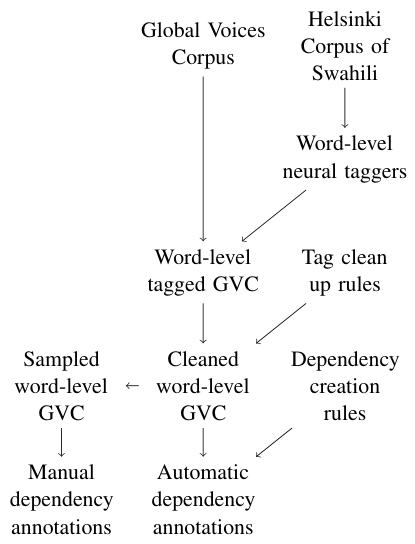
Figure 1: Diagram of the steps involved in creating the Universal Dependency Treebank for Swahili.
Recently, researchers have developed corpora for question answering and emotion classification in Swahili (Martin et al., 2022). In addition, a transformer model for Swahili has been developed (Martin et al., 2022).
3 System Overview
Since no dependency treebank is available, we create the dependency trees automatically, using the annotations in the Helsinki Corpus of Swahili. This corpus contains syntactic information in the form of word-level constraint grammar labels, which need to be converted into Universal Dependency annotations. For this conversion, we use a number of neural tagging models, post-processing rules, and dependency arc creation rules.
The smaller higher-quality, manually annotated, portion of the treebank undergoes a similar series of steps but before dependency creation rules are applied, a portion of the treebank is sampled. This sample is then manually annotated. Figure 1 displays the different steps and resources involved in the process.
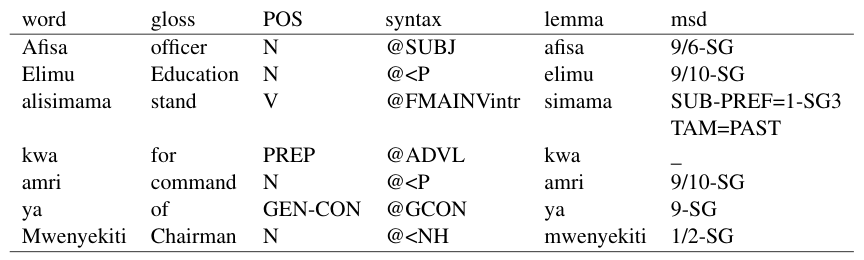
Table 1: Tags for a single sentence in the HCS.
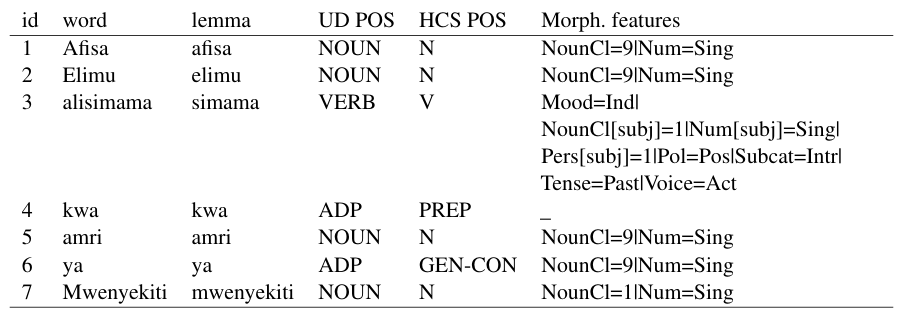
Table 2: CONLL-U representation of the sentence in Table 1, focusing on the relevant columns only.
4 Corpora
The corpus situation for Swahili is somewhat difficult. We use both the Helsinki Corpus of Swahili (HCS) (Hurskainen, 2004a) and the Swahili section of the Global Voices corpus (GVC) (Tiedemann, 2012) in this work. Because of licensing limitations, we are unable to annotate the Helsinki Corpus of Swahili with dependencies and redistribute it. For this reason, we leverage the word-level annotations of this corpus to create a POS tagger using the Helsinki Corpus of Swahili POS tagset, a POS tagger for UD POS tags, a morphological analyzer, and a word-level constraint-grammar syntactic tagger. We then use these taggers to annotate the Swahili portion of the Global Voices corpus on the word level. In a final step, we create Universal Dependency annotations based on all of these annotations via a rule-based approach.
The texts contained in the Helsinki Corpus of Swahili are primarily from legislative assemblies, a collection of stories, and news articles. In terms of annotations, the Helsinki Corpus of Swahili is a silver standard corpus created by the SALAMA finite state transducer and disambiguat r (Hurskainen, 1999). In the corpus, each word is annotated with its lemma, POS tag, a series of morphological tags, and a functional syntactic tag (constraint grammar) describing the word's role in the sentence are included for each word. Table 1 shows the word-level annotation for the sentence Afisa Elimu alisimama kwa amri ya Mwenyekiti (Eng.: The education officer stood for the Chairman's command) from the HCS.
Table 2 shows the conversion of this sentence to CONLL-U format. The HCS uses multiple ways to express the noun class or noun class agreement of a word. For example, nouns (which inherently have a noun class) indicate the noun class of the singular form, the noun class of the plural form and whether the given noun is singular or plural (i.e. 9/10-SG). Noun class agreement prefixes on a verb follow a different convention where noun class, number, and person are indicated (e.g., 1-SG3). Adpositions such as ya, meanwhile, indicate noun class agreement as simply a noun class followed by the number (i.e., 9-SG). Additionally, for some POS tags, certain morphological features are assumed as the default by the HCS, and only features which diverge from this default are included. For example, active voice and positive polarity are frequently not explicitly annotated in the HCS annotations, but passive voice and negative polarity are.

Table 3: Tokenization examples of Swahili demonyms.
The Global Voices Corpus, in contrast, is a large massively multilingual corpus with parallel texts in 46 languages. The GVC consists of news articles from around the world. Because the corpus features articles by citizen journalists, social media text is included as well. Unlike the HCS, the GVC consists of plain text without any word-level annotations. For our treebank, we use the section of the GVC with parallel texts in Swahili and English. This section of the corpus consists of 29 698 Swahili sentences, 546 000 words.
5 Creating Word-Level Annotations
Our ultimate goal is the creation of a Universal Dependency Treebank for Swahili. As a first step, we need to annotate the Global Voices Corpus (GVC) for word-level information, based on which we can then apply the rules that will construct the dependency annotations.
We trained word-level neural tagging models using a sample of 789 691 words, corresponding to 35 925 sentences, from the Helsinki Corpus of Swahili (HCS). A common neural architecture was used for the following word-level tagging models: UD POS tags, language specific POS tags from the HCS, morphological features, and functional syntactic tags. This architecture consists of a two layer bidirectional GRU-LSTM using learned character and word embeddings. Because of the large number of morphological tags, we developed a second architecture that models individual morphological features as single tags. This model is very similar in design to the other neural tagging architecture. However, instead of using argmax to predict a single tag, this model predicts all tags that exceed a threshold (0.5) after a sigmoid activation.
We then automatically tagged the Global Voices Corpus (GVC) with these neural models. From the automatically tagged GVC data, 150 short sentences (length 8-30 words) and 30 longer sentences (length 20-50 words) were randomly sampled for manual annotation. Then, the rule system was applied to the remainder of the GVC to create the UD annotations.
Integrating Swahili into the Universal Dependency framework required us to make annotation decisions regarding tokenization, conversion of part of speech tags, handling of particular constructions in Swahili. We detail these decisions below.
Tokenization When tokenizing, we took special consideration to ensure that demonyms with hyphens were not separated, but compounds were split apart. Demonyms such as those shown in Table 3 are frequently present in the Global Voices corpus. The regular expressions used for tokenization ensured that hyphens after noun class prefixes were not separated from the rest of the word.
Following UD guidelines, compounds of coordinating conjunctions and pronouns are separated into their component tokens. For example, naye is separated into na yeye (Eng.: and he/she) and nasi is separate into na sisi (Eng: and you all).
Converting POS Tags to UD The POS tags for the Helsinki Corpus of Swahili are relatively close to Universal Dependency POS tags. In general, the conversion is a many-to-one mapping: the Helsinki corpus tags annotate a number of distinctions that are not featured in Universal Dependencies. Additionally, all POS tags reserved for punctuation in the Helsinki Corpus of Swahili tagset (i.e., COLON, HYPHEN, etc.) are mapped to PUNCT. Table 4 shows the correspondence between the two POS tags annotations.
In some cases, additional information was required to determine the appropriate Universal Dependency tag. For example, in HCS, EXCLAM is typically used for interjections such as jamani (Eng.: hey there). However, it is also used for exclamation marks. For those cases, we assign PUNCT.
Both relative pronouns and verbs with relative markers received the Helsinki POS tags REL-LI or REL-LI-VYO. In such cases, we use the functional syntactic tag assigned to the word for disambiguation: if the word has a verbal functional tag, then we assign the UD tag V. In all other cases, we assign PRON.
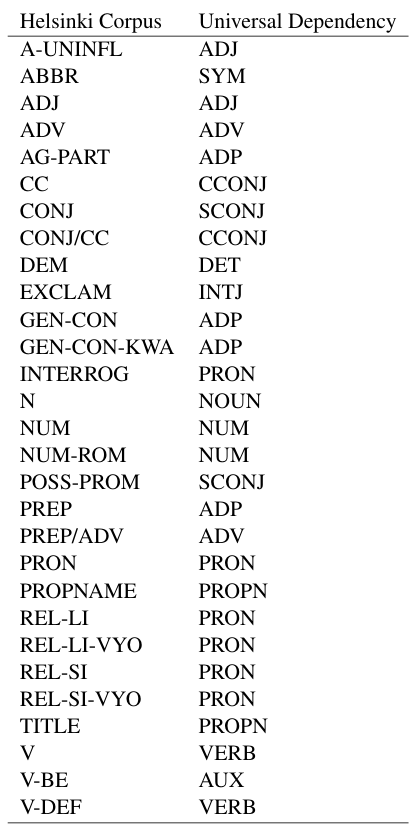
Table 4: Correspondence between Helsinki Corpus of Swahili and Universal Dependencies POS tags.
Morphological Features Unlike the conversion of POS tags, which is a relatively straightforward process, morphological tag extraction is considerably more complex.
Morphological features in Universal Dependency consist of attribute-value pairs. These are represented in the CONLL-U format with attributes separated from their associated values by '=' and each pair is separated by '|'. The Universal Dependency annotation guidelines (Nivre et al., 2017) provide morphological features to accommodate noun classes in Bantu languages. These features are indicated using different values for the NounClass attribute. However, these features are not sufficient since verbs can have multiple noun class markers indicating the noun class of the subject, object, and relative head.
For example, the word a-li-yo-i-tum-ia has markers indicating noun class, person, and number for the subject, object, and relative head, see the analysis in example (1).
- (1) a-li-yo-i-tum-ia 3SG-PST-4.REL-9.OBJ-use-APPL those that he/she used for it
To address this issue, we use layered morphological features. For Person, Number, and NounClass, additional subtypes such as rel, subj, and obj are added. Until recently, this was not a documented possibility in Universal Dependencies, however other treebanks have established these layered features as a precedent. One example is the Basque Universal Dependency treebank (Aranzabe et al., 2015). Though subtypes are not described in the documentation of the conversion process (Aranzabe et al., 2015), this treebank includes verbs with multiple number features using subtypes to indicate the type. Unlike the Basque Universal Dependency treebank, we do not use subtypes with the case of the agreeing element indicated for Swahili. Rather, the subtypes simply specify the function of the agreeing element. For example, where the Basque corpus uses Number[nom], the Swahili corpus uses Number[subj]. The Basque option is not usable for Swahili as Swahili does not have overt case, and adopting a covert case analysis for all languages like Swahili does not follow the principles of Universal Dependency.
6 Creating Dependency Annotations
6.1 Dependency Guidelines
We adhere to the guidelines laid out by Universal Dependency (Nivre et al., 2017). This section outlines some specifics for how we applied these guidelines to Swahili. The Universal Dependency guidelines state that "[t]he copula be is not treated as the head of a clause, but rather the nonverbal predicate" (de Marneffe et al., 2020). The guidelines also advise that "[t]he cop relation should only be used for pure copulas that add at most TAME categories to the meaning of the predicate".
In the Swahili treebank, we make a distinction between the "verbal" copula kuwa and other copulas like ni, the negated form si, emphatic forms like ndiyo and locative copulas like uko. We analyze kuwa as a verb while the other copulas are given the POS tag COP and are not considered the head of their clause.
6.2 Rule application
To create rules for correcting common issues with the neural taggers and generate dependency arcs, CG3 was used (Bick and Didriksen, 2015). CG3 is an extended variant of constraint grammar with implementations for compiling and applying constraint grammar rules, allowing us to develop and apply complex rules.
Addressing errors in word-level tags Initially, rules were written to remedy errors with the word-level tags produced by the neural POS models. To correct errors produced by the automatic tagger, SUBSTITUTE and ADD commands were used to change one tag to another, add a missing tag, or remove an errant tag. These word-level tag correction rules were applied before all rules creating dependency arcs.
In many cases, tag rewrite rules were leveraged to rewrite a word-level tag if three or more of the other word-level tags indicated that an error had occurred. The first example in Table 5 displays a rule that replaces NOUN with VERB in cases where other taggers indicate that the word in question is actually a verb. More specifically, the language specific POS tagger must assign this word a V tag, and it must have the morphological feature specifying polarity and one of a number of functional syntactic tags indicating that this word is serving as a verb in the sentence for the rule to apply.
Dependency arc creation To create dependency arcs from sentences plus the word-level annotations, we created ordered regular expression rules, such that highly specific rules were followed by more generic versions using more lax restrictions; and occasionally we used fallback rules. Some phenomena were addressed using a single generic rule without more specific or lax versions. For example, the bold phrase in the sentence in example (2) shows an example of multiple noun phrases linked together in an associative noun phrase chain.
(2) Biti COP
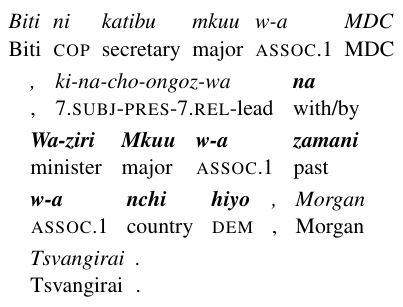
Biti is the secretary general for Movement for Democratic Change, led by former Prime Minister Morgan Tsvangirai.
Without taking noun class agreement into consideration, the noun phrase in bold is ambiguous, i.e., both dependency analyses in Figure 2 would be possible.
As the interlinear analysis in example (2) indicates, zamani is a class 9 noun, the associative adposition wa is class 1, and Waziri is class 1. The associative agrees in noun class with the noun that its parent noun modifies. Thus the syntactic analysis in the dependency analysis on the right of Figure 2 is the correct one. The specific version of the rule, shown as the second rule in Table 5, leverages this agreement.
More generic rules are applied if no match for a specific rule is found. A generic rule may apply because of errors in the morphological tags produced by the tagging model or because of missing agreement between the two tokens. In this particular case, associative adpositions in different noun classes are often polysemous. For example, wa can indicate that the noun modified by its parent noun is class 1, as in the example above, or classes 2, 3, or 11. The neural taggers can leverage the surrounding context; however errors still occur with some frequency. A generic rule is thus used to combat errors in the morphological annotations. This rule, shown as the third rule in Table 5, has no agreement constraints.
Fallback rules are applied in cases where criteria using morphological and functional tags both na Waziri Mkuu wa zamani wa nchi hiyo fail. Instead, simple linear ordering patterns conditioned on POS are used in fallback rules.
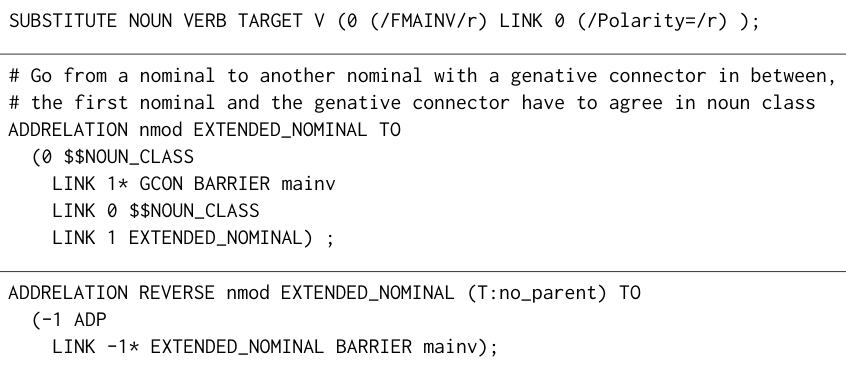
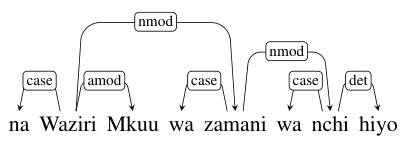
Figure 2: Two possible dependency analyses for the noun phrase chain from example (2).
Table 5: Example rule for error correction in word-level tags.
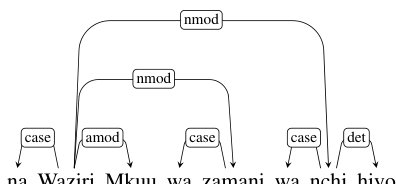
Table 6 shows how often specific, generic, and fallback rule types are used to address each type of phenomenon. While the highly specific rules are able to disambiguate between different possible arcs more effectively, these specific rules are triggered less frequently.
7 Quality of Annotations
7.1 Word-Level Tagging Results
Before we trained the neural tagging models, we set aside 2 000 sentences from the Helsinki Corpus of Swahili, 1 000 sentences for validation and 1 000 sentences for testing the model's performance. Table 7 shows the results of this evaluation. All models exceed 94% accuracy, and all but the multilabel morphological tagger reach an accuracy of 97% and higher; corresponding F-scores for POS tagging, and functional role are in the same range. As discussed in section 5, the multilabel tagger outputs a tag if it exceeds a threshold of 0.5. While this allows the tagger to be more flexible and consider combinations of morphological features that were not present in the training data, it also does not enforce co-occurrence restrictions between morphemes. The multilabel model can predict both NounClass=9 and NounClass=7 for the same noun, though this should not be permitted. These restrictions are automatically followed when using the monolithic morphological tagger.
Note that the test data are derived from the source corpus, the Helsinki Corpus of Swahili, and therefore the exact performance of the models on the target corpus (GVC) cannot be determined. During the manual corpus creation process, we corrected UD POS tags and added depedency arcs but did not correct other word level tags. In the future, other word level tags will also be corrected.
7.2 Strengths and Limitations in Generated Trees
Out of 29 698 sentences, the dependency creation rules rules generate spanning trees for 4 994 sentences. 3 499 of these trees are projective dependency trees. When examining particular linguistic phenomena, the rules do well at some and produce incorrect or incomplete trees when confronted with others.
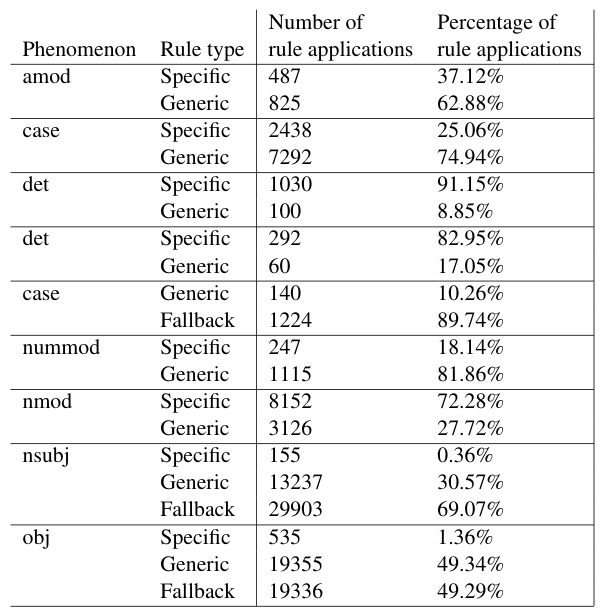
Table 6: Rule type frequency for dependency creation rules on Global Voices Corpus.
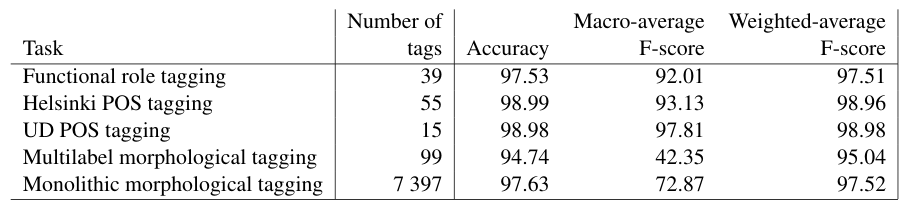
Table 7: Model accuracy in relation to tagset size for bidirectional GRU-based models.
Associative chains In Swahili, complex noun phrases are often constructed using chains of associative adpositions. Our system of rules does well with these constructions. Figure 3 shows the tree generated for the associative chain at the beginning of the sentence in example (3). While the associative chain is handled correctly, the locative noun phrase nchini Cambodia should be modifying Wa-tumiaji (users), at the beginning of the text. However, there are no morphological features that can help the rules disambiguate the attachment of this locative noun phrase.
- (3) Wa-tumiaji 1-users w-a 1-ASSOC mitandao network y-a 9-ASSOC jamii society nchini country Cambodia Cambodia pia also wa-me-hamas-ish-wa 3PL-PERF-motivate-CAUS-PASS ku-weka 15-set picha pictures z-a 10-ASSOC alama sign y-a 9-ASSOC kampeni campaign
Social media users in Cambodia are also encouraged to replace their profile photos with icons of the campaign.
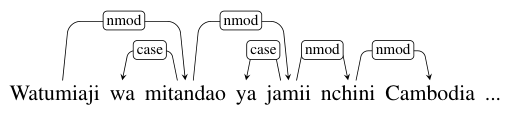
Figure 3: Initial associate chain in example 3
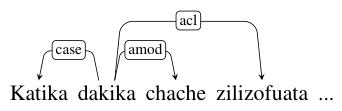
Figure 4: A tree for a short headless relative clause
Relative clauses Both headless and headed relative clauses are often handled correctly by the system of rules. Only headless relative clauses are shown here due to space constraints. Example (4) displays a phrase with a headless relative clause. The noun dakika (Eng.: minutes) is modified by the relative clause zilizofuata (Eng.: following). The intervening adjective chache does not interfere with the rules and is also connected to dakika, as appropriate.
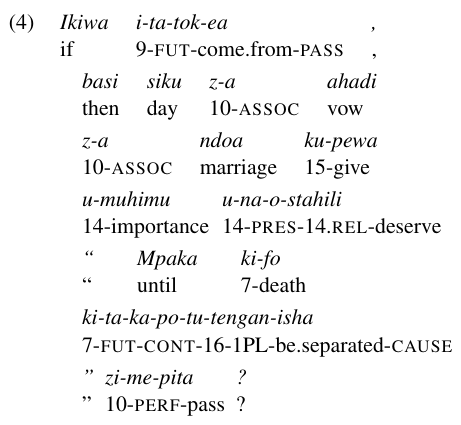
If this will happen, gone are the days when the marriage vows are to be taken seriously "Til death do us part"?
Root identification Identifying the root of the clause using rules is difficult. This is particularly true in cases where topicalization of some kind has occurred.
In example (4), the fronted adverbial clause Ikiwa itatokea (Eng.: If this will happen) interferes with the current rules for root identification.
Instead of assigning kupewa root status, the verb in the adverbial clause itatokea is erroneously labeled as the root. While itatokea is a verbal form and thus a possible root, it is the head of the subordinate clause.
8 Conclusion
Our work is concerned with creating a Universal Dependency treebank for Swahili leveraging the annotations in the Helsinki Corpus of Swahili. We show that we can train neural taggers to annotate UD POS tags, language specific POS tags, morphological tags, as well as functional syntactic tags, and that we can use those annotations on a new corpus to create regular expression rules to derive a dependency annotation. The results are not perfect: for about 30% of the sentences, our methods do not create fully connected trees. But our annotations can be improved in the future. It is, of course, possible to add more rules to our framework to cover more cases. However, any new rule will be very specific and will thus only improve a very small number of cases. We consequently argue that additional improvement should come from training a robust parser and manually correcting the parse trees. We are planning to investigate robust parsing methods that will provide reliable parses when trained on the available annotations.
9 Limitations
It is certain that there are errors in the automatic and manual annotations. Our conversion procedure is limited by the information available in the Helsinki Corpus of Swahili. And while the first author, who manually annotated the portion of the Swahili treebank, has extensive training in Bantu syntax, he is not a native speaker of Swahili. We hope that this initial step inspires future expansion and/or correction of the corpus.
10 Ethics Statement
Working on an under-resourced language is always accompanied by the danger of disenfranchising the language community. However, dependency annotations require a syntactic background, and there are often not enough speakers of the language with such a training. We hope that the Swahili community will adopt and improve our treebank. We have consciously chosen a corpus the can be freely distributed, rather than working with the Helsinki Corpus of Swahili, which comes with restrictive licensing requirements.
Notes
1 For more details on CONLL-U format, see https://universaldependencies.org/format.html
2 Locative copulas like uko could perhaps be annotated as an adverbial. However, this only affects the label. The nonverbal predicate following uko would still be the head of the clause.
3 For example, some adpositions like wa agree with the noun class of the preceding noun and would match a specific rule form. However, other adpositions like katika do not indicate the noun class of the preceding noun in any way.
References
Maria Jesus Aranzabe, Aitziber Atutxa, Kepa Bengoetxea, Arantza Diaz de Ilarraza, Iakes Goenaga, Koldo Gojenola, and Larraitz Uria. 2015. Automatic conversion of the Basque Dependency Treebank to Universal Dependencies. In Proceedings of the Fourteenth International Workshop on Treebanks and Linguistic Theories (TLT14), pages 233-241.
Eckhard Bick and Tino Didriksen. 2015. CG-3 - Beyond classical constraint grammar. In Proceedings of the 20th Nordic Conference of Computational Linguistics (NODALIDA 2015), pages 305-308.
Marie-Catherine de Marneffe, Filip Ginter, Yoav Goldberg, Jan Hajič, Christopher Manning, Ryan McDonald, Joakim Nivre, Slav Petrov, Sampo Pyysalo, Sebastian Schuster, Natalia Silveira, Reut Tsarfaty, Francis Tyers, and Dan Zeman. 2020. Universal Dependencies.
Marie-Catherine de Marneffe, Christopher D. Manning, Joakim Nivre, and Daniel Zeman. 2021. Universal Dependencies. Computational Linguistics, 47(2):255-308.
Guy De Pauw, Gilles-Maurice De Schryver, and Peter W Wagacha. 2006. Data-driven part-of-speech tagging of Kiswahili. In International Conference on Text, Speech and Dialogue, pages 197-204. Springer.
Zellig S. Harris. 1955. From phoneme to morpheme. Language, 31(2):190-222.
Yu Hu, Irina Matveeva, John Goldsmith, and Colin Sprague. 2005. Refining the SED heuristic for morpheme discovery: Another look at Swahili. In Proceedings of the Workshop on Psychocomputational Models of Human Language Acquisition, pages 28-35, Ann Arbor, Michigan. Association for Computational Linguistics.
Arvi Hurskainen. 1992. A two-level computer formalism for the analysis of Bantu morphology. an application to Swahili. Nordic Journal of African Studies, 1(1).
Arvi Hurskainen. 1996. Disambiguation of morphological analysis in Bantu languages. In Proceedings of the 16th Conference on Computational Linguistics, pages 568-573.
Arvi Hurskainen. 1999. Salama: Swahili language manager. Nordic Journal of African Studies, 8:139-157.
Arvi Hurskainen. 2004a. Helsinki corpus of Swahili. Compilers: Institute for Asian and African Studies (University of Helsinki) and CSC.
Arvi Hurskainen. 2004b. Swahili language manager: A storehouse for developing multiple computational applications. Nordic Journal of African Studies, 13(3):363-397.
Kimmo Koskenniemi. 1983. Two-level model for morphological analysis. In IJCAI, volume 83, pages 683-685.
Patrick Littell, Kaitlyn Price, and Lori Levin. 2014. Morphological parsing of Swahili using crowd-sourced lexical resources. In Proceedings of the Ninth International Conference on Language Resources and Evaluation (LREC'14), pages 3333-3339, Reykjavik, Iceland. European Language Resources Association (ELRA).
Gati Martin, Medard Edmund Mswahili, Young-Seob Jeong, and Jiyoung Woo. 2022. SwahBERT: Language model of Swahili. In Proceedings of the 2022 Conference of the North American Chapter of the Association for Computational Linguistics: Human Language Technologies, pages 303-313, Seattle, United States. Association for Computational Linguistics.
Joakim Nivre, Željko Agić, Lars Ahrenberg, Maria Jesus Aranzabe, Masayuki Asahara, Aitziber Atutxa, Miguel Ballesteros, John Bauer, Kepa Bengoetxea, Riyaz Ahmad Bhat, Eckhard Bick, Cristina Bosco, Gosse Bouma, Sam Bowman, Marie Candito, Gülşen Cebiroğlu Eryiğit, Giuseppe G. A. Celano, Fabricio Chalub, Jinho Choi, Çağrı Çöltekin, Miriam Connor, Elizabeth Davidson, Marie-Catherine de Marneffe, Valeria de Paiva, Arantza Diaz de Ilarraza, Kaja Dobrovoljc, Timothy Dozat, Kira Droganova, Puneet Dwivedi, Marhaba Eli, Tomaž Erjavec, Richárd Farkas, Jennifer Foster, Cláudia Freitas, Katarína Gajdošová, Daniel Galbraith, Marcos Garcia, Filip Ginter, Iakes Goenaga, Koldo Gojenola, Memduh Gökırmak, Yoav Goldberg, Xavier Gómez Guinovart, Berta Gonzáles Saavedra, Matias Grioni, Normunds Grūzītis, Bruno Guillaume, Nizar Habash, Jan Hajič, Linh Hà Mỹ, Dag Haug, Barbora Hladká, Petter Hohle, Radu Ion, Elena Irimia, Anders Johannsen, Fredrik Jørgensen, Hüner Kaşıkara, Hiroshi Kanayama, Jenna Kanerva, Natalia Kotsyba, Simon Krek, Veronika Laippala, Phng Lê Hồng, Alessandro Lenci, Nikola Ljubešić, Olga Lyashevskaya, Teresa Lynn, Aibek Makazhanov, Christopher Manning, Cătălina Mărănduc, David Mareček, Héctor Martínez Alonso, André Martins, Jan Mašek, Yuji Matsumoto, Ryan McDonald, Anna Missilä, Verginica Mititelu, Yusuke Miyao, Simonetta Montemagni, Amir More, Shunsuke Mori, Bohdan Moskalevskyi, Kadri Muischnek, Nina Mustafina, Kaili Müürisep, Lng Nguyễn Thị, Huyền Nguyễn Thị Minh, Vitaly Nikolaev, Hanna Nurmi, Stina Ojala, Petya Osenova, LiljaØvrelid, Elena Pascual, Marco Passarotti, Cenel-Augusto Perez, Guy Perrier, Slav Petrov, Jussi Piitulainen, Barbara Plank, Martin Popel, Lauma Pretkalnin, a, Prokopis Prokopidis, Tiina Puolakainen, Sampo Pyysalo, Alexandre Rademaker, Loganathan Ramasamy, Livy Real, Laura Rituma, Rudolf Rosa, Shadi Saleh, Manuela Sanguinetti, Baiba Saulīte, Sebastian Schuster, Djamé Seddah, Wolfgang Seeker, Mojgan Seraji, Lena Shakurova, Mo Shen, Dmitry Sichinava, Natalia Silveira, Maria Simi, Radu Simionescu, Katalin Simkó, Mária Šimková, Kiril Simov, Aaron Smith, Alane Suhr, Umut Sulubacak, Zsolt Szántó, Dima Taji, Takaaki Tanaka, Reut Tsarfaty, Francis Tyers, Sumire Uematsu, Larraitz Uria, Gertjan van Noord, Viktor Varga, Veronika Vincze, Jonathan North Washington, Zdeněk Žabokrtský, Amir Zeldes, Daniel Zeman, and Hanzhi Zhu. 2017. Universal dependencies 2.0. LINDAT/CLARIAH-CZ digital library at the Institute of Formal and Applied Linguistics (ÚFAL), Faculty of Mathematics and Physics, Charles University.
Gary F Simons and Charles D Fennig. 2018. Ethnologue: Languages of the world, twenty. Dallas: SIL International. Retrieved from www. ethnologue. com. Accessed, page 2018.
Jörg Tiedemann. 2012. Parallel data, tools and interfaces in OPUS. In Proceedings of the Eight International Conference on Language Resources and Evaluation (LREC'12), Istanbul, Turkey. European Language Resources Association (ELRA).
Towards a Swahili Universal Dependency Treebank: Leveraging the Annotations of the Helsinki Corpus of Swahili
Vers une banque d’arbres de dépendance universelle pour le swahili : tirer parti des annotations du Corpus d’Helsinki du swahili
Affiliations
Kenneth Steimel
Sandra Kübler
Indiana University
Indiana University
Affiliations
Kenneth Steimel
Sandra Kübler
Indiana University
Indiana University
Abstract
Résumé
Dependency annotation can be a laborious process for under-resourced languages. However, in some cases, other resources are available. We investigate whether we can leverage such resources in the case of Swahili: We use the annotations of the Helsinki Corpus of Swahili for creating a Universal Dependency treebank for Swahili. The Helsinki Corpus of Swahili provides word-level annotations for part of speech tags, morphological features, and functional syntactic tags. We train neural taggers for these types of annotations, then use those models to annotate our target corpus, the Swahili portion of the Global Voices Corpus. Based on the word-level annotations, we then manually create constraint grammar rules to annotate the target corpus for Universal Dependencies. In this paper, we describe the process, discuss the annotation decisions we had to make, and we evaluate the approach.
L'annotation de dépendance peut être un processus laborieux pour les langues sous-dotées en ressources. Cependant, dans certains cas, d'autres ressources sont disponibles. Nous étudions si nous pouvons exploiter de telles ressources dans le cas du swahili : nous utilisons les annotations du Helsinki Corpus of Swahili pour créer un arbre-banc de dépendances universelles pour le swahili. Le Helsinki Corpus of Swahili fournit des annotations au niveau des mots pour les catégories grammaticales, les traits morphologiques et les étiquettes syntaxiques fonctionnelles. Nous entraînons des étiqueteurs neuronaux pour ces types d'annotations, puis nous utilisons ces modèles pour annoter notre corpus cible, la partie swahili du Global Voices Corpus. Sur la base des annotations au niveau du mot, nous créons ensuite manuellement des règles de grammaire de contrainte pour annoter le corpus cible pour les Dépendances Universelles. Dans cet article, nous décrivons le processus, discutons des décisions d'annotation que nous avons dû prendre, et nous évaluons l'approche.
1 Introduction
1 Introduction
Swahili is the most-widely spoken Bantu language with an estimated 16 million native speakers (Simons and Fennig, 2018) and 50-100 million L2 speakers. Swahili serves as a national language of Tanzania, Kenya, Uganda, and the DRC, is a working language of the African Union, and serves as lingua franca for the East African Community.
Le swahili est la langue bantoue la plus parlée avec environ 16 millions de locuteurs natifs (Simons et Fennig, 2018) et 50 à 100 millions de locuteurs L2. Le swahili sert de langue nationale de la Tanzanie, du Kenya, de l'Ouganda et de la RDC, est une langue de travail de l'Union africaine et sert de lingua franca pour la Communauté d'Afrique de l'Est.
While not a typical under-resourced language in general, there are no syntactic treebanks available for Swahili. Since dependency annotation is a costly endeavor and requires experts in the syntactic framework as well as in the language, we investigate whether we can leverage existing resources to automate the creation of a treebank as much as possible. We investigate an approach where we use the Helsinki Corpus of Swahili (Hurskainen, 2004a) and its annotations as a starting point. We then create automatic taggers for the word-level annotation based on this corpus. After applying these taggers to our target corpus, the Swahili section of the Global Voices Corpus (Tiedemann, 2012), we use a rule-based approach to convert the word-level annotation to Universal Dependency (UD) annotations (de Marneffe et al., 2021). The word-level annotations available in the Helsinki Corpus of Swahili consist of part of speech (POS) tags, based on a POS tagset that has more fine grained information than the Universal Dependency part of speech tagset. Additionally, the corpus contains morphological features and functional syntactic tags, which are based on a constraint grammar framework.
Bien que ce ne soit pas une langue typiquement sous-dotée en général, il n'existe pas d'arborescences syntaxiques disponibles pour le swahili. Puisque l'annotation des dépendances est une entreprise coûteuse et nécessite des experts dans le cadre syntaxique ainsi que dans le langage, nous étudions si nous pouvons tirer parti des ressources existantes pour automatiser la création d'une banque d'arbres autant que possible. Nous étudions une approche où nous utilisons le Corpus Helsinki de Swahili (Hurskainen, 2004a) et ses annotations comme point de départ. Nous créons ensuite des étiqueteurs automatiques pour l'annotation au niveau des mots basés sur ce corpus. Après avoir appliqué ces étiqueteurs à notre corpus cible, la section swahili du Global Voices Corpus (Tiedemann, 2012), nous utilisons une approche à base de règles pour convertir l'annotation au niveau des mots en annotations Universal Dependency (UD) (de Marneffe et al., 2021). Les annotations au niveau des mots disponibles dans le Helsinki Corpus of Swahili se composent d'étiquettes de catégorie grammaticale (POS), fondées sur un jeu d'étiquettes POS qui contient des informations plus fines que le jeu d'étiquettes de catégorie grammaticale d'Universal Dependency. De plus, le corpus contient des caractéristiques morphologiques et des étiquettes syntaxiques fonctionnelles, qui sont basées sur un cadre de grammaire contrainte.
In the process of converting the morphological and syntactic information into the Universal Dependency framework, we encountered challenges based on the fact that little work has been done on UD annotations for Bantu languages. We will discuss some of these cases along with the annotation decisions we have made. The treebank, all rules and code are available at https://git.steimel.info/ksteimel/SWH_UDT. The treebank will be included in the next release of UD.
Lors de la conversion des informations morphologiques et syntaxiques dans le cadre des dépendances universelles, nous avons rencontré des défis basés sur le fait que peu de travaux ont été réalisés sur les annotations UD pour les langues bantoues. Nous discuterons de certains de ces cas ainsi que des décisions d'annotation que nous avons prises. Le treebank, toutes les règles et le code sont disponibles à https://git.steimel.info/ksteimel/SWH_UDT. La banque d'arbres sera incluse dans la prochaine version d'UD.
The remainder of this paper is structured as follows: section 2 reports on related work, section 3 gives an overview of the system used for converting the annotations, and section 4 describes the corpora we use. In section 5, we describe the word-level annotations, and in section 6, we describe the rules for the dependency annotation. Section 7 looks into the quality of our annotations, and section 8 concludes.
Le reste de cet article est structuré comme suit : la section 2 rend compte des travaux connexes, la section 3 donne un aperçu du système utilisé pour convertir les annotations et la section 4 décrit les corpus que nous utilisons. Dans la section 5, nous décrivons les annotations au niveau des mots, et dans la section 6, nous décrivons les règles pour l'annotation de dépendance. La section 7 examine la qualité de nos annotations, et la section 8 conclut.
2 Related Work: NLP Approaches for Swahili
2 Travaux connexes : Approches de TAL pour le swahili
Political and economic significance promote research on Swahili making it one of the more well-studied Bantu languages in natural language processing. Rule-based systems, data driven approaches, and unsupervised methods have been adopted for Swahili. Hurskainen (1992) presents the first research into morphological analysis of Swahili. The SWATWOL morphological analyzer uses a finite-state two level morphology (Koskenniemi, 1983) to tag words. A constraint grammar system is used to disambiguate when multiple analyses are provided by the finite state-system (Hurskainen, 1996). These components are combined together into the Swahili language manager (SALAMA) (Hurskainen, 2004b). The SALAMA system is extended to include a shallow constraint grammar parser and a deeper grammar-based dependency parser. Though the dependency parser in SALAMA would appear invaluable to the present work, the parser is not freely available and the dependency structure is not provided as part of the Helsinki Corpus of Swahili (Hurskainen, 2004a). Littell et al. (2014) develop a similar finite state morphological analyzer for Swahili. However, their approach involves using an online crowd-sourced dictionary (kamusi.org) to ensure wide lexical coverage.
L'importance politique et économique encourage la recherche sur le swahili, ce qui en fait l'une des langues bantoues les plus étudiées dans le traitement du langage naturel. Des systèmes basés sur des règles, des approches axées sur les données et des méthodes non supervisées ont été adoptés pour le swahili. Hurskainen (1992) présente la première recherche sur l'analyse morphologique du swahili. L'analyseur morphologique SWATWOL utilise une morphologie à deux niveaux à états finis (Koskenniemi, 1983) pour marquer les mots. Un système de grammaire à contraintes est utilisé pour désambiguïser lorsque plusieurs analyses sont fournies par le système à états finis (Hurskainen, 1996). Ces composants sont combinés ensemble dans le gestionnaire de langue swahilie (SALAMA) (Hurskainen, 2004b). Le système SALAMA est étendu pour inclure un analyseur syntaxique superficiel à grammaire de contraintes et un analyseur syntaxique en dépendance plus profond basé sur la grammaire. Bien que l'analyseur syntaxique à dépendances dans SALAMA semblerait inestimable pour le présent travail, l'analyseur n'est pas librement disponible et la structure de dépendance n'est pas fournie comme partie du Helsinki Corpus of Swahili (Hurskainen, 2004a). Littell et al. (2014) développent un analyseur morphologique à états finis similaire pour le swahili. Cependant, leur approche implique l'utilisation d'un dictionnaire en ligne participatif (kamusi.org) pour assurer une large couverture lexicale.
Using corpora developed by rule-based methods, De Pauw et al. (2006) adopt a data driven approach instead. They train part of speech taggers on the Helsinki Corpus of Swahili (Hurskainen, 2004a), which was built using the SALAMA language manager system described above. They use a variety of different off the shelf taggers including a Hidden Markov Model (TnT), SVMs (SVMtool), memory-based taggers (MBT) and a maximum entropy model tagger (MXPOST). The best performance is achieved with the maximum entropy model, though all models reach an accuracy of more than 90%. The maximum entropy model does particularly well with out-of-vocabulary words.
En utilisant des corpus développés par des méthodes fondées sur des règles, De Pauw et coll. (2006) adoptent plutôt une approche axée sur les données. Ils entraînent des étiqueteurs de catégories grammaticales sur le Helsinki Corpus of Swahili (Hurskainen, 2004a), qui a été construit en utilisant le système de gestionnaire de langue SALAMA décrit ci-dessus. Ils utilisent une variété d'étiqueteurs prêts à l'emploi, y compris un modèle de Markov caché (TnT), des SVM (SVMtool), des étiqueteurs basés sur la mémoire (MBT) et un étiqueteur à modèle d'entropie maximale (MXPOST). La meilleure performance est atteinte avec le modèle d'entropie maximale, bien que tous les modèles atteignent une précision de plus de 90 %. Le modèle d'entropie maximale se comporte particulièrement bien avec les mots hors vocabulaire.
Swahili has also been the focus of research on unsupervised morpheme discovery. Hu et al. (2005) use a string-edit-distance (SED) heuristic to learn the morphology of Swahili. This heuristic goes through all pairs of words in a corpus and creates an alignment between the pairs using edit distance with specific penalties for substitution, addition and deletion. Then, finite-state automata describing pairs of related strings are collapsed together with aligned sequences of characters mapping onto the same state. This process iterates; the finite state automata produced combine with other automata. In the end, the places where the FSA diverges are morpheme boundaries. The authors report high performance when compared to other unsupervised morpheme discovery heuristics such as successor frequency (Harris, 1955).
Le swahili a également été au centre de recherches sur la découverte non supervisée de morphèmes. Hu et al. (2005) utilisent une heuristique string-edit-distance (SED) pour apprendre la morphologie du swahili. Cette heuristique passe en revue toutes les paires de mots d'un corpus et crée un alignement entre les paires en utilisant la distance d'édition avec des pénalités spécifiques pour la substitution, l'addition et la suppression. Ensuite, les automates à états finis décrivant des paires de chaînes liées sont réduits ensemble avec des séquences alignées de caractères mappant sur le même état. Ce processus itère ; les automates à états finis produits se combinent avec d'autres automates. À la fin, les endroits où l'AEF diverge sont les limites des morphèmes. Les auteurs font état de performances élevées par rapport à d'autres heuristiques de découverte de morphèmes non supervisées telles que la fréquence des successeurs (Harris, 1955).
Figure 1: Diagram of the steps involved in creating the Universal Dependency Treebank for Swahili.
Figure 1: Diagramme des étapes impliquées dans la création de l'Universal Dependency Treebank pour le swahili.
Recently, researchers have developed corpora for question answering and emotion classification in Swahili (Martin et al., 2022). In addition, a transformer model for Swahili has been developed (Martin et al., 2022).
Récemment, des chercheurs ont développé des corpus pour les systèmes de questions-réponses et la classification des émotions en swahili (Martin et al., 2022). De plus, un modèle transformeur pour le swahili a été développé (Martin et al., 2022).
3 System Overview
3 Aperçu du système
Since no dependency treebank is available, we create the dependency trees automatically, using the annotations in the Helsinki Corpus of Swahili. This corpus contains syntactic information in the form of word-level constraint grammar labels, which need to be converted into Universal Dependency annotations. For this conversion, we use a number of neural tagging models, post-processing rules, and dependency arc creation rules.
Étant donné qu'aucune banque d'arbres de dépendance n'est disponible, nous créons automatiquement les arbres de dépendance en utilisant les annotations dans le Corpus d'Helsinki en Swahili. Ce corpus contient des informations syntaxiques sous la forme d'étiquettes de grammaire de contraintes au niveau des mots, qui doivent être converties en annotations de dépendance universelle. Pour cette conversion, nous utilisons un certain nombre de modèles de marquage neuronal, de règles de post-traitement et de règles de création d'arcs de dépendance.
The smaller higher-quality, manually annotated, portion of the treebank undergoes a similar series of steps but before dependency creation rules are applied, a portion of the treebank is sampled. This sample is then manually annotated. Figure 1 displays the different steps and resources involved in the process.
La portion plus petite et de meilleure qualité, annotée manuellement, de la banque d'arbres subit une série d'étapes similaires, mais avant que les règles de création de dépendance ne soient appliquées, une portion de la banque d'arbres est échantillonnée. Cet échantillon est ensuite annoté manuellement. La figure 1 montre les différentes étapes et ressources impliquées dans le processus.
Table 1: Tags for a single sentence in the HCS.
Tableau 1 : Étiquettes pour une seule phrase dans le HCS.
Table 2: CONLL-U representation of the sentence in Table 1, focusing on the relevant columns only.
Tableau 2: Représentation CONLL-U de la phrase du tableau 1, en se concentrant uniquement sur les colonnes pertinentes.
4 Corpora
4 Corpora
The corpus situation for Swahili is somewhat difficult. We use both the Helsinki Corpus of Swahili (HCS) (Hurskainen, 2004a) and the Swahili section of the Global Voices corpus (GVC) (Tiedemann, 2012) in this work. Because of licensing limitations, we are unable to annotate the Helsinki Corpus of Swahili with dependencies and redistribute it. For this reason, we leverage the word-level annotations of this corpus to create a POS tagger using the Helsinki Corpus of Swahili POS tagset, a POS tagger for UD POS tags, a morphological analyzer, and a word-level constraint-grammar syntactic tagger. We then use these taggers to annotate the Swahili portion of the Global Voices corpus on the word level. In a final step, we create Universal Dependency annotations based on all of these annotations via a rule-based approach.
La situation du corpus en swahili est quelque peu difficile. Nous utilisons à la fois le Helsinki Corpus of Swahili (HCS) (Hurskainen, 2004a) et la section swahili du Global Voices corpus (GVC) (Tiedemann, 2012) dans ce travail. En raison des limitations de licence, nous ne sommes pas en mesure d'annoter le Corpus d'Helsinki du Swahili avec les dépendances et de le redistribuer. Pour cette raison, nous exploitons les annotations au niveau du mot de ce corpus pour créer un étiqueteur morphosyntaxique utilisant le jeu d'étiquettes POS du Helsinki Corpus of Swahili, un étiqueteur morphosyntaxique pour les étiquettes UD POS, un analyseur morphologique et un étiqueteur syntaxique de grammaire de contraintes au niveau du mot. Nous utilisons ensuite ces étiqueteurs pour annoter la partie swahili du Global Voices corpus au niveau des mots. Dans une dernière étape, nous créons des annotations de dépendance universelle basées sur toutes ces annotations via une approche basée sur des règles.
The texts contained in the Helsinki Corpus of Swahili are primarily from legislative assemblies, a collection of stories, and news articles. In terms of annotations, the Helsinki Corpus of Swahili is a silver standard corpus created by the SALAMA finite state transducer and disambiguat r (Hurskainen, 1999). In the corpus, each word is annotated with its lemma, POS tag, a series of morphological tags, and a functional syntactic tag (constraint grammar) describing the word's role in the sentence are included for each word. Table 1 shows the word-level annotation for the sentence Afisa Elimu alisimama kwa amri ya Mwenyekiti (Eng.: The education officer stood for the Chairman's command) from the HCS.
Les textes contenus dans le corpus d'Helsinki du swahili proviennent principalement d'assemblées législatives, d'un recueil d'histoires et d'articles de presse. En termes d'annotations, le Helsinki Corpus of Swahili est un corpus de norme argentée créé par le transducteur à états finis et désambiguïsateur SALAMA (Hurskainen, 1999). Dans le corpus, chaque mot est annoté avec son lemme, sa balise POS, une série de balises morphologiques et une balise syntaxique fonctionnelle (grammaire des contraintes) décrivant le rôle du mot dans la phrase sont incluses pour chaque mot. Le tableau 1 montre l'annotation au niveau du mot pour la phrase Afisa Elimu alisimama kwa amri ya Mwenyekiti (Eng. : The education officer stood for the Chairman's command) du HCS.
Table 2 shows the conversion of this sentence to CONLL-U format. The HCS uses multiple ways to express the noun class or noun class agreement of a word. For example, nouns (which inherently have a noun class) indicate the noun class of the singular form, the noun class of the plural form and whether the given noun is singular or plural (i.e. 9/10-SG). Noun class agreement prefixes on a verb follow a different convention where noun class, number, and person are indicated (e.g., 1-SG3). Adpositions such as ya, meanwhile, indicate noun class agreement as simply a noun class followed by the number (i.e., 9-SG). Additionally, for some POS tags, certain morphological features are assumed as the default by the HCS, and only features which diverge from this default are included. For example, active voice and positive polarity are frequently not explicitly annotated in the HCS annotations, but passive voice and negative polarity are.
Le tableau 2 montre la conversion de cette phrase au format CONLL-U. Le HCS utilise plusieurs façons d'exprimer la classe nominale ou l'accord de classe nominale d'un mot. Par exemple, les noms (qui possèdent intrinsèquement une classe nominale) indiquent la classe nominale de la forme singulière, la classe nominale de la forme plurielle et si le nom donné est singulier ou pluriel (c.-à-d. 9/10-SG). Les préfixes d'accord de classe nominale sur un verbe suivent une convention différente où la classe nominale, le nombre et la personne sont indiqués (par exemple, 1-SG3). Les adpositions telles que ya, quant à elles, indiquent l'accord de classe de nom comme étant simplement une classe de nom suivie du nombre (i.e., 9-SG). En outre, pour certaines étiquettes POS, certaines caractéristiques morphologiques sont supposées par défaut par le HCS, et seules les caractéristiques qui divergent de cette valeur par défaut sont incluses. Par exemple, la voix active et la polarité positive ne sont souvent pas explicitement annotées dans les annotations HCS, mais la voix passive et la polarité négative le sont.
Table 3: Tokenization examples of Swahili demonyms.
Tableau 3: Exemples de tokenisation de démonymes swahilis.
The Global Voices Corpus, in contrast, is a large massively multilingual corpus with parallel texts in 46 languages. The GVC consists of news articles from around the world. Because the corpus features articles by citizen journalists, social media text is included as well. Unlike the HCS, the GVC consists of plain text without any word-level annotations. For our treebank, we use the section of the GVC with parallel texts in Swahili and English. This section of the corpus consists of 29 698 Swahili sentences, 546 000 words.
Le Global Voices Corpus, en revanche, est un grand corpus massivement multilingue avec des textes parallèles dans 46 langues. Le GVC se compose d'articles d'actualité du monde entier. Parce que le corpus contient des articles de journalistes citoyens, le texte des médias sociaux est également inclus. Contrairement au HCS, le GVC se compose de texte brut sans aucune annotation au niveau des mots. Pour notre treebank, nous utilisons la section du GVC avec des textes parallèles en swahili et en anglais. Cette section du corpus se compose de 29 698 phrases en swahili, 546 000 mots.
5 Creating Word-Level Annotations
5 Création d'annotations au niveau des mots
Our ultimate goal is the creation of a Universal Dependency Treebank for Swahili. As a first step, we need to annotate the Global Voices Corpus (GVC) for word-level information, based on which we can then apply the rules that will construct the dependency annotations.
Notre objectif ultime est la création d'un Universal Dependency Treebank pour le swahili. En première étape, nous devons annoter le Global Voices Corpus (GVC) pour les informations au niveau des mots, sur la base desquelles nous pourrons ensuite appliquer les règles qui construiront les annotations de dépendance.
We trained word-level neural tagging models using a sample of 789 691 words, corresponding to 35 925 sentences, from the Helsinki Corpus of Swahili (HCS). A common neural architecture was used for the following word-level tagging models: UD POS tags, language specific POS tags from the HCS, morphological features, and functional syntactic tags. This architecture consists of a two layer bidirectional GRU-LSTM using learned character and word embeddings. Because of the large number of morphological tags, we developed a second architecture that models individual morphological features as single tags. This model is very similar in design to the other neural tagging architecture. However, instead of using argmax to predict a single tag, this model predicts all tags that exceed a threshold (0.5) after a sigmoid activation.
Nous avons entraîné des modèles d’étiquetage neuronal au niveau des mots en utilisant un échantillon de 789 691 mots, correspondant à 35 925 phrases, du Corpus d’Helsinki du swahili (HCS). Une architecture neuronale commune a été utilisée pour les modèles de marquage de mots suivants : étiquettes UD POS, étiquettes POS spécifiques à la langue du HCS, caractéristiques morphologiques et étiquettes syntaxiques fonctionnelles. Cette architecture se compose d'un GRU-LSTM bidirectionnel à deux couches utilisant des embeddings de caractères et de mots appris. En raison du grand nombre de balises morphologiques, nous avons développé une deuxième architecture qui modélise les caractéristiques morphologiques individuelles en tant que balises uniques. Ce modèle est très similaire dans sa conception à l'autre architecture de marquage neuronal. Cependant, au lieu d'utiliser argmax pour prédire une seule étiquette, ce modèle prédit toutes les étiquettes qui dépassent un seuil (0,5) après une activation sigmoïde.
We then automatically tagged the Global Voices Corpus (GVC) with these neural models. From the automatically tagged GVC data, 150 short sentences (length 8-30 words) and 30 longer sentences (length 20-50 words) were randomly sampled for manual annotation. Then, the rule system was applied to the remainder of the GVC to create the UD annotations.
Nous avons ensuite automatiquement tagué le Global Voices Corpus (GVC) avec ces modèles neuronaux. À partir des données GVC automatiquement étiquetées, 150 phrases courtes (longueur 8-30 mots) et 30 phrases plus longues (longueur 20-50 mots) ont été échantillonnées au hasard pour une annotation manuelle. Ensuite, le système de règles a été appliqué au reste de la GVC pour créer les annotations UD.
Integrating Swahili into the Universal Dependency framework required us to make annotation decisions regarding tokenization, conversion of part of speech tags, handling of particular constructions in Swahili. We detail these decisions below.
L'intégration du swahili dans le cadre des dépendances universelles nous a obligés à prendre des décisions d'annotation concernant la tokenisation, la conversion des étiquettes de catégorie grammaticale, le traitement de constructions particulières en swahili. Nous détaillons ces décisions ci-dessous.
Tokenization When tokenizing, we took special consideration to ensure that demonyms with hyphens were not separated, but compounds were split apart. Demonyms such as those shown in Table 3 are frequently present in the Global Voices corpus. The regular expressions used for tokenization ensured that hyphens after noun class prefixes were not separated from the rest of the word.
Lors de la tokenisation, nous avons accordé une attention particulière pour nous assurer que les démonymes avec des traits d'union n'étaient pas séparés, mais que les composés étaient séparés. Les démonymes tels que ceux présentés dans le tableau 3 sont fréquemment présents dans le corpus de Global Voices. Les expressions régulières utilisées pour la tokenisation assuraient que les traits d'union après les préfixes de classe nominale n'étaient pas séparés du reste du mot.
Following UD guidelines, compounds of coordinating conjunctions and pronouns are separated into their component tokens. For example, naye is separated into na yeye (Eng.: and he/she) and nasi is separate into na sisi (Eng: and you all).
Conformément aux directives de UD, les composés de conjonctions de coordination et de pronoms sont séparés en leurs tokens constitutifs. Par exemple, naye est séparé en na yeye (Eng.: et il / elle) et nasi est séparé en na sisi (Eng: et vous tous).
Converting POS Tags to UD The POS tags for the Helsinki Corpus of Swahili are relatively close to Universal Dependency POS tags. In general, the conversion is a many-to-one mapping: the Helsinki corpus tags annotate a number of distinctions that are not featured in Universal Dependencies. Additionally, all POS tags reserved for punctuation in the Helsinki Corpus of Swahili tagset (i.e., COLON, HYPHEN, etc.) are mapped to PUNCT. Table 4 shows the correspondence between the two POS tags annotations.
Conversion des étiquettes POS en UD Les étiquettes POS du Helsinki Corpus of Swahili sont relativement proches des étiquettes POS de Universal Dependency. En général, la conversion est un mapping multi-to-one : les balises Helsinki corpus annotent un certain nombre de distinctions qui ne figurent pas dans Universal Dependencies. De plus, toutes les balises POS réservées à la ponctuation dans le corpus de balises swahili d'Helsinki (c'est-à-dire COLON, HYPHEN, etc.) sont mappées dans PUNCT. Le tableau 4 montre la correspondance entre les deux annotations des étiquettes POS.
In some cases, additional information was required to determine the appropriate Universal Dependency tag. For example, in HCS, EXCLAM is typically used for interjections such as jamani (Eng.: hey there). However, it is also used for exclamation marks. For those cases, we assign PUNCT.
Dans certains cas, des informations supplémentaires étaient nécessaires pour déterminer la balise de dépendance universelle appropriée. Par exemple, dans HCS, EXCLAM est généralement utilisé pour les interjections telles que jamani (Eng. : hey there). Cependant, il est également utilisé pour les points d'exclamation. Pour ces cas, nous assignons PUNCT.
Both relative pronouns and verbs with relative markers received the Helsinki POS tags REL-LI or REL-LI-VYO. In such cases, we use the functional syntactic tag assigned to the word for disambiguation: if the word has a verbal functional tag, then we assign the UD tag V. In all other cases, we assign PRON.
Les pronoms relatifs et les verbes avec marqueurs relatifs ont tous deux reçu les étiquettes POS Helsinki REL-LI ou REL-LI-VYO. Dans de tels cas, nous utilisons l'étiquette syntaxique fonctionnelle assignée au mot pour la désambiguïsation : si le mot a une étiquette fonctionnelle verbale, alors nous assignons l'étiquette UD V. Dans tous les autres cas, nous assignons PRON.
Table 4: Correspondence between Helsinki Corpus of Swahili and Universal Dependencies POS tags.
Tableau 4 : Correspondance entre les étiquettes POS du Helsinki Corpus of Swahili et des Universal Dependencies.
Morphological Features Unlike the conversion of POS tags, which is a relatively straightforward process, morphological tag extraction is considerably more complex.
Contrairement à la conversion des balises POS, qui est un processus relativement simple, l'extraction morphologique des balises est considérablement plus complexe.
Morphological features in Universal Dependency consist of attribute-value pairs. These are represented in the CONLL-U format with attributes separated from their associated values by '=' and each pair is separated by '|'. The Universal Dependency annotation guidelines (Nivre et al., 2017) provide morphological features to accommodate noun classes in Bantu languages. These features are indicated using different values for the NounClass attribute. However, these features are not sufficient since verbs can have multiple noun class markers indicating the noun class of the subject, object, and relative head.
Les caractéristiques morphologiques dans Universal Dependency consistent en des paires attribut-valeur. Ceux-ci sont représentés au format CONLL-U avec les attributs séparés de leurs valeurs associées par '=' et chaque paire est séparée par '|'. Les directives d'annotation Universal Dependency (Nivre et al., 2017) fournissent des caractéristiques morphologiques pour accommoder les classes nominales dans les langues bantoues. Ces caractéristiques sont indiquées en utilisant différentes valeurs pour l'attribut NounClass. Cependant, ces caractéristiques ne sont pas suffisantes puisque les verbes peuvent avoir plusieurs marqueurs de classe nominale indiquant la classe nominale du sujet, de l'objet et de la tête relative.
For example, the word a-li-yo-i-tum-ia has markers indicating noun class, person, and number for the subject, object, and relative head, see the analysis in example (1).
Par exemple, le mot a-li-yo-i-tum-ia possède des marqueurs indiquant la classe nominale, la personne et le nombre pour le sujet, l'objet et la tête relative, voir l'analyse dans l'exemple (1).
(1) a-li-yo-i-tum-ia 3SG-PST-4.REL-9.OBJ-use-APPL those that he/she used for it
(1) a-li-yo-i-tum-ia 3SG-PST-4.REL-9.OBJ-use-APPL ceux qu'il/elle a utilisés pour cela
To address this issue, we use layered morphological features. For Person, Number, and NounClass, additional subtypes such as rel, subj, and obj are added. Until recently, this was not a documented possibility in Universal Dependencies, however other treebanks have established these layered features as a precedent. One example is the Basque Universal Dependency treebank (Aranzabe et al., 2015). Though subtypes are not described in the documentation of the conversion process (Aranzabe et al., 2015), this treebank includes verbs with multiple number features using subtypes to indicate the type. Unlike the Basque Universal Dependency treebank, we do not use subtypes with the case of the agreeing element indicated for Swahili. Rather, the subtypes simply specify the function of the agreeing element. For example, where the Basque corpus uses Number[nom], the Swahili corpus uses Number[subj]. The Basque option is not usable for Swahili as Swahili does not have overt case, and adopting a covert case analysis for all languages like Swahili does not follow the principles of Universal Dependency.
Pour résoudre ce problème, nous utilisons des caractéristiques morphologiques stratifiées. Pour Person, Number, et NounClass, des sous-types supplémentaires tels que rel, subj, et obj sont ajoutés. Jusqu'à récemment, cette possibilité n'était pas documentée dans Universal Dependencies, cependant d'autres treebanks ont établi ces caractéristiques en couches comme un précédent. Un exemple est le treebank Basque Universal Dependency (Aranzabe et al., 2015). Bien que les sous-types ne soient pas décrits dans la documentation du processus de conversion (Aranzabe et al., 2015), ce treebank inclut des verbes avec plusieurs caractéristiques de nombre utilisant des sous-types pour l'indiquer. Contrairement à l'arborescence de dépendance universelle basque, nous n'utilisons pas de sous-types avec le cas de l'élément concordant indiqué pour le swahili. Plutôt, les sous-types spécifient simplement la fonction de l'élément d'accord. Par exemple, là où le corpus basque utilise Number[nom], le corpus swahili utilise Number[subj]. L'option basque n'est pas utilisable pour le swahili car le swahili n'a pas de cas manifeste, et l'adoption d'une analyse de cas secrète pour toutes les langues comme le swahili ne suit pas les principes de la dépendance universelle.
6 Creating Dependency Annotations
6 Création d'annotations de dépendance
6.1 Dependency Guidelines
6.1 Lignes directrices sur la dépendance
We adhere to the guidelines laid out by Universal Dependency (Nivre et al., 2017). This section outlines some specifics for how we applied these guidelines to Swahili. The Universal Dependency guidelines state that "[t]he copula be is not treated as the head of a clause, but rather the nonverbal predicate" (de Marneffe et al., 2020). The guidelines also advise that "[t]he cop relation should only be used for pure copulas that add at most TAME categories to the meaning of the predicate".
Nous adhérons aux lignes directrices établies par Universal Dependency (Nivre et al., 2017). Cette section présente quelques détails sur la façon dont nous avons appliqué ces lignes directrices au swahili. Les directives de Universal Dependency indiquent que "[l]e copule be n'est pas traité comme le noyau d'une clause, mais plutôt comme le prédicat non verbal" (de Marneffe et al., 2020). Les directives conseillent également que "[l]a relation cop doit uniquement être utilisée pour les copules pures qui ajoutent au plus des catégories TAME au sens du prédicat".
In the Swahili treebank, we make a distinction between the "verbal" copula kuwa and other copulas like ni, the negated form si, emphatic forms like ndiyo and locative copulas like uko. We analyze kuwa as a verb while the other copulas are given the POS tag COP and are not considered the head of their clause.
Dans l'arborescence swahilie, nous distinguons la copule "verbale" kuwa et d'autres copules comme ni, la forme négative si, les formes emphatiques comme ndiyo et les copules locatives comme uko. Nous analysons kuwa comme un verbe tandis que les autres copules reçoivent l'étiquette POS COP et ne sont pas considérées comme le noyau de leur clause.
6.2 Rule application
6.2 Application des règles
To create rules for correcting common issues with the neural taggers and generate dependency arcs, CG3 was used (Bick and Didriksen, 2015). CG3 is an extended variant of constraint grammar with implementations for compiling and applying constraint grammar rules, allowing us to develop and apply complex rules.
Pour créer des règles de correction des problèmes courants avec les étiqueteurs neuronaux et générer des arcs de dépendance, CG3 a été utilisé (Bick et Didriksen, 2015). CG3 est une variante étendue de la grammaire de contrainte avec des implémentations pour compiler et appliquer des règles de grammaire de contrainte, nous permettant de développer et d'appliquer des règles complexes.
Addressing errors in word-level tags Initially, rules were written to remedy errors with the word-level tags produced by the neural POS models. To correct errors produced by the automatic tagger, SUBSTITUTE and ADD commands were used to change one tag to another, add a missing tag, or remove an errant tag. These word-level tag correction rules were applied before all rules creating dependency arcs.
Corrigeant les erreurs dans les étiquettes au niveau des mots Initialement, des règles ont été écrites pour remédier aux erreurs des étiquettes au niveau des mots produites par les modèles POS neuronaux. Pour corriger les erreurs produites par l'étiqueteur automatique, les commandes SUBSTITUTE et ADD ont été utilisées pour changer une étiquette en une autre, ajouter une étiquette manquante ou supprimer une étiquette erronée. Ces règles de correction des balises au niveau des mots ont été appliquées avant toutes les règles créant des arcs de dépendance.
In many cases, tag rewrite rules were leveraged to rewrite a word-level tag if three or more of the other word-level tags indicated that an error had occurred. The first example in Table 5 displays a rule that replaces NOUN with VERB in cases where other taggers indicate that the word in question is actually a verb. More specifically, the language specific POS tagger must assign this word a V tag, and it must have the morphological feature specifying polarity and one of a number of functional syntactic tags indicating that this word is serving as a verb in the sentence for the rule to apply.
Dans de nombreux cas, les règles de réécriture des balises étaient utilisées pour réécrire une balise de niveau mot si trois ou plus des autres balises de niveau mot indiquaient qu'une erreur s'était produite. Le premier exemple du tableau 5 montre une règle qui remplace NOUN par VERB dans les cas où d'autres étiqueteurs indiquent que le mot en question est en réalité un verbe. Plus précisément, l'étiqueteur morphosyntaxique spécifique à la langue doit attribuer à ce mot une étiquette V, et il doit avoir la caractéristique morphologique spécifiant la polarité et l'une des nombreuses étiquettes syntaxiques fonctionnelles indiquant que ce mot sert de verbe dans la phrase pour que la règle s'applique.
Dependency arc creation To create dependency arcs from sentences plus the word-level annotations, we created ordered regular expression rules, such that highly specific rules were followed by more generic versions using more lax restrictions; and occasionally we used fallback rules. Some phenomena were addressed using a single generic rule without more specific or lax versions. For example, the bold phrase in the sentence in example (2) shows an example of multiple noun phrases linked together in an associative noun phrase chain.
Création d'arcs de dépendance Pour créer des arcs de dépendance à partir de phrases et des annotations au niveau du mot, nous avons créé des règles d'expressions régulières ordonnées, de sorte que les règles très spécifiques étaient suivies de versions plus génériques utilisant des restrictions plus souples ; et occasionnellement, nous avons utilisé des règles de repli. Certains phénomènes ont été abordés à l'aide d'une seule règle générique sans versions plus spécifiques ou laxistes. Par exemple, la phrase en gras dans la phrase de l'exemple (2) montre un exemple de plusieurs phrases nominales liées ensemble dans une chaîne de phrases nominales associative.
(2) Biti COP
(2) Biti COP
Biti is the secretary general for Movement for Democratic Change, led by former Prime Minister Morgan Tsvangirai.
Biti est le secrétaire général du Mouvement pour le changement démocratique, dirigé par l'ancien Premier ministre Morgan Tsvangirai.
Without taking noun class agreement into consideration, the noun phrase in bold is ambiguous, i.e., both dependency analyses in Figure 2 would be possible.
Sans prendre en compte l'accord de classe nominale, le syntagme nominal en gras est ambigu, c'est-à-dire que les deux analyses de dépendance de la Figure 2 seraient possibles.
As the interlinear analysis in example (2) indicates, zamani is a class 9 noun, the associative adposition wa is class 1, and Waziri is class 1. The associative agrees in noun class with the noun that its parent noun modifies. Thus the syntactic analysis in the dependency analysis on the right of Figure 2 is the correct one. The specific version of the rule, shown as the second rule in Table 5, leverages this agreement.
Comme l'analyse interlinéaire dans l'exemple (2) l'indique, zamani est un nom de classe 9, la préposition associative wa est de classe 1, et Waziri est de classe 1. L'associatif s'accorde en classe nominale avec le nom que son nom parent modifie. Ainsi, l'analyse syntaxique dans l'analyse de dépendance à droite de la Figure 2 est la bonne. La version spécifique de la règle, présentée comme la deuxième règle dans le tableau 5, tire parti de cet accord.
More generic rules are applied if no match for a specific rule is found. A generic rule may apply because of errors in the morphological tags produced by the tagging model or because of missing agreement between the two tokens. In this particular case, associative adpositions in different noun classes are often polysemous. For example, wa can indicate that the noun modified by its parent noun is class 1, as in the example above, or classes 2, 3, or 11. The neural taggers can leverage the surrounding context; however errors still occur with some frequency. A generic rule is thus used to combat errors in the morphological annotations. This rule, shown as the third rule in Table 5, has no agreement constraints.
Des règles plus génériques sont appliquées si aucune correspondance pour une règle spécifique n'est trouvée. Une règle générique peut s'appliquer en raison d'erreurs dans les étiquettes morphologiques produites par le modèle d'étiquetage ou en raison d'un accord manquant entre les deux tokens. Dans ce cas particulier, les adpositions associatives dans différentes classes de noms sont souvent polysémiques. Par exemple, wa peut indiquer que le nom modifié par son nom parent est de classe 1, comme dans l'exemple ci-dessus, ou de classe 2, 3 ou 11. Les étiqueteurs neuronaux peuvent tirer parti du contexte environnant ; cependant, des erreurs se produisent encore avec une certaine fréquence. Une règle générique est ainsi utilisée pour lutter contre les erreurs dans les annotations morphologiques. Cette règle, présentée comme la troisième règle dans le tableau 5, n'a pas de contraintes d'accord.
Fallback rules are applied in cases where criteria using morphological and functional tags both na Waziri Mkuu wa zamani wa nchi hiyo fail. Instead, simple linear ordering patterns conditioned on POS are used in fallback rules.
Les règles de repli sont appliquées dans les cas où les critères utilisant les étiquettes morphologiques et fonctionnelles échouent. Au lieu de cela, de simples schémas d'ordre linéaire conditionnés par les POS sont utilisés dans les règles de repli.
Figure 2: Two possible dependency analyses for the noun phrase chain from example (2).
Figure 2 : Deux analyses de dépendance possibles pour la chaîne de syntagmes nominaux de l'exemple (2).
Table 5: Example rule for error correction in word-level tags.
Tableau 5 : Exemple de règle pour la correction des erreurs dans les étiquettes au niveau des mots.
Table 6 shows how often specific, generic, and fallback rule types are used to address each type of phenomenon. While the highly specific rules are able to disambiguate between different possible arcs more effectively, these specific rules are triggered less frequently.
Le tableau 6 montre la fréquence à laquelle des types de règles spécifiques, génériques et de repli sont utilisés pour traiter chaque type de phénomène. Bien que les règles très spécifiques soient capables de désambiguïser plus efficacement entre différents arcs possibles, ces règles spécifiques sont déclenchées moins fréquemment.
7 Quality of Annotations
7 Qualité des annotations
7.1 Word-Level Tagging Results
7.1 Résultats de l'étiquetage au niveau des mots
Before we trained the neural tagging models, we set aside 2 000 sentences from the Helsinki Corpus of Swahili, 1 000 sentences for validation and 1 000 sentences for testing the model's performance. Table 7 shows the results of this evaluation. All models exceed 94% accuracy, and all but the multilabel morphological tagger reach an accuracy of 97% and higher; corresponding F-scores for POS tagging, and functional role are in the same range. As discussed in section 5, the multilabel tagger outputs a tag if it exceeds a threshold of 0.5. While this allows the tagger to be more flexible and consider combinations of morphological features that were not present in the training data, it also does not enforce co-occurrence restrictions between morphemes. The multilabel model can predict both NounClass=9 and NounClass=7 for the same noun, though this should not be permitted. These restrictions are automatically followed when using the monolithic morphological tagger.
Avant d'entraîner les modèles de balisage neuronal, nous avons mis de côté 2 000 phrases du Corpus d'Helsinki du swahili, 1 000 phrases pour la validation et 1 000 phrases pour tester les performances du modèle. Le tableau 7 présente les résultats de cette évaluation. Tous les modèles dépassent 94 % d'exactitude, et tous sauf l'étiqueteur morphologique multi-étiquettes atteignent une exactitude de 97 % et plus ; les F-scores correspondants pour l'étiquetage POS et le rôle fonctionnel sont dans la même fourchette. Comme discuté dans la section 5, l'étiqueteur multi-étiquettes produit une étiquette si elle dépasse un seuil de 0,5. Bien que cela permette à l'étiqueteur d'être plus flexible et de considérer des combinaisons de caractéristiques morphologiques qui n'étaient pas présentes dans les données d'entraînement, cela n'impose pas non plus de restrictions de cooccurrence entre les morphèmes. Le modèle multilabel peut prédire à la fois NounClass=9 et NounClass=7 pour le même nom, bien que cela ne devrait pas être permis. Ces restrictions sont automatiquement respectées lors de l'utilisation de l'étiqueteur morphologique monolithique.
Note that the test data are derived from the source corpus, the Helsinki Corpus of Swahili, and therefore the exact performance of the models on the target corpus (GVC) cannot be determined. During the manual corpus creation process, we corrected UD POS tags and added depedency arcs but did not correct other word level tags. In the future, other word level tags will also be corrected.
Notez que les données de test sont dérivées du corpus source, le Helsinki Corpus of Swahili, et donc la performance exacte des modèles sur le corpus cible (GVC) ne peut être déterminée. Au cours du processus de création manuelle de corpus, nous avons corrigé les balises UD POS et ajouté des arcs de décence, mais nous n’avons pas corrigé les autres balises de niveau de mot. À l'avenir, d'autres balises de niveau de mot seront également corrigées.
7.2 Strengths and Limitations in Generated Trees
7.2 Points forts et limites des arbres générés
Out of 29 698 sentences, the dependency creation rules rules generate spanning trees for 4 994 sentences. 3 499 of these trees are projective dependency trees. When examining particular linguistic phenomena, the rules do well at some and produce incorrect or incomplete trees when confronted with others.
Sur 29 698 phrases, les règles de création de dépendances génèrent des arbres de dépendance pour 4 994 phrases. 3 499 de ces arbres sont des arbres de dépendance projectifs. Lors de l'examen de phénomènes linguistiques particuliers, les règles fonctionnent bien pour certains et produisent des arbres incorrects ou incomplets lorsqu'elles sont confrontées à d'autres.
Table 6: Rule type frequency for dependency creation rules on Global Voices Corpus.
Tableau 6 : Fréquence de type de règle pour les règles de création de dépendance sur Global Voices Corpus.
Table 7: Model accuracy in relation to tagset size for bidirectional GRU-based models.
Tableau 7 : Précision du modèle par rapport à la taille des tagsets pour les modèles bidirectionnels basés sur GRU.
Associative chains In Swahili, complex noun phrases are often constructed using chains of associative adpositions. Our system of rules does well with these constructions. Figure 3 shows the tree generated for the associative chain at the beginning of the sentence in example (3). While the associative chain is handled correctly, the locative noun phrase nchini Cambodia should be modifying Wa-tumiaji (users), at the beginning of the text. However, there are no morphological features that can help the rules disambiguate the attachment of this locative noun phrase.
Chaînes associatives En swahili, les phrases nominales complexes sont souvent construites en utilisant des chaînes d'adpositions associatives. Notre système de règles se comporte bien avec ces constructions. La figure 3 montre l'arbre généré pour la chaîne associative au début de la phrase dans l'exemple (3). Bien que la chaîne associative soit gérée correctement, la phrase nominale locative nchini Cambodia devrait modifier Wa-tumiaji (utilisateurs), au début du texte. Cependant, il n'y a pas de caractéristiques morphologiques qui peuvent aider les règles à désambiguïser l'attachement de cette phrase de nom locatif.
(3) Wa-tumiaji 1-users w-a 1-ASSOC mitandao network y-a 9-ASSOC jamii society nchini country Cambodia Cambodia pia also wa-me-hamas-ish-wa 3PL-PERF-motivate-CAUS-PASS ku-weka 15-set picha pictures z-a 10-ASSOC alama sign y-a 9-ASSOC kampeni campaign
(3) Wa-tumiaji 1-users w-a 1-ASSOC mitandao network y-a 9-ASSOC jamii society nchini country Cambodia Cambodia pia alama wa-me-hamas-ish-wa 3PL-PERF-motivate-CAUS-PASS ku-weka 15-set picha images z-a 10-ASSOC signe alama y-a 9-ASSOC
Social media users in Cambodia are also encouraged to replace their profile photos with icons of the campaign.
Les utilisateurs de médias sociaux au Cambodge sont également encouragés à remplacer leurs photos de profil par des icônes de la campagne.
Figure 3: Initial associate chain in example 3
Figure 3 : Chaîne associative initiale dans l'exemple 3
Figure 4: A tree for a short headless relative clause
Figure 4 : Un arbre pour une courte clause relative sans tête
Relative clauses Both headless and headed relative clauses are often handled correctly by the system of rules. Only headless relative clauses are shown here due to space constraints. Example (4) displays a phrase with a headless relative clause. The noun dakika (Eng.: minutes) is modified by the relative clause zilizofuata (Eng.: following). The intervening adjective chache does not interfere with the rules and is also connected to dakika, as appropriate.
Clauses relatives Les clauses relatives headless et headed sont souvent traitées correctement par le système de règles. Seules les clauses relatives sans tête sont montrées ici en raison de contraintes d'espace. L'exemple (4) affiche une phrase avec une clause relative sans tête. Le nom dakika (Eng.: minutes) est modifié par la clause relative zilizofuata (Eng.: following). L'adjectif intercalé chache n'interfère pas avec les règles et est également relié à dakika, comme il convient.
If this will happen, gone are the days when the marriage vows are to be taken seriously "Til death do us part"?
Si cela se produit, sont partis les jours où les vœux de mariage doivent être pris au sérieux "Jusqu'à ce que la mort nous sépare"?
Root identification Identifying the root of the clause using rules is difficult. This is particularly true in cases where topicalization of some kind has occurred.
Identification de la racine L'identification de la racine de la proposition à l'aide de règles est difficile. Cela est particulièrement vrai dans les cas où une certaine forme de topicalisation s’est produite.
In example (4), the fronted adverbial clause Ikiwa itatokea (Eng.: If this will happen) interferes with the current rules for root identification.
Dans l'exemple (4), la clause adverbiale frontale Ikiwa itatokea (Eng.: Si cela se produit) interfère avec les règles actuelles d'identification de la racine.
Instead of assigning kupewa root status, the verb in the adverbial clause itatokea is erroneously labeled as the root. While itatokea is a verbal form and thus a possible root, it is the head of the subordinate clause.
Au lieu d’assigner le statut de racine à kupewa, le verbe dans la proposition adverbiale itatokea est erronément étiqueté comme la racine. Bien que itatokea soit une forme verbale et donc une racine possible, il est le noyau de la proposition subordonnée.
8 Conclusion
8 Conclusion
Our work is concerned with creating a Universal Dependency treebank for Swahili leveraging the annotations in the Helsinki Corpus of Swahili. We show that we can train neural taggers to annotate UD POS tags, language specific POS tags, morphological tags, as well as functional syntactic tags, and that we can use those annotations on a new corpus to create regular expression rules to derive a dependency annotation. The results are not perfect: for about 30% of the sentences, our methods do not create fully connected trees. But our annotations can be improved in the future. It is, of course, possible to add more rules to our framework to cover more cases. However, any new rule will be very specific and will thus only improve a very small number of cases. We consequently argue that additional improvement should come from training a robust parser and manually correcting the parse trees. We are planning to investigate robust parsing methods that will provide reliable parses when trained on the available annotations.
Notre travail vise à créer un arbre de dépendances universelles pour le swahili en s'appuyant sur les annotations du Helsinki Corpus of Swahili. Nous montrons que nous pouvons entraîner des étiqueteurs neuronaux pour annoter les étiquettes UD POS, les étiquettes POS spécifiques à la langue, les étiquettes morphologiques, ainsi que les étiquettes syntaxiques fonctionnelles, et que nous pouvons utiliser ces annotations sur un nouveau corpus pour créer des règles d'expression régulière afin de dériver une annotation de dépendance. Les résultats ne sont pas parfaits : pour environ 30 % des phrases, nos méthodes ne créent pas d'arbres entièrement connectés. Mais nos annotations peuvent être améliorées à l'avenir. Il est, bien sûr, possible d'ajouter plus de règles à notre cadre pour couvrir plus de cas. Cependant, toute nouvelle règle sera très spécifique et n'améliorera donc qu'un très petit nombre de cas. Nous soutenons par conséquent que des améliorations supplémentaires devraient provenir de l'entraînement d'un analyseur syntaxique robuste et de la correction manuelle des arbres syntaxiques. Nous prévoyons d'étudier des méthodes d'analyse syntaxique robustes qui fourniront des analyses fiables lorsqu'elles sont entraînées sur les annotations disponibles.
9 Limitations
9 Limites
It is certain that there are errors in the automatic and manual annotations. Our conversion procedure is limited by the information available in the Helsinki Corpus of Swahili. And while the first author, who manually annotated the portion of the Swahili treebank, has extensive training in Bantu syntax, he is not a native speaker of Swahili. We hope that this initial step inspires future expansion and/or correction of the corpus.
Il est certain qu'il y a des erreurs dans les annotations automatiques et manuelles. Notre procédure de conversion est limitée par les informations disponibles dans le Corpus de Helsinki du Swahili. Et bien que le premier auteur, qui a annoté manuellement la partie du treebank swahili, ait un entraînement approfondi en syntaxe bantoue, il n'est pas un locuteur natif du swahili. Nous espérons que cette première étape inspire une expansion et/ou une correction future du corpus.
10 Ethics Statement
10 Déclaration éthique
Working on an under-resourced language is always accompanied by the danger of disenfranchising the language community. However, dependency annotations require a syntactic background, and there are often not enough speakers of the language with such a training. We hope that the Swahili community will adopt and improve our treebank. We have consciously chosen a corpus the can be freely distributed, rather than working with the Helsinki Corpus of Swahili, which comes with restrictive licensing requirements.
Travailler sur une langue sous-dotée s'accompagne toujours du danger de désavantager la communauté linguistique. Cependant, les annotations de dépendance nécessitent un bagage syntaxique, et il n'y a souvent pas assez de locuteurs de la langue avec un tel entraînement. Nous espérons que la communauté swahili adoptera et améliorera notre banque d’arbres. Nous avons choisi consciemment un corpus qui peut être distribué librement, plutôt que de travailler avec le Helsinki Corpus of Swahili, qui est assorti d'exigences de licence restrictives.
Notes
Notes
1 For more details on CONLL-U format, see https://universaldependencies.org/format.html
1 Pour plus de détails sur le format CONLL-U, voir https://universaldependencies.org/format.html
2 Locative copulas like uko could perhaps be annotated as an adverbial. However, this only affects the label. The nonverbal predicate following uko would still be the head of the clause.
2 Les copules localisées comme uko pourraient peut-être être annotées comme adverbiales. Cependant, cela n'affecte que l'étiquette. Le prédicat non verbal suivant uko serait toujours le noyau de la proposition.
3 For example, some adpositions like wa agree with the noun class of the preceding noun and would match a specific rule form. However, other adpositions like katika do not indicate the noun class of the preceding noun in any way.
3 Par exemple, certaines adpositions comme wa s’accordent avec la classe nominale du nom précédent et correspondraient à une forme de règle spécifique. Cependant, d'autres adpositions comme katika n'indiquent pas la classe nominale du nom précédent de quelque façon que ce soit.
References
Références
Maria Jesus Aranzabe, Aitziber Atutxa, Kepa Bengoetxea, Arantza Diaz de Ilarraza, Iakes Goenaga, Koldo Gojenola, and Larraitz Uria. 2015. Automatic conversion of the Basque Dependency Treebank to Universal Dependencies. In Proceedings of the Fourteenth International Workshop on Treebanks and Linguistic Theories (TLT14), pages 233-241.
Eckhard Bick and Tino Didriksen. 2015. CG-3 - Beyond classical constraint grammar. In Proceedings of the 20th Nordic Conference of Computational Linguistics (NODALIDA 2015), pages 305-308.
Marie-Catherine de Marneffe, Filip Ginter, Yoav Goldberg, Jan Hajič, Christopher Manning, Ryan McDonald, Joakim Nivre, Slav Petrov, Sampo Pyysalo, Sebastian Schuster, Natalia Silveira, Reut Tsarfaty, Francis Tyers, and Dan Zeman. 2020. Universal Dependencies.
Marie-Catherine de Marneffe, Christopher D. Manning, Joakim Nivre, and Daniel Zeman. 2021. Universal Dependencies. Computational Linguistics, 47(2):255-308.
Guy De Pauw, Gilles-Maurice De Schryver, and Peter W Wagacha. 2006. Data-driven part-of-speech tagging of Kiswahili. In International Conference on Text, Speech and Dialogue, pages 197-204. Springer.
Zellig S. Harris. 1955. From phoneme to morpheme. Language, 31(2):190-222.
Yu Hu, Irina Matveeva, John Goldsmith, and Colin Sprague. 2005. Refining the SED heuristic for morpheme discovery: Another look at Swahili. In Proceedings of the Workshop on Psychocomputational Models of Human Language Acquisition, pages 28-35, Ann Arbor, Michigan. Association for Computational Linguistics.
Arvi Hurskainen. 1992. A two-level computer formalism for the analysis of Bantu morphology. an application to Swahili. Nordic Journal of African Studies, 1(1).
Arvi Hurskainen. 1996. Disambiguation of morphological analysis in Bantu languages. In Proceedings of the 16th Conference on Computational Linguistics, pages 568-573.
Arvi Hurskainen. 1999. Salama: Swahili language manager. Nordic Journal of African Studies, 8:139-157.
Arvi Hurskainen. 2004a. Helsinki corpus of Swahili. Compilers: Institute for Asian and African Studies (University of Helsinki) and CSC.
Arvi Hurskainen. 2004b. Swahili language manager: A storehouse for developing multiple computational applications. Nordic Journal of African Studies, 13(3):363-397.
Kimmo Koskenniemi. 1983. Two-level model for morphological analysis. In IJCAI, volume 83, pages 683-685.
Patrick Littell, Kaitlyn Price, and Lori Levin. 2014. Morphological parsing of Swahili using crowd-sourced lexical resources. In Proceedings of the Ninth International Conference on Language Resources and Evaluation (LREC'14), pages 3333-3339, Reykjavik, Iceland. European Language Resources Association (ELRA).
Gati Martin, Medard Edmund Mswahili, Young-Seob Jeong, and Jiyoung Woo. 2022. SwahBERT: Language model of Swahili. In Proceedings of the 2022 Conference of the North American Chapter of the Association for Computational Linguistics: Human Language Technologies, pages 303-313, Seattle, United States. Association for Computational Linguistics.
Joakim Nivre, Željko Agić, Lars Ahrenberg, Maria Jesus Aranzabe, Masayuki Asahara, Aitziber Atutxa, Miguel Ballesteros, John Bauer, Kepa Bengoetxea, Riyaz Ahmad Bhat, Eckhard Bick, Cristina Bosco, Gosse Bouma, Sam Bowman, Marie Candito, Gülşen Cebiroğlu Eryiğit, Giuseppe G. A. Celano, Fabricio Chalub, Jinho Choi, Çağrı Çöltekin, Miriam Connor, Elizabeth Davidson, Marie-Catherine de Marneffe, Valeria de Paiva, Arantza Diaz de Ilarraza, Kaja Dobrovoljc, Timothy Dozat, Kira Droganova, Puneet Dwivedi, Marhaba Eli, Tomaž Erjavec, Richárd Farkas, Jennifer Foster, Cláudia Freitas, Katarína Gajdošová, Daniel Galbraith, Marcos Garcia, Filip Ginter, Iakes Goenaga, Koldo Gojenola, Memduh Gökırmak, Yoav Goldberg, Xavier Gómez Guinovart, Berta Gonzáles Saavedra, Matias Grioni, Normunds Grūzītis, Bruno Guillaume, Nizar Habash, Jan Hajič, Linh Hà Mỹ, Dag Haug, Barbora Hladká, Petter Hohle, Radu Ion, Elena Irimia, Anders Johannsen, Fredrik Jørgensen, Hüner Kaşıkara, Hiroshi Kanayama, Jenna Kanerva, Natalia Kotsyba, Simon Krek, Veronika Laippala, Phng Lê Hồng, Alessandro Lenci, Nikola Ljubešić, Olga Lyashevskaya, Teresa Lynn, Aibek Makazhanov, Christopher Manning, Cătălina Mărănduc, David Mareček, Héctor Martínez Alonso, André Martins, Jan Mašek, Yuji Matsumoto, Ryan McDonald, Anna Missilä, Verginica Mititelu, Yusuke Miyao, Simonetta Montemagni, Amir More, Shunsuke Mori, Bohdan Moskalevskyi, Kadri Muischnek, Nina Mustafina, Kaili Müürisep, Lng Nguyễn Thị, Huyền Nguyễn Thị Minh, Vitaly Nikolaev, Hanna Nurmi, Stina Ojala, Petya Osenova, LiljaØvrelid, Elena Pascual, Marco Passarotti, Cenel-Augusto Perez, Guy Perrier, Slav Petrov, Jussi Piitulainen, Barbara Plank, Martin Popel, Lauma Pretkalnin, a, Prokopis Prokopidis, Tiina Puolakainen, Sampo Pyysalo, Alexandre Rademaker, Loganathan Ramasamy, Livy Real, Laura Rituma, Rudolf Rosa, Shadi Saleh, Manuela Sanguinetti, Baiba Saulīte, Sebastian Schuster, Djamé Seddah, Wolfgang Seeker, Mojgan Seraji, Lena Shakurova, Mo Shen, Dmitry Sichinava, Natalia Silveira, Maria Simi, Radu Simionescu, Katalin Simkó, Mária Šimková, Kiril Simov, Aaron Smith, Alane Suhr, Umut Sulubacak, Zsolt Szántó, Dima Taji, Takaaki Tanaka, Reut Tsarfaty, Francis Tyers, Sumire Uematsu, Larraitz Uria, Gertjan van Noord, Viktor Varga, Veronika Vincze, Jonathan North Washington, Zdeněk Žabokrtský, Amir Zeldes, Daniel Zeman, and Hanzhi Zhu. 2017. Universal dependencies 2.0. LINDAT/CLARIAH-CZ digital library at the Institute of Formal and Applied Linguistics (ÚFAL), Faculty of Mathematics and Physics, Charles University.
Gary F Simons and Charles D Fennig. 2018. Ethnologue: Languages of the world, twenty. Dallas: SIL International. Retrieved from www. ethnologue. com. Accessed, page 2018.
Jörg Tiedemann. 2012. Parallel data, tools and interfaces in OPUS. In Proceedings of the Eight International Conference on Language Resources and Evaluation (LREC'12), Istanbul, Turkey. European Language Resources Association (ELRA).
Towards a Swahili Universal Dependency Treebank: Leveraging the Annotations of the Helsinki Corpus of Swahili
Kuelekea Treebank ya Utegemezi wa Universal ya Kiswahili: Kutumia Ufafanuzi wa Helsinki Corpus of Swahili
Affiliations
Kenneth Steimel
Sandra Kübler
Indiana University
Indiana University
Taasisi
Kenneth Steimel
Sandra Kübler
Indiana University
Indiana University
Abstract
Muhtasari
Dependency annotation can be a laborious process for under-resourced languages. However, in some cases, other resources are available. We investigate whether we can leverage such resources in the case of Swahili: We use the annotations of the Helsinki Corpus of Swahili for creating a Universal Dependency treebank for Swahili. The Helsinki Corpus of Swahili provides word-level annotations for part of speech tags, morphological features, and functional syntactic tags. We train neural taggers for these types of annotations, then use those models to annotate our target corpus, the Swahili portion of the Global Voices Corpus. Based on the word-level annotations, we then manually create constraint grammar rules to annotate the target corpus for Universal Dependencies. In this paper, we describe the process, discuss the annotation decisions we had to make, and we evaluate the approach.
Ufafanuzi wa utegemezi unaweza kuwa mchakato mgumu kwa lugha zenye rasilimali chache. Hata hivyo, katika baadhi ya matukio, rasilimali nyingine zinapatikana. Tunachunguza ikiwa tunaweza kutumia rasilimali hizo katika kisa cha Kiswahili: Tunatumia ufafanuzi wa Helsinki Corpus of Swahili kuunda treebank ya Utegemezi wa Universal kwa Kiswahili. Helsinki Corpus of Swahili hutoa ufafanuzi wa kiwango cha neno kwa aina za maneno, vipengele vya kimofolojia, na lebo za kisintaksia za kiuamilifu. Tunafunza vitambulishi vya neva kwa aina hizi za ufafanuzi, kisha tunatumia mifano hiyo kufafanua mkusanyiko wetu lengwa, sehemu ya Kiswahili ya Global Voices Corpus. Kulingana na ufafanuzi wa kiwango cha neno, kisha tunaunda kwa mikono sheria za sarufi ya vizuizi ili kufafanua mkusanyiko lengwa kwa Universal Dependencies. Katika makala hii, tunaelezea mchakato, tunajadili maamuzi ya ufafanuzi tuliyopaswa kufanya, na tunatathmini mbinu hiyo.
1 Introduction
1 Utangulizi
Swahili is the most-widely spoken Bantu language with an estimated 16 million native speakers (Simons and Fennig, 2018) and 50-100 million L2 speakers. Swahili serves as a national language of Tanzania, Kenya, Uganda, and the DRC, is a working language of the African Union, and serves as lingua franca for the East African Community.
Kiswahili ndiyo lugha ya Kibantu inayozungumzwa na watu wengi zaidi ikiwa na wastani wa wazungumzaji asilia milioni 16 (Simons na Fennig, 2018) na wazungumzaji wa L2 milioni 50-100. Kiswahili hutumika kama lugha ya taifa ya Tanzania, Kenya, Uganda, na DRC, ni lugha ya kazi ya Umoja wa Afrika, na hutumika kama lingua franca kwa Jumuiya ya Afrika Mashariki.
While not a typical under-resourced language in general, there are no syntactic treebanks available for Swahili. Since dependency annotation is a costly endeavor and requires experts in the syntactic framework as well as in the language, we investigate whether we can leverage existing resources to automate the creation of a treebank as much as possible. We investigate an approach where we use the Helsinki Corpus of Swahili (Hurskainen, 2004a) and its annotations as a starting point. We then create automatic taggers for the word-level annotation based on this corpus. After applying these taggers to our target corpus, the Swahili section of the Global Voices Corpus (Tiedemann, 2012), we use a rule-based approach to convert the word-level annotation to Universal Dependency (UD) annotations (de Marneffe et al., 2021). The word-level annotations available in the Helsinki Corpus of Swahili consist of part of speech (POS) tags, based on a POS tagset that has more fine grained information than the Universal Dependency part of speech tagset. Additionally, the corpus contains morphological features and functional syntactic tags, which are based on a constraint grammar framework.
Ingawa si lugha ya kawaida yenye rasilimali chache kwa ujumla, hakuna miti ya sintaksia inayopatikana kwa Kiswahili. Kwa kuwa ufafanuzi wa utegemezi ni jitihada ya gharama kubwa na inahitaji wataalamu katika mfumo wa kisintaksia na pia katika lugha, tunachunguza ikiwa tunaweza kutumia rasilimali zilizopo ili kuendesha kiotomatiki uundaji wa treebank kadri inavyowezekana. Tunachunguza mbinu ambapo tunatumia Helsinki Corpus of Swahili (Hurskainen, 2004a) na ufafanuzi wake kama hatua ya kuanzia. Kisha tunaunda vitambulishi vya kiotomatiki kwa ufafanuzi wa kiwango cha neno kulingana na korasi hii. Baada ya kutumia vitambulishi hivi kwenye korasi yetu lengwa, sehemu ya Kiswahili ya Global Voices Corpus (Tiedemann, 2012), tunatumia mbinu inayotegemea kanuni kubadilisha ufafanuzi wa kiwango cha neno kuwa ufafanuzi wa Universal Dependency (UD) (de Marneffe et al., 2021). Ufafanuzi wa kiwango cha neno unaopatikana katika Helsinki Corpus of Swahili unajumuisha vitambulisho vya aina za maneno (POS), kulingana na seti ya vitambulisho vya POS ambayo ina taarifa zaidi zenye maelezo ya kina kuliko seti ya vitambulisho vya aina za maneno ya Universal Dependency. Zaidi ya hayo, korasi ina vipengele vya kimofolojia na lebo za kisintaksia za kiutendaji, ambazo zinatokana na mfumo wa sarufi ya vizuizi.
In the process of converting the morphological and syntactic information into the Universal Dependency framework, we encountered challenges based on the fact that little work has been done on UD annotations for Bantu languages. We will discuss some of these cases along with the annotation decisions we have made. The treebank, all rules and code are available at https://git.steimel.info/ksteimel/SWH_UDT. The treebank will be included in the next release of UD.
Katika mchakato wa kubadilisha taarifa za kimofolojia na kisintaksia kuwa mfumo wa Universal Dependency, tulikumbana na changamoto zilizotokana na ukweli kwamba kazi ndogo imefanywa kuhusu ufafanuzi wa UD kwa Lugha za Kibantu. Tutajadili baadhi ya visa hivi pamoja na maamuzi ya ufafanuzi ambayo tumefanya. treebank, sheria zote na msimbo zinapatikana katika https://git.steimel.info/ksteimel/SWH_UDT. treebank itajumuishwa katika toleo lijalo la UD.
The remainder of this paper is structured as follows: section 2 reports on related work, section 3 gives an overview of the system used for converting the annotations, and section 4 describes the corpora we use. In section 5, we describe the word-level annotations, and in section 6, we describe the rules for the dependency annotation. Section 7 looks into the quality of our annotations, and section 8 concludes.
Sehemu iliyobaki ya karatasi hii imeundwa kama ifuatavyo: sehemu ya 2 inaripoti kazi zinazohusiana, sehemu ya 3 inatoa muhtasari wa mfumo uliotumika kubadilisha ufafanuzi, na sehemu ya 4 inaeleza korasi tunazotumia. Katika sehemu ya 5, tunaeleza ufafanuzi wa kiwango cha neno, na katika sehemu ya 6, tunaeleza sheria za ufafanuzi wa utegemezi. Sehemu ya 7 inachunguza ubora wa ufafanuzi wetu, na sehemu ya 8 inahitimisha.
2 Related Work: NLP Approaches for Swahili
2 Kazi Husika: Mbinu za NLP kwa Kiswahili
Political and economic significance promote research on Swahili making it one of the more well-studied Bantu languages in natural language processing. Rule-based systems, data driven approaches, and unsupervised methods have been adopted for Swahili. Hurskainen (1992) presents the first research into morphological analysis of Swahili. The SWATWOL morphological analyzer uses a finite-state two level morphology (Koskenniemi, 1983) to tag words. A constraint grammar system is used to disambiguate when multiple analyses are provided by the finite state-system (Hurskainen, 1996). These components are combined together into the Swahili language manager (SALAMA) (Hurskainen, 2004b). The SALAMA system is extended to include a shallow constraint grammar parser and a deeper grammar-based dependency parser. Though the dependency parser in SALAMA would appear invaluable to the present work, the parser is not freely available and the dependency structure is not provided as part of the Helsinki Corpus of Swahili (Hurskainen, 2004a). Littell et al. (2014) develop a similar finite state morphological analyzer for Swahili. However, their approach involves using an online crowd-sourced dictionary (kamusi.org) to ensure wide lexical coverage.
Umuhimu wa kisiasa na kiuchumi unakuza utafiti kuhusu Kiswahili na kuifanya kuwa mojawapo ya Lugha za Kibantu zilizofanyiwa utafiti zaidi katika uchakataji wa lugha asilia. Mifumo inayotegemea kanuni, mbinu zinazoongozwa na data, na mbinu zisizosimamiwa zimepitishwa kwa Kiswahili. Hurskainen (1992) anawasilisha utafiti wa kwanza kuhusu uchanganuzi wa kimofolojia wa Kiswahili. Kichanganuzi cha kimofolojia cha SWATWOL kinatumia mofolojia ya ngazi mbili ya hali ya mwisho (Koskenniemi, 1983) kutambulisha maneno. Mfumo wa sarufi ya vizuizi unatumika kuondoa utata pale ambapo uchanganuzi mwingi unatolewa na mfumo wa hali ya mwisho (Hurskainen, 1996). Vipengele hivi vinaunganishwa pamoja kuwa msimamizi wa lugha ya Kiswahili (SALAMA) (Hurskainen, 2004b). Mfumo wa SALAMA unapanuliwa ili kujumuisha kichanganuzi cha sarufi ya vizuizi fupi na kichanganuzi cha utegemezi kinachotegemea sarufi ya kina zaidi. Ingawa kichanganuzi cha vitegemezi katika SALAMA kingeonekana kuwa cha thamani kubwa kwa kazi hii ya sasa, kichanganuzi hicho hakipatikani kwa uhuru na muundo wa vitegemezi hautolewi kama sehemu ya Helsinki Corpus of Swahili (Hurskainen, 2004a). Littell et al. (2014) wanatengeneza kichanganuzi sawia cha kimofolojia cha hali ya kikomo kwa Kiswahili. Hata hivyo, njia yao inahusisha kutumia kamusi ya mtandaoni inayotolewa na watu wengi (kamusi.org) ili kuhakikisha kufunika kwa msamiati mpana.
Using corpora developed by rule-based methods, De Pauw et al. (2006) adopt a data driven approach instead. They train part of speech taggers on the Helsinki Corpus of Swahili (Hurskainen, 2004a), which was built using the SALAMA language manager system described above. They use a variety of different off the shelf taggers including a Hidden Markov Model (TnT), SVMs (SVMtool), memory-based taggers (MBT) and a maximum entropy model tagger (MXPOST). The best performance is achieved with the maximum entropy model, though all models reach an accuracy of more than 90%. The maximum entropy model does particularly well with out-of-vocabulary words.
Kwa kutumia korasi zilizotengenezwa kwa mbinu za kikanuni, De Pauw et al. (2006) wanachukua mbinu inayoongozwa na data badala yake. Wanafunza vitambulishi vya aina za maneno kwenye Helsinki Corpus of Swahili (Hurskainen, 2004a), ambayo ilijengwa kwa kutumia mfumo wa meneja wa lugha wa SALAMA ulioelezwa hapo juu. Wanatumia aina mbalimbali za vitambulishi vilivyotengenezwa tayari vikiwemo Muundo wa Markov Uliyefichwa (TnT), SVM (SVMtool), vitambulishi vinavyotegemea kumbukumbu (MBT) na kitambulishi cha muundo wa kiwango cha juu cha entropi (MXPOST). Utendaji bora unafikiwa kwa muundo wa kiwango cha juu cha entropi, ingawa miundo yote inafikia Usahihi wa zaidi ya 90%. Muundo wa kiwango cha juu cha entropi unafanya vizuri hasa kwa maneno yaliyo nje ya msamiati.
Swahili has also been the focus of research on unsupervised morpheme discovery. Hu et al. (2005) use a string-edit-distance (SED) heuristic to learn the morphology of Swahili. This heuristic goes through all pairs of words in a corpus and creates an alignment between the pairs using edit distance with specific penalties for substitution, addition and deletion. Then, finite-state automata describing pairs of related strings are collapsed together with aligned sequences of characters mapping onto the same state. This process iterates; the finite state automata produced combine with other automata. In the end, the places where the FSA diverges are morpheme boundaries. The authors report high performance when compared to other unsupervised morpheme discovery heuristics such as successor frequency (Harris, 1955).
Kiswahili pia kimekuwa lengo la utafiti kuhusu ugunduzi wa mofimu bila usimamiaji. Hu et al. (2005) wanatumia mbinu ya kiheuristic ya umbali wa kuhariri wa mfuatano (SED) kujifunza mofolojia ya Kiswahili. Mbinu hii ya kiheuristic hupitia jozi zote za maneno katika korasi na kuunda ulinganifu kati ya jozi hizo kwa kutumia umbali wa kuhariri wenye adhabu maalum kwa ubadilishaji, uongezaji na ufutaji. Kisha, otomata za hali-kikomo zinazoelezea jozi za mifuatano inayohusiana huangushwa pamoja na mifuatano ya herufi iliyolinganishwa ikipangwa kwenye hali ileile. Mchakato huu hujirudia; otomata za hali-kikomo zinazozalishwa hujichanganya na otomata nyingine. Mwishowe, mahali ambapo FSA hutofautiana ni mipaka ya mofimu. Waandishi wanaripoti utendaji wa juu ikilinganishwa na mbinu nyingine za kiheuristic za ugunduzi wa mofimu bila usimamiaji kama vile marudio ya mwandamizi (Harris, 1955).
Figure 1: Diagram of the steps involved in creating the Universal Dependency Treebank for Swahili.
Kielelezo 1: Mchoro wa hatua zinazohusika katika kuunda Universal Dependency Treebank kwa Kiswahili.
Recently, researchers have developed corpora for question answering and emotion classification in Swahili (Martin et al., 2022). In addition, a transformer model for Swahili has been developed (Martin et al., 2022).
Hivi karibuni, watafiti wameunda kumbukumbu za kujibu maswali na uainishaji wa hisia katika Kiswahili (Martin et al., 2022). Vilevile, mfano wa Transformer kwa Kiswahili umetengenezwa (Martin et al., 2022).
3 System Overview
3 Muhtasari wa Mfumo
Since no dependency treebank is available, we create the dependency trees automatically, using the annotations in the Helsinki Corpus of Swahili. This corpus contains syntactic information in the form of word-level constraint grammar labels, which need to be converted into Universal Dependency annotations. For this conversion, we use a number of neural tagging models, post-processing rules, and dependency arc creation rules.
Kwa kuwa hakuna treebank ya utegemezi inayopatikana, tunaunda miti ya utegemezi kiotomatiki, kwa kutumia maelezo katika Helsinki Corpus of Swahili. Kumbukumbu hii ina taarifa za kisintaksia katika mfumo wa lebo za sarufi za vizuizi vya kiwango cha neno, ambazo zinahitaji kubadilishwa kuwa maelezo ya Universal Dependency. Kwa ubadilishaji huu, tunatumia idadi ya mifano ya neva ya kuweka tagi, sheria za baada ya usindikaji, na sheria za uundaji wa tao za utegemezi.
The smaller higher-quality, manually annotated, portion of the treebank undergoes a similar series of steps but before dependency creation rules are applied, a portion of the treebank is sampled. This sample is then manually annotated. Figure 1 displays the different steps and resources involved in the process.
Sehemu ndogo ya ubora wa juu, iliyofafanuliwa kwa mikono, ya treebank hupitia mfululizo sawa wa hatua lakini kabla ya sheria za uundaji wa utegemezi kutumika, sehemu ya treebank inachukuliwa kama sampuli. Sampuli hii kisha inafafanuliwa kwa mikono. Kielelezo cha 1 kinaonyesha hatua na rasilimali mbalimbali zinazohusika katika mchakato huo.
Table 1: Tags for a single sentence in the HCS.
Jedwali la 1: Lebo za sentensi moja katika HCS.
Table 2: CONLL-U representation of the sentence in Table 1, focusing on the relevant columns only.
Jedwali la 2: Uwakilishaji wa CONLL-U wa sentensi katika Jedwali la 1, ukizingatia safu wima husika pekee.
4 Corpora
4 Corpora
The corpus situation for Swahili is somewhat difficult. We use both the Helsinki Corpus of Swahili (HCS) (Hurskainen, 2004a) and the Swahili section of the Global Voices corpus (GVC) (Tiedemann, 2012) in this work. Because of licensing limitations, we are unable to annotate the Helsinki Corpus of Swahili with dependencies and redistribute it. For this reason, we leverage the word-level annotations of this corpus to create a POS tagger using the Helsinki Corpus of Swahili POS tagset, a POS tagger for UD POS tags, a morphological analyzer, and a word-level constraint-grammar syntactic tagger. We then use these taggers to annotate the Swahili portion of the Global Voices corpus on the word level. In a final step, we create Universal Dependency annotations based on all of these annotations via a rule-based approach.
Hali ya corpus kwa Kiswahili ni ngumu kidogo. Tunatumia Helsinki Corpus of Swahili (HCS) (Hurskainen, 2004a) na sehemu ya Kiswahili ya Global Voices corpus (GVC) (Tiedemann, 2012) katika kazi hii. Kwa sababu ya vikwazo vya leseni, hatuwezi kufafanua Helsinki Corpus of Swahili kwa vitegemezi na kuisambaza tena. Kwa sababu hii, tunatumia maelezo ya kiwango cha neno ya kopus hii kuunda kitambulishi cha POS kwa kutumia seti ya lebo za POS ya Helsinki Corpus of Swahili, kitambulishi cha POS kwa lebo za POS za UD, kichanganuzi cha mofolojia, na kitambulishi cha kisintaksia cha sarufi-vikwazo cha kiwango cha neno. Kisha tunatumia vitambulishi hivi kufafanua sehemu ya Kiswahili ya Global Voices corpus katika kiwango cha neno. Katika hatua ya mwisho, tunaunda vidokezo vya Utegemezi wa Kijumla kulingana na vidokezo hivi vyote kupitia mbinu inayotegemea sheria.
The texts contained in the Helsinki Corpus of Swahili are primarily from legislative assemblies, a collection of stories, and news articles. In terms of annotations, the Helsinki Corpus of Swahili is a silver standard corpus created by the SALAMA finite state transducer and disambiguat r (Hurskainen, 1999). In the corpus, each word is annotated with its lemma, POS tag, a series of morphological tags, and a functional syntactic tag (constraint grammar) describing the word's role in the sentence are included for each word. Table 1 shows the word-level annotation for the sentence Afisa Elimu alisimama kwa amri ya Mwenyekiti (Eng.: The education officer stood for the Chairman's command) from the HCS.
Maandiko yaliyomo katika Helsinki Corpus ya Kiswahili ni hasa kutoka kwenye mikutano ya bunge, mkusanyiko wa hadithi, na makala za habari. Kwa upande wa vidokezo, Helsinki Corpus of Swahili ni korasi ya kiwango cha fedha iliyoundwa na SALAMA finite state transducer na disambiguat r (Hurskainen, 1999). Katika korasi, kila neno linawekewa vidokezo vya lemma yake, tagi ya POS, mfululizo wa tagi za kimofolojia, na tagi ya kisintaksia ya kiuamilifu (sarufi ya vizuizi) inayoelezea dhima ya neno katika sentensi. Jedwali la 1 linaonyesha uwekaji vidokezo wa kiwango cha neno kwa sentensi Afisa Elimu alisimama kwa amri ya Mwenyekiti (Eng.: The education officer stood for the Chairman's command) kutoka HCS.
Table 2 shows the conversion of this sentence to CONLL-U format. The HCS uses multiple ways to express the noun class or noun class agreement of a word. For example, nouns (which inherently have a noun class) indicate the noun class of the singular form, the noun class of the plural form and whether the given noun is singular or plural (i.e. 9/10-SG). Noun class agreement prefixes on a verb follow a different convention where noun class, number, and person are indicated (e.g., 1-SG3). Adpositions such as ya, meanwhile, indicate noun class agreement as simply a noun class followed by the number (i.e., 9-SG). Additionally, for some POS tags, certain morphological features are assumed as the default by the HCS, and only features which diverge from this default are included. For example, active voice and positive polarity are frequently not explicitly annotated in the HCS annotations, but passive voice and negative polarity are.
Jedwali la 2 linaonyesha ubadilishaji wa sentensi hii kuwa umbizo la CONLL-U. HCS hutumia njia nyingi kueleza ngeli au upatanisho wa ngeli wa neno. Kwa mfano, nomino (ambazo kwa asili zina ngeli) huonyesha ngeli ya umbo la umoja, ngeli ya umbo la wingi na kama nomino husika ni ya umoja au wingi (yaani 9/10-SG). Nukuu za jamii zinazokubaliana kuhusu kitenzi hufuata mkusanyiko tofauti ambapo jamii ya nomino, namba, na mtu wanaonyeshwa (e.g., 1-SG3). Maneno kama vile ya, wakati huo, huonyesha makubaliano ya nomino darasani kama tu jamii ya nomino inayofuatiwa na nambari (yaani.e., 9-SG). Zaidi ya hayo, kwa baadhi ya vitambulisho vya POS, vipengele fulani vya kimofolojia huchukuliwa kuwa vya msingi na HCS, na ni vipengele tu vinavyokengeuka kutoka kwa msingi huu ndivyo hujumuishwa. Kwa mfano, sauti tendaji na uelekeo chanya mara nyingi hazifafanuliwi kwa uwazi katika maelezo ya HCS, lakini sauti tendewa na uelekeo hasi hufafanuliwa.
Table 3: Tokenization examples of Swahili demonyms.
Jedwali la 3: Mifano ya utenganishaji wa maneno ya majina ya watu wa Kiswahili.
The Global Voices Corpus, in contrast, is a large massively multilingual corpus with parallel texts in 46 languages. The GVC consists of news articles from around the world. Because the corpus features articles by citizen journalists, social media text is included as well. Unlike the HCS, the GVC consists of plain text without any word-level annotations. For our treebank, we use the section of the GVC with parallel texts in Swahili and English. This section of the corpus consists of 29 698 Swahili sentences, 546 000 words.
Kinyume chake, Global Voices Corpus ni mkusanyiko mkubwa wa lugha nyingi wenye matini sambamba katika lugha 46. GVC ina makala ya habari kutoka duniani kote. Kwa sababu mkusanyiko huu una makala za waandishi wa habari za kiraia, matini za mitandao ya kijamii zinajumuishwa pia. Tofauti na HCS, GVC ina maandishi matupu bila vidokezo vyovyote vya kiwango cha neno. Kwa treebank yetu, tunatumia sehemu ya GVC yenye maandishi sambamba katika Kiswahili na Kiingereza. Sehemu hii ya korasi ina sentensi 29 698 za Kiswahili, maneno 546 000.
5 Creating Word-Level Annotations
5 Kuunda Vidokezo vya Kiwango cha Neno
Our ultimate goal is the creation of a Universal Dependency Treebank for Swahili. As a first step, we need to annotate the Global Voices Corpus (GVC) for word-level information, based on which we can then apply the rules that will construct the dependency annotations.
Lengo letu kuu ni uundaji wa Universal Dependency Treebank kwa Kiswahili. Kama hatua ya kwanza, tunahitaji kuweka vidokezo kwenye Global Voices Corpus (GVC) kwa taarifa za kiwango cha neno, ambazo kwa msingi wake tunaweza kisha kutumia kanuni zitakazounda vidokezo vya utegemezi.
We trained word-level neural tagging models using a sample of 789 691 words, corresponding to 35 925 sentences, from the Helsinki Corpus of Swahili (HCS). A common neural architecture was used for the following word-level tagging models: UD POS tags, language specific POS tags from the HCS, morphological features, and functional syntactic tags. This architecture consists of a two layer bidirectional GRU-LSTM using learned character and word embeddings. Because of the large number of morphological tags, we developed a second architecture that models individual morphological features as single tags. This model is very similar in design to the other neural tagging architecture. However, instead of using argmax to predict a single tag, this model predicts all tags that exceed a threshold (0.5) after a sigmoid activation.
Tulifunza mifano ya neva ya kuweka tagi za kiwango cha neno kwa kutumia sampuli ya maneno 789 691, yanayolingana na sentensi 35 925, kutoka Helsinki Corpus of Swahili (HCS). Usanifu wa kawaida wa neva ulitumika kwa mifano ifuatayo ya kuweka tagi za kiwango cha neno: tagi za UD POS, tagi za POS mahususi za lugha kutoka HCS, vipengele vya kimofolojia, na tagi za kisintaksia za kiutendaji. Usanifu huu unajumuisha GRU-LSTM ya pande mbili yenye tabaka mbili inayotumia upachikaji wa herufi na maneno uliojifunza. Kwa sababu ya idadi kubwa ya lebo za kimofolojia, tulitengeneza usanifu wa pili unaowakilisha vipengele vya kimofolojia binafsi kama lebo moja. Mfano huu unafanana sana katika muundo wake na usanifu mwingine wa kuweka lebo kwa njia ya neva. Hata hivyo, badala ya kutumia argmax kutabiri lebo moja, mfano huu unatabiri lebo zote zinazozidi kizingiti (0.5) baada ya uamilishaji wa sigmoid.
We then automatically tagged the Global Voices Corpus (GVC) with these neural models. From the automatically tagged GVC data, 150 short sentences (length 8-30 words) and 30 longer sentences (length 20-50 words) were randomly sampled for manual annotation. Then, the rule system was applied to the remainder of the GVC to create the UD annotations.
Kisha tuliweka lebo kiotomatiki kwenye Global Voices Corpus (GVC) kwa kutumia mifano hii ya neva. Kutoka kwa data ya GVC iliyowekewa lebo kiotomatiki, sentensi fupi 150 (urefu wa maneno 8-30) na sentensi ndefu 30 (urefu wa maneno 20-50) zilichukuliwa kwa nasibu kwa ajili ya ufafanuzi wa kibinafsi. Kisha, mfumo wa kanuni ulitumika kwenye sehemu iliyobaki ya GVC ili kuunda uainishaji wa UD.
Integrating Swahili into the Universal Dependency framework required us to make annotation decisions regarding tokenization, conversion of part of speech tags, handling of particular constructions in Swahili. We detail these decisions below.
Kuunganisha Kiswahili katika mfumo wa Universal Dependency kulitulazimu kufanya maamuzi ya ufafanuzi kuhusu ugawaji wa maneno, ubadilishaji wa lebo za aina za maneno, na ushughulikiaji wa miundo mahususi katika Kiswahili. Tunaeleza maamuzi haya hapa chini.
Tokenization When tokenizing, we took special consideration to ensure that demonyms with hyphens were not separated, but compounds were split apart. Demonyms such as those shown in Table 3 are frequently present in the Global Voices corpus. The regular expressions used for tokenization ensured that hyphens after noun class prefixes were not separated from the rest of the word.
Tokenization Wakati tokenizing, tulichukua kuzingatia maalum ili kuhakikisha kwamba demonyms na hyphens walikuwa si kutengwa, lakini misombo walikuwa kugawanywa mbali. Majina ya watu kama yale yaliyoonyeshwa katika Jedwali 3 yanapatikana mara kwa mara katika mkusanyiko wa Global Voices. Mifano ya kawaida iliyotumika kwa ajili ya kutenganisha maneno ilihakikisha kuwa mistari ya kati iliyofuata viambishi vya ngeli ya nomo haikatengwa na sehemu nyingine ya neno.
Following UD guidelines, compounds of coordinating conjunctions and pronouns are separated into their component tokens. For example, naye is separated into na yeye (Eng.: and he/she) and nasi is separate into na sisi (Eng: and you all).
Kwa kufuata miongozo ya UD, viambajengo vya viunganishi vya kuratibu na viwakilishi vinatenganishwa kuwa tokeni zao za sehemu. Kwa mfano, Nue hutenganishwa na yeye (Eng: na yeye/she) na na nasi hutenganishwa na sisi (Eng: na nyinyi nyote).
Converting POS Tags to UD The POS tags for the Helsinki Corpus of Swahili are relatively close to Universal Dependency POS tags. In general, the conversion is a many-to-one mapping: the Helsinki corpus tags annotate a number of distinctions that are not featured in Universal Dependencies. Additionally, all POS tags reserved for punctuation in the Helsinki Corpus of Swahili tagset (i.e., COLON, HYPHEN, etc.) are mapped to PUNCT. Table 4 shows the correspondence between the two POS tags annotations.
Kubadilisha Lebo za POS kuwa UD Lebo za POS za Helsinki Corpus of Swahili zinakaribiana kwa kiasi na lebo za POS za Universal Dependency. Kwa ujumla, ubadilishaji huu ni ramani ya vingi-kwa-kimoja: lebo za mkusanyiko wa Helsinki zinafafanua idadi ya tofauti ambazo hazionyeshwi katika Universal Dependencies. Zaidi ya hayo, lebo zote za POS zilizotengwa kwa ajili ya alama ya uakifishaji katika seti ya lebo ya Helsinki Corpus of Swahili (yaani, COLON, HYPHEN, n.k.) zinawekwa kwenye PUNCT. Jedwali la 4 linaonyesha ulinganifu kati ya ufafanuzi wa lebo mbili za POS.
In some cases, additional information was required to determine the appropriate Universal Dependency tag. For example, in HCS, EXCLAM is typically used for interjections such as jamani (Eng.: hey there). However, it is also used for exclamation marks. For those cases, we assign PUNCT.
Katika baadhi ya matukio, taarifa za ziada zilihitajika ili kubaini lebo sahihi ya Universal Dependency. Kwa mfano, katika HCS, EXCLAM kwa kawaida hutumika kwa viingizi kama vile jamani (Eng.: hey there). Hata hivyo, pia hutumika kwa alama za mshangao. Kwa hali hizo, tunaweka PUNCT.
Both relative pronouns and verbs with relative markers received the Helsinki POS tags REL-LI or REL-LI-VYO. In such cases, we use the functional syntactic tag assigned to the word for disambiguation: if the word has a verbal functional tag, then we assign the UD tag V. In all other cases, we assign PRON.
Viwakilishi vya uhusiano na vitenzi vyenye viashiria vya uhusiano vilipokea lebo za Helsinki POS REL-LI au REL-LI-VYO. Katika matukio kama hayo, tunatumia lebo ya kisintaksia tendaji iliyokabidhiwa kwa neno kwa ajili ya utatuzi wa utata: ikiwa neno lina lebo tendaji ya kitenzi, basi tunakabidhi lebo ya UD V. Katika matukio mengine yote, tunakabidhi PRON.
Table 4: Correspondence between Helsinki Corpus of Swahili and Universal Dependencies POS tags.
Jedwali la 4: Uwiano kati ya Helsinki Corpus of Swahili na lebo za POS za Universal Dependencies.
Morphological Features Unlike the conversion of POS tags, which is a relatively straightforward process, morphological tag extraction is considerably more complex.
Sifa za Kimofolojia Tofauti na ubadilishaji wa lebo za POS, ambao ni mchakato wa moja kwa moja kiasi, uchimbaji wa lebo za kimofolojia ni mgumu zaidi kwa kiasi kikubwa.
Morphological features in Universal Dependency consist of attribute-value pairs. These are represented in the CONLL-U format with attributes separated from their associated values by '=' and each pair is separated by '|'. The Universal Dependency annotation guidelines (Nivre et al., 2017) provide morphological features to accommodate noun classes in Bantu languages. These features are indicated using different values for the NounClass attribute. However, these features are not sufficient since verbs can have multiple noun class markers indicating the noun class of the subject, object, and relative head.
Sifa za kimofolojia katika Universal Dependency zinajumuisha jozi za sifa-thamani. Hizi zinawakilishwa katika umbizo la CONLL-U huku sifa zikitenganishwa na thamani zake zinazohusiana kwa '=' na kila jozi ikitenganishwa kwa '|'. Mwongozo wa ufafanuzi wa Universal Dependency (Nivre et al., 2017) unatoa sifa za kimofolojia ili kushughulikia ngeli katika Lugha za Kibantu. Sifa hizi zinaonyeshwa kwa kutumia thamani tofauti kwa sifa ya NounClass. Hata hivyo, vipengele hivi havitoshi kwa sababu vitenzi vinaweza kuwa na alama nyingi za darasa la nomino zinazoonyesha darasa la nomino la mwenyeji, kitu, na kichwa cha uhusiano.
For example, the word a-li-yo-i-tum-ia has markers indicating noun class, person, and number for the subject, object, and relative head, see the analysis in example (1).
Kwa mfano, neno a-li-yo-i-tum-ia lina alama zinazoonyesha aina ya kitenzi, mtu, na idadi kwa mhusika, kitu, na kichwa kinachohusiana, tazama uchambuzi katika mfano (1).
(1) a-li-yo-i-tum-ia 3SG-PST-4.REL-9.OBJ-use-APPL those that he/she used for it
(1) a-li-yo-i-tum-ia 3SG-PST-4.REL-9.OBJ-tumia-APPL zile alizozitumia kwa ajili yake
To address this issue, we use layered morphological features. For Person, Number, and NounClass, additional subtypes such as rel, subj, and obj are added. Until recently, this was not a documented possibility in Universal Dependencies, however other treebanks have established these layered features as a precedent. One example is the Basque Universal Dependency treebank (Aranzabe et al., 2015). Though subtypes are not described in the documentation of the conversion process (Aranzabe et al., 2015), this treebank includes verbs with multiple number features using subtypes to indicate the type. Unlike the Basque Universal Dependency treebank, we do not use subtypes with the case of the agreeing element indicated for Swahili. Rather, the subtypes simply specify the function of the agreeing element. For example, where the Basque corpus uses Number[nom], the Swahili corpus uses Number[subj]. The Basque option is not usable for Swahili as Swahili does not have overt case, and adopting a covert case analysis for all languages like Swahili does not follow the principles of Universal Dependency.
Ili kushughulikia suala hili, tunatumia vipengele vya kimofolojia vilivyo na tabaka. Kwa Person, Number, na NounClass, aina ndogo za ziada kama vile rel, subj, na obj zimeongezwa. Hadi hivi karibuni, hii haikuwa uwezekano ulioandikwa katika Universal Dependencies, hata hivyo treebank nyingine zimeweka vipengele hivi vya tabaka kama kielelezo. Mfano mmoja ni treebank ya Basque Universal Dependency (Aranzabe et al., 2015). Ingawa aina ndogo hazijaelezewa katika nyaraka za mchakato wa ubadilishaji (Aranzabe et al., 2015), treebank hii inajumuisha vitenzi vyenye vipengele vingi vya nambari kwa kutumia aina ndogo kuashiria aina. Tofauti na treebank ya Basque Universal Dependency, hatutumii aina ndogo huku kisa cha kipengele kinachokubali kikionyeshwa kwa Kiswahili. Badala yake, aina ndogo zinabainisha tu kazi ya kipengele kinachokubali. Kwa mfano, pale ambapo korasi ya Kihispania inatumia Number[nom], korasi ya Kiswahili inatumia Number[subj]. Chaguo la Kihispania halitumiki kwa Kiswahili kwa vile Kiswahili hakina kategoria dhahiri ya kijalizo, na kupitisha uchanganuzi wa kategoria fiche kwa lugha zote kama Kiswahili hakufuati kanuni za Universal Dependency.
6 Creating Dependency Annotations
6 Kuunda Ufafanuzi wa Utegemezi
6.1 Dependency Guidelines
6.1 Miongozo ya Utegemezi
We adhere to the guidelines laid out by Universal Dependency (Nivre et al., 2017). This section outlines some specifics for how we applied these guidelines to Swahili. The Universal Dependency guidelines state that "[t]he copula be is not treated as the head of a clause, but rather the nonverbal predicate" (de Marneffe et al., 2020). The guidelines also advise that "[t]he cop relation should only be used for pure copulas that add at most TAME categories to the meaning of the predicate".
Tunafuata miongozo iliyowekwa na Universal Dependency (Nivre et al., 2017). Sehemu hii inaeleza baadhi ya maelezo mahususi kuhusu jinsi tulivyotumia miongozo hii kwa Kiswahili. Miongozo ya Utegemezi wa Kimaadili inasema kuwa "[k]iashiria cha kuwa hakihusishwi kama kichwa cha sentensi, bali badala yake ni usemi usio na kitenzi" (de Marneffe et al., 2020). Miongozo pia inashauri kwamba "[u]husiano wa cop unapaswa kutumika tu kwa vitenzi vishirikishi safi vinavyoongeza zaidi kategoria za TAME kwenye maana ya kihusishi".
In the Swahili treebank, we make a distinction between the "verbal" copula kuwa and other copulas like ni, the negated form si, emphatic forms like ndiyo and locative copulas like uko. We analyze kuwa as a verb while the other copulas are given the POS tag COP and are not considered the head of their clause.
Katika treebank ya Kiswahili, tunatofautisha kati ya kikopula cha "kitenzi" kuwa na vikopula vingine kama ni, umbo la kukanusha si, maumbo ya msisitizo kama ndiyo na vikopula vya mahali kama uko. Tunachambua kuwa kama kitenzi wakati kopula nyingine zimepewa lebo ya POS COP na hazijachukuliwa kama kichwa cha sentensi zao.
6.2 Rule application
6.2 Utumiaji wa kanuni
To create rules for correcting common issues with the neural taggers and generate dependency arcs, CG3 was used (Bick and Didriksen, 2015). CG3 is an extended variant of constraint grammar with implementations for compiling and applying constraint grammar rules, allowing us to develop and apply complex rules.
Ili kuunda kanuni za kurekebisha masuala ya kawaida na vitambulisho vya neva na kuzalisha tao za utegemezi, CG3 ilitumika (Bick na Didriksen, 2015). CG3 ni lahaja iliyopanuliwa ya sarufi ya vizuizi yenye utekelezaji wa kukusanya na kutumia kanuni za sarufi ya vizuizi, ikituruhusu kuunda na kutumia kanuni changamano.
Addressing errors in word-level tags Initially, rules were written to remedy errors with the word-level tags produced by the neural POS models. To correct errors produced by the automatic tagger, SUBSTITUTE and ADD commands were used to change one tag to another, add a missing tag, or remove an errant tag. These word-level tag correction rules were applied before all rules creating dependency arcs.
Kushughulikia makosa katika tagi za kiwango cha neno Hapo awali, kanuni ziliandikwa ili kurekebisha makosa na tagi za kiwango cha neno zilizozalishwa na miundo ya POS ya neva. Ili kurekebisha makosa yaliyozalishwa na kitambulishi otomatiki, amri za SUBSTITUTE na ADD zilitumika kubadilisha tagi moja hadi nyingine, kuongeza tagi iliyokosekana, au kuondoa tagi potovu. Kanuni hizi za kurekebisha tagi za kiwango cha neno zilitumika kabla ya kanuni zote zinazounda tao za utegemezi.
In many cases, tag rewrite rules were leveraged to rewrite a word-level tag if three or more of the other word-level tags indicated that an error had occurred. The first example in Table 5 displays a rule that replaces NOUN with VERB in cases where other taggers indicate that the word in question is actually a verb. More specifically, the language specific POS tagger must assign this word a V tag, and it must have the morphological feature specifying polarity and one of a number of functional syntactic tags indicating that this word is serving as a verb in the sentence for the rule to apply.
Katika visa vingi, sheria za kuandika upya tagi zilitumika kuandika upya tagi ya kiwango cha neno ikiwa tagi tatu au zaidi kati ya tagi nyingine za kiwango cha neno zilionyesha kwamba kosa limetokea. Mfano wa kwanza katika Jedwali la 5 unaonyesha sheria inayobadilisha NOUN na kuwa VERB katika visa ambapo vitambulishi vingine vinaonyesha kwamba neno linalohusika kwa kweli ni kitenzi. Kwa usahihi zaidi, kitambulishi cha POS cha lugha mahususi lazima kikabidhi neno hili tagi ya V, na lazima kiwe na kipengele cha kimofolojia kinachobainisha ukanushi na mojawapo ya idadi ya tagi za kisintaksia za kiutendaji zinazoonyesha kwamba neno hili linatumika kama kitenzi katika sentensi ili sheria itumike.
Dependency arc creation To create dependency arcs from sentences plus the word-level annotations, we created ordered regular expression rules, such that highly specific rules were followed by more generic versions using more lax restrictions; and occasionally we used fallback rules. Some phenomena were addressed using a single generic rule without more specific or lax versions. For example, the bold phrase in the sentence in example (2) shows an example of multiple noun phrases linked together in an associative noun phrase chain.
Uundaji wa tao la utegemezi Ili kuunda tao za utegemezi kutoka kwa sentensi pamoja na maelezo ya kiwango cha neno, tuliunda sheria za usemi wa kawaida zilizopangwa, kiasi kwamba sheria mahususi sana zilifuatwa na matoleo ya jumla zaidi yanayotumia vizuizi vya kulegea zaidi; na mara kwa mara tulitumia sheria za akiba. Baadhi ya matukio yalishughulikiwa kwa kutumia sheria moja ya jumla bila matoleo mahususi zaidi au yaliyolegea. Kwa mfano, kishazi kilichoandikwa kwa herufi nzito katika sentensi katika mfano (2) kinaonyesha mfano wa vishazi vingi vya nomino vilivyounganishwa pamoja katika mnyororo wa vishazi vya nomino vya ushirikisho.
(2) Biti COP
(2) Biti COP
Biti is the secretary general for Movement for Democratic Change, led by former Prime Minister Morgan Tsvangirai.
Biti ni katibu mkuu wa Movement for Democratic Change, inayoongozwa na Waziri Mkuu wa zamani Morgan Tsvangirai.
Without taking noun class agreement into consideration, the noun phrase in bold is ambiguous, i.e., both dependency analyses in Figure 2 would be possible.
Bila kuzingatia upatanisho wa ngeli, kirai nomino kilicho katika herufi nzito kina utata, yaani, uchanganuzi wote wa utegemezi katika Kielelezo 2 unawezekana.
As the interlinear analysis in example (2) indicates, zamani is a class 9 noun, the associative adposition wa is class 1, and Waziri is class 1. The associative agrees in noun class with the noun that its parent noun modifies. Thus the syntactic analysis in the dependency analysis on the right of Figure 2 is the correct one. The specific version of the rule, shown as the second rule in Table 5, leverages this agreement.
Kama uchambuzi wa kisarufi katika mfano (2) unavyoonyesha, zamani ni kitenzi cha darasa la 9, kiunganishi wa ni cha darasa la 1, na Waziri ni cha darasa la 1. Kihusishi shirikishi hupatana katika ngeli na nomino ambayo nomino yake kuu inaifafanua. Hivyo basi uchanganuzi wa kisintaksia katika uchanganuzi wa utegemezi upande wa kulia wa Kielelezo 2 ndio sahihi. Toleo mahususi la kanuni, lililoonyeshwa kama kanuni ya pili katika Jedwali 5, linatumia upatanisho huu.
More generic rules are applied if no match for a specific rule is found. A generic rule may apply because of errors in the morphological tags produced by the tagging model or because of missing agreement between the two tokens. In this particular case, associative adpositions in different noun classes are often polysemous. For example, wa can indicate that the noun modified by its parent noun is class 1, as in the example above, or classes 2, 3, or 11. The neural taggers can leverage the surrounding context; however errors still occur with some frequency. A generic rule is thus used to combat errors in the morphological annotations. This rule, shown as the third rule in Table 5, has no agreement constraints.
Kanuni za jumla zaidi hutumika ikiwa hakuna ulinganifu wa kanuni mahususi unaopatikana. Kanuni ya jumla inaweza kutumika kwa sababu ya makosa katika vitambulisho vya kimofolojia vinavyotolewa na modeli ya utambulishaji au kwa sababu ya kukosekana kwa upatanisho kati ya tokeni mbili. Katika hali hii maalum, viambishi vya mwingiliano katika ngeli tofauti za nomino mara nyingi huwa na maana nyingi. Kwa mfano, wa inaweza kuashiria kwamba nomino inayorekebishwa na nomino yake kuu ni ya ngeli ya 1, kama ilivyo katika mfano hapo juu, au ngeli za 2, 3, au 11. Vitambulishi vya neva vinaweza kutumia muktadha unaozunguka; hata hivyo makosa bado hutokea kwa kiasi fulani cha mara kwa mara. Kwa hiyo kanuni ya jumla hutumika kukabiliana na makosa katika ufafanuzi wa kimofolojia. Kanuni hii, inayoonyeshwa kama kanuni ya tatu katika Jedwali la 5, haina vikwazo vya upatanisho.
Fallback rules are applied in cases where criteria using morphological and functional tags both na Waziri Mkuu wa zamani wa nchi hiyo fail. Instead, simple linear ordering patterns conditioned on POS are used in fallback rules.
Kanuni mbadala hutumika katika hali ambapo vigezo vinavyotumia lebo za kimofolojia na za kiutendaji vyote viwili na Waziri Mkuu wa zamani wa nchi hiyo vinashindwa. Badala yake, mifumo rahisi ya mpangilio wa mstari inayotegemea POS hutumika katika kanuni mbadala.
Figure 2: Two possible dependency analyses for the noun phrase chain from example (2).
Picha 2: Uchambuzi mbili zinazowezekana za utegemezi kwa mnyororo wa msemo wa jina kutoka mfano (2).
Table 5: Example rule for error correction in word-level tags.
Jedwali la 5: Kanuni ya mfano ya kusahihisha makosa katika lebo za kiwango cha neno.
Table 6 shows how often specific, generic, and fallback rule types are used to address each type of phenomenon. While the highly specific rules are able to disambiguate between different possible arcs more effectively, these specific rules are triggered less frequently.
Jedwali la 6 linaonyesha ni mara ngapi aina za sheria mahususi, za jumla, na za mbadala zinatumiwa kushughulikia kila aina ya jambo. Ingawa sheria mahususi sana zinaweza kutofautisha kati ya tao mbalimbali zinazowezekana kwa ufanisi zaidi, sheria hizi mahususi huanzishwa mara chache zaidi.
7 Quality of Annotations
7 Ubora wa Vidokezo
7.1 Word-Level Tagging Results
7.1 Matokeo ya Uwekaji Tagi katika Kiwango cha Neno
Before we trained the neural tagging models, we set aside 2 000 sentences from the Helsinki Corpus of Swahili, 1 000 sentences for validation and 1 000 sentences for testing the model's performance. Table 7 shows the results of this evaluation. All models exceed 94% accuracy, and all but the multilabel morphological tagger reach an accuracy of 97% and higher; corresponding F-scores for POS tagging, and functional role are in the same range. As discussed in section 5, the multilabel tagger outputs a tag if it exceeds a threshold of 0.5. While this allows the tagger to be more flexible and consider combinations of morphological features that were not present in the training data, it also does not enforce co-occurrence restrictions between morphemes. The multilabel model can predict both NounClass=9 and NounClass=7 for the same noun, though this should not be permitted. These restrictions are automatically followed when using the monolithic morphological tagger.
Kabla ya kufunza mifano ya uwekaji tagi ya neva, tulitenga sentensi 2 000 kutoka Helsinki Corpus of Swahili, sentensi 1 000 kwa uthibitishaji na sentensi 1 000 kwa kupima utendaji wa mfano. Jedwali la 7 linaonyesha matokeo ya tathmini hii. Mifano yote inazidi Usahihi wa 94%, na yote isipokuwa kielekezi cha mofolojia chenye lebo nyingi hufikia Usahihi wa 97% na zaidi; alama-F zinazolingana za uwekaji tagi wa POS, na dhima ya kiutendaji ziko katika masafa sawa. Kama ilivyojadiliwa katika sehemu ya 5, kielekezi chenye lebo nyingi hutoa tagi ikiwa inazidi kizingiti cha 0.5. Ingawa hii inaruhusu kitambulishi kuwa rahisi zaidi na kuzingatia michanganyiko ya vipengele vya kimofolojia ambavyo havikuwepo katika data ya mafunzo, pia haitekelezi vizuizi vya utokeaji pamoja kati ya mofimu. Mfano wa lebo nyingi unaweza kutabiri NounClass=9 na NounClass=7 kwa nomino ileile, ingawa hii haipaswi kuruhusiwa. Vizuizi hivi hufuatwa kiotomatiki wakati wa kutumia kitambulishi cha kimofolojia cha kimonolithiki.
Note that the test data are derived from the source corpus, the Helsinki Corpus of Swahili, and therefore the exact performance of the models on the target corpus (GVC) cannot be determined. During the manual corpus creation process, we corrected UD POS tags and added depedency arcs but did not correct other word level tags. In the future, other word level tags will also be corrected.
Kumbuka kuwa data ya majaribio imetokana na mkusanyiko wa matini chanzi, Helsinki Corpus of Swahili, na kwa hivyo utendakazi halisi wa mifano kwenye mkusanyiko wa matini lengwa (GVC) hauwezi kubainishwa. Wakati wa mchakato wa uundaji wa korpusi kwa mikono, tulirekebisha lebo za UD POS na kuongeza mistari ya utegemezi lakini hatukurekebisha lebo nyingine za kiwango cha maneno. Katika siku zijazo, lebo nyingine za kiwango cha neno pia zitarekebishwa.
7.2 Strengths and Limitations in Generated Trees
7.2 Nguvu na Mapungufu katika Miti Inayozalishwa
Out of 29 698 sentences, the dependency creation rules rules generate spanning trees for 4 994 sentences. 3 499 of these trees are projective dependency trees. When examining particular linguistic phenomena, the rules do well at some and produce incorrect or incomplete trees when confronted with others.
Kati ya sentensi 29 698, sheria za uundaji wa utegemezi huzalisha miti inayozunguka kwa sentensi 4 994. 3 499 kati ya miti hii ni miti tegemezi ya kikadirio. Wakati wa kuchunguza misingi maalum ya lugha, kanuni hufanya vizuri kwa baadhi yake na kutoa miti isiyo sahihi au isiyo kamili zinapokutana na nyingine.
Table 6: Rule type frequency for dependency creation rules on Global Voices Corpus.
Jedwali la 6: Marudio ya aina ya sheria kwa sheria za uundaji wa utegemezi kwenye Global Voices Corpus.
Table 7: Model accuracy in relation to tagset size for bidirectional GRU-based models.
Jedwali la 7: Usahihi wa modeli kuhusiana na ukubwa wa seti ya tagi kwa modeli za GRU za pande mbili.
Associative chains In Swahili, complex noun phrases are often constructed using chains of associative adpositions. Our system of rules does well with these constructions. Figure 3 shows the tree generated for the associative chain at the beginning of the sentence in example (3). While the associative chain is handled correctly, the locative noun phrase nchini Cambodia should be modifying Wa-tumiaji (users), at the beginning of the text. However, there are no morphological features that can help the rules disambiguate the attachment of this locative noun phrase.
Minyororo ya uhusishi Katika Kiswahili, virai nomino changamano mara nyingi huundwa kwa kutumia minyororo ya viunganishi vya uhusishi. Mfumo wetu wa sheria hufanya vizuri na miundo hii. Kielelezo cha 3 kinaonyesha mti uliozalishwa kwa mnyororo wa uhusishi mwanzoni mwa sentensi katika mfano (3). Ingawa mnyororo wa uhusishi unashughulikiwa kwa usahihi, kirai nomino cha mahali nchini Cambodia kinapaswa kuwa kikirekebisha Wa-tumiaji (watumiaji), mwanzoni mwa maandishi. Hata hivyo, hakuna vipengele vya kimofolojia vinavyoweza kusaidia kanuni kutenganisha kiambatisho cha kirai hiki cha nomino cha mahali.
(3) Wa-tumiaji 1-users w-a 1-ASSOC mitandao network y-a 9-ASSOC jamii society nchini country Cambodia Cambodia pia also wa-me-hamas-ish-wa 3PL-PERF-motivate-CAUS-PASS ku-weka 15-set picha pictures z-a 10-ASSOC alama sign y-a 9-ASSOC kampeni campaign
(3) Jamii ya Wa-Sitiaji 1-usista pia ni 1-ASSSOC mitaboo y-a 9-ASSOC jemushii nchi ya Kambodia na picha zus-me-ish-wa 3PERF-motivate-CAUS-PAS ku 15-we-weset pica 10-ASa-SOC catic al-AS.
Social media users in Cambodia are also encouraged to replace their profile photos with icons of the campaign.
Watumiaji wa mitandao ya kijamii nchini Cambodia pia wanahimizwa kubadilisha picha zao za wasifu kwa aikoni za kampeni.
Figure 3: Initial associate chain in example 3
Kielelezo 3: Msururu wa awali wa kiambatanishi katika mfano 3
Figure 4: A tree for a short headless relative clause
Kielelezo 4: Mti wa kishazi kifupi cha jamaa kisicho na kichwa
Relative clauses Both headless and headed relative clauses are often handled correctly by the system of rules. Only headless relative clauses are shown here due to space constraints. Example (4) displays a phrase with a headless relative clause. The noun dakika (Eng.: minutes) is modified by the relative clause zilizofuata (Eng.: following). The intervening adjective chache does not interfere with the rules and is also connected to dakika, as appropriate.
Vishazi vya jamaa Vishazi vya jamaa vyote viwili, visivyo na vichwa na vyenye vichwa, mara nyingi hushughulikiwa kwa usahihi na mfumo wa kanuni. Vishazi vya jamaa visivyo na vichwa pekee ndivyo vinavyoonyeshwa hapa kutokana na vikwazo vya nafasi. Mfano (4) unaonyesha fungu la maneno lisilo na vichwa. Neno dakika (Kiing.: minutes) limebadilishwa na sentensi ya uhusiano zilizofuata (Kiing.: following). Kivumishi kinachoingilia kati chache hakivurugi kanuni na pia huunganishwa na dakika, kama inavyofaa.
If this will happen, gone are the days when the marriage vows are to be taken seriously "Til death do us part"?
Ikiwa hili litatokea, yamepita siku ambazo viapo vya ndoa vinapaswa kuchukuliwa kwa uzito "Til death do us part"?
Root identification Identifying the root of the clause using rules is difficult. This is particularly true in cases where topicalization of some kind has occurred.
Utambuzi wa mzizi Kutambua mzizi wa kishazi kwa kutumia kanuni ni vigumu. Hii ni kweli hasa katika hali ambapo uwekaji mada wa aina fulani umetokea.
In example (4), the fronted adverbial clause Ikiwa itatokea (Eng.: If this will happen) interferes with the current rules for root identification.
Katika mfano (4), kishazi kielezi kilichotangulizwa Ikiwa itatokea (Kisw.: If this will happen) kinavuruga kanuni za sasa za utambuzi wa mzizi.
Instead of assigning kupewa root status, the verb in the adverbial clause itatokea is erroneously labeled as the root. While itatokea is a verbal form and thus a possible root, it is the head of the subordinate clause.
Badala ya kupewa cheo cha mzizi, kitenzi katika sentensi ya kiunganishi itatokea kimepewa cheo cha mzizi kwa makosa. Ingawa itatokea ni umbo la kitenzi na hivyo mzizi unaowezekana, ni kichwa cha sentensi ya chini.
8 Conclusion
8 Hitimisho
Our work is concerned with creating a Universal Dependency treebank for Swahili leveraging the annotations in the Helsinki Corpus of Swahili. We show that we can train neural taggers to annotate UD POS tags, language specific POS tags, morphological tags, as well as functional syntactic tags, and that we can use those annotations on a new corpus to create regular expression rules to derive a dependency annotation. The results are not perfect: for about 30% of the sentences, our methods do not create fully connected trees. But our annotations can be improved in the future. It is, of course, possible to add more rules to our framework to cover more cases. However, any new rule will be very specific and will thus only improve a very small number of cases. We consequently argue that additional improvement should come from training a robust parser and manually correcting the parse trees. We are planning to investigate robust parsing methods that will provide reliable parses when trained on the available annotations.
Kazi yetu inahusu kuunda treebank ya Universal Dependency kwa Kiswahili kwa kutumia vidokezo katika Helsinki Corpus of Swahili. Tunaonyesha kwamba tunaweza kufunza vitambulishi vya neva ili kuweka vidokezo vya lebo za UD POS, lebo za POS mahususi kwa lugha, lebo za kimofolojia, pamoja na lebo za kisintaksia za kikazi, na kwamba tunaweza kutumia vidokezo hivyo kwenye korasi mpya ili kuunda kanuni za semi za kawaida ili kupata ufafanuzi wa utegemezi. Matokeo si kamilifu: kwa takriban 30% ya sentensi, mbinu zetu hazitengenezi miti iliyounganishwa kikamilifu. Lakini vidokezo vyetu vinaweza kuboreshwa baadaye. Ni, bila shaka, inawezekana kuongeza kanuni zaidi kwenye mfumo wetu ili kushughulikia kesi zaidi. Hata hivyo, kanuni yoyote mpya itakuwa mahususi sana na kwa hiyo itaboresha tu idadi ndogo sana ya kesi. Kwa hiyo tunasisitiza kwamba uboreshaji zaidi unapaswa kuja kutokana na mafunzo ya parser imara na manually kusahihisha miti parse. Tunapanga kuchunguza mbinu imara za uchanganuzi ambazo zitatoa uchanganuzi wa kuaminika zinapofunzwa kwa vidokezo vilivyopo.
9 Limitations
9 Mapungufu
It is certain that there are errors in the automatic and manual annotations. Our conversion procedure is limited by the information available in the Helsinki Corpus of Swahili. And while the first author, who manually annotated the portion of the Swahili treebank, has extensive training in Bantu syntax, he is not a native speaker of Swahili. We hope that this initial step inspires future expansion and/or correction of the corpus.
Ni hakika kwamba kuna makosa katika ufafanuzi wa kiotomatiki na wa mikono. Utaratibu wetu wa ubadilishaji una vikwazo kutokana na taarifa inayopatikana katika Helsinki Corpus of Swahili. Na ingawa mwandishi wa kwanza, ambaye alifafanua kwa mikono sehemu ya treebank ya Kiswahili, ana mafunzo ya kina katika sintaksi ya Kibantu, yeye si mzungumzaji asilia wa Kiswahili. Tunatumaini kwamba hatua hii ya awali itachochea upanuzi wa baadaye na/au marekebisho ya korasi.
10 Ethics Statement
10 Taarifa ya Maadili
Working on an under-resourced language is always accompanied by the danger of disenfranchising the language community. However, dependency annotations require a syntactic background, and there are often not enough speakers of the language with such a training. We hope that the Swahili community will adopt and improve our treebank. We have consciously chosen a corpus the can be freely distributed, rather than working with the Helsinki Corpus of Swahili, which comes with restrictive licensing requirements.
Kufanya kazi kwa lugha yenye rasilimali chache daima huambatana na hatari ya kuwanyima haki jumuiya ya lugha. Hata hivyo, ufafanuzi wa vitegemezi unahitaji msingi wa kisintaksia, na mara nyingi hakuna wazungumzaji wa kutosha wa lugha hiyo wenye mafunzo kama hayo. Tunatumaini kwamba jumuiya ya Kiswahili itakubali na kuboresha treebank yetu. Tumechagua kwa uangalifu korasi inayoweza kusambazwa kwa uhuru, badala ya kufanya kazi na Helsinki Corpus of Swahili, ambayo ina mahitaji ya leseni yenye vikwazo.
Notes
Maelezo
1 For more details on CONLL-U format, see https://universaldependencies.org/format.html
1 Kwa maelezo zaidi kuhusu muundo wa CONLL-U, angalia https://universaldependencies.org/format.html
2 Locative copulas like uko could perhaps be annotated as an adverbial. However, this only affects the label. The nonverbal predicate following uko would still be the head of the clause.
2 Locative copulas kama uko pengine inaweza kuwa annoted kama adverbial. Hata hivyo, hii inaathiri tu lebo. Ushirikiano usio na kitenzi unaofuata uko bado utakuwa kichwa cha sentensi.
3 For example, some adpositions like wa agree with the noun class of the preceding noun and would match a specific rule form. However, other adpositions like katika do not indicate the noun class of the preceding noun in any way.
3 Kwa mfano, baadhi ya vihusishi kama wa vinapatana na ngeli ya nomino iliyotangulia na vinaweza kulingana na umbo maalum la kanuni. Hata hivyo, vihusishi vingine kama katika havionyeshi ngeli ya nomino iliyotangulia kwa namna yoyote.
References
Marejeo
Maria Jesus Aranzabe, Aitziber Atutxa, Kepa Bengoetxea, Arantza Diaz de Ilarraza, Iakes Goenaga, Koldo Gojenola, and Larraitz Uria. 2015. Automatic conversion of the Basque Dependency Treebank to Universal Dependencies. In Proceedings of the Fourteenth International Workshop on Treebanks and Linguistic Theories (TLT14), pages 233-241.
Eckhard Bick and Tino Didriksen. 2015. CG-3 - Beyond classical constraint grammar. In Proceedings of the 20th Nordic Conference of Computational Linguistics (NODALIDA 2015), pages 305-308.
Marie-Catherine de Marneffe, Filip Ginter, Yoav Goldberg, Jan Hajič, Christopher Manning, Ryan McDonald, Joakim Nivre, Slav Petrov, Sampo Pyysalo, Sebastian Schuster, Natalia Silveira, Reut Tsarfaty, Francis Tyers, and Dan Zeman. 2020. Universal Dependencies.
Marie-Catherine de Marneffe, Christopher D. Manning, Joakim Nivre, and Daniel Zeman. 2021. Universal Dependencies. Computational Linguistics, 47(2):255-308.
Guy De Pauw, Gilles-Maurice De Schryver, and Peter W Wagacha. 2006. Data-driven part-of-speech tagging of Kiswahili. In International Conference on Text, Speech and Dialogue, pages 197-204. Springer.
Zellig S. Harris. 1955. From phoneme to morpheme. Language, 31(2):190-222.
Yu Hu, Irina Matveeva, John Goldsmith, and Colin Sprague. 2005. Refining the SED heuristic for morpheme discovery: Another look at Swahili. In Proceedings of the Workshop on Psychocomputational Models of Human Language Acquisition, pages 28-35, Ann Arbor, Michigan. Association for Computational Linguistics.
Arvi Hurskainen. 1992. A two-level computer formalism for the analysis of Bantu morphology. an application to Swahili. Nordic Journal of African Studies, 1(1).
Arvi Hurskainen. 1996. Disambiguation of morphological analysis in Bantu languages. In Proceedings of the 16th Conference on Computational Linguistics, pages 568-573.
Arvi Hurskainen. 1999. Salama: Swahili language manager. Nordic Journal of African Studies, 8:139-157.
Arvi Hurskainen. 2004a. Helsinki corpus of Swahili. Compilers: Institute for Asian and African Studies (University of Helsinki) and CSC.
Arvi Hurskainen. 2004b. Swahili language manager: A storehouse for developing multiple computational applications. Nordic Journal of African Studies, 13(3):363-397.
Kimmo Koskenniemi. 1983. Two-level model for morphological analysis. In IJCAI, volume 83, pages 683-685.
Patrick Littell, Kaitlyn Price, and Lori Levin. 2014. Morphological parsing of Swahili using crowd-sourced lexical resources. In Proceedings of the Ninth International Conference on Language Resources and Evaluation (LREC'14), pages 3333-3339, Reykjavik, Iceland. European Language Resources Association (ELRA).
Gati Martin, Medard Edmund Mswahili, Young-Seob Jeong, and Jiyoung Woo. 2022. SwahBERT: Language model of Swahili. In Proceedings of the 2022 Conference of the North American Chapter of the Association for Computational Linguistics: Human Language Technologies, pages 303-313, Seattle, United States. Association for Computational Linguistics.
Joakim Nivre, Željko Agić, Lars Ahrenberg, Maria Jesus Aranzabe, Masayuki Asahara, Aitziber Atutxa, Miguel Ballesteros, John Bauer, Kepa Bengoetxea, Riyaz Ahmad Bhat, Eckhard Bick, Cristina Bosco, Gosse Bouma, Sam Bowman, Marie Candito, Gülşen Cebiroğlu Eryiğit, Giuseppe G. A. Celano, Fabricio Chalub, Jinho Choi, Çağrı Çöltekin, Miriam Connor, Elizabeth Davidson, Marie-Catherine de Marneffe, Valeria de Paiva, Arantza Diaz de Ilarraza, Kaja Dobrovoljc, Timothy Dozat, Kira Droganova, Puneet Dwivedi, Marhaba Eli, Tomaž Erjavec, Richárd Farkas, Jennifer Foster, Cláudia Freitas, Katarína Gajdošová, Daniel Galbraith, Marcos Garcia, Filip Ginter, Iakes Goenaga, Koldo Gojenola, Memduh Gökırmak, Yoav Goldberg, Xavier Gómez Guinovart, Berta Gonzáles Saavedra, Matias Grioni, Normunds Grūzītis, Bruno Guillaume, Nizar Habash, Jan Hajič, Linh Hà Mỹ, Dag Haug, Barbora Hladká, Petter Hohle, Radu Ion, Elena Irimia, Anders Johannsen, Fredrik Jørgensen, Hüner Kaşıkara, Hiroshi Kanayama, Jenna Kanerva, Natalia Kotsyba, Simon Krek, Veronika Laippala, Phng Lê Hồng, Alessandro Lenci, Nikola Ljubešić, Olga Lyashevskaya, Teresa Lynn, Aibek Makazhanov, Christopher Manning, Cătălina Mărănduc, David Mareček, Héctor Martínez Alonso, André Martins, Jan Mašek, Yuji Matsumoto, Ryan McDonald, Anna Missilä, Verginica Mititelu, Yusuke Miyao, Simonetta Montemagni, Amir More, Shunsuke Mori, Bohdan Moskalevskyi, Kadri Muischnek, Nina Mustafina, Kaili Müürisep, Lng Nguyễn Thị, Huyền Nguyễn Thị Minh, Vitaly Nikolaev, Hanna Nurmi, Stina Ojala, Petya Osenova, LiljaØvrelid, Elena Pascual, Marco Passarotti, Cenel-Augusto Perez, Guy Perrier, Slav Petrov, Jussi Piitulainen, Barbara Plank, Martin Popel, Lauma Pretkalnin, a, Prokopis Prokopidis, Tiina Puolakainen, Sampo Pyysalo, Alexandre Rademaker, Loganathan Ramasamy, Livy Real, Laura Rituma, Rudolf Rosa, Shadi Saleh, Manuela Sanguinetti, Baiba Saulīte, Sebastian Schuster, Djamé Seddah, Wolfgang Seeker, Mojgan Seraji, Lena Shakurova, Mo Shen, Dmitry Sichinava, Natalia Silveira, Maria Simi, Radu Simionescu, Katalin Simkó, Mária Šimková, Kiril Simov, Aaron Smith, Alane Suhr, Umut Sulubacak, Zsolt Szántó, Dima Taji, Takaaki Tanaka, Reut Tsarfaty, Francis Tyers, Sumire Uematsu, Larraitz Uria, Gertjan van Noord, Viktor Varga, Veronika Vincze, Jonathan North Washington, Zdeněk Žabokrtský, Amir Zeldes, Daniel Zeman, and Hanzhi Zhu. 2017. Universal dependencies 2.0. LINDAT/CLARIAH-CZ digital library at the Institute of Formal and Applied Linguistics (ÚFAL), Faculty of Mathematics and Physics, Charles University.
Gary F Simons and Charles D Fennig. 2018. Ethnologue: Languages of the world, twenty. Dallas: SIL International. Retrieved from www. ethnologue. com. Accessed, page 2018.
Jörg Tiedemann. 2012. Parallel data, tools and interfaces in OPUS. In Proceedings of the Eight International Conference on Language Resources and Evaluation (LREC'12), Istanbul, Turkey. European Language Resources Association (ELRA).
How to cite
Cite the original paper for its content and results. Cite the translation when you quote the translated wording.
Cite the original paper
Steimel, K., & Kübler, S. (2023). Towards a Swahili Universal Dependency Treebank: Leveraging the Annotations of the Helsinki Corpus of Swahili. In Proceedings of the Fourth workshop on Resources for African Indigenous Languages (RAIL 2023) (pp. 86-96). https://doi.org/10.18653/v1/2023.rail-1.10
@inproceedings{steimel-etal-2023-towards,
    title = "Towards a {S}wahili {U}niversal {D}ependency Treebank: Leveraging the Annotations of the {H}elsinki Corpus of {S}wahili",
    author = {Steimel, Kenneth  and
      K{\"u}bler, Sandra},
    editor = "Mabuya, Rooweither  and
      Mthobela, Don  and
      Setaka, Mmasibidi  and
      Van Zaanen, Menno",
    booktitle = "Proceedings of the Fourth workshop on Resources for {A}frican Indigenous Languages ({RAIL} 2023)",
    month = may,
    year = "2023",
    address = "Dubrovnik, Croatia",
    publisher = "Association for Computational Linguistics",
    url = "https://aclanthology.org/2023.rail-1.10/",
    doi = "10.18653/v1/2023.rail-1.10",
    pages = "86--96"
}TY - CONF AU - Steimel, Kenneth AU - Kübler, Sandra TI - Towards a Swahili Universal Dependency Treebank: Leveraging the Annotations of the Helsinki Corpus of Swahili T2 - Proceedings of the Fourth workshop on Resources for African Indigenous Languages (RAIL 2023) PY - 2023 SP - 86 EP - 96 DO - 10.18653/v1/2023.rail-1.10 UR - https://aclanthology.org/2023.rail-1.10/ LA - en ER -
Translations have their own pages, each with a citation.