RAIL 2022Original text
GiellaLT: an infrastructure for rule-based language technology tool development
This is the original text of the paper. Translations are linked above.
Proceedings of the 3rd Workshop on Resources for African Indigenous Languages (RAIL 2022), Journal of the Digital Humanities Association of Southern Africa.
Original text, shown under its licence (CC BY-SA 4.0). Reuse allowed with attribution; share adaptations alike. The translations on this site are by Ernst van Gassen (Arktos AI Lab).
Plain text for reuse, with its licence: English · LICENSE
Affiliations
Pirinen, Flammie A
UiT Arctic University of Norway
Trosterud, Trond
UiT Arctic University of Norway
Moshagen, Sjur N.
UiT Arctic University of Norway
Wiechetek, Linda
UiT Arctic University of Norway
E-mail addresses removed for privacy. They are in the original PDF.
Abstract
Currently, machine learning is presented as the ultimate solution for language technology regardless of use case and application, however, it requires as a starting point a massive amount of curated linguistic data in electronic form that is expected to be high quality and representative of the kind of language usage that the tools will follow. For minority and indigenous languages, this can be an insurmountable task, as digital materials of the necessary sizes do not exist and can not easily be produced. In this article we present an approach we have successfully used for supporting indigenous languages to survive and grow in digital contexts for years, and describe the potential of our approach for African contexts. Our technological solution is a free and open-source infrastructure that enables language experts and users to cooperate on creating linguistic resources like dictionaries and grammatical descriptions. In addition we provide language-independent frameworks to build these into applications that are needed by the language community.
Keywords
Rule-based LT, keyboards, proofing tools, LT infrastructure, Extremely low-Resource LT
Introduction
Machine learning (ML) approaches have dominated Natural Language Processing (NLP) during the last two decades. They typically require a big amount of noise-free data, which does not exist for 99% of the 7,000 world's languages, either due to the small number of writers or a young written norm. Even if a small language community like the Inari Sámi one in Finland is exceptionally productive in text writing (10,533 words/speaker as opposed to 1,440 words/speaker for Swedish) the amount of text recommended for regular machine learning approaches ("A 3.4 billion word text corpus was used for the original BERT-Large, so it is worth training with a data set of this size."[1]) cannot be reached. The same counts for language communities with many speakers but with a low degree of literacy in this language or simply missing written language domains or a bilingual context where the majority language only is used as a written language.
In this article, we present óur infrastructure - GiellaLT - presently hosting language models for more than 130 languages and building a number of language technology tools that are useful for any language community. GiellaLT is based on an alternative to corpus-based language technology - knowledge-based, also known as rule-based, language technology. The technology is chosen for its ability to support languages with no earlier digital presence. As long as a project has access to a native speaker and a linguist, maybe even in one and the same person, useful tools can be made. Digital resources are always welcome and will help speed up the development work, but they are not a requirement.
A language community with no or little earlier digital presence also needs different types of tools than languages with billion-word corpora. Every language community is unique, but for ones that have or are aiming for a written tradition digitised, typically the first tool to develop is a keyboard, including mobile keyboards nowadays, to be able to enter text correctly and efficiently. No machine learning can create a keyboard layout or discuss language community needs.
The GiellaLT infrastructure provides all the building blocks to get started on the language work right away, based on open-source technologies and solutions. There is proven integration with most existing systems and platforms, saving huge amounts of time, money, and resources for newcomers. This is especially important for many indigenous language communities, which would not have the resources to develop underlying technologies and integration solutions on their own. By separating language-independent parts from language-specific ones, the cost of developing the language-independent parts can be shared by everyone, or be carried by communities with enough resources. Being open source we are also maintaining an approach that empowers the language communities in a way that retains their ownership of the language and linguistic data they are working on. In the free open-source model, there is no large danger that someone working on the language models simply acquires the linguistic data from the community for free in order to sell it back to them at a higher price.
One final consideration that our rule-based approach has over the machine-learnt models is one of efficiency: a neural language model has to be trained on a system with at least one GPU for over a period of days or weeks and should probably also run on similar hardware, or accessed over high-speed internet. The rule-based language tools can be compiled on a low-end home computer and run locally on even lower-end mobile phones, which is almost a necessity for many writers' tools. As an added bonus the approach is energy-efficient which is something neural models at the moment still struggle with, c.f. Treviso et al. (n.d.).
GiellaLT - A multilingual infrastructure for everyone
The foundation for the work presented in this article is the multilingual infrastructure GiellaLT, which includes numerous languages that have little or no data, a rare case in the NLP world. Everything produced in the GiellaLT infrastructure is under free and open licences and freely available. The corpora are available with free licensing where possible. The infrastructure is split code-wise into three GitHub organisations: GiellaLT containing the language data for each language, Divvun containing language-independent code for the infrastructure, and Giellatekno for corpus infrastructure. End user tools served by the Divvun group are at divvun.no & divvun.org, and tools served by the Giellatekno group at giellatekno.uit.no, both at UiT-Norway's Arctic University.
The basic requirement for developing language tools in GiellaLT is an orthography that is either defined beforehand or is being defined in making the language tools. Access to a printed dictionary is of great help, even more so if it is available electronically. An existing grammatical description is also of tremendous help, but not a requirement.
We build systems that include lexical data as well as rules governing morphophonology, syntax, and semantics as well as a number of application-specific information, e.g. grammatical rules for grammar checking, phonetic rules for Text-To-Speech (TTS), and so forth.
The language-dependent work is done within the infrastructure in language-specific repositories, the language-independent features and updates that are relevant to all languages are semi-automatically merged as they are developed. To ensure that language-independent and common features and updates do not destroy existing language data or degrade the language tools, we enforce a rigorous continuous integration-based testing regime. The current system for testing is a combination of our long-term investment in testing within the infrastructure locally for developers-combined with modern automatic testing currently supplied by GitHub actions.
Another part of the GiellaLT philosophy is that of reusable and multi-purposeful resources, cf. Antonsen et al. (2010). This is true for all of our work, from corpus collection to cross-lingual cooperation and is crucial for the sustainability of the work in indigenous and lower-resourced languages where language experts' work time is scarce and precious.
Despite the lack of data, there are high-level tools in GiellaLT such as machine translation (MT), text-to-speech TTS, spelling and grammar checkers, and more, that have been very well received in the language communities. This would not have been possible without first developing basic tools such as keyboards, morphological analysers, and spelling checkers.
GiellaLT for African languages
In this section, we go through the NLP tools GiellaLT infrastructure provides for language users. We list here a subset of the applications that we have found are most useful for the language communities we work with, in language support and revitalisation work: Keyboards and spelling and grammar checking and correction, dictionaries and machine translation. We also provide tools for speech technology, however, this is not discussed in detail in this article, for example, c.f. Hiovain-Asikainen & Moshagen (2022). Furthermore, the linguistic resources that are used as a basis of end-user tools like morphological analysers, are a key resource for digital humanities work on the language: tokenisation, morphosyntactic analysis and glossing for example.
Languages for which Microsoft and Google do not make language technology solutions are vulnerable to technological changes. Closed source programs for such languages run the risk of becoming unusable as word processors or operative system change. Companies behand these programs may then either go bankrupt or change their focus to other areas. Being closed source, the work behind these solutions is then lost. The GiellaTL solution to this is to keep both the linguistic software and the software needed for integrating it in various applications as open source. This means that scarce resources may be reused, without the risk of loosing work. Open access to language independent software also makes it easier to build solutions for lesserused languages.
Keyboards
Most African languages are written with the Latin alphabet. Many of them have letters outside the A-Z range and even more, have extensive systems of diacritical symbols. On top of that comes the challenge of how click sounds are treated in the San languages, with letter symbols resembling punctuation marks.
Each of these languages does need its own keyboard setup. When language technology tools to an increasing extent are linked to keyboard setups, languages using only the letters A-Z will need their own keyboard to invoke language technology tools for the appropriate language.
In order to meet this challenge, the GiellaLT infrastructure comes with a pipeline for making keyboards and installing them and their corresponding language technology tools on different platforms. The core of the pipeline is the kbdgen tool, with which one can easily specify a keyboard layout in a YAML file, mimicking the actual layout of the keyboard. The listing below shows the definition of the Android mobile keyboard layout for Lule Sámi. The tool takes this definition and a bit of metadata combines it with code for an Android keyboard app, compiles everything, signs the built artefact and uploads it to the Google Play Store, ready for testing.
kbdgen supports generating keyboard apps or installer packages for Android, iOS, macOS, Windows, Linux (X11 and m17n) and Chrome OS. There is experimental support for generating Common Language Data Repository (CLDR) XML files, Scalable Vector Graphics (SVG) files for fast layout debugging, and finite state transducers for neighbour key mistyping error models. The Windows installer includes a tool to register unknown languages, so that even languages never seen on a Windows computer will be properly registered, thus making it ready to support proofing tools and other language processing tools.
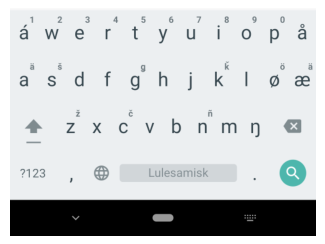
Figure 1: Screenshot of Lule Sámi keyboard for Android, as defined in the listing above.
The mobile keyboard app also includes support for spellers (see later), to support the writing process.
Morphological analysers and dictionaries
Not counting Swahili and a few other languages, African languages have very limited corpus resources. Many African languages also have complex morphological structures. This holds most notably for Khoisan and (most) Bantu languages in the south and east as well as Afro-Asiatic languages in the northeast. Such languages, having complex morphology and little or no text resources, will be problematic for mainstream language technology.
Not much lnguage technology has been developed for these languages. The main exceptions are the works by Arvi Hurskainen on Swahili (for an overviow and references, see Hurskainen (2018)) and the works by Laurette Pretorius, Sonja Bosch and others for Zulu, Xhosa and other South African languages (e.g. Pretorius & Bosch (2009a), Pretorius & Bosch (2009b)).
The GiellaLT infrastructure was developed to deal with this situation. The challenge of making language technology for complex and marginalised circumpolar languages was solved by representing the morphological structure as finite state transducers. Morphological analysers are the core of our language technology tools, they are written in form of Finite State Morphology Beesley & Karttunen (2003), Lindén et al. (2013). This means in practice that language modelling is based on dictionaries and hand-written rules for morphotactics as well as syntactic and semantic processing as needed, e.g. with Constraint Grammar Karlsson (1990), Didriksen (2010). While writing rule-based models for language processing is contemporarily written off as too slow and labour-intensive, in our experience full-time work on the dictionary and morphotactic rules for three months is enough to create high-coverage usable language models. If one compares this to the work it takes to create and curate corpora for machine learning, three months does not get one very far in the creation of gigaword corpora.
The main language families treated in the GiellaLT infrastructure are Uralic, Algonquin, EskimoAleut and various Siberian languages. As for African languages, we have so far only experimented with eight of them[2]. The Somali language model is far beyond alpha level, it contains almost 16000 stems and the core morphology. The other language models are all relatively small, but in some cases, they still give an impression of how central morphophonological challenges may be solved.
Proofing tools
Proofing tools are a crucial piece of software to support normative language writing, i.e. spelling and grammar checkers and correctors. The morphological analysers described above are the basis for about every other tool one can build using the GiellaLT infrastructure, including proofing tools.
Spellers
A speller consists of essentially two parts: a morphological dictionary that contains the information as to whether a given word is part of the language or not. It is assumed by spell-checking that words not in the collected dictionary are misspellings of real words. The second part is an error model that takes the unknown word user inputted and tries to find similar words that are found in the language.
Technologies similar to the ones presented hare have been applied for African languages as well. One example is Bosch & Eiselen (2012), for Zulu, another is the Swahili speller distributed by the Finnish company Lingsoft.
In the GiellaLT infrastructure, both parts are modelled as finite state transducers (FSTs). The morphologically aware dictionary is built directly on the morphological analyser mentioned above after removing unwanted content such as punctuation and non-standard language. The error model is built as a Levenshtein edit distance model Levenshtein (1965) plus language-specific weighted replace rules Pirinen & Lindén (2010).
The speller package is distributed through our own desktop installation and updates system Páhkat, and a pahkat client is also part of the mobile keyboard apps. This means that spellers on all supported systems, both mobile and desktop, are automatically kept up to date.
As part of the mobile keyboard app, spellers help people in the writing process when using their native keyboard. We are currently experimenting with various forms of word completion and prediction models, but nothing has been released yet.
Grammar checking
The GiellaLT infrastructure includes an advanced grammar checker framework. It uses a combination of morphological analysers and Constraint Grammar Didriksen (2010) disambiguation and error detection components. Furthermore, the constraint grammar logic is used to determine where the grammar errors are; the logic is similar to grammar-based syntax parsing Wiechetek (2012). It is all rule-based, which means that it is possible to develop with essentially no pre-existing electronic corpora. The grammar checker features are quite new but are already used for four different languages.
Machine Translation
The GiellaLT infrastructure supports developing machine translation systems in cooperation with Apertium Khanna et al. (2021). The monolingual models developed in the GiellaLT infra are then combined with the transfer rules and lexicons in Apertium to provide an end-to-end MT system. The Apertium system at its core is also a rule-based machine translation toolkit. This means that one can build MT systems for languages with next to no existing resources in bilingual corpora as well, extending the work put in the monolingual dictionaries. The components needed for a rule-based machine translation on top of the rule-based morphological analysis in GiellaLT infra are a bilingual dictionary, i.e. a regular word-to-word translation dictionary and a set of grammatical rules concerning the translation of linguistic differences between languages.
Conclusion
We have presented the GiellaLT infrastructure and its philosophy and goal of supporting indigenous languages around the world, especially languages with complex morphology or phonology - or both. We have shown that a broad range of useful tools for language communities can be built with minimal preexisting electronic resources, thus allowing the creation of language technology tools for any language, and we have stressed the importance of open source as a strategy for avoiding losing language resources. Finally, we have given an overview of existing resources for African languages in the GiellaLT infrastructure.
The current status of African languages within our infrastructure is limited to several startups and experimental languages, one of the aims of this article is to further survey the potential for future cooperation and engagement in the development of African NLP within our infrastructure.
Notes
- [1] Hajdu Róbert 2021: Train BERT-Large in your own language. Towards Data Science.
- [2] These are Akan, Amharic, Luo, Ndolo, Pedi, Somali, Tigrinya, and Zulu. The source code is available at https://github.com/giellalt/lang-xxx, where xxx should be replaced with the ISO 639-3 code of the language in question.
Acknowledgements
All work by the Divvun development group at UiT is funded by the Norwegian Ministry of Local Government and Regional Development. All work by the Giellatekno research group is funded by UiT The Arctic University of Norway.
References
Antonsen, L., Trosterud, T. & Wiechetek, L. (2010), Reusing grammatical resources for new languages, in 'Proceedings of the Seventh International Conference on Language Resources and Evaluation (LREC'10)', European Language Resources Association (ELRA), Valletta, Malta. URL: http: // www. lrec-conf. org/ proceedings/ lrec2010/ pdf/ 254_ Paper. pdf
Beesley, K. R. & Karttunen, L. (2003), 'Finite-state morphology: Xerox tools and techniques', CSLI, Stanford.
Bosch, S. & Eiselen, R. (2012), 'The effectiveness of morphological rules for an isiZulu spelling checker', South African Journal of African Languages 25, 25-36.
Didriksen, T. (2010), Constraint Grammar Manual: 3rd version of the CG formalism variant, GrammarSoft ApS, Denmark. URL: http: // visl. sdu. dk/ cg3/ vislcg3. pdf (Accessed 2017-11-29)
Hiovain-Asikainen, K. & Moshagen, S. (2022), Building open-source speech technology for low-resource minority languages with sámi as an example - tools, methods and experiments, in 'Proceedings of the the 1st Annual Meeting of the ELRA/ISCA Special Interest Group on Under-Resourced Languages', European Language Resources Association, Marseille, France, pp. 169-175. URL: https: // aclanthology. org/ 2022. sigul-1. 22
Hurskainen, A. (2018), Sustainable language technology for african languages, in A. Agwuele & A. Bodomo, eds, 'The Routledge Handbook of African Linguistics', Routledge Handbooks, Routledge, Abingdon, pp. 359-375. URL: https: // doi. org/ 10. 4324/ 9781315392981-19
Karlsson, F. (1990), Constraint grammar as a framework for parsing unrestricted text, in H. Karlgren, ed., 'Proceedings of the 13th International Conference of Computational Linguistics', Vol. 3, Helsinki, pp. 168-173.
Khanna, T., Washington, J. N., Tyers, F. M., Bayatlı, S., Swanson, D. G., Pirinen, T. A., Tang, I. & Alòs i Font, H. (2021), 'Recent advances in apertium, a free/open-source rule-based machine translation platform for low-resource languages', Machine Translation pp. 1-28.
Levenshtein, V. I. (1965), 'Двоичные коды с исправлением выпадений, вставок и замещений символов', Доклады Академий Наук СCCP 163(4), 845-848.
Lindén, K., Axelson, E., Drobac, S., Hardwick, S., Kuokkala, J., Niemi, J., Pirinen, T. A. & Silfverberg, M. (2013), Hfst-a system for creating nlp tools, in 'International workshop on systems and frameworks for computational morphology', Springer, pp. 53-71.
Pirinen, T. & Lindén, K. (2010), 'Finite-state spell-checking with weighted language and error models: Building and evaluating spell-checkers with wikipedia as corpus', Proceedings of LREC 2010.
Pretorius, L. & Bosch, S. (2009a), 'Computational aids for Zulu natural language processing', Southern African Linguistics and Applied Language Studies 21,267-282.
Pretorius, L. & Bosch, S. (2009b), Exploiting cross-linguistic similarities in Zulu and Xhosa computational morphology, in 'Proceedings of the EACL 2009 Workshop on Language Technologies for African Languages', Association for Computational Linguistics, p. 96-103.
Treviso, M., Ji, T., Lee, J.-U., van Aken, B., Cao, Q., Ciosici, M. R., Hassid, M., Heafield, K., Hooker, S., Martins, P. H., Martins, A. F. T., Milder, P., Raffel, C., Simpson, E., Slonim, N., Balasubramanian, N., Derczynski, L. & Schwartz, R. (n.d.). URL: https: // arxiv. org/ abs/ 2209. 00099
Wiechetek, L. (2012), Constraint Grammar based correction of grammatical errors for North Sámi, in G. D.
Pauw, G.-M. de Schryver, M. Forcada, K. Sarasola, F. Tyers & P. Wagacha, eds, 'Proceedings of the Workshop on Language Technology for Normalisation of Less-Resourced Languages (SALTMIL 8/AFLAT 2012)', European Language Resources Association (ELRA), Istanbul, Turkey, pp. 35-40.
GiellaLT: an infrastructure for rule-based language technology tool development
GiellaLT : une infrastructure pour le développement d'outils de technologies du langage à base de règles
Affiliations
Pirinen, Flammie A
UiT Arctic University of Norway
Trosterud, Trond
UiT Arctic University of Norway
Moshagen, Sjur N.
UiT Arctic University of Norway
Wiechetek, Linda
UiT Arctic University of Norway
Affiliations
Pirinen, Flammie A
UiT Arctic University of Norway
Trosterud, Trond
UiT Arctic University of Norway
Moshagen, Sjur N.
UiT Arctic University of Norway
Wiechetek, Linda
UiT Arctic University of Norway
Abstract
Résumé
Currently, machine learning is presented as the ultimate solution for language technology regardless of use case and application, however, it requires as a starting point a massive amount of curated linguistic data in electronic form that is expected to be high quality and representative of the kind of language usage that the tools will follow. For minority and indigenous languages, this can be an insurmountable task, as digital materials of the necessary sizes do not exist and can not easily be produced. In this article we present an approach we have successfully used for supporting indigenous languages to survive and grow in digital contexts for years, and describe the potential of our approach for African contexts. Our technological solution is a free and open-source infrastructure that enables language experts and users to cooperate on creating linguistic resources like dictionaries and grammatical descriptions. In addition we provide language-independent frameworks to build these into applications that are needed by the language community.
Actuellement, l’apprentissage automatique est présenté comme la solution ultime pour la technologie du langage, indépendamment du cas d’utilisation et de l’application. Cependant, il nécessite comme point de départ une quantité massive de données linguistiques organisées sous forme électronique qui devraient être de haute qualité et représentatives du type d’utilisation du langage que les outils suivront. Pour les langues minoritaires et indigènes, cela peut être une tâche insurmontable, car les matériaux numériques des tailles nécessaires n'existent pas et ne peuvent pas facilement être produits. Dans cet article, nous présentons une approche que nous avons utilisée avec succès pour aider les langues autochtones à survivre et à se développer dans les contextes numériques depuis des années, et nous décrivons le potentiel de notre approche pour les contextes africains. Notre solution technologique est une infrastructure libre et open-source qui permet aux experts en langues et aux utilisateurs de coopérer pour créer des ressources linguistiques comme des dictionnaires et des descriptions grammaticales. En outre, nous fournissons des cadres indépendants du langage pour les intégrer dans des applications dont la communauté linguistique a besoin.
Keywords
Mots-clés
Rule-based LT, keyboards, proofing tools, LT infrastructure, Extremely low-Resource LT
Technologies du langage à base de règles, claviers, outils de vérification, infrastructure de technologies du langage, technologies du langage à ressources extrêmement faibles
Introduction
Introduction
Machine learning (ML) approaches have dominated Natural Language Processing (NLP) during the last two decades. They typically require a big amount of noise-free data, which does not exist for 99% of the 7,000 world's languages, either due to the small number of writers or a young written norm. Even if a small language community like the Inari Sámi one in Finland is exceptionally productive in text writing (10,533 words/speaker as opposed to 1,440 words/speaker for Swedish) the amount of text recommended for regular machine learning approaches ("A 3.4 billion word text corpus was used for the original BERT-Large, so it is worth training with a data set of this size."[1]) cannot be reached. The same counts for language communities with many speakers but with a low degree of literacy in this language or simply missing written language domains or a bilingual context where the majority language only is used as a written language.
Les approches d'apprentissage automatique (ML) ont dominé le traitement automatique du langage naturel (NLP) au cours des deux dernières décennies. Ils nécessitent généralement une grande quantité de données sans bruit, ce qui n'existe pas pour 99% des 7 000 langues du monde, soit en raison du petit nombre d'écrivains, soit en raison d'une norme écrite jeune. Même si une petite communauté linguistique comme celle du same d'Inari en Finlande est exceptionnellement productive en écriture de textes (10 533 mots/locuteur contre 1 440 mots/locuteur pour le suédois), la quantité de texte recommandée pour les approches régulières d'apprentissage automatique (« Un corpus de 3,4 milliards de mots a été utilisé pour le BERT-Large original, il vaut donc la peine de s'entraîner avec un jeu de données de cette taille. » [1]) ne peut pas être atteinte. Il en va de même pour les communautés linguistiques comptant de nombreux locuteurs mais avec un faible degré d'alphabétisation dans cette langue ou simplement en l'absence de domaines linguistiques écrits ou dans un contexte bilingue où seule la langue majoritaire est utilisée comme langue écrite.
In this article, we present óur infrastructure - GiellaLT - presently hosting language models for more than 130 languages and building a number of language technology tools that are useful for any language community. GiellaLT is based on an alternative to corpus-based language technology - knowledge-based, also known as rule-based, language technology. The technology is chosen for its ability to support languages with no earlier digital presence. As long as a project has access to a native speaker and a linguist, maybe even in one and the same person, useful tools can be made. Digital resources are always welcome and will help speed up the development work, but they are not a requirement.
Dans cet article, nous présentons notre infrastructure — GiellaLT — qui héberge actuellement des modèles de langage pour plus de 130 langues et construit un certain nombre d'outils de technologies du langage utiles pour toute communauté linguistique. GiellaLT est basé sur une alternative aux technologies du langage fondées sur des corpus — les technologies du langage fondées sur les connaissances, également connues sous le nom de technologies du langage à base de règles. La technologie est choisie pour sa capacité à soutenir les langues sans présence numérique antérieure. Tant qu'un projet a accès à un locuteur natif et à un linguiste, peut-être même en une seule et même personne, des outils utiles peuvent être créés. Les ressources numériques sont toujours les bienvenues et aideront à accélérer le travail de développement, mais elles ne sont pas une exigence.
A language community with no or little earlier digital presence also needs different types of tools than languages with billion-word corpora. Every language community is unique, but for ones that have or are aiming for a written tradition digitised, typically the first tool to develop is a keyboard, including mobile keyboards nowadays, to be able to enter text correctly and efficiently. No machine learning can create a keyboard layout or discuss language community needs.
Une communauté linguistique avec peu ou pas de présence numérique a également besoin de différents types d’outils que les langues avec des corpus de milliards de mots. Chaque communauté linguistique est unique, mais pour celles qui ont ou visent une tradition écrite numérisée, le premier outil à développer est généralement un clavier, y compris des claviers mobiles de nos jours, pour pouvoir saisir du texte correctement et efficacement. Aucun apprentissage automatique ne peut créer une disposition de clavier ni discuter des besoins d'une communauté linguistique.
The GiellaLT infrastructure provides all the building blocks to get started on the language work right away, based on open-source technologies and solutions. There is proven integration with most existing systems and platforms, saving huge amounts of time, money, and resources for newcomers. This is especially important for many indigenous language communities, which would not have the resources to develop underlying technologies and integration solutions on their own. By separating language-independent parts from language-specific ones, the cost of developing the language-independent parts can be shared by everyone, or be carried by communities with enough resources. Being open source we are also maintaining an approach that empowers the language communities in a way that retains their ownership of the language and linguistic data they are working on. In the free open-source model, there is no large danger that someone working on the language models simply acquires the linguistic data from the community for free in order to sell it back to them at a higher price.
L'infrastructure GiellaLT fournit tous les blocs de construction pour commencer immédiatement le travail sur la langue, en s'appuyant sur des technologies et des solutions open-source. L'intégration avec la plupart des systèmes et plates-formes existants est prouvée, ce qui permet d'économiser énormément de temps, d'argent et de ressources pour les nouveaux arrivants. Cela est particulièrement important pour de nombreuses communautés de langues indigènes, qui n'auraient pas les ressources nécessaires pour développer des technologies sous-jacentes et des solutions d'intégration par elles-mêmes. En séparant les parties indépendantes de la langue des parties spécifiques à la langue, le coût du développement des parties indépendantes de la langue peut être partagé par tous, ou être supporté par des communautés disposant de suffisamment de ressources. En étant open source, nous maintenons également une approche qui donne aux communautés linguistiques un pouvoir qui leur permet de conserver la propriété de la langue et des données linguistiques sur lesquelles elles travaillent. Dans le modèle open source gratuit, il n'y a pas de grand danger que quelqu'un travaillant sur les modèles de langage acquière simplement les données linguistiques de la communauté gratuitement pour les lui revendre à un prix plus élevé.
One final consideration that our rule-based approach has over the machine-learnt models is one of efficiency: a neural language model has to be trained on a system with at least one GPU for over a period of days or weeks and should probably also run on similar hardware, or accessed over high-speed internet. The rule-based language tools can be compiled on a low-end home computer and run locally on even lower-end mobile phones, which is almost a necessity for many writers' tools. As an added bonus the approach is energy-efficient which is something neural models at the moment still struggle with, c.f. Treviso et al. (n.d.).
Une dernière considération que notre approche basée sur des règles a sur les modèles appris par machine est celle de l'efficacité : un modèle de langage neuronal doit être entraîné sur un système avec au moins un GPU pendant une période de jours ou de semaines et devrait probablement également fonctionner sur un matériel similaire, ou être accessible via un internet haut débit. Les outils de langage basés sur des règles peuvent être compilés sur un ordinateur domestique bas de gamme et exécutés localement sur des téléphones mobiles même bas de gamme, ce qui est presque une nécessité pour de nombreux outils de rédaction. En prime, l'approche est économe en énergie, ce qui est quelque chose avec lequel les modèles neuronaux ont encore du mal à l'heure actuelle, cf. Treviso et coll. (s.d.).
GiellaLT - A multilingual infrastructure for everyone
GiellaLT - Une infrastructure multilingue pour tous
The foundation for the work presented in this article is the multilingual infrastructure GiellaLT, which includes numerous languages that have little or no data, a rare case in the NLP world. Everything produced in the GiellaLT infrastructure is under free and open licences and freely available. The corpora are available with free licensing where possible. The infrastructure is split code-wise into three GitHub organisations: GiellaLT containing the language data for each language, Divvun containing language-independent code for the infrastructure, and Giellatekno for corpus infrastructure. End user tools served by the Divvun group are at divvun.no & divvun.org, and tools served by the Giellatekno group at giellatekno.uit.no, both at UiT-Norway's Arctic University.
Le fondement du travail présenté dans cet article est l'infrastructure multilingue GiellaLT, qui comprend de nombreuses langues disposant de peu ou pas de données, un cas rare dans le monde du TAL. Tout ce qui est produit dans l'infrastructure GiellaLT est sous licence libre et ouverte et disponible gratuitement. Les corpus sont disponibles avec une licence gratuite lorsque cela est possible. L'infrastructure est divisée en trois organisations GitHub : GiellaLT contenant les données linguistiques pour chaque langue, Divvun contenant le code indépendant de la langue pour l'infrastructure, et Giellatekno pour l'infrastructure des corpus. Les outils destinés aux utilisateurs finaux gérés par le groupe Divvun se trouvent sur divvun.no et divvun.org, et les outils gérés par le groupe Giellatekno sur giellatekno.uit.no, tous deux à l'Université de l'Arctique UiT-Norvège.
The basic requirement for developing language tools in GiellaLT is an orthography that is either defined beforehand or is being defined in making the language tools. Access to a printed dictionary is of great help, even more so if it is available electronically. An existing grammatical description is also of tremendous help, but not a requirement.
L'exigence de base pour le développement d'outils linguistiques dans GiellaLT est une orthographe qui est soit définie au préalable, soit définie lors de la création des outils linguistiques. L'accès à un dictionnaire imprimé est d'une grande aide, encore plus s'il est disponible électroniquement. Une description grammaticale existante est également d'une aide considérable, mais pas une exigence.
We build systems that include lexical data as well as rules governing morphophonology, syntax, and semantics as well as a number of application-specific information, e.g. grammatical rules for grammar checking, phonetic rules for Text-To-Speech (TTS), and so forth.
Nous construisons des systèmes qui incluent des données lexicales ainsi que des règles régissant la morphophonologie, la syntaxe et la sémantique, ainsi qu'un certain nombre d'informations spécifiques à l'application, par exemple des règles de grammaire pour la vérification de la grammaire, des règles phonétiques pour la synthèse vocale de texte (TTS), etc.
The language-dependent work is done within the infrastructure in language-specific repositories, the language-independent features and updates that are relevant to all languages are semi-automatically merged as they are developed. To ensure that language-independent and common features and updates do not destroy existing language data or degrade the language tools, we enforce a rigorous continuous integration-based testing regime. The current system for testing is a combination of our long-term investment in testing within the infrastructure locally for developers-combined with modern automatic testing currently supplied by GitHub actions.
Le travail dépendant de la langue est effectué au sein de l'infrastructure dans des dépôts spécifiques à la langue, les fonctionnalités et les mises à jour indépendantes de la langue qui sont pertinentes pour toutes les langues sont fusionnées de manière semi-automatique au fur et à mesure de leur développement. Pour s'assurer que les fonctionnalités et mises à jour communes et indépendantes de la langue ne détruisent pas les données linguistiques existantes ou ne dégradent pas les outils linguistiques, nous appliquons un régime de test rigoureux basé sur l'intégration continue. Le système actuel de test est une combinaison de notre investissement à long terme dans les tests au sein de l'infrastructure locale pour les développeurs, combiné avec les tests automatiques modernes actuellement fournis par les actions GitHub.
Another part of the GiellaLT philosophy is that of reusable and multi-purposeful resources, cf. Antonsen et al. (2010). This is true for all of our work, from corpus collection to cross-lingual cooperation and is crucial for the sustainability of the work in indigenous and lower-resourced languages where language experts' work time is scarce and precious.
Une autre partie de la philosophie de GiellaLT est celle des ressources réutilisables et polyvalentes, cf. Antonsen et al. (2010). C'est vrai pour l'ensemble de nos travaux, de la collecte de corpus à la coopération interlingue, et c'est crucial pour la durabilité des travaux dans les langues indigènes et moins dotées en ressources, où le temps de travail des experts en langues est rare et précieux.
Despite the lack of data, there are high-level tools in GiellaLT such as machine translation (MT), text-to-speech TTS, spelling and grammar checkers, and more, that have been very well received in the language communities. This would not have been possible without first developing basic tools such as keyboards, morphological analysers, and spelling checkers.
Malgré le manque de données, il existe dans GiellaLT des outils de haut niveau tels que la traduction automatique (TA), la synthèse vocale de texte TTS, des correcteurs d'orthographe et de grammaire, et plus encore, qui ont été très bien accueillis dans les communautés linguistiques. Cela n'aurait pas été possible sans développer d'abord des outils de base tels que des claviers, des analyseurs morphologiques et des correcteurs d'orthographe.
GiellaLT for African languages
GiellaLT pour les langues africaines
In this section, we go through the NLP tools GiellaLT infrastructure provides for language users. We list here a subset of the applications that we have found are most useful for the language communities we work with, in language support and revitalisation work: Keyboards and spelling and grammar checking and correction, dictionaries and machine translation. We also provide tools for speech technology, however, this is not discussed in detail in this article, for example, c.f. Hiovain-Asikainen & Moshagen (2022). Furthermore, the linguistic resources that are used as a basis of end-user tools like morphological analysers, are a key resource for digital humanities work on the language: tokenisation, morphosyntactic analysis and glossing for example.
Dans cette section, nous passons en revue les outils de TAL que l'infrastructure GiellaLT fournit pour les utilisateurs de langues. Nous énumérons ici un sous-ensemble des applications que nous avons trouvées les plus utiles pour les communautés linguistiques avec lesquelles nous travaillons, dans le soutien linguistique et le travail de revitalisation: Claviers et vérification et correction de l'orthographe et de la grammaire, dictionnaires et traduction automatique. Nous fournissons également des outils pour la technologie de la parole, cependant, cela n'est pas discuté en détail dans cet article, par exemple, c.f. Hiovain-Asikainen & Moshagen (2022). De plus, les ressources linguistiques qui sont utilisées comme base des outils pour utilisateurs finaux comme les analyseurs morphologiques, sont une ressource clé pour le travail en humanités numériques sur la langue : tokenisation, analyse morphosyntaxique et glossage par exemple.
Languages for which Microsoft and Google do not make language technology solutions are vulnerable to technological changes. Closed source programs for such languages run the risk of becoming unusable as word processors or operative system change. Companies behand these programs may then either go bankrupt or change their focus to other areas. Being closed source, the work behind these solutions is then lost. The GiellaTL solution to this is to keep both the linguistic software and the software needed for integrating it in various applications as open source. This means that scarce resources may be reused, without the risk of loosing work. Open access to language independent software also makes it easier to build solutions for lesserused languages.
Les langues pour lesquelles Microsoft et Google ne proposent pas de solutions de technologies du langage sont vulnérables aux changements technologiques. Les programmes à code source fermé pour de telles langues risquent de devenir inutilisables lorsque les traitements de texte ou les systèmes d'exploitation changent. Les entreprises qui développent ces programmes peuvent alors soit faire faillite, soit changer leur orientation pour d'autres domaines. Étant une source fermée, le travail derrière ces solutions est alors perdu. La solution GiellaTL consiste à maintenir à la fois le logiciel linguistique et le logiciel nécessaire pour l'intégrer dans diverses applications en open source. Cela signifie que les ressources rares peuvent être réutilisées, sans risque de perte de travail. Le libre accès à des logiciels indépendants de la langue facilite également la création de solutions pour les langues moins utilisées.
Keyboards
Claviers
Most African languages are written with the Latin alphabet. Many of them have letters outside the A-Z range and even more, have extensive systems of diacritical symbols. On top of that comes the challenge of how click sounds are treated in the San languages, with letter symbols resembling punctuation marks.
La plupart des langues africaines sont écrites avec l'alphabet latin. Beaucoup d'entre eux ont des lettres en dehors de la gamme A-Z et même plus, ont des systèmes étendus de symboles diacritiques. En plus de cela vient le défi de la façon dont les sons de clic sont traités dans les langues San, avec des symboles de lettres ressemblant à des signes de ponctuation.
Each of these languages does need its own keyboard setup. When language technology tools to an increasing extent are linked to keyboard setups, languages using only the letters A-Z will need their own keyboard to invoke language technology tools for the appropriate language.
Chacune de ces langues a besoin de sa propre configuration de clavier. Lorsque les outils de technologies du langage sont de plus en plus liés aux configurations de clavier, les langues n'utilisant que les lettres A-Z auront besoin de leur propre clavier pour invoquer les outils de technologies du langage de la langue appropriée.
In order to meet this challenge, the GiellaLT infrastructure comes with a pipeline for making keyboards and installing them and their corresponding language technology tools on different platforms. The core of the pipeline is the kbdgen tool, with which one can easily specify a keyboard layout in a YAML file, mimicking the actual layout of the keyboard. The listing below shows the definition of the Android mobile keyboard layout for Lule Sámi. The tool takes this definition and a bit of metadata combines it with code for an Android keyboard app, compiles everything, signs the built artefact and uploads it to the Google Play Store, ready for testing.
Afin de relever ce défi, l'infrastructure GiellaLT est fournie avec un pipeline pour créer des claviers et les installer, ainsi que les outils de technologies du langage correspondants, sur différentes plateformes. Le cœur du pipeline est l'outil kbdgen, avec lequel on peut facilement spécifier une disposition de clavier dans un fichier YAML, imitant la disposition réelle du clavier. La liste ci-dessous montre la définition de la disposition du clavier pour les mobiles Android pour Lule Sámi. L'outil prend cette définition et un peu de métadonnées, les combine avec du code pour une application de clavier Android, compile tout, signe l'artefact construit et le télécharge sur le Google Play Store, prêt pour les tests.
kbdgen supports generating keyboard apps or installer packages for Android, iOS, macOS, Windows, Linux (X11 and m17n) and Chrome OS. There is experimental support for generating Common Language Data Repository (CLDR) XML files, Scalable Vector Graphics (SVG) files for fast layout debugging, and finite state transducers for neighbour key mistyping error models. The Windows installer includes a tool to register unknown languages, so that even languages never seen on a Windows computer will be properly registered, thus making it ready to support proofing tools and other language processing tools.
kbdgen prend en charge la génération d'applications clavier ou de packages d'installation pour Android, iOS, macOS, Windows, Linux (X11 et m17n) et Chrome OS. Il existe un support expérimental pour la génération de fichiers XML du Common Language Data Repository (CLDR), de fichiers Scalable Vector Graphics (SVG) pour un débogage rapide des dispositions, et de transducteurs à états finis pour les modèles d'erreur de frappe sur touches voisines. L'installateur Windows inclut un outil pour enregistrer des langues inconnues, de sorte que même les langues jamais vues sur un ordinateur Windows seront correctement enregistrées, le rendant ainsi prêt à prendre en charge les outils de vérification et autres outils de traitement des langues.
Figure 1: Screenshot of Lule Sámi keyboard for Android, as defined in the listing above.
Figure 1 : Capture d'écran du clavier Lule Sámi pour Android, tel que défini dans la liste ci-dessus.
The mobile keyboard app also includes support for spellers (see later), to support the writing process.
L'application clavier mobile inclut également la prise en charge des correcteurs orthographiques (voir plus loin), pour soutenir le processus d'écriture.
Morphological analysers and dictionaries
Analyseurs morphologiques et dictionnaires
Not counting Swahili and a few other languages, African languages have very limited corpus resources. Many African languages also have complex morphological structures. This holds most notably for Khoisan and (most) Bantu languages in the south and east as well as Afro-Asiatic languages in the northeast. Such languages, having complex morphology and little or no text resources, will be problematic for mainstream language technology.
Sans compter le swahili et quelques autres langues, les langues africaines ont des ressources en corpus très limitées. Beaucoup de langues africaines ont aussi des structures morphologiques complexes. C'est le cas notamment des langues khoïsanes et (de la plupart des) langues bantoues dans le sud et l'est, ainsi que des langues afro-asiatiques dans le nord-est. De telles langues, ayant une morphologie complexe et peu ou pas de ressources textuelles, seront problématiques pour les technologies du langage dominantes.
Not much lnguage technology has been developed for these languages. The main exceptions are the works by Arvi Hurskainen on Swahili (for an overviow and references, see Hurskainen (2018)) and the works by Laurette Pretorius, Sonja Bosch and others for Zulu, Xhosa and other South African languages (e.g. Pretorius & Bosch (2009a), Pretorius & Bosch (2009b)).
Peu de technologies langagières ont été développées pour ces langues. Les principales exceptions sont les travaux d'Arvi Hurskainen sur le swahili (pour une vue d'ensemble et les références, voir Hurskainen (2018)) et les travaux de Laurette Pretorius, Sonja Bosch et d'autres sur le zoulou, le xhosa et d'autres langues d'Afrique du Sud (par exemple, Pretorius & Bosch (2009a), Pretorius & Bosch (2009b)).
The GiellaLT infrastructure was developed to deal with this situation. The challenge of making language technology for complex and marginalised circumpolar languages was solved by representing the morphological structure as finite state transducers. Morphological analysers are the core of our language technology tools, they are written in form of Finite State Morphology Beesley & Karttunen (2003), Lindén et al. (2013). This means in practice that language modelling is based on dictionaries and hand-written rules for morphotactics as well as syntactic and semantic processing as needed, e.g. with Constraint Grammar Karlsson (1990), Didriksen (2010). While writing rule-based models for language processing is contemporarily written off as too slow and labour-intensive, in our experience full-time work on the dictionary and morphotactic rules for three months is enough to create high-coverage usable language models. If one compares this to the work it takes to create and curate corpora for machine learning, three months does not get one very far in the creation of gigaword corpora.
L'infrastructure GiellaLT a été développée pour faire face à cette situation. Le défi de créer des technologies du langage pour des langues circumpolaires complexes et marginalisées a été résolu en représentant la structure morphologique sous forme de transducteurs à états finis. Les analyseurs morphologiques sont le cœur de nos outils de technologies du langage, ils sont écrits sous forme de morphologie à états finis Beesley & Karttunen (2003), Lindén et al. (2013). Cela signifie en pratique que la modélisation du langage est basée sur des dictionnaires et des règles manuscrites pour la morphotaxie ainsi que le traitement syntaxique et sémantique selon les besoins, par exemple avec Constraint Grammar Karlsson (1990), Didriksen (2010). Alors que l'écriture de modèles basés sur des règles pour le traitement du langage est actuellement considérée comme trop lente et exigeante en main-d'œuvre, dans notre expérience, un travail à temps plein sur le dictionnaire et les règles morphotactiques pendant trois mois suffit à créer des modèles de langage utilisables à haute couverture. Si l'on compare cela au travail nécessaire pour créer et organiser des corpus pour l'apprentissage automatique, trois mois ne permettent pas d'aller bien loin dans la création de corpus gigaword.
The main language families treated in the GiellaLT infrastructure are Uralic, Algonquin, EskimoAleut and various Siberian languages. As for African languages, we have so far only experimented with eight of them[2]. The Somali language model is far beyond alpha level, it contains almost 16000 stems and the core morphology. The other language models are all relatively small, but in some cases, they still give an impression of how central morphophonological challenges may be solved.
Les principales familles linguistiques traitées dans l'infrastructure GiellaLT sont l'oural, l'algonquin, l'esquimo-aléoute et diverses langues sibériennes. En ce qui concerne les langues africaines, nous n'avons expérimenté que huit d'entre elles jusqu'à présent[2]. Le modèle de langage somali est bien au-delà du niveau alpha, il contient près de 16000 radicaux et la morphologie de base. Les autres modèles de langage sont tous relativement petits, mais dans certains cas, ils donnent encore une impression de la façon dont les défis morphophonologiques centraux peuvent être résolus.
Proofing tools
Outils de vérification
Proofing tools are a crucial piece of software to support normative language writing, i.e. spelling and grammar checkers and correctors. The morphological analysers described above are the basis for about every other tool one can build using the GiellaLT infrastructure, including proofing tools.
Les outils de correction sont des logiciels essentiels pour soutenir l'écriture normative, c'est-à-dire les vérificateurs et correcteurs d'orthographe et de grammaire. Les analyseurs morphologiques décrits ci-dessus constituent la base de presque tous les autres outils que l'on peut construire en utilisant l'infrastructure GiellaLT, y compris les outils de relecture.
Spellers
Correcteurs orthographiques
A speller consists of essentially two parts: a morphological dictionary that contains the information as to whether a given word is part of the language or not. It is assumed by spell-checking that words not in the collected dictionary are misspellings of real words. The second part is an error model that takes the unknown word user inputted and tries to find similar words that are found in the language.
Un correcteur orthographique se compose essentiellement de deux parties : un dictionnaire morphologique qui contient les informations permettant de déterminer si un mot donné fait partie de la langue ou non. Il est supposé par la vérification orthographique que les mots qui ne sont pas dans le dictionnaire collecté sont des fautes d'orthographe de mots réels. La deuxième partie est un modèle d'erreur qui prend le mot inconnu saisi par l'utilisateur et tente de trouver des mots similaires qui sont présents dans la langue.
Technologies similar to the ones presented hare have been applied for African languages as well. One example is Bosch & Eiselen (2012), for Zulu, another is the Swahili speller distributed by the Finnish company Lingsoft.
Des technologies similaires à celles présentées ici ont également été appliquées aux langues africaines. Un exemple est Bosch & Eiselen (2012), pour le zoulou, un autre est le correcteur orthographique swahili distribué par l'entreprise finlandaise Lingsoft.
In the GiellaLT infrastructure, both parts are modelled as finite state transducers (FSTs). The morphologically aware dictionary is built directly on the morphological analyser mentioned above after removing unwanted content such as punctuation and non-standard language. The error model is built as a Levenshtein edit distance model Levenshtein (1965) plus language-specific weighted replace rules Pirinen & Lindén (2010).
Dans l'infrastructure GiellaLT, les deux parties sont modélisées comme des transducteurs à états finis (FST). Le dictionnaire morphologiquement conscient est construit directement sur l'analyseur morphologique mentionné ci-dessus après avoir supprimé le contenu indésirable tel que la ponctuation et le langage non standard. Le modèle d'erreur est construit comme un modèle de distance d'édition de Levenshtein Levenshtein (1965) plus des règles de remplacement pondérées spécifiques à la langue Pirinen & Lindén (2010).
The speller package is distributed through our own desktop installation and updates system Páhkat, and a pahkat client is also part of the mobile keyboard apps. This means that spellers on all supported systems, both mobile and desktop, are automatically kept up to date.
Le paquet du correcteur orthographique est distribué via notre propre système d'installation et de mise à jour de bureau Páhkat, et un client pahkat fait également partie des applications de clavier mobile. Cela signifie que les correcteurs orthographiques sur tous les systèmes pris en charge, à la fois mobiles et de bureau, sont automatiquement maintenus à jour.
As part of the mobile keyboard app, spellers help people in the writing process when using their native keyboard. We are currently experimenting with various forms of word completion and prediction models, but nothing has been released yet.
Dans le cadre de l'application de clavier mobile, les correcteurs d'orthographe aident les utilisateurs lors du processus d'écriture avec leur clavier natif. Nous expérimentons actuellement diverses formes de modèles de complétion et de prédiction de mots, mais rien n'a encore été publié.
Grammar checking
Vérification de grammaire
The GiellaLT infrastructure includes an advanced grammar checker framework. It uses a combination of morphological analysers and Constraint Grammar Didriksen (2010) disambiguation and error detection components. Furthermore, the constraint grammar logic is used to determine where the grammar errors are; the logic is similar to grammar-based syntax parsing Wiechetek (2012). It is all rule-based, which means that it is possible to develop with essentially no pre-existing electronic corpora. The grammar checker features are quite new but are already used for four different languages.
L'infrastructure GiellaLT comprend un cadre avancé de vérificateur de grammaire. Elle utilise une combinaison d'analyseurs morphologiques et de composants de désambiguïsation et de détection d'erreurs de Constraint Grammar (Didriksen 2010). En outre, la logique de grammaire à contraintes est utilisée pour déterminer où se trouvent les erreurs de grammaire ; la logique est similaire à l'analyse syntaxique basée sur la grammaire Wiechetek (2012). Tout est basé sur des règles, ce qui signifie qu’il est possible de se développer sans corpus électroniques préexistants. Les fonctionnalités du vérificateur de grammaire sont assez nouvelles, mais sont déjà utilisées pour quatre langues différentes.
Machine Translation
Traduction automatique
The GiellaLT infrastructure supports developing machine translation systems in cooperation with Apertium Khanna et al. (2021). The monolingual models developed in the GiellaLT infra are then combined with the transfer rules and lexicons in Apertium to provide an end-to-end MT system. The Apertium system at its core is also a rule-based machine translation toolkit. This means that one can build MT systems for languages with next to no existing resources in bilingual corpora as well, extending the work put in the monolingual dictionaries. The components needed for a rule-based machine translation on top of the rule-based morphological analysis in GiellaLT infra are a bilingual dictionary, i.e. a regular word-to-word translation dictionary and a set of grammatical rules concerning the translation of linguistic differences between languages.
L’infrastructure GiellaLT soutient le développement de systèmes de traduction automatique en coopération avec Apertium Khanna et al. (2021). Les modèles monolingues développés dans l'infra GiellaLT sont ensuite combinés avec les règles de transfert et les lexiques d'Apertium pour fournir un système de MT de bout en bout. Le système Apertium, dans son cœur, est également un outil de traduction automatique basé sur des règles. Cela signifie que l’on peut construire des systèmes de TA pour des langues n’ayant pratiquement aucune ressource existante dans des corpus bilingues, en élargissant le travail effectué dans les dictionnaires monolingues. Les composants nécessaires pour une traduction automatique basée sur des règles en plus de l'analyse morphologique basée sur des règles dans GiellaLT infra sont un dictionnaire bilingue, c'est-à-dire un dictionnaire de traduction de mot à mot régulier et un ensemble de règles grammaticales concernant la traduction des différences linguistiques entre les langues.
Conclusion
Conclusion
We have presented the GiellaLT infrastructure and its philosophy and goal of supporting indigenous languages around the world, especially languages with complex morphology or phonology - or both. We have shown that a broad range of useful tools for language communities can be built with minimal preexisting electronic resources, thus allowing the creation of language technology tools for any language, and we have stressed the importance of open source as a strategy for avoiding losing language resources. Finally, we have given an overview of existing resources for African languages in the GiellaLT infrastructure.
Nous avons présenté l'infrastructure GiellaLT et sa philosophie et son objectif de soutenir les langues autochtones à travers le monde, en particulier les langues avec une morphologie ou une phonologie complexes - ou les deux. Nous avons montré qu'une large gamme d'outils utiles pour les communautés linguistiques peut être construite avec un minimum de ressources électroniques préexistantes, permettant ainsi la création d'outils de technologies du langage pour toute langue, et nous avons souligné l'importance de l'open source comme stratégie pour éviter de perdre des ressources linguistiques. Enfin, nous avons donné un aperçu des ressources existantes pour les langues africaines dans l'infrastructure GiellaLT.
The current status of African languages within our infrastructure is limited to several startups and experimental languages, one of the aims of this article is to further survey the potential for future cooperation and engagement in the development of African NLP within our infrastructure.
Le statut actuel des langues africaines au sein de notre infrastructure est limité à plusieurs startups et langues expérimentales, l’un des objectifs de cet article est d’étudier plus en profondeur le potentiel de coopération et d’engagement futurs dans le développement du TALN africain au sein de notre infrastructure.
Notes
Notes
[1] Hajdu Róbert 2021: Train BERT-Large in your own language. Towards Data Science.
[1] Hajdu Róbert 2021 : Entraîner BERT-Large dans votre propre langue. Towards Data Science.
[2] These are Akan, Amharic, Luo, Ndolo, Pedi, Somali, Tigrinya, and Zulu. The source code is available at https://github.com/giellalt/lang-xxx, where xxx should be replaced with the ISO 639-3 code of the language in question.
[2] Il s’agit des langues akan, amharique, luo, ndolo, pedi, somali, tigrinya et zoulou. Le code source est disponible sur https://github.com/giellalt/lang-xxx, où xxx doit être remplacé par le code ISO 639-3 de la langue en question.
Acknowledgements
Remerciements
All work by the Divvun development group at UiT is funded by the Norwegian Ministry of Local Government and Regional Development. All work by the Giellatekno research group is funded by UiT The Arctic University of Norway.
Tous les travaux du groupe de développement de Divvun à l'UiT sont financés par le ministère norvégien des collectivités locales et du développement régional. Tous les travaux du groupe de recherche Giellatekno sont financés par l’UiT The Arctic University of Norway.
References
Références
Antonsen, L., Trosterud, T. & Wiechetek, L. (2010), Reusing grammatical resources for new languages, in 'Proceedings of the Seventh International Conference on Language Resources and Evaluation (LREC'10)', European Language Resources Association (ELRA), Valletta, Malta. URL: http: // www. lrec-conf. org/ proceedings/ lrec2010/ pdf/ 254_ Paper. pdf
Beesley, K. R. & Karttunen, L. (2003), 'Finite-state morphology: Xerox tools and techniques', CSLI, Stanford.
Bosch, S. & Eiselen, R. (2012), 'The effectiveness of morphological rules for an isiZulu spelling checker', South African Journal of African Languages 25, 25-36.
Didriksen, T. (2010), Constraint Grammar Manual: 3rd version of the CG formalism variant, GrammarSoft ApS, Denmark. URL: http: // visl. sdu. dk/ cg3/ vislcg3. pdf (Accessed 2017-11-29)
Hiovain-Asikainen, K. & Moshagen, S. (2022), Building open-source speech technology for low-resource minority languages with sámi as an example - tools, methods and experiments, in 'Proceedings of the the 1st Annual Meeting of the ELRA/ISCA Special Interest Group on Under-Resourced Languages', European Language Resources Association, Marseille, France, pp. 169-175. URL: https: // aclanthology. org/ 2022. sigul-1. 22
Hurskainen, A. (2018), Sustainable language technology for african languages, in A. Agwuele & A. Bodomo, eds, 'The Routledge Handbook of African Linguistics', Routledge Handbooks, Routledge, Abingdon, pp. 359-375. URL: https: // doi. org/ 10. 4324/ 9781315392981-19
Karlsson, F. (1990), Constraint grammar as a framework for parsing unrestricted text, in H. Karlgren, ed., 'Proceedings of the 13th International Conference of Computational Linguistics', Vol. 3, Helsinki, pp. 168-173.
Khanna, T., Washington, J. N., Tyers, F. M., Bayatlı, S., Swanson, D. G., Pirinen, T. A., Tang, I. & Alòs i Font, H. (2021), 'Recent advances in apertium, a free/open-source rule-based machine translation platform for low-resource languages', Machine Translation pp. 1-28.
Levenshtein, V. I. (1965), 'Двоичные коды с исправлением выпадений, вставок и замещений символов', Доклады Академий Наук СCCP 163(4), 845-848.
Lindén, K., Axelson, E., Drobac, S., Hardwick, S., Kuokkala, J., Niemi, J., Pirinen, T. A. & Silfverberg, M. (2013), Hfst-a system for creating nlp tools, in 'International workshop on systems and frameworks for computational morphology', Springer, pp. 53-71.
Pirinen, T. & Lindén, K. (2010), 'Finite-state spell-checking with weighted language and error models: Building and evaluating spell-checkers with wikipedia as corpus', Proceedings of LREC 2010.
Pretorius, L. & Bosch, S. (2009a), 'Computational aids for Zulu natural language processing', Southern African Linguistics and Applied Language Studies 21,267-282.
Pretorius, L. & Bosch, S. (2009b), Exploiting cross-linguistic similarities in Zulu and Xhosa computational morphology, in 'Proceedings of the EACL 2009 Workshop on Language Technologies for African Languages', Association for Computational Linguistics, p. 96-103.
Treviso, M., Ji, T., Lee, J.-U., van Aken, B., Cao, Q., Ciosici, M. R., Hassid, M., Heafield, K., Hooker, S., Martins, P. H., Martins, A. F. T., Milder, P., Raffel, C., Simpson, E., Slonim, N., Balasubramanian, N., Derczynski, L. & Schwartz, R. (n.d.). URL: https: // arxiv. org/ abs/ 2209. 00099
Wiechetek, L. (2012), Constraint Grammar based correction of grammatical errors for North Sámi, in G. D.
Pauw, G.-M. de Schryver, M. Forcada, K. Sarasola, F. Tyers & P. Wagacha, eds, 'Proceedings of the Workshop on Language Technology for Normalisation of Less-Resourced Languages (SALTMIL 8/AFLAT 2012)', European Language Resources Association (ELRA), Istanbul, Turkey, pp. 35-40.
GiellaLT: an infrastructure for rule-based language technology tool development
GiellaLT: miundombinu ya ukuzaji wa zana za teknolojia ya lugha inayotegemea kanuni
Affiliations
Pirinen, Flammie A
UiT Arctic University of Norway
Trosterud, Trond
UiT Arctic University of Norway
Moshagen, Sjur N.
UiT Arctic University of Norway
Wiechetek, Linda
UiT Arctic University of Norway
Taasisi
Pirinen, Flammie A
UiT Arctic University of Norway
Trosterud, Trond
UiT Arctic University of Norway
Moshagen, Sjur N.
UiT Arctic University of Norway
Wiechetek, Linda
UiT Arctic University of Norway
Abstract
Muhtasari
Currently, machine learning is presented as the ultimate solution for language technology regardless of use case and application, however, it requires as a starting point a massive amount of curated linguistic data in electronic form that is expected to be high quality and representative of the kind of language usage that the tools will follow. For minority and indigenous languages, this can be an insurmountable task, as digital materials of the necessary sizes do not exist and can not easily be produced. In this article we present an approach we have successfully used for supporting indigenous languages to survive and grow in digital contexts for years, and describe the potential of our approach for African contexts. Our technological solution is a free and open-source infrastructure that enables language experts and users to cooperate on creating linguistic resources like dictionaries and grammatical descriptions. In addition we provide language-independent frameworks to build these into applications that are needed by the language community.
Kwa sasa, ujifunzaji wa mashine unawasilishwa kama suluhisho kuu la teknolojia ya lugha bila kujali kisa cha matumizi na programu, hata hivyo, unahitaji kama hatua ya kuanzia kiasi kikubwa cha data ya kiisimu iliyoratibiwa katika umbo la kielektroniki ambayo inatarajiwa kuwa ya ubora wa juu na uwakilishi wa aina ya matumizi ya lugha ambayo zana zitafuata. Kwa lugha za wachache na za kiasili, hili linaweza kuwa kazi isiyowezekana, kwani nyenzo za kidijitali za ukubwa unaohitajika hazipo na haziwezi kutayarishwa kwa urahisi. Katika makala haya tunawasilisha mbinu ambayo tumeitumia kwa mafanikio kwa miaka mingi kusaidia lugha za kiasili kuishi na kukua katika mazingira ya kidijitali, na tunaelezea uwezo wa mbinu yetu kwa mazingira ya Kiafrika. Suluhisho letu la kiteknolojia ni miundombinu ya bure na Programu huria inayowawezesha wataalamu wa lugha na watumiaji kushirikiana katika kuunda nyenzo za kiisimu kama vile kamusi na maelezo ya sarufi. Kwa kuongezea tunatoa mifumo isiyotegemea lugha maalum ili kujenga hizi katika programu ambazo zinahitajika na jamii ya lugha.
Keywords
Maneno Muhimu
Rule-based LT, keyboards, proofing tools, LT infrastructure, Extremely low-Resource LT
Teknolojia ya lugha inayotegemea kanuni, kibodi, zana za kusahihisha, miundombinu ya teknolojia ya lugha, Teknolojia ya lugha yenye rasilimali chache sana
Introduction
Utangulizi
Machine learning (ML) approaches have dominated Natural Language Processing (NLP) during the last two decades. They typically require a big amount of noise-free data, which does not exist for 99% of the 7,000 world's languages, either due to the small number of writers or a young written norm. Even if a small language community like the Inari Sámi one in Finland is exceptionally productive in text writing (10,533 words/speaker as opposed to 1,440 words/speaker for Swedish) the amount of text recommended for regular machine learning approaches ("A 3.4 billion word text corpus was used for the original BERT-Large, so it is worth training with a data set of this size."[1]) cannot be reached. The same counts for language communities with many speakers but with a low degree of literacy in this language or simply missing written language domains or a bilingual context where the majority language only is used as a written language.
Mbinu za ujifunzaji wa mashine (ML) zimetawala uchakataji wa lugha asilia (NLP) katika miongo miwili iliyopita. Kwa kawaida huhitaji kiasi kikubwa cha data isiyo na kelele, ambayo haipo kwa asilimia 99 ya lugha 7,000 za dunia, ama kwa sababu ya idadi ndogo ya waandishi au kwa sababu ya kanuni za kisasa za kuandika. Hata kama jumuiya ndogo ya lugha kama ile ya Inari Sámi nchini Finland ina tija ya kipekee katika uandishi wa maandishi (maneno 10,533 kwa kila mzungumzaji ikilinganishwa na maneno 1,440 kwa kila mzungumzaji kwa Kiswidi) kiasi cha maandishi kinachopendekezwa kwa mbinu za kawaida za ujifunzaji wa mashine ("Korasi ya maandishi ya maneno bilioni 3.4 ilitumika kwa BERT-Large ya awali, kwa hivyo inafaa kufunza kwa seti ya data ya ukubwa huu."[1]) hakiwezi kufikiwa. Vile vile hutumika kwa jumuiya za lugha zenye wazungumzaji wengi lakini kiwango cha chini cha ujuzi wa kusoma na kuandika katika lugha hii au kukosa tu nyanja za maandishi za lugha au muktadha wa lugha mbili ambapo lugha ya wengi pekee ndiyo inayotumika kama lugha ya maandishi.
In this article, we present óur infrastructure - GiellaLT - presently hosting language models for more than 130 languages and building a number of language technology tools that are useful for any language community. GiellaLT is based on an alternative to corpus-based language technology - knowledge-based, also known as rule-based, language technology. The technology is chosen for its ability to support languages with no earlier digital presence. As long as a project has access to a native speaker and a linguist, maybe even in one and the same person, useful tools can be made. Digital resources are always welcome and will help speed up the development work, but they are not a requirement.
Katika makala hii, tunawasilisha miundombinu yetu - GiellaLT - ambayo kwa sasa inashikilia miundo ya lugha kwa zaidi ya lugha 130 na kujenga idadi ya zana za teknolojia ya lugha ambazo ni muhimu kwa jumuiya yoyote ya lugha. GiellaLT inategemea mbadala wa teknolojia ya lugha inayotegemea korasi - teknolojia ya lugha inayotegemea maarifa, inayojulikana pia kama inayotegemea kanuni. Teknolojia hiyo imechaguliwa kwa uwezo wake wa kusaidia lugha zisizo na uwepo wowote wa awali wa kidijitali. Mradi unapokuwa na ufikiaji wa mzungumzaji asilia na mwanaisimu, labda hata katika mtu mmoja yuleyule, zana muhimu zinaweza kutengenezwa. Rasilimali za kidijitali zinakaribishwa daima na zitasaidia kuharakisha kazi ya maendeleo, lakini si hitaji.
A language community with no or little earlier digital presence also needs different types of tools than languages with billion-word corpora. Every language community is unique, but for ones that have or are aiming for a written tradition digitised, typically the first tool to develop is a keyboard, including mobile keyboards nowadays, to be able to enter text correctly and efficiently. No machine learning can create a keyboard layout or discuss language community needs.
Jumuiya ya lugha isiyo na uwepo wa awali wa kidijitali au iliyo na uwepo mdogo pia inahitaji aina tofauti za zana kuliko lugha zenye korasi za maneno bilioni moja. Kila jumuiya ya lugha ni ya kipekee, lakini kwa zile ambazo zina au zinalenga kuwa na mapokeo ya maandishi yaliyowekwa kidijitali, kwa kawaida zana ya kwanza ya kuunda ni kibodi, ikiwa ni pamoja na kibodi za simu za mkononi siku hizi, ili kuweza kuingiza maandishi kwa usahihi na kwa ufanisi. Hakuna ujifunzaji wa mashine unaoweza kuunda mpangilio wa kibodi au kujadili mahitaji ya jumuiya ya lugha.
The GiellaLT infrastructure provides all the building blocks to get started on the language work right away, based on open-source technologies and solutions. There is proven integration with most existing systems and platforms, saving huge amounts of time, money, and resources for newcomers. This is especially important for many indigenous language communities, which would not have the resources to develop underlying technologies and integration solutions on their own. By separating language-independent parts from language-specific ones, the cost of developing the language-independent parts can be shared by everyone, or be carried by communities with enough resources. Being open source we are also maintaining an approach that empowers the language communities in a way that retains their ownership of the language and linguistic data they are working on. In the free open-source model, there is no large danger that someone working on the language models simply acquires the linguistic data from the community for free in order to sell it back to them at a higher price.
Miundombinu ya GiellaLT inatoa vipengele vyote vya msingi vya kuanza kazi ya lugha mara moja, kwa kuzingatia teknolojia na suluhisho za Programu huria. Kuna ujumuishaji uliothibitishwa na mifumo na majukwaa mengi yaliyopo, ukiokoa kiasi kikubwa cha muda, fedha, na rasilimali kwa wageni. Hili ni muhimu hasa kwa jumuiya nyingi za lugha za kiasili, ambazo hazingekuwa na rasilimali za kuunda teknolojia za msingi na suluhisho za ujumuishaji zenyewe. Kwa kutenganisha sehemu zisizotegemea lugha na zile zinazotegemea lugha maalum, gharama ya kuunda sehemu zisizotegemea lugha inaweza kushirikiwa na kila mtu, au kubebwa na jumuiya zilizo na rasilimali za kutosha. Kwa kuwa ni Programu huria, pia tunadumisha mbinu inayowezesha jumuiya za lugha kwa njia inayohifadhi umiliki wao wa lugha na data za kiisimu wanazofanyia kazi. Katika muundo wa programu huria, hakuna hatari kubwa kwamba mtu anayefanyia kazi miundo ya lugha atapata tu data za lugha kutoka kwa jamii bila malipo ili kuziuza kwao tena kwa bei ya juu.
One final consideration that our rule-based approach has over the machine-learnt models is one of efficiency: a neural language model has to be trained on a system with at least one GPU for over a period of days or weeks and should probably also run on similar hardware, or accessed over high-speed internet. The rule-based language tools can be compiled on a low-end home computer and run locally on even lower-end mobile phones, which is almost a necessity for many writers' tools. As an added bonus the approach is energy-efficient which is something neural models at the moment still struggle with, c.f. Treviso et al. (n.d.).
Jambo moja la mwisho la kuzingatia ambalo mbinu yetu inayotegemea kanuni inalo juu ya miundo iliyojifunza kwa mashine ni lile la ufanisi: muundo wa lugha wa neva lazima ufunzwe kwenye mfumo wenye angalau GPU moja kwa muda wa siku au wiki na pengine pia uendeshe kwenye vifaa sawia, au ufikiwe kupitia intaneti ya kasi ya juu. Zana za lugha zinazotegemea kanuni zinaweza kukusanywa kwenye kompyuta ya nyumbani ya kiwango cha chini na kuendeshwa moja kwa moja kwenye kifaa kwenye simu za mkononi za kiwango cha chini zaidi, jambo ambalo ni karibu hitaji la lazima kwa zana nyingi za waandishi. Kama nyongeza ya ziada, mbinu hiyo ina ufanisi wa nishati jambo ambalo miundo ya neva kwa sasa bado inapambana nalo, taz. Treviso et al. (n.d.).
GiellaLT - A multilingual infrastructure for everyone
GiellaLT - Miundombinu ya lugha nyingi kwa kila mtu
The foundation for the work presented in this article is the multilingual infrastructure GiellaLT, which includes numerous languages that have little or no data, a rare case in the NLP world. Everything produced in the GiellaLT infrastructure is under free and open licences and freely available. The corpora are available with free licensing where possible. The infrastructure is split code-wise into three GitHub organisations: GiellaLT containing the language data for each language, Divvun containing language-independent code for the infrastructure, and Giellatekno for corpus infrastructure. End user tools served by the Divvun group are at divvun.no & divvun.org, and tools served by the Giellatekno group at giellatekno.uit.no, both at UiT-Norway's Arctic University.
Msingi wa kazi iliyowasilishwa katika makala haya ni miundombinu ya lugha nyingi ya GiellaLT, ambayo inajumuisha lugha nyingi ambazo zina data chache au hazina kabisa, hali adimu katika ulimwengu wa NLP. Kila kitu kinachozalishwa katika miundombinu ya GiellaLT kiko chini ya leseni huria na wazi na kinapatikana kwa uhuru. Korasi zinapatikana kwa leseni huria pale inapowezekana. Miundombinu imegawanywa kwa mtazamo wa msimbo katika mashirika matatu ya GitHub: GiellaLT yenye data za lugha kwa kila lugha, Divvun yenye msimbo usiotegemea lugha kwa ajili ya miundombinu, na Giellatekno kwa ajili ya miundombinu ya korasi. Zana za mtumiaji wa mwisho zinazotolewa na kikundi cha Divvun ziko divvun.no & divvun.org, na zana zinazotolewa na kikundi cha Giellatekno ziko giellatekno.uit.no, zote zikiwa katika Chuo Kikuu cha Aktiki cha UiT-Norway.
The basic requirement for developing language tools in GiellaLT is an orthography that is either defined beforehand or is being defined in making the language tools. Access to a printed dictionary is of great help, even more so if it is available electronically. An existing grammatical description is also of tremendous help, but not a requirement.
Sharti la msingi la kuunda zana za lugha katika GiellaLT ni tahajia ambayo ama imefafanuliwa mapema au inafafanuliwa wakati wa kutengeneza zana za lugha. Upatikanaji wa kamusi iliyochapishwa ni wa msaada mkubwa, na hata zaidi ikiwa inapatikana kwa njia ya kielektroniki. Maelezo yaliyopo ya kisarufi pia ni ya msaada mkubwa, lakini si sharti.
We build systems that include lexical data as well as rules governing morphophonology, syntax, and semantics as well as a number of application-specific information, e.g. grammatical rules for grammar checking, phonetic rules for Text-To-Speech (TTS), and so forth.
Tunajenga mifumo inayojumuisha data za kileksika pamoja na kanuni zinazotawala mofofonolojia, sintaksi, na semantiki pamoja na idadi ya taarifa mahususi kwa matumizi, kwa mfano kanuni za kisarufi za kukagua sarufi, kanuni za kifonetiki za Text-To-Speech (TTS), na kadhalika.
The language-dependent work is done within the infrastructure in language-specific repositories, the language-independent features and updates that are relevant to all languages are semi-automatically merged as they are developed. To ensure that language-independent and common features and updates do not destroy existing language data or degrade the language tools, we enforce a rigorous continuous integration-based testing regime. The current system for testing is a combination of our long-term investment in testing within the infrastructure locally for developers-combined with modern automatic testing currently supplied by GitHub actions.
Kazi inayotegemea lugha hufanywa ndani ya miundombinu katika hazina mahususi za lugha, vipengele na masasisho yasiyotegemea lugha ambayo yanafaa kwa lugha zote huunganishwa kwa njia ya nusu otomatiki kadri yanavyotengenezwa. Ili kuhakikisha kwamba vipengele na masasisho yasiyotegemea lugha na ya pamoja hayaharibu data zilizopo za lugha au kushusha ubora wa zana za lugha, tunatekeleza utaratibu mkali wa upimaji unaotegemea ujumuishaji endelevu. Mfumo wa sasa wa upimaji ni mchanganyiko wa uwekezaji wetu wa muda mrefu katika upimaji ndani ya miundombinu kwa ndani kwa watengenezaji—ukichanganywa na upimaji wa kisasa wa kiotomatiki unaotolewa kwa sasa na vitendo vya GitHub.
Another part of the GiellaLT philosophy is that of reusable and multi-purposeful resources, cf. Antonsen et al. (2010). This is true for all of our work, from corpus collection to cross-lingual cooperation and is crucial for the sustainability of the work in indigenous and lower-resourced languages where language experts' work time is scarce and precious.
Sehemu nyingine ya falsafa ya GiellaLT ni ile ya rasilimali zinazoweza kutumika tena na zenye malengo mengi, linganisha. Antonsen et al. (2010). Hii ni kweli kwa kazi yetu yote, kuanzia ukusanyaji wa korasi hadi ushirikiano kati ya lugha na ni muhimu kwa uendelevu wa kazi katika lugha za kiasili na zenye rasilimali chache ambapo muda wa kazi wa wataalamu wa lugha ni haba na wa thamani.
Despite the lack of data, there are high-level tools in GiellaLT such as machine translation (MT), text-to-speech TTS, spelling and grammar checkers, and more, that have been very well received in the language communities. This would not have been possible without first developing basic tools such as keyboards, morphological analysers, and spelling checkers.
Licha ya ukosefu wa data, kuna zana za kiwango cha juu katika GiellaLT kama vile tafsiri ya mashine (MT), TTS ya maandishi-kwa-sauti, vikagua tahajia na sarufi, na zaidi, ambazo zimepokelewa vizuri sana katika jamii za lugha. Hili lisingewezekana bila kwanza kuunda zana za msingi kama vile kibodi, vichanganuzi vya kimofolojia, na vikagua tahajia.
GiellaLT for African languages
GiellaLT kwa Lugha za Afrika
In this section, we go through the NLP tools GiellaLT infrastructure provides for language users. We list here a subset of the applications that we have found are most useful for the language communities we work with, in language support and revitalisation work: Keyboards and spelling and grammar checking and correction, dictionaries and machine translation. We also provide tools for speech technology, however, this is not discussed in detail in this article, for example, c.f. Hiovain-Asikainen & Moshagen (2022). Furthermore, the linguistic resources that are used as a basis of end-user tools like morphological analysers, are a key resource for digital humanities work on the language: tokenisation, morphosyntactic analysis and glossing for example.
Katika sehemu hii, tunapitia zana za NLP ambazo miundombinu ya GiellaLT hutoa kwa watumiaji wa lugha. Tunaorodhesha hapa kikundi kidogo cha programu ambazo tumeona zinafaa zaidi kwa jamii za lugha tunazofanya nazo kazi, katika kazi ya usaidizi wa lugha na uhuishaji: Kibodi na ukaguzi na usahihishaji wa tahajia na sarufi, kamusi na tafsiri ya mashine. Pia tunatoa zana za teknolojia ya usemi, hata hivyo, hili halijajadiliwa kwa kina katika makala hii, kwa mfano, taz. Hiovain-Asikainen & Moshagen (2022). Zaidi ya hayo, rasilimali za kiisimu zinazotumiwa kama msingi wa zana za mtumiaji wa mwisho kama vile vichanganuzi vya mofolojia, ni rasilimali muhimu kwa kazi ya ubinadamu wa kidijitali kuhusu lugha: ugawaji wa maneno, uchanganuzi wa mofosintaksia na ufafanuzi kwa mfano.
Languages for which Microsoft and Google do not make language technology solutions are vulnerable to technological changes. Closed source programs for such languages run the risk of becoming unusable as word processors or operative system change. Companies behand these programs may then either go bankrupt or change their focus to other areas. Being closed source, the work behind these solutions is then lost. The GiellaTL solution to this is to keep both the linguistic software and the software needed for integrating it in various applications as open source. This means that scarce resources may be reused, without the risk of loosing work. Open access to language independent software also makes it easier to build solutions for lesserused languages.
Lugha ambazo Microsoft na Google hawatengenezei suluhu za teknolojia ya lugha ziko hatarini kwa mabadiliko ya kiteknolojia. Programu zenye msimbo funge kwa lugha kama hizo zina hatari ya kutotumika tena kadiri vichakataji maneno au mfumo wa uendeshaji unavyobadilika. Makampuni yaliyo nyuma ya programu hizi yanaweza basi ama kufilisika au kubadilisha mwelekeo wao kwenda maeneo mengine. Kwa kuwa ni chanzo kilichofungwa, kazi iliyo nyuma ya suluhisho hizi inapotea kisha. Suluhu ya GiellaTL kwa hili ni kuweka programu ya kiisimu na programu inayohitajika kwa kuiunganisha katika matumizi mbalimbali kama Programu huria. Hii inamaanisha kwamba rasilimali adimu zinaweza kutumika tena, bila hatari ya kupoteza kazi. Ufikiaji wazi wa programu isiyotegemea lugha pia hurahisisha kujenga suluhu kwa lugha zinazotumika kidogo.
Keyboards
Kibodi
Most African languages are written with the Latin alphabet. Many of them have letters outside the A-Z range and even more, have extensive systems of diacritical symbols. On top of that comes the challenge of how click sounds are treated in the San languages, with letter symbols resembling punctuation marks.
Lugha nyingi za Afrika huandikwa kwa alfabeti ya Kilatini. Nyingi kati yazo zina herufi zilizo nje ya masafa ya A-Z na hata zaidi, zina mifumo mipana ya alama za matamshi. Juu ya hayo kunakuja changamoto ya jinsi sauti za kubofya zinavyoshughulikiwa katika lugha za San, kwa alama za herufi zinazofanana na alama ya uakifishaji.
Each of these languages does need its own keyboard setup. When language technology tools to an increasing extent are linked to keyboard setups, languages using only the letters A-Z will need their own keyboard to invoke language technology tools for the appropriate language.
Kila moja ya lugha hizi inahitaji mpangilio wake wa kibodi. Wakati zana za teknolojia ya lugha kwa kiwango kinachoongezeka zinapounganishwa na mipangilio ya kibodi, lugha zinazotumia herufi A-Z pekee zitahitaji kibodi yao wenyewe ili kuamsha zana za teknolojia ya lugha kwa lugha husika.
In order to meet this challenge, the GiellaLT infrastructure comes with a pipeline for making keyboards and installing them and their corresponding language technology tools on different platforms. The core of the pipeline is the kbdgen tool, with which one can easily specify a keyboard layout in a YAML file, mimicking the actual layout of the keyboard. The listing below shows the definition of the Android mobile keyboard layout for Lule Sámi. The tool takes this definition and a bit of metadata combines it with code for an Android keyboard app, compiles everything, signs the built artefact and uploads it to the Google Play Store, ready for testing.
Ili kukabiliana na changamoto hii, miundombinu ya GiellaLT inakuja na mkondo wa kutengeneza kibodi na kuzisakinisha pamoja na zana zake za teknolojia ya lugha kwenye majukwaa tofauti. Kiini cha mkondo huo ni zana ya kbdgen, ambayo kwayo mtu anaweza kubainisha kwa urahisi mpangilio wa kibodi katika faili ya YAML, akiiga mpangilio halisi wa kibodi. Orodha ifuatayo inaonyesha ufafanuzi wa mpangilio wa kibodi ya simu ya Android kwa Lule Sámi. Zana hii inachukua ufafanuzi huu na metadata kidogo na kuiunganisha na msimbo wa programu ya kibodi ya Android, inakusanya kila kitu, inatia sahihi kifurushi kilichojengwa na kuipakia kwenye Duka la Google Play, tayari kwa majaribio.
kbdgen supports generating keyboard apps or installer packages for Android, iOS, macOS, Windows, Linux (X11 and m17n) and Chrome OS. There is experimental support for generating Common Language Data Repository (CLDR) XML files, Scalable Vector Graphics (SVG) files for fast layout debugging, and finite state transducers for neighbour key mistyping error models. The Windows installer includes a tool to register unknown languages, so that even languages never seen on a Windows computer will be properly registered, thus making it ready to support proofing tools and other language processing tools.
kbdgen inasaidia kutengeneza programu za kibodi au vifurushi vya kisakinishi kwa Android, iOS, macOS, Windows, Linux (X11 na m17n) na Chrome OS. Kuna usaidizi wa majaribio wa kutengeneza faili za XML za Hifadhi ya Data ya Lugha ya Pamoja (CLDR), faili za Michoro ya Vekta Inayoweza Kupanuka (SVG) kwa utatuzi wa haraka wa mpangilio, na transducers za hali finiti (FST) kwa mifano ya makosa ya kuandika vibaya kwa vitufe vya jirani. Kisakinishi cha Windows kinajumuisha zana ya kusajili lugha zisizojulikana, ili hata lugha ambazo hazijawahi kuonekana kwenye kompyuta ya Windows zitasajiliwa ipasavyo, na hivyo kuifanya iwe tayari kusaidia zana za uhakiki na zana nyingine za usindikaji wa lugha.
Figure 1: Screenshot of Lule Sámi keyboard for Android, as defined in the listing above.
Kielelezo 1: Picha ya skrini ya kibodi ya Kisami cha Lule kwa Android, kama ilivyofafanuliwa katika orodha iliyo hapo juu.
The mobile keyboard app also includes support for spellers (see later), to support the writing process.
Programu ya kibodi ya simu pia inajumuisha usaidizi wa vikagua tahajia (tazama baadaye), ili kusaidia mchakato wa uandishi.
Morphological analysers and dictionaries
Vichanganuzi vya kimofolojia na kamusi
Not counting Swahili and a few other languages, African languages have very limited corpus resources. Many African languages also have complex morphological structures. This holds most notably for Khoisan and (most) Bantu languages in the south and east as well as Afro-Asiatic languages in the northeast. Such languages, having complex morphology and little or no text resources, will be problematic for mainstream language technology.
Bila kuhesabu Kiswahili na lugha nyingine chache, Lugha za Afrika zina rasilimali chache sana za korasi. Lugha nyingi za Afrika pia zina miundo changamano ya kimofolojia. Hii inahusu hasa lugha za Khoisan na Lugha za Kibantu (nyingi) kusini na mashariki pamoja na lugha za Kiafrika-Kiasia kaskazini-mashariki. Lugha kama hizo, zikiwa na mofolojia changamano na rasilimali chache au hakuna za maandishi, zitakuwa tatizo kwa teknolojia ya lugha ya kawaida.
Not much lnguage technology has been developed for these languages. The main exceptions are the works by Arvi Hurskainen on Swahili (for an overviow and references, see Hurskainen (2018)) and the works by Laurette Pretorius, Sonja Bosch and others for Zulu, Xhosa and other South African languages (e.g. Pretorius & Bosch (2009a), Pretorius & Bosch (2009b)).
Teknolojia ndogo ya lugha imetengenezwa kwa lugha hizi. Vighairi vikuu ni kazi za Arvi Hurskainen kuhusu Kiswahili (kwa muhtasari na marejeleo, ona Hurskainen (2018)) na kazi za Laurette Pretorius, Sonja Bosch na wengine kwa Kizulu, Kixhosa na Lugha nyingine za Afrika Kusini (k.m. Pretorius & Bosch (2009a), Pretorius & Bosch (2009b)).
The GiellaLT infrastructure was developed to deal with this situation. The challenge of making language technology for complex and marginalised circumpolar languages was solved by representing the morphological structure as finite state transducers. Morphological analysers are the core of our language technology tools, they are written in form of Finite State Morphology Beesley & Karttunen (2003), Lindén et al. (2013). This means in practice that language modelling is based on dictionaries and hand-written rules for morphotactics as well as syntactic and semantic processing as needed, e.g. with Constraint Grammar Karlsson (1990), Didriksen (2010). While writing rule-based models for language processing is contemporarily written off as too slow and labour-intensive, in our experience full-time work on the dictionary and morphotactic rules for three months is enough to create high-coverage usable language models. If one compares this to the work it takes to create and curate corpora for machine learning, three months does not get one very far in the creation of gigaword corpora.
Miundombinu ya GiellaLT ilitengenezwa ili kukabiliana na hali hii. Changamoto ya kutengeneza teknolojia ya lugha kwa lugha changamano na zilizotengwa za ncha ya kaskazini ilitatuliwa kwa kuwakilisha muundo wa kimofolojia kama transducers za hali finiti. Vichanganuzi vya kimofolojia ndio kiini cha zana zetu za teknolojia ya lugha, vimeandikwa kwa namna ya Mofolojia ya Hali Finiti Beesley & Karttunen (2003), Lindén et al. (2013). Hii inamaanisha kiutendaji kwamba uundaji wa modeli za lugha unategemea kamusi na sheria zilizoandikwa kwa mkono za mofotaktiki pamoja na uchakataji wa kisintaksia na kisemantiki inapohitajika, k.mf. kwa Sarufi ya Vikwazo Karlsson (1990), Didriksen (2010). Ingawa uandikaji wa modeli zinazotegemea sheria kwa ajili ya uchakataji wa lugha kwa sasa unapuuzwa kuwa wa polepole mno na unaohitaji nguvu kazi kubwa, kwa uzoefu wetu kazi ya muda wote kwenye kamusi na sheria za mofotaktiki kwa miezi mitatu inatosha kuunda modeli za lugha zinazoweza kutumika zenye ufunikaji wa juu. Ikiwa mtu analinganisha hili na kazi inayohitajika kuunda na kusimamia korasi za ujifunzaji wa mashine, miezi mitatu haimfikishi mtu mbali sana katika uundaji wa korasi za gigaword.
The main language families treated in the GiellaLT infrastructure are Uralic, Algonquin, EskimoAleut and various Siberian languages. As for African languages, we have so far only experimented with eight of them[2]. The Somali language model is far beyond alpha level, it contains almost 16000 stems and the core morphology. The other language models are all relatively small, but in some cases, they still give an impression of how central morphophonological challenges may be solved.
Familia kuu za lugha zinazoshughulikiwa katika miundombinu ya GiellaLT ni Uralic, Algonquin, EskimoAleut na lugha mbalimbali za Siberia. Kuhusu Lugha za Afrika, hadi sasa tumejaribu tu na nane kati yazo[2]. Modeli ya lugha ya Kisomali iko mbali zaidi ya kiwango cha alpha, ina karibu mashina 16000 na mofolojia ya msingi. Modeli nyingine za lugha zote ni ndogo kiasi, lakini katika baadhi ya matukio, bado zinatoa taswira ya jinsi changamoto kuu za kimofofonolojia zinavyoweza kutatuliwa.
Proofing tools
Zana za uhakiki
Proofing tools are a crucial piece of software to support normative language writing, i.e. spelling and grammar checkers and correctors. The morphological analysers described above are the basis for about every other tool one can build using the GiellaLT infrastructure, including proofing tools.
Zana za uhakiki ni kipande muhimu cha programu kusaidia uandishi wa lugha sanifu, yaani, vikagua na visahihishi vya tahajia na sarufi. Vichanganuzi vya kimofolojia vilivyoelezwa hapo juu ni msingi wa karibu kila zana nyingine inayoweza kujengwa kwa kutumia miundombinu ya GiellaLT, ikijumuisha zana za uhakiki.
Spellers
Vikagua tahajia
A speller consists of essentially two parts: a morphological dictionary that contains the information as to whether a given word is part of the language or not. It is assumed by spell-checking that words not in the collected dictionary are misspellings of real words. The second part is an error model that takes the unknown word user inputted and tries to find similar words that are found in the language.
Kikagua tahajia kinajumuisha sehemu mbili kimsingi: kamusi ya kimofolojia iliyo na taarifa kuhusu kama neno fulani ni sehemu ya lugha au la. Inachukuliwa na kikagua tahajia kwamba maneno yasiyomo katika kamusi iliyokusanywa ni makosa ya tahajia ya maneno halisi. Sehemu ya pili ni kielelezo cha makosa kinachochukua neno lisilojulikana lililoingizwa na mtumiaji na kujaribu kutafuta maneno yanayofanana yanayopatikana katika lugha.
Technologies similar to the ones presented hare have been applied for African languages as well. One example is Bosch & Eiselen (2012), for Zulu, another is the Swahili speller distributed by the Finnish company Lingsoft.
Teknolojia zinazofanana na zile zilizowasilishwa hapa zimetumika kwa Lugha za Afrika pia. Mfano mmoja ni Bosch & Eiselen (2012), kwa Kizulu, mwingine ni kikagua tahajia cha Kiswahili kinachosambazwa na kampuni ya Kifini ya Lingsoft.
In the GiellaLT infrastructure, both parts are modelled as finite state transducers (FSTs). The morphologically aware dictionary is built directly on the morphological analyser mentioned above after removing unwanted content such as punctuation and non-standard language. The error model is built as a Levenshtein edit distance model Levenshtein (1965) plus language-specific weighted replace rules Pirinen & Lindén (2010).
Katika miundombinu ya GiellaLT, sehemu zote mbili zinaundwa kama transducers za hali finiti (FSTs). Kamusi inayofahamu mofolojia inajengwa moja kwa moja juu ya kichanganuzi cha mofolojia kilichotajwa hapo juu baada ya kuondoa maudhui yasiyotakikana kama vile alama ya uakifishaji na lugha isiyo sanifu. Mfano wa makosa umejengwa kama mfano wa umbali wa uhariri wa Levenshtein Levenshtein (1965) pamoja na sheria za ubadilishaji zenye uzani mahususi kwa lugha Pirinen & Lindén (2010).
The speller package is distributed through our own desktop installation and updates system Páhkat, and a pahkat client is also part of the mobile keyboard apps. This means that spellers on all supported systems, both mobile and desktop, are automatically kept up to date.
Paketi ya speller inasambazwa kupitia mfumo wetu wa kipekee wa usakinishaji na masasisho ya desktop unaoitwa Páhkat, na mteja wa pahkat pia ni sehemu ya programu za kibodi za simu. Hii inamaanisha kwamba vikagua tahajia kwenye mifumo yote inayotumika, ya simu ya mkononi na ya eneokazi, vinasasishwa kiotomatiki.
As part of the mobile keyboard app, spellers help people in the writing process when using their native keyboard. We are currently experimenting with various forms of word completion and prediction models, but nothing has been released yet.
Kama sehemu ya programu ya kibodi ya simu ya mkononi, vikagua tahajia huwasaidia watu katika mchakato wa uandishi wanapotumia kibodi yao ya asili. Kwa sasa tunajaribu aina mbalimbali za ukamilishaji wa neno na mifano ya utabiri, lakini hakuna kitu ambacho kimetolewa bado.
Grammar checking
Ukaguzi wa sarufi
The GiellaLT infrastructure includes an advanced grammar checker framework. It uses a combination of morphological analysers and Constraint Grammar Didriksen (2010) disambiguation and error detection components. Furthermore, the constraint grammar logic is used to determine where the grammar errors are; the logic is similar to grammar-based syntax parsing Wiechetek (2012). It is all rule-based, which means that it is possible to develop with essentially no pre-existing electronic corpora. The grammar checker features are quite new but are already used for four different languages.
Miundombinu ya GiellaLT inajumuisha mfumo wa hali ya juu wa kukagua sarufi. Inatumia mchanganyiko wa vichanganuzi vya kimofolojia na vipengele vya Constraint Grammar Didriksen (2010) vya kuondoa utata na kugundua makosa. Zaidi ya hayo, mantiki ya sarufi ya vizuizi inatumiwa kubainisha mahali ambapo makosa ya sarufi yapo; mantiki hiyo inafanana na uchanganuzi wa sintaksi unaotegemea sarufi Wiechetek (2012). Yote inategemea kanuni, jambo ambalo linamaanisha kwamba inawezekana kuendeleza bila kimsingi kuwepo kwa korasi za kielektroniki za awali. Vipengele vya kikagua sarufi ni vipya kabisa lakini tayari vinatumika kwa lugha nne tofauti.
Machine Translation
Utafsiri wa Mashine
The GiellaLT infrastructure supports developing machine translation systems in cooperation with Apertium Khanna et al. (2021). The monolingual models developed in the GiellaLT infra are then combined with the transfer rules and lexicons in Apertium to provide an end-to-end MT system. The Apertium system at its core is also a rule-based machine translation toolkit. This means that one can build MT systems for languages with next to no existing resources in bilingual corpora as well, extending the work put in the monolingual dictionaries. The components needed for a rule-based machine translation on top of the rule-based morphological analysis in GiellaLT infra are a bilingual dictionary, i.e. a regular word-to-word translation dictionary and a set of grammatical rules concerning the translation of linguistic differences between languages.
Miundombinu ya GiellaLT inasaidia kuendeleza mifumo ya tafsiri ya mashine kwa ushirikiano na Apertium Khanna et al. (2021). Mifano ya lugha moja iliyoendelezwa katika miundombinu ya GiellaLT kisha inaunganishwa na kanuni za uhamishaji na leksika katika Apertium ili kutoa mfumo wa MT wa mwanzo hadi mwisho. Mfumo wa Apertium katika msingi wake pia ni zana ya tafsiri ya mashine inayotegemea kanuni. Hii ina maana kwamba mtu anaweza kujenga mifumo ya MT kwa lugha zisizo na rasilimali zilizopo katika korasi za lugha mbili pia, akipanua kazi iliyowekwa katika kamusi za lugha moja. Vipengele vinavyohitajika kwa tafsiri ya mashine inayotegemea kanuni juu ya uchanganuzi wa kimofolojia unaotegemea kanuni katika miundombinu ya GiellaLT ni kamusi ya lugha mbili, yaani kamusi ya kawaida ya tafsiri ya neno kwa neno na seti ya kanuni za kisarufi zinazohusu tafsiri ya tofauti za kiisimu kati ya lugha.
Conclusion
Hitimisho
We have presented the GiellaLT infrastructure and its philosophy and goal of supporting indigenous languages around the world, especially languages with complex morphology or phonology - or both. We have shown that a broad range of useful tools for language communities can be built with minimal preexisting electronic resources, thus allowing the creation of language technology tools for any language, and we have stressed the importance of open source as a strategy for avoiding losing language resources. Finally, we have given an overview of existing resources for African languages in the GiellaLT infrastructure.
Tumewasilisha miundombinu ya GiellaLT na falsafa yake na lengo lake la kusaidia lugha za kiasili kote ulimwenguni, hasa lugha zenye mofolojia changamano au fonolojia changamano - au zote mbili. Tumeonyesha kwamba anuwai pana ya zana muhimu kwa jamii za lugha inaweza kujengwa kwa rasilimali ndogo za kielektroniki zilizopo awali, hivyo kuruhusu uundaji wa zana za teknolojia ya lugha kwa lugha yoyote, na tumesisitiza umuhimu wa Programu huria kama mkakati wa kuepuka kupoteza rasilimali za lugha. Hatimaye, tumetoa muhtasari wa rasilimali zilizopo kwa Lugha za Afrika katika miundombinu ya GiellaLT.
The current status of African languages within our infrastructure is limited to several startups and experimental languages, one of the aims of this article is to further survey the potential for future cooperation and engagement in the development of African NLP within our infrastructure.
Hali ya sasa ya Lugha za Afrika ndani ya miundombinu yetu ni finyu kwa lugha chache zilizoanza kujengwa na lugha za majaribio, moja ya malengo ya makala hii ni kuchunguza zaidi uwezekano wa ushirikiano wa baadaye na ushiriki katika maendeleo ya NLP ya Afrika ndani ya miundombinu yetu.
Notes
Maelezo
[1] Hajdu Róbert 2021: Train BERT-Large in your own language. Towards Data Science.
[1] Hajdu Róbert 2021: Fanya mafunzo ya BERT-Large kwa lugha yako mwenyewe. Kuelekea Sayansi ya Data.
[2] These are Akan, Amharic, Luo, Ndolo, Pedi, Somali, Tigrinya, and Zulu. The source code is available at https://github.com/giellalt/lang-xxx, where xxx should be replaced with the ISO 639-3 code of the language in question.
[2] Hizi ni Akan, Amharic, Luo, Ndolo, Pedi, Somali, Tigrinya, na Zulu. Msimbo wa chanzo unapatikana katika https://github.com/giellalt/lang-xxx, ambapo xxx inapaswa kubadilishwa na msimbo wa ISO 639-3 wa lugha husika.
Acknowledgements
Shukrani
All work by the Divvun development group at UiT is funded by the Norwegian Ministry of Local Government and Regional Development. All work by the Giellatekno research group is funded by UiT The Arctic University of Norway.
Kazi yote ya kikundi cha maendeleo cha Divvun katika UiT inafadhiliwa na Wizara ya Serikali za Mitaa na Maendeleo ya Mikoa ya Norway. Kazi yote ya kikundi cha utafiti cha Giellatekno inafadhiliwa na UiT Chuo Kikuu cha Aktiki cha Norway.
References
Marejeo
Antonsen, L., Trosterud, T. & Wiechetek, L. (2010), Reusing grammatical resources for new languages, in 'Proceedings of the Seventh International Conference on Language Resources and Evaluation (LREC'10)', European Language Resources Association (ELRA), Valletta, Malta. URL: http: // www. lrec-conf. org/ proceedings/ lrec2010/ pdf/ 254_ Paper. pdf
Beesley, K. R. & Karttunen, L. (2003), 'Finite-state morphology: Xerox tools and techniques', CSLI, Stanford.
Bosch, S. & Eiselen, R. (2012), 'The effectiveness of morphological rules for an isiZulu spelling checker', South African Journal of African Languages 25, 25-36.
Didriksen, T. (2010), Constraint Grammar Manual: 3rd version of the CG formalism variant, GrammarSoft ApS, Denmark. URL: http: // visl. sdu. dk/ cg3/ vislcg3. pdf (Accessed 2017-11-29)
Hiovain-Asikainen, K. & Moshagen, S. (2022), Building open-source speech technology for low-resource minority languages with sámi as an example - tools, methods and experiments, in 'Proceedings of the the 1st Annual Meeting of the ELRA/ISCA Special Interest Group on Under-Resourced Languages', European Language Resources Association, Marseille, France, pp. 169-175. URL: https: // aclanthology. org/ 2022. sigul-1. 22
Hurskainen, A. (2018), Sustainable language technology for african languages, in A. Agwuele & A. Bodomo, eds, 'The Routledge Handbook of African Linguistics', Routledge Handbooks, Routledge, Abingdon, pp. 359-375. URL: https: // doi. org/ 10. 4324/ 9781315392981-19
Karlsson, F. (1990), Constraint grammar as a framework for parsing unrestricted text, in H. Karlgren, ed., 'Proceedings of the 13th International Conference of Computational Linguistics', Vol. 3, Helsinki, pp. 168-173.
Khanna, T., Washington, J. N., Tyers, F. M., Bayatlı, S., Swanson, D. G., Pirinen, T. A., Tang, I. & Alòs i Font, H. (2021), 'Recent advances in apertium, a free/open-source rule-based machine translation platform for low-resource languages', Machine Translation pp. 1-28.
Levenshtein, V. I. (1965), 'Двоичные коды с исправлением выпадений, вставок и замещений символов', Доклады Академий Наук СCCP 163(4), 845-848.
Lindén, K., Axelson, E., Drobac, S., Hardwick, S., Kuokkala, J., Niemi, J., Pirinen, T. A. & Silfverberg, M. (2013), Hfst-a system for creating nlp tools, in 'International workshop on systems and frameworks for computational morphology', Springer, pp. 53-71.
Pirinen, T. & Lindén, K. (2010), 'Finite-state spell-checking with weighted language and error models: Building and evaluating spell-checkers with wikipedia as corpus', Proceedings of LREC 2010.
Pretorius, L. & Bosch, S. (2009a), 'Computational aids for Zulu natural language processing', Southern African Linguistics and Applied Language Studies 21,267-282.
Pretorius, L. & Bosch, S. (2009b), Exploiting cross-linguistic similarities in Zulu and Xhosa computational morphology, in 'Proceedings of the EACL 2009 Workshop on Language Technologies for African Languages', Association for Computational Linguistics, p. 96-103.
Treviso, M., Ji, T., Lee, J.-U., van Aken, B., Cao, Q., Ciosici, M. R., Hassid, M., Heafield, K., Hooker, S., Martins, P. H., Martins, A. F. T., Milder, P., Raffel, C., Simpson, E., Slonim, N., Balasubramanian, N., Derczynski, L. & Schwartz, R. (n.d.). URL: https: // arxiv. org/ abs/ 2209. 00099
Wiechetek, L. (2012), Constraint Grammar based correction of grammatical errors for North Sámi, in G. D.
Pauw, G.-M. de Schryver, M. Forcada, K. Sarasola, F. Tyers & P. Wagacha, eds, 'Proceedings of the Workshop on Language Technology for Normalisation of Less-Resourced Languages (SALTMIL 8/AFLAT 2012)', European Language Resources Association (ELRA), Istanbul, Turkey, pp. 35-40.
How to cite
Cite the original paper for its content and results. Cite the translation when you quote the translated wording.
Cite the original paper
Pirinen, F. A., Trosterud, T., Moshagen, S. N., & Wiechetek, L. (2022). GiellaLT: an infrastructure for rule-based language technology tool development. Journal of the Digital Humanities Association of Southern Africa. https://upjournals.up.ac.za/index.php/dhasa/article/view/4451
@article{pirinen2022giellalt,
  title = {{GiellaLT: an infrastructure for rule-based language technology tool development}},
  author = {Flammie A Pirinen and Trond Trosterud and Sjur N. Moshagen and Linda Wiechetek},
  journal = {Journal of the Digital Humanities Association of Southern Africa},
  year = {2022},
  url = {https://upjournals.up.ac.za/index.php/dhasa/article/view/4451}
}TY - JOUR AU - Pirinen, Flammie A AU - Trosterud, Trond AU - Moshagen, Sjur N. AU - Wiechetek, Linda TI - GiellaLT: an infrastructure for rule-based language technology tool development JO - Journal of the Digital Humanities Association of Southern Africa PY - 2022 UR - https://upjournals.up.ac.za/index.php/dhasa/article/view/4451 LA - en ER -
Translations have their own pages, each with a citation.