RAIL 2022Original text
Deriving lexical statistics for psycholinguistic research on isiXhosa
This is the original text of the paper. Translations are linked above.
Proceedings of the 3rd Workshop on Resources for African Indigenous Languages (RAIL 2022), Journal of the Digital Humanities Association of Southern Africa.
Original text, shown under its licence (CC BY-SA 4.0). Reuse allowed with attribution; share adaptations alike. The translations on this site are by Ernst van Gassen (Arktos AI Lab).
Plain text for reuse, with its licence: English · LICENSE
Affiliations
Berghoff, Robyn
Stellenbosch University
E-mail addresses removed for privacy. They are in the original PDF.
Abstract
Psycholinguistic research on isiXhosa and related Bantu languages is scarce. For research on lexical processing in particular, a prerequisite is data on lexical properties that impact word recognition, such as word frequency and neighbourhood density. This paper describes the derivation of these and related lexical statistics from a newly created 4.8-million-word isiXhosa corpus. It then reviews the potential applications of such a lexical database for research on language acquisition, language development, and language processing. The paper closes with recommendations for further work in this domain.
Keywords
isiXhosa, psycholinguistics, lexical statistics, lexical processing, corpus
Introduction
The vast majority of language acquisition and processing research focuses on a small subset of the world's languages, specifically those from the Germanic and Romance branches of the Indo-European language family (Bylund, Khafif & Berghoff 2022; Norcliffe, Harris & Jaeger 2015). Within the neglected language groups, the Bantu languages are particularly understudied. This narrow focus in terms of language typology severely limits the generalizability of theories of language processing.
isiXhosa is an agglutinating language, meaning that its words typically consist of multiple morphemes that are concatenated in a relatively transparent manner. It has two particular features that distinguish it from more commonly studied agglutinating languages such as Turkish, Basque, and Hungarian (see van de Velde et al. 2019 for discussion). Firstly, alongside suffixation, it makes widespread use of prefixation to produce morphologically complex words. Secondly, it has a rich grammatical gender or noun class system, whereby nouns are divided into 15 groups, with noun class agreement being marked on several syntactic constituents (e.g., verbs, adjectives/relatives, determiners). As language-specific properties of affixation (e.g., Boudelaa & Marslen-Wilson 2011) and grammatical gender (e.g., Colé, Pynte & Andriamamonjy 2003) are known to affect language processing, psycholinguistic examinations of isiXhosa and related languages have much to contribute to theories of lexical and morphological processing. Further, in terms of practical applications, an understanding of how language and literacy development proceeds in languages of this sort is indispensable in designing teaching and intervention materials for young learners (Pretorius 2019).
A sine qua non of robust psycholinguistic research into lexical processing are statistics on certain lexical properties known to influence word recognition, such as word frequency and neighbourhood density. Databases of such statistics are increasingly being developed and made available to facilitate research on more commonly studied languages. Examples include GreekLex, for Greek (Ktori, van Heuven & Pitchford 2008); EsPal, for Spanish (Duchon et al. 2013); Aralex, for Modern Standard Arabic (Boudelaa & Marslen-Wilson 2010); StimulStat, for Russian (Alexeeva, Slioussar & Chernova 2018); the Chinese Lexical Database, for Mandarin (Sun et al. 2018); P-PAL, for Portuguese (Soares et al. 2018); and E-Hitz, for Basque (Perea et al. 2006); as well as CLEARPOND (Cross-Linguistic Easy Access Resource for Phonological and Orthographic Neighbourhood Densities; Marian et al. 2012), which provides lexical data for five widely examined European languages.
Resources on African indigenous languages are scarce. Unsurprisingly, then, the kinds of data needed for robust psycholinguistic research on isiXhosa processing and acquisition are lacking. This paper describes the generation of lexical statistics for isiXhosa. It identifies and defines the types of lexical statistics needed for lexical processing research on isiXhosa and exemplifies their calculation based on a newly created 4.8-million-word isiXhosa corpus. The paper concludes by reviewing potential applications of such a database and outlining steps for future work.
Characteristics to be included in a database of lexical statistics for isiXhosa
This section reviews the characteristics that should, at a minimum, be included in a database of lexical statistics for isiXhosa. This overview focuses on characteristics that are relevant specifically to visual word recognition.
Frequency
Frequency is arguably the most important variable in studies of lexical processing (van Heuven et al. 2014), where more frequent words are processed more rapidly than less frequent words. This effect can be explained on the basis of lexical activation, whereby more frequently encountered words have higher resting activation levels and are thus accessed more quickly than their low-frequency counterparts. A word's frequency is calculated based on the number of its occurrences in a corpus. It can be expressed on the standardized Zipf frequency scale, where the lower half of the scale (1-3) represents low-frequency words and the upper half of the scale (4-6) represents high-frequency words (words with a Zipf frequency above 7 tend to be function words). Zipf frequency is calculated as log10 (frequency per million words) + 3 (van Heuven et al. 2014).
Word length
Word length is calculated simply as the number of letters in a given word. At least in English, it has been found to have non-linear effects on word recognition independently of other variables such as number of syllables (New et al. 2006).
Neighbourhood statistics
A neighbour of a given word is any word that can be created by substituting, adding, or deleting a single letter (for example, the isiXhosa ubisi 'milk' has as neighbours ubusi 'honey ' and usisi 'sister' , among others). The neighbourhood density of a word is equal to the number of its neighbours. Neighbourhood density effects on lexical processing typically manifest as processing slowdowns for words with more neighbours (Andrews 1997), which is attributed to the fact that when recognizing a word with many neighbours, numerous candidate lexical items become activated and must consequently be inhibited for the correct item to be selected. A related variable that is also of importance is neighbourhood frequency, which is the average frequency of a given word's neighbours. Here, a word with high-frequency neighbours takes longer to recognize than a word with low-frequency neighbours (e.g., Brysbaert, Mandera & Keuleers 2018).
Method
The corpus
The calculation of lexical statistics requires a sizeable corpus of contemporary language materials. The corpus used in this paper was created by combining the isiXhosa corpora provided in the Leipzig Corpora Collection (Goldhahn, Eckart & Quasthoff 2012) with a new corpus created by the author from the online isiXhosa newssite Isolezwe lesiXhosa. The Leipzig isiXhosa corpora consist of texts randomly collected from the web and Wikipedia and therefore cover a multitude of topics (see Goldhahn, Eckart & Quasthoff 2012 for discussion). The Isolezwe corpus, on the other hand, contains reports on general news, sports, entertainment, opinion, and agriculture. This corpus was created via web-scraping using the rvest package (version 1.0.2; Wickham 2021) in the R environment for statistical computing (version 4.2.1; R Core Team 2022). The entire history of articles that was available from the site's inception (26 June 2015) up until 24 June 2022 was scraped.
To create the final corpus, each subcorpus was read into R and subjected to basic cleaning (e.g., removal of digits) using the stringr package (version 1.4; Wickham 2019). Tokenization of each subcorpus was then performed using the "unnest_tokens" function from the tidytext package (version 0.3.3; Silge & Robinson 2016).
Details of each component of the final corpus are provided in Table 1.
Table 1: Components of final corpus
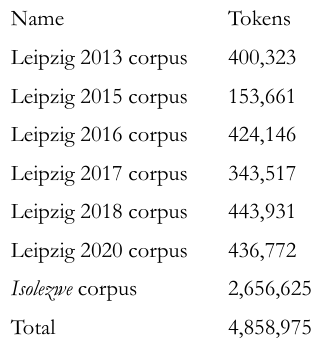
All the subcorpora were combined prior to further processing. The final corpus contained 466,957 distinct tokens. This size is comparable to that used in the calculation of lexical statistics for other languages (e.g., Basque; Perea et al. 2006).
Calculation of statistics
Frequency numbers were obtained using the tidytext package in R. These raw numbers were then converted to Zipf frequencies. The other lexical statistics were calculated using the LexiCAL program (Chee et al. 2021). This Windows application allows the user to input a corpus file, which specifies the tokens and their frequency in the corpus, for any alphabetic language. It then calculates the selected metrics and outputs the results to a separate file. For neighbourhood statistics, it also provides the neighbours of the words that are included in the corpus.
Excerpts from the database
This section presents excerpts from the database. To begin with, Table 2 lists the 20 most frequent words in the corpus with their raw and Zipf frequencies.
Table 2: Twenty most frequent words in the corpus
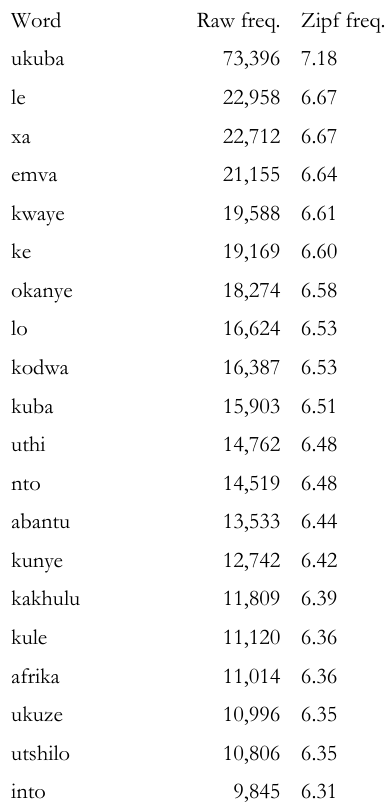
Unsurprisingly, the majority of the 20 most frequent words are function words, with the exception of uthi ' you/he/she says' , (i)nto 'thing' , abantu 'people' , kakhulu ' very, a lot' , afrika 'Africa' , and utshilo ' you/he/she said' .
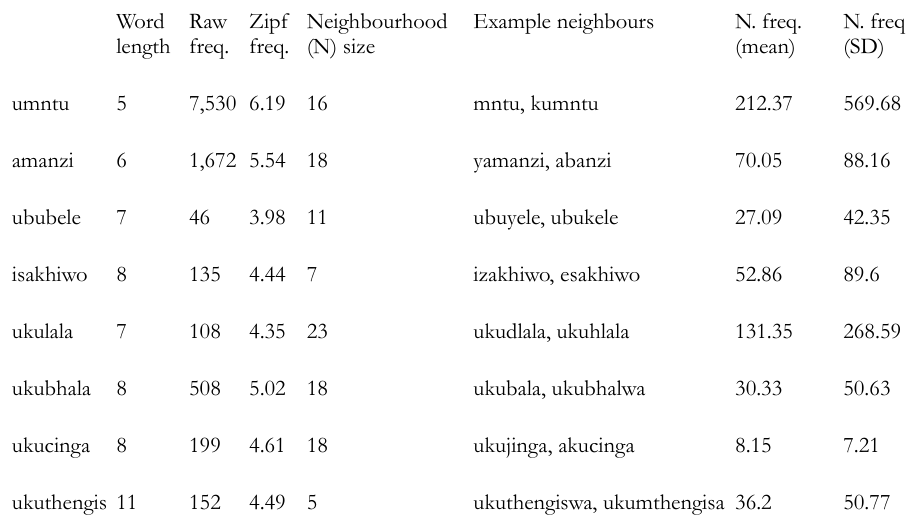
The crucial factor in designing psycholinguistic experiments, however, is not the raw frequency of items, but matching frequency and other lexical properties across items. Table 3 presents example database entries for ten randomly selected items from the corpus. In creating an experiment, the aim would be to select lexical items that are as closely matched on the numerical values in Table 3 as possible.
Applications
A database of lexical statistics such as that described in this paper has numerous applications for research on lexical processing, which requires careful control of word-level properties such as frequency and neighbourhood density. There is, for example, significant interest in whether recognition of morphologically complex words takes place at the whole-word level or whether it entails breaking a word down into its constituent morphemes. To the best of the author's knowledge, only one study has investigated this question in relation to a Bantu language (Setswana; Ciaccio, Kgolo & Clahsen 2020). The extent to which morphosyntactic processing differs across first- and second-language speakers of a language is also theoretically important and critically understudied in relation to Bantu languages (Spinner 2011).
Another set of applications arises in the domain of language development. Lexical databases of the type described in this paper have been developed specifically for use in psycholinguistic studies of children's language processing and for evaluating literacy materials aimed at developing readers (e.g., Corral, Ferrero & Goikoetxea 2009; Masterson et al. 2010; Schroeder et al. 2015; Terzopoulos et al. 2017). For such applications, corpora are typically compiled using a large selection of materials created specifically for children in order to increase the likelihood of children having been exposed to the language it contains.
Table 3: Example database entries

Limitations and suggestions for further work
There are several additional steps that can be taken to improve on and expand the database presented in this paper. For one, after compiling the corpus and before processing it to derive lexical statistics, it would be desirable to cross-reference the corpus word list with a word list from an official isiXhosa dictionary. This cross-referencing process would enable misspellings to be filtered out from the corpus, thus reducing the number of spurious neighbours identified, and also facilitate the removal of non-isiXhosa words. At the time of writing, no such dictionary word list could be obtained in a digital format, and so this step has not yet been taken.
Another notable consideration is that all of the above calculations were based on word forms rather than roots or lemmas. This means that instead of, for example, -lala being treated as a lemma that surfaces in ukulala, uyalala, siyalala, and so forth, each of these word forms is treated as an individual item. This can also lead to inflation of neighbourhood density (however, the words affected by this issue - most notably, verbs - will tend to have their neighbourhood density inflated to the same extent). It remains an empirical question whether it is properties of the word form or the lemma that are better predictors of, for example, word recognition latency in languages such as isiXhosa. In order to address this question, lemmas could be obtained from corpus data using a morphological analyzer (e.g., du Toit & Puttkammer 2021).
Lastly, the work presented here could also be expanded by deriving phonological statistics for isiXhosa, such as syllable number and phonological neighbourhood density. Such statistics can be obtained via LexiCAL if each word entry is paired with a phonetic transcription and would enable research on spoken word processing in the language.
Conclusion
Psycholinguistic techniques that can capture language processing as it unfolds in real time have yet to be leveraged to examine the processing of isiXhosa and related languages. This paper has discussed one kind of resource - a database of lexical statistics on the language, compiled based on a large-scale corpus - that is necessary to address this research gap and realize the considerable theoretical and practical benefits of doing so. Future collaboration between (computational) linguists and language specialists will allow for the refinement of this resource and the creation of others.
Acknowledgements
This work was made by possible by an NRF Thuthuka grant (grant no. 138180) awarded to R. Berghoff.
References
Alexeeva, S, Slioussar, N & Chernova, D 2018, 'StimulStat: A lexical database for Russian' , Behavior Research Methods, vol. 50, no. 6, pp. 2305-15.
Andrews, S 1997, 'The effect of orthographic similarity on lexical retrieval: Resolving neighborhood conflicts' , Psychonomic Bulletin & Review, vol. 4, no. 4, pp. 439-61.
Boudelaa, S & Marslen-Wilson, WD 2010, 'Aralex: A lexical database for Modern Standard Arabic' , Behavior Research Methods, vol. 42, no. 2, pp. 481-7.
Boudelaa, S & Marslen-Wilson, WD 2011, 'Productivity and priming: Morphemic decomposition in Arabic' , Language and Cognitive Processes, vol. 26, 4-6, pp. 624-52.
Brysbaert, M, Mandera, P & Keuleers, E 2018, 'The word frequency effect in word processing: An updated review ' , Current Directions in Psychological Science, vol. 27, no. 1, pp. 45-50.
Bylund, E, Khafif, Z & Berghoff, R 2022, 'Linguistic and geographic diversity (or lack thereof) in research on second language acquisition and multilingualism' , Applied Linguistics. Manuscript submitted for publication.
Chee, QW, Chow, KJ, Goh, WD, Yap, MJ & Miwa, K 2021, 'LexiCAL: A calculator for lexical variables' , PloS one, vol. 16, no. 4, pp. e0250891.
Ciaccio, LA, Kgolo, N & Clahsen, H 2020, 'Morphological decomposition in Bantu: a masked priming study on Setswana prefixation' , Language, Cognition and Neuroscience, vol. 35, no. 10, pp. 1257-71.
Colé, P, Pynte, J & Andriamamonjy, P 2003, 'Effect of grammatical gender on visual word recognition: Evidence from lexical decision and eye movement experiments' , Perception & Psychophysics, vol. 65, no. 3, pp. 407-19.
Corral, S, Ferrero, M & Goikoetxea, E 2009, 'LEXIN: A lexical database from Spanish kindergarten and first-grade readers' , Behavior research methods, vol. 41, no. 4, pp. 1009-17.
du Toit, Jakobus S. & Puttkammer, MJ 2021, 'Developing core technologies for resource-scarce Nguni languages' , Information, vol. 12, no. 12, p. 520.
Duchon, A, Perea, M, Sebastián-Gallés, N, Martí, A & Carreiras, M 2013, 'EsPal: One-stop shopping for Spanish word properties' , Behavior Research Methods, vol. 45, no. 4, pp. 1246-58.
Goldhahn, D, Eckart, T & Quasthoff, U 2012, 'Building large monolingual dictionaries at the Leipzig Corpora Collection: From 100 to 200 languages' , Proceedings of the 8th International Language Resources and Evaluation.
Ktori, M, van Heuven, W & Pitchford, NJ 2008, 'GreekLex: A lexical database of Modern Greek' , Behavior Research Methods, vol. 40, no. 3, pp. 773-83.
Marian, V, Bartolotti, J, Chabal, S, Shook, A & White, SA 2012, 'CLEARPOND: Cross-Linguistic Easy-Access Resource for Phonological and Orthographic Neighborhood Densities' , PloS one, vol. 7, no. 8, pp. e43230.
Masterson, J, Stuart, M, Dixon, M & Lovejoy, S 2010, 'Children's printed word database: Continuities and changes over time in children's early reading vocabulary ' , British Journal of Psychology, vol. 101, no. 2, pp. 221-42.
New, B, Ferrand, L, Pallier, C & Brysbaert, M 2006, 'Reexamining the word length effect in visual word recognition: New evidence from the English Lexicon Project' , Psychonomic Bulletin & Review, vol. 13, no. 1, pp. 45-52.
Norcliffe, E, Harris, AC & Jaeger, TF 2015, 'Cross-linguistic psycholinguistics and its critical role in theory development: early beginnings and recent advances' , Language, Cognition and Neuroscience, vol. 30, no. 9, pp. 1009-32.
Perea, M, Urkia, M, Davis, CJ, Agirre, A, Laseka, E & Carreiras, M 2006, 'E-Hitz: A word frequency list and a program for deriving psycholinguistic statistics in an agglutinative language (Basque)' , Behavior Research Methods, vol. 38, no. 4, pp. 610-5.
Pretorius, E 2019, 'Getting it right from the start' , in N Spaull & J Comings (eds), Improving Early Literacy Outcomes, BRILL, pp. 63-80.
R Core Team 2022, R: A language and environment for statistical computing, <https://www.R-project.org/>.
Schroeder, S, Würzner, K, Heister, J, Geyken, A & Kliegl, R 2015, 'childLex: a lexical database of German read by children' , Behavior Research Methods, vol. 47, no. 4, pp. 1085-94.
Silge, J & Robinson, D 2016, 'tidytext: Text Mining and Analysis Using Tidy Data Principles in R' , JOSS, vol. 1, no. 3, <http:// dx.doi.org/10.21105/joss.00037>.
Soares, AP, Iriarte, Á, de Almeida, José João, Simões, A, Costa, A, Machado, J, França, P, Comesaña, M, Rauber, A, Rato, A & Perea, M 2018, 'Procura-PALavras (P-PAL): A Web-based interface for a new European Portuguese lexical database' , Behavior Research Methods, vol. 50, no. 4, pp. 1461-81.
Spinner, P 2011, 'Review article: Second language acquisition of Bantu languages: A (mostly) untapped research opportunity ' , Second Language Research, vol. 27, no. 3, pp. 418-30.
Sun, CC, Hendrix, P, Ma, J & Baayen, RH 2018, 'Chinese lexical database (CLD)' , Behavior Research Methods, vol. 50, no. 6, pp. 2606-29.
Terzopoulos, AR, Duncan, LG, Wilson, Mark A. J., Niolaki, GZ & Masterson, J 2017, 'HelexKids: A word frequency database for Greek and Cypriot primary school children' , Behavior Research Methods, vol. 49, no. 1, pp. 83-96.
van de Velde, M, Bostoen, K, Nurse, D & Philippson, G (eds) 2019, The Bantu Languages, Routledge, New York.
van Heuven, W, Mandera, P, Keuleers, E & Brysbaert, M 2014, 'Subtlex-UK: A new and improved word frequency database for British English' , Quarterly Journal of Experimental Psychology, vol. 67, no. 6, pp. 1176-90.
Wickham, H 2019, stringr: Simple, Consistent Wrappers for Common String Operations, <https://CRAN.R-project.org/package=stringr>.
Wickham, H 2021, rvest: Easily Harvest (Scrape) Web Pages, <https://CRAN.R-project.org/package=rvest>.
Deriving lexical statistics for psycholinguistic research on isiXhosa
Dériver des statistiques lexicales pour la recherche psycholinguistique sur l’isiXhosa
Affiliations
Berghoff, Robyn
Stellenbosch University
Affiliations
Berghoff, Robyn
Stellenbosch University
Abstract
Résumé
Psycholinguistic research on isiXhosa and related Bantu languages is scarce. For research on lexical processing in particular, a prerequisite is data on lexical properties that impact word recognition, such as word frequency and neighbourhood density. This paper describes the derivation of these and related lexical statistics from a newly created 4.8-million-word isiXhosa corpus. It then reviews the potential applications of such a lexical database for research on language acquisition, language development, and language processing. The paper closes with recommendations for further work in this domain.
Les recherches psycholinguistiques sur l'isiXhosa et les langues bantoues apparentées sont rares. Pour la recherche sur le traitement lexical en particulier, un prérequis est la disponibilité de données sur les propriétés lexicales qui impactent la reconnaissance des mots, telles que la fréquence des mots et la densité de voisinage. Cet article décrit la dérivation de ces statistiques et des statistiques lexicales connexes à partir d'un corpus isiXhosa nouvellement créé de 4,8 millions de mots. Il passe ensuite en revue les applications potentielles d'une telle base de données lexicale pour la recherche sur l'acquisition du langage, le développement du langage et le traitement du langage. Le document se termine par des recommandations pour la poursuite des travaux dans ce domaine.
Keywords
Mots-clés
isiXhosa, psycholinguistics, lexical statistics, lexical processing, corpus
isiXhosa, psycholinguistique, statistiques lexicales, traitement lexical, corpus
Introduction
Introduction
The vast majority of language acquisition and processing research focuses on a small subset of the world's languages, specifically those from the Germanic and Romance branches of the Indo-European language family (Bylund, Khafif & Berghoff 2022; Norcliffe, Harris & Jaeger 2015). Within the neglected language groups, the Bantu languages are particularly understudied. This narrow focus in terms of language typology severely limits the generalizability of theories of language processing.
La grande majorité de la recherche sur l'acquisition et le traitement du langage se concentre sur un petit sous-ensemble des langues du monde, en particulier celles des branches germanique et romane de la famille des langues indo-européennes (Bylund, Khafif et Berghoff 2022; Norcliffe, Harris et Jaeger 2015). Parmi les groupes linguistiques négligés, les langues bantoues sont particulièrement peu étudiées. Cette focalisation étroite en termes de typologie linguistique limite sévèrement la généralisabilité des théories du traitement du langage.
isiXhosa is an agglutinating language, meaning that its words typically consist of multiple morphemes that are concatenated in a relatively transparent manner. It has two particular features that distinguish it from more commonly studied agglutinating languages such as Turkish, Basque, and Hungarian (see van de Velde et al. 2019 for discussion). Firstly, alongside suffixation, it makes widespread use of prefixation to produce morphologically complex words. Secondly, it has a rich grammatical gender or noun class system, whereby nouns are divided into 15 groups, with noun class agreement being marked on several syntactic constituents (e.g., verbs, adjectives/relatives, determiners). As language-specific properties of affixation (e.g., Boudelaa & Marslen-Wilson 2011) and grammatical gender (e.g., Colé, Pynte & Andriamamonjy 2003) are known to affect language processing, psycholinguistic examinations of isiXhosa and related languages have much to contribute to theories of lexical and morphological processing. Further, in terms of practical applications, an understanding of how language and literacy development proceeds in languages of this sort is indispensable in designing teaching and intervention materials for young learners (Pretorius 2019).
L'isiXhosa est une langue agglutinante, ce qui signifie que ses mots sont généralement constitués de plusieurs morphèmes qui sont concaténés d'une manière relativement transparente. Elle présente deux caractéristiques particulières qui la distinguent des langues agglutinantes plus couramment étudiées comme le turc, le basque et le hongrois (voir van de Velde et al. 2019 pour une discussion). Tout d’abord, à côté de la suffixation, il fait un usage généralisé de la préfixation pour produire des mots morphologiquement complexes. Ensuite, il possède un système de genre grammatical ou de classe nominale riche, selon lequel les noms sont divisés en 15 groupes, l'accord de classe nominale étant marqué sur plusieurs constituants syntaxiques (par exemple, les verbes, les adjectifs/relatifs, les déterminants). Comme les propriétés spécifiques à la langue de l'affixation (par ex., Boudelaa & Marslen-Wilson 2011) et du genre grammatical (par ex., Colé, Pynte & Andriamamonjy 2003) sont connues pour affecter le traitement du langage, les examens psycholinguistiques de l'isiXhosa et des langues apparentées ont beaucoup à apporter aux théories du traitement lexical et morphologique. De plus, en termes d'applications pratiques, la compréhension de la manière dont le développement du langage et de la littératie se déroule dans des langues de ce type est indispensable pour concevoir des matériaux d'enseignement et d'intervention pour les jeunes apprenants (Pretorius 2019).
A sine qua non of robust psycholinguistic research into lexical processing are statistics on certain lexical properties known to influence word recognition, such as word frequency and neighbourhood density. Databases of such statistics are increasingly being developed and made available to facilitate research on more commonly studied languages. Examples include GreekLex, for Greek (Ktori, van Heuven & Pitchford 2008); EsPal, for Spanish (Duchon et al. 2013); Aralex, for Modern Standard Arabic (Boudelaa & Marslen-Wilson 2010); StimulStat, for Russian (Alexeeva, Slioussar & Chernova 2018); the Chinese Lexical Database, for Mandarin (Sun et al. 2018); P-PAL, for Portuguese (Soares et al. 2018); and E-Hitz, for Basque (Perea et al. 2006); as well as CLEARPOND (Cross-Linguistic Easy Access Resource for Phonological and Orthographic Neighbourhood Densities; Marian et al. 2012), which provides lexical data for five widely examined European languages.
Une condition sine qua non de la recherche psycholinguistique robuste sur le traitement lexical sont les statistiques sur certaines propriétés lexicales connues pour influencer la reconnaissance des mots, telles que la fréquence des mots et la densité de voisinage. Des bases de données de telles statistiques sont de plus en plus développées et mises à disposition pour faciliter la recherche sur les langues plus couramment étudiées. Parmi les exemples, on trouve GreekLex, pour le grec (Ktori, van Heuven & Pitchford 2008) ; EsPal, pour l'espagnol (Duchon et al. 2013) ; Aralex, pour l'arabe moderne standard (Boudelaa & Marslen-Wilson 2010) ; StimulStat, pour le russe (Alexeeva, Slioussar & Chernova 2018) ; la Chinese Lexical Database, pour le mandarin (Sun et al. 2018) ; P-PAL, pour le portugais (Soares et al. 2018) ; et E-Hitz, pour le basque (Perea et al. 2006) ; ainsi que CLEARPOND (Cross-Linguistic Easy Access Resource for Phonological and Orthographic Neighbourhood Densities ; Marian et al. 2012), qui fournit des données lexicales pour cinq langues européennes largement examinées.
Resources on African indigenous languages are scarce. Unsurprisingly, then, the kinds of data needed for robust psycholinguistic research on isiXhosa processing and acquisition are lacking. This paper describes the generation of lexical statistics for isiXhosa. It identifies and defines the types of lexical statistics needed for lexical processing research on isiXhosa and exemplifies their calculation based on a newly created 4.8-million-word isiXhosa corpus. The paper concludes by reviewing potential applications of such a database and outlining steps for future work.
Les ressources sur les langues autochtones africaines sont rares. Il n’est donc pas surprenant que les types de données nécessaires à une recherche psycholinguistique robuste sur le traitement et l’acquisition de l’isiXhosa fassent défaut. Cet article décrit la génération de statistiques lexicales pour isiXhosa. Il identifie et définit les types de statistiques lexicales nécessaires à la recherche sur le traitement lexical de l'isiXhosa et illustre leur calcul sur la base d'un corpus isiXhosa de 4,8 millions de mots nouvellement créé. L'article se conclut par une revue des applications potentielles d'une telle base de données et par l'esquisse des étapes pour les travaux futurs.
Characteristics to be included in a database of lexical statistics for isiXhosa
Caractéristiques à inclure dans une base de données de statistiques lexicales pour isiXhosa
This section reviews the characteristics that should, at a minimum, be included in a database of lexical statistics for isiXhosa. This overview focuses on characteristics that are relevant specifically to visual word recognition.
Cette section passe en revue les caractéristiques qui devraient, au minimum, être incluses dans une base de données de statistiques lexicales pour isiXhosa. Cette vue d'ensemble se concentre sur les caractéristiques qui sont pertinentes spécifiquement à la reconnaissance visuelle des mots.
Frequency
Fréquence
Frequency is arguably the most important variable in studies of lexical processing (van Heuven et al. 2014), where more frequent words are processed more rapidly than less frequent words. This effect can be explained on the basis of lexical activation, whereby more frequently encountered words have higher resting activation levels and are thus accessed more quickly than their low-frequency counterparts. A word's frequency is calculated based on the number of its occurrences in a corpus. It can be expressed on the standardized Zipf frequency scale, where the lower half of the scale (1-3) represents low-frequency words and the upper half of the scale (4-6) represents high-frequency words (words with a Zipf frequency above 7 tend to be function words). Zipf frequency is calculated as log10 (frequency per million words) + 3 (van Heuven et al. 2014).
La fréquence est sans doute la variable la plus importante dans les études sur le traitement lexical (van Heuven et al. 2014), où les mots plus fréquents sont traités plus rapidement que les mots moins fréquents. Cet effet peut être expliqué sur la base de l'activation lexicale, selon laquelle les mots rencontrés plus fréquemment ont des niveaux d'activation au repos plus élevés et sont donc accessibles plus rapidement que leurs homologues à faible fréquence. La fréquence d'un mot est calculée en fonction du nombre de ses occurrences dans un corpus. Elle peut être exprimée sur l'échelle de fréquence Zipf standardisée, où la moitié inférieure de l'échelle (1-3) représente les mots de basse fréquence et la moitié supérieure de l'échelle (4-6) représente les mots de haute fréquence (les mots avec une fréquence Zipf supérieure à 7 ont tendance à être des mots de fonction). La fréquence Zipf est calculée en log10 (fréquence par million de mots) + 3 (van Heuven et al. 2014).
Word length
Longueur du mot
Word length is calculated simply as the number of letters in a given word. At least in English, it has been found to have non-linear effects on word recognition independently of other variables such as number of syllables (New et al. 2006).
La longueur du mot est calculée simplement comme le nombre de lettres dans un mot donné. Au moins en anglais, il a été démontré qu'elle a des effets non linéaires sur la reconnaissance des mots, indépendamment d'autres variables telles que le nombre de syllabes (New et al. 2006).
Neighbourhood statistics
Statistiques de voisinage
A neighbour of a given word is any word that can be created by substituting, adding, or deleting a single letter (for example, the isiXhosa ubisi 'milk' has as neighbours ubusi 'honey ' and usisi 'sister' , among others). The neighbourhood density of a word is equal to the number of its neighbours. Neighbourhood density effects on lexical processing typically manifest as processing slowdowns for words with more neighbours (Andrews 1997), which is attributed to the fact that when recognizing a word with many neighbours, numerous candidate lexical items become activated and must consequently be inhibited for the correct item to be selected. A related variable that is also of importance is neighbourhood frequency, which is the average frequency of a given word's neighbours. Here, a word with high-frequency neighbours takes longer to recognize than a word with low-frequency neighbours (e.g., Brysbaert, Mandera & Keuleers 2018).
Un voisin d'un mot donné est tout mot qui peut être créé en substituant, en ajoutant ou en supprimant une seule lettre (par exemple, le isiXhosa ubisi «lait» a comme voisins ubusi «miel» et usisi «soeur», entre autres). La densité de voisinage d'un mot est égale au nombre de ses voisins. Les effets de densité de voisinage sur le traitement lexical se manifestent généralement par des ralentissements de traitement pour les mots avec plus de voisins (Andrews 1997), ce qui est attribué au fait que lors de la reconnaissance d'un mot avec de nombreux voisins, de nombreux éléments lexicaux candidats deviennent activés et doivent par conséquent être inhibés pour que l'élément correct soit sélectionné. Une variable connexe qui est également importante est la fréquence de voisinage, qui est la fréquence moyenne des voisins d'un mot donné. Ici, un mot avec des voisins de haute fréquence prend plus de temps à reconnaître qu'un mot avec des voisins de faible fréquence (par exemple, Brysbaert, Mandera & Keuleers 2018).
Method
Méthode
The corpus
Le corpus
The calculation of lexical statistics requires a sizeable corpus of contemporary language materials. The corpus used in this paper was created by combining the isiXhosa corpora provided in the Leipzig Corpora Collection (Goldhahn, Eckart & Quasthoff 2012) with a new corpus created by the author from the online isiXhosa newssite Isolezwe lesiXhosa. The Leipzig isiXhosa corpora consist of texts randomly collected from the web and Wikipedia and therefore cover a multitude of topics (see Goldhahn, Eckart & Quasthoff 2012 for discussion). The Isolezwe corpus, on the other hand, contains reports on general news, sports, entertainment, opinion, and agriculture. This corpus was created via web-scraping using the rvest package (version 1.0.2; Wickham 2021) in the R environment for statistical computing (version 4.2.1; R Core Team 2022). The entire history of articles that was available from the site's inception (26 June 2015) up until 24 June 2022 was scraped.
Le calcul des statistiques lexicales nécessite un corpus important de matériaux linguistiques contemporains. Le corpus utilisé dans cet article a été créé en combinant les corpus isiXhosa fournis dans la Leipzig Corpora Collection (Goldhahn, Eckart & Quasthoff 2012) avec un nouveau corpus créé par l'auteur à partir du site d'actualités isiXhosa en ligne Isolezwe lesiXhosa. Les corpus isiXhosa de Leipzig sont constitués de textes collectés aléatoirement sur le web et sur Wikipedia et couvrent donc une multitude de sujets (voir Goldhahn, Eckart & Quasthoff 2012 pour discussion). Le corpus Isolezwe, quant à lui, contient des reportages sur l'actualité générale, le sport, le divertissement, les opinions et l'agriculture. Ce corpus a été créé via le moissonnage de données en utilisant le package rvest (version 1.0.2 ; Wickham 2021) dans l'environnement R pour le calcul statistique (version 4.2.1 ; R Core Team 2022). L'ensemble de l'historique des articles disponible depuis la création du site (26 juin 2015) jusqu'au 24 juin 2022 a été extrait.
To create the final corpus, each subcorpus was read into R and subjected to basic cleaning (e.g., removal of digits) using the stringr package (version 1.4; Wickham 2019). Tokenization of each subcorpus was then performed using the "unnest_tokens" function from the tidytext package (version 0.3.3; Silge & Robinson 2016).
Pour créer le corpus final, chaque sous-corpus a été lu dans R et soumis à un nettoyage de base (par exemple, suppression des chiffres) à l'aide du package stringr (version 1.4 ; Wickham 2019). La tokenisation de chaque sous-corpus a ensuite été réalisée à l'aide de la fonction "unnest_tokens" du package tidytext (version 0.3.3 ; Silge & Robinson 2016).
Details of each component of the final corpus are provided in Table 1.
Les détails de chaque composante du corpus final sont présentés dans le tableau 1.
Table 1: Components of final corpus
Tableau 1: Composantes du corpus final
All the subcorpora were combined prior to further processing. The final corpus contained 466,957 distinct tokens. This size is comparable to that used in the calculation of lexical statistics for other languages (e.g., Basque; Perea et al. 2006).
Tous les sous-corpus ont été combinés avant tout traitement ultérieur. Le corpus final contenait 466 957 tokens distincts. Cette taille est comparable à celle utilisée dans le calcul des statistiques lexicales pour d'autres langues (par exemple, le basque ; Perea et al. 2006).
Calculation of statistics
Calcul des statistiques
Frequency numbers were obtained using the tidytext package in R. These raw numbers were then converted to Zipf frequencies. The other lexical statistics were calculated using the LexiCAL program (Chee et al. 2021). This Windows application allows the user to input a corpus file, which specifies the tokens and their frequency in the corpus, for any alphabetic language. It then calculates the selected metrics and outputs the results to a separate file. For neighbourhood statistics, it also provides the neighbours of the words that are included in the corpus.
Les nombres de fréquence ont été obtenus à l'aide du package tidytext dans R. Ces nombres bruts ont ensuite été convertis en fréquences de Zipf. Les autres statistiques lexicales ont été calculées à l'aide du programme LexiCAL (Chee et al. 2021). Cette application Windows permet à l'utilisateur de saisir un fichier de corpus, qui spécifie les tokens et leur fréquence dans le corpus, pour toute langue alphabétique. Elle calcule ensuite les métriques sélectionnées et sort les résultats dans un fichier séparé. Pour les statistiques de voisinage, il fournit également les voisins des mots qui sont inclus dans le corpus.
Excerpts from the database
Extraits de la base de données
This section presents excerpts from the database. To begin with, Table 2 lists the 20 most frequent words in the corpus with their raw and Zipf frequencies.
Cette section présente des extraits de la base de données. Pour commencer, le Tableau 2 liste les 20 mots les plus fréquents dans le corpus avec leurs fréquences brutes et de Zipf.
Table 2: Twenty most frequent words in the corpus
Tableau 2: Vingt mots les plus fréquents dans le corpus
Unsurprisingly, the majority of the 20 most frequent words are function words, with the exception of uthi ' you/he/she says' , (i)nto 'thing' , abantu 'people' , kakhulu ' very, a lot' , afrika 'Africa' , and utshilo ' you/he/she said' .
Sans surprise, la majorité des 20 mots les plus fréquents sont des mots grammaticaux, à l'exception de uthi « tu dis/il ou elle dit », (i)nto « chose », abantu « gens », kakhulu « très, beaucoup », afrika « Afrique » et utshilo « tu as dit/il ou elle a dit ».
The crucial factor in designing psycholinguistic experiments, however, is not the raw frequency of items, but matching frequency and other lexical properties across items. Table 3 presents example database entries for ten randomly selected items from the corpus. In creating an experiment, the aim would be to select lexical items that are as closely matched on the numerical values in Table 3 as possible.
Le facteur crucial dans la conception d'expériences psycholinguistiques n'est toutefois pas la fréquence brute des items, mais l'appariement de la fréquence et des autres propriétés lexicales entre les items. Le tableau 3 présente des exemples d'entrées de base de données pour dix items sélectionnés aléatoirement dans le corpus. En créant une expérience, l'objectif serait de sélectionner des éléments lexicaux qui correspondent aussi étroitement que possible aux valeurs numériques du tableau 3.
Applications
Applications
A database of lexical statistics such as that described in this paper has numerous applications for research on lexical processing, which requires careful control of word-level properties such as frequency and neighbourhood density. There is, for example, significant interest in whether recognition of morphologically complex words takes place at the whole-word level or whether it entails breaking a word down into its constituent morphemes. To the best of the author's knowledge, only one study has investigated this question in relation to a Bantu language (Setswana; Ciaccio, Kgolo & Clahsen 2020). The extent to which morphosyntactic processing differs across first- and second-language speakers of a language is also theoretically important and critically understudied in relation to Bantu languages (Spinner 2011).
Une base de données de statistiques lexicales telle que celle décrite dans cet article a de nombreuses applications pour la recherche sur le traitement lexical, qui nécessite un contrôle minutieux des propriétés au niveau des mots telles que la fréquence et la densité de voisinage. Il y a, par exemple, un intérêt significatif à savoir si la reconnaissance des mots morphologiquement complexes a lieu au niveau du mot entier ou si elle implique de décomposer un mot en ses morphèmes constitutifs. À la connaissance de l'auteur, une seule étude a étudié cette question en relation avec une langue bantoue (Setswana; Ciaccio, Kgolo & Clahsen 2020). La mesure dans laquelle le traitement morphosyntaxique diffère entre les locuteurs de langue maternelle et les locuteurs de langue seconde d’une langue est également théoriquement importante et sous-étudiée de façon critique en ce qui concerne les langues bantoues (Spinner 2011).
Another set of applications arises in the domain of language development. Lexical databases of the type described in this paper have been developed specifically for use in psycholinguistic studies of children's language processing and for evaluating literacy materials aimed at developing readers (e.g., Corral, Ferrero & Goikoetxea 2009; Masterson et al. 2010; Schroeder et al. 2015; Terzopoulos et al. 2017). For such applications, corpora are typically compiled using a large selection of materials created specifically for children in order to increase the likelihood of children having been exposed to the language it contains.
Un autre ensemble d'applications se situe dans le domaine du développement du langage. Les bases de données lexicales du type décrit dans cet article ont été développées spécifiquement pour être utilisées dans les études psycholinguistiques sur le traitement du langage chez les enfants et pour évaluer les matériels d'alphabétisation visant à développer les lecteurs (p. ex., Corral, Ferrero et Goikoetxea 2009; Masterson et coll. 2010; Schroeder et coll. 2015; Terzopoulos et coll. 2017). Pour de telles applications, les corpus sont généralement compilés en utilisant une grande sélection de matériel créé spécifiquement pour les enfants afin d'augmenter la probabilité que les enfants aient été exposés au langage qu'il contient.
Table 3: Example database entries
Tableau 3 : Exemples d'entrées de base de données
Limitations and suggestions for further work
Limites et suggestions pour la suite des travaux
There are several additional steps that can be taken to improve on and expand the database presented in this paper. For one, after compiling the corpus and before processing it to derive lexical statistics, it would be desirable to cross-reference the corpus word list with a word list from an official isiXhosa dictionary. This cross-referencing process would enable misspellings to be filtered out from the corpus, thus reducing the number of spurious neighbours identified, and also facilitate the removal of non-isiXhosa words. At the time of writing, no such dictionary word list could be obtained in a digital format, and so this step has not yet been taken.
Il existe plusieurs étapes supplémentaires qui peuvent être prises pour améliorer et étendre la base de données présentée dans cet article. D'une part, après avoir compilé le corpus et avant de le traiter pour dériver des statistiques lexicales, il serait souhaitable de croiser la liste de mots du corpus avec une liste de mots provenant d'un dictionnaire officiel isiXhosa. Ce processus de croisement permettrait de filtrer les fautes d'orthographe du corpus, réduisant ainsi le nombre de voisins erronés identifiés, et faciliterait également l'élimination des mots non isiXhosa. Au moment de la rédaction, aucune telle liste de mots de dictionnaire n'a pu être obtenue au format numérique, et donc cette étape n'a pas encore été prise.
Another notable consideration is that all of the above calculations were based on word forms rather than roots or lemmas. This means that instead of, for example, -lala being treated as a lemma that surfaces in ukulala, uyalala, siyalala, and so forth, each of these word forms is treated as an individual item. This can also lead to inflation of neighbourhood density (however, the words affected by this issue - most notably, verbs - will tend to have their neighbourhood density inflated to the same extent). It remains an empirical question whether it is properties of the word form or the lemma that are better predictors of, for example, word recognition latency in languages such as isiXhosa. In order to address this question, lemmas could be obtained from corpus data using a morphological analyzer (e.g., du Toit & Puttkammer 2021).
Une autre considération notable est que tous les calculs ci-dessus étaient basés sur les formes de mots plutôt que sur les racines ou les lemmes. Cela signifie qu'au lieu, par exemple, de traiter -lala comme un lemme qui apparaît dans ukulala, uyalala, siyalala, et ainsi de suite, chacune de ces formes de mots est traitée comme un élément individuel. Cela peut également conduire à une inflation de la densité de voisinage (cependant, les mots affectés par ce problème - plus particulièrement les verbes - auront tendance à avoir leur densité de voisinage gonflée dans la même mesure). Il reste une question empirique de savoir si ce sont les propriétés de la forme du mot ou du lemme qui sont de meilleurs prédicteurs, par exemple, de la latence de reconnaissance des mots dans des langues telles que l'isiXhosa. Pour répondre à cette question, les lemmes pourraient être obtenus à partir de données de corpus à l’aide d’un analyseur morphologique (p. ex., du Toit & Puttkammer 2021).
Lastly, the work presented here could also be expanded by deriving phonological statistics for isiXhosa, such as syllable number and phonological neighbourhood density. Such statistics can be obtained via LexiCAL if each word entry is paired with a phonetic transcription and would enable research on spoken word processing in the language.
Enfin, le travail présenté ici pourrait également être étendu en dérivant des statistiques phonologiques pour isiXhosa, telles que le nombre de syllabes et la densité phonologique de voisinage. De telles statistiques peuvent être obtenues via LexiCAL si chaque entrée de mot est associée à une transcription phonétique et permettraient de mener des recherches sur le traitement des mots parlés dans la langue.
Conclusion
Conclusion
Psycholinguistic techniques that can capture language processing as it unfolds in real time have yet to be leveraged to examine the processing of isiXhosa and related languages. This paper has discussed one kind of resource - a database of lexical statistics on the language, compiled based on a large-scale corpus - that is necessary to address this research gap and realize the considerable theoretical and practical benefits of doing so. Future collaboration between (computational) linguists and language specialists will allow for the refinement of this resource and the creation of others.
Les techniques psycholinguistiques qui peuvent capturer le traitement du langage à mesure qu'il se déroule en temps réel n'ont pas encore été exploitées pour examiner le traitement de l'isiXhosa et des langues connexes. Cet article a discuté d'un type de ressource - une base de données de statistiques lexicales sur la langue, compilée à partir d'un corpus à grande échelle - qui est nécessaire pour combler cette lacune de recherche et réaliser les avantages théoriques et pratiques considérables qui en découlent. La collaboration future entre linguistes (informatiques) et spécialistes des langues permettra d’affiner cette ressource et d’en créer d’autres.
Acknowledgements
Remerciements
This work was made by possible by an NRF Thuthuka grant (grant no. 138180) awarded to R. Berghoff.
Ce travail a été rendu possible grâce à une subvention NRF Thuthuka (subvention n ° 138180) décernée à R. Berghoff.
References
Références
Alexeeva, S, Slioussar, N & Chernova, D 2018, 'StimulStat: A lexical database for Russian' , Behavior Research Methods, vol. 50, no. 6, pp. 2305-15.
Andrews, S 1997, 'The effect of orthographic similarity on lexical retrieval: Resolving neighborhood conflicts' , Psychonomic Bulletin & Review, vol. 4, no. 4, pp. 439-61.
Boudelaa, S & Marslen-Wilson, WD 2010, 'Aralex: A lexical database for Modern Standard Arabic' , Behavior Research Methods, vol. 42, no. 2, pp. 481-7.
Boudelaa, S & Marslen-Wilson, WD 2011, 'Productivity and priming: Morphemic decomposition in Arabic' , Language and Cognitive Processes, vol. 26, 4-6, pp. 624-52.
Brysbaert, M, Mandera, P & Keuleers, E 2018, 'The word frequency effect in word processing: An updated review ' , Current Directions in Psychological Science, vol. 27, no. 1, pp. 45-50.
Bylund, E, Khafif, Z & Berghoff, R 2022, 'Linguistic and geographic diversity (or lack thereof) in research on second language acquisition and multilingualism' , Applied Linguistics. Manuscript submitted for publication.
Chee, QW, Chow, KJ, Goh, WD, Yap, MJ & Miwa, K 2021, 'LexiCAL: A calculator for lexical variables' , PloS one, vol. 16, no. 4, pp. e0250891.
Ciaccio, LA, Kgolo, N & Clahsen, H 2020, 'Morphological decomposition in Bantu: a masked priming study on Setswana prefixation' , Language, Cognition and Neuroscience, vol. 35, no. 10, pp. 1257-71.
Colé, P, Pynte, J & Andriamamonjy, P 2003, 'Effect of grammatical gender on visual word recognition: Evidence from lexical decision and eye movement experiments' , Perception & Psychophysics, vol. 65, no. 3, pp. 407-19.
Corral, S, Ferrero, M & Goikoetxea, E 2009, 'LEXIN: A lexical database from Spanish kindergarten and first-grade readers' , Behavior research methods, vol. 41, no. 4, pp. 1009-17.
du Toit, Jakobus S. & Puttkammer, MJ 2021, 'Developing core technologies for resource-scarce Nguni languages' , Information, vol. 12, no. 12, p. 520.
Duchon, A, Perea, M, Sebastián-Gallés, N, Martí, A & Carreiras, M 2013, 'EsPal: One-stop shopping for Spanish word properties' , Behavior Research Methods, vol. 45, no. 4, pp. 1246-58.
Goldhahn, D, Eckart, T & Quasthoff, U 2012, 'Building large monolingual dictionaries at the Leipzig Corpora Collection: From 100 to 200 languages' , Proceedings of the 8th International Language Resources and Evaluation.
Ktori, M, van Heuven, W & Pitchford, NJ 2008, 'GreekLex: A lexical database of Modern Greek' , Behavior Research Methods, vol. 40, no. 3, pp. 773-83.
Marian, V, Bartolotti, J, Chabal, S, Shook, A & White, SA 2012, 'CLEARPOND: Cross-Linguistic Easy-Access Resource for Phonological and Orthographic Neighborhood Densities' , PloS one, vol. 7, no. 8, pp. e43230.
Masterson, J, Stuart, M, Dixon, M & Lovejoy, S 2010, 'Children's printed word database: Continuities and changes over time in children's early reading vocabulary ' , British Journal of Psychology, vol. 101, no. 2, pp. 221-42.
New, B, Ferrand, L, Pallier, C & Brysbaert, M 2006, 'Reexamining the word length effect in visual word recognition: New evidence from the English Lexicon Project' , Psychonomic Bulletin & Review, vol. 13, no. 1, pp. 45-52.
Norcliffe, E, Harris, AC & Jaeger, TF 2015, 'Cross-linguistic psycholinguistics and its critical role in theory development: early beginnings and recent advances' , Language, Cognition and Neuroscience, vol. 30, no. 9, pp. 1009-32.
Perea, M, Urkia, M, Davis, CJ, Agirre, A, Laseka, E & Carreiras, M 2006, 'E-Hitz: A word frequency list and a program for deriving psycholinguistic statistics in an agglutinative language (Basque)' , Behavior Research Methods, vol. 38, no. 4, pp. 610-5.
Pretorius, E 2019, 'Getting it right from the start' , in N Spaull & J Comings (eds), Improving Early Literacy Outcomes, BRILL, pp. 63-80.
R Core Team 2022, R: A language and environment for statistical computing, <https://www.R-project.org/>.
Schroeder, S, Würzner, K, Heister, J, Geyken, A & Kliegl, R 2015, 'childLex: a lexical database of German read by children' , Behavior Research Methods, vol. 47, no. 4, pp. 1085-94.
Silge, J & Robinson, D 2016, 'tidytext: Text Mining and Analysis Using Tidy Data Principles in R' , JOSS, vol. 1, no. 3, <http:// dx.doi.org/10.21105/joss.00037>.
Soares, AP, Iriarte, Á, de Almeida, José João, Simões, A, Costa, A, Machado, J, França, P, Comesaña, M, Rauber, A, Rato, A & Perea, M 2018, 'Procura-PALavras (P-PAL): A Web-based interface for a new European Portuguese lexical database' , Behavior Research Methods, vol. 50, no. 4, pp. 1461-81.
Spinner, P 2011, 'Review article: Second language acquisition of Bantu languages: A (mostly) untapped research opportunity ' , Second Language Research, vol. 27, no. 3, pp. 418-30.
Sun, CC, Hendrix, P, Ma, J & Baayen, RH 2018, 'Chinese lexical database (CLD)' , Behavior Research Methods, vol. 50, no. 6, pp. 2606-29.
Terzopoulos, AR, Duncan, LG, Wilson, Mark A. J., Niolaki, GZ & Masterson, J 2017, 'HelexKids: A word frequency database for Greek and Cypriot primary school children' , Behavior Research Methods, vol. 49, no. 1, pp. 83-96.
van de Velde, M, Bostoen, K, Nurse, D & Philippson, G (eds) 2019, The Bantu Languages, Routledge, New York.
van Heuven, W, Mandera, P, Keuleers, E & Brysbaert, M 2014, 'Subtlex-UK: A new and improved word frequency database for British English' , Quarterly Journal of Experimental Psychology, vol. 67, no. 6, pp. 1176-90.
Wickham, H 2019, stringr: Simple, Consistent Wrappers for Common String Operations, <https://CRAN.R-project.org/package=stringr>.
Wickham, H 2021, rvest: Easily Harvest (Scrape) Web Pages, <https://CRAN.R-project.org/package=rvest>.
Deriving lexical statistics for psycholinguistic research on isiXhosa
Kupata takwimu za kileksika kwa ajili ya utafiti wa kisaikolojia-lugha kuhusu isiXhosa
Affiliations
Berghoff, Robyn
Stellenbosch University
Taasisi
Berghoff, Robyn
Stellenbosch University
Abstract
Muhtasari
Psycholinguistic research on isiXhosa and related Bantu languages is scarce. For research on lexical processing in particular, a prerequisite is data on lexical properties that impact word recognition, such as word frequency and neighbourhood density. This paper describes the derivation of these and related lexical statistics from a newly created 4.8-million-word isiXhosa corpus. It then reviews the potential applications of such a lexical database for research on language acquisition, language development, and language processing. The paper closes with recommendations for further work in this domain.
Utafiti wa kisaikolojia-lugha kuhusu isiXhosa na Lugha za Kibantu zinazohusiana ni haba. Kwa utafiti wa uchakataji wa kileksika hasa, sharti la awali ni data kuhusu sifa za kileksika zinazoathiri utambuzi wa neno, kama vile marudio ya neno na msongamano wa ujirani. Karatasi hii inaelezea ukokotoaji wa takwimu hizi na takwimu za kileksika zinazohusiana kutoka kwenye korasi mpya ya isiXhosa yenye maneno milioni 4.8 iliyoundwa hivi karibuni. Kisha inapitia matumizi yanayowezekana ya hifadhidata hiyo ya kileksika kwa ajili ya utafiti kuhusu upataji wa lugha, ukuzaji wa lugha, na uchakataji wa lugha. Karatasi inahitimisha kwa mapendekezo ya kazi zaidi katika kikoa hiki.
Keywords
Maneno Muhimu
isiXhosa, psycholinguistics, lexical statistics, lexical processing, corpus
isiXhosa, saikolojia-lugha, takwimu za kileksika, uchakataji wa kileksika, korasi
Introduction
Utangulizi
The vast majority of language acquisition and processing research focuses on a small subset of the world's languages, specifically those from the Germanic and Romance branches of the Indo-European language family (Bylund, Khafif & Berghoff 2022; Norcliffe, Harris & Jaeger 2015). Within the neglected language groups, the Bantu languages are particularly understudied. This narrow focus in terms of language typology severely limits the generalizability of theories of language processing.
Idadi kubwa mno ya utafiti wa upataji na uchakataji wa lugha inalenga kikundi kidogo cha lugha za dunia, hasa zile kutoka matawi ya Kijerumaniki na Kiromansi ya familia ya lugha ya Kihindi-Kiulaya (Bylund, Khafif & Berghoff 2022; Norcliffe, Harris & Jaeger 2015). Ndani ya makundi ya lugha yaliyopuuzwa, Lugha za Kibantu hazijafanyiwa utafiti hasa. Mtazamo huu finyu katika taaluma ya aina za lugha unazuia kwa kiasi kikubwa uwezo wa kujumlisha wa nadharia za uchakataji wa lugha.
isiXhosa is an agglutinating language, meaning that its words typically consist of multiple morphemes that are concatenated in a relatively transparent manner. It has two particular features that distinguish it from more commonly studied agglutinating languages such as Turkish, Basque, and Hungarian (see van de Velde et al. 2019 for discussion). Firstly, alongside suffixation, it makes widespread use of prefixation to produce morphologically complex words. Secondly, it has a rich grammatical gender or noun class system, whereby nouns are divided into 15 groups, with noun class agreement being marked on several syntactic constituents (e.g., verbs, adjectives/relatives, determiners). As language-specific properties of affixation (e.g., Boudelaa & Marslen-Wilson 2011) and grammatical gender (e.g., Colé, Pynte & Andriamamonjy 2003) are known to affect language processing, psycholinguistic examinations of isiXhosa and related languages have much to contribute to theories of lexical and morphological processing. Further, in terms of practical applications, an understanding of how language and literacy development proceeds in languages of this sort is indispensable in designing teaching and intervention materials for young learners (Pretorius 2019).
isiXhosa ni lugha ambatizi, ikimaanisha kwamba maneno yake kwa kawaida hujumuisha mofimu nyingi ambazo huambatanishwa kwa namna iliyo wazi kiasi. Ina vipengele viwili mahususi vinavyotofautisha na lugha ambatizi zinazofanyiwa utafiti zaidi kama vile Kituruki, Kibaski, na Kihungaria (angalia van de Velde et al. 2019 kwa mjadala). Kwanza, pamoja na uambishaji nyuma, inatumia kwa kiasi kikubwa uambishaji mbele ili kutoa maneno yenye mofimu changamano. Pili, ina mfumo tajiri wa jinsia ya kisarufi au ngeli, ambapo nomino hugawanywa katika vikundi 15, huku upatanisho wa ngeli ukiwekwa alama kwenye viambajengo kadhaa vya kisintaksia (k.m., vitenzi, vivumishi/virejeshi, vibainishi). Kwa vile sifa mahususi za lugha za uambishaji (k.m., Boudelaa & Marslen-Wilson 2011) na jinsia ya kisarufi (k.m., Colé, Pynte & Andriamamonjy 2003) zinajulikana kuathiri uchakataji wa lugha, uchunguzi wa kisaikolojia-lugha wa isiXhosa na lugha zinazohusiana una mchango mkubwa katika nadharia za uchakataji wa kileksika na kimofolojia. Zaidi ya hayo, katika suala la matumizi ya kivitendo, uelewa wa jinsi ukuzaji wa lugha na ujuzi wa kusoma na kuandika unavyoendelea katika lugha za aina hii ni muhimu sana katika kubuni nyenzo za kufundishia na za kuingilia kati kwa wanafunzi wachanga (Pretorius 2019).
A sine qua non of robust psycholinguistic research into lexical processing are statistics on certain lexical properties known to influence word recognition, such as word frequency and neighbourhood density. Databases of such statistics are increasingly being developed and made available to facilitate research on more commonly studied languages. Examples include GreekLex, for Greek (Ktori, van Heuven & Pitchford 2008); EsPal, for Spanish (Duchon et al. 2013); Aralex, for Modern Standard Arabic (Boudelaa & Marslen-Wilson 2010); StimulStat, for Russian (Alexeeva, Slioussar & Chernova 2018); the Chinese Lexical Database, for Mandarin (Sun et al. 2018); P-PAL, for Portuguese (Soares et al. 2018); and E-Hitz, for Basque (Perea et al. 2006); as well as CLEARPOND (Cross-Linguistic Easy Access Resource for Phonological and Orthographic Neighbourhood Densities; Marian et al. 2012), which provides lexical data for five widely examined European languages.
Sharti lisiloepukika la utafiti imara wa kisaikolojia-lugha kuhusu uchakataji wa kileksika ni takwimu za sifa fulani za kileksika zinazojulikana kuathiri utambuzi wa neno, kama vile marudio ya neno na msongamano wa ujirani. Hifadhidata za takwimu kama hizo zinazidi kutengenezwa na kupatikana ili kuwezesha utafiti kuhusu lugha zinazosomwa zaidi. Mifano ni pamoja na GreekLex, kwa Kigiriki (Ktori, van Heuven & Pitchford 2008); EsPal, kwa Kihispania (Duchon et al. 2013); Aralex, kwa Kiarabu Sanifu cha Kisasa (Boudelaa & Marslen-Wilson 2010); StimulStat, kwa Kirusi (Alexeeva, Slioussar & Chernova 2018); Hifadhidata ya Kileksika ya Kichina, kwa Kimandarini (Sun et al. 2018); P-PAL, kwa Kireno (Soares et al. 2018); na E-Hitz, kwa Kibaski (Perea et al. 2006); pamoja na CLEARPOND (Rasilimali ya Ufikiaji Rahisi wa Lugha Mbalimbali kwa Msongamano wa Ujirani wa Kifonolojia na Kiothografia; Marian et al. 2012), ambayo hutoa data ya kileksika kwa lugha tano za Ulaya zilizochunguzwa sana.
Resources on African indigenous languages are scarce. Unsurprisingly, then, the kinds of data needed for robust psycholinguistic research on isiXhosa processing and acquisition are lacking. This paper describes the generation of lexical statistics for isiXhosa. It identifies and defines the types of lexical statistics needed for lexical processing research on isiXhosa and exemplifies their calculation based on a newly created 4.8-million-word isiXhosa corpus. The paper concludes by reviewing potential applications of such a database and outlining steps for future work.
Rasilimali kuhusu lugha asilia za Kiafrika ni chache. Kwa hivyo, haishangazi kwamba aina za data zinazohitajika kwa utafiti imara wa kisaikolojia-lugha kuhusu uchakataji na ujifunzaji wa isiXhosa hazipo. Makala haya yanaelezea uzalishaji wa takwimu za kileksika kwa isiXhosa. Inabainisha na kufafanua aina za takwimu za kileksika zinazohitajika kwa utafiti wa uchakataji wa kileksika kuhusu isiXhosa na inatoa mfano wa hesabu yake kwa kuzingatia korasi mpya ya isiXhosa ya maneno milioni 4.8. Makala yanahitimisha kwa kupitia matumizi yanayowezekana ya hifadhidata kama hiyo na kubainisha hatua za kazi ya baadaye.
Characteristics to be included in a database of lexical statistics for isiXhosa
Sifa zinazopaswa kujumuishwa katika hifadhidata ya takwimu za kileksika za isiXhosa
This section reviews the characteristics that should, at a minimum, be included in a database of lexical statistics for isiXhosa. This overview focuses on characteristics that are relevant specifically to visual word recognition.
Sehemu hii inapitia sifa ambazo, kwa kiwango cha chini, zinapaswa kujumuishwa katika hifadhidata ya takwimu za kileksika za isiXhosa. Muhtasari huu unazingatia sifa ambazo zinafaa hasa kwa utambuzi wa maneno kwa njia ya kuona.
Frequency
Marudio
Frequency is arguably the most important variable in studies of lexical processing (van Heuven et al. 2014), where more frequent words are processed more rapidly than less frequent words. This effect can be explained on the basis of lexical activation, whereby more frequently encountered words have higher resting activation levels and are thus accessed more quickly than their low-frequency counterparts. A word's frequency is calculated based on the number of its occurrences in a corpus. It can be expressed on the standardized Zipf frequency scale, where the lower half of the scale (1-3) represents low-frequency words and the upper half of the scale (4-6) represents high-frequency words (words with a Zipf frequency above 7 tend to be function words). Zipf frequency is calculated as log10 (frequency per million words) + 3 (van Heuven et al. 2014).
Marudio bila shaka ni kigezo muhimu zaidi katika tafiti za uchakataji wa kileksika (van Heuven et al. 2014), ambapo maneno yenye marudio zaidi huchakatwa kwa kasi zaidi kuliko maneno yenye marudio machache. Athari hii inaweza kuelezwa kwa msingi wa uamilishaji wa kileksika, ambapo maneno yanayokutana nayo mara nyingi zaidi yana viwango vya juu vya uamilishaji wa utulivu na hivyo hufikiwa kwa haraka zaidi kuliko maneno ya marudio ya chini yanayolingana nayo. Masafa ya neno yanahesabiwa kulingana na idadi ya matukio yake katika korpusi. Inaweza kuonyeshwa kwenye kipimo sanifu cha mara kwa mara cha Zipf, ambapo nusu ya chini ya kipimo (1-3) inawakilisha maneno ya mara kwa mara ya chini na nusu ya juu ya kipimo (4-6) inawakilisha maneno ya mara kwa mara ya juu (maneno yenye mara kwa mara ya Zipf zaidi ya 7 huwa ni maneno ya kazi). Masafa ya Zipf yanahesabiwa kama log10 (masafa kwa kila milioni ya maneno) + 3 (van Heuven et al. 2014).
Word length
Urefu wa neno
Word length is calculated simply as the number of letters in a given word. At least in English, it has been found to have non-linear effects on word recognition independently of other variables such as number of syllables (New et al. 2006).
Urefu wa neno hukokotolewa kwa urahisi kama idadi ya herufi katika neno husika. Angalau kwa Kiingereza, imegundulika kuwa na athari zisizo za mstari kwenye utambuzi wa neno bila kutegemea vigezo vingine kama vile idadi ya silabi (New et al. 2006).
Neighbourhood statistics
Takwimu za majirani
A neighbour of a given word is any word that can be created by substituting, adding, or deleting a single letter (for example, the isiXhosa ubisi 'milk' has as neighbours ubusi 'honey ' and usisi 'sister' , among others). The neighbourhood density of a word is equal to the number of its neighbours. Neighbourhood density effects on lexical processing typically manifest as processing slowdowns for words with more neighbours (Andrews 1997), which is attributed to the fact that when recognizing a word with many neighbours, numerous candidate lexical items become activated and must consequently be inhibited for the correct item to be selected. A related variable that is also of importance is neighbourhood frequency, which is the average frequency of a given word's neighbours. Here, a word with high-frequency neighbours takes longer to recognize than a word with low-frequency neighbours (e.g., Brysbaert, Mandera & Keuleers 2018).
Jirani wa neno fulani ni neno lolote linaloweza kuundwa kwa kubadilisha, kuongeza, au kufuta herufi moja (kwa mfano, neno la isiXhosa ubisi 'maziwa' lina majirani ubusi 'asali' na usisi 'dada', miongoni mwa mengine). Msongamano wa ujirani wa neno ni sawa na idadi ya majirani zake. Athari za msongamano wa ujirani kwenye uchakataji wa kileksika kwa kawaida hujitokeza kama kupungua kwa kasi ya uchakataji kwa maneno yenye majirani wengi zaidi (Andrews 1997), jambo ambalo linahusishwa na ukweli kwamba wakati wa kutambua neno lenye majirani wengi, vipashio vingi vya kileksika vinavyowezekana huamilishwa na kwa hiyo lazima vizuiliwe ili kipashio sahihi kichaguliwe. Kigezo kinachohusiana ambacho pia ni muhimu ni marudio ya ujirani, ambayo ni wastani wa marudio ya majirani wa neno fulani. Hapa, neno lenye majirani wa masafa ya juu huchukua muda mrefu zaidi kutambuliwa kuliko neno lenye majirani wa masafa ya chini (k.m., Brysbaert, Mandera & Keuleers 2018).
Method
Mbinu
The corpus
Korasi
The calculation of lexical statistics requires a sizeable corpus of contemporary language materials. The corpus used in this paper was created by combining the isiXhosa corpora provided in the Leipzig Corpora Collection (Goldhahn, Eckart & Quasthoff 2012) with a new corpus created by the author from the online isiXhosa newssite Isolezwe lesiXhosa. The Leipzig isiXhosa corpora consist of texts randomly collected from the web and Wikipedia and therefore cover a multitude of topics (see Goldhahn, Eckart & Quasthoff 2012 for discussion). The Isolezwe corpus, on the other hand, contains reports on general news, sports, entertainment, opinion, and agriculture. This corpus was created via web-scraping using the rvest package (version 1.0.2; Wickham 2021) in the R environment for statistical computing (version 4.2.1; R Core Team 2022). The entire history of articles that was available from the site's inception (26 June 2015) up until 24 June 2022 was scraped.
Hesabu ya takwimu za kileksika inahitaji korasi kubwa ya nyenzo za lugha za kisasa. Korasi iliyotumika katika makala hii iliundwa kwa kuunganisha korasi za isiXhosa zilizotolewa katika Leipzig Corpora Collection (Goldhahn, Eckart & Quasthoff 2012) na korasi mpya iliyoundwa na mwandishi kutoka kwenye tovuti ya habari ya mtandaoni ya isiXhosa Isolezwe lesiXhosa. Korasi za Leipzig za isiXhosa zinajumuisha maandishi yaliyokusanywa kwa nasibu kutoka kwenye wavuti na Wikipedia na kwa hiyo zinashughulikia mada nyingi (tazama Goldhahn, Eckart & Quasthoff 2012 kwa majadiliano). Korasi ya Isolezwe, kwa upande mwingine, ina ripoti kuhusu habari za jumla, michezo, burudani, maoni, na kilimo. Korasi hii iliundwa kupitia ukusanyaji wa data kutoka wavuti kwa kiotomatiki kwa kutumia kifurushi cha rvest (toleo 1.0.2; Wickham 2021) katika mazingira ya R kwa kompyuta ya takwimu (toleo 4.2.1; R Core Team 2022). Historia nzima ya makala iliyopatikana tangu kuanzishwa kwa tovuti (26 Juni 2015) hadi 24 Juni 2022 ilikusanywa kiotomatiki kutoka kwenye tovuti.
To create the final corpus, each subcorpus was read into R and subjected to basic cleaning (e.g., removal of digits) using the stringr package (version 1.4; Wickham 2019). Tokenization of each subcorpus was then performed using the "unnest_tokens" function from the tidytext package (version 0.3.3; Silge & Robinson 2016).
Ili kuunda korasi ya mwisho, kila korasi ndogo ilisomwa katika R na kufanyiwa usafishaji wa kimsingi (k.m., uondoaji wa tarakimu) kwa kutumia kifurushi cha stringr (toleo la 1.4; Wickham 2019). Uwekaji tokeni wa kila korasi ndogo ulifanywa kwa kutumia kazi ya "unnest_tokens" kutoka kifurushi cha tidytext (toleo la 0.3.3; Silge & Robinson 2016).
Details of each component of the final corpus are provided in Table 1.
Maelezo ya kila sehemu ya korasi ya mwisho yametolewa katika Jedwali la 1.
Table 1: Components of final corpus
Jedwali la 1: Sehemu za korasi ya mwisho
All the subcorpora were combined prior to further processing. The final corpus contained 466,957 distinct tokens. This size is comparable to that used in the calculation of lexical statistics for other languages (e.g., Basque; Perea et al. 2006).
Vipande vyote viliunganishwa pamoja kabla ya kufanyiwa usindikaji zaidi. Korasi ya mwisho ilikuwa na tokeni 466,957 tofauti. Ukubwa huu unalinganishwa na ule uliotumika katika hesabu ya takwimu za kileksika kwa lugha nyingine (k.m., Kibaski; Perea et al. 2006).
Calculation of statistics
Hesabu ya takwimu
Frequency numbers were obtained using the tidytext package in R. These raw numbers were then converted to Zipf frequencies. The other lexical statistics were calculated using the LexiCAL program (Chee et al. 2021). This Windows application allows the user to input a corpus file, which specifies the tokens and their frequency in the corpus, for any alphabetic language. It then calculates the selected metrics and outputs the results to a separate file. For neighbourhood statistics, it also provides the neighbours of the words that are included in the corpus.
Nambari za marudio zilipatikana kwa kutumia kifurushi cha tidytext katika R. Nambari hizi ghafi zilibadilishwa kuwa marudio ya Zipf. Takwimu nyingine za kileksika zilikokotolewa kwa kutumia programu ya LexiCAL (Chee et al. 2021). Programu hii ya Windows inamruhusu mtumiaji kuingiza faili ya korasi, ambayo inabainisha tokeni na marudio yake katika korasi, kwa lugha yoyote ya kialfabeti. Kisha inahesabu metriki zilizoteuliwa na kutokeza matokeo kwenye faili tofauti. Kwa takwimu za ujirani, pia hutoa majirani ya maneno ambayo yamejumuishwa katika korasi.
Excerpts from the database
Dondoo kutoka kwenye hifadhidata
This section presents excerpts from the database. To begin with, Table 2 lists the 20 most frequent words in the corpus with their raw and Zipf frequencies.
Sehemu hii inawasilisha dondoo kutoka kwenye hifadhidata. Kwanza, Jedwali la 2 linaorodhesha maneno 20 yanayotokea mara nyingi zaidi katika korasi pamoja na marudio yake ghafi na ya Zipf.
Table 2: Twenty most frequent words in the corpus
Jedwali 2: Maneno ishirini yanayotokea mara nyingi zaidi katika korasi
Unsurprisingly, the majority of the 20 most frequent words are function words, with the exception of uthi ' you/he/she says' , (i)nto 'thing' , abantu 'people' , kakhulu ' very, a lot' , afrika 'Africa' , and utshilo ' you/he/she said' .
Haishangazi, wingi wa maneno 20 yanayotokea mara nyingi zaidi ni maneno ya kazi, isipokuwa uthi'unasema/anasema' , (i)nto 'kitu' , abantu 'watu' , kakhulu'sana, mengi' , afrika 'Afrika' , na utshilo'ulisema/alisema' .
The crucial factor in designing psycholinguistic experiments, however, is not the raw frequency of items, but matching frequency and other lexical properties across items. Table 3 presents example database entries for ten randomly selected items from the corpus. In creating an experiment, the aim would be to select lexical items that are as closely matched on the numerical values in Table 3 as possible.
Jambo muhimu katika kubuni majaribio ya kisaikolojia-lugha, hata hivyo, si marudio ghafi ya vipengele, bali ni kulinganisha marudio na sifa nyingine za kileksika katika vipengele vyote. Jedwali 3 linawasilisha mifano ya maingizo ya hifadhidata kwa vipengele kumi vilivyochaguliwa kwa nasibu kutoka kwenye korasi. Katika kuunda jaribio, lengo litakuwa kuchagua vipengele vya kileksika ambavyo vinalingana kwa karibu iwezekanavyo kwenye thamani za namba katika Jedwali 3.
Applications
Matumizi
A database of lexical statistics such as that described in this paper has numerous applications for research on lexical processing, which requires careful control of word-level properties such as frequency and neighbourhood density. There is, for example, significant interest in whether recognition of morphologically complex words takes place at the whole-word level or whether it entails breaking a word down into its constituent morphemes. To the best of the author's knowledge, only one study has investigated this question in relation to a Bantu language (Setswana; Ciaccio, Kgolo & Clahsen 2020). The extent to which morphosyntactic processing differs across first- and second-language speakers of a language is also theoretically important and critically understudied in relation to Bantu languages (Spinner 2011).
Hifadhidata ya takwimu za kileksika kama ile iliyoelezwa katika karatasi hii ina matumizi mengi kwa utafiti wa uchakataji wa kileksika, ambao unahitaji udhibiti makini wa sifa za kiwango cha neno kama vile marudio na msongamano wa ujirani. Kuna, kwa mfano, hamu kubwa katika kujua kama utambuzi wa maneno yenye mofimu changamano unafanyika katika kiwango cha neno zima au kama unahusisha kugawanya neno katika mofimu zake za msingi. Kwa ufahamu wa mwandishi, ni utafiti mmoja tu ambao umechunguza swali hili kuhusiana na lugha ya Kibantu (Setswana; Ciaccio, Kgolo & Clahsen 2020). Kiwango ambacho uchakataji wa kimofosintaksia hutofautiana kati ya wazungumzaji wa lugha ya kwanza na wa lugha ya pili wa lugha fulani pia ni muhimu kinadharia na hakijafanyiwa utafiti wa kutosha kuhusiana na Lugha za Kibantu (Spinner 2011).
Another set of applications arises in the domain of language development. Lexical databases of the type described in this paper have been developed specifically for use in psycholinguistic studies of children's language processing and for evaluating literacy materials aimed at developing readers (e.g., Corral, Ferrero & Goikoetxea 2009; Masterson et al. 2010; Schroeder et al. 2015; Terzopoulos et al. 2017). For such applications, corpora are typically compiled using a large selection of materials created specifically for children in order to increase the likelihood of children having been exposed to the language it contains.
Seti nyingine ya matumizi hujitokeza katika kikoa cha ukuzaji wa lugha. Hifadhidata za kileksika za aina iliyoelezwa katika karatasi hii zimetengenezwa mahususi kwa ajili ya matumizi katika tafiti za kisaikolojia-lugha za uchakataji wa lugha ya watoto na kwa ajili ya kutathmini nyenzo za kusoma na kuandika zinazolenga kukuza wasomaji (k.m., Corral, Ferrero & Goikoetxea 2009; Masterson et al. 2010; Schroeder et al. 2015; Terzopoulos et al. 2017). Kwa matumizi kama hayo, korasi kwa kawaida hukusanywa kwa kutumia uteuzi mkubwa wa nyenzo zilizoundwa mahususi kwa ajili ya watoto ili kuongeza uwezekano kwamba watoto wamewahi kukutana na lugha iliyomo ndani yake.
Table 3: Example database entries
Jedwali la 3: Mifano ya maingizo ya hifadhidata
Limitations and suggestions for further work
Vikwazo na mapendekezo kwa kazi zaidi
There are several additional steps that can be taken to improve on and expand the database presented in this paper. For one, after compiling the corpus and before processing it to derive lexical statistics, it would be desirable to cross-reference the corpus word list with a word list from an official isiXhosa dictionary. This cross-referencing process would enable misspellings to be filtered out from the corpus, thus reducing the number of spurious neighbours identified, and also facilitate the removal of non-isiXhosa words. At the time of writing, no such dictionary word list could be obtained in a digital format, and so this step has not yet been taken.
Kuna hatua kadhaa za ziada zinazoweza kuchukuliwa ili kuboresha na kupanua hifadhidata iliyowasilishwa katika karatasi hii. Kwanza, baada ya kukusanya korasi na kabla ya kuichakata ili kupata takwimu za kileksika, ingependeza kuoanisha orodha ya maneno ya korasi na orodha ya maneno kutoka kamusi rasmi ya isiXhosa. Mchakato huu wa kuoanisha mtambuka ungewezesha makosa ya tahajia kuchujwa kutoka kwenye korasi, hivyo kupunguza idadi ya majirani bandia wanaotambuliwa, na pia kurahisisha uondoaji wa maneno yasiyo ya Kixhosa. Wakati wa kuandika, hakuna orodha ya maneno ya kamusi kama hiyo iliyoweza kupatikana katika muundo wa kidijitali, na kwa hiyo hatua hii bado haijachukuliwa.
Another notable consideration is that all of the above calculations were based on word forms rather than roots or lemmas. This means that instead of, for example, -lala being treated as a lemma that surfaces in ukulala, uyalala, siyalala, and so forth, each of these word forms is treated as an individual item. This can also lead to inflation of neighbourhood density (however, the words affected by this issue - most notably, verbs - will tend to have their neighbourhood density inflated to the same extent). It remains an empirical question whether it is properties of the word form or the lemma that are better predictors of, for example, word recognition latency in languages such as isiXhosa. In order to address this question, lemmas could be obtained from corpus data using a morphological analyzer (e.g., du Toit & Puttkammer 2021).
Jambo lingine muhimu la kuzingatia ni kwamba hesabu zote zilizo hapo juu ziliegemezwa kwenye maumbo ya maneno badala ya mizizi au lemma. Hii ina maana kwamba badala ya, kwa mfano, -lala kuchukuliwa kama lemma inayojitokeza katika ukulala, uyalala, siyalala, na kadhalika, kila moja ya maumbo haya ya maneno huchukuliwa kama kipengele cha mtu binafsi. Hii inaweza pia kusababisha mfumuko wa msongamano wa ujirani (hata hivyo, maneno yaliyoathiriwa na suala hili - hasa, vitenzi - yataelekea kuwa na msongamano wao wa ujirani uliofumuka kwa kiwango sawa). Inabaki kuwa swali la kiuchunguzi ikiwa ni sifa za umbo la neno au za lemma ambazo ni vitabiri bora vya, kwa mfano, muda wa utambuzi wa neno katika lugha kama vile isiXhosa. Ili kushughulikia swali hili, lemma zinaweza kupatikana kutoka kwenye data ya korasi kwa kutumia kichanganuzi cha kimofolojia (k.m., du Toit & Puttkammer 2021).
Lastly, the work presented here could also be expanded by deriving phonological statistics for isiXhosa, such as syllable number and phonological neighbourhood density. Such statistics can be obtained via LexiCAL if each word entry is paired with a phonetic transcription and would enable research on spoken word processing in the language.
Mwisho, kazi iliyowasilishwa hapa inaweza pia kupanuliwa kwa kupata takwimu za kifonolojia za Kixhosa, kama vile idadi ya silabi na msongamano wa ujirani wa kifonolojia. Takwimu kama hizo zinaweza kupatikana kupitia LexiCAL ikiwa kila ingizo la neno limeoanishwa na unukuzi wa kifonetiki na zingewezesha utafiti kuhusu uchakataji wa maneno ya kusemwa katika lugha hiyo.
Conclusion
Hitimisho
Psycholinguistic techniques that can capture language processing as it unfolds in real time have yet to be leveraged to examine the processing of isiXhosa and related languages. This paper has discussed one kind of resource - a database of lexical statistics on the language, compiled based on a large-scale corpus - that is necessary to address this research gap and realize the considerable theoretical and practical benefits of doing so. Future collaboration between (computational) linguists and language specialists will allow for the refinement of this resource and the creation of others.
Mbinu za saikolojia-lugha ambazo zinaweza kunasa uchakataji wa lugha unapojitokeza kwa wakati halisi bado hazijatumiwa kuchunguza uchakataji wa isiXhosa na lugha zinazohusiana. Karatasi hii imejadili aina moja ya rasilimali - hifadhidata ya takwimu za kileksika kuhusu lugha, iliyokusanywa kwa msingi wa korasi ya kiwango kikubwa - ambayo ni muhimu kushughulikia pengo hili la utafiti na kutambua manufaa makubwa ya kinadharia na ya kivitendo ya kufanya hivyo. Ushirikiano wa baadaye kati ya wanaisimu (wa kikompyuta) na wataalamu wa lugha utaruhusu uboreshaji wa rasilimali hii na uundaji wa nyingine.
Acknowledgements
Shukrani
This work was made by possible by an NRF Thuthuka grant (grant no. 138180) awarded to R. Berghoff.
Kazi hii iliwezekana kwa ruzuku ya NRF Thuthuka (nambari ya ruzuku 138180) iliyotolewa kwa R. Berghoff.
References
Marejeo
Alexeeva, S, Slioussar, N & Chernova, D 2018, 'StimulStat: A lexical database for Russian' , Behavior Research Methods, vol. 50, no. 6, pp. 2305-15.
Andrews, S 1997, 'The effect of orthographic similarity on lexical retrieval: Resolving neighborhood conflicts' , Psychonomic Bulletin & Review, vol. 4, no. 4, pp. 439-61.
Boudelaa, S & Marslen-Wilson, WD 2010, 'Aralex: A lexical database for Modern Standard Arabic' , Behavior Research Methods, vol. 42, no. 2, pp. 481-7.
Boudelaa, S & Marslen-Wilson, WD 2011, 'Productivity and priming: Morphemic decomposition in Arabic' , Language and Cognitive Processes, vol. 26, 4-6, pp. 624-52.
Brysbaert, M, Mandera, P & Keuleers, E 2018, 'The word frequency effect in word processing: An updated review ' , Current Directions in Psychological Science, vol. 27, no. 1, pp. 45-50.
Bylund, E, Khafif, Z & Berghoff, R 2022, 'Linguistic and geographic diversity (or lack thereof) in research on second language acquisition and multilingualism' , Applied Linguistics. Manuscript submitted for publication.
Chee, QW, Chow, KJ, Goh, WD, Yap, MJ & Miwa, K 2021, 'LexiCAL: A calculator for lexical variables' , PloS one, vol. 16, no. 4, pp. e0250891.
Ciaccio, LA, Kgolo, N & Clahsen, H 2020, 'Morphological decomposition in Bantu: a masked priming study on Setswana prefixation' , Language, Cognition and Neuroscience, vol. 35, no. 10, pp. 1257-71.
Colé, P, Pynte, J & Andriamamonjy, P 2003, 'Effect of grammatical gender on visual word recognition: Evidence from lexical decision and eye movement experiments' , Perception & Psychophysics, vol. 65, no. 3, pp. 407-19.
Corral, S, Ferrero, M & Goikoetxea, E 2009, 'LEXIN: A lexical database from Spanish kindergarten and first-grade readers' , Behavior research methods, vol. 41, no. 4, pp. 1009-17.
du Toit, Jakobus S. & Puttkammer, MJ 2021, 'Developing core technologies for resource-scarce Nguni languages' , Information, vol. 12, no. 12, p. 520.
Duchon, A, Perea, M, Sebastián-Gallés, N, Martí, A & Carreiras, M 2013, 'EsPal: One-stop shopping for Spanish word properties' , Behavior Research Methods, vol. 45, no. 4, pp. 1246-58.
Goldhahn, D, Eckart, T & Quasthoff, U 2012, 'Building large monolingual dictionaries at the Leipzig Corpora Collection: From 100 to 200 languages' , Proceedings of the 8th International Language Resources and Evaluation.
Ktori, M, van Heuven, W & Pitchford, NJ 2008, 'GreekLex: A lexical database of Modern Greek' , Behavior Research Methods, vol. 40, no. 3, pp. 773-83.
Marian, V, Bartolotti, J, Chabal, S, Shook, A & White, SA 2012, 'CLEARPOND: Cross-Linguistic Easy-Access Resource for Phonological and Orthographic Neighborhood Densities' , PloS one, vol. 7, no. 8, pp. e43230.
Masterson, J, Stuart, M, Dixon, M & Lovejoy, S 2010, 'Children's printed word database: Continuities and changes over time in children's early reading vocabulary ' , British Journal of Psychology, vol. 101, no. 2, pp. 221-42.
New, B, Ferrand, L, Pallier, C & Brysbaert, M 2006, 'Reexamining the word length effect in visual word recognition: New evidence from the English Lexicon Project' , Psychonomic Bulletin & Review, vol. 13, no. 1, pp. 45-52.
Norcliffe, E, Harris, AC & Jaeger, TF 2015, 'Cross-linguistic psycholinguistics and its critical role in theory development: early beginnings and recent advances' , Language, Cognition and Neuroscience, vol. 30, no. 9, pp. 1009-32.
Perea, M, Urkia, M, Davis, CJ, Agirre, A, Laseka, E & Carreiras, M 2006, 'E-Hitz: A word frequency list and a program for deriving psycholinguistic statistics in an agglutinative language (Basque)' , Behavior Research Methods, vol. 38, no. 4, pp. 610-5.
Pretorius, E 2019, 'Getting it right from the start' , in N Spaull & J Comings (eds), Improving Early Literacy Outcomes, BRILL, pp. 63-80.
R Core Team 2022, R: A language and environment for statistical computing, <https://www.R-project.org/>.
Schroeder, S, Würzner, K, Heister, J, Geyken, A & Kliegl, R 2015, 'childLex: a lexical database of German read by children' , Behavior Research Methods, vol. 47, no. 4, pp. 1085-94.
Silge, J & Robinson, D 2016, 'tidytext: Text Mining and Analysis Using Tidy Data Principles in R' , JOSS, vol. 1, no. 3, <http:// dx.doi.org/10.21105/joss.00037>.
Soares, AP, Iriarte, Á, de Almeida, José João, Simões, A, Costa, A, Machado, J, França, P, Comesaña, M, Rauber, A, Rato, A & Perea, M 2018, 'Procura-PALavras (P-PAL): A Web-based interface for a new European Portuguese lexical database' , Behavior Research Methods, vol. 50, no. 4, pp. 1461-81.
Spinner, P 2011, 'Review article: Second language acquisition of Bantu languages: A (mostly) untapped research opportunity ' , Second Language Research, vol. 27, no. 3, pp. 418-30.
Sun, CC, Hendrix, P, Ma, J & Baayen, RH 2018, 'Chinese lexical database (CLD)' , Behavior Research Methods, vol. 50, no. 6, pp. 2606-29.
Terzopoulos, AR, Duncan, LG, Wilson, Mark A. J., Niolaki, GZ & Masterson, J 2017, 'HelexKids: A word frequency database for Greek and Cypriot primary school children' , Behavior Research Methods, vol. 49, no. 1, pp. 83-96.
van de Velde, M, Bostoen, K, Nurse, D & Philippson, G (eds) 2019, The Bantu Languages, Routledge, New York.
van Heuven, W, Mandera, P, Keuleers, E & Brysbaert, M 2014, 'Subtlex-UK: A new and improved word frequency database for British English' , Quarterly Journal of Experimental Psychology, vol. 67, no. 6, pp. 1176-90.
Wickham, H 2019, stringr: Simple, Consistent Wrappers for Common String Operations, <https://CRAN.R-project.org/package=stringr>.
Wickham, H 2021, rvest: Easily Harvest (Scrape) Web Pages, <https://CRAN.R-project.org/package=rvest>.
How to cite
Cite the original paper for its content and results. Cite the translation when you quote the translated wording.
Cite the original paper
Berghoff, R. (2022). Deriving lexical statistics for psycholinguistic research on isiXhosa. Journal of the Digital Humanities Association of Southern Africa. https://upjournals.up.ac.za/index.php/dhasa/article/view/4442
@article{berghoff2022deriving,
  title = {{Deriving lexical statistics for psycholinguistic research on isiXhosa}},
  author = {Robyn Berghoff},
  journal = {Journal of the Digital Humanities Association of Southern Africa},
  year = {2022},
  url = {https://upjournals.up.ac.za/index.php/dhasa/article/view/4442}
}TY - JOUR AU - Berghoff, Robyn TI - Deriving lexical statistics for psycholinguistic research on isiXhosa JO - Journal of the Digital Humanities Association of Southern Africa PY - 2022 UR - https://upjournals.up.ac.za/index.php/dhasa/article/view/4442 LA - en ER -
Translations have their own pages, each with a citation.